IJPSR (2013), Vol. 4, Issue 9 (Research Article)
Received on 05 May, 2013; received in revised form, 16 June, 2013; accepted, 25 August, 2013; published 01 September, 2013
EFFECT OF pH OF ENTERIC POLYER ON DISSOLUTION PROFILE OF DULOXETINE HCl DELAYED RELEASE PELLETS AT VARIOUS pH RANGES
Raja Subburayalu*1, Janakiraman Kunchithapatham 1 and Ramkumar Pillppan 2
Department of Pharmacy, Annamalai University 1, Annamalai Nagar, Chidambaram, Tamil Nadu, India Orchid Chemicals & Pharmaceuticals Ltd. 2, SIPCOT Industrial Park, Irungattukottai, Sriperumbudur 602105, Tamil Nadu, India
ABSTRACT: The main objective of the present study is to evaluate the effect of pH of enteric polymer [methacrylic acid ethyl acrylate copolymer dispersion (Eudragit L30 D-55)], on dissolution profile of Duloxetine HCl delayed release formulation with the Tlag of 2hrs. The
said formulation was formulated using fluidized bed process in three separate layers, the drug layer, the barrier layer and the enteric layer, were coated on sugar spheres. The enteric coated pellets were top coated using a film coating material, filled in hard gelatin capsules. Eudragit L30-D55 is used as such and neutralized to different pH (pH 4.00, pH 4.25, pH 4.50, pH 4.75, pH 5.00 and pH 5.25), coated on barrier coated pellets. The formulation coated by using enteric polymer neutralized to pH 4.75 shows the maximum extent of dissolution (91.8%) in 0.1N HCl for 2 hrs followed by pH 5.5 phosphate buffer at 120mins.
INTRODUCTION: Enteric polymers are mainly applied as enteric-coatings to conventional solid dosage forms such as tablets, capsules or pellets, which are designed to be insoluble in gastric fluid and soluble in intestinal fluid. They consist of a long-chain polymer with ionizable carboxyl groups. In low-pH environment, the acidic groups are protonized and the polymer is lipophilic. A dramatic change in pH occurs when the dosage form is emptied into the duodenum. The application of an enteric coating to a solid dosage form is a well-established approach to prevent drug release in the stomach and allow release in the small intestine.
QUICK RESPONSE CODE
DOI:
10.13040/IJPSR.0975-8232.4(9).3400-07
Article can be accessed online on:
www.ijpsr.com
DOI link: http://dx.doi.org/10.13040/IJPSR.0975-8232.4(9).3400-07
It is used to preclude the degradation of acid-labile actives in the gastric environment or to protect the stomach from irritant compounds 1.
The commonly used enteric coatings employ pH dependent polymers which contain carboxylic groups. These remain un-ionized in the low pH environment of the stomach, and become ionized in the higher pH conditions of the small intestine, thus allowing the dissolution of the coating and drug release
The in vitro dissolution performance of enteric coatings is usually assessed in compendial pH 6.8 phosphate buffer. In this medium, drug release is typically rapid 2, 3.
However, neither does this reflect the in vivo
performance of enteric coated products, nor it is sufficient to discriminate the dissolution behaviour between different enteric coatings.
Keywords:
Dissolution, Duloxetine Hydrochloride, Enteric coated pellets,
Neutralization Correspondence to Author:
Raja Subburayalu
In vivo gamma scintigraphy studies have shown that there is a substantial time delay (up to 2 h) for such products to disintegrate in the human small intestine post gastric emptying, with different enteric polymer coatings exhibiting varying disintegration times 4, 5, 6. Hence, the dissolution is recommended to be evaluated at lower pH like pH 6.0 phosphate buffer and pH 5.5 phosphate buffer, instead of pH 6.8 phosphate buffer 7.
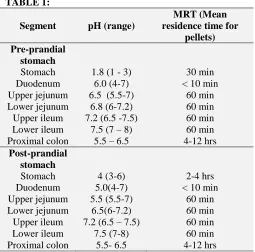
[image:2.612.43.298.234.486.2]The typical value of pH and mean residence time in various segments of the GI tract of young healthy volunteers is summarized in table 1.
TABLE 1:
Segment pH (range)
MRT (Mean residence time for
pellets) Pre-prandial
stomach
Stomach 1.8 (1 - 3) 30 min Duodenum 6.0 (4-7) < 10 min Upper jejunum 6.5 (5.5-7) 60 min Lower jejunum 6.8 (6-7.2) 60 min Upper ileum 7.2 (6.5 -7.5) 60 min Lower ileum 7.5 (7 – 8) 60 min Proximal colon 5.5 – 6.5 4-12 hrs
Post-prandial stomach
Stomach 4 (3-6) 2-4 hrs Duodenum 5.0(4-7) < 10 min Upper jejunum 5.5 (5.5-7) 60 min Lower jejunum 6.5(6-7.2) 60 min Upper ileum 7.2 (6.5 – 7.5) 60 min Lower ileum 7.5 (7-8) 60 min Proximal colon 5.5- 6.5 4-12 hrs
Orally administered duloxetine hydrochloride is well absorbed 8. There is a median 2 hour lag until absorption begins (Tlag), with maximal plasma
concentrations (Cmax) of duloxetine occurring 6
hours post dose. Food does not affect the Cmax of
duloxetine, but delays the time to reach peak concentration from 6 to 10 hours and it marginally decreases the extent of absorption (AUC) by about 10%. There is a 3 hour delay in absorption and a one-third increase in apparent clearance of duloxetine after an evening dose as compared to a morning dose. Under post- prandial condition, the formulation will be at around pH 5.5.
MATERIALS AND METHODS:
Materials: The following chemicals were obtained from commercial suppliers and used as received:
Duloxetine Hydrochloride (Orchid chemicals and pharmaceuticals, Chennai), Sugar spheres (Werner, USA), HPMC 5cps (Dow chemicals), Eudragit L100-55 was purchased from Evonic Industries, Talc (Luzenac, Italy), triethyl citrate(Morflex, Greensboro, USA),New Delhi,. All chemicals were reagent grade or higher.
Digital weighing balance (C-220) (make: Saritorious), Remi mechanical propellant stirrer (RA124) (make: Remi), Fluid bed processor (GPCG 1.1) (make : pam glatt), Automatic capsule filling machine (AFT-Lab) (make: Pam machineries), Tray drier (make : Ganson engg), Double beam UV Visible spectrophotometer (Lambda 20) (make: Perkin Elmer), Digital Dissolution test apparatus (D58000) (lab India),
Methods:
Preparation of Pellets 8, 9: Formulation of duloxetine delayed release pellets involves 4 stages
a) Stage – I : Drug layering
b) Stage - II : Barrier coating
c) Stage - III : Enteric coating
d) Stage - IV : Top coating
Stage I:
Preparation of Duloxetine HCl drug layered pellets:
Binder solution was prepared by dissolving 42 g of povidone (PVP K30) in 1546g of purified water, under stirring using Remi propellant stirrer. Stirring was continued for 45 minutes to get clear solution.
Duloxetine HCl was added to the above solution under stirring, mixed by using Remi propellant stirrer for 30 minutes to get uniform homogeneous dispersion.
Corn starch, sodium chloride and talc are added to the above binder solution, mixed by using Remi propellant stirrer for 30 minutes to get uniform homogeneous dispersion.
Sugar spheres (710-850µ) of 480g were loaded in Fluid bed processor, GPCG 1.1, with bottom spray assembly, drug layering suspension was coated on sugar spheres. The process parameters are tabulated in table 3.
The solid content of drug layering suspension was 20% w/w.
Each formula was having the batch size of 4000 units.
To achieve 100% drug layering, the overage of 5% was used in the formulation.
Stage II:
Preparation of Duloxetine HCl barrier coated pellets:
Barrier coating solution was prepared by dispersing Opadry white Y-1-7000 in purified water, mixed for 45 minutes, using Remi propellant stirrer.
10% w/v solution was prepared
The resulting suspension was filtered using ASTM 60#, and coated on 217g of drug layered pellets using fluid bed processor (GPCG 1.1), to achieve 20% build up. During the preparation of coating solution
the 10% of excess was prepared to recover the loss during practical work. And the coating solution was sprayed over drug layered pellets using Fluid bed coater until weight gain was achieved and % yield was calculated.
The solid content of barrier coating suspension was 10% w/w
The lot size for barrier coating was 1000 units.
Stage III:
Preparation of Duloxetine HCl Enteric coated pellets:
Eudragit L30-D-55 is added to part quantity of purified water under stirring using Remi propellant stirrer, mixed for 10 minutes to get uniform suspension.
The suspension is neutralized to different pH (4.00, 4.25, 4.50, 4.75, 5.00 & 5.25 respectively) using 0.1N Sodium hydroxide
solution to the required pH, mixed for 30 minutes.
Triethyl citrate was added to the above solution under stirring, mixed for 10 minutes.
Talc was suspended in purified water separately, added to the above solution and mixed for 30 minutes.
The resulting suspension was filtered through ASTM 60#, coated on barrier coated pellets using fluid bed processor (GPCG 1.1)
During the preparation of coating solution the 10% of excess was prepared to recover the loss during practical work. And the coating solution was sprayed over barrier coated pellets using Fluid bed coater until weight gain was achieved and % yield was calculated.
The solid content of enteric coating suspension was 15% w/w
Stage IV:
Preparation of Duloxetine HCl Top coated pellets:
Top coating solution was prepared by dispersing Opadry white Y-1-7000 and Talc in purified water, mixed for 45 minutes, using Remi propellant stirrer.
The resulting suspension was filtered using ASTM 60#, and coated on enteric coated pellets using fluid bed processor (GPCG 1.1)
Barrier coating was performed in different lots, to the weight gain of 5% w/w.
During the preparation of coating solution the 10% of excess was prepared to recover the loss during practical work. And the coating solution was sprayed over enteric coated pellets using Fluid bed coater until weight gain was achieved and % yield was calculated.
The solid content of barrier coating suspension was 10% w/w
Encapsulation: The top coated pellets were cured for 2 hrs using tray drier, at 50°C. The cured pellets
were filled in to size “1” hard gelatin capsules, and evaluated for assay, dissolution and acid resistance.
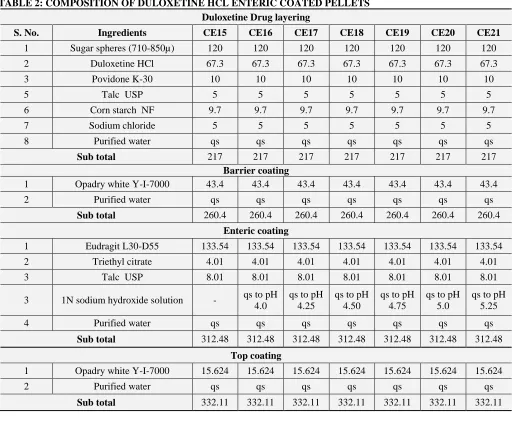
TABLE 2: COMPOSITION OF DULOXETINE HCL ENTERIC COATED PELLETS Duloxetine Drug layering
S. No. Ingredients CE15 CE16 CE17 CE18 CE19 CE20 CE21
1 Sugar spheres (710-850µ) 120 120 120 120 120 120 120
2 Duloxetine HCl 67.3 67.3 67.3 67.3 67.3 67.3 67.3
3 Povidone K-30 10 10 10 10 10 10 10
5 Talc USP 5 5 5 5 5 5 5
6 Corn starch NF 9.7 9.7 9.7 9.7 9.7 9.7 9.7
7 Sodium chloride 5 5 5 5 5 5 5
8 Purified water qs qs qs qs qs qs qs
Sub total 217 217 217 217 217 217 217
Barrier coating
1 Opadry white Y-I-7000 43.4 43.4 43.4 43.4 43.4 43.4 43.4
2 Purified water qs qs qs qs qs qs qs
Sub total 260.4 260.4 260.4 260.4 260.4 260.4 260.4
Enteric coating
1 Eudragit L30-D55 133.54 133.54 133.54 133.54 133.54 133.54 133.54 2 Triethyl citrate 4.01 4.01 4.01 4.01 4.01 4.01 4.01
3 Talc USP 8.01 8.01 8.01 8.01 8.01 8.01 8.01
3 1N sodium hydroxide solution - qs to pH 4.0
qs to pH 4.25
qs to pH 4.50
qs to pH 4.75
qs to pH 5.0
qs to pH 5.25
4 Purified water qs qs qs qs qs qs qs
Sub total 312.48 312.48 312.48 312.48 312.48 312.48 312.48
Top coating
1 Opadry white Y-I-7000 15.624 15.624 15.624 15.624 15.624 15.624 15.624
2 Purified water qs qs qs qs qs qs qs
[image:4.612.50.562.87.510.2]Sub total 332.11 332.11 332.11 332.11 332.11 332.11 332.11
TABLE 3: PROCESSING PARAMETERS AT VARIOUS STEPS
Processing parameters Drug Coating Barrier coating Enteric coating Top coating
Inlet Temperature (°C) 55-58 52-55 38-42 52-55
Exhaust Temperature (°C) 32-36 31-32 27-28 31-32
Product Temperature (°C) 40-44 41-43 32-33 41-43
Spray rate (g/min) 2.5-7 1.8-2 4-6 1.8-2
Atomization (bar) 1.1-1.5 1.1-1.3 1.1-1.3 1.1-1.3
Air flow (CFM) 52-73 52-70 52-68 52-70
Spray nozzle dia (mm) 1.0 0.8 1.0 0.8
Evaluation of Duloxetine HCl Enteric coated pellets Assay 9, 11: Pellets from the capsule were dispersed in to 190 ml of pH 6.8 phosphate buffers by ultra-sonication for 30 minutes followed by 10 minutes stirring using magnetic stirrer. The solution was then filtered and the residues over filter paper were washed with 10 ml phosphate buffer. The solution was then diluted up to suitable
concentration and absorbance was measured using double beam UV-VIS Spectrophotometer at 289 nm.
Apparatus: USP Dissolution apparatus type I (basket)
Simulated Gastric fluid: 0.1N HCl (pH 1.2)
Volume of media: 1000 ml
Capsules were placed in the Basket and were rotated at 100 rpm at 37 ± 0.5oC for 2 (Two) hours. After two hours drug content left in the pellets was assayed. Pellets left in the Basket after two hours were dissolved in 190ml 6.8 pH Phosphate buffer for 30 minute by Ultra sonicator followed by 10 min stirring using magnetic stirrer until pellets disintegrates completely.
The solution was filtered and the residues over filter paper were washed with 10 ml phosphate buffer. The solution was then diluted up to suitable concentration and absorbance was measured using double beam UV-VIS Spectro photometer at 289nm. Drug release in 0.1 N HCl was calculated using following equation;
Drug released in Gastric Fluid = Drug content of Capsule – Residual Assay…... (I)
In-vitro drug release study 12: Capsules were evaluated for in-vitro release study in 0.1 N HCl and phosphate buffer 6.8 pH, 0.1 N HCl and phosphate buffer 6.0 pH and 0.1 N HCl and phosphate buffer 5.5 pH. The drug dissolution test of Capsule was carried out using USP Dissolution apparatus type I (basket). Capsules were placed into the baskets and 1000 ml of 0.1 N HCl (pH 1.2) solution was filled in to the beaker. The baskets were rotated at 100 rpm.
Buffer temperature was maintained at 37 ± 0.5ºC for two hours. Then 0.1N HCl solution was replaced with 1000 ml of pH 6.8 phosphate buffer, and the baskets were rotated at 100 rpm and 37 ± 0.5ºC buffer temperature. Then 10 ml of sample aliquots were collected at 90 minutes. The absorbance of sample was then measured using Double beam UV Visible spectrophotometer at 289 nm.
RESULTS & DISCUSSIONS: Assay: The filled capsules were evaluated for assay and acid resistance, and the results are tabulated below:
Batch Number ↓ Drug content* Acid resistance*
Residual Assay % Drug Release in 0.1N HCl* Cymbalta (A525312) 100.7 ± 0.46 99.0 ± 0.36 1.7
CE-15 99.7 ± 0.38 99.6 ± 0.42 0.0
CE-16 99.7 ± 0.46 99.4 ± 0.47 0.3
CE-17 99.3 ± 0.38 99.7 ± 0.5 0.0
CE-18 99.2 ± 0.46 99.7 ± 0.5 0.1
CE-19 100.5 ± 0.49 100.1 ± 0.2 0.4
CE-20 100.8 ± 0.35 99.0 ± 0.31 1.8
CE-21 100.8 ± 0.36 91.0 ± 1.36 9.8
*Listed value indicates mean value of results and Standard deviation (Where n=3) In-vitro Drug release study: In-vitro drug release
study was performed using USP apparatus-I (Basket type) for reference product (Cymbalta) and In-house formulations (CE15 to CE 21) in 0.1 N HCl for first two hrs followed by pH 6.8 phosphate buffer for 120 mins, 0.1 N HCl for first two hrs followed by pH 6.0 phosphate buffer for 120 mins and 0.1 N HCl for first two hrs followed by pH 5.5 phosphate buffer for 120 mins, the results are presented in table.
In-vitro Dissolution in 0.1N HCl for 2 hrs followed by pH 6.8 phosphate buffer for 120 minutes:
Apparatus : USP Type-I (Basket)
Medium : 0.1 HCl for 2 hrs followed pH 6.8 Phosphate buffer for 120 mins
RPM : 100
TABLE 6: COMPARATIVE DISSOLUTION PROFILE OF DULOXETINE HCl DELAYED RELEASE CAPSULES 60MG IN 0.1N HCl FOR 2 HRS FOLLOWED BY PH 6.8 PHOSPHATE BUFFER FOR 120 mins (Reference product Vs In-house product)*
Batch Number → Time (mins) ↓
Cymbalta
(A525312) CE-15 CE-16 CE-17 CE-18 CE-19 CE-20 CE-21
30 mins 33.1±0.9 22.6 ±0.9 24.9 ± 0.4 27.1 ± 0.5 30.5 ± 0.7 35.2 ± 1.4 41.2 ± 0.4 20.3 ± 0.9 60 mins 64.4 ± 2.0 48.8± 2.9 52.2 ± 0.8 60.7 ± 0.5 62.2 ± 0.6 64.5 ± 0.9 74.8 ± 0.6 34.6 ± 2.0 90 mins 88.6 ± 0.2 81.3 ± 0.9 81.4 ± 1.0 81.1 ± 1.4 80.2 ± 0.3 87.1 ± 1.3 88.4 ± 0.2 50.9 ± 0.3 120 mins 97.1 ± 0.4 92.4 ± 0.3 91.2 ± 1.6 91.9 ± 0.5 91.5 ± 0.8 97.8 ± 1.1 92.5 ± 0.1 60.4 ± 0.7 *Listed value indicates mean value of results and Standard deviation (Where n=3)
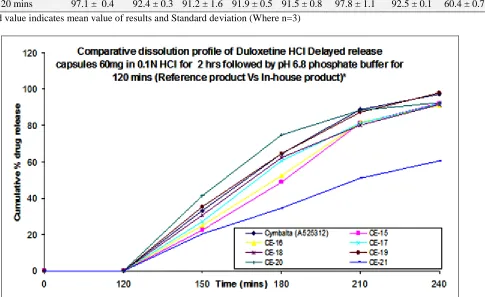
GRAPH 1: COMPARATIVE DISSOLUTION OF DULOXETINE HCl REFERENCE (CYMBALTA) Vs IN-HOUSE FORMULATION IN 0.1N HCl FOR 2 HRS FOLLOWED BY pH 6.8 PHOSPHATE BUFFER FOR 120 MINUTES
The dissolution profile indicates the formulations CE-18 & CE-19 are comparable to reference product. Whereas, the formulation CE-21 (Eudragit neutralized to pH 5.25), shows lower dissolution profile, and the extent is 60.4% is only achieved. The enteric polymer is not suitable for the formulation when it is neutralized to pH more than 5.0.
The formulation CE-15, CE-16, CE-17 & CE -20 are not having significance difference in dissolution profile and discrimination is not observed in the dissolution profile. Hence, it was required to evaluate the dissolution in 0.1N HCl for 2 hrs
followed by pH 5.5 phosphate buffer for 120 minutes.
In-vitro Dissolution in 0.1N HCl for 2 hrs followed by pH 5.5 phosphate buffer for 120 minutes:
Apparatus : USP Type-I (Basket)
Medium : 0.1 HCl for 2 hrs followed pH 5.5 Phosphate buffer for 120 mins
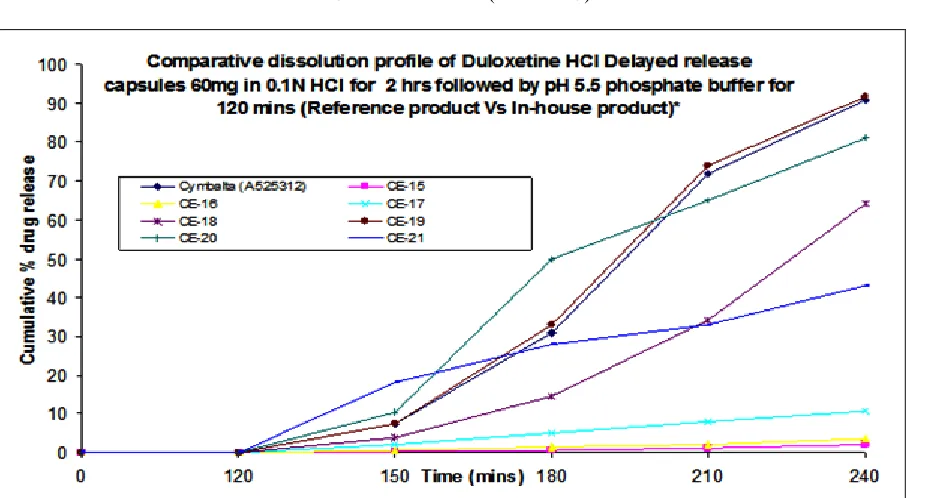
[image:6.612.76.561.155.452.2]TABLE 7: COMPARATIVE DISSOLUTION PROFILE OF DULOXETINE HCl DELAYED RELEASE CAPSULES 60mg IN 0.1N HCl FOR 2 HRS FOLLOWED BY pH 5.5 PHOSPHATE BUFFER FOR 120 MINS (Reference product Vs In-house product)*
Batch Number →
Cymbalta (A525312) CE-15 CE-16 CE-17 CE-18 CE-19 CE-20 CE-21
Time (mins)↓
30 mins 7.5 ± 0.3 0.2 ± 0.1 0.5 ± 0.3 2.1 ± 0.6 4.0 ± 0.3 7.3 ± 0.9 10.5 ± 0.7 18.2 ± 1.5 60 mins 30.8 ± 1.0 0.6 ± 0.1 1.4 ± 0.2 5.1 ± 0.6 14.5 ± 2.0 33.0 ± 1.3 50 ± 1.2 28 ± 0.2 90 mins 71.9 ± 0.4 1.3 ± 0.1 2.2 ± 0.2 8.1 ± 0.6 34.2 ± 1.5 73.9 ± 1.1 65 ± 3.2 33 ± 1.0 120 mins 90.9 ± 0.6 2.0 ± 0.2 3.5 ± 0.2 10.7 ± 0.5 64.2 ± 1.4 91.8 ± 0.6 81 ± 0.8 43 ± 0.6 *Listed value indicates mean value of results and Standard deviation (Where n=3)
The dissolution profile in pH 5.5 phosphate buffer indicates, the formulation CE-19 shows the extent of 91.8% dissolution and the dissolution profile is comparable to reference product. Formulation CE-15 to CE-17 are not having release in pH 5.5 phosphate buffer. CE-18, CE-20 & CE-21 are having lower dissolution profile, and the extent of 64.2%, 81% & 43% is released respectively. The discrimination in dissolution difference from pH 6.8 phosphate buffer and pH 5.5 phosphate buffer is high. It was decided to evaluate the dissolution in pH 6.0 phosphate buffer.
In-vitro Dissolution in 0.1N HCl for 2 hrs followed by pH 6.0 phosphate buffer for 120 minutes:
Apparatus : USP Type-I (Basket)
Medium : 0.1 HCl for 2 hrs followed pH 6.0 Phosphate buffer for 120 mins
RPM : 100
TABLE 8: COMPARATIVE DISSOLUTION PROFILE OF DULOXETINE HCl DELAYED RELEASE CAPSULES 60mg IN 0.1N HCl FOR 2 HRS FOLLOWED BY pH 6.0 PHOSPHATE BUFFER FOR 120 MINS (Reference product Vs In-house product)*
Batch Number → Cymbalta
(A525312) CE-15 CE-16 CE-17 CE-18 CE-19 CE-20 CE-21
Time (mins)↓
[image:7.612.81.546.176.425.2] [image:7.612.45.577.649.742.2]The dissolution profile in pH 6.0 phosphate buffer indicates, the formulation CE-19 shows the extent of 93.9% dissolution and the dissolution profile is comparable to reference product. Whereas, the remaining formulations are having the extent of dissolution to the maximum of 82%. The formulation CE-19 is comparable to the reference product.
CONCLUSION: Duloxetine Hydrochloride delayed release pellets were evaluated for dissolution at various pH to achieve the complete dissolution with the Tlag of 2 hrs. The formulation
CE-19 (enteric polymer neutralized to pH 4.7) shown the better extent of dissolution in all the three dissolution media 0.1N HCl for 2hrs followed by pH 6.8 phosphate buffer for 120 minutes, 0.1N HCl for 2hrs followed by pH 5.5 phosphate buffer for 120 minutes and 0.1N HCl for 2hrs followed by pH 6.0 phosphate buffer for 120 minutes. The dissolution profile is also comparable to reference product.
REFERENCES:
1. Zonghua, L, Yanpeng, J, Yifei, W, Changren Z and Ziyong Z: Polysaccharides- based nanoparticles as drug delivery systems. Advanced Drug Delivery Reviews 2008; 60:1650– 1662.
2. Agyilirah, G.A. and G.S. Banker, Polymers for enteric coating and applications in Polymers for controlled drug delivery, 1991; 39-66.
3. Bianchini, R., M. Resciniti, and C. Vecchio, Technological evaluation of aqueous enteric coating systems with and without insoluble additives. Drug Development Industrial Pharmacy, 1991; 17: 1779-1794.
4. Dangel, C., K. Kolter, H.B. Reich, and G. Schepky, Aqueous enteric coatings with methacrylic acid copolymer type C on acidic and basic drugs in tablets and pellets, Part I: acetylsalicylic acid tablets and crystals. Pharmaceutical technology, 2000; 64-70. 5. Bogentoft, C., M. Alpsten, and G. Ekenved, Absorption of
acetylsalicylic acid from enteric-coated tablets in relation to gastric emptying and in-vivo disintegration. Journal of Pharmacy and pharmacology, 1984; 36: 350-351.
6. Cole, E.T., R.A. Scott, A.L. Connor, I.R. Wilding, H.U. Petereit, C. Schminke, T. Beckert, and D. Cade, Enteric coated HPMC capsules designed to achieve intestinal targeting. International Journal of pharmacy, 2002; 231: 83-95.
7. Ebel, J.P., M. Jay, and R.M. Beihn, An in vitro/in vivo correlation for the disintegration and onset of drug release from enteric-coated pellets. Pharmaceutical Research, 1993; 10: 233-238. 8. Sandra Klein, Erika Stippler, Martin Wunderlich,and Jennifer
Dressman, Pharmaceutical dissolution testing: Development of dissolution test on the basis of Gastrointestinal physiology,2007; 195
9. Full prescribing information, Cymbalta® DULOXETINE HCl DELAYED RELEASE CAPSULES, www.Cymbalta.com , Eli Lilly and Company, 2013.
10. Vijay R, “A validated UV Spectrophotometric determination of an antidepressant drug Duloxetine hydrochloride from capsule formulations” International journal of pharmacy and bioscience, 2011; 2: 716- 720.
11. USFDA, “Dissolution method for Duloxetine HCl”,.
http://www.accessdata.
fda.gov/scripts/cder/dissolution/dsp_SearchResults.Dissolution.cf m, 2006.
12. Kamila M, Mondal N and Ghosh L, “A validated UV
spectrophotometric method for determination of duloxetine hydrochloride”, Pharmazie, 2007; 62: 414-415.
All © 2013 are reserved by International Journal of Pharmaceutical Sciences and Research. This Journal licensed under a Creative Commons Attribution-NonCommercial-ShareAlike 3.0 Unported License.
This article can be downloaded to ANDROID OS based mobile. Scan QR Code using Code/Bar Scanner from your mobile. (Scanners are available on Google Playstore)
How to cite this article: