Copyright © The Author(s). All Rights Reserved. Published by American Research Institute for Policy Development DOI: 10.15640/jibe.v7n2a12 URL: https://doi.org/10.15640/jibe.v7n2a12
The Effect of ESG Performance on Economic Performance in the High Profile Industry in
Indonesia
Mita Kurnia Yawika
1& Susi Handayani
2Abstract
This study aims to examine the effects of ESG performance on economic performance. This research was conducted in 2015-2017 and produced 387 samples. The analysis technique used is multiple regression analysis with SPSS Statistics program 23. The results of the study show that ESG performance has a positive effect on economic performance. In further analysis, environmental performance and social performance shows that there is no influence on economic performance, except environmental performance which negatively affects market measurement. Conversely, governance performance has a positive effect on accounting measurements, but has a negative effect on market measurement. This condition due to the disclosure traditionof governance is longer applied in Indonesia than other sustainability aspects and the increasing value of the relevance of governance performance to stakeholders.
Keywords: ESG, environmental, social, governance, economic, high profile industry
Introduction
The concept of sustainability in a business perspective is the company's ability to survive for a long time, both in financial and non-financial terms (Giovannoni & Fabietti, 2013).Environmental, Social, and Governance (ESG) aspect was first proposed by the UN Global Compact to put forward the importance of these aspects in financial analysis (Otoritas Jasa Keuangan, 2015). ESG refers to a comprehensive approach to sustainability factors in the analysis and decisions of investors and companies in industries. This is because the combination of these aspects will strengthen management practice to improve company performance (Tarmuji, Maelah, &Tarmuji, 2016). The ESG aspect provides a pleasant perception for stakeholders by ensuring that they will not get negative influences from company activities that are considered as unsustainable (Palazzo & Richter, 2005);(Yoon & Schwarz, 2006);(Sila & Cek, 2018). Whereas, Friede, Busch, &Bassen (2015) stated that rational investors must be oriented towards responsible and sustainable investment to fulfill company obligations and align them with the wider community.
Attention to ESG disclosure of companies is aligned with stakeholder theory (Freeman, et al., 2010), where companies will strive to maintain stakeholder relations by meeting their needs for the company's long-term interests. In addition, the disclosure of ESG performance shows good faith by the company in managing resources and operational activities. It is based on the legitimacy theory in which the company will gain legitimacy from communities when companies are carrying out operations with due regard to the prevailing norms and social welfare (Syafrullah & Muharam, 2017).
Brooks & Oikonomou (2018) stated that the questions related to the direct impact of ESG performance and disclosure on economic aspects that are good for business entities are one of the important topics to be discussed for more than four decades. Evidence of a link between ESG issues and increasingly large financial performance, coupled with their obligations and recognition will be the importance of long-term sustainable investment. Previous studies have found mixed results.
Sustainability practices in Malaysia and Singapore influenced economic performance (Tarmuji et al., 2016). Furthermore, Ferrero-ferrero, Fernández-izquierdo, & Muñoz-torres(2016)found that in the EU-15, ESG disclosures
1Student of Surabaya State University. [email protected]
consistently had an effect on economic performance. On the other hand, the study of Sila&Cek(2018) found varity results for companies in Australia. In addition, Barnett & Salomon (2011) found that ESG performance can have a negative or positive effect, depending on how well the company can utilize social responsibility efforts for stakeholder management and ultimately improve economic performance.
Previous researchers that found a positive influence between ESG performance on economic were Ferrero-ferrero et al., (2016), Signes, Ona, Jimenez, & Vargas (2013), Michelon, Boesso, & Kumar (2013), Roman, Hayibor, &Agle (1999), Simpson & Kohers (2002),Orlitzky, Schmidt, Rynes, &Rynes (2000), and Al-tuwaijri& Ii (2003). Meanwhile, studies that found negative results were Crisostomo, Freire, & Vasconcellos (2011).Other studies from Tarmuji, Maelah, & Tarmuji(2016), Dahlberg & Wiklund (2018),Waworuntu, Wantah, & Rusmanto (2014),Long, Bakhtiar, Chuann, Abdullah, & Mohammad (2017), and Velte (2018) found mixed results with the different object and variables.
Their positive effect is consistent with the stakeholder theory and the majority of previous studies, in which stakeholders understand the relationship ESG performance with the performance and long-term sustainability (Tarmuji et al., 2016). This shows that responsible for ESG issues produces a constructive environment, so it will gain reputation, increase investor confidence, improve resource efficiency, and maintain the company's competitive position. On the other hand, stakeholders in developing countries do not consider sustainable factors as much as stakeholders in developed countries, so they are not relevant to stakeholders and show negative influences (Crisostomo, Freire, &Vasconcellos, 2011). This is supported by the statement that the country and culture greatly affect the relationship between ESG performance and economic performance (Sila&Cek, 2018). Dahlberg &Wiklund (2018)found that ESG only affects market measurements, but does not affect accounting measurements. This can be explained by stakeholder and shareholder theory that the two stakeholders have different goals.
Forte(2013) revealed that research related to this field was carried out in various different countries, so it became difficult to make generalized conclusions. In addition, Barnett & Salomon (2011) stated that ESG performance can have a negative or positive effect, depending on how well the company can take advantage of social responsibility efforts to reduce the exposure the company receives in the future and ultimately improve economic performance. Research on the influence of ESG performance on economic performance in developing countries is still minimum, especially in Indonesia, which is rarely found. There are two studies that found by Prastiwi, Faisal, & Yuyetta(2018)about the relationship board characteristics, ESG disclosure, and performance of the company and Syafrullah & Muharam (2017)with abnormal return as the dependent variable.
Previous researchers in this field used financial performance and economic performance to measure company performance, although financial performance is more widely used (Sacconi, 2004). Economic performance has a more comprehensive nature (Friede et al., 2015) because it considers financial and non-financial performance. Therefore, the lack of research related to the influence of ESG performance on economic performance in Indonesia, the differences regarding the results of ties between the two variables, and the importance of this topic to be discussed, so this research intend to determine the effect of the ESG performance on the economic performance in the high profile industry listed on IDX from 2015 to 2017. The high profile industry was chosen because it is an industrial sector that has a high sensitivity to environmental and social issues. The results of this study are expected to provide additional literature and other evidence of the research gap from previous researchers, especially in developing countries such as Indonesia. In addition, it can be a consideration for companies to regard sustainability aspect in their business strategies well enough.
Literature Review And Hypothesis Development
1.Stakeholder Theory
State of the art of stakeholder theory (Freeman, et al., 2010:5)shows that stakeholders are individuals or groups that can affect or be affected by the performance and the achievement of a company. The company will try to have a good relationship with stakeholders through meeting the needs of both financial and non-financial performance and strengthen the relationship of trust for the long-term interests of the company (Freeman, et al., 2010:24).
2.Legitimacy Theory
Legitimacy is related to the company's efforts to carry out its operational activities in accordance with the norms in the community as one of the determinants of the company's survival (Syafrullah & Muharam, 2017). According to Brammer & Pavelin (2006), the legitimacy of the community will have an impact on the regulatory burden borne by the company and the market stigma over the reputation of environmental carelessness. The company will carry out social and environmental responsibility to gain the trust and support of the community in order to gain benefits in the form of better opportunities in the market. This opportunity can increase the ability to produce lab and value for the company. In addition, when the company wants to reduce the risks that must be faced, this company must disclose information openly with better quality to gain legitimacy for its business (Fatima, Abdullah, & Sulaiman, 2015).
3.Environmental Social Governance Performance
The integration of ESG aspects as the main dimension of sustainability development into corporate strategy theoretically provides benefits in terms of reputation, customer trust and loyalty, cost savings, access to capital, human resources management, innovation capacity, and risk management (Ferrero-ferrero et al., 2016). Information on ESG performance can be obtained from annual reports, official website, and professional rating agencies. ESG performance measurements that are most widely used in previous studies are reputable indexes and content analysis. Examples of reputable indexes are Bloomberg, Thomson Reuters, and KLD. Content analysis is also widely used in previous research. The generally accepted indicator for analyzing disclosure content is the GRI 4 (G4) standard with five categories (116 indicators) (Aris et al. 2018).
4.Economic Performance
Tarmuji, Maelah, & Tarmuji (2016)found that the economic performance are trying to measure a company's ability to grow and provide a high return on investment through efficient used of resources to increase revenues or margins to maintain good relations with the stakeholders. According to Friede, Busch, & Bassen (2015) and Devinney & Yip(2009),economic performance has more comprehensive nature, which considers financial and non-financial performance as the basis for its measurement. Financial index refers to sales, profitability, inventory turnover, and equity profit. Meanwhile, non-financial index refers to the market value of shares, sales territories, and number of customers. Günther, Hoppe, &Endrikat(2011)show that stock market and accounting based are the most widely used measures.
5.High Profile Industry
High profile industries are defined as industries that have a higher sensitivity to the environment and social than companies that are operationally not sensitive to the environment (Hackston& Milne, 1996). There are differences from previous researchers in the grouping of high profile industries (Rupley, Brown, & Marshall, 2012);(Hackston& Milne, 1996). Kelly(1981) supported previous statements that major industries and second industries tend to reveal more about environmental and energy information than third industries. The sectors included in the grouping on the IDX are agriculture, mining, basic and chemical industries, miscellaneous industries, and consumer goods industries.
6.Hypothesis Development
When companies implement good management to avoid environmental risks, companies can get better opportunities and improve company performance (Tarmuji et al., 2016). This is because, good environmental practices in its operational activities can avoid any business impacts due to contamination issues, both from environmental, social, and governance aspects that saving costs for the company. These cost savings increase a company's ability to produce better profits. Stakeholder theory encourages companies to increase environmental awareness and raises the need to improve planning by adapting to changes in market demand (Elijido-ten, 1985). Melnyk, Sroufe, & Calantone (2003) stated that strong environmental performance can increase company value and attract new investors. Therefore, the hypothesis (H1) in this study are:
H1a : environmental performance has a positive effect on EBITDA margin
H1b : environmental performance has a positive effect on ROA
Sustainable responsibility practices can affect financial performance and corporate value (Dhaliwal, Li, Tsang, & Yang, 2011). Therefore, when a company has the intention to carry out its social responsibilities voluntarily, it can help companies to avoid government sanctions, increase productivity, and moreover reduce the cost of complaints. As stakeholder theory, fulfilling stakeholder interests can transform corporate social responsibility into profits (Tarmuji et al., 2016). When compared with companies that have low or normal social performance (on average), companies with high social performance have the best financial performance (Barnett & Salomon, 2011). In addition, social practices can increase demand for company products and services (Fombrun&Gardberg, 2013) and increase company reputation and shareholder satisfaction (Dhaliwal et al., 2011). Therefore, the hypothesis (H2) in this study are:
H2a : social performance has a positive effect on EBITDA margin
H2b : social performance has a positive effect on ROA
H2c : social performance has a positive effect on MBV
Governance has an important role in terms of the company's strategic decision making. The Board must be able to manage risk by anticipating activities that can affect the community and the surrounding environment (Mallin, Michelon, &Raggi, 2013). This can be done by considering sustainability aspects into the core decision-making process that will direct the company to achieve the expected sustainability value for the goals achievement. With an information disclosure strategy to stakeholders, it can improve company performance (Tarmuji et al., 2016). In other aspects, the structure and process of governance that consider social responsibility will make companies easier to accommodate the interests of stakeholders in the company's sustainability strategy. Stakeholder trust is maintained and company sustainability is guaranteed to provide good economic performance for the company. Therefore, the hypothesis (H 3) in this study are:
H3a : governance performance has a positive effect on EBITDA margin
H3b : governance performance has a positive effect on ROA
H3a : governance performance has a positive effect on MBV
Research Methods
This type of research is quantitative research, which aims to test the hypothesis of the effect of ESG performance on economic performance in high profile industryin Indonesia. The sample taken at the company reveal ESG performance during(2015-2017) (Signes et al., 2013);(Michelon et al., 2013). The sample technique used is probability sampling (Weber, Koellner, & Steffensen, 2008)and the total sample were 387 sample.
The independent variable used is ESG performance as measured by content analysis with G4 as an indicator (34 environmental indicators, 48 social indicators, and 22 governance indicators) (Aris et al., 2018). Content analysis used with giving score (1 = yes, 0 = no) to the company’s disclosure. The index for each dimension is calculated by dividing the number of items expressed to total items (Tarigan & Semuel, 2014). Variable dependent used are EBITDA margin, ROA, and MBV. EBITDA margin is used because it can show cost cutting effort and more objective from managerial policy (Orlitzky et al., 2000). EBITDA margin is measured by dividing EBITDA by total income (Signes et al., 2013). Furthermore, ROA indicates the company's ability to use assets to generate profits. ROA is measured by dividing profit after tax by total assets (Harmono, 2017:110). MBV interprets the company's ability to create value for the company by dividing the market value per share and book value per share (Ross, Westerfield, & Jordan, 2010:64).This study uses company size as a control variable, because it can influence the quality of disclosure (Zhao, Guo, & Yuan, 2018) and the stakeholder interests for corporate social responsibility (Velte, 2018). Company size is measured by the Natural Total Asset Logarithm (Velte, 2018).
Regression Model
Multiple regression analysis used to measure the effect of the independent variable on the dependent variable to predict the population mean or average value of the dependent and measure the strength and direction of influence (Ghozali, 2013:93). Regression analysis is performed on each dependent variable, so there are three regression models to be analyzed. The following is the regression equation used:
ECO (EBITDA Margin, ROA, MBV) it = β 0+β 1 ENV it+β 2 SOC it+β 3 GOV it+β 4 SIZE it+ε it
Information:
ENV = environmental performance SOC = social performance
GOV = governance performance SIZE = size of company
Β = constant
ε = error
Results and Analysis
This study consists of 7 variables, environmental performance (X1), social performance (X2), governance performance (X3), company size (X4), EBITDA margin (Y1), ROA (Y2), and MBV (Y3) with 387 samples. Descriptive statististic was done to determine the characteristics of the data used. Environmental performance was the lowest mean with a value of 0.191366, while governance performance has the highest with 0,702373. The highest maximum value obtained from environmental performance, while the lowest minimum value obtained from social performance of 0,0208. The size of the company as a control variable has an average value of 28.858298 with the highest value of 33.3202 and the lowest value of 20.5910. The MBV standard deviation is very large compared to other economic performance which shows that between companies and the industry sectorshave variaty values.
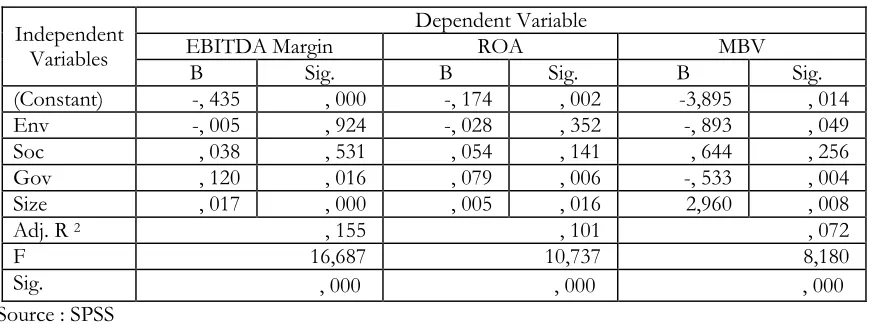
Table 1 . Results Summary
Independent Variables
Dependent Variable
EBITDA Margin ROA MBV
B Sig. B Sig. B Sig.
(Constant) -, 435 , 000 -, 174 , 002 -3,895 , 014
Env -, 005 , 924 -, 028 , 352 -, 893 , 049
Soc , 038 , 531 , 054 , 141 , 644 , 256
Gov , 120 , 016 , 079 , 006 -, 533 , 004
Size , 017 , 000 , 005 , 016 2,960 , 008
Adj. R 2 , 155 , 101 , 072
F 16,687 10,737 8,180
Sig. , 000 , 000 , 000
Source : SPSS
Table 1 shows that the strength of the ESG performance influence on EBITDA margin has a highest value of adjusted R2 of 0,155 or 15,5%. Meanwhile, ROA showed an influence contribution of 10,1% and MBV of
7,2%. This condition shows that factors outside the studied variables have a far greater contribution in influencing the company's economic performance.The first regression model indicates the influence of governance performance with a value of 0,016 and control variable with a value of 0,000 with a positive direction. Conversely, environmental performance and social performance showed no effect with values of 0,924 and 0,531. The second regression model shows the significance value of the environmental performance and social performance variables respectively of 0,352 and 0,141, so both of them have no effect on ROA. Conversely, governance performance and company size with a significance value of 0,006 and 0,016 are stated to have a positive effect on ROA. The third regression model shows different results. Social performanceshowed no influence with a significance value of 0,256. In contrast, environmental performance, governance performance, and company size have significant values of 0,049, 0,018, and 0,012, respectively, so that they indicate influence. The direction of the influence shows mixed results. Environmental performance and governance performance have a negative effect, while company size has a positive effect on MBV.
Discussion
1. Effect of Environmental Performance on Economic Performance
the legitimacy of the community relates to the company's efforts to minimize the environmental impact on the community while implementing sustainable management for the long term cost reduction. On the other hand, when the efforts made only have an impact on society, the company does not get any influence from the environmental performance. This research is different from Braam et al. (2016) who found a positive effect because companies with greater legitimacy and public pressure succeeded in providing certainty of relevant environmental performance. In addition, Michelon, Boesso, & Kumar(2013)also found influence because companies need to correlate CSR initiatives with stakeholder preferences and corporate strategies. Therefore, based on the discussion above, hypothesis 1a is not accepted.
The second regression model shows that environmental performance also has no effect on ROA. This shows that the company's environmental performance has not shown any influence on its ability to produce better profits due to the company's motivation for environmental performance is based on fulfilling the obligations. Therefore, the environmental performance is not directed as a form of investment for the company to do better operational activities and environmentally friendly. In addition, the results of the average disclosure was minimum, which is around 6-7 disclosures from 34 environmental indicators with more than half the sample companies below the average. Another study that also found no influence was Barnett & Salomon(2011). When a company has weak social responsibility, the expected benefits and burdensome costs are not able to influence the company. Crisostomo, Freire, & Vasconcellos (2011), Elijido-ten (1985), and Dahlberg & Wiklund (2018)are previous studies that also found no influence. Therefore, based on the discussion above, hypothesis 1b is not accepted.
The third regression model shows that environmental performance has a negative effect on MBV. Companies with large environmental risks or problems, but have not been able to overcome them tend to direct their environmental performance to other aspects. This is done to divert public attention to a greater environmental risk, because it will be bad news for investors. This condition often occurs in companies whose operational activities are closely related to the environment, such as the high profile industry.“CSR washing” indicates that the company is unable to show environmental performance based on investor preferences, so information or disclosures made will not be considered and regarded as unnecessary expenses for investors (Fauzi, Mahoney, & Rahman, 2007). This condition is consistent with Tirole (2006)which revealed that there is always the possibility of an opportunistic management attitude in utilizing social responsibility for the benefit of incentives, especially if the company focuses on the aspect of sustainability to maximize the welfare of shareholders. Previous research which also showed a negative influence was Crisostomo, Freire, & Vasconcellos (2011). Therefore, based on the discussion above, hypothesis 1c is not accepted.
2.Effect of Social Performance on Economic Performance
The first regression model shows that social performance has no effect on EBITDA margin. The results of this study indicate the aspect of sustainability has a low influence contribution compared to other factors outside the study. In line with Zhang (2010), the reason for not finding influence between social performance and financial performance is the existence of a very dynamic market situation, so that management's attention is more directed to deal with market conditions that are directly related to earnings and sales compared to non-financial performance, like employee development. This result is consistent with the research of Barnett & Salomon(2011)and Elijido-ten (1985).This research contradicts the results of Oeyono, Samy, & Bampton (2011)and Vaia, Bisogno, & Tommasetti(2017)who found a positive influence. Therefore, based on the discussion above, hypothesis 2a is rejected. The second regression model shows that social performance has no effect on ROA. The average of social disclosure by the company is quite minimalwith 11 disclosures from 48 indicators. In addition, the efforts made by the company also focus on community empowerment, not on the internal development of companies that can provide added value to their financial performance.
Similar to the two previous regression models, the third regression model shows that social performance has no effect on MBV. Social responsibility will reduce corporate risk which capital market are more sensitive to. Therefore, the absence of influence is due to the inability of companies to carry out social performance on important aspects for investors.So far, the consideration of Indonesian investors is still focused on financial performance. Apart from the unstable market conditions, the facilities provided by the government related to sustainable investment are also still minimal. Similar to previous research, the factor most concerned by investors in developing countries is financial performance and does not take into account long-term sustainability, so it is not possible to find a relationship between social responsibility and financial performance (Aras, Aybars, & Kutlu, 2010). In addition, disclosures will be neutral news for investors, when their statements are minimal without the fact that they show support for the company's financial performance. Therefore, based on the discussion above, social performance has no effect on economic performance, then hypothesis 2c is rejected.
3.The Effect of Governance Performance on Economic Performance
The first regression model shows that governance performance has a positive effect on EBITDA margin. Companies with good governance certainly do not hesitate to open information as widely as possible to the public, because it shows management's ability to manage the company. For example, when companies express diversification in the corporate governance bodies, this shows the diversity of backgrounds and competencies that exist (Rose, 2007). This diversity indicates that governance considers various aspects of managing the company to ensure stakeholder welfare. In addition, the implementation of responsibilities that take sides with stakeholders will minimize the burden of conflict and build better relationships (Becchetti, Giacomo, & Pinnacchio, 2005). These results are consistent with Signes, Ona, Jimenez, & Vargas(2013)who found a positive influence. Therefore, based on the discussion above, governance performance has an effect on EBITDA margin, then hypothesis 3a isaccepted.
The second regression model shows that governance performance has a positive effect on ROA. Governance performance produces a positive effect because the disclosure’s tradition of corporate governance has been implemented in Indonesia for a long time and the value of the governance performance has increased with respect to stakeholders. In addition, it shows that good governance is a factorconsidered by the company. This study found that companies with governance performance above average have stable financial performance above the average as well compared to other companies.This result is also consistent with stakeholder theory. When the highest governance body in company is able to manage its assets and risks well, it will certainly have an impact on the company's image and ability to meet the interests of stakeholders, one of which is to generate profits. Moreover, reducing unnecessary conflict costs, good governance also indicates better productivity (Becchetti et al., 2005). This can be seen in terms of the diversity of competencies of governance bodies that refer to more responsible management of resources or assets. This condition is consistent with Velte (2018).Therefore, based on the discussion above, governance performance affects ROA, so hypothesis 3b is accepted.
The third regression model shows that governance performance has a negative effect on MBV. The characteristics of corporate governance structure in Indonesian companies are the existence of controlling ownership, whether by an agency, government, or family ownership. This condition indicates weak corporate control and agency conflict between majority and minority owners. Corporate disclosure and transparency signal the company's performance. Furthermore, environmental performance and company performance are influenced by how the board of directors are formed, how the company is managed, and how the company is owned. This condition will certainly be negative information for investors. Majority ownership also tends to keep company information compared todisclose it to public because of the motivation to keep the benefits of the information in the interests of the majority group. The composition of corporate governance is indeed very important and attracts the attention of stakeholders (Rose, 2007).This relates to the concept of stakeholder theory where the existence of the highest governance body is not only to maximize shareholder value, but also to supervise the responsibilities carried out by management.
This condition is in line with the study of Brammer & Pavelin (2006)that well performance companies with scattered ownership have a better intention to conduct non-financial disclosures that provide benefits to the company. Previous studies with similar results were Crisostomo, Freire, & Vasconcellosn (2011). Therefore, based on the discussion above, then hypothesis 3c is not accepted.
Conclusion
the concept of stakeholder management. On the contrary, governance performance shows a positive influence, although negative signals are found for investors. Consistent with previous studies, the size of the company's positive influence on economic performance. The implication of this study is the company could reflect and improve the sustainability performance that is relevant to stakeholders progressively. This is intended so that not only can overcome the impact given and as a risk management company, but also in order to produce better economic performance. Suggestions for further research are the sample used in the specific industryor on a particular index which indicates similar expectations of stakeholders, so that it can show different results, either strengthen or weaken its economic performance. Furthermore, this study shows a weak correlation, so it is recommended to use different proxies on economic performance variables and different ESG performance measurements such as reputable indices.
References
Al-tuwaijri, S. A., & Ii, K. E. H. (2003). The Relations among Environmental Disclosure, Environmental Performance, and Economic Performance: A Simultaneous Equations Approach, (801).
Aras, G., Aybars, A., & Kutlu, O. (2010). Managing Corporate Performance Investigating The Relationship between Corporate Social Responsibility and Financial Performance in Emerging Markets. International Journal of Productivity and Performance Management, 59(3), 229–254. https://doi.org/10.1108/17410401011023573 Aris, N. A., Marzuki, M. M., Othman, R., Rahman, S. A., & Ismail, N. H. (2018). Designing Indicators for
Cooperative Sustainability: The Malaysian Perspective. Social and Environmental Accounting, 14(1), 226–248. https://doi.org/10.1108/SRJ-01-2017-0015
Barnett, M. L., & Salomon, R. M. (2011). Does it Pay to be Really Good? Addressing The Shape of The Relationship Between Social and Financial Performance. Strategic Management Journal, 15.
Becchetti, L., Giacomo, S. Di, & Pinnacchio, D. (2005).Eevidence from A Panel of US Listed Companies (Vol. 26). Braam, G. J. M., Uit De Weerd, L., Hauck, M., & Huijbregts, M. A. J. (2016). Determinants of Corporate
Environmental Reporting: The Importance of Environmental Performance and Assurance. Journal of Cleaner Production, 129, 724–734. https://doi.org/10.1016/j.jclepro.2016.03.039
Brammer, S., & Pavelin, S. (2006). Voluntary Environmental Disclosures by Large UK Companies. Journal of Business, Finance, & Accounting, 33(7–8), 1168–1188. https://doi.org/10.1111/j.1468-5957.2006.00598.x Brooks, C., & Oikonomou, I. (2018). The Effects of Environmental, Social and Governance Disclosures and
Performance on Firm Value: A Review of The Literature in Accounting and Finance. The British Accounting Review, 50(1), 1–15. https://doi.org/10.1016/j.bar.2017.11.005
Crisostomo, V. L., Freire, F. de S.,& Vasconcellos, F. C. De. (2011). Corporate Social Responsibility, Firm Value and Financial Performance in Brazil, 1–24.
Dahlberg, L., & Wiklund, F. (2018). ESG Investing in Nordic Countries An Analysis of The Shareholder View of Creating Value.
Devinney, T., & Yip, G. (2009). Measuring Organizational Performance: Towards Methodological Best Practice. Journal of Management, 35(3), 718–804. https://doi.org/10.1177/0149206308330560
Dhaliwal, D. S., Li, O. Z., Tsang, A., & Yang, Y. G. (2011). Voluntary Nonfinancial Disclosure and The Cost of Equity Capital: The Initiation of Corporate Social Responsibility Reporting. Accounting Review, 86(1), 59– 100. https://doi.org/10.2308/accr.00000005
Elijido-ten, E. (1985). Applying Stakeholder Theory to Analyze Corporate Environmental Performance: Evidence from Australia’s Top 100 Listed Companies
Fatima, A. H., Abdullah, N., & Sulaiman, M. (2015). Environmental Disclosure Quality: Examining The Impact of The Stock Exchange of Malaysia’s Listing Requirements. Social Responsibility Journal, 22(1), 63–90. https://doi.org/10.1108/SRJ-03-2014-0041
Fauzi, H., Mahoney, L. S., & Rahman, A. A. (2007). The Link between Corporate Social Performance and Financial Performance: Evidence from Indonesian Companies. Social and Environmental Accounting, 1(1), 149–159. Ferrero-ferrero, I., Fernández-izquierdo, M. Á., & Muñoz-torres, M. J. (2016). The Effect of Environmental, Social
and Governance Consistency on Economic Results. Sustainability, 8. https://doi.org/10.3390/su8101005 Fombrun, C., & Gardberg, N. A. (2013). The Reputation Quotient: A Multi-stakeholder Measure of Corporate
Reputation. Journal of Brand Management, 4(December), 241–255. https://doi.org/10.1057/bm.2000.10 Forte, A. (2013). Corporate Social Responsibility in The United States And Europe: How Important Is It? The Future
Friede, G., Busch, T., & Bassen, A. (2015). ESG and Financial performance: Aggregated Evidence from more than 2000 Empirical Studies. Journal of Sustainable Finance and Investment, 5(4), 210–233. https://doi.org/10.1080/20430795.2015.1118917
Ghozali, I. (2013). Aplikasi Analisis Multivariete dengan Program IBM SPSS 23. (P. P. Harto, Ed.) (VIII). Semarang: Badan Penerbit Universitas Diponegoro.
Giovannoni, E., & Fabietti, G. (2013). What Is Sustainability? A Review of The Concept and Its Applications. Integrated Reporting, (2010), 1–350. https://doi.org/10.1007/978-3-319-02168-3
Günther, E., Hoppe, H., & Endrikat, J. (2011). Corporate Financial Performance and Corporate Environmental Performance: A Perfect Match? Abhandlung, 3, 279–296.
Hackston, D., & Milne, M. J. (1996). Some Determinants of Social and Environmental Disclosures in New Zealand Companies. Accounting, Auditing, & Accountability Journal, 9(1), 77–108.
https://doi.org/10.1108/09513579610109987
Harmono. (2017). Manajemen Keuangan Berbasis Balanced Scorecard Pendekatan Teori, Kasus, dan Riset Bisnis. (R. Rachmatika, Ed.) (1st ed.). Jakarta: Bumi Aksara.
Hillman, A. M. Y. J., & Keim, G. D. (2010). Shareholder Value, Stakeholder Management, and Social Issues: What’s the Bottom Line? Strategic Management Journal, 22(2), 125–139.
Kelly, G. J. (1981). Australian Social Responsibility Disclosure: Some Insights into Contemporary Measurement. Long, K. Q., Bakhtiar, A., Chuann, C. Y., Abdullah, W., & Mohammad, W. (2017). The Effects of Environmental,
Social and Governance on The Corporate Performance of Malaysian Government-Linked Companies. ICGA, 22. https://doi.org/DOI: 10.1051/shsconf/20173600022
Mallin, C., Michelon, G., & Raggi, D. (2013). Monitoring Intensity and Stakeholders’ Orientation: How Does Governance Affect Social and Environmental Disclosure? Journal of Business Ethics.
Melnyk, S. A., Sroufe, R. P., & Calantone, R. (2003). Assessing The Impact of Environmental Management Systems on Corporate and Environmental Performance. Journal of Operations Management, 21, 329–351.
Michelon, G., Boesso, G., & Kumar, K. (2013). Examining the Link between Strategic Corporate Social Responsibility and Company Performance: An Analysis of The Best Corporate Citizens. Corporate Social Responsibility and Environemntal Management, 94(February 2012), 81–94. https://doi.org/10.1002/csr.1278
Oeyono, J., Samy, M., & Bampton, R. (2011). An Examination of Corporate Social Responsibility and Financial Performance A Study of The Top 50 Indonesian Listed Corporations. Journal of Consumer Psychology, 2(1), 100–112. https://doi.org/10.1108/20412561111128555
Orlitzky, M., Schmidt, F. L., Rynes, S. L., & Rynes, S. L. (2000). Corporate Social and Financial Performance: A Meta-analysis. Organizational Studies, 24(3), 403–441.
Otoritas Jasa Keuangan. Integrasi Lingkungan Sosial dan Tata Kelola bagi Bank Panduan untuk Memulai Implementasi (2015).
Palazzo, G., & Richter, U. (2005). CSR Business as Usual ? The Case of The Tobacco Industry. Journal of Business Ethics, (61), 387–401. https://doi.org/10.1007/s10551-005-7444-3
Prastiwi, A., Faisal, F., & Yuyetta, E. N. A. (2018). Board Characteristics, Environmental Social Governance Disclosure and Corporate Performance: Evidence from Indonesia Public Listed Companies. ICGA.
Revelli, C., & Viviani, J. (2017). The Link Between SRI and Financial Performance: Effects and Moderators. Management International, 17(2).
Roman, R. M., Hayibor, S., & Agle, B. R. (1999). The Relationship between Social and Financial Performance. Business and Society Review, 38, 109–125.
Rose, C. (2007). Does Female Board Representation Influence Firm Performance ? The Danish Evidence, 15(2), 404– 413.
Ross, S. A., Westerfield, R. W., & Jordan, B. D. (2010). Fundamentals of Corporate Finance.
Rupley, K. H., Brown, D., & Marshall, S. (2012). Governance, Media and The Quality of Environmental Disclosure, (March).
Sacconi, L. (2004). A Social Contract Account for CSR as Extended Model of Corporate Governance ( Part I ): Rational Bargaining and Justification.
Signes, Ona, M., Jimenez, & Vargas, M. (2013). Influence of The Environmental, Social and Corporate Governance Ratings on The Economic Performance of Companies: An overview. IJER, 7(1), 105–112.
Simpson, W. G.,& Kohers, T. (2002). The Link between Corporate Social and Financial Performance: Evidence from The Banking Industry. Journal of Business Ethics, 35(1997), 97–109.
Syafrullah, S., & Muharam, H. (2017). Analisis Pengaruh Kinerja Environmental, Social, dan Governance (ESG) terhadap Abnormal Return (Studi pada Perusahaan Indonesia dan Malaysia yang Mengungkapkan ESG Score dan Terdaftar pada Bursa Efek Indonesia dan Bursa Malaysia Tahun 2010-2015). Diponegoro Journal of Management, 6(2), 1–14.
Tarigan, J., & Semuel, H. (2014). Pengungkapan Sustainability Report dan Kinerja Keuangan. Jurnal Akuntansi Dan Keuangan, 16(2), 88–101. https://doi.org/10.9744/jak.16.2.88-101
Tarmuji, I., Maelah, R., & Tarmuji, N. H. (2016). The Impact of Environmental, Social and Governance Practices (ESG) on Economic Performance: Evidence from ESG Score. International Journal of Trade, Economics and Finance, 7(3). https://doi.org/10.18178/ijtef.2016.7.3.501
Tirole, J. (2006). Corporate Governance. Econometrica, 69(1), 1–35.
Vaia, G., Bisogno, M., & Tommasetti, A. (2017). Investigating The Relationship between The Social and Economic-financial Performance. Finance and Accounting, 3(1), 55–64. https://doi.org/10.11114/afa.v3i1.2126
Velte, P. (2018). Does ESG Performance have An Impact on Financial Performance? Evidence from Germany. Journal of Global Responsibility, 8(2), 169–178. https://doi.org/10.1108/JGR-11-2016-0029
Waworuntu, S. R., Wantah, M. D., & Rusmanto, T. (2014). CSR and Financial Performance Analysis: Evidence from Top ASEAN Listed Companies. Procedia - Social and Behavioral Sciences, 164(August), 493–500. https://doi.org/10.1016/j.sbspro.2014.11.107
Weber, O., Koellner, T., & Steffensen, H. (2008). The Relation between The GRI Indicators and The Financial Performance of Firms. Progress in Industrial Ecology An International Journal, 5(3).
Yoon, Y., & Schwarz, N. (2006). The Effect of Corporate Social Responsibility (CSR) Activities on Companies with Bad Reputations. Journal of Consumer Psychology, 16(4), 377–390.
Zhang, J. (2010). Employee Orientation and Performance: An Exploration of The Mediating Role of Customer Orientation. Journal of Business Ethics, (91), 111–121. https://doi.org/10.1007/s10551-010-0570-6