298
Volume-4, Issue-4, August-2014, ISSN No.: 2250-0758
International Journal of Engineering and Management Research
Available at:
www.ijemr.net
Page Number: 298-302
To Study the Main Promotional Tools Used by Pharmaceutical Industry to
Obtain Doctors’ Prescription
Suprit John Joshi
Sr. Assistant Professor, Joseph School of Business Studies, S.H.I.A.T.S(deemed to be University, Allahabad, INDIA
ABSTRACT
Marketing management is an art and science of choosing target markets and getting, keeping and growing customers through creating, delivering, and communicating superior customer value.
Pharmaceutical companies are money making corporations just like any other; they exist to create a profit. The overarching aim of corporate drug promotion, therefore, is to increase profits by raising consumer demand for pharmaceutical products. The purpose of the study is to develop a simple framework for finding out the impact of the different kind of promotional tools offered by pharmaceutical industry on the prescribing behavior of doctors. Further the study also focused on whether the perception of doctors towards various promotional tools is different with respect to demographic variables. Pharmaceutical companies are spending lot of money on promotion of their products to doctors.
Promotional strategy objectives vary among organizations. Some use promotion to expand their markets, others to hold their current positions, still others to present a corporate viewpoint on a public issue. Promotional strategies can also be used to reach selected markets. Most sources identify the specific promotional objectives or goals of providing information, differentiating the product, increasing sales, stabilizing sales, and accentuating the product's value.
I.
INTRODUCTION
The Indian pharmaceutical industry came into existence in 1901, when Bengal Chemical & Pharmaceutical Company started its maiden operation in Calcutta. The next few decades saw the pharmaceutical industry moving through several phases, largely in accordance with government policies. Commencing with repackaging and preparation of formulations from imported bulk drugs, the Indian industry has moved on to become a net foreign exchange earner, and has been able to underline its presence in the global pharmaceutical
arena as one of the top 35 drug producers worldwide. Currently, there are more than 2,400 registered pharmaceutical producers in India. There are 24,000 licensed pharmaceutical companies. Of the 465 bulk drugs used in India, approximately 425 are manufactured here. India has more drug-manufacturing facilities that have been approved by the U.S. Food and Drug Administration than any country other than the US. Indian generics companies supply 84% of the AIDS drugs that Doctors without Borders uses to treat 60,000 patients in more than 30 countries.
299
wants, belief and attitude of customers towards productsand services. A strong and different approach of promotion as compared to the competitor may be required for sustaining and growing the business.
II.
OBJECTIVE
To Study The Main Promotional Tools Used By Pharmaceutical Industry To Obtain Doctors’ Prescription.
III.
RESEARCH METHODOLOGY
The researcher made use of sample survey in the present study. A sample is a small specimen or a separated part of the whole population, representing its general qualities, as far as possible. It is a smaller set of values selected from the population, reflecting its characteristics. Sample Size : 100 Pharmaceutical companies {Multinational and National in operations on the basis of turnover more than 100 crores}
Area of survey : Allahabad Urban, Uttar Pradesh Sampling Technique : Random sampling
Research Tool : Structured Questionnaire Attitude measurement : By Likert scale
IV.
DATA ANALYSIS
Current Promotional Strategies Adopted By Pharma Companies Are Adequate
Frequency Percent Valid Percent Cumulative Percent
Strongly Disagree 6 6.0 6.0 6.0
Disagree 21 21.0 21.0 27.0
Do not Know 21 21.0 21.0 48.0
Agree 21 21.0 21.0 69.0
Strongly Agree 31 31.0 31.0 100.0
Total 100 100.0 100.0
Table 1: Current Promotional Strategies Adopted By Pharma Companies Are Adequate
Among the respondents 31% are strongly agree, 21% agree, 6% strongly disagree, 21% disagree & 21% do not know. Data shows that in current perspective the Promotional strategies are adequate but still needs improvement.
Medical Representatives, Sponsorships ,CME, Company Funded Clinical Trial Are The Main Promotional
Tool For Pharma Industry
Frequency
Percent
Valid Percent
Cumulative Percent
Strongly Disagree 15
15.0
15.0
15.0
Disagree
23
23.0
23.0
38.0
Do not Know
9
9.0
9.0
47.0
Agree
19
19.0
19.0
66.0
Strongly Agree
34
34.0
34.0
100.0
Total
100
100.0
100.0
Table 2: Medical Representatives, Sponsorships, CME, Company Funded Clinical Trial Are The Main Promotional Tool For Pharma Industry
300
Medical Representatives Are The Main Promotional Tools For Pharma IndustryFrequency Percent Valid Percent Cumulative Percent
Disagree 27 27.0 27.0 27.0
Do not Know 6 6.0 6.0 33.0
Agree 26 26.0 26.0 59.0
Strongly Agree 41 41.0 41.0 100.0
Total 100 100.0 100.0
Table 3: Medical Representatives Are the Main Promotional Tools for Pharma Industry
Among the respondents 41% are strongly agree, 26% agree, 27% disagree, & 6% do not know. Data shows that Pharma Industry too is in strong favour of the MR’s being the main Promotional tool where prescriptions are concerned.
Sponsorship Is The Main Promotional Tools For Pharma Industry
Frequency
Percent
Valid Percent
Cumulative Percent
Disagree
20
20.0
20.0
20.0
Do not Know
29
29.0
29.0
49.0
Agree
19
19.0
19.0
68.0
Strongly Agree
32
32.0
32.0
100.0
Total
100
100.0
100.0
Table 4: Sponsorship Is The Main Promotional Tools For Pharma Industry
Among the respondents 32% are strongly agree, 19% agree, 29% do not know & 20% disagree.
Majority of the percentage of the respondents of the industry is with the fact that sponsorships campaigns also play a big Promotional role in Prescription growth as per the data received.
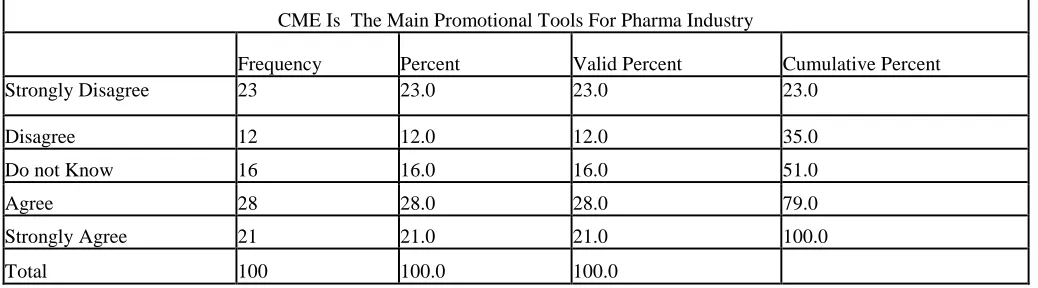
CME Is The Main Promotional Tools For Pharma Industry
Frequency Percent Valid Percent Cumulative Percent
Strongly Disagree 23 23.0 23.0 23.0
Disagree 12 12.0 12.0 35.0
Do not Know 16 16.0 16.0 51.0
Agree 28 28.0 28.0 79.0
Strongly Agree 21 21.0 21.0 100.0
Total 100 100.0 100.0
301
Among the respondents 21% strongly agree, 28% agree, 12% disagree, 23% strongly disagree & 16% do not know. As per the data received Continued medical education is also an important promotional tool for the industry but as per the respondents the favour percentage is less than the above two.Company Funded Clinical Trial Is The Main Promotional Tools For Pharma Industry
Frequency Percent Valid Percent Cumulative Percent
Strongly Disagree 14 14.0 14.0 14.0
Disagree 14 14.0 14.0 28.0
Do not Know 13 13.0 13.0 41.0
Agree 30 30.0 30.0 71.0
Strongly Agree 29 29.0 29.0 100.0
Total 100 100.0 100.0
Table 6: Company Funded Clinical Trial Is the Main Promotional Tools for Pharma Industry
Among the respondents 29% strongly agree, 30% agree, 14% disagree, 14% strongly disagree & 13% do not know. Data received shows that around one fourth of the respondents strongly agreed with this fact, so it can be considered as the third best option in the promotional tools.
Highly Qualified And Knowledgeable MR Has A Higher Recall Value In Drug Prescription
Frequency Percent Valid Percent Cumulative Percent
Strongly Disagree 12 12.0 12.0 12.0
Disagree 6 6.0 6.0 18.0
Do not Know 7 7.0 7.0 25.0
Agree 34 34.0 34.0 59.0
Strongly Agree 41 41.0 41.0 100.0
Total 100 100.0 100.0
Table 7: Highly Qualified and Knowledgeable MR Has A Higher Recall Value
Among the respondents 41% are strongly agree, 34% agree, 12% strongly disagree, 6% disagree, & 7% do not know. Data analysis show that the qualification and Knowledge base of a MR who is the base of Promotion of the industry plays an high role in the recall value of the Doctor hence increased Prescription.
V.
RESULT
After this study it is clear that it largely depends on the various Promotional campaigns of the Pharmaceutical Companies in which Medical Representatives play an important role in implementations. Medical Representative and the related sales team are main instruments in gaining the Prescription flow from the doctors. It is often pondered that which promotional tool gives the companies increased Prescription flow which results in increased sales and revenues for them. This study was directed towards this goal of comparatively evaluating these options and brings forward the best among them. Sponsorships, Continued Medical Education (CME),
Company funded Clinical Trials are the other important Promotional tools.
VI.
CONCLUSION
302
prescription flow, Company should be focusing onrecruiting a good and sharp Sales team taking care of its Qualitative life as well as professional needs. Other promotional tools should also be frequently used to keep the attention of the Physician focused on the product so that the Prescription flow is continuous.
REFERENCE
[1] Baethge C (2008). Transparent texts. Dtsch Arztebl Int., 105(40): 675-9.
[2] Bloor K, Freemantle N (1996). Lessons from international experience in controlling pharmaceutical expenditure II: Influencing doctors. BMJ, 312: 1525-1527. [3] Bowman MA, Pearle DL (1988). Changes in drug prescribing patterns related to commercial company funding of continuing medical education. J. Contin. Edu. Health Prof., 8: 13-20.
[4] Campbell EG, Gruen RL, Mountford J, Miller LG, Cleary PD, Blumenthal D (2007). A national survey of
physician-industry relationships. N. Eng. J. Med., 356: 1742-1750.
[5] Chimonas S, Brennan TA, Rothman DJ (2007). Physicians and drug representatives: exploring the dynamics of the relationship. J. Gen. Int. Med., 22: 184-190.
[6] Chren MM, Landefeld CS (1994). Physicians’ behavior and their interactions with drug companies. A controlled study of physicians who requested additions to a hospital drug formulary. JAMA, 271: 684-689.
[7] Denig P, Haajer-Ruskamp FM, Zijsling Hox DH (1998). Physicians choose drugs. Soc. Sci. Med., 7: 1381-1386.
[8] Fischer MA, Keough ME, Baril JL, Saccoccio L, Mazor KM (2009). Prescribers and pharmaceutical representatives: why are we still meeting? J. Gen. Int. Med., 24: 795-801.
[9] Gagnon MA, Lexchin J (2008). The cost of pushing pills: a new estimate of pharmaceutical promotion expenditures in the United States. PLoS Med., 5: e1. doi:10.1371/journal.pmed.0050001.