The Thirty-Third AAAI Conference on Artificial Intelligence (AAAI-19)
Syntax-Aware Neural Semantic Role Labeling
∗Qingrong Xia,
1Zhenghua Li,
1Min Zhang,
1Meishan Zhang,
2Guohong Fu,
2Rui Wang,
3Luo Si
3 1Institute of Artificial Intelligence, School of Computer Science and Technology, Soochow University, China2School of Computer Science and Technology, Heilongjiang University, China,3Alibaba Group, China 1[email protected],{zhli13, minzhang}@suda.edu.cn
2[email protected], [email protected],3{masi.wr, luo.si}@alibaba-inc.com
Abstract
Semantic role labeling (SRL), also known as shallow seman-tic parsing, is an important yet challenging task in NLP. Mo-tivated by the close correlation between syntactic and se-mantic structures, traditional discrete-feature-based SRL ap-proaches make heavy use of syntactic features. In contrast, deep-neural-network-based approaches usually encode the input sentence as a word sequence without considering the syntactic structures. In this work, we investigate several pre-vious approaches for encoding syntactic trees, and make a thorough study on whether extra syntax-aware representa-tions are beneficial for neural SRL models. Experiments on the benchmark CoNLL-2005 dataset show that syntax-aware SRL approaches can effectively improve performance over a strong baseline with external word representations from ELMo. With the extra syntax-aware representations, our ap-proaches achieve new state-of-the-art 85.6 F1 (single model) and 86.6 F1 (ensemble) on the test data, outperforming the corresponding strong baselines with ELMo by 0.8 and 1.0, re-spectively. Detailed error analysis are conducted to gain more insights on the investigated approaches.
Introduction
Semantic role labeling (SRL), also known as shallow se-mantic parsing, is an important yet challenging task in NLP. Given an input sentence and one or more predicates, SRL aims to determine the semantic roles of each predicate, i.e., who did what to whom, when and where, etc. Seman-tic knowledge has been proved informative in many down-stream NLP applications, such as question answering (Shen and Lapata 2007; Wang et al. 2015), text summarization (Genest and Lapalme 2011; Khan, Salim, and Jaya Ku-mar 2015), and machine translation (Liu and Gildea 2010; Gao and Vogel 2011).
Depending on how the semantic roles are defined, there are two forms of SRL in the community. The span-based SRL follows the manual annotations in the PropBank (Palmer, Gildea, and Kingsbury 2005) and NomBank (Mey-ers et al. 2004) and uses a continuous word span to be a se-mantic role. In contrast, the dependency-based SRL fulfills a role with a single word, which is usually the syntactic or
∗
Zhenghua Li is the corresponding Author.
Copyright c2019, Association for the Advancement of Artificial Intelligence (www.aaai.org). All rights reserved.
..
Ms... Haag plays Elianti . Root
. . .
A0 . . .
V .
. .
A1 .
. .
O ..
nn
..
nsubj
..
dobj
..
punct
..
root
Figure 1: Example of dependency and SRL structures.
semantic head of the manually annotated span (Surdeanu et al. 2008).
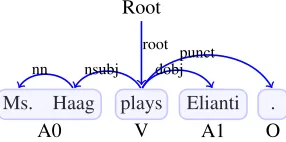
This work follows the span-based formulation. Formally, given an input sentencew=w1...wnand a predicative word prd=wp(1≤p≤n), the task is to recognize the seman-tic roles ofprdin the sentence, such as A0, A1, AM-ADV, etc. We denote the whole role set as R. Each role corre-sponds to a word span ofwj...wk(1≤j≤k≤n). Taking Figure 1 as an example,“Ms. Hag” is the A0 role of the pred-icate “plays”.
In the past few years, thanks to the success of deep learning, researchers has proposed effective neural-network-based models and improved SRL performance by large mar-gins (Zhou and Xu 2015; He et al. 2017; Tan et al. 2018). Unlike traditional discrete-feature-based approaches that make heavy use of syntactic features, recent deep-neural-network-based approaches are mostly in an end-to-end fash-ion and give little consideratfash-ion of syntactic knowledge.
Intuitively, syntax is strongly correlative with semantics. Taking Figure 1 as an example, theA0role in the SRL struc-ture is also the subject (marked bynsubj) in the dependency tree, and theA1role is the direct object (marked bydobj). In fact, the semanticA0orA1argument of a verb predicate are usually the syntactic subject or object interchangeably according to the PropBank annotation guideline.
representa-tions, requiring little change of the architecture of the basic SRL model.
For the base SRL model, we employ the recently proposed deep highway-BiLSTM model (He et al. 2017). Considering that the quality of the parsing results has great impact on the performance of syntax-aware SRL models, we employ the state-of-the-art biaffine parser to parse all the data in our work, which achieves 94.3% labeled parsing accuracy on the WSJ test data (Dozat and Manning 2017).
We conduct our experiments on the benchmark CoNLL-2005 dataset, comparing our syntax-aware SRL approaches with a strong baseline with external word representations from ELMo. Detailed error analyses also give us more in-sights on the investigated approaches. The results show that, with the extra syntax-aware representations, our approach achieves new state-of-the-art 85.6 F1 (single model) and 86.6 F1 (ensemble) on the test set, outperforming the cor-responding strong baselines with ELMo by 0.8 and 1.0, re-spectively, demonstrating the usefulness of syntactic knowl-edge.
The Basic SRL Architecture
Following previous works (Zhou and Xu 2015; He et al. 2017; Tan et al. 2018), we also treat the task as a se-quence labeling problem and try to find the highest-scoring tag sequenceyˆ.
ˆ
y= argmax y∈Y(w)
score(w,y) (1)
whereyi∈ R0is the tag of thei-th wordwi, andY(w)is the
set of all legal sequences. Please note thatR0 = ({B, I} × R)∪ {O}.
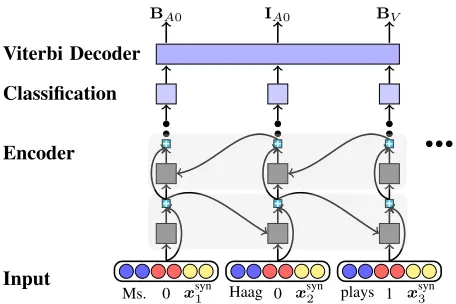
In order to computescore(w,y), which is the score of a tag sequenceyforw, we directly adopt the architecture of He et al. (2017), which consists of the following four com-ponents, as illustrated in Figure 2.
The Input Layer Given the sentencew = w1...wn and
the predicateprd=wp, the input of the network is the com-bination of the word embeddings and the predicate-indicator embeddings. Specifically, the input vector at the i-th time stamp is
xi=embwordwi ⊕emb prd
i==p (2)
where the predicate-indicator embedding embprd0 is used for non-predicate positions and embprd
1 is used for thep
-th position, in order to distinguish -the predicate word from other words, as shown in Figure 2.
With the predicate-indicator embedding, the encoder component can represent the sentence in a predicate-specific way, leading to superior performance (Zhou and Xu 2015; He et al. 2017; Tan et al. 2018). However, the side effect is that we need to separately encode the sentence for each pred-icate, dramatically slowing down training and evaluation.
The BiLSTM Encoding Layer Over the input layer, four stacking layers of BiLSTMs are applied to fully encode long-distance dependencies in the sentence and obtain the rich predicate-specific token-level representations.
..
Input ...
Ms.
. 0
.
xsyn1
....
.. ..
. .. . Haag
. 0 .
xsyn2
....
.. ..
. .. .
plays .
1 .
xsyn3
..
Encoder
... . . . . . .
.
... . . . . . .
... . .
Classification
... .
Viterbi Decoder
.... . ....
BA0
.
IA0
.
BV
Figure 2: The basic SRL architecture.
Moreover, He et al. (2017) propose to use highway con-nections (Srivastava, Greff, and Schmidhuber 2015; Zhang et al. 2016) to alleviate the vanishing gradient problem, im-proving the parsing performance by 2% F1. As illustrated in Figure 2, the basic idea is to combine the input and output of an LSTM node in some way, and feed the combined result as the final output of the node into the next LSTM layer and the next time-stamp of the same LSTM layer.
We use the outputs of the final (top) backward LSTM layer as the representation of each word, denoted ashi.
Classification Layer With the representation vectorhiof the wordwi, we employ a linear transformation and a soft-max operation to compute the probability distribution of dif-ferent tags, denoted asp(r|w, i)(r∈ R0).
Decoder With the local tag probabilities of each word, then the score of a tag sequence is
score(w,y) =
n X
i=1
logp(yi|w, i) (3)
Finally, we employ the Viterbi algorithm to find the highest-scoring tag sequence and ensure the resulting se-quence does not contain illegal tag transitions such as yi−1=BA0andyi=IA1.
The Syntax-aware SRL Approaches
The previous section introduces the basic model architecture of SRL, and in this section, we will illustrate how to encode the syntactic features into a dense vector and use it as extra inputs. Intuitively, dependency syntax has a strong correla-tion with semantics. For instance, a subject of a verb in de-pendency trees usually corresponds to the agent or patient of the verb. Therefore, traditional discrete-feature based SRL approaches make heavy use of syntax-related features. In contrast, the state-of-the-art neural network based SRL mod-els usually adopt the end-to-end framework without consult-ing the syntax.
.. Ms...
nn .
Haag
. ... .
nsubj
.
plays
. ...
Root
.. .
root
.
Elianti
. .... .
dobj
.
.
. .... .
punct
Figure 3: Bi-directional (bottom-up and top-down) Tree-GRU.
investigate and compare four different approaches for en-coding syntactic trees.
• The Tree-GRU (tree-structured gated recurrent unit)
ap-proach globally encodes an entire dependency tree once for all, and produces unified representations of all words in a predicate-independent way.
• TheSDP(shortest dependency path) approach considers the shortest path from the focused wordwiand the predi-catedwp, and use the max-pooling of the syntactic labels in the path as the predicate-specific (different from Tree-GRU) syntax-aware representation ofwi.
• The TPF (tree position feature) approach considers the relative positions ofwiandwpto their common ancestor word in the parse tree, and use the embedding of such position features as the representation ofwi.
• ThePE(pattern embedding) approach classifies the rela-tionship betweenwiandwpin the parse tree into several pre-defined patterns (or types), and use the embeddings of the pattern and a few dependency relations as the rep-resentation ofwi.
The four approaches encode dependency trees from different perspectives and in different ways. Each approach produces a syntax-aware representation of the focused word.
Formally, we denote these representations as xsyni for wordwi. We treat these syntactic representations as the ex-ternal model input, and concatenate them with the basic in-putxi. In the following, we introduce the four approaches in detail.
The Tree-GRU Approach
As a straightforward method, tree-stuctured recurrent neu-ral network (Tree-RNN) (Tai, Socher, and Manning 2015; Chen et al. 2017) can globally encode a parse tree and return syntax-aware representation vectors of all words in the sentence. Previous works have successfully employed Tree-RNN for exploiting syntactic parse trees for differ-ent tasks, such as sdiffer-entimdiffer-ent classification (Tai, Socher, and Manning 2015), relation extraction (Miwa and Bansal 2016; Feng et al. 2017) and machine translation (Chen et al. 2017; Wang et al. 2018).
Following Chen et al. (2017), we employ a bi-directional Tree-GRU to encode the dependency tree of the input sen-tence, as illustrated in Figure 3.
The bottom-up Tree-GRU computes the representation vectorh↑i of the wordwi based on its children, as marked
.. Ms....
nn .
Haag
.. .
nsubj
.
plays
..
Root
. .
root
.
Elianti
.
. .
dobj
.
.
.
. .
punct
Figure 4: The SDP approach: where the blue line marks the path from the focused word “Ms.” to the common ancestor
“plays”, and the red line is the path from the predicate to the
ancestor.
by the red lines in Figure 3. The detailed equations are as follows.
¯
h↑i,L= X
j∈lchild(i)
h↑j, ¯h↑i,R= X
k∈rchild(i) h↑k
ri,L=σ(WrLli+UrLh¯↑i,L+V rLh¯↑
i,R)
ri,R=σ(WrRli+UrRh¯↑i,L+V rRh¯↑
i,R)
zi,L=σ(WzLli+UzL¯h↑i,L+V zLh¯↑
i,R)
zi,R=σ(WzRli+UzRh¯↑i,L+V zRh¯↑
i,R)
zi=σ(Wzli+Uz¯h↑i,L+V z¯h↑
i,R)
ˆ
h↑i=tanh Wli+U(ri,Lh¯↑i,L)+V(ri,R¯h↑i,R)
h↑i =zi,Lh¯↑i,L+zi,Rh¯↑i,R+ziˆh↑i,
(4)
wherelchild/rchild(.)means the set of left/right-side children,liis the embedding of the syntactic label between wiand its head, andWs,Us andVs are all model parame-ters.
Analogously, the top-down Tree-GRU computes the rep-resentation vector h↓i of the word wi based on its parent node, as marked by the blue lines in Figure 3. We omit the equations for brevity.
We use the concatenation of the two resulting hidden vec-tors as the final representation of the wordwi:
xsyni =h↑i ⊕h↓i (5)
The SDP Approach
SDP-based features have been extensively used in traditional discrete-feature based approaches for exploiting syntactic knowledge in relation extraction. The idea is to consider the shortest path of two focused words in the dependency tree, and extract path-related features as syntactic clues.
Xu et al. (2015) first adapt SDP into the nerual network settings in the task of relation classification. They treat the SDP as two sub-paths from the two focused entity words to their lowest common ancestor, and run two LSTMs respec-tively along the two sub-paths to obtain extra syntax-aware representations, leading to improved performance.
.. Ms... (0, 2) .
Haag
. .
(0, 1) .
plays
..
Root
.
(0, 0)
.
Elianti
.
(0, 1) .
.
.
(0, 1)
Figure 5: Example of Tree-based Position Feature. The number-tuples with brackets are relative positions of TPF.
haveO(n)paths given a sentence and a predicate. There-fore, we adopt the max pooling operation to obtain a repre-sentation vector over an SDP. Following Xu et al. (2015), we divide the SDP into two parts in the position of the lowest common ancestor, in order to distinguish the directions, as shown in Equation 6 and Figure 4.
xsyni = MaxPool
j∈path(i,a)(lj)⊕kMaxPool∈path(p,a)(lk) (6)
wherepath(i, a)is the set of all the words along the path from the focused wordwi to the lowest common ancestor wa, andpath(i, a)is for the path from the predicate wp towa;lj is the embedding of the dependency relation label betweenwjand its parent.
The TPF Approach
Collobert et al. (2011) first propose position features for the task of SRL. The basic idea is to use the embedding of the distance (as discrete numbers) between the predicate word and the focused word as extra inputs.
In order to use syntactic trees, Yang et al. (2016) extend the position features and propose the tree-based position fea-tures (TPF) for the task of relation classification.
In this work, we directly adopt the TPF approach of Yang et al. (2016) for encoding syntactic knowledge.1
Fig-ure 5 gives an example. The number pairs in the parentheses are the TPFs of the corresponding words. The first number means the distance from the predicate in concern to the low-est common anclow-estor, and the second number is the distance from the focused word to the ancestor. For instance, sup-pose “Ms.” is the focused word and “plays” is the predicate. Their lowest common ancestor is “plays”, which is the pred-icate itself. There are 2 dependencies in the path from “Ms.” to “plays”. Therefore, the TPF of “Ms.” is “(0, 2)”.
Then, we embed the TPF of each word into a dense vec-tor through a lookup operation, use it as the syntax-related representation.
xsyni =embTPFfi (7)
wherefiis the TPF ofwi.
1
Yang et al. (2016) propose two versions of TPF. We directly use the Tree-based Position Feature 2 due to its better performance.
..
predicate self:.. i(p)←p
child:i←p
. .
grand:i←j←p
. .
sibling:i←j →p
. .
reverse child:i→p
. .
reverse grand:i→j→p
. .
else:{3; 4−5; 6;≥7}
. . .... ..
embPE pt(i,p)
Figure 6: Patterns used in this work.
Train Dev WSJ Test Brown Test
#Sent 39,832 1,346 2,416 426
#Tok 950,028 32,853 56,684 7,159
#Pred 90,750 3,248 5,267 804
#Arg 239,858 8,346 14,077 2,177
Table 1: Data statistics of the CoNLL-2005.
The PE Approach
Jiang et al. (2018) propose the PE approach for the task of treebank conversion, which aims to convert a parse tree fol-lowing the source-side annotation guideline into another tree following the target-side guideline. The basic idea is to clas-sify the relationship between two given words in the source-side tree into several pre-defined patterns (or types), and use the embedding of the pattern and a few dependency relations as the source-side syntax representation.
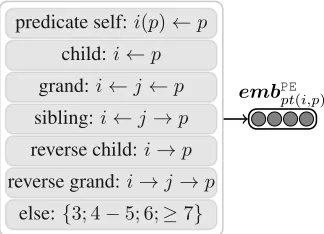
In this work, we adopt their PE approach for encoding syntactic knowledge. Figure 6 lists the patterns used in this work. Given a focused wordwiand a predicatewp, we first decide the pattern type according to the structural relation-ship betweenwiandwp, denoted aspt(i, p).
Taking wi =“Ms.” and wp = “plays” as an example, since “Ms.” is the grandchild of “plays”, then the pattern is “grandchild”. Then we embedpt(i, p)into a dense vector
embPE
pt(i,p). We also use the embeddings of three highly
re-lated syntactic labels as extra representations, i.e.,li,la,lp, wherela is the syntactic label between the lowest common ancestorwa and its father. Then, the four embeddings are concatenated asxsyni to represent the structural information ofwiandwpin a dependency tree.
xsyni =embPE
pt(i,p)⊕li⊕la⊕lp (8)
Experiments
Settings
WSJ Test Brown Test Combined
Methods P R F1 Comp. P R F1 Comp. F1
Single
Baseline (He et al., 2017) 83.1 83.0 83.1 64.3 72.9 71.4 72.1 44.8 81.6 Baseline (Our re-impl) 83.4 83.0 83.2 64.9 72.3 70.8 71.6 44.3 81.6
Tree-GRU 83.9 83.6 83.8 65.2 72.9 71.1 72.3 44.9 82.2
SDP 84.2 83.9 84.0 65.9 74.0 72.0 73.0 45.2 82.6
TPF 84.3 83.8 84.1 65.9 73.7 72.0 72.9 45.5 82.6
PE 83.7 83.8 83.8 65.3 73.4 72.5 73.0 46.1 82.3
Single+ELMo
Baseline 86.3 86.2 86.3 69.4 75.2 74.3 74.7 48.1 84.8
Tree-GRU 86.2 86.2 86.2 68.9 77.9 75.6 76.7 50.8 84.9
SDP 86.9 86.7 86.8 70.2 78.0 76.3 77.1 52.4 85.5
TPF 87.0 86.8 86.9 70.4 77.6 75.9 76.8 51.6 85.6
PE 86.5 86.3 86.4 69.6 77.4 76.4 76.9 51.5 85.1
Ensemble
5×Baseline (He et al., 2017) 85.0 84.3 84.6 66.5 74.9 72.4 73.6 46.5 83.2 5×Baseline (Our re-impl) 84.6 84.0 84.3 66.4 74.9 72.1 73.5 46.1 82.9
5×TPF 85.6 85.0 85.3 68.1 75.9 73.4 74.8 48.1 83.9
4 Syntax-aware Methods 85.8 85.5 85.6 68.7 76.3 74.5 75.4 49.3 84.3
Ensemble+ELMo
5×Baseline 87.2 86.8 87.0 70.8 77.7 75.8 76.7 50.4 85.6
5×TPF 87.5 87.0 87.3 71.1 78.6 76.5 77.5 52.5 86.0
4 Syntax-aware Methods 88.0 87.6 87.8 72.2 79.7 78.0 78.8 53.2 86.6
Table 2: Comparison with baseline model and all our syntax-aware methods on the CoNLL-2005 dataset. We report the results in precision (P), recall (R), F1 and percentage of completely correct predicates (Comp.).
Dependency Parsing In recent years, neural network based dependency parsing has achieved significant progress. We adopt the state-of-the-art biaffine parser proposed by Dozat and Manning (2017) in this work. We use the orig-inal phrase-structure Penn Treebank (PTB) data to produce the dependency structures for the CoNLL-2005 SRL data. Following standard practice in the dependency parsing com-munity, the phrase-structure trees are converted into Stan-ford dependencies using the StanStan-ford Parser v3.3.02. Since the biaffine parser needs part-of-speech (POS) tags as inputs, we use an in-house CRF-based POS tagger to produce auto-matic POS tags on all the data. After training, the biaffine parser achieves 94.3% parsing accuracy (LAS) on the WSJ test dataset. Additionally, we use the 5-way jackknifing to obtain the automatic POS tagging and dependency parsing results of the training data.
ELMo Peters et al. (2018) recently propose to produce contextualized word representations (ELMo) with an unsu-pervised language model learning objective, and show that simply using the learned external word representations as extra inputs can effectively boost performance of a variety of tasks, including SRL. To further investigate the effective-ness of our syntax-aware methods, we build a stronger base-line with the ELMo representations as extra input.
Evaluation We adopt the official script provided by CoNLL-20053 for evaluation. We conduct significance test
2
https://nlp.stanford.edu/software/lex-parser.html
3
http://www.cs.upc.edu/∼srlconll/st05/st05.html
using the Dan Bikel’s randomized parsing evaluation com-parer.
Implementation We implement the baseline and all the syntax-aware methods with Pytorch 0.3.04.
Initialization and Hyper-parameters For the parameter settings, we mostly follow the work of He et al. (2017). We adopt the Adadelta optimizer with learning rate ρ = 0.95
and = 1e−6, use a batchsize of80, and clip gradients with norm larger than 1.0. All the embedding dimensions (word, predicate-indicator, syntactic label, pattern, and TPF) are set to100. All models are trained for500 iterations on the trained data and select the best iteration that has the peak performance on the dev data.
Main Results
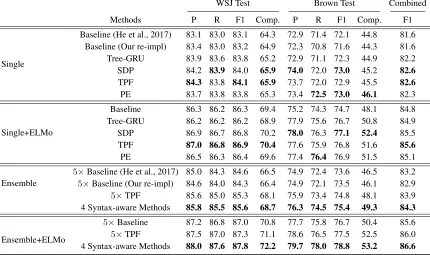
Table 2 shows the main results of different approaches on CoNLL-2005 dataset. The results are presented in four ma-jor rows. For the ensemble of “5×baseline” and “5×TPF”, we randomly sample 4/5 of the training data and train one model at each time. For the ensemble of 4 syntax-aware ap-proaches, each model is trained on the whole training data.
Results of single models are shown in the first major row. First, our re-implemented baseline of He et al. (2017) achieves nearly the same results with those reported in their paper. Second, the four syntax-aware approaches are simi-larly effective and can improve the performance by 0.6 ∼ 1.0in F1 (combined). All the improvements are statistically
4
significant (p < 0.001). Third, we find that the Tree-GRU approach is slightly inferior to the other three. The possi-ble reason is that Tree-GRU produces unified representa-tions for the sentence without specific considerarepresenta-tions of the given predicate, whereas all other three approaches derive predicate-specific representations.
Results of single models with ELMoare shown in the second major row, in which each single model is enhanced using the ELMo representations as extra inputs. We can see that ELMo representations brings substantial improvements over the corresponding baselines by2.7 ∼3.2in F1 (com-bined). Compared with the stronger baseline w/ ELMo, SDP, TPF, and PE w/ ELMo still achieve absolute and significant (p < 0.001) improvement of0.7,0.8, and0.3in F1 (com-bined), respectively. Tree-GRU w/ ELMo increases F1 by
2.0on the out-of-domain Brown test data, but decreases F1 by0.1on the in-domain WSJ test data, leading to an over-all improvement of0.1 on combined F1 (p > 0.05). Simi-larly to the results in the first major row, this again indicates that the predicate-independent Tree-GRU approach may not be suitable for syntax encoding in our SRL task, especially when the baseline is strong.
Results of ensemble modelsare shown in the third major row. Compared with the baseline single model, the baseline ensemble approaches increase F1 (combined) by 1.3. The F1 score of the “5×Baseline” of He et al. (2017) is 83.2%, whereas our re-implemented “5×Baseline” achieves 82.9% F1. We guess the 0.3 gap may be caused by the random fac-tors in 5-fold data split and parameter initialization. In our preliminary experiments, we have run the single model of He et al. (2017) for several times using different random seeds for parameter initialization, and found about0.1∼0.3
F1 variation. The ensemble of five TPF models further im-proves F1 (combined) over the ensemble of five baselines by1.0(p < 0.001). We choose the TPF method as a case study since it consistently achieves best performances in all scenarios. The ensemble of the four syntax-aware methods achieves the best performance in this scenario, outperform-ing the TPF ensemble by 0.4 F1. This indicates that the four syntax-aware approaches are discrepant and thus more complementary in the ensemble scenario than using a single method.
Results of ensemble models with ELMoare shown in the bottom major row, where each single model is enhanced with ELMo representations before the ensemble operation. Again, using ELMo representations as extra input greatly improves F1 (combined) by2.1 ∼2.7over the correspond-ing ensemble methods in the third major row. Similar to the above findings, the ensemble of five TPF with ELMo im-prove F1 (combined) by0.4 (p < 0.001) over the ensem-ble of five baselines with ELMo, and the ensemensem-ble of the four syntax-aware methods with ELMo further increases F1 (combined) by0.6.
Overall, we can conclude that the syntax-aware ap-proaches can consistently improve SRL performance.
Comparison with Previous Works
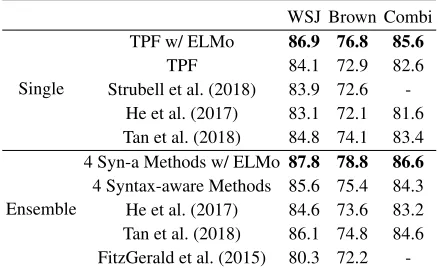
Table 3 compare our approaches with previous works. In the single-model scenario, the TPF approach outperforms both
WSJ Brown Combi
Single
TPF w/ ELMo 86.9 76.8 85.6
TPF 84.1 72.9 82.6 Strubell et al. (2018) 83.9 72.6
-He et al. (2017) 83.1 72.1 81.6 Tan et al. (2018) 84.8 74.1 83.4
Ensemble
4 Syn-a Methods w/ ELMo 87.8 78.8 86.6
4 Syntax-aware Methods 85.6 75.4 84.3 He et al. (2017) 84.6 73.6 83.2 Tan et al. (2018) 86.1 74.8 84.6 FitzGerald et al. (2015) 80.3 72.2
-Table 3: Comparison with previous results.
Methods Devel WSJ Brown Combined
Baseline 81.5 83.2 71.6 81.6
TPF 82.5 84.1 72.9 82.6
TPF-Gold 88.4 89.6 79.8 88.3
Baseline w/ ELMo 85.5 86.3 74.7 84.8
TPF w/ ELMo 85.3 86.9 76.8 85.6
TPF-Gold w/ ELMo 89.8 91.1 82.2 89.9
Table 4: Upper-bound analysis of the TPF Method.
He et al. (2017) and Strubell et al. (2018), and is only infe-rior to Tan et al. (2018), which is based on the recently pro-posed deep self-attention encoder (Vaswani et al. 2017). Us-ing ELMo representations promotes our results as the state-of-the-art. We discuss the work of Strubell et al. (2018) in the related works section, which also makes use of syntactic information.
In the ensemble scenario, the findings are similar, and the ensemble of four syntax-aware approaches with ELMo reaches new state-of-the-art performances.
Analysis
In this section, we conduct detailed analysis to better un-derstand the improvements introduced by the syntax-aware approaches. We use the TPF approach as a case study since it consistently achieves best performances in all scenarios. We sincerely thank Luheng He for the kind sharing of her analysis scripts.
Using Gold-standard Syntax To understand the upper-bound performance of the syntax-aware approaches, we use the gold-standard dependency trees as the input and ap-ply the TPF approach. Table 4 shows the results. The TPF method with gold-standard parse trees brings a very large improvement of6.7in F1 (combined) over the baseline with-out using ELMo, and 5.1 when using ELMo. This shows the usefulness and great potential of syntax-aware SRL ap-proaches.
...
0-1
.
2-3
.
4-7
.
≥8
.
70
.
75
.
80
.
85
.
90
.
Distance (num. words) .
F1
(%)
.
. TPF w/ ELMo.. . Baseline w/ ELMo..
. TPF..
. Baseline..
Figure 7: F1 regarding surface distance between arguments and predicates.
...
Orig.
.
Fix Labels
.
Move Core Arg.
.
Merge Spans
.
Split Spans
.
Fix Span Boundary
.
Drop Arg.
.
Add Arg.
.
80. 85
.
90
.
95
.
100
.
F1
(%)
.
. TPF-Gold w/ ELMo..
. TPF w/ ELMo..
. TPF..
. Baseline..
Figure 8: Performance of CoNLL-2005 models after per-forming oracle transformations.
predicates, as shown in Figure 7. It is clear that larger im-provements are obtained for arguments longer-distance ar-guments, in both scenarios of with or without ELMo repre-sentations. This demonstrates that syntactic knowledge ef-fectively captures long-distance dependencies and thus is most beneficial for arguments that are far away from predi-cates.
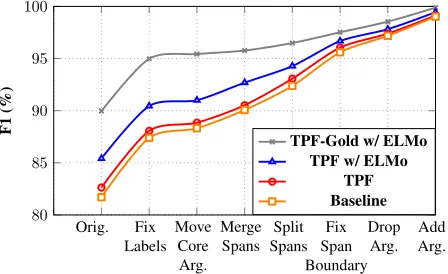
Error Type Breakdown In order to understand error dis-tribution of different approaches in terms of different types of mistakes, we follow the work of He et al. (2017) and em-ploy a set of oracle transformations on the system outputs to observe the relative F1 improvements by fixing various pre-diction errors incrementally. “Orig” corresponds to the F1 scores of the original model outputs. First, we fix the label errors in the model outputs and the fixed results are shown by “Fix Labels”. Specifically, if we find a predicted span matches a gold-standard one but has a wrong label, then we assign the correct label to the span in the model out-puts. Then, based on the results of “Fix Labels”, we perform “Move Core Arg.”. If a span is labeled as a core argument (i.e., A0-A5), but the boundaries are wrong, then we move the span to its correct boundaries. Third, based on the re-sults of “Move Core Arg.”, we perform “Merge Spans”. If two predicted spans can be merged to match a gold-standard span, then we do so and assign the correct label. Fourth, we
preform “Split Spans”. If a predicted span can be split into two gold-standard spans, then we do so and assign correct labels to them. Fifth, if a predicted span’s label matches an overlapping gold span, we perform “Fix Span Boundary” to correct its boundary. Sixth, we perform “Drop Arg.” to drop the predicted arguments that doesn’t overlap with any gold spans. Finally, if a gold argument doesn’t overlap with any predicted spans, we perform “Add Arg.” Figure 8 shows the results, from which we can see that 1) different approaches have similar error distributions, among which labeling errors account for the largest proportion, and span boundary errors (split, merge, boundary) also have a large share; 2) using automatic parse trees leads to consistent improvements over all error types; 3) using ELMo representations also consis-tently improves performance by large margin; 4) using gold parse trees can effectively resolve almost all span boundary (including merge and split) errors.
Related Work
Traditional discrete-feature based SRL models make heavy use of syntactic information (Swanson and Gordon 2006; Punyakanok, Roth, and Yih 2008). With the rapid devel-opment of deep learning in NLP, researchers propose sev-eral simple yet effective end-to-end neural network models with little consideration of syntactic knowledge (Zhou and Xu 2015; He et al. 2017; Tan et al. 2018).
Meanwhile, inspired by the success of syntactic features in traditional SRL approaches, researchers also try to en-hance neural network based SRL approaches by syntax. He et al. (2017) show that large improvement can be achieved by using gold-standard constituent trees as rule-based con-straints during viterbi decoding. Strubell et al. (2018) pro-pose a syntactically-informed SRL approach based on the self-attention mechanism. The key idea is introduce an aux-iliary training objective that encourages one attention head to attend to its syntactic head word. They also use multi-task learning on POS tagging, dependency parsing, and SRL to obtain better encoding of the input sentence. We make comparison with their results in Table 3. Swayamdipta et al. (2018) propose a multi-task learning framework to incor-porate constituent parsing loss into other semantic-related tasks such as SRL and coreference resolution. They report +0.8 F1 improvement over their baseline SRL model. Dif-ferent from Swayamdipta et al. (2018), our work focuses on dependency parsing and try to explicitly encode parse out-puts to help SRL.
us-ing dependency label embeddus-ings as extra inputs, and 2) employing a tree-based k-th order algorithm for argument pruning. Cai et al. (2018) propose a strong end-to-end neu-ral approach for the dependency-based SRL based on deep BiLSTM encoding and Biaffine attention. They use depen-dency trees for argument pruning and find no improvement over the syntax-agnostic counterpart.
Conclusions
This paper makes a thorough investigation and comparison of four different approaches, i.e., Tree-GRU, SDP, TPF, and PE, for exploiting syntactic knowledge for neural SRL. The experimental results show that syntax is consistently help-ful to improve SRL performance, even when the models are enhanced with external ELMo representations. By uti-lizing both ELMo and syntax-aware representations, our fi-nal models achieve new state-of-the-art performance in both single and ensemble scenarios on the benchmark CoNLL-2005 dataset. Detailed analyses show that syntax helps the most on arguments that are far away from predicates, due to the long-distance dependencies captured by syntactic trees. Moreover, there is still a large performance gap between us-ing gold-standard and automatic parse trees, indicatus-ing that there is still large room for further research on syntax-aware SRL.
Acknowledgments
We thank our anonymous reviewers for their helpful com-ments. This work was supported by National Natural Sci-ence Foundation of China (Grant No. 61525205, 61876116, 61432013), and was partially supported by the joint research project of Alibaba and Soochow University.
References
Cai, J.; He, S.; Li, Z.; and Zhao, H. 2018. A full end-to-end semantic role labeler, syntax-agnostic over syntax-aware? In
Proceedings of COLING, 2753–2765.
Carreras, X., and M`arquez, L. 2005. Introduction to the conll-2005 shared task: Semantic role labeling. In
Proceed-ings of CoNLL, 152–164.
Chen, H.; Huang, S.; Chiang, D.; and Chen, J. 2017. Im-proved neural machine translation with a syntax-aware en-coder and deen-coder. InProceedings of ACL, 1936–1945. Collobert, R.; Weston, J.; Bottou, L.; Karlen, M.; Kavukcuoglu, K.; and Kuksa, P. 2011. Natural language pro-cessing (almost) from scratch.Journal of Machine Learning
Research12:2493–2537.
Dozat, T., and Manning, C. D. 2017. Deep biaffine attention for neural dependency parsing. InProceedings of ICIR. Feng, Y.; Zhang, H.; Hao, W.; and Chen, G. 2017. Joint ex-traction of entities and relations using reinforcement learn-ing and deep learnlearn-ing.Computational Intelligence and
Neu-roscience2017:1–11.
FitzGerald, N.; T¨ackstr¨om, O.; Ganchev, K.; and Das, D. 2015. Semantic role labeling with neural network factors.
InProceedings of EMNLP, 960–970.
Gao, Q., and Vogel, S. 2011. Corpus expansion for statisti-cal machine translation with semantic role label substitution rules. InProceedings of ACL, 294–298.
Genest, P.-E., and Lapalme, G. 2011. Framework for ab-stractive summarization using text-to-text generation. In
Proceedings of MTTG, 64–73.
He, L.; Lee, K.; Lewis, M.; and Zettlemoyer, L. 2017. Deep semantic role labeling: What works and what’s next. In
Pro-ceedings of ACL, 473–483.
He, S.; Li, Z.; Zhao, H.; and Bai, H. 2018. Syntax for se-mantic role labeling, to be, or not to be. InProceedings of ACL, 2061–2071.
Jiang, X.; Li, Z.; Zhang, B.; Zhang, M.; Li, S.; and Si, L. 2018. Supervised treebank conversion: Data and ap-proaches. InProceedings of ACL, 2705–2715.
Khan, A.; Salim, N.; and Jaya Kumar, Y. 2015. A framework for multi-document abstractive summarization based on se-mantic role labelling. Applied Soft Computing30(C):737– 747.
Liu, D., and Gildea, D. 2010. Semantic role features for machine translation. InProceedings of COLING, 716–724. Marcheggiani, D., and Titov, I. 2017. Encoding sentences with graph convolutional networks for semantic role label-ing. InProceedings of ACL, 1506–1515.
Meyers, A.; Reeves, R.; Macleod, C.; Szekely, R.; Zielin-ska, V.; Young, B.; and Grishman, R. 2004. The nombank project: An interim report. InProceedings of HLT-NAACL. Miwa, M., and Bansal, M. 2016. End-to-end relation ex-traction using lstms on sequences and tree structures. In
Proceedings of ACL, 1105–1116.
Palmer, M.; Gildea, D.; and Kingsbury, P. 2005. The propo-sition bank: An annotated corpus of semantic roles.
Compu-tational linguistics31(1):71–106.
Peters, M. E.; Neumann, M.; Iyyer, M.; Gardner, M.; Clark, C.; Lee, K.; and Zettlemoyer, L. 2018. Deep contextual-ized word representations. InProceedings of NAACL-HLT, 2227–2237.
Punyakanok, V.; Roth, D.; and Yih, W.-t. 2008. The im-portance of syntactic parsing and inference in semantic role labeling. Computational Linguistics34(2):257–287.
Roth, M., and Lapata, M. 2016. Neural semantic role label-ing with dependency path embeddlabel-ings. InProceedings of ACL, 1192–1202.
Shen, D., and Lapata, M. 2007. Using semantic roles to improve question answering. In Proceedings of
EMNLP-CoNLL, 12–21.
Srivastava, R. K.; Greff, K.; and Schmidhuber, J. 2015. Training very deep networks. In Proceedings of NIPS, 2377–2385.
of syntactic and semantic dependencies. InProceedings of
CoNLL, 159–177.
Swanson, R., and Gordon, A. S. 2006. A comparison of alternative parse tree paths for labeling semantic roles. In
Proceedings of COLING/ACL, 811–818.
Swayamdipta, S.; Thomson, S.; Lee, K.; Zettlemoyer, L.; Dyer, C.; and Smith, N. A. 2018. Syntactic scaffolds for semantic structures. InProceedings of EMNLP, 3772–3782. Tai, K. S.; Socher, R.; and Manning, C. D. 2015. Im-proved semantic representations from tree-structured long short-term memory networks. InProceedings of ACL, 1556– 1566.
Tan, Z.; Wang, M.; Xie, J.; Chen, Y.; and Shi, X. 2018. Deep semantic role labeling with self-attention. InProceedings of AAAI, 4929–4936.
Vaswani, A.; Shazeer, N.; Parmar, N.; Uszkoreit, J.; Jones, L.; Gomez, A. N.; Kaiser, Ł.; and Polosukhin, I. 2017. At-tention is all you need. InProceedings of NIPS, 5998–6008. Wang, H.; Bansal, M.; Gimpel, K.; and McAllester, D. 2015. Machine comprehension with syntax, frames, and seman-tics. InProceedings of ACL-IJCNLP, 700–706.
Wang, Y.; Li, S.; Yang, J.; Sun, X.; and Wang, H. 2018. Tag-enhanced tree-structured neural networks for implicit discourse relation classification. InProceedings of IJCNLP, 496–505.
Xu, Y.; Mou, L.; Li, G.; Chen, Y.; Peng, H.; and Jin, Z. 2015. Classifying relations via long short term memory networks along shortest dependency paths. InProceedings of EMNLP, 1785–1794.
Yang, Y.; Tong, Y.; Ma, S.; and Deng, Z.-H. 2016. A po-sition encoding convolutional neural network based on de-pendency tree for relation classification. InProceedings of
EMNLP, 65–74.
Zhang, Y.; Chen, G.; Yu, D.; Yaco, K.; Khudanpur, S.; and Glass, J. 2016. Highway long short-term memory rnns for distant speech recognition. InProceedings of ICASSP, 5755–5759.
Zhou, J., and Xu, W. 2015. End-to-end learning of semantic role labeling using recurrent neural networks. In