R E S E A R C H A R T I C L E
Open Access
Impact of different privacy conditions and
incentives on survey response rate, participant
representativeness, and disclosure of sensitive
information: a randomized controlled trial
Maureen Murdoch
1,2,3*, Alisha Baines Simon
2, Melissa Anderson Polusny
2,4,5, Ann Kay Bangerter
2,
Joseph Patrick Grill
2, Siamak Noorbaloochi
2,3and Melissa Ruth Partin
2,3Abstract
Background:Anonymous survey methods appear to promote greater disclosure of sensitive or stigmatizing information compared to non-anonymous methods. Higher disclosure rates have traditionally been interpreted as being more accurate than lower rates. We examined the impact of 3 increasingly private mailed survey conditions—ranging from potentially identifiable to completely anonymous—on survey response and on respondents’representativeness of the underlying sampling frame, completeness in answering sensitive survey items, and disclosure of sensitive information. We also examined the impact of 2 incentives ($10 versus $20) on these outcomes.
Methods:A 3X2 factorial, randomized controlled trial of 324 representatively selected, male Gulf War I era veterans who had applied for United States Department of Veterans Affairs (VA) disability benefits. Men were asked about past sexual assault experiences, childhood abuse, combat, other traumas, mental health symptoms, and sexual orientation. We used a novel technique, the pre-merged questionnaire, to link anonymous responses to administrative data.
Results:Response rates ranged from 56.0% to 63.3% across privacy conditions (p= 0.49) and from 52.8% to 68.1% across incentives (p= 0.007). Respondents’characteristics differed by privacy and by incentive assignments, with completely anonymous respondents and $20 respondents appearing least different from their non-respondent counterparts. Survey completeness did not differ by privacy or by incentive. No clear pattern of disclosing sensitive
information by privacy condition or by incentive emerged. For example, although all respondents came from the same sampling frame, estimates of sexual abuse ranged from 13.6% to 33.3% across privacy conditions, with the highest estimate coming from the intermediate privacy condition (p= 0.007).
Conclusion:Greater privacy and larger incentives do not necessarily result in higher disclosure rates of sensitive information than lesser privacy and lower incentives. Furthermore, disclosure of sensitive or stigmatizing information under differing privacy conditions may have less to do with promoting or impeding participants’ “honesty”or “accuracy”than with selectively recruiting or attracting subpopulations that are higher or lower in such experiences. Pre-merged questionnaires bypassed many historical limitations of anonymous surveys and hold promise for exploring non-response issues in future research.
Keywords:Randomized trial, Patient surveys, Participation bias, Non-response bias, Anonymity, Confidentiality
* Correspondence:[email protected] 1
Section of General Internal Medicine, Minneapolis VA Medical Center, Minneapolis, MN, USA
2
Center for Chronic Disease Outcomes Research, Minneapolis VA Medical, One Veterans Drive, Minneapolis, MN 55417, USA
Full list of author information is available at the end of the article
Background
Surveys represent one of the most efficient and inexpen-sive research methods available to collect representative, high quality data from large numbers of research partici-pants. They therefore frequently serve as the backbone used to define the scope and magnitude of many poten-tial public health problems. In the United States, for ex-ample, large national surveys have been used to estimate what proved at the time to be surprisingly high levels of mental illness within the general population [1], physical violence within families [2], and sexual assault among women [3]. Even the United States Census, which serves as the basis of apportioning Congressional representatives and taxes to each state, is survey-based. Typically, survey data are either collected by interviewers using face-to-face or telephone communication with the participant or via the participant’s own self-report.
Regardless of the topic studied and how the information is collected, scientifically correct, survey-based prevalence estimates require that research participants be representa-tive of the population from which they are drawn, that participants actually answer the questions that are asked of them, and that they answer those questions honestly. On average, research participants disclose sensitive and personal information, such as mental health symptoms, drug misuse, and history of sexual assault more fre-quently when responding to self-administered question-naires than when taking part in face-to-face or telephone interviews [4-7]. Studies suggest that disclosure of sensi-tive information on self-administered questionnaires is enhanced yet more when participants respond anonym-ously instead of confidentially [5,8-11]. This implies that anonymous, self-administered surveys may be the optimal method for accurately cataloging information about certain public health problems, such as the preva-lence of physical or sexual abuse or of mental health symptoms.
Although by no means proven, most survey researchers take the stance that methods that generate higher preva-lence estimates for stigmatizing or sensitive information are probably more accurate than methods that generate lower estimates. This stance, however, rests upon a rather unlikely assumption that all people carry the same pro-pensity to participate in survey research. Particularly when a survey topic is sensitive, survey respondents tend to dif-fer substantially from non-respondents [12]. Therefore, three mechanisms might explain why anonymous surveys generate higher prevalence estimates of stigmatizing or sensitive information compared to non-anonymous sur-veys: 1) propensity to participate in research is in fact equal across all members of a sampling frame, and an-onymous methods promote more honest self-disclosure among the participants with stigmatizing experiences; 2) sampling frame members with stigmatizing experiences
are more reluctant than others to participate in surveys, but anonymous methods reduce this inherent reluc-tance (under selection is reduced); 3) anonymous methods disproportionately increase the propensity of people with stigmatizing experiences to participate in the survey rela-tive to those without such experiences (over selection is induced). The first two mechanisms reduce bias; the last introduces bias. Without information about non-respondents’characteristics relative to respondents’, how-ever, one cannot determine which possibility is correct. Unfortunately, under typical anonymous conditions, such information is unavailable.
Anonymous surveys carry other drawbacks relative to confidential surveys. For example, unlike confidential survey methods, anonymous survey responses cannot be linked to administrative or other non-survey data, thus limiting anonymous data’s richness and utility. Also, un-less creative methods are employed, researchers often can-not track or send follow-up mailings to non-respondents of anonymous surveys, thus obtaining inferior response rates (e.g., [13]). While low response rates do not neces-sarily correlate to poor data quality, risks for non-response bias do increase with lower response rates.
Two methods to bypass the tracking limitation in an-onymous surveys have been described. In one, partici-pants return a completed survey and a separately mailed postcard. Only the postcard contains a unique identifier, which is used to track respondents [14-16]. However, this method increases respondent burden, which can re-duce response rates. Furthermore, participants may find it confusing and hence return only one item –e.g., the sur-vey or the postcard, but not both. Receipt of equal num-bers of postcards and surveys do not necessarily mean the same people returned both. Even when both are returned by the same person, the survey may be received consider-ably earlier than the postcard. The participant may there-fore be subjected to additional mailings until the postcard is received, which may be annoying, and the researcher may incur unnecessary mailing expenses. Finally, unbe-knownst to the researcher, some respondents may return more than one survey, leading to the overweighting of those individuals’responses.
the survey is not truly anonymous. Participants must rely on the researcher’s integrity to maintain anonymity, and they may be less willing to disclose sensitive informa-tion relative to the postcard tracking method, where priv-acy is absolute. Each approach has pros and cons, but the two’s effect on response rates, survey completeness, or dis-closure of sensitive information have never been directly compared.
In the present paper we address these issues using a novel technique we developed, the pre-merged question-naire, which allows comparisons between respondents and non-respondents even under anonymous survey conditions. The study involved a potentially sensitive, self-administered questionnaire asking about several traumatic experiences, including sexual assault during military service. The population of interest was male US Gulf War I era veterans with possible posttraumatic stress disorder (PTSD) who had previously applied for Department of Veterans Affairs (VA) disability benefits. We had reason to believe that sexual assault experiences were particularly high in this population [18]. However, we also feared that traditional rape myth beliefs [19], which may be especially strongly held by military ser-vice members socialized into a masculinized subcul-ture, might either deter male sexual assault survivors’ participation in the research or impede their disclos-ing of such experiences.
Using 3 levels of increasing privacy tied to the tracking methods described above, we hypothesized that re-sponse rate and participant representativeness, the number of sensitive questions actually answered by participants, and the proportion of participants disclos-ing potentially sensitive information would increase in a dose-response manner from the lowest to highest priv-acy condition. Because higher incentives consistently improve survey response [20], we also tested the im-pact of two incentives, $10 versus $20, on survey re-sponse. We expected the response rate, number of sensitive questions answered, and proportion of par-ticipants disclosing sensitive information would be higher among those receiving the $20 incentive com-pared to the $10 incentive.
Methods
Population and setting
We used simple randomization without replacement to select 324 veterans for survey from the population of 46,824 men who applied for VA PTSD disability benefits prior to June 2007 and had served in the US Armed Forces between August 2, 1990 and July 31, 1991.
Study design and assignment
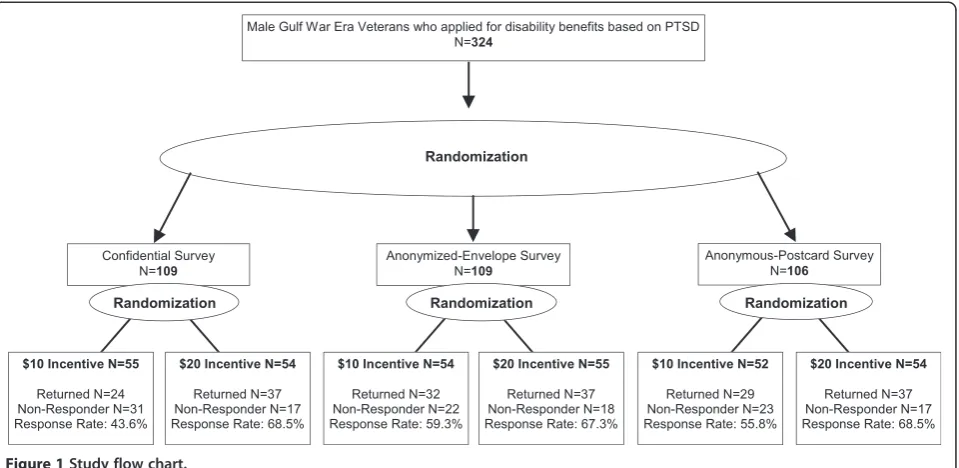
The study was a 3X2 factorial, randomized controlled trial (Figure 1). Using simple randomization, Veterans
were assigned to one of 3 tracking/privacy condi-tions:
1) “Confidential”: Under the least private condition, veterans received a survey with a highly visible, coded, unique identifier affixed to the front page of the survey. This was used for tracking, and individual respondents were potentially identifiable from their surveys.
2) “Anonymized-Envelope”: Intermediate in privacy, veterans were asked to return their surveys in a study envelope, which had a pre-printed, unique identification number (ID) on it. When the completed questionnaire was returned, study personnel immediately separated it from the envelope. The questionnaire was intermixed with other arriving surveys and set aside. The envelope ID was used to indicate who had returned surveys. Technically, as long as the survey resided within the envelope, respondents could be identified. Thus,
this method was not fully anonymous. Once the questionnaire was removed from the envelope, however, there was no longer any way to identify the respondent (hence the term“anonymized”).
3) “Anonymous-Postcard”: The most private condition, veterans returned their surveys in unmarked envelopes. Besides the survey, veterans were also asked to return an enclosed, brightly colored postcard, which had a unique ID to allow tracking. Respondents could not be identified from their surveys or envelopes at any time.
Once Veterans were assigned to their tracking/privacy condition, we then used simple randomization within each condition to assign them to receive $10 or $20.
Protocol Data collection
from you even if you were not deployed to the Persian Gulf.” Cover letters were the same across groups, except that they described the incentive, tracking method, and privacy protections that were specific to each group. Copies of cover letters are available upon request.
Pre-merged questionnaires
To our knowledge, we are the first to develop pre-merged questionnaires for use in anonymous surveys. However, pre-merged questionnaires are simply an extension of the common strategy of using different colored paper, say, to collect data from different groups (e.g., green paper for men, yellow for women). Instead of different colored pa-pers, however, we created a sticker that was applied to each subject’s questionnaire just before mailing. The sticker was designed to be as unobtrusive as possible and was thus camouflaged as a return address on the survey’s back page (Figure 2). Just below the address, we embedded an alpha-numeric code into the mailcode, which corresponded to key administrative data associated with each potential
subject. When the survey was returned, so was the admin-istrative data—already merged. The sticker code was delib-erately intended to be non-exclusive to the subject. For example, a code such as“504ADBY”, indicating a veteran was aged 50 years or older, served 4 years in the Army and received disability benefits from the VA, could apply to hundreds of thousands of veterans.
We maintained two separate, but interrelated computer-ized files: an administrative file containing subjects’ name and administrative codes, which were used to generate the stickers, and a tracking file containing their names and tracking ID. As envelopes, postcards, or confidential sur-veys were returned, the tracking ID was entered into the tracking file. This action deleted respondents’name and ID from the tracking file and triggered a simultaneous deletion of their name and administrative code from the adminis-trative file. Thus, by study’s end, only non-respondents’ administrative codes remained in the computerized rec-ord. These were then used to compare non-respondents to respondents. Respondents’ administrative codes were
Figure 1Study flow chart.
recaptured from the sticker on their returned question-naires and hand-entered back into the analytical frame.
Measures Primary outcomes
The primary outcome was response rate, calculated as the number of returned surveys divided by the number of veterans assigned to each arm.
Secondary outcomes
Secondary outcomes included the representativeness of respondents, percentage of Veterans fully completing all sensitive survey items, and the percentage disclosing sen-sitive information. Information collected by the survey that we thought might be sensitive included veterans’ ex-periences of sexual abuse, including sexual assault during the time of Gulf War I; other traumatic experiences, in-cluding combat and childhood physical abuse; mental health problems, including depression, PTSD, and prob-lem drinking; and veterans’sexual orientation.
Representativeness of respondents We used data from the pre-merged sticker to compare respondents to non-respondents. Available data included age greater than or equal to 50 years versus younger, service in the Army versus other branch, VA disability benefit status (receiv-ing versus not), and any VA health care utilization versus none. Specifically, we assessed whether the participant had made a visit to any VA medical facility in the prior year for any reason or had made visits to a VA facility for primary or mental health care. The term, original sample, refers to all veterans selected for the survey, re-gardless of their response status.Respondersand respon-dents refer to the subset of veterans from the original sample who returned surveys, and non-responders/non-respondents refer to the subset of veterans who did not return surveys.
Sensitive information Sensitive information was col-lected by the survey and included the following:
Sexual abuse
We used 3 items from Sexual Harassment Inventory’s criminal sexual misconduct scale [21] plus one additional item [22] to assess sexual assault during the time of Gulf War I, 4 items from the Sexual Abuse subscale of the Childhood Trauma Questionnaire [23] to assess childhood sexual abuse, and one item from the Life Stressor Checklist [24] to assess any sexual assault in the past year. A positive response to any one of these questions indicated a history of sexual abuse. Other traumatic experiences
Other traumatic experiences included combat
exposure, assessed using an adapted Combat Exposure
Inventory [25] version; childhood physical abuse, assessed using items from the Childhood Trauma Questionnaire’s relevant subscale [23]; and past-year traumas, assessed using an adaptation of the Life Stressor Checklist [24]. Veterans who reported any childhood physical abuse item more than“rarely”were considered physically abused.
Mental health problems
We used the 5-item RAND Mental Health Battery [26] to assess depression, the Penn Inventory for PTSD [27] to assess PTSD symptoms, and the TWEAK [28] to assess alcohol misuse.
Sexual orientation
Sexual orientation was assessed using a single survey item that read,“People are different in their sexual attraction to other people. Which best describes your feelings?”Responses ranged from1=“Completely heterosexual or‘straight’”to5=“Completely
homosexual or‘gay’”. Responses were dichotomized as “Completely heterosexual”versus“Not completely heterosexual”for analysis.
Power
The study was funded to examine different incentives’ im-pact on response rate and had 80% power to detect a 10% difference in response rates across incentives, assuming a 60% response rate in the $10 group and two-tailed alpha of 0.05.
Analysis
The study was intended to examine main effects, but in-teractions were assessed in an exploratory fashion. Results are reported for tracking/privacy condition first; incentive condition second; and, when tested, interactions third. We usedχ2tests to compare outcomes across privacy condi-tions and incentives and to compare respondents and non-respondents. We used logistic regression to test for interactions between tracking/privacy condition and incentive on outcomes. We used IBM SPSS Statistics (version 19) and SAS (version 9.2) statistical packages for analyses.
Masking, disclosure, and ethical approval
Data collectors and analysts were aware of study group assignment. The Minneapolis VA Medical Center’s Subcommittee for Human Studies approved the protocol.
Results Response rate
Response rate overall was 60.5% and did not differ signifi-cantly across tracking/privacy assignments (Confidential response rate = 56.0%, Anonymized-envelope response rate = 63.3%, Anonymous postcard response rate = 62.3%,
percentage points higher among veterans randomized to receive the $20 incentive (response rate = 68.1%) com-pared to the $10 incentive (response rate = 52.8%, p= 0.007). While the lowest response rate was obtained from men randomized to the Confidential/$10 incentive group (response rate = 43.6%; see Figure 1), tests for interactions between tracking/privacy and incentives on response rate were not statistically significant (p= 0.46).
Respondent representativeness
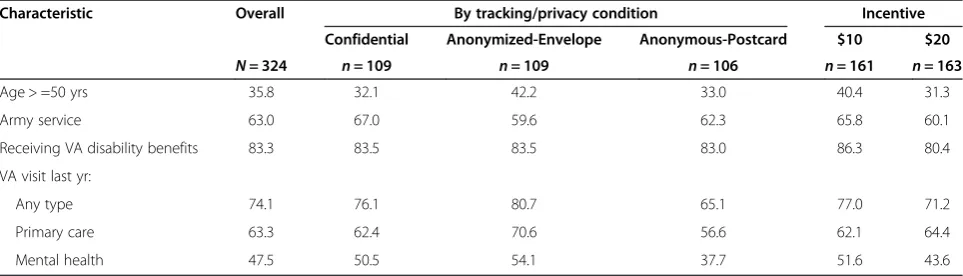
As Table 1 shows, randomization failed to evenly distribute the 324 veterans according to their past-year VA health care utilization. Specifically, veterans randomized to the Anonymous-Postcard were less likely to have made a VA health care visit of any kind in the past year than were veterans randomized to the Anonymized-Envelope and Confidential groups (67.6% versus 75.4% in the other two conditions). Otherwise, randomization successfully distrib-uted all the remaining administrative characteristics evenly across all the tracking/privacy and incentive conditions.
The characteristics of survey responders are shown in Table 2. Responders in the Anonymized-Envelope group had a higher proportion of individuals aged 50 years or older, a lower proportion of white persons, and a lower proportion of persons working for pay compared to the other two groups, but none of these differences were sta-tistically significant (all p’s > 0.18). Consistent with the original sample’s maldistribution, Anonymous-Postcard re-spondents were less likely than other rere-spondents to have made a visit of any kind to a VA medical facility in the prior year. Compared to the other tracking/privacy condi-tions, Anonymous-Postcard respondents were also sub-stantially less likely to have made a mental health care visit to a VA medical facility, but this could not be attributed to a maldistribution of the original sample. Compared to the administrative record, all respondents substantially under-reported receiving VA disability benefits.
Respondents in the $10 incentive arm were signifi-cantly older, less likely to be working for pay, and more
likely to say they received VA disability benefits than re-spondents in the $20 incentive arm. Both groups substan-tially underreported their receipt of VA disability benefits compared to the administrative record. There were no sta-tistically significant tracking/privacy-by-incentive interac-tions (allp’s > 0.20).
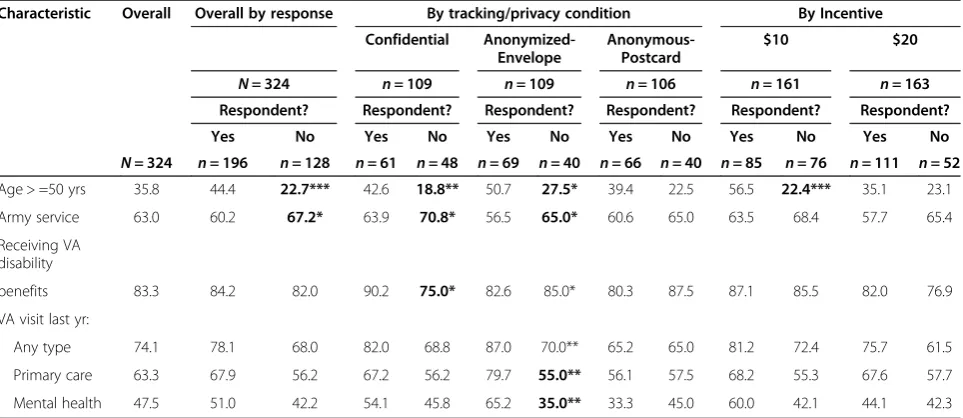
Table 3 presents information for the original sample, stratified by response status and by study assignment. Find-ings show that Confidential and Anonymized-Envelope re-spondents differed significantly from their non-respondent counterparts in terms of age and service branch. Compared to their non-respondent counterparts, Confidential re-spondents were also more likely to be receiving VA disability benefits, and Anonymized-Envelope respon-dents were more likely to have made VA primary care and mental health visits. There were significant age differ-ences among respondents and non-respondents random-ized to receive $10, but respondents and non-respondents did not differ significantly on any available characteristic among those assigned to the Anonymous-Postcard or $20 incentive. There were no significant tracking/privacy-by-incentive interactions.
Percentage fully completing sensitive items and percentage disclosing sensitive information
As Table 4 shows, with the exception of combat items, re-spondents answered every item on each of the potentially sensitive scales more than 90% of the time, regardless of tracking/privacy condition or incentive. Twenty-six ques-tions were used to assess combat exposure, which may explain why it had the most skipped items (10.7% over-all), though respondents were twice as likely to skip a combat item as they were to skip a PTSD item (3.1% over-all), which also contained 26 questions. The sexual abuse questions were second most likely to be skipped (7.1% overall). There were no statistically significant associations between tracking/privacy assignment and completion of sensitive survey items. Likewise, higher incentive was not associated with greater completion of sensitive survey
Table 1 Population characteristics by tracking/privacy condition and incentive; results reported as a percentage (%)
Characteristic Overall By tracking/privacy condition Incentive
Confidential Anonymized-Envelope Anonymous-Postcard $10 $20
N= 324 n= 109 n= 109 n= 106 n= 161 n= 163
Age > =50 yrs 35.8 32.1 42.2 33.0 40.4 31.3
Army service 63.0 67.0 59.6 62.3 65.8 60.1
Receiving VA disability benefits 83.3 83.5 83.5 83.0 86.3 80.4
VA visit last yr:
Any type 74.1 76.1 80.7 65.1 77.0 71.2
Primary care 63.3 62.4 70.6 56.6 62.1 64.4
items, and there were no interactions between tracking/ privacy assignment and incentive.
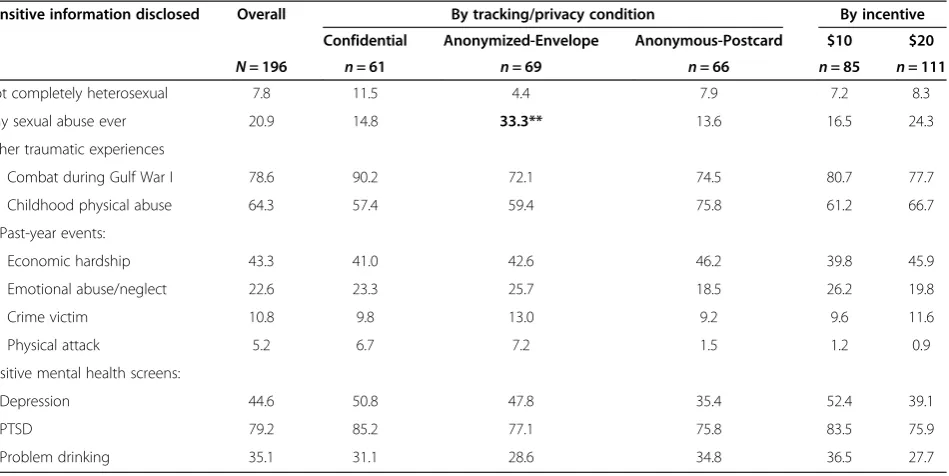
As Table 5 shows, Anonymized-Envelope respondents were substantially more likely than other respondents to disclose a history of sexual abuse. Several other contrasts appeared numerically large, even though they did not
reach statistical significance: Anonymous-Postcard respon-dents reported more childhood physical abuse (p= 0.06) and had fewer positive depression screens compared to the other tracking/privacy groups (p= 0.09), and Confidential respondents reported more combat (p= 0.09) and had more positive PTSD screens (p= 0.08).
Table 2 Respondent characteristics by tracking/privacy condition and incentive, results reported as a percentage (%)
Characteristic Overall By tracking/privacy condition By incentive
Confidential Anonymized-Envelope Anonymous-Postcard $10 $20
N= 196 n= 61 n= 69 n= 66 n= 85 n= 111
Age > =50 years 44.4 42.6 50.7 39.4 56.5 35.1***
Race
White 52.6 55.7 47.8 54.5 54.1 51.4
Black 27.0 21.3 34.8 24.2 22.4 30.6
Hispanic 6.1 8.2 5.8 4.5 8.2 4.5
Some college experience 74.5 75.4 73.9 74.2 76.5 73.0
Married 67.4 67.8 65.2 69.2 66.3 68.2
Working for pay 61.0 61.0 55.2 67.2 51.9 67.3*
Served in Army 60.2 63.9 56.5 60.6 63.5 57.7
Receiving VA disability benefits:
Per the administrative record 84.2 90.2 82.6 80.3 87.1 82.0
Per self-report 68.4 75.4 71.0 59.1 76.5 62.2*
VA visit in past year:
Any type 78.1 82.0 87.0 65.2* 81.2 75.7
Primary care 67.9 67.2 79.7 56.1 68.2 67.6
Mental health 51.0 54.1 65.2 33.3*** 60.0 44.1
Bold face font signifies a statistically significant difference across group. *p≤0.05, ***p≤0.001.
Table 3 Characteristics of original sample, stratified by response status and by tracking/privacy condition and incentive; results reported as a percentage (%)
Characteristic Overall Overall by response By tracking/privacy condition By Incentive
Confidential Anonymized-Envelope
Anonymous-Postcard
$10 $20
N= 324 n= 109 n= 109 n= 106 n= 161 n= 163
Respondent? Respondent? Respondent? Respondent? Respondent? Respondent?
Yes No Yes No Yes No Yes No Yes No Yes No
N= 324 n= 196 n= 128 n= 61 n= 48 n= 69 n= 40 n= 66 n= 40 n= 85 n= 76 n= 111 n= 52
Age > =50 yrs 35.8 44.4 22.7*** 42.6 18.8** 50.7 27.5* 39.4 22.5 56.5 22.4*** 35.1 23.1
Army service 63.0 60.2 67.2* 63.9 70.8* 56.5 65.0* 60.6 65.0 63.5 68.4 57.7 65.4
Receiving VA disability
benefits 83.3 84.2 82.0 90.2 75.0* 82.6 85.0* 80.3 87.5 87.1 85.5 82.0 76.9
VA visit last yr:
Any type 74.1 78.1 68.0 82.0 68.8 87.0 70.0** 65.2 65.0 81.2 72.4 75.7 61.5
Primary care 63.3 67.9 56.2 67.2 56.2 79.7 55.0** 56.1 57.5 68.2 55.3 67.6 57.7
Mental health 47.5 51.0 42.2 54.1 45.8 65.2 35.0** 33.3 45.0 60.0 42.1 44.1 42.3
Main effects in disclosing sensitive information by in-centive did not reach statistical significance. However, there was a trend toward statistical significance in the pro-portion of respondents randomized to the $10 incentive with a positive depression screen compared to the $20
respondents (p= 0.08). Among Anonymized-Envelope re-spondents, those randomized to the $10 incentive were substantially more likely to screen positive for PTSD than those in the $20 arm (90.6%v. 65.8%;p= 0.05). Otherwise, there were no tracking/privacy-by-incentive interactions.
Table 4 Percentage (%) of respondents fully completing all items in a potentially sensitive scale by tracking/privacy condition and incentive
Scale/Item Number of
items in scale
Percentage (%) completing all items in the scale
Overall By tracking/privacy condition By incentive
Confidential Anonymized-Envelope Anonymous-Postcard $10 $20
N= 196 n= 61 n= 69 n= 66 n= 85 n= 111
Sexual Orientation 1 98.5 100 98.6 95.5 97.6 98.2
Sexual Abuse 8 92.9 93.4 94.2 90.9 91.8 93.7
Other Traumatic events:
Combata 26 89.3 86.5 96.8 85.7 89.1 89.5
Childhood physical abuse 5 96.4 96.7 97.1 95.5 95.3 97.3
Past-year events:
Economic hardship 1 98.5 100 97.1 98.5 97.6 99.1
Emotional abuse/neglect 1 99.0 98.4 100 98.5 98.8 99.1
Crime victim 1 99.0 100 98.6 98.5 97.6 100
Physical attack 1 98.5 98.4 98.6 98.5 97.6 99.1
Mental health screens
Depression 5 99.0 100 98.6 98.5 98.8 99.1
PTSD 26 96.9 100 97.1 93.9 94.1 99.1
Problem drinking 5 100 100 100 100 100 100
a
Among those who said they experienced any combat in the Gulf.
Table 5 Percentage (%) of respondents disclosing potentially sensitive information by tracking/privacy condition and incentive
Sensitive information disclosed Overall By tracking/privacy condition By incentive
Confidential Anonymized-Envelope Anonymous-Postcard $10 $20
N= 196 n= 61 n= 69 n= 66 n= 85 n= 111
Not completely heterosexual 7.8 11.5 4.4 7.9 7.2 8.3
Any sexual abuse ever 20.9 14.8 33.3** 13.6 16.5 24.3
Other traumatic experiences
Combat during Gulf War I 78.6 90.2 72.1 74.5 80.7 77.7
Childhood physical abuse 64.3 57.4 59.4 75.8 61.2 66.7
Past-year events:
Economic hardship 43.3 41.0 42.6 46.2 39.8 45.9
Emotional abuse/neglect 22.6 23.3 25.7 18.5 26.2 19.8
Crime victim 10.8 9.8 13.0 9.2 9.6 11.6
Physical attack 5.2 6.7 7.2 1.5 1.2 0.9
Positive mental health screens:
Depression 44.6 50.8 47.8 35.4 52.4 39.1
PTSD 79.2 85.2 77.1 75.8 83.5 75.9
Problem drinking 35.1 31.1 28.6 34.8 36.5 27.7
Discussion
In this randomized controlled trial, more survey privacy was not associated with statistically significantly higher re-sponse rates compared to less privacy, nor did tracking/ privacy condition affect the proportion of respondents who actually answered our sensitive questions. Instead, each tracking/privacy condition attracted its own unique pool of respondents, which in turn may have influenced our group-specific estimates of sexual abuse, childhood physical abuse, combat, and mental health problems— despite the fact that all participants originated from the same sampling frame. Estimates of sexual abuse, for ex-ample, were more than 2 times higher in the Anonymized-Envelope condition than in the other two conditions.
As expected, the higher incentive resulted in a sub-stantially higher response rate than the lower incentive, but there was no association between incentive and the proportion answering our sensitive questions. As with the tracking/privacy manipulation, each incentive ap-peared to attract its own unique pool of respondents, with the larger incentive attracting younger workers for pay who were less likely to say they were receiving disability benefits compared to the smaller incentive. Statistically, prevalence estimates for potentially sensitive or stigmatiz-ing material did not differ significantly by incentive, des-pite some numerically large differences. For example, more than half of respondents randomized to the $10 in-centive screened positive for depression, compared to about a third of respondents in the $20 arm.
According to leverage-salience theory [29], individuals attend to different criteria when deciding to return a sur-vey and, further, assign to each criterion different weights and importance. These are known as “leverages”. In the present study, each tracking/privacy and incentive condi-tion appeared to trigger a different set of leverages, so that unique subpopulations selectively participated in each of the study’s arms. When considering sensitive material, therefore, one cannot assume that the survey method gen-erating the highest estimate is most accurate.
Since Anonymous-Postcard respondents did not differ significantly from non-respondents on available measures, one might be tempted to conclude that this tracking/ privacy method generated the most representative sample of respondents and hence most accurate prevalence estimates. If so, one would also have to conclude that the Anonymized-Envelope approach over recruited sexual abuse survivors. His-tory of sexual abuse was 13.6% among Anonymous-Postcard respondents and 33.3% among Anonymized-Envelope re-spondents. However, we have shown elsewhere that, even when using Anonymized-Envelopes, survey respondents underreport their military sexual assault experiences by a factor of three [30]. This suggests that the Anonymized-Envelope method either reduces under selection of veterans with sexual abuse histories or optimizes more “honest”
reporting among those who have such histories—or both— compared to the Anonymous-Postcard method. It may do so, however, at the expense of either over excluding vet-erans with a history of childhood physical abuse or discour-aging“honest”reporting of childhood abuse. In the present study the Anonymized-Envelope method generated a sub-stantially lower, albeit not statistically significant, estimate of childhood physical abuse of 59.4% compared to the Anonymous-Postcard’s estimate of 75.8%.
In general, tracking/privacy condition and incentive level appeared to affect respondent representativeness in-dependently, with incentives’ principal impact being the recruitment of younger and healthier participants. These findings may be reassuring to Human Studies oversight boards, who might otherwise worry that large incentives coerce the sickest and most vulnerable into survey re-search participation. Halpern et al. [31] has shown that higher payment levels do not override research partici-pants’risk perceptions when considering whether to en-roll in clinical trials, and, furthermore, poorer, presumably more vulnerable participants are actually less sensitive to higher incentive levels than are wealthier participants. Similar findings have been reported for those deciding whether to respond to a survey [32].
The present study offers proof-of-concept for pre-merged questionnaires’ utility. However, pre-merged question-naires will prove most powerful when they incorporate ad-ministrative information that is highly related to the survey’s topic (e.g., sexual abuse, childhood abuse) instead of basic demographic information. Because we did not have such information for the present study, we cannot say whether our differing estimates for these sensitive data across the three tracking/privacy conditions were a func-tion of reducing or inflating selecfunc-tion biases, a funcfunc-tion of enhancing or impeding“honest”reporting, or both. Future research will be needed to explore these issues further. It may well be that different tracking/privacy methods will prove best for different sensitive topics.
We used a computerized system to manage the track-ing and administrative data interface in the present study, but the pre-merged questionnaire concept could easily be applied to manual methods. For example in a study using up to three survey mailings per subject, one could pre-print 3 stickers per subject, file them under each subject’s name, and then throw away any remaining stickers once the subject’s postcard or envelope ID was returned. By study’s end, only non-respondents’stickers would remain.
branch in the present study for this reason. Pre-merged questionnaires also cannot capitalize on new information. Health care visits occurring after a survey is mailed cannot be linked into a dataset, for example. Nonetheless, the tech-nique offers an advance over usual anonymous methods, particularly in its ability to assess for non-response bias, and it could easily be applied to other sensitive topics.
This study’s strengths include its randomized, controlled design and demonstration of a unique technique to over-come what has historically been an important limitation of anonymous methods–namely, an inability to evaluate non-response bias. We also compared two tracking methods that can be used in anonymous surveys. Limitations include its relatively small and unique sample. Since we did not have access to verifying information, we cannot say how honestly participants reported their experiences. Findings’ generalizability to other sensitive topics, to non-veterans, or to women is also uncertain. The study was powered to examine main effects of incentives on response rates, and we may have made Type II errors when examining second-ary outcomes, effects of the different tracking/privacy con-ditions, and potential interactions. When findings appeared suggestive, however, we described them in the text. We also made multiple comparisons, which may have inflated our Type I error.
Conclusion
We anticipated that greater privacy and larger incentives would be associated with higher response rate, better par-ticipant representativeness, more survey completeness, and greater disclosure of potentially sensitive information. Re-sults showed no association between privacy and response rate or survey completeness, supported the association be-tween greater privacy and participant representativeness, and yielded mixed effects for the disclosure of sensitive in-formation. A larger incentive was associated with higher response rate and better participant representativeness but no association with survey completeness. In the intermedi-ate privacy arm, lower incentive—not higher—was associ-ated with reporting more PTSD symptoms. Otherwise, we found no statistically significant associations between in-centive and disclosing potentially sensitive information.
Having shown that different tracking/privacy conditions yielded different estimates of sensitive information, we can-not, unfortunately, tell which estimate was most accurate. Traditionally, higher disclosure rates of sensitive or stigma-tizing information have been interpreted as being more accurate than lower rates, but our data suggest that appar-ently different disclosure rates may simply be a function of the subpopulations successfully recruited into a survey. This possibility needs greater investigation. Pre-merged questionnaires bypassed many of the limitations historic-ally associated with anonymous survey methods and could be used to explore non-response issues in future research.
Abbreviations
ID:Identification number; PTSD: Posttraumatic stress disorder; TWEAK: An acronym of 5 items used to assess problem drinking: T = tolerance, W = Worried, E = Eye-opener, A = Amnesia, K = Cut down; VA: Department of Veterans Affairs.
Competing interests
The authors declare they have no competing interests.
Authors’contributions
MM obtained funding; designed the study; oversaw data collection, analysis, interpretation; and drafted the manuscript. MAP also assisted in obtaining funding. MAP, AKB, ABS, SN, and JPG contributed to data collection, analysis, and interpretation of data. MRP contributed to analysis and interpretation of data. MAP, AKB, ABS, SN, JPG, MRP read and approved the final manuscript.
Authors’information
MM, MAP, and MRP are core-investigators; AKB is data manager; and SN is core statistician for the Center for Chronic Disease Outcomes Research at the Minneapolis VA Medical Center. ABS is a former Center for Chronic Disease Outcomes Research data manager and currently works in the Health Economics Program, Minnesota Department of Health, St. Paul, MN. JPG is a former Center for Chronic Disease Outcomes Research statistician.
Acknowledgements
The Center for Chronic Disease Outcomes Research is a VA Health Services Research and Development (HSR&D) Service Center of Excellence (Center grant #HFP 98-001). This study was supported by grant #GWI 04-352 from VA HSR&D service. The funding agency had no role in the design, data collection, analysis, data interpretation, manuscript writing, or decision to submit the manuscript.
Disclaimer
The views presented in this paper are those of the authors and do not necessarily represent the views of the Department of Veterans Affairs.
Author details
1Section of General Internal Medicine, Minneapolis VA Medical Center,
Minneapolis, MN, USA.2Center for Chronic Disease Outcomes Research, Minneapolis VA Medical, One Veterans Drive, Minneapolis, MN 55417, USA. 3
Department of Internal Medicine, University of Minnesota School of Medicine, Minneapolis, MN, USA.4Departments of Psychiatry and Psychology, Minneapolis VA Medical Center, Minneapolis, MN, USA.5Department of Psychiatry, University of Minnesota School of Medicine, Minneapolis, MN, USA.
Received: 3 March 2014 Accepted: 7 July 2014 Published: 16 July 2014
References
1. Kessler R, McGonagle K, Zhao S, Nelson C, Hughes M, Eshleman S, Wittchen H, Kendler K:Lifetime and 12-month prevalence of DSM-III-R psychiatric disorders in the United States: results from the national comorbidity study.Arch Gen Psychiatry1994,51:8–19.
2. Straus M, Gelles R:How violent are American families? Estimates from the National Family Violence Resurvey and other studies.InPhysical violence in American families Risk factors and adaptations to violence in 8,145 families. Edited by Strauss M, Gelles R. New Brunswick: Transaction Publishers; 1992:95–112.
3. Resnick H, Kilpatrick D, Dansky B, Saunders B, Best C:Prevalence of civilian trauma and posttraumatic stress disorder in a representative national sample of women.J Consult Clin Psychol1993,61:984–991.
4. Moum T:Mode of administration and interviewer effects in self-reported symptoms of anxiety and depression.Soc Indic Res1998,45(1–3):279–318. 5. Richman WL, Kiesler S, Weisband S, Drasgow F:A meta-analytic study of
social desirability distortion in computer-administered questionnaires, traditional questionnaires, and interviews.J Appl Psychol1999, 84(5):754–775.
7. Testa M, Livingston J, VanZile-Tamsen C:The impact of questionnaire administration mode on response rate and reporting of consensual and nonconsensual sexual behavior.Psychol Women Q2005, 29:345–352.
8. Beebe T, Harrison P, Park E, McRae JJ, Evans J:The effects of data collection mode and disclosure on adolescent reporting of health behavior.Soc Sci Computer Rev2006,24(4):476–488.
9. Stander V, Olson C, Merrill L:Self-definition as a survivor of childhood sexual abuse among Navy recruits.J Consult Clin Psychol2002,70(2):369–377. 10. Ong A, Weiss D:The impact of anonymity of responses to sensitive
questions.J Appl Soc Psychol2000,30(8):1691–1708.
11. Durant L, Carey M, Schroder K:Effects of anonymity, gender, and erotophilia on the quality of data obtained from self-reports of socially sensitive behaviors.J Behav Med2002,25(5):438–467.
12. Rolnick S, Gross C, Garrard J, Gibson R:A comparison of response rate, data quality, and cost in the collection of data on sexual history and personal behaviors. Mail survey approaches and in-person interview. Am J Epidemiol1989,129(5):1052–1061.
13. Campbell M, Waters W:Does anonymity increase response rate in postal questionnaire surveys about sensitive subjects? A randomised trial. J Epidemiol Community Health1990,44:75–76.
14. Biggar R, Melbye M:Responses to anonymous questionnaires concerning sexual behavior: a method to examine potential biases.Am J Public Health1992,82(11):1506–1512.
15. Asch D:Use of a coded postcard to maintain anonymity in a highly sensitive mail survey: cost, response rates, and bias.Epidemiol1996, 7:550–551.
16. Dunne M, Martin N, Bailey J, Heath A, Bucholz K, Madden P, Statham D: Participation bias in a sexuality survey: psychological and behavioural characteristics of responders and non-responders.Int J Epidemiol1997, 26(4):844–854.
17. Murdoch M, Kressin N, Fortier L, Giuffre P:Evaluating the psychometric properties of a scale to measure medical students’career-related values. Acad Med2001,76(2):157–165.
18. Murdoch M, Polusny M, Hodges J, O’Brien N:Prevalence of in-service and post-service sexual assault among combat and noncombat veterans applying for Department of Veterans Affairs posttraumatic stress disorder disability benefits.Milit Med2004,169(May):392–395.
19. Coxell A, King MB:Male victims of rape and sexual abuse.Sex Marital Ther 1996,11:297–308.
20. Edwards P, Roberts I, Clarke M, DiGuiseppi C, Pratap S, Wentz R, Kwan I, Cooper R:Methods to increase response rates to postal questionnaires. Cochrane Database Methodol Rev2003, (4). Art. No.: MR000008. doi:000010.001002/14651858.MR14000008.pub14651852.
21. Murdoch M, McGovern P:Development and validation of the Sexual Harassment Inventory.Violence Vict1998,13(3):203–216.
22. Murdoch M, Pryor J, Polusny M, Gackstetter GD, Cowper-Ripley D:Local social norms and military sexual stressors: Do senior officers’norms matter?Milit Med2009,174(10):1100–1104.
23. Bernstein D, Fink L:Childhood Trauma Questionnaire: A Retrospective Self-Report. Manual.San Antonio: The Psychological Corp.; Harcourt Brace & Co; 1998.
24. Wolfe J, Kimerling R, Brown P, Chrestman K, Levin K:Psychometric review of the Life Stressor Checklist-Revised.InMeasurement of Stress, Trauma, and Adaptation.Edited by Stamm B. Lutherville, MD: Sidran Press; 1996:198–201. 25. Janes G, Goldberg J, Eisen S, True W:Reliability and validity of a combat
exposure index for Vietnam veterans.J Clin Psychol1991,47:80–86. 26. Berwick D, Murphy J, Goldman P, Ware JJ, Barsky A, Weinstein M:
Performance of a five-item mental health screening test.Med Care1991, 29(2):169–176.
27. Hammarberg M:Penn Inventory for posttraumatic stress disorder: psychometric properties.Psychol Assess1992,4(1):67–76.
28. Russell M, Martier S, Sokol R, Mudar P, Bottoms S, Jacobson S, Jacobson J: Screening for pregnancy risk-drinking.Alcohol Clin Exp Res1994, 18(5):1156–1161.
29. Groves R, Singer E, Corning A:Leverage-Saliency Theory of survey participation: description and an illustration.Public Opin Q2000, 64(3):299–308.
30. Murdoch M, Polusny M, Street A, Grill J, Baines Simon A, Bangerter A, Noorbaloochi S, Voller E:Sexual assault of male US Troops during the Gulf War I Era: prevalence and correlates among applicants for
Department of Veterans Affairs PTSD disability benefits.Milit Med2014, 179(3):285–293.
31. Halpern S, Karlawish J, Casarett D, Berlin J, Asch D:Empirical assessment of whether moderate payments are undue or unjust inducements for participation in clinical trials.Arch Intern Med2004,164(7):801–803. 32. Couper M, Singer E:The role of numeracy in informed consent for
surveys.J Empir Res Hum Res Ethics2009,4:17–26.
doi:10.1186/1471-2288-14-90
Cite this article as:Murdochet al.:Impact of different privacy conditions and incentives on survey response rate, participant representativeness, and disclosure of sensitive information: a randomized controlled trial.
BMC Medical Research Methodology201414:90.
Submit your next manuscript to BioMed Central and take full advantage of:
• Convenient online submission
• Thorough peer review
• No space constraints or color figure charges
• Immediate publication on acceptance
• Inclusion in PubMed, CAS, Scopus and Google Scholar
• Research which is freely available for redistribution