B R I E F C O M M U N I C A T I O N
Open Access
Low dose of rFSH [100 IU] in controlled ovarian
hyperstimulation response: a pilot study
Caio Parente Barbosa, Emerson Barchi Cordts, Andrea Couto Costa, Renato de Oliveira,
Marina Acosta de Mendonça, Denise Maria Christofolini and Bianca Bianco
*Abstract
Background:The initial dose of recombinant Follicle Stimulating Hormone [rFSH] to be used in assisted reproduction treatment depends on several factors, mainly the cause of the infertility and the patient’s age. For young patients [≤35 years] usually an initial dose of around 150 IU of rFSH is recommended, but there are no studies proving that this should actually be the standard initial dose. We aimed to report the experience of a low-cost Human Reproduction Center where a dose of 100 IU of rFSH was used for controlled ovarian hyperstimulation [COH].
Findings:An observational prospective study was performed on 212 women aged≤38 years old that underwent
high-complexity assisted reproduction treatments. The patients’infertility was mainly caused by tuboperitoneal, idiopathic or male factors. Controlled ovarian stimulation was performed using 100 IU of rFSH. Regarding the COH, 53.8% of the patients presented a satisfactory response, 25.9% low response, 14.2% hyper-response, and 6.1% developed ovarian hyperstimulation syndrome. Of the 55 patients with poor response, 20 started a new cycle with an initial dose of 200 IU of rFSH; 65% showed a satisfactory response, 10% a poor response, 20% a hyper-response, and 5% developed OHSS.
Conclusion:The initial dose of 100 IU of rFSH was considered adequate for controlled ovarian hyperstimulation, meeting the aim to reduce the costs of the assisted reproduction treatment.
Keywords:Assisted reproduction treatment, Controlled ovarian hyperstimulation, Recombinant FSH,
Infertility, Oocyte
Background
Conjugal infertility is characterized by the absence of spontaneous pregnancy after the minimum period of twelve months, with the practice of regular and unpro-tected intercourse [1]. Although infertility is not a phys-ical problem and does not threaten the life of the individual, marital infertility is related to emotional, mental and social problems, as the act of procreation is one of the goals and desires of the human [2]. Studies conducted by the British Association of Counselling in Infertility and the Royal College of Obstetricians and Gynecologists demonstrated that infertility is related to low productivity and the loss of financial reserves for that country [3]. Approximately 20% of adults of
reproductive age face difficulties to conceive. In Brazil, data of the Ministry of Health considered to be under-estimated reported the existence of at least 278,000 in-dividuals affected by infertility [4], however it is believed that approximately 30,000,000 people in Brazil are infertile.
Since the birth of the first in vitro fertilization [IVF] baby almost 30 years ago, dramatic developments have occurred in assisted reproductive technology. The ap-proach of maximizing pregnancy rates per cycle has led to very complex and costly ovarian hyperstimulation protocols. Ovarian stimulation has been applied with the aim of increasing the number of oocytes in order to compensate for inefficiencies of the IVF procedure, en-abling the selection of one or more embryos for transfer [5]. In the context of improved laboratory performance, the need for a large number of oocytes as an integral part of a successful IVF program may be questioned [6]. * Correspondence:[email protected]
Human Reproduction and Genetics Center, Faculdade de Medicina do ABC, Santo André, SP, Brazil
Currently used medication protocols for ovarian stimu-lation are complex and expensive, and can be associated with negative effects such as ovarian hyperstimulation syndrome [7] and impaired luteal phase [6]. Thus, there has been increasing interest in identification and the rela-tive performance of tests of ovarian reserve prior to embarking on controlled ovarian stimulation [8].
Several parameters have been postulated as predictors of ovarian response. Because ovarian function cannot be measured directly, the use of serum markers [FSH (Fol-licle Stimulation Hormone), inhibin B, 17-β-estradiol and anti-Müllerian hormone (AMH)] and/or ultrasound variables [ovarian volume, measurement of antral folli-cles, ovarian stromal blood flow] have been proven useful although limited [8]. These markers do not reflect the complex follicular dynamics and none of them shows strong correlation with the population of primordial follicles that remain in the gonad. In other words, these tests do not reveal the cohort of inactive follicles responsible for the continuation of ovulatory cycles or reproductive potential [9].
In the same context, the initial dose of rFSH that should be used depends on several factors, mainly the cause of the infertility and the patient’s age. According to Devroey et al. (1998) [10], the initial dose of FSH should be around 150 IU or 225UI for young patients [<35 years] undergoing assisted reproduction treatment of high complexity, to be adjusted according to the ultrasound control [antral follicle counting] and/or dos-age of plasma estradiol, but so far there are no studies proving that this should actually be the standard initial dose.
Considering the lack of data concerning the recom-mended initial dose of rFSH for patients undergoing assisted reproduction treatment, we report here the ex-perience of a low-cost Human Reproduction Center where the dose of 100 IU of rFSH has been used for controlled ovarian hyperstimulation.
Material and methods Patients
An observational prospective study was performed on 212 women [mean age 31.6 ± 3.4 years old] who under-went high-complexity assisted reproduction treatments at Instituto Ideia Fértil - Centro de Reprodução Humana e Genética da Faculdade de Medicina do ABC, Santo André/SP, Brazil. The inclusion criteria were: tube peri-toneal, unexplained or male factor infertility, age≤38 years old, serum FSH [≤10.0 mIU/ml], TSH [<4mIU/L] and prolactin [<25 ng/ml] within normal limits, both ovar-ies present and without any morphological abnormalitovar-ies, normal ovulatory cycles [25 to 35 days], body mass index [BMI] ≤30, no history of inadequate ovulatory response [poor responder] and no evidence of endocrine diseases
such as hyperprolactinemia, thyroid dysfunction or polycys-tic ovary syndrome. Exclusion criteria were: age >38 years old, high-complexity ovulation induction protocols with rFSH starting dose >100 IU, low-complexity protocols, patients with polycystic ovary syndrome, moderate/severe endometriosis [grades III and IV], previous history of ovarian surgery and/or radiation/ chemotherapy.
The investigation into the cause of infertility included a hormonal and biochemical profile, testing for sexually transmitted diseases, imaging examinations, investiga-tion of genetic and/or immunological abnormalities, and semen analysis of the partner, hysterosalpingography, hysteroscopy and laparoscopy [performed in all women up to 36 years of age and also in patients over 36 when-ever there were symptoms or abnormalities on the im-aging examinations]. If no abnormalities were found in these exams, the infertility was classified as unexplained.
Anatomic tubal abnormalities preventing the proper functioning of the tubes, such as tubal obstruction, func-tional changes caused by pelvic inflammatory disease, endometriosis, or previous tubal surgery were consid-ered tubeperitoneal factors. These abnormalities were di-agnosed by hysterosalpingography and/or laparoscopy.
According to the criteria of the World Health Organization [WHO, 2010] [11], when a patient’s partner presented an initial concentration of less than 15 million sperm/ml, 5 million/mL rapid progressive after sperm pro-cessing, or asthenospermia [less than 40% of motile spermatozoa considering rapid progressive or nonpro-gressive or less than 32% if we consider only the rapid progressive sperms], the case was classified as male factor infertility.
Clinical and laboratory data were collected only after explaining the objectives of the study and obtaining a signed informed consent form, as approved by the local Research Ethics Committee.
Ovarian stimulation protocol
To the patients who met the inclusion criteria an initial daily dose of 100 IU of rFSH was administered for 10 days, starting on the second day of menstruation. As of the 6th day and until the 10th day, the antagonist was also administered. Between day 10 and 11, when the fol-licles reached a diameter of approximately 17 mm, as determined by transvaginal ultrasound, the patients were given human chorionic gonadotropin [hCG], and on day 13 oocyte retrieval was performed.
with the same or a higher dosage, according to medical indication.
With regard to the controlled ovarian stimulation we considered: i] Ovarian hyperstimulation syndrome [OHSS], characterized by multiple ovarian follicles [≥20 follicles] accompanied by≥4000 IU of serum estradiol and possible clinical symptoms such as ascites, hematological changes [hemoconcentration], pleural effusion, and liver and/or coagulation abnormalities according to the classification proposed by Golan et al. [1989] [12]; ii] Hyperresponse, when after 6 days of ovarian stimulation with gonadotro-pins there was the development of≥12≤19 follicles, with-out clinical symptoms of OHSS; iii] Poor response, when after 6 days of ovarian stimulation with gonadotropins only up to 3 follicles smaller than 14 mm developed; and iv] Satisfactory response, when after 6 days of ovarian stimulation with gonadotropins 4 to 12 follicles larger than 14 mm had developed.
Results
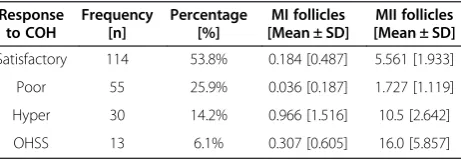
The study included 212 patients who underwent high-complexity assisted reproduction treatments, of which 53.8% [114/212] presented a satisfactory response to con-trolled ovarian hyperstimulation, 25.9% [55/212] were classified as poor responders, 14.2% [30/212] showed a hyper-response, and 6.1% [13/212] developed ovarian hy-perstimulation syndrome [OHSS], as shown in Table 1.
Considering the patients with poor response, 20 out of 55 started a new treatment cycle with an initial dose of 200 IU of rFSH, and 65% [13/20] showed a satisfactory response, 10% [2/20] a poor response, 20% [4/20] a hyperresponse, and 5% [1/20] developed OHSS, as shown in Table 2.
Discussion
In vitro fertilization is a complex multistep process that comprises collection of oocyte-containing follicles after controlled ovarian hyperstimulation with FSH, oocyte fertilization, embryo development, embryo transfer to the uterus, and implantation. All these steps are critical for successful IVF. However, the initial critical step of this complex procedure is the COH whose aim it is to
safely obtain a high number of mature oocytes, so as to allow the selection of the most viable embryo for transfer. Both quantitative and qualitative factors in oo-cyte production have a high influence on the IVF out-come. The significant inter-individual variability regarding COH with rFSH is one of the most challenging issues in IVF treatment. The goal is to transfer a single embryo and thus reduce the risk of multiple pregnancies, the main complication of IVF [13,14].
Since both practitioners and patients believed that the replacement of several embryos increased the success rate, multiple embryo replacement was the rule. Very slowly one realized that this practice had considerable side effects. The price to be paid for the multiple births is enormous, both in financial and health terms, but also in terms of psychological suffering [15,16]. An important move away from this model occurred only a few years ago with the introduction of single embryo transfer [17,18].
The process that started with single embryo transfer should eventually result in a global ’patient-friendly’ approach. Patient-friendly assisted reproductive treat-ment includes four different aspects or criteria: cost-effectiveness, equity of access, risk minimization and burden minimization for the patients [19].
In 1996, Edwards et al. were the first to express con-cern with regard to contemporary ovarian stimulation approaches for IVF and called for the use of a milder stimulation protocol [20]. The aim of mild stimulation is to develop safer and more patient-friendly protocols in which the risks of treatment are minimized [7,19,21-23].
The term“low-cost IVF”was coined by Professor Alan Trounson at a World Health Organization meeting in Geneva in 2001. The concern of the World Health Organization had always been to promote advances in health care in low resource economies. A milder stimulation protocol offers the same advantages as natural-cycle IVF, but has higher efficacy by recruiting few dominant follicle in addition to a many codominant folli-cles that do not develop spontaneously in a natural cycle [7,24]. However, there are reservations about the efficacy
Table 1 Classification of patients according to their response to controlled ovarian hyperstimulation with an initial dose of 100 IU of rFSH
Response to COH
Frequency [n]
Percentage [%]
MI follicles [Mean ± SD]
MII follicles [Mean ± SD]
Satisfactory 114 53.8% 0.184 [0.487] 5.561 [1.933]
Poor 55 25.9% 0.036 [0.187] 1.727 [1.119]
Hyper 30 14.2% 0.966 [1.516] 10.5 [2.642]
OHSS 13 6.1% 0.307 [0.605] 16.0 [5.857]
COH - controlled ovarian hyperstimulation, OHSS–Ovarian hyperstimulation syndrome.
Table 2 Classification of patients with poor response to the initial dose of 100 IU of rFSH according to their response to controlled ovarian hyperstimulation with an initial dose of 200 IU of rFSH in a new treatment cycle
Response to COH
Frequency [n]
Percentage [%]
MI follicles [Mean ± SD]
MII follicles [Mean ± SD]
Satisfactory 13 65% 0.538 [0.929] 5.46 [1.677]
Poor 2 10% 0 1.5 [1.576]
Hyper 4 20% 1.25 [2.165] 8.5 [2.179]
OHSS 1 5% 3.0 14.0
of a low-dose approach, including lower pregnancy rates compared with conventional IVF, in addition to a lower profit for IVF centers [6].
In underdeveloped or developing countries, infertility treatment can involve more complex socioeconomic is-sues, raising two main points: the problem of superpo-pulation, about which it is argued that this should be the focus of family planning programs; and, in view of the high cost of an assisted reproduction treatment com-pared to the low income of the population, that this in-come should be directed towards higher priorities. However, even in these countries, it is observed that the consequences of infertility without a possibility of treat-ment vary from a period of anguish to social isolation, murder and even suicide [25].
As older health care demands are controlled, new needs arise in our days, bringing about increasing costs and the issue of universal access. In between the public and the private sphere, the third sector arises in the process of remodeling the institutional managing ways as a combination of the several kinds of arrangements between the State and the civil so-ciety, so as to implement and co-manage public pol-icies and to face the different manifestations of the Brazilian social issues. Distant from a philanthropic and charitable perspective, this “group” is organized with the purpose of warranting the respect of the rights resulting from the Constitution of 1988 and the Organic Laws they entail.
Infertility treatment arises as an emerging need, as it is estimated that in Brazil over 278,000 couples face dif-ficulties in conceiving a child at some point of their reproductive age. The development of new assisted reproduction technologies and the search for success in the treatment of human infertility have generated an in-creasing demand for such treatments in the public sec-tor, the third sector and the private services, even at a significantly high cost.
Countless questionings have been brought up ever since these techniques have been incorporated to the ar-senal of medical procedures made available to the popu-lation, and their use is more and more common in social organizations that aim to ensure, by means of an inte-grated set of actions, the constitutional rights, among which health as a qualification of the civil right to life.
The technological advances bring about new question-ings, such as the role of the State in the access of the less favored population to modern treatments and all the other necessities of a Third-World country. A health care system that offers equitable access to basic health care services is only viable when both patients and phy-sicians realize that the interests of the individual patient and of the social system must be balanced. This implies that patients do not have a right to the most effective
treatment [regardless of the cost] but only to the most cost effective treatment [19].
Based on the cost of the medication used for con-trolled ovarian stimulation, manufactured by several pharmaceutical industries, the use of an initial dose of 100 IU of rFSH represents a saving of approximately 45% of the total cost of the treatment. This saving may make it viable to offer low-income populations a possi-bility to have children and make their dream of a family come true.
Conclusion
In conclusion, the initial dose of 100 IU of rFSH was considered adequate for controlled ovarian hyperstimu-lation, aiming to reduce the costs of the assisted reproduction treatment, considering 'patient-friendly’ assisted reproductive treatment.
Competing interests
The authors declare that they have no competing interests.
Authors’contributions
CPB; EBC and BB conceived study design. EBC; ACC and Rde Oliveira performed the data collection and analysed data. CPB, MA de Mendonça, DMC and BB interpretation the data. All authors were involved in literature search, writing the paper and had final approval of the submitted and published versions. All authors read and approved the final manuscript.
Received: 30 September 2013 Accepted: 5 January 2014 Published: 21 January 2014
References
1. American Society for Reproductive Medicine:Frequently asked questions about infertility.http://www.asrm.org/awards/index.aspx?id=3012. 2. Jones HW, Torner JP:Current concepts: the infertile couple.N Engl J Med
1993,329:1710–1715.
3. Kon A:Infertility: The Real Costs : A Report on the Financial, Emotional and Practical Implications of Childlessness for Infertile Couples and the National Health Service.Publisher Issue; 1993:1–28.
4. Portal da Saúde do Ministério da Saúde do Brasil:Média e alta complexidade.http://portal.saude.gov.br/portal/sas/mac/área.cfm. id_area=832.
5. Fauser BC, Devroey P, Macklon NS:Multiple births resulting from ovarian stimulation for subfertility treatment.Lancet2005,365:1807–1816. 6. Aletebi F:High-response intrauterine insemination cycles converted to
low-cost in vitro fertilization.J MultidiscHealthc2011,4:119–124. 7. Fauser BC, Devroey P, Yen SS,et al:Minimal ovarian stimulation for IVF:
appraisal of potential benefits and drawbacks.Hum Reprod1999,
14:2681–2686.
8. Broekmans FJ, Kwee J, Hendriks DJ, Mol BW, Lambalk CB:A systematic review of tests predicting ovarian reserve and IVF outcome.Hum Reprod Update2006,12:685–718.
9. Frankfurt S, Nunes AL, Reis AD, Christofolini DM, Bianco B, Barbosa CP:
Evaluation of basal FSH serum levels in infertile patients with deep ovarian endometriosis whose underwent surgery.Rev Bras Ginecol Obstet
2009,31(7):349–352.
10. Devroey P, Tournaye H, Van Steirteghem A, Hendrix P, Out HJ:The use of a 100 IU starting dose of recombinant follicle stimulating hormone [Puregon] in in-vitro fertilization.Hum Reprod1998,13(3):565–566. 11. WHO manual for the standardized investigation and diagnosis of the
infertile male, 2004:Infertility: Optimal Evaluation of the Infertile Male: Revised 2010; Infertility: Report on Varicocele and Infertility.Cambridge University Press; 2010.
12. Golan A, Ron-el R, Herman A, Soffer Y, Weinraub Z, Caspi E:Ovarian hyper-stimulation syndrome: an update review.Obstet Gynecol Surv1989,
13. Grady R, Alavi N, Vale R, Khandwala M, McDonald SD:Elective single embryo transfer and perinatal outcomes: a systematic review and meta-analysis.Fertil Steril2012,97:324–331.
14. Boudjenah R, Molina-Gomes D, Torre A, Bergere M, Bailly M, Boitrelle F, Taieb S, Wainer R, Benahmed M, de Mazancourt P, Selva J, Vialard F:Genetic polymorphisms influence the ovarian response to rFSH stimulation in patients undergoing in vitro fertilization programs with ICSI.PLoS One
2012,7(6):e38700.
15. Pennings G:Multiple pregnancies: a test case for the moral status of medically assisted reproduction.Hum Reprod2000,15:2466–2469. 16. Ombelet W, De Sutter P, Van der Elst J, Martens G:Multiple gestation and
infertility treatment: registration, reflection and reaction: the Belgian project.Hum Reprod Update2005,11:3–14.
17. Wolner-Hanssen P, Rydhstroem H:Cost-effectiveness analysis of in-vitro fertilization: estimated costs per successful pregnancy after transfer of one or two embryos.Hum Reprod1998,13:88–94.
18. Gerris JM:Single embryo transfer and IVF/ICSI outcome: a balanced appraisal.Hum Reprod Update2005,11(2):105–121.
19. Pennings G, Ombelet W:Coming soon to your clinic: patient-friendly ART. Hum Reprod2007,22:2075–2079.
20. Edwards RG, Lobo R, Bouchard P:Time to revolutionize ovarian stimulation.Hum Reprod1996,11:917–919.
21. Nargund G, Frydman R:Towards a more physiological approach to IVF. Reprod Biomed Online2007,14:550–552.
22. Diedrich K, Ferberbaum F:New approaches to ovarian stimulation. Hum Reprod1998,13(Suppl 3):1–13.
23. Olivennes F, Frydman R, Friendly IVF:The way of the future?Hum Reprod
1998,13:1121–1124.
24. Williams SC, Gibbons WE, Muasher SJ,et al:Minimal ovarian hyperstimulation for in vitro fertilization using sequential clomiphene citrate and
gonadotrophin with or without the addition of a gonadotropin releasing hormone antagonist.Fertil Steril2002,78:1068–1072.
25. Daar ES:Treatment of primary HIV infection.Med Gen Med2002,4(4):15.
doi:10.1186/1757-2215-7-11
Cite this article as:Barbosaet al.:Low dose of rFSH [100 IU] in controlled ovarian hyperstimulation response: a pilot study.Journal of Ovarian Research20147:11.
Submit your next manuscript to BioMed Central and take full advantage of:
• Convenient online submission • Thorough peer review
• No space constraints or color figure charges • Immediate publication on acceptance
• Inclusion in PubMed, CAS, Scopus and Google Scholar
• Research which is freely available for redistribution