Spongy Diamond
M. V. DIUDEA,1, M. MEDELEANU,2 Z. KHALAJ3AND A. R. ASHRAFI4,5
1
Department of Chemistry, Faculty of Chemistry and Chemical Engineering, Babes-Bolyai University, 400028 Cluj, Romania
2
University Politehnica of Timisoara, Faculty of Industrial Chemistry and Environmental Engineering, Telbisz Str. No. 6, 300001, Timisoara, Romania
3
Department of Physics, Shahr-e-Qods Branch, Islamic Azad University, Tehran, Iran
4
Department of Pure Mathematics, Faculty of Mathematical Sciences, University of Kashan, Kashan 87317−53153, Iran
5
Institute of Nanosciences and Nanotechnology, University of Kashan, Kashan 87317−53153, Iran
ARTICLE INFO ABSTRACT
Article History:
Received 20 August 2018 Accepted 1 January 2019
Published online 12 January 2019 Academic Editor: Hassan Yousefi-Azari
Rhombellanes are mathematical structures existing in various environments, in crystal or quasicrystal networks, or even in their homeomorphs, further possible becoming real molecules. Rhombellanes originate in the K2.3 complete bipartite graph, a tile found in the linear polymeric staffanes. In close analogy, a rod-like polymer derived from hexahydroxy-cyclohexane was imagined. Further, the idea of linear polymer synthesized from dehydro-adamantane was extended in the design of a three-dimensional crystal network, named dia(s), of which tile is a hyper-adamantane (an adamantane of which vertices are just adamantanes). It was suggested that this network could be synthesized starting from the real molecule tetrabromo-adamantane, by dehydrogenation and polymerization. The crystal structures herein proposed were characterized by connectivity and ring surrounding sequences and also by the omega polynomial.
© 2019 University of Kashan Press. All rights reserved Keywords: Rhombellane Adamantane Staffane Crystal network Omega polynomial.
Corresponding author (Email: [email protected]). DOI: 10.22052/ijmc.2019.167340.1416
1
I
NTRODUCTIONRhombellanes are structures with all strong rings being rhombs/squares (Figure 1, left); they have been proposed by Diudea in 2017 [1]. Rombellanes are structurally related to [1,1,1]propellane, an organic molecule, first synthesized in 1982 [2];by IUPAC rules[3], it is named tricyclo[1.1.1.01,3]pentane, a hydrocarbon with formula C5H6, containing only triangles; its reduced form, C5H8, eventually named bicyclo[1.1.1]pentane, has only rhomb/square rings; it can be represented as the complete bipartite graph, K2,3 (Figure 1, right). [1,1,1]Propellane undergoes spontaneous polymerization, to bicyclo[1.1.1]pentyl oligo- and polymers (degree of polymerization up to 100), called [n]staffanes [4,5]; they are rigid, linear structures (Figure 2, left), molecular rods that exhibit restricted rotation along the rod axis.
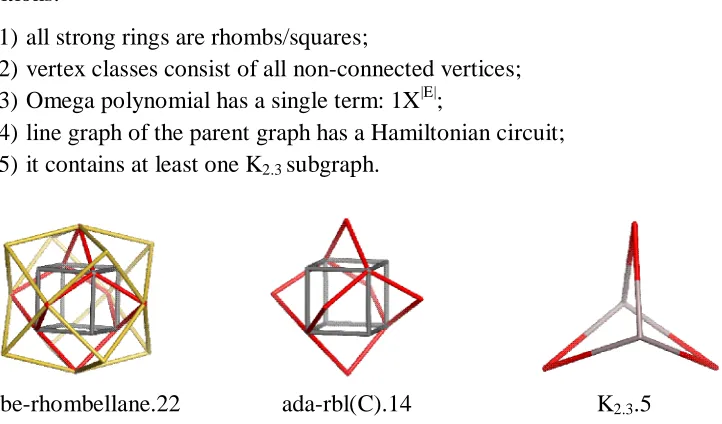
A rhombellane was defined by Diudea [6−8] as a structure fulfilling the conditions:
(1) all strong rings are rhombs/squares;
(2) vertex classes consist of all non-connected vertices; (3) Omega polynomial has a single term: 1X|E|;
(4) line graph of the parent graph has a Hamiltonian circuit; (5) it contains at least one K2.3 subgraph.
Cube-rhombellane.22 ada-rbl(C).14 K2.3.5
Figure 1. Rhombellane basic structures.
Construction of the cube-rhombellane (Figure 1, left) is illustrated in Figure 1. Each square face forms a K2.3 motif (Figure 1, middle and right) by joining the opposite corners with homeomorphic diagonals; these diagonals are joint together in an adamantane motif (Figure 1, middle, the red contour); K2.3 and adamantane ada.10 are both “tiles”, not polyhedra.
each of them with the rbl-vertices lying in the proximity of each parent vertex, thus local rh-cells being formed. The process can continue, considering the envelope rhn as “rh0” for rhn+1, in this way shell by shell being added to the precedent structure. Since the two diagonals of a rhomb may be topologically different, each generation may consist of two isomers.
The cube-rhombellane.22(Figure 1, left) has the vertex connectivity 6 and 3, respectively. To synthesize itas a molecule, one may start from 1,2,3,4,5,6-hexahydroxy-cyclohexane “hhch”, to provide the connectivity 6; connectivity 3 is more accessible [9,10]. By analogy to [1.1.1]propellane and staffanes [n]stf [5], a linear rod-like polymer [n]hhch (a poly-ether) was designed by Diudea (Figure 2, middle and right).
[3]stf [2]stf [3]hhch
Figure 2. Rhombellane-related linear polymers (in square brackets is the number of building blocks)
This analogy was also exploited in the synthesis of linear (“zig-zag”) polymer of which building block is 1,3-dehydro-adamantane (Figure 3, left - named here [3]dhada, with the staffane system). Adamantane ada.10 molecule was discovered by Landa (a Czech chemist) in 1933 in petrol [11]; then a series of syntheses of ada.10 and its derivatives have been proposed [5,12-14]. Dehydro-adamantane dhada.10 (Figure 3, middle) is obtained by eliminating the two bromine atoms from 1,3-dibromo-adamantane (Figure 3, right). The number suffixing the structure names counts the heavy atoms in the molecule.
[3]dhada oligomer dehydro-adamantane 1,3-dibromo-adamantane
2.
R
ESULTSAccording to Steinhardt [15], crystals are highly ordered structures, with atomic clusters repeated periodically, in three independent directions of the space, and showing an essentially discrete diffraction diagram; there are only 14 ways to build the crystal structures, namely the Bravais lattices; they are completely described by the 230 symmetry groups of the space.
2.1. SPONGY DIAMOND CRYSTAL NETWORK
A hypothetical tetra-dehydro-adamantane tdada molecule, obtainable by eliminating the four bromine atoms in tetraboromo-adamantane, is conceivable to undergo a 3D-polymerization, to provide a triple-periodic crystal network, eventually named dia(s), as Diudea designed.
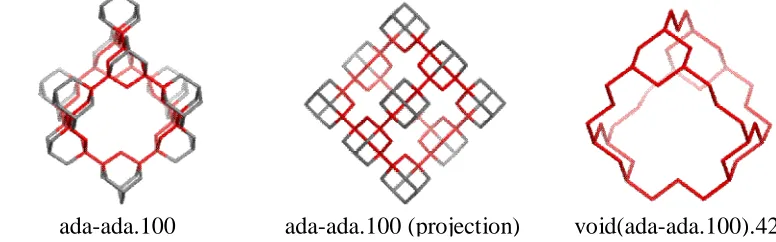
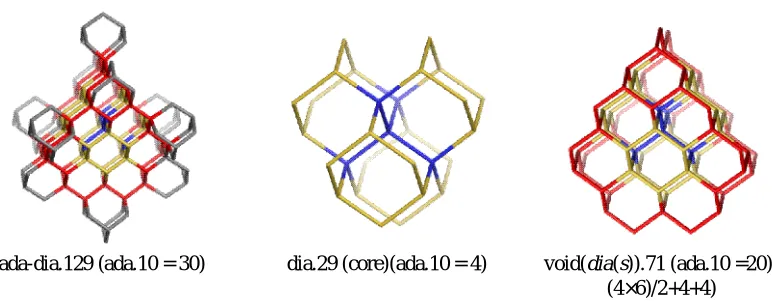
The newly proposed 3D dia(s)-net (space group Fd-3m), has the unit/building block ada-ada.100 (Figure 4, left), a hyper-adamantane tile [16], (i.e., an adamantane, in which all atoms are changed by the classical adamantane, ada.10, named tricyclo[3.3.1.13.7]decane, by IUPAC nomenclature [3]). The unit has a tetrahedral symmetry, as the adamantane ada.10; dia(s)-net and its void (Figure 4, right) can be perfectly embedded in the dia-net (space group Fd-3m), as shown in ada-dia.129 (Figure 5, left); the missing part of dia-net, dia.29 (Figure 5, middle), consists of four ada.10 units sharing a common (central) point (in blue, Figure 5, middle). Thus, dia(s)-net is a kind of dia-net, with defects (namely, dia.29), as shown in Figure 6. The filled void(dia(s)).71 (Figure 5, right) is a tetrahedral tile, with faces having six ada.10 units (each shared by two faces) around a central ada.10 (i.e., dia.29, the core of four ada.10) and one ada.10 on each of the four corners, a total of twenty ada.10 units. The ada-dia.129 filled tile (Figure 5, left) has additional ten ada.10, a total of 30 ada.10 units; by the number of atoms, the dia(s)-net has 0.775 = 100/129 of the density of the classical dia-net.
ada-ada.100 ada-ada.100 (projection) void(ada-ada.100).42
ada-dia.129 (ada.10 = 30) dia.29 (core)(ada.10 = 4) void(dia(s)).71 (ada.10 =20); (4×6)/2+4+4)
Figure 5. A filled (by dia-net) ada-ada unit (left), the missing core (middle) and its void (right).
dia(s)-embedding dia.29 defects in dia-net dia(s)-net (empty of dia.29)
Figure 6. The embedding of dia(s)-net in dia-net.
Any crystal net has its co-net, the complementary net; of course, the two nets are one and the same, only the building blocks, can be distinctly designed (see Figure 4, left and right). Translating ada-ada.100 (Figure 4, left) along the orthogonal coordinates, results in the dia(s)-net (Figure 6, right); from this structure, one may cut-off the corresponding dia(s)-co-net (ortho, Figure 7, left); the translation failed in case of the complementary tile, the void(ada-ada.100).42 (Figure 4, right), however, it was successful if translated this void by inclined (60o) coordinates [17] (Figure 7, middle and right).
rings surrounding (coming from the layer matrix of rings, of which entries are the sum of all rings around, of the choice length) was described [7, 22].
dia(s)-co-net (ortho) dia(s)-co-net (inclined) void-42 (inclined (60o))
Figure 7. The dia(s)-co-net.
Table 1. The dia(s) binodal net characterization: connectivity (LC) and atom ring
surrounding (LR).
Tile: ada-ada.100; (deg=4(40); deg=2(60); r6=40; r8=30; r18=4) Degree and
vertex type LC LR
deg=4; 6^3.8^3.18^6 4. 6. 9. 15. 18. 27. 45. 54. 75. 105 12. 30. 54. 90. 108. 162. 270. 324. 486. 738. 756 deg=2; 6^2.8^2.18^2 2. 6. 8. 9. 18. 24. 30. 54. 70. 74 6. 24. 48. 60. 102. 144. 180. 324. 432. 528. 780
2.2. OMEGA POLYNOMIAL CHARACTERIZATION OF [N]HHCH AND DIA(S) NETWORKS
Omega polynomial Ω(x) is defined on the ground of opposite edge strips ops in the
graph [23-25] Denoting by m, the number of ops of length s=|S|, one can write:
Ω(x) = Ʃsmsxs. Its first derivative (in x = 1) can be taken as a graph invariant or a topological index: Ω`(1) = Ʃssms= |E(G)|. The CI (Cluj-Ilmenau) index [26] is
calculated from Ω(x) (in x = 1) as: CI = Ω`2−(Ω`+ Ω``). The polynomial is
computed fixing the limits (rmin.rmax) of the strong rings in the graph.
There are graphs with single ops, which is a Hamiltonian circuit. For such
graphs, Omega polynomial has a single term: Ω(x) = 1X s; s = |E(G)|; it is the case
of rhombellanes, as defined in the introductory part of this paper.
For the rod-like network [n]hhch, the Omega polynomial and CI-index (calculated at (r6.r8)) are as follows:
6 6( 1)
( )x 6x nx x n
; CI 108(n1)236(n1)30
In case of dia(s)-network, the omega polynomial (calculated at (r6.r18)) is more complicate:
2
1
( 2 1) ( 2 1) 12 ( 4 5 1)
1
( ) 8 4
n
i n n n n n n
i
x x x x
The above results were obtained by numerical analysis of series with increasing number of building blocks.
Table 2. Omega polynomial in [n]hhch and dia(s)polymers (examples).
n HHCH; (r6.r8) dia(s); (r6.r18)
Polynomial CI Polynomial
1 6X+1X6+1X12 390 4X3+X120
2 6X+2X6+1X18 894 8X5+4X10+X648 3 6X+3X6+1X24 1614 8X7+8X14+4X21+X1872 4 6X+4X6+1X30 2550 8X9+8X18+8X27+4X36+X4080 5 6X+5X6+1X36 3702 8X11+8X22+8X33+8X44+4X55+X7560
Structures and data were performed by the Nano-Studio software program [27] developed at Topo Group Cluj.
3
.C
ONCLUSIONSRhombellanes are mathematical structures existing in various environments, in crystal or quasicrystal networks, or even in their homeomorphs, the lasts providing a plethora of molecular graphs, finally candidates to the status of real molecules [see also 28−30].
Rhombellanes originate in the K2.3 complete bipartite graph, found as a motif in the linear polymeric staffanes. In close analogy, and using the cube-rhombellane structure, the rod-like (yet hypothetical) polymer [n]hhch was designed, with vertices of connectivity 6 coming from the hexahydroxy-cyclohexane, hhch. Further, the idea of linear polymer synthesized from dehydro-adamantane, dhada, was extended in the design of a three-dimensional spongy diamond dia(s)-network, of which tile/building block is a hyper-adamantane (an adamantane of which vertices are just adamantanes). It was suggested that dia(s)-net may be synthesized starting from the real molecule tetrabromo-adamantane, by dehydrogenation and polymerization. The crystal structures herein proposed were characterized by connectivity and ring sequences and also by the Omega polynomial, also used in defining the rhombellane structure. It is strongly believed that Mathematical Chemistry can approach to the real needs of Chemistry by studies as that herein presented.
R
EFERENCES2. K. B. Wiberg, F. H. Walker, [1.1.1]Propellane. J. Am. Chem. Soc. 1982, 104 (19), 5239–5240.
3. Nomenclature of Organic Chemistry: IUPAC Recommendations and preferred names 2013 (Blue Book). Cambridge: The Royal Society of Chemistry, 2014. p. 169.
4. P. Kazynsky, J. Michl, [n]Staffanes: a molecular-size tinkertoy construction set for nanotechnology. Preparation of end-functionalized telomers and a polymer of [1.1.1]propellane. J. Am. Chem. Soc. 1988, 110 (15), 5225–5226.
5. A. Dilmaç, E. Spuling, A. de Meijere, S. Bräse, Propellanes—from a chemical curiosity to “explosive” materials and natural products. 2016, Angew. Chem., Int. Ed. 2017, 56, 5684−5718.
6. M. V. Diudea, Hypercube related polytopes, Iranian J. Math. Chem. 2018, 9 (1), 1−8.
7. M. V. Diudea, Rhombellanic crystals and quasicrystals, Iranian J. Math. Chem. 2018, 9 (3), 167−178.
8. B. Szefler, P. Czeleń, M. V. Diudea, Docking of indolizine derivatives
on cube rhombellane functionalized homeomorphs, Studia Univ. “Babes-Bolyai”, Chemia 2018, 63 (2), 7−18.
9. M. V. Diudea, Rhombellanes – a new class of structures, Int. J. Chem. Model. 2018, 9 (2−3), 91 − 96.
10. M. V. Diudea, Cube-Rhombellane: from graph to molecule, Int. J. Chem. Model. 2018, 9 (2−3), 97−103.
11. S. Landa, V. Machácek, Sur l’adamantane, nouvel hydrocarbureextrait de naphte. Collect. Czech. Chem. Commun. 1933, 5, 1–5.
12. P. von R. Schleyer, A simple preparation of adamantane. J. Am. Chem. Soc. 1957, 79 (12), 3292–3292.
13. R. Takagi, Y. Miwa, S. Matsumura, K. Ohkata, One-pot synthesis of adamantane derivatives by domino Michael reactions from ethyl 2,4-dioxocyclohexanecarboxylate, J. Org. Chem. 2005,70 (21), 8587−8589. 14. J. C. Garcia, J. F. Justo, W. V. M. Machado, L. V. C. Assali, Functionalized adamantane: building blocks for nanostructure self-assembly. Phys. Rev. B. 2009, 80 (12), 125421.
15. P. J. Steinhardt, Quasi–Crystals – A new form of matter, Endeavour 1990, 14, 112−116.
17. M. Goldberg, A class of multi-symmetric polyhedral, Tôhoku Math. J. 1937, 43, 104–108.
18. M. V. Diudea, Molecular Topology. 16. Layer matrixes in molecular graphs, J. Chem. Inf. Comput. Sci. 1994, 34, 1064−1071.
19. M. V. Diudea, M. Topan, A. Graovac, Molecular topology. 17. Layer matrixes of walk degrees. J. Chem. Inf. Comput. Sci. 1994, 34, 1072−1078.
20. M. V. Diudea, O. Ursu, Layer matrices and distance property descriptors, Indian J. Chem. A 2003, 42 (6), 1283−1294.
21. C. L. Nagy, M. V. Diudea, Ring signature index, MATCH Commun. Math. Comput. Chem. 2017, 77 (2), 479−492.
22. M. V. Diudea, C. L. Nagy, Rhombellane space filling, J. Math. Chem. 2018; DOI: 10.1007/s10910-018-0959-5.
23. M. V. Diudea, Omega polynomial, Carpath. J. Math. 2006, 22, 43−47. 24. M. V. Diudea, S. Klavžar, Omega polynomial revisited, Acta Chim.
Slov. 2010, 57, 565−570.
25. A.E. Vizitiu, S. Cigher, M. V. Diudea, M. S. Florescu, Omega polynomial in ((4, 8) 3) tubular nanostructures, MATCH Commun. Math. Comput. Chem. 2007, 57 (2), 457−462.
26. P. E. John, A. E. Vizitiu, S. Cigher, M. V. Diudea, CI index in tubular nanostructures, MATCH Commun. Math. Comput. Chem. 2007, 57, 479−484.
27. C. L. Nagy, M. V. Diudea, Nano Studio Software “Babes-Bolyai” University, Cluj, 2009.
28. M. V. Diudea, A. Pîrvan-Moldovan, R. Pop, M. Medeleanu, Energy of graphs and remote graphs, in hypercubes, rhombellanes and fullerenes, MATCH Commun. Math. Comput. Chem. 2018, 80, 835−852.
29. M. V. Diudea, C. N. Lungu, C. L. Nagy, Cube-rhombellane related bioactive structures, Molecules 2018, 23 (10), 2533; DOI:10.3390/molecules23102533.