Iran University of Medical Sciences
____________________________________________________________________________________________________________________
1. Assistant Professor, Department of Health Economics, School of Health Management and Information Science, Iran University of Medical
Sciences, Tehran, Iran. [email protected]
2. Non-communicable Diseases Research Center, Endocrinology and Metabolism Research Institute, Tehran University of Medical Sciences,
Tehran, Iran. [email protected]
3. (Corresponding author) Assistant Professor, Department of Health Economics, School of Health Management and Information Science,
Iran University of Medical Sciences, Tehran, Iran. [email protected]
4. Assistant Professor, Department of Health Economics, School of Health Management and Information Science, Iran University of Medical
Sciences, Tehran, Iran. [email protected]
Cost effectiveness of type 2 diabetes screening:
A systematic review
Behzad Najafi1, Farshad Farzadfar2, Hossein Ghaderi*3, Mohammad Hadian4
Received:27 February 2015 Accepted:17 May 2015 Published:13 February 2016
Abstract
Background: Although studies reported diabetes mellitus screening cost effective, the mass screen-ing for type2 diabetes remains controversial. In this study we reviewed the recently evidence about the cost effectiveness of mass screening systematically.
Methods: We reviewed the MEDLINE, Scopus, Web of Science (WOS), and Cochrane library da-tabases by MeSH terms to identify relevant studies from 2000 to 2013. We had 4 inclusion and 6 exclusion criteria and used the Drummond’s checklist for appraising the quality of studies.
Results: The initial search yielded 358 potentially related studies from selected databases. 6 studies met our inclusion and exclusion criteria and included in final review. 3 and 2 of them were conduct-ed in Europe and America and only one of them in Asia. Quality-adjustconduct-ed life year (QALY) was the main outcome to appraise the effectiveness in the studies. Incremental cost effectiveness ratio (ICER) was computed in range from $516.33 to $126,238 per QALY in the studies.
Conclusion: A review of previous diabetes screening cost effectiveness analysis showed that the studies varied in some aspects but reached similar conclusions. They concluded that the screening may be cost effective, however further studies is required to support the diabetes mass screening.
Keywords: Cost effectiveness, Diabetes, Screening, Economic evaluation.
Cite this article as:Najafi B, Farzadfar F, Ghaderi H, Hadian M. Cost effectiveness of type 2 diabetes screening: A systematic review. Med J Islam Repub Iran2015 (13 February). Vol. 29:326.
Introduction
Diabetes mellitus is one of the major met-abolic and one of the most serious chronic diseases (1–4) with substantial prevalence, incidence and economic burden in the world (3,5). Recent estimates suggest that diabetes mellitus causes 59258034 disabil-ity-adjusted life years (DALYs) in 2012 with 89.7% increase in deaths from diabe-tes since 1990 to 2013 (6). International Diabetes Federation (I DF) estimated about 382 million people (8.3% of adults) have diabetes in 2013 and it rises to 592 million people in 2035. The majority of diseased
persons aged between 40 to 59 and this led to higher economic burden of diabetes (7).
Diabetes mellitus is asymptomatic in ear-ly stage and can remain undiagnosed for 9 to 12 years (8,9). The asymptomatic and chronic nature of diabetes cause to many individuals have diabetes related complica-tions when in diagnosed (5). Individual with diabetes are at higher risk to have long term dysfunction and failure in heart, kid-neys, nerves and damage on eyes and blood vessels (8). Diabetes mellitus cause 5.1 mil-lion deaths that half of them occur under age 60 and 11% of total health expenditure
(USD 548 billion in health expenditure) (10).
The burden of diabetes can be reduced by many interventions but due to resource lim-itation they should be prioritized (11). Several studies and organization have rec-ommended diabetes screening to reduce the burden of disease (12,13). Although diabe-tes meets screening criteria (14), random-ized trials have not demonstrated reduction of diabetes’ complications or burden via mass screening (15). Despite the results of the clinical trial, some statistical models-based studies have demonstrated the benefit of mass screening for diabetes (5,15) and others have shown opportunistic screening may be cost effective (13).
Although many studies have shown the diabetes screening is cost effective but their qualities and conclusions are vary (11). Some of them do not support mass screen-ing in all settscreen-ing and conclude screenscreen-ing for high risk individuals may be worthwhile (16,17). Therefore in this study, we want to appraise individual studies and summarize results using a systematic review, to help policy makers and clinicians in planning and resource allocation, and to finance cost effective interventions for preventing dia-betes and its complications.
Methods
The design of the study was approved by the Ethics Committee of Iran University of Medical Sciences.
Search strategy
The review began with systematic search of the main databases. Medical Literature Analysis and Retrieval System Online (MEDLINE), Scopus, Web of Science (WOS), and Cochrane library databases were selected to identify relevant studies from January 2000 to November 2013. We used medical subject headings (MeSH) to identify synonyms of keywords and rele-vant studies. “diabetes, screening, cost ef-fectiveness and economic evaluation” were the base keywords and these terms com-bined in different ways based on data bases.
MEDLINE was searched using: MeSH terms of diabetes mellitus AND screening AND “cost effectiveness", diabetes mellitus AND screening AND (key words for costs) AND (keywords for effectiveness), and Di-abetes mellitus AND screening AND (“cost-benefit”) OR (“cost-effectiveness”) OR (“cost-utility”) OR (“economic evalua-tion”) OR (“cost saving”).
Scopus and Web of Sciences were searched with keywords for (cost) AND (effectiveness) AND (diabetes) AND (screening). In the Cochrane Library search we coded terms and combined them as fol-lows: #1"cost effectiveness, #2"economic evaluation", #3"cost benefit" , #4"cost utili-ty", #5 “cost saving” #6"diabetes melli-tus”, #7"diabetes", #8" type 2 diabetes” #9"diabetes mellitus type II” and #10 screening. We combined these cods as fol-low:#1 and #6and #10, #1 and #7 and#10, #1and #8 and #10, #1and#9 and #10, #2 and #6and #10, #2 and #7 and#10, #2and #8 and #10, #2and#9 and #10, #3 and #6and #10, #3 and #7 and#10, #3and #8 and #10, #3and#9 and #10, #4 and #6and #10, #4 and #7 and#10, #4and #8 and #10, #4and#9 and #10, :#5 and #6and #10, #5 and #7 and#10, #5and #8 and #10, #5and#9 and #10,
For more additional search we used “Google Scholar”, Center for Reviews and Dissemination, CEA Registry and also manually checked reference lists of all pub-lications including original studies and re-views to identify studies not found through systemic searching.
Studies selection
In overall, studies were included in this review if apprise and report both costs and outcomes of screening. We had 4 inclusion and 7 exclusion criteria for selecting of studies and finally only studies which had excellent or good quality rank entered in final analysis.
Inclusion criteria
1) systematic review and original eco-nomic evaluation in each three categories
of cost benefits or cost effectiveness and cost utility analysis; 2), studies which were apprised type 2 diabetes, 3) outcomes were measured as life years gained (LYGs) or quality-adjusted life years (QALYs) gained and cost saving; and 4) Publication in the English occurred between January 2000 and November 2013.
Excluding criteria
1) Studies which appraise cost or out-come only, 2) studies appraise other type of diabetes than type 2, 3) opportunistic screening economic evaluation, 4) review papers and documents, 5) health economic evaluation studies in children 6) studies ap-praise only cost per case identification and 7) short term horizon (less than 10 years) to analyzing cost and effectiveness.
Quality assessment
Health economic evaluation studies vary based on their quality of conducting and reporting and there are heterogeneity in their purposes, perspective, conceptual, modeling and measurement issues (18). In order to ensure studies with acceptable quality are included, we used the Drum-mond’s checklist (19) for appraising the quality of studies. Only those which ob-tained good and excellent scores according to the Drummond’s checklist were included in the final analysis.
Data extraction
From the selected studies, data were ex-tracted based on the predetermined form. This form contains1) bibliography, includ-ing year, country of studies, and authors, 2) study design, including aim and cases of studies, time horizon, interventions and al-ternatives, costs included in the study, out-come measures for effectiveness, study’s perspective, modeling, discount rate for costs and outcome and sensitivity analysis, and 3) results and conclusion, including incremental cost effectiveness ratio (ICER), cost saving and cost per identification of new diabetic or pre-diabetic.
Analysis process and reporting
The title and abstract of primary results was reviewed by two people to identify re-peated and unrelated documents separately. The output of these reviews checked and disagreed cases were identified by referring to the papers’ main text (Kappa was 94%). After reviewing the abstract we reviewed the full text of papers and some of them were excluded based on the inclusion and exclusion criteria. The included papers in the final apprising met the quality assess-ment criteria.
Results
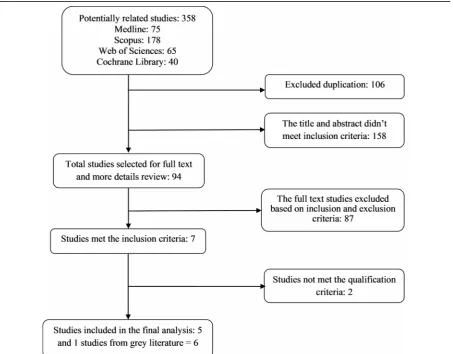
The initial search from selected databases yielded 358 potentially related studies. 106 papers were duplicated and excluded from the analysis. 158 papers did not meet inclu-sion criteria based on title and abstract view and 94 possible original papers re-mained for full screen. Further review of the full text resulted in 7 CE studies that met our inclusion criteria. One studies met the inclusion criteria from the grey litera-ture. Two studies recognized as poor quali-ty papers and excluded from the final anal-ysis. Error! Reference source not found. shows the detailed description of studies selection process and data abstraction which we included in the study.
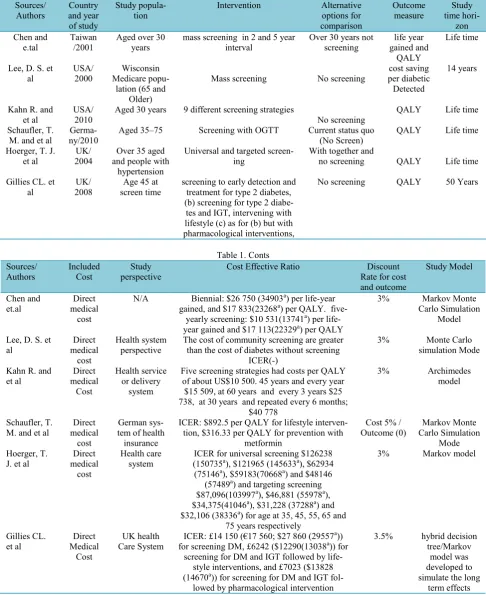
In this review, studies were described based on their country setting and year of the study, study population, intervention and alternative options for comparison, the outcome (effectiveness) that study focuses on, costs included in the analysis, analytical time horizon, perspective, discount rate for outcome and costs, cost effectiveness ratio and modeling of study that used for long term outcome and cost estimation in the long term studies.
Review yielded six studies with our in-clusion and exin-clusion criteria. The studies took the long term time horizon and as-sessed the long-term costs and consequenc-es of screening (5,14,15,20–22). The char-acteristics of these are summarized in Er-ror! Reference source not found.. Four of 6 studies took the life time (5,15,20,21) and
one of them took 14 years (14) and other one took 50 years analytical horizon (22). The studies were conducted in the United States, United Kingdom, Germany, and Thailand. In this review we did not find any study for recent years and all included stud-ies were conducted before 2011. All studstud-ies assessed the cost effectiveness of screening in the populations aged over 30 years (two studies over 30; two others over 35; one 45, and another one over 65 years).
All studies assessed the cost effectiveness of mass screening by different interventions for screening and diagnostic tests in com-parison with no screening (Error! Refer-ence source not found.). Five of 6 studies used Fasting Plasma Glucose (FPG) as screening or diagnostic test. Moreover some studies have applied additional tests such as hemoglobin test (15); Oral Glucose Tolerance Test (OGTT) (15,22), and Capil-lary Blood Glucose (CBG) (21) as
screen-ing or diagnostic tests. In one study (20) only OGTT was used for screening and di-agnostic of diabetic individuals.
Different screening intervals are the prev-alent strategy which was used as an alterna-tive option for comparison. Chen, et al (15) conducted 2 and 5 year intervals and Kahn et al (5) developed 8 strategies based on screening interval and age at initiation for comparison. Except one (21) which com-pared universal screening with targeted screening in people with hypertension, all the rest compared the interventions and strategies with no screening.
QALY is the most prevalent outcome used for measuring the effectiveness of in-terventions. Five of 6 studies used QALY and one the cost saving for measuring the effectiveness. Chen et al applied LYGs in addition to QALY.
Markov simulation models were conduct-ed to assess the long-term outcomes and Fig. 1. Studies review process for systematic review of cost effectiveness of diabetes screening
costs of screening for type 2 diabetes melli-tus in 4 studies. Two studies have devel-oped the Archimedes model (5) and hybrid
decision tree/Markov model (21) to simu-late the long-term costs and effects.
All studies included the direct medical Table 1. Description of long-term cost effectiveness studies characteristics
Sources/
Authors and yearCountry of study
Study
popula-tion Intervention Alternativeoptions for comparison
Outcome
measure time hori-Study zon Chen and
e.tal Taiwan/2001 Aged over 30years mass screening in 2 and 5 yearinterval Over 30 years notscreening gained andlife year QALY
Life time
Lee, D. S. et
al USA/2000 Medicare popu-Wisconsin lation (65 and
Older)
Mass screening No screening per diabeticcost saving Detected
14 years
Kahn R. and
et al USA/2010 Aged 30 years 9 different screening strategies No screening QALY Life time Schaufler, T.
M. and et al ny/2010Germa- Aged 35–75 Screening with OGTT Current status quo(No Screen) QALY Life time Hoerger, T. J.
et al 2004UK/ and people withOver 35 aged hypertension
Universal and targeted
screen-ing With together andno screening QALY Life time
Gillies CL. et
al 2008UK/ screen timeAge 45 at screening to early detection andtreatment for type 2 diabetes, (b) screening for type 2
diabe-tes and IGT, intervening with lifestyle (c) as for (b) but with pharmacological interventions,
No screening QALY 50 Years
Table 1. Conts Sources/
Authors IncludedCost perspectiveStudy Cost Effective Ratio Rate for costDiscount and outcome
Study Model
Chen and
et.al medicalDirect cost
N/A Biennial: $26 750 (34903a) per life-year
gained, and $17 833(23268a) per QALY.
five-yearly screening: $10 531(13741a) per
life-year gained and $17 113(22329a) per QALY
3% Markov Monte
Carlo Simulation Model
Lee, D. S. et
al medicalDirect cost
Health system
perspective The cost of community screening are greaterthan the cost of diabetes without screening ICER(-)
3% Monte Carlo
simulation Mode
Kahn R. and
et al medicalDirect Cost
Health service or delivery
system
Five screening strategies had costs per QALY of about US$10 500. 45 years and every year $15 509, at 60 years and every 3 years $25 738, at 30 years and repeated every 6 months;
$40 778
3% Archimedes
model
Schaufler, T.
M. and et al medicalDirect cost
German sys-tem of health insurance
ICER: $892.5 per QALY for lifestyle interven-tion, $316.33 per QALY for prevention with
metformin
Cost 5% /
Outcome (0) Carlo SimulationMarkov Monte Mode Hoerger, T.
J. et al medicalDirect cost
Health care
system (150735ICER for universal screening $126238a), $121965 (145633a), $62934
(75146a), $59183(70668a) and $48146
(57489a) and targeting screening
$87,096(103997a), $46,881 (55978a),
$34,375(41046a), $31,228 (37288a) and
$32,106 (38336a) for age at 35, 45, 55, 65 and
75 years respectively
3% Markov model
Gillies CL.
et al MedicalDirect Cost
UK health
Care System ICER: £14 150 (€17 560; $27 860 (29557
a))
for screening DM, £6242 ($12290(13038a)) for
screening for DM and IGT followed by life-style interventions, and £7023 ($13828 (14670a)) for screening for DM and IGT
fol-lowed by pharmacological intervention
3.5% hybrid decision tree/Markov
model was developed to simulate the long
term effects a: Inflated to 2010 with 3% yearly.
costs in their models. They did not included direct non-medical costs and used the health system perspective to identify the costs. Four studies used 3% rate to discount the future costs and effectiveness of inter-ventions (5,14,15,21). One (20) used the 5% and zero to discount costs and outcome, respectively, and the other (22) discounted the costs and outcome by 3.5%.
Studies yielded very different range of ICER. In order to make them comparable we inflate to 2010 with 3% yearly. Chen et al.(15) had estimated the ICER for biennial and 5-yearly screening $26750 and $10531 per LYGs and also $17833 and $17113 per QALY gained, respectively. Lee et al used the CDC diabetes cost effectiveness study group(23) results and assumptions for their estimation. They estimated the cost of screening $100 per diagnosed diabetes. They presented three scenarios to estimate the lifetime costs and assumed screening could reduce cardiovascular risk zero and 30%. In this way excess lifetime costs as-sociated with screening would be $4471, and $3246 greater than no screening per identification, respectively. In addition to cardiovascular risk reduction, if screening lead to 30% reduction in routine medical care costs, it can save an average of $619 per detected diabetes. Kahn et al appraised 8 strategies to identify the cost effective-ness of screening.
Five screening strategies had about $10500 costs per QALY, screening at age 45 years and repeat every year had $15509, age at 60 years and repeated every 3 years $25738, and age at 30 years and repeated every 6 months had $40,778 cost per QALY compared with no screening. Schau-fler et al estimated the ICER for screening and lifestyle and metformin intervention €562.54 ($892.50) and €325.44 ($516.33) per QALY compared with no screening. Hoerger et al estimated the ICER for uni-versal and targeted screening with intensive glycemic control and intensive hyperten-sion control at 5 age initiation screening. They calculated ICER for universal screen-ing $126238, $121965, $62934, $59183
and $48146 and targeting screening $87,096, $46,881, $34,375, $31,228 and $32,106 for age at 35, 45, 55, 65 and 75 years, respectively. Gillies et al computed ICER for diabetes and IGT screening by two preventive interventions. They estimat-ed ICER $27,860 for screening type2 dia-betes, $12,290 for diabetes and IGT screen-ing by lifestyle interventions, and $13828 for diabetes and IGT screening followed by pharmacological intervention.
Conclusion
We found that all studies conclude the screening for diabetes is cost effective. However country setting can lead to differ-ent ICER for same intervdiffer-entions. For ex-ample screening for diabetes and glycemic control in new diabetic detected individuals is low cost effective in the US in compari-son with other developed countries (7). On the other hand, the health outcome measures that have been used to estimate QALYs may overestimate or underestimate health utilities. Our study showed that cost effectiveness ratio has very wide range in the different countries. It varies from $516.33 (€325.44) in Germany (20) to $126,238 in UK per QALY(21). But it var-ies by some factors such as initiation age for screening, cutoff point for diagnosis, screening interval and prevention strategies from diabetes complications. Therefore it is difficult to aggregate data or to compare the ICER from different studies.
However the cost-effectiveness of diabe-tes screening and modification intervention varies by age at the time of screening. Cur-rent studies are uncertain on how the cost effectiveness of diabetes screening would change with the age at initiation. Some studies concluded the incremental costs per QALY increased with initial screening age (5,15), whereas others found that screening for diabetes may be more cost effective if it initiated at high ages like as 55, 65 years than 35(21).
All studies except one used the FPG as screening test (20). However some of them only used this test for screening and
nosis without repetition (5,14), others used the extra tests as diagnosis test and this could rise the screening costs (15,21,22). Schaufler et al used the OGTT as screening test but they estimated lowest ICER in the studies. It seems diversity in screening and diagnosis tests are not very strong determi-nant in cost effectiveness of diabetes screening.
Mass screening, opportunistic and target-ed screening is discusstarget-ed in the studies. Chen et al concluded that incremental cost of opportunistic screening is higher than mass screening in both per LYGs and QALY gained. Their results showed mass screening with 5-year interval is more cost-effective than opportunistic screening when diabetes prevalence is between 6–12%. On the other hand Kahn found that opportunis-tic screening strategies at the time of visits had the lowest costs per QALY.
Chen and colleagues and Hoerger and colleagues assumed treatment and preven-tive intervention can control glycemic level and accordingly reduce micro and macro-vascular complications. They did not have alternative treatment options for compari-son and include costs and effectiveness of preventive and treatment intervention in model based on previous studies. Lee and colleagues had three scenarios for preven-tive and treatment intervention effecpreven-tive- effective-ness. They assume zero and 30% reduction in cardiovascular risk and 30% reduction in cardiovascular risk and 3% reduction in cost of routine care with preventive and treatment intervention. They concluded in third scenario we have cost saving. Kahn and colleagues included the lifestyle and metformin modification as preventive in-tervention in their model. They also had some other interventions in the next stage of diabetes development. But they did not report the separated ICER for every of them. Schuafler and colleagues compared the cost effectiveness ratio in metformin and lifestyle as diabetes preventive inter-ventions. They estimated prevention with metformin is more cost effective than life-style. In contrast other studies found the
diet and lifestyle interventions are more cost effective than pharmacological inter-ventions (22,24). However, it is likely the models not taking full account of the bene-fits of the diet and lifestyle changes on car-diovascular risk factors and had underesti-mated benefit of lifestyle due to focus mainly on prevention of diabetes.
There are very few studies on cost effec-tiveness analysis of diabetes screening in developing countries, while more than 80% of people with diabetes live in low- and middle-income countries (25). In our re-view we found only one study for the Asian countries.
In this study we tried to review the cost effectiveness studies about the mass screen-ing of type 2 diabetes. In conclusion, stud-ies did not demonstrate that the mass screening for type2 diabetes is not cost ef-fective. However some of them concluded that the ratio of cost effectiveness may be altered by some considerations such as age and screening interval.
There were some limitations in our study. Firstly, despite of abundant studies on cost effectiveness of diabetes prevention strate-gies, there were only a small number of pa-pers on cost effectiveness of screening in type 2 diabetes. Secondly, the efficacy of global diabetes screening depend on many parameters including the screening and di-agnosing tests or tools, the natural history of disease, and the follow up protocol of disease (15). On the other hand the ex-penditure of health care, devices and oppor-tunity cost of human resource are varied by country. Thus, these results could not be generalized to the other settings. Thirdly, we include only English publication in our study so it means some publication in other languages may be missed. And finally there were several factors led to heterogeneity among the studies. Firstly, the studies did not describe the treatment process very well, but it seemed the process of treatment was not same in the studies. Secondly, some studies include the preventive inter-ventions in their model while other neglect-ed them. Thirdly, there is very diversity in
screening and diagnostic process among the studies. Therefore, it is difficult to integrate the results and interpretation of should be made by caution.
Acknowledgment
This study was part of PhD. dissertation supported by Iran University of Medical Sciences (Grant NO: IUMS/SHMIS-778-2012).
Conflict of Interests
All authors declare that they have no sig-nificant competing interests.
References
1. Durand CP. A systematic review and meta-analysis of diabetes disease management programs [MSc Thesis] [Internet]. ProQuest; 2008. Available from: Texas Medical Center Dissertations (via ProQuest). /http://digitalcommons.library.tmc.edu/ dissertations/AAI1454501.
2. Roglic G, Unwin N. Mortality attributable to diabetes: estimates for the year 2010. Diabetes Res. Clin Pract Elsevier 2010;87(1):15–19.
3. Kiadaliri A, Najafi B. Obesity in type 2 diabetes mellitus: a review of health economics’ evidences. Int J Heal Insur Equity 2013;1(1):2-13.
4. Lawrence J, Robinson A. Screening for diabetes in general practice. Prev Cardiol 2003; 6(2):78–84.
5. Kahn R, Alperin P, Eddy D, Borch-Johnsen K, Buse J, Feigelman J, et al. Age at initiation and frequency of screening to detect type 2 diabetes: a cost-effectiveness analysis. Lancet. 2010/04/02 ed. 2010;375(9723):1365–74.
6. Naghavi M, Wang H, Lozano R, Davis A, Liang X, Zhou M, et al. Global, regional, and national age–sex specifi c all-cause and cause-specifi c mortality for 240 causes of death, 1990– 2013: a systematic analysis for the Global Burden of Disease Study 2013. Lancet. Elsevier 2015; 385(9963):117–71.
7. Internatinal Diabetes Federation. IDF Diabetes Atlas, sixth edition. Hallado en http//www. idf. org/diabetesatlas/6e. International Diabetes Federation; 2013;
8. American Dibetes Association. Screening for type 2 diabetes. Diabetes Care 2003;26(SUPPL. 1): S21–S24.
9. Brown J, Nicolas G, Glauber H, Bakst A. incremental medical care costs during the first 8 years after diagnosis. Diabetes Care 1999; 22:1116–24.
10. International Diabetes Federation. Diabetes
Atlas, fifth edition. Hallado en http//www. idf. org/diabetesatlas/5e/es/prologo. 2013.
11. Li R, Zhang P, Barker LE, Chowdhury FM, Zhang X. Cost-effectiveness of interventions to prevent and control diabetes mellitus: A systematic review. Diabetes Care 2010;33(8):1872–94.
12. American Diabetes Association. screening for type 2 diabetes. Diabetes Care 2004;27 (suppl (SUPPL. 1):s11–14.
13. Calonge N, Petitti DB, DeWitt TG, Dietrich AJ, Gordis L, Gregory KD, et al. Screening for type 2 diabetes mellitus in adults: US Preventive Services Task Force recommendation statement. Ann Intern Med 2008;148(11):846–54.
14. Lee DS, Remington P, Madagame J, Blustein J. A cost analysis of community screening for diabetes in the central Wisconsin Medicare population (results from the MetaStar pilot project in Wausau). Wmj 2000;99(3):39–43.
15. Chen THH, Yen MF, Tung TH. A computer simulation model for cost-effectiveness analysis of mass screening for Type 2 diabetes mellitus. Diabetes Res Clin Pract 2001;54(SUPPL. 1):S37– S42.
16. O’Connor PJ, Rush WA, Cherney LM, Pronk NP. Screening for diabetes mellitus in high-risk patients: cost, yield, and acceptability. Eff Clin Pract 2001;4(6):271–7.
17. canadian diabetes association. Canadian Diabetes Association 2008 Clinical Practice Guidelines for the Prevention and Management of Diabetes in Canada 2008;32(September):1–215.
18. Langer A. A framework for assessing Health Economic Evaluation ( HEE ) quality appraisal instruments. BMC Health Serv. Res. [Internet]. 2012;12(253). Available from: http://www. biomedcentral. com/1472-6963/12/253
19. Drummond MF, Jefferson TO. Guidelines for authors and peer reviewers of economic submissions to the BMJ. The BMJ Economic Evaluation Working Party. BMJ Br 1996; 313(7052):275–83.
20. Schaufler TM, Wolff M. Cost effectiveness of preventive screening programmes for type 2 diabetes mellitus in Germany. Appl Heal Econ Heal Policy 2010;8(3):191–202.
21. Hoerger TJ, Harris R, Hicks KA, Donahue K, Sorensen S, Engelgau M. Screening for type 2 diabetes mellitus: a cost-effectiveness analysis. Ann Intern Med 2004;140(9):689–99.
22. Gillies CL, Lambert PC, Abrams KR, Sutton AJ, Cooper NJ, Hsu RT, et al. Different strategies for screening and prevention of type 2 diabetes in adults: Cost effectiveness analysis. BMJ 2008; 336(7654):1180–4.
23. CDC Diabetes Cost effectiveness Study Group. the cost effectiveness of screening for type 2 diabetes. JAMA 1998;280:1757–63.
24. Vijgen SMC, Hoogendoorn M, Baan CA, De Wit GA, Limburg W, Feenstra TL. Cost effectiveness of preventive interventions in type 2 diabetes mellitus: A systematic literature review.
Pharmacoeconomics 2006;24(5):425–41.
25. IDF. IDF Annual Report 2013. Annu. Rep. 2013: p. 14.