Research Paper: Effect of Cognitive Behavioral Therapy on
Social Competence in Physically Disabled Adolescents
Faeze Seyedi1, Mansour Fathi2 , Asghar Dadkhah3 , Seyed Hossein Mohaqeqi Kamal4* , Pouria Rezasoltani5
1. Department of Social Work, University of Social Welfare and Rehabilitation Sciences, Tehran, Iran. 2. Department of Social Work, Faculty of Social Sciences, Allameh Tabataba’i University, Tehran, Iran. 3. Department of Counseling, University of Social Welfare and Rehabilitation Sciences, Tehran, Iran.
4. Social Welfare Management Research Center, University of Social Welfare and Rehabilitation Sciences, Tehran, Iran. 5. Medical Sciences Educational Development Center, University of Social Welfare and Rehabilitation Sciences, Tehran, Iran.
* Corresponding Author:
Seyed Hossein Mohaqeqi Kamal, PhD.
Address: Social Welfare Management Research Center, University of Social Welfare and Rehabilitation Sciences, Tehran, Iran.
Tel: +98 (21) 22180048
E-mail: [email protected]
Objectives: This study aimed to evaluate the effect of social group work interventions with cognitive behavioral approach on social competence in physically disabled adolescents. Methods: This was a quasi-experimental study with a pre-test and post-test and control group design. The statistical population included physically disabled adolescents aged 13-18 years who were referred to the Center of Rehabilitation and Vocational Training in Sanandaj City, Iran, to participate in educational programs. To this end, 30 physically disabled adolescents were selected based on inclusion criteria and were divided into 2 matching groups (intervention and control). Social competence questionnaire was completed by both groups at the beginning and at the end of training. The intervention group was trained for 8 weeks in terms of social competence, whereas the control group received no special training. The obtained data were analyzed using SPSS. The Chi-square, Independent samples t-test, and Paired t test were used to verify the study assumptions.
Results: Comparing the intervention group with the controls before and after training reveled that teaching patients with cognitive behavioral strategies had a significant impact on increasing their social competence (Mean±SD, 181.66±17.88 versus 120.93±10.47; P=0.0001) and its dimensions (cognitive, behavioral, emotional and motivational) of the former group. Discussion: It seems that one of the efficient methods to increase social competence among physically disabled adolescents is cognitive behavioral therapy within the social group work. Thus, coaches and teachers of this group are recommended to use this method, to increase their social competence and subsequently increasing their presence in public areas.
A B S T R A C T
Article info: Received: 13 Mar 2018
Accepted: 10 Jul 2018
Available Online: 01 Dec 2018
Keywords:
Disabled persons, Adolescents, Social work, Social
competence, Cognitive behavioral therapy
Citation Seyedi F, Fathi M, Dadkhah A, Mohaqeqi Kamal SH, Rezasoltani P. Effect of Cognitive Behavioral Therapy on Social Competence in Physically Disabled Adolescents. Iranian Rehabilitation Journal. 2018; 16(4):339-346. http://dx.doi. org/10.32598/irj.16.4.339
: http://dx.doi.org/10.32598/irj.16.4.339
Use your device to scan
Highlights
● Social competence refers to the quality of peer communication and social behavior in social settings.
● Children’s social competence is one of the most important predictors of children’s development.
● Adolescents with early problems in social behaviors are at risk for experiencing negative consequences.
Plain Language Summary
People with disabilities need to adapt with their environment. However, family members of disabled people might take an avoidance attitude, rejection, or too much support that add to already many problems for these people. Disabled people in dealing with these issues may develop negative attitudes, prejudices, discrimination, and maladaptive behav-iors. The consequences of these issues are psychosocial barriers and deficiencies in health and social capabilities. Thus, the disabled people have lower self-esteem and self-confidence and in general have less social interactions. Some of these factors can be explained by lower “social competence” in persons with disabilities.
1. Introduction
isability goes beyond physical dysfunction and includes activity restrictions, stigma, discrimination, and social participation
limitations [1]. The Global Burden of
Dis-ease (GBD) has defined disability as the loss of health in areas such as mobility, cognition,
hear-ing, and vision [2]. More than 15% of the world
popula-tion suffer from disabilities that restrict their funcpopula-tion in family, community, and politics. Eighty percent of them
live in low- and middle-income countries [3]. According
to the International Classification of Functioning, dis-ability and health (ICF), social stigma and discrimina-tion are considered as significant ‘environmental factors’
that contribute to disability [2, 4, 5].
As the National Information Center for Children and Youth with Disabilities (2015) describes, a physical dis-ability is defined as a physical condition that negatively affects at least one main living activity of an individual
[6]. People with disabilities need an ability to be
compat-ible and adapt to their environment. Moreover, because of unfavorable attitudes in society, the family members of physically disabled people are avoidant, rejectful, or too much supportive to them, that creates many problems. Once dealing with such issues, disabled individuals may experience negative attitudes, prejudice, discrimination, and maladaptive behaviors that affect various aspects of their lives. The consequences of these issues are psy-chosocial barriers and deficiencies in health and social capabilities. This leads to lower esteem and self-confidence in this population, compare to other healthy people. It also makes them uncomfortable in social
com-munication, ultimately resulting in less social interac-tion. Some of these factors can be explained by lower “social competence” in persons with disabilities.
Social competence is a basic characteristic of child’s
psychological adaptation [7]. It refers to the ability to
interact positively and get along well with others [8].
In other words, social competence is described by a set of essential social skills to interact well with others and act effectively in peer groups. Children with inadequate social skills are more exposed to various adverse social
outcomes in subsequent lifetimes [9]. Children’s social
competence is among the most important determinants
of children’s development [10, 11]. Moreover,
adoles-cents with early problems in social behavior are at risk of negative consequences such as academic failure, peer
rejection, and delinquent behavior [12].
In the current study, we conducted Cognitive Behavior Therapy (CBT) to reduce emotional distress and behav-ioral problems in persons with physical disabilities, in order to increase their social competence. The efficacy of CBT on social work domains is evident by the constant increase in the number of therapists who consider CBT
as their preferred approach of practice [13]. In the CBT
approach, clients are assumed to participate in their own
changing process. CBT is an empowering model [14].
There is a wealth of literature describing positive con-sequences of CBT in emotional distress and behavioral problems such as anxiety, depression, and aggression
[15-17]. However, there is a gap in investigating the positive consequences of CBT with regard to social fac-tors like social competence. On the other hand, various
studies have reported that social competence can play a substantial role in the social life of disabled persons
[18-20]. Thus, this study evaluated the effect of CBT (in-cluding assertiveness skills, self relaxation techniques, cognitive restructuring, stress inoculation training, and self-efficacy) on social competence in physically dis-abled adolescents.
2. Methods
Study design
The study was designed as a pre-test and post-test with a control group and was conducted at a single site (Cen-ter of Rehabilitation and Vocational Training) in Sanan-daj City, Iran from June to August 2016.
Study participants
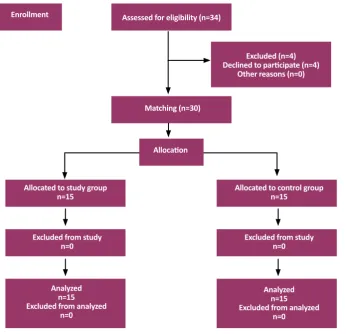
As shown in Figure 1, from the 34 prospective
par-ticipants recruited from the center of rehabilitation and vocational training, 4 participants were excluded be-cause of not meeting the inclusion criteria. By matching allocation (based on age, gender, education and type of
disability), 15 disabled persons were assigned into the intervention group and 15 others into the control group. The inclusion criteria were physically disabled adoles-cents being 13 to 18 years old, having normal IQ, be-ing educated, and havbe-ing physical ability to attend the training sessions. The excluding criteria were unwilling-ness to participate and absence in more than 2 training sessions. The objective and protocol of the study were described to the participants before signing the written informed consent. In addition, one of the physically dis-abled adolescents, who was close with other members and had a training experience, served as the facilitator in the training sessions.
Intervention plan and study tools
The tools employed in the current study were de-mographic data questionnaire and Felner social
com-petence scale [21]. The socio-demographic data
ques-tionnaire included data on age, gender, educational level, and disbility type. In addition, Felner social competence scale contained 47 questions in 4 dimen-sions of cognitive (e.g. sense of responsibility and
criti-Figure 1. Flowchart of the study Enrollment
Allocation Assessed for eligibility (n=34)
Matching (n=30)
Excluded (n=4) Declined to participate (n=4)
Other reasons (n=0)
Allocated to control group n=15
Allocated to study group n=15
Excluded from study n=0 Excluded from study
n=0
Analyzed n=15 Excluded from analyzed
n=0 Analyzed
n=15 Excluded from analyzed
cal reception), behavioral (e.g. escape from school and completing homework), emotional (e.g. affection for parents and friends), and motivational skills (e.g. doubt in personal abilities and optimism about the future). It had a Likert-type Scale with 7 response options rang-ing from “strongly agree” to “strongly disagree”. The validity and reliability of the questionnaire has been
confirmed in previous studies [21, 22].
The social competence questionnaire was completed by the groups both at the beginning and the end of train-ing program. The intervention group was trained for 8 weeks in terms of assertiveness skills, self-relaxation techniques, cognitive restructuring, stress inoculation training, and self-efficacy. The control group received no special trainings. Each session content included the following items:
First week: Creating a positive and supportive relation-ship among members and the social worker, as well as creating positive impressions among group members. Second week: Promoting trust and group interactions, creating a positive environment for the members, and implementing group activities to enhance member con-fidence. Third week (skills related to the cognitive di-mension): Understanding the efficient and inefficient be-liefs when working on issues, educating the participants about cognitive restructuring to change the beliefs and perceptions about problems and inefficient behaviors. Fourth week (skills related to the behavioral dimension): Assertiveness training through role playing exercises. Fifth week (skills related to the motivational dimension): Educating participants about self-efficacy and its stages (self-regulation, succession experiences, and self-talk), and helping members with creating life purpose, and self-regulation. Sixth week: Making progress in training regarding the previous session. Practicing self-talk tech-niques in a challenging situation. Seventh week (skills related to the emotional dimension): Stress inocula-tion training, and practicing self-relaxainocula-tion techniques. Eighth week: Finalizing the teamwork and reviewing the whole process.
All techniques were applied for all 15 participants in the intervention group and in a similar manner. Training sessions lasted 60 minutes and were held once per week. All training sessions were held in the Center of Reha-bilitation and Vocational Training in Sanandaj. A trained social worker delivered the intervention sessions. All of the participants completed the treatment protocol. There was no missing data on the intervention sessions.
Data analysis
The obtained data were analyzed using SPSS. Descrip-tive statistics including mean and standard deviation scores were computed for all variables. In addition, the Chi-square, Independent samples t-test, and Paired t test were used to verify the study assumptions. The signifi-cance level was set at P<0.05.
3. Results
According to the demographic findings, the Mean±SD age of the intervention and control groups were 15.47±1.40 and 15.80±1.56 years, respectively. The participants included 8 boys and 7 girls in both groups. In the intervention group, 27% were educated up to the elementary school, 60% intermediate school, and 13% high school. In the control group, 27% were educated up to the elementary school, 46% intermediate school, and 27% high school. In addition, 80% of participants suffered from congenital disabilities and 20% were dis-abled because of accidents (in both groups). In terms of type of disability, 20% of the participants in the inter-vention group suffered from ataxia, 47% from Cerebral Palsy (CP), 13% from Spinal Cord Injury (SCI), 13% from amputations, and 7% from poliomyelitis. While in the control group, 13% suffered from ataxia, 54% from CP, 13% from SCI, 13% from amputations and 7% from poliomyelitis. According to the Mann-Whit-ney U Test and Chi-square Test results, both groups had the same type of disability and educational level. Moreover, no significant difference was observed be-tween the intervention and control groups in terms of
demographic data (Table 1).
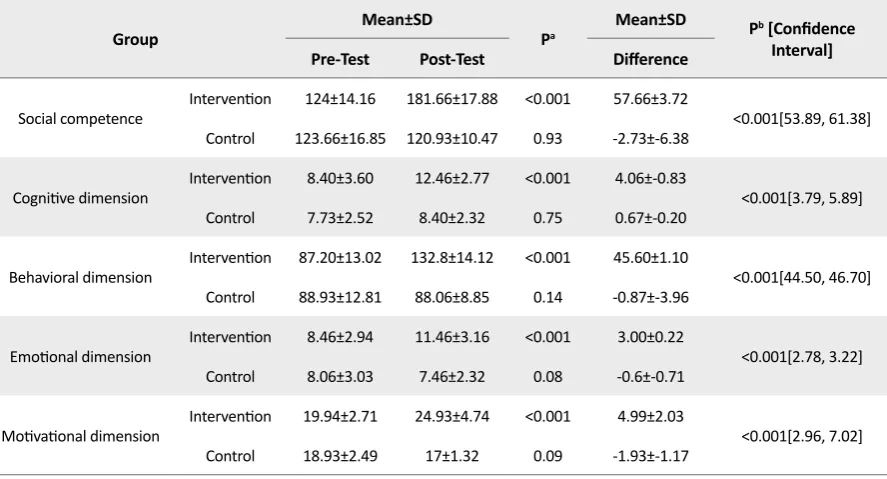
The results of Independent samples t test were calculat-ed bascalculat-ed on the differences between mean scores of so-cial competence and its dimensions in pre-test and post-test, obtained from the intervention and control groups
(first P) (Table 2). As a result, the mean score of social
competence and its dimensions were higher in the inter-vention group compared to the control group (P=0.001).
As presented in Table 2, it is suggested that social
group work interventions and CBT had a positive effect on social competence (and its cognitive, behavioral, emotional and motivational dimensions) in the interven-tion group. In order to confirm the validity of the results, the means score of all 5 main variables were evaluated.
According to Table 2, the differences were significant in
Table 1. Demographic information of the intervention and control groupsa
Demographic Factors Intervention Control Total P
Gender
Male 7(46.7) 8(53.3) 15(50)
1
Female 8(53.3) 7(46.7) 15(50)
Total 15(100) 15(100) 30(100)
Type of disability
Ataxia 2(13.3) 3(20) 5(16.7)
0.761
Cerebral Palsy 8(53.3) 7(46.7) 15(50)
Spinal cord injury 2(13.3) 2(13.3) 4(13.3)
Amputations 1(6.7) 1(6.7) 2(6.7)
Poliomyelitis 2(13.3) 2(13.3) 4(13.3)
Total 15(100) 15(100) 30(100)
Educational level
Elementary school 4(26.7) 4(26.7) 8(26.7)
0.438
Guidance school 9(60) 7(46.7) 16(53.3)
High school 2(13.3) 4(26.7) 6(20)
Total 15(100) 15(100) 30(100)
Age, y Mean±SD 15.47±1.40 15.80±1.56 15.64±1.48 0.652
a: Data are presented in No. (%) or Mean±SD.
Table 2. Independent samples t-test results of differences between the study variables in the intervention and control groups (N=30)
Group Mean±SD Pa Mean±SD Pb [Confidence
Interval]
Pre-Test Post-Test Difference
Social competence Intervention 124±14.16 181.66±17.88 <0.001 57.66±3.72 <0.001[53.89, 61.38]
Control 123.66±16.85 120.93±10.47 0.93 -2.73±-6.38
Cognitive dimension Intervention 8.40±3.60 12.46±2.77 <0.001 4.06±-0.83 <0.001[3.79, 5.89]
Control 7.73±2.52 8.40±2.32 0.75 0.67±-0.20
Behavioral dimension Intervention 87.20±13.02 132.8±14.12 <0.001 45.60±1.10 <0.001[44.50, 46.70]
Control 88.93±12.81 88.06±8.85 0.14 -0.87±-3.96
Emotional dimension Intervention 8.46±2.94 11.46±3.16 <0.001 3.00±0.22 <0.001[2.78, 3.22]
Control 8.06±3.03 7.46±2.32 0.08 -0.6±-0.71
Motivational dimension Intervention 19.94±2.71 24.93±4.74 <0.001 4.99±2.03 <0.001[2.96, 7.02]
Control 18.93±2.49 17±1.32 0.09 -1.93±-1.17
4. Discussion
In this study, the CBT improved social competence among physically disabled adolescents, so that after CBT, social competence significantly improved in the intervention group compared to the controls. This find-ing is in agreement with the results of similar studies
conducted in this field [22-25]. Momeni et al. reported
the positive impact of life skills training on enhancement
of social and emotional competence in students [22]. It
seems that CBT has a positive effect on social compe-tence among physically disabled adolescents. The results also revealed that social work interventions using the CBT had a significant effect on all cognitive, behavioral, emotional, and motivational dimensions among adoles-cents with physical disability. This finding complies with the results of some studies such as Evans and Allze, Jans-son et al. and Hronis et al. For example, Evans and Al-lze (2018) demonstrated that CBT decrease the client’s
feelings of anger and increase their self-esteem [26-28].
Previous studies have mainly focused on the role of CBT in reducing psychological and behavioral problems in the normal population. However, the current study focused on the effect of CBT on social competence in physically disabled adolescents.
There are not sufficient supportive recourses in the developing countries to address the needs of people with disabilities. In addition, disabled people face more social stigma in these countries and are seldom pres-ent in public areas. Therefore, applying assertiveness, self-relaxation, cognitive restructuring, stress inocu-lation, and self-efficacy techniques as a social group work intervention can be an effective way to promote the social competence. It could subsequently increase their attendance in educational and occupational fields. Therefore, social workers and professionals are rec-ommended to benefit from these trainings to support physically disabled persons.
Although this study has accomplished its goals, a number of limitations need to be noted. The lack of a follow-up measure to examine whether the results are maintained in the future was among the main limita-tions. Another limitation in this study relates to the lack of standard training programs for social group work in physically disabled persons.
Further study should focus on the social dimensions of disabilities in order to better know about the effects and dimensions of this issue. Evaluation of the effectiveness of the intervention package introduced in this study with
the aim of improving social competence in other groups of adolescents and comparing them with people with dis-abilities are also suggested. A follow-up evaluation should be conducted to assess the validity of obtained results.
5. Conclusion
CBT within the social group work is an efficient meth-od to increase social competence among physically disabled adolescents. Thus, the coaches and teachers of such adolescents are recommended to make use of this technique to increase their social competence and subse-quently increase their presence in public areas.
Ethical Considerations
Compliance with ethical guidelines
The purpose and protocol of the study was fully ex-plained to the participants and all of them provided a written informed consent. Furthermore, upon comple-tion of the study, the control group received CBT with the same order. The study was approved by the Ethics Committee of the University of Social Welfare and Re-habilitation Sciences (IR.USWR.No.700.240).
Funding
The present paper was extracted from the MSc. the-sis of Faeze Seyedi in Social Work, University of Social Welfare and Rehabilitation Sciences.
Authors contributions
Study concept and design: Faeze Seyedi, Mansour Fa-thi, Asghar Dadkhah, Seyed Hossein Mohaqeqi Kamal; Interpretation of data: Poria Reza Soltani, Faeze Seyedi; Manuscript preparation: Seyed Hossein Mohaqeqi Ka-mal.
Conflict of interest
The authors declared no conflict of interest.
Acknowledgements
References
[1] Leonardi M, Bickenbach J, Ustun TB, Kostanjsek N, Chatterji S.
The definition of disability: What is in a name? The Lancet. 2006; 368(9543):1219-21. [DOI:10.1016/S0140-6736(06)69498-1] [2] World Health Organization. International Classification of Func
-tioning, disability and health (ICF). Geneva: World Health Or
-ganization; 2017.
[3] Fellinghauer B, Reinhardt JD, Stucki G, Bickenbach J. Explain-ing the disability paradox: A cross-sectional analysis of the
Swiss general population. BMC Public Health. 2012; 12:655.
[DOI:10.1186/1471-2458-12-655] [PMID] [PMCID]
[4] Stevelink SA, Van Brakel WH, Augustine V. Stigma and social
participation in Southern India: Differences and commonalities
among persons affected by leprosy and persons living with HIV/ AIDS. Psychology, Health & Medicine. 2011; 16(6):695-707. [DOI:1
0.1080/13548506.2011.555945] [PMID]
[5] Van Brakel WH. Measuring health-related stigma-a literature review. Psychology, Health & Medicine. 2006; 11(3):307-34.
[DOI:10.1080/13548500600595160] [PMID]
[6] Disabilities, Opportunities, Internetworking, and Technology (DO.IT). National Information Center for Children and Youth
with Disabilities (NICHCY). Washington: Disabilities, Opportuni
-ties, Internetworking, and Technology (DO.IT); 2017.
[7] Burt KB, Obradović J, Long JD, Masten AS. The interplay of social competence and psychopathology over 20 years: Testing transac
-tional and cascade models. Child Development. 2008;
79(2):359-74. [DOI:10.1111/j.1467-8624.2007.01130.x] [PMID]
[8] Semrud Clikeman M. Social competence in children. Berlin:
Springer; 2007. [DOI:10.1007/978-0-387-71366-3_3]
[9] Posner MI, Rothbart MK. Developing mechanisms of
self-reg-ulation. Development and Psychopathology. 2000; 12(3):427-41.
[DOI:10.1017/S0954579400003096]
[10] Eiden RD, Colder C, Edwards EP, Leonard KE. A longitudi-nal study of social competence among children of alcoholic and nonalcoholic parents: Role of parental psychopathology, parental warmth, and self-regulation. Psychology of Addictive Behaviors.
2009; 23(1):36-46. [DOI:10.1037/a0014839] [PMID] [PMCID]
[11] Spinrad TL, Eisenberg N, Gaertner B, Popp T, Smith CL, Kupfer
A, et al. Relations of maternal socialization and toddlers’ effortful
control to children’s adjustment and social competence.
Devel-opmental Psychology. 2007; 43(5):1170-86. [DOI:10.1037/0012-1649.43.5.1170] [PMID] [PMCID]
[12] Ganesalingam K, Yeates KO, Taylor HG, Walz NC, Stancin T,
Wade S. Executive functions and social competence in young chil
-dren 6 months following traumatic brain injury. Neuropsychol
-ogy. 2011; 25(4):466-76. [DOI:10.1037/a0022768] [PMID] [PMCID]
[13] González Prendes AA, Hicks LM, Matthews Th, Domke S. Cog -nitive behavioral therapy in social work. In: Mullen EJ, editors.
Social Work . Oxford: Oxford University Press; 2012.
[14] Dobson D, Dobson KS. Evidence-based practice of
cognitive-behavioral therapy. New York: Guilford Press; 2008.
[15] Haby MM, Donnelly M, Corry J, Vos T. Cognitive behavioural
therapy for depression, panic disorder and generalized anxiety
disorder: A meta-regression of factors that may predict outcome.
Australian and New Zealand Journal of Psychiatry. 2006;
40(1):9-19. [DOI:10.1080/j.1440-1614.2006.01736.x] [PMID]
[16] Hofmann SG, Asnaani A, Vonk IJ, Sawyer AT, Fang A. The
efficacy of cognitive behavioral therapy: A review of meta-analyses. Cognitive Therapy and Research. 2012; 36(5):427-40.
[DOI:10.1007/s10608-012-9476-1] [PMID] [PMCID]
[17] Hofmann SG, Smits JA. Cognitive-behavioral therapy for adult
anxiety disorders: A meta-analysis of randomized placebo-con
-trolled trials. The Journal of Clinical Psychiatry. 2008; 69(4):621-32.
[DOI:10.4088/JCP.v69n0415] [PMID] [PMCID]
[18] Joseph JD, Rausch A, Strain PS. Social competence and
young children with special needs: Debunking
“mythcon-ceptions”. Young Exceptional Children. 2018; 21(1):48-60.
[DOI:10.1177/1096250615621359]
[19] Romero V, Fitzpatrick P, Roulier S, Duncan A, Richardson MJ,
Schmidt RC. Evidence of embodied social competence during conversation in high functioning children with autism spectrum
disorder. PLOS One. 2018; 13(3):e0193906. [DOI:10.1371/journal. pone.0193906]
[20] Noushabadi FR, Adibsereshki N, Sajedi F, Bakhshi E, Rostami
M, Syakhaneh S. Social competence of students with learning dis-ability: Advantages of verbal self-instructional package. Iranian
Rehabilitation Journal. 2015; 13(1):8-13.
[21] Felner RD, Lease AM, Phillips RSC. Social competence and
the language of adequacy as a subject matter for psychology: A quadripartite tri-level framework. In Gullotta TP, Adams GR, Montemayor R, editors. The Development of Social Competence
in Adolescence. Thousand Oaks: Sage Publications; 1990.
[22] Momeni S, Barak M, Kazemi R, Abolghasemi A, Babaei M,
Ezati F. Study of the effectiveness of social skills training on so -cial and emotional competence among students with
mathemat-ics learning disorder. Creative Education. 2012; 3(08):1307-10.
[DOI:10.4236/ce.2012.38191]
[23] Bana S, Sajedi F, Mirzaie H, Rezasoltani P. The efficacy of cogni -tive behavioral play therapy on self esteem of children with
intel-lectual disability. Iranian Rehabilitation Journal. 2017; 15(3):235-42. [DOI:10.29252/nrip.irj.15.3.235]
[24] Soleimani Sefat E, Younesi SJ, Dadkhah A, Rostami M.
Effec-tiveness of cognitive behavioral therapy training in reducing de-pression in visually impaired male students. Iranian
Rehabilita-tion Journal. 2017; 15(2):165-72. [DOI:10.18869/nrip.irj.15.2.165]
[25] Poulsen S, Lunn S, Daniel SI, Folke S, Mathiesen BB, Katznel
-son H, et al. A Randomized Controlled Trial of Psychoanalytic
Psychotherapy or Cognitive-Behavioral Therapy for Bulimia
Nervosa. American Journal of Psychiatry. 2014; 171(1):109-16.
[DOI:10.1176/appi.ajp.2013.12121511] [PMID]
[26] Evans L, Allez K. Cognitive behaviour therapy for low self-es
-teem in a person with a learning disability: A case study.
Advanc-es in Mental Health and Intellectual DisabilitiAdvanc-es. 2018; 12(2):67-76.
[DOI:10.1108/AMHID-06-2017-0023]
[27] Jansson Fröjmark M, Linton SJ, Flink IK, Granberg S, Danermark
B, Norell Clarke A. Cognitive-behavioral therapy for insomnia
co-morbid with hearing impairment: A randomized controlled trial. Journal of Clinical Psychology in Medical Settings. 2012;
19(2):224-34. [DOI:10.1007/s10880-011-9275-y] [PMID]
[28] Hronis A, Roberts L, Kneebone II. A review of cognitive impair
-ments in children with intellectual disabilities: Implications for cognitive behaviour therapy. British Journal of Clinical