Exploring the English Language Needs of EAP
Students of Humanities and Social Sciences in Iran:
A Triangulated Approach
Amir Zand-Moghadam
Assistant Professor of Applied Linguistics, Allameh Tabataba’i University
Hussein Meihami
PhD in Applied Linguistics, Shiraz University
Farhad Ghiasvand
PhD Candidate of TEFL, Allameh Tabataba’i University
Abstract
Given the fact that few studies have investigated the English language needs of EAP students in Iran, the present study was an attempt to analyze the needs of Iranian EAP learners of Humanities and Social Sciences. To this end, 114 EAP learners at different educational levels (BA, MA, and Ph.D.) and with different English proficiency levels (elementary, intermediate, and advanced) were asked to provide their responses to a questionnaire. Moreover, ten EAP learners and eight EAP instructors were asked to write narratives about their experiences in EAP courses. Their narratives were then analyzed based on Strauss and Corbin's (1998) systematic approach. The results revealed that the EAP courses did not pay the deserved attention to writing, speaking, and listening skills, while the coverage of the sub-skills (grammar and vocabulary) was successful. Moreover, it was revealed that the EAP textbooks were insufficient in terms of the inclusion of language skills, community-specific cultural issues and conventions, and the topical knowledge. The analysis of the EAP learners’ needs also showed that not all interaction types happened in the EAP courses. Furthermore, the analysis of the narratives of EAP learners and EAP instructors indicated that the EAP curriculum, EAP textbooks and also EAP assessment should include the four language skills, provide a communicative venue for EAP learners to practice their disciplinary issues, and design communicative materials. It can be concluded that the current EAP curriculum needs revision to fulfill the EAP learners’ present and target situation needs.
Keywords: EAP instructors, EAP learners, Narrative analysis, Needs analysis
INTRODUCTION
According to Anthony (2015) “English for Specific Purposes (ESP) is an approach to language teaching that targets the current and/or future academic or occupational needs of learners, [and] focuses on the language, skills, discourses, and genres required to address these needs...” (p. 2). Thus, the main goal of ESP, following Anthony, is to help learners fulfill their general and specific needs; this assistance will be through instruction.
The emergence of ESP dates back to the 1950s when the development in science, technology, and business turned into the highlighted purpose of many countries all around the world. At that time, English was considered as the world’s lingua franca (Kırkgöz & Dikilitaş, 2018) to facilitate communication among people of different nationalities and with different languages. Later, when the inquiries for which people tried to communicate became more specific, and the communications among people became more need-driven, ESP and EAP found their way to become the reason and motive of some practitioners to conduct studies regarding ESP and EAP needs analysis. Accordingly, a guiding principle became widespread among the English language educationists, which tried to tailor the needs and demands of language learners of different disciplines to make them competent in communicating for specific purposes (Hutchinson & Waters, 1987; Kırkgöz & Dikilitaş, 2018). Such a needs analysis procedure is part of what is called English for academic purposes (EAP) as a sub-section of ESP.
analysis” or sometimes “needs assessment,” which helps the field to design and tailor the best approaches and materials based on the needs of the students. Therefore, needs analysis in EAP and ESP is an important arena of research. By scrutinizing the world-leading journals in the field of ESP and EAP, such as English for Specific Purposes Journal and Journal of English for Academic Purposes, it will be revealed that many of the research studies have been devoted to needs analysis of EAP and ESP students around the world.
LITERATURE REVIEW
Needs Analysis in EAP
When talking about needs analysis, one can think of it as a process. According to Dudley-Evans and St. John (1998, p. 121), needs analysis is “the process of establishing the what and how of a course.” It means that needs analysis deals with a deep process of understanding the desires and wants of L2 learners who have different goals to learn English. Moreover, needs analysis can be regarded as an appropriate tool to recognize the learners’ language needs based on the contexts (Long, 2005; Weddel & Duzer, 1997). The key term, here, in the context that is influential when the needs of learners are investigated. Accordingly, as pointed out by Flowerdew (2013), it can be stated that if the context in which and for which the learners want to learn English will be ignored, the obtained needs will not be the exact mirror of what should be followed in the process of EAP and ESP instruction. Furthermore, the fact that needs analysis is a process and a context-oriented phenomenon is emphasized by Brown (1995) in that needs analysis is a set of practices involving the data gathering and data analysis regarding the necessary elements which should be included in the curricula to address those needs. Furthermore, Nunan (1994, p. 54) describes needs analysis as “a set of procedures for specifying the parameters of a course of study. Such parameters include the criteria and rationale for grouping learners, the selection and sequencing of course content, methodology, course length, and intensity and duration.” Moreover, Hyland (2006, p. 74) defines needs analysis as
the techniques for collecting and assessing information relevant to course design: it is the means of establishing the how and what of a course. It is a continuous process since we modify our teaching as we come to learn more about our students, and in this way, it actually shades into evaluation – the means of establishing the effectiveness of a course.
the models of needs analysis are target situation analysis, present situation analysis, Hutchinson and Waters' (1987) model, and Dudley-Evans and St John's (1998) model of needs analysis which will be presented in the following sections.
Target Situation Analysis
Target situation analysis refers to the contexts in which the learners have to realistically use the L2 they are learning. It is similar to the English as a second language (ESL) context in that the learners have different opportunities to make use of the L2 they have learned before. According to Robinson (1991), the target situation analysis focuses on what the needs of the learners will be at the end of the language course. Li (2014, p. 1870) states that “the target situation includes the language application information, communicative skills, and the cognition of the teaching objectives of the learners, working institutions and societies.” This means that the target situation model of needs analysis has an overall view of the needs of the learners. In this regard, this model is in a similar vein to the one proposed by Munby (1978), namely communication needs processor. Munby’s model emphasizes communication variables, such as topics, participants, and media. To summarize, the target situation analysis model of needs analysis deals with the target communicative needs of the learners.
Present Situation Analysis
etc. will be considered as important issues (Li, 2014) to bridge what the EAP learners need at present with, simultaneously, what they should be prepared for their future real needs.
Hutchinson and Waters' (1987) Model
The needs analysis model proposed by Hutchinson and Waters (1987) concentrates on a learning-centered approach toward needs analysis, meaning that the emphasis of the model is on the learning aspects(s) of the ESP and EAP learners. Hutchinson and Waters (1987) divide the model into two dichotomies, encompassing target needs and learning needs. The three main concepts related to target needs are necessities, lacks, and wants. Li (2014) states that necessities are determined by what is demanded by the target situations. Addressing these necessary issues will help learners to use language effectively in the target situations. Moreover, lacks are the unknown issues existing between the necessities and the current proficiency. It can be stated that these lacks are the objective needs of the learners, which should be addressed through the curriculum and syllabus. Finally, wants are the other part of the target situation needs, which are about the subjective needs of the learners. These subjective needs are difficult to be perceived by the teachers of the courses or even curriculum designers, thus curriculum designers need to let the curriculum open for the educational agility of the teachers to obtain these needs. The second dichotomy of the learning-centered approach model of needs analysis proposed by Hutchinson and Waters (1987) is the learning needs, including “learners’ motivation of learning the language, the way they prefer to learn, the available resources, the time and place the course will take place and the learners’ personal information” (Li, 2014, p. 1871). Addressing these needs in the EAP learning context is of utmost importance and should be in line with the target situation needs.
Dudley-Evans and St John's (1998) Model of Needs Analysis
information about the target situation, learners’ lacks, learners’ needs from the course, language learning needs, and professional information about learners. Each of these aspects refers to a specific need associated with ESP and EAP learning. While, for instance, professional information about learners is about the learners’ needs related to the target situation issues and objective needs, the personal information about the learners is about their background and their previous experiences. That said, the cultural background and learners’ attitudes are regarded as important in obtaining the needs of the EAP and ESP learners. These needs are the correspondence of the subjective needs of the learners. Language learning needs are related to the methods and approaches needed to teach in ESP and EAP contexts. Obtaining these needs is very important since they let curriculum designers know how to teach the ESP and EAP concepts to suit the learners’ needs. Based on this model, other needs, such as the learners’ lacks should be addressed meticulously in order to establish a successful EAP and ESP program.
PURPOSE OF THE STUDY
The purpose of this study was to investigate the needs of the students of the main majors of humanities and social sciences. Hence, the EAP learners’ majors, educational levels, and general English proficiency levels were taken into consideration. The following research questions were then formulated:
1. What are the needs of EAP learners of humanities and social sciences from their perspectives and the EAP instructors’ perspectives?
2. Are there any statistically significant differences between the needs of the EAP learners majoring in humanities and those majoring in social sciences?
3. Are there any statistically significant differences between the needs of the EAP learners at different educational levels, including BA, MA, and Ph.D.?
METHODOLOGY
Participants and Settings
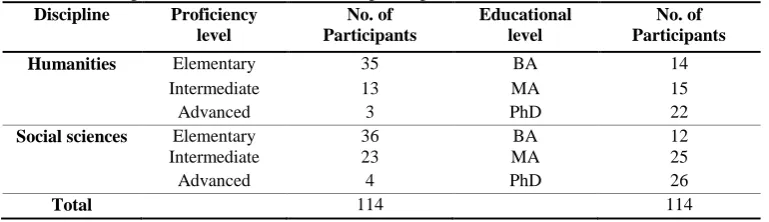
A total number of 114 EAP learners from different majors of humanities and social sciences were selected based on convenience sampling. From the total, 51 participants were students of humanities, including law, geography, history, accounting, Persian literature, and philosophy, and 63 of them were the students of different majors of social sciences, including educational psychology, sociology, economics, and management. These participants were selected from two state universities, namely Allameh Tabataba’i University and Shiraz University. Forty-eight of the participants were Ph.D. students, 40 were MA students, and 26 were BA students. Furthermore, the students’ general English proficiency level was identified through self-uttered reports. Based on the reports, 71 students considered their general proficiency level as the elementary, 36 students claimed intermediate as their current general proficiency level, and, seven students asserted that their general English proficiency level was advanced at the time of conducting this study. To obtain reliable responses about the general English proficiency level of the participants, they were asked to state why they thought they were grouped under elementary, intermediate, or advanced. It was then found out that 95% of the participants’ asserted levels were based on the proficiency levels English language institutes had already identified. The other 5% declared that they had taken part in English proficiency tests either at their university or at language institutes. On top of this, the students were asked whether or not they had passed a course in EAP. The responses obtained to this inquiry showed that not only all of the participants had passed a course in general English at their university, but also they passed or were passing a course in EAP at the time of doing this study.
identified EAP learners’ needs. Table 1 illustrates the characteristics of the participants in this study (EAP learners only).
Table 1: Background information about the participants
Discipline Proficiency level
No. of Participants
Educational level
No. of Participants Humanities Elementary 35 BA 14
Intermediate 13 MA 15
Advanced 3 PhD 22
Social sciences Elementary 36 BA 12
Intermediate 23 MA 25
Advanced 4 PhD 26
Total 114 114
Instrumentation
EAP Needs Analysis Questionnaire
stated that in some of the statements, 1 means (never), 2 (seldom), 3 (sometimes), 4 (often), and 5 (always).
To validate the questionnaire, after developing different parts, the same EAP and ESP experts were asked to raise their opinions about the questionnaire and the necessary corrections were made. Moreover, the questionnaire was piloted once with 45 students in the humanities and social sciences for the matter of obtaining its overall and componential reliability. Conducting different Cronbach’s Alphas, the overall reliability index was α=.72. Moreover, the componential Cronbach’s Alpha was α=.72 for language skills, α=.78 for language sub-skills, α=.8 for EAP materials, α=.71 for EAP assessment, and α=.73 for educational EAP environment. The results of Cronbach’s Alphas, both the overall and the componential ones, showed acceptable level of reliability. Consequently, the questionnaire was administrated to 114 students of humanities and social sciences as the participants of the main study.
Narratives Authored by the EAP Learners and EAP Instructors
Qualitizing the research studies which only use the questionnaire as the main instrument of data collection is considered as a very important issue (Dornyei, 2007) due to methodological issues that the questionnaires have in collecting valid and reliable data. To that end, the narrative inquiry was used in this study to collect qualitative data about the EAP learners’ needs. Given that, the narratives authored by ten students who had already responded to the questionnaire were gathered. Moreover, to analyze the perspectives of the EAP instructors about the EAP learners’ needs, the narratives authored by eight EAP instructors who were instructing EAP courses were also collected.
interactionally oriented approach considers self-development as a process with different interactions between the narrator and narrative analyst. It is highly important to note that the term identity construction here means how the individuals engage in a practice and imagine different aspects of an issue. It was believed that by asking the participants to write down their narratives of their experience during the EAP courses, they would provide the researchers with invaluable points about the needs they had in the past, or even would have in the future. That said since there were no interactions with the participants, or better to say no treatment was applied in the study, the participants were asked to write their biographical narratives about their experiences of the EAP courses that they participated in.
Data Analysis Procedure
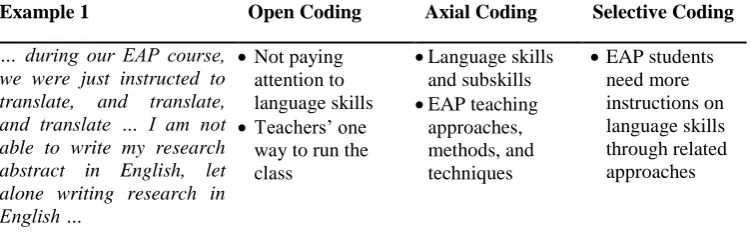
Table 2: An example of narrative analysis based on a systematic approach (Strauss & Corbin, 1998)
Example 1 Open Coding Axial Coding Selective Coding
… during our EAP course, we were just instructed to translate, and translate, and translate … I am not able to write my research abstract in English, let alone writing research in English …
Not paying attention to language skills
Teachers’ one way to run the class
Language skills and subskills
EAP teaching approaches, methods, and techniques
EAP students need more instructions on language skills through related approaches
As can be seen in Table 2, this EAP student thinks that he needs the writing skill to be able to have research communication in his major. Moreover, through his narratives, he talks about his never-ending translating sessions, which indicates that he is not happy with the course. Furthermore, implicitly, this part of the narrative elucidates that the EAP instructor did not implement an appropriate approach to the instruction of EAP in the class.
RESULTS
The EAP Learners Needs: Responses to the Questionnaire
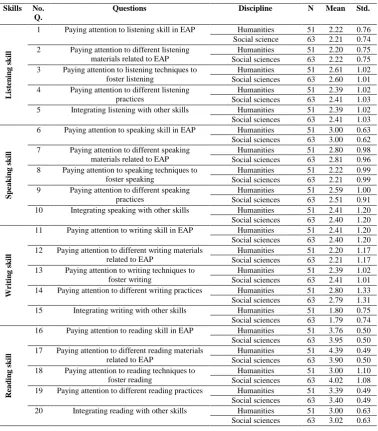
Table 3: EAP learners’ responses to how skills are addressed in EAP courses: descriptive statistics
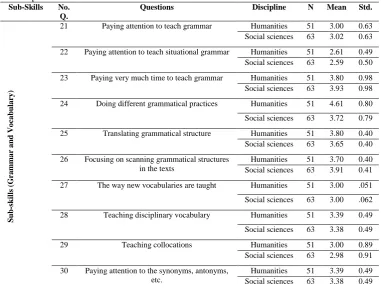
The EAP learners’ responses were also investigated regarding the two language sub-skills, including grammar and vocabulary. Table 4
Skills No.
Q.
Questions Discipline N Mean Std.
L ist en in g sk il l
1 Paying attention to listening skill in EAP Humanities 51 2.22 0.76 Social science 63 2.21 0.74 2 Paying attention to different listening
materials related to EAP
Humanities 51 2.20 0.75 Social sciences 63 2.22 0.75 3 Paying attention to listening techniques to
foster listening
Humanities 51 2.61 1.02 Social sciences 63 2.60 1.01 4 Paying attention to different listening
practices
Humanities 51 2.39 1.02 Social sciences 63 2.41 1.03 5 Integrating listening with other skills Humanities 51 2.39 1.02 Social sciences 63 2.41 1.03
S p ea k in g sk il l
6 Paying attention to speaking skill in EAP Humanities 51 3.00 0.63 Social sciences 63 3.00 0.62 7 Paying attention to different speaking
materials related to EAP
Humanities 51 2.80 0.98 Social sciences 63 2.81 0.96 8 Paying attention to speaking techniques to
foster speaking
Humanities 51 2.22 0.99 Social sciences 63 2.21 0.99 9 Paying attention to different speaking
practices
Humanities 51 2.59 1.00 Social sciences 63 2.51 0.91 10 Integrating speaking with other skills Humanities 51 2.41 1.20 Social sciences 63 2.40 1.20
Wr it in g sk il l
11 Paying attention to writing skill in EAP Humanities 51 2.41 1.20 Social sciences 63 2.40 1.20 12 Paying attention to different writing materials
related to EAP
Humanities 51 2.20 1.17 Social sciences 63 2.21 1.17 13 Paying attention to writing techniques to
foster writing
Humanities 51 2.39 1.02 Social sciences 63 2.41 1.01 14 Paying attention to different writing practices Humanities 51 2.80 1.33 Social sciences 63 2.79 1.31 15 Integrating writing with other skills Humanities 51 1.80 0.75 Social sciences 63 1.79 0.74
R ea d in g sk il l
16 Paying attention to reading skill in EAP Humanities 51 3.76 0.50 Social sciences 63 3.95 0.50 17 Paying attention to different reading materials
related to EAP
Humanities 51 4.39 0.49 Social sciences 63 3.90 0.50 18 Paying attention to reading techniques to
foster reading
indicates the results of the responses provided by the EAP learners. Table 4 shows that, overall, the EAP learners in both disciplines believed grammar and vocabulary were highly (mean score around 3.80) addressed in the EAP courses in terms of the time allocated to teaching grammar, grammatical practices, translating grammatical structure, finding specific grammatical points in the texts, teaching collocations, and addressing synonyms and antonyms. However, situational grammar is not paid due attention in their EAP courses (mean score around = 2.60). Situational grammar is conducive to situational communication, which is an inseparable part of disciplinary communication.
Table 4: EAP learners’ responses to how sub-skills are addressed in EAP courses: Descriptive statistics
Sub-Skills No.
Q.
Questions Discipline N Mean Std.
Sub
-sk
il
ls (G
ra
mm
a
r
a
n
d
V
o
ca
b
u
la
ry
)
21 Paying attention to teach grammar Humanities 51 3.00 0.63 Social sciences 63 3.02 0.63
22 Paying attention to teach situational grammar Humanities 51 2.61 0.49 Social sciences 63 2.59 0.50
23 Paying very much time to teach grammar Humanities 51 3.80 0.98 Social sciences 63 3.93 0.98
24 Doing different grammatical practices Humanities 51 4.61 0.80
Social sciences 63 3.72 0.79
25 Translating grammatical structure Humanities 51 3.80 0.40 Social sciences 63 3.65 0.40
26 Focusing on scanning grammatical structures in the texts
Humanities 51 3.70 0.40 Social sciences 63 3.91 0.41
27 The way new vocabularies are taught Humanities 51 3.00 .051
Social sciences 63 3.00 .062
28 Teaching disciplinary vocabulary Humanities 51 3.39 0.49
Social sciences 63 3.38 0.49
29 Teaching collocations Humanities 51 3.00 0.89 Social sciences 63 2.98 0.91
30 Paying attention to the synonyms, antonyms, etc.
Humanities 51 3.39 0.49 Social sciences 63 3.38 0.49
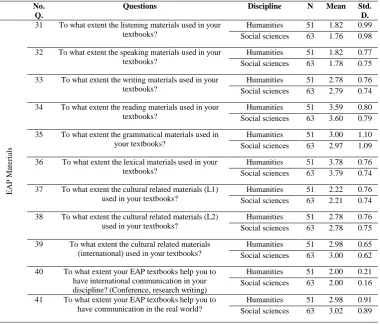
shown in Table 5. As can be seen, the respondents had repeated their responses regarding the inclusion of language skills in the EAP courses in that they believed that the EAP textbooks, as the main sources of EAP courses, did not include listening, speaking, and writing materials (overall mean score around = 2.2). However, they thought that the EAP textbooks pay the deserved attention to the reading skill. On top of this, the EAP learners asserted that the EAP textbooks did not pay attention to cultural issues (L1, L2, and international cultures). Finally, it was revealed that the EAP learners did not think that the EAP textbooks train them for international disciplinary communication (overall mean score around = 2.3).
Table 5: EAP learners’ responses about EAP materials in EAP courses: Descriptive statistics
No. Q.
Questions Discipline N Mean Std.
D. EA P M at er ia ls
31 To what extent the listening materials used in your textbooks?
Humanities 51 1.82 0.99 Social sciences 63 1.76 0.98
32 To what extent the speaking materials used in your textbooks?
Humanities 51 1.82 0.77 Social sciences 63 1.78 0.75
33 To what extent the writing materials used in your textbooks?
Humanities 51 2.78 0.76 Social sciences 63 2.79 0.74
34 To what extent the reading materials used in your textbooks?
Humanities 51 3.59 0.80 Social sciences 63 3.60 0.79
35 To what extent the grammatical materials used in your textbooks?
Humanities 51 3.00 1.10 Social sciences 63 2.97 1.09
36 To what extent the lexical materials used in your textbooks?
Humanities 51 3.78 0.76 Social sciences 63 3.79 0.74
37 To what extent the cultural related materials (L1) used in your textbooks?
Humanities 51 2.22 0.76 Social sciences 63 2.21 0.74
38 To what extent the cultural related materials (L2) used in your textbooks?
Humanities 51 2.78 0.76 Social sciences 63 2.78 0.75
39 To what extent the cultural related materials (international) used in your textbooks?
Humanities 51 2.98 0.65 Social sciences 63 3.00 0.62
40 To what extent your EAP textbooks help you to have international communication in your discipline? (Conference, research writing)
Humanities 51 2.00 0.21 Social sciences 63 2.00 0.16
41 To what extent your EAP textbooks help you to have communication in the real world?
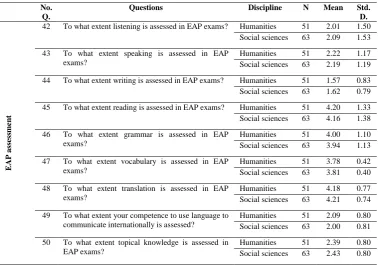
In another part of the questionnaire, the EAP learners’ assessment needs were investigated. To that end, it was investigated how EAP courses assess language skills, language sub-skills, translation, and topical knowledge. Table 6 indicates that based on the responses provided by the EAP learners to the items, to a great extent, none of the language skills expect for the reading skill, was assessed in the EAP courses. Moreover, it can be seen that the language sub-skills, including grammar and vocabulary, are assessed in the EAP exams. Translation from Persian to English and vice versa, moreover, has the highest mean score (about 4.20), while assessing international communicative competence (the ability to communicate in international contexts through English) using the English language is rather low (M = 2). The EAP learners also declared that sometimes the topical knowledge of their majors was assessed in the EAP exams.
Table 6: EAP learners’ responses about EAP assessment in EAP courses: Descriptive statistics
No. Q.
Questions Discipline N Mean Std.
D.
E
A
P
a
ssess
me
nt
42 To what extent listening is assessed in EAP exams? Humanities 51 2.01 1.50 Social sciences 63 2.09 1.53
43 To what extent speaking is assessed in EAP exams?
Humanities 51 2.22 1.17 Social sciences 63 2.19 1.19
44 To what extent writing is assessed in EAP exams? Humanities 51 1.57 0.83 Social sciences 63 1.62 0.79
45 To what extent reading is assessed in EAP exams? Humanities 51 4.20 1.33 Social sciences 63 4.16 1.38
46 To what extent grammar is assessed in EAP exams?
Humanities 51 4.00 1.10 Social sciences 63 3.94 1.13
47 To what extent vocabulary is assessed in EAP exams?
Humanities 51 3.78 0.42 Social sciences 63 3.81 0.40
48 To what extent translation is assessed in EAP exams?
Humanities 51 4.18 0.77 Social sciences 63 4.21 0.74
49 To what extent your competence to use language to communicate internationally is assessed?
Humanities 51 2.09 0.80 Social sciences 63 2.00 0.81
50 To what extent topical knowledge is assessed in EAP exams?
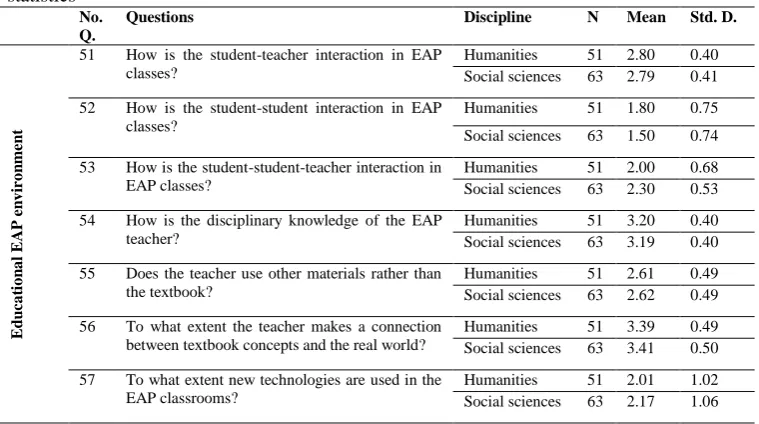
Furthermore, the EAP learners’ responses about the educational EAP environments were examined through the questionnaire. The reason behind this section of the questionnaire was to inform the researchers of the types of interactions that happened in the EAP classes, the EAP teachers’ use of materials other than the textbooks, and the use of technology in the classroom. Table 7 displays that the interaction types used in the EAP classrooms were mostly student-teacher interactions (M = 2.80), while the student-student and student-student-teacher interactions are rather low in the EAP classes. Moreover, Table 7 demonstrated that technologies are rarely used in the EAP classes (M = 2.15). However, when considering EAP teachers’ use of materials other than the textbooks and topical knowledge in the EAP classrooms, it was shown that, based on the EAP learners’ responses, sometimes the EAP teachers did so in their EAP classes.
Table 7: EAP learners’ responses about EAP educational environment: Descriptive statistics
No. Q.
Questions Discipline N Mean Std. D.
E d u ca ti o n a l E A P e n v ir o n me n t
51 How is the student-teacher interaction in EAP classes?
Humanities 51 2.80 0.40 Social sciences 63 2.79 0.41
52 How is the student-student interaction in EAP classes?
Humanities 51 1.80 0.75
Social sciences 63 1.50 0.74
53 How is the student-student-teacher interaction in EAP classes?
Humanities 51 2.00 0.68 Social sciences 63 2.30 0.53
54 How is the disciplinary knowledge of the EAP teacher?
Humanities 51 3.20 0.40 Social sciences 63 3.19 0.40
55 Does the teacher use other materials rather than the textbook?
Humanities 51 2.61 0.49 Social sciences 63 2.62 0.49
56 To what extent the teacher makes a connection between textbook concepts and the real world?
Humanities 51 3.39 0.49 Social sciences 63 3.41 0.50
57 To what extent new technologies are used in the EAP classrooms?
Humanities 51 2.01 1.02 Social sciences 63 2.17 1.06
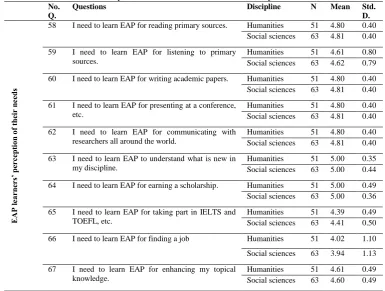
speak about the topical issues in their discipline (with an overall mean score higher than 4). They believed that the EAP courses should enable them to conduct studies and write research papers in their disciplines, earn a scholarship, and find a job.
Table 8: EAP learners’ responses about their EAP needs: Descriptive statistics
No. Q.
Questions Discipline N Mean Std.
D. E A P le ar ne rs’ p er ce pt io n of t he ir n ee ds
58 I need to learn EAP for reading primary sources. Humanities 51 4.80 0.40 Social sciences 63 4.81 0.40
59 I need to learn EAP for listening to primary sources.
Humanities 51 4.61 0.80 Social sciences 63 4.62 0.79
60 I need to learn EAP for writing academic papers. Humanities 51 4.80 0.40 Social sciences 63 4.81 0.40
61 I need to learn EAP for presenting at a conference, etc.
Humanities 51 4.80 0.40 Social sciences 63 4.81 0.40
62 I need to learn EAP for communicating with researchers all around the world.
Humanities 51 4.80 0.40 Social sciences 63 4.81 0.40
63 I need to learn EAP to understand what is new in my discipline.
Humanities 51 5.00 0.35 Social sciences 63 5.00 0.44
64 I need to learn EAP for earning a scholarship. Humanities 51 5.00 0.49 Social sciences 63 5.00 0.36
65 I need to learn EAP for taking part in IELTS and TOEFL, etc.
Humanities 51 4.39 0.49 Social sciences 63 4.41 0.50
66 I need to learn EAP for finding a job Humanities 51 4.02 1.10
Social sciences 63 3.94 1.13
67 I need to learn EAP for enhancing my topical knowledge.
Humanities 51 4.61 0.49 Social sciences 63 4.60 0.49
Table 9: Investigating whether or not EAP learners’ need in humanities and social sciences are different: Inferential statistics
Needs
Mann-Whitney U
Wilcoxon W Z Sig. (2-tailed)
Language skills 1592.50 3628 -.086 .91
Language sub-skills 1606.00 2927 .000 .94
EAP materials 1584.50 2912 -.149 .87
EAP assessment 1581.50 2907 -.166 .74
EAP learners’ perception of their needs
1586.00 3600 -.134 .69
educational EAP environment
1573.50 3596 -.158 .862
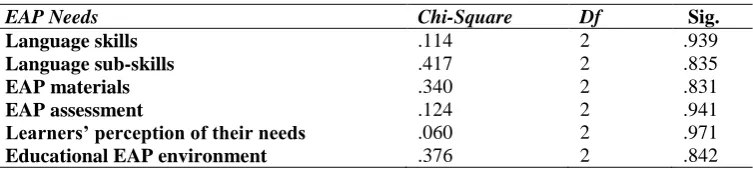
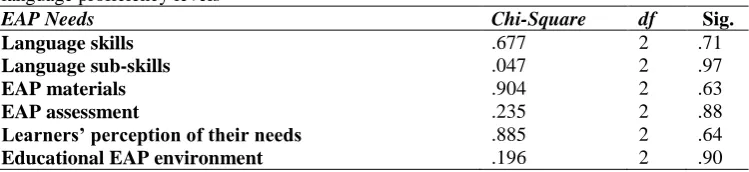
More importantly, it was investigated whether the needs of the EAP learners across different proficiency levels and different educational levels were different or not. To address these issues, two sets of Kruskal-Wallis Tests were run. As Table 10 indicates, there is no statistically significant difference between the English language needs of the EAP learners across different educational levels, including BA, MA, and Ph.D. (p > .05).
Table 10: Kruskal-Wallis Test results for the differences in EAP needs based on their educational levels
EAP Needs Chi-Square Df Sig.
Language skills .114 2 .939
Language sub-skills .417 2 .835
EAP materials .340 2 .831
EAP assessment .124 2 .941
Learners’ perception of their needs .060 2 .971
Educational EAP environment .376 2 .842
Table 11: Kruskal-Wallis Test results for the differences in EAP needs based on their language proficiency levels
EAP Needs Chi-Square df Sig.
Language skills .677 2 .71
Language sub-skills .047 2 .97
EAP materials .904 2 .63
EAP assessment .235 2 .88
Learners’ perception of their needs .885 2 .64
Educational EAP environment .196 2 .90
Analysis of EAP Learners’ Narratives
As it was stated earlier in this study, 10 EAP learners were asked to write some narratives of their experiences in the EAP classes. The main purpose of doing so was to elicit the needs of the EAP learners qualitatively. The narratives authored by these learners were then analyzed based on the systematic approach proposed by Strauss and Corbin (1998). As a result, four main themes were identified: teaching language skills are unbalanced, not paying attention to the jargon of global disciplinary communication, not instructing how to use language in academic situations, addressing the topical knowledge in the narratives.
The first theme was the fact that in the EAP courses, there was no balance in teaching the four skills. This led to EAP learners’ inability to make use of language in their disciplines. In the following section, the extracts from two narratives show this theme.
Extract 1
…I remember that I wanted to write a letter to the professor of my major who lives abroad, but I was not able to do so. The thing was that I know many vocabularies, but I was not able to put them together …
Extract 2
…all I can remember about my EAP classes is a never-ending translation from English to Persian …. I cannot even speak a word about my major, but I am able to translate any texts like a professional translator …
believed that even though the EAP courses sought to make them competent in doing interactions, they were not successful in this regard. Through the course of analysis, it was understood from the narratives that the EAP courses failed to familiarize the EAP learners with the discourse of their disciplines. Hence, although some of the EAP learners believed that their EAP level of proficiency was advanced, they did not think they could run a meaningful communication in their disciplines. Extracts 3 and 4 show the related examples.
Extract 3
… I believe in my speaking, reading, listening, and writing; however, the problem is something else. I know many specific and general words, and I can make sentences with them, but I do not know why I cannot identify the situation in which I speak …
Extract 4
…EAP courses do not help us to be able to participate in different contexts… each context in our field needs its vocabularies, idioms [he wants to say discourse, but he does not know it] …
The analysis of the narratives written by the EAP learners disclosed that they thought the EAP courses needed to be a resemblance of what they wanted in the future. In other words, the EAP learners need to present their papers in international conferences, for example; therefore, they need to practice in a similar context before they do so in a real conference. Moreover, they need to publish their papers in international journals, so they need to practice their research writing under the supervision of their instructors. Extract 5 and 6 are some related examples.
Extract 5
…I think the EAP courses need to have role plays on different academic affairs such as research writing, paper presentation, …
Extract 6
Finally, the analysis of the narratives indicated that EAP learners thought that the EAP courses needed to take into account the topical knowledge of the discipline and that the EAP teachers should have the necessary expertise in the target subject matter (Extracts 7 & 8).
Extract 7
…sometime our EAP classes are the same as our general classes in that no trace of any topical issue is discussed in the class …
Extract 8
… if we know English well, and we be able to talk and write and read and listen, it is not enough since we need to do all those things about the subjects of our majors. Consequently, the EAP course should have specific topics as its core…
Analysis of the EAP Teachers’ Narratives
To analyze the EAP learners’ needs from the perspective of the EAP teachers, eight university instructors who were involved in instructing EAP courses in diffident majors of humanities and social sciences were requested to write their biographical narratives about their experience of EAP instruction and context. After thematic analysis, three main themes were extracted: paying attention to the four language skills, preparing communicatively based EAP materials, and allocating more time to EAP courses.
Through the analysis of narratives produced by the EAP instructors, it can be deciphered that they believed that the EAP learners need to develop their skills for academic purposes. By academic purposes, EAP instructors meant different academic venues, such as participating in a conference, symposiums or writing a research manuscript. It can be mentioned that, by academic purposes, one can refer to the community of practice (Wenger, 1998) in which each EAP learner is involved based on his/her discipline. Extracts 9 and 10 are examples of EAP instructors’ narratives.
Extract 9
the global trends of their discipline … one of my students wanted to write research, and he begged me to teach something in this regard, instead of the syllabus of the department …
Extract 10
… I think that the language skills should be taught by the EAP instructors in a way that prepares EAP learners to be able to use the skills for the specific purposes …
Communicative language teaching and learning is now the mainstream of language pedagogy, which assumes that L2 learners need to be able to use language to communicate. One of the English language needs of the EAP learners referred to in EAP instructors’ narratives was preparing communicatively based EAP materials. Through the analysis of EAP instructors’ narratives, it was revealed that EAP materials in the EAP courses are not communicative. Thus, communicative materials might be recognized as lacks for EAP learners in the instructors’ view. Extract 11 and 12 show two examples in this regard.
Excerpt 11
… when our textbooks are just for reading skill, how I can teach my students to communicate in their disciplines …
Excerpt 12
The EAP learners need to be able to communicate through the English language and in their discipline … one of the ways to develop communicative abilities is to have communicative-based EAP textbooks …
Extract 13
… EAP course is just for one semester, and during the semester many of the sessions are red days … it is not possible to address many points during this short time …
Extract 14
Last semester I tried to change my teaching methodology in my EAP classes to make it more communicative based, but I could not do so. The reason was that I could not cover the imposed syllabus, so I turned back the previous syllabus ….
DISCUSSION
not show any statistically significant difference when the EAP learners’ disciplines (humanities or social sciences), educational levels, and language proficiency levels were also considered (Table 9, 10, and 11).
The findings of the present study showed that the EAP learners of humanities and social sciences need more instruction on language skills with more attention to writing, speaking, and listening. The importance of the inclusion of the four skills in the EAP courses across different disciplines is not a new result obtained just in this study; this issue has already been announced by the previous studies (e.g. Atai & Khazaee, 2014; Atai & Shoja, 2011; Khanjani, 2005; Shahini & Riazi, 2001). However, the important point which distinguishes the results of the current study from those obtained by the previous studies is the skill types. Previous studies showed that the reading skill was the most important need for EAP learners; however, through the obtained results of the present study, one can see that, now, writing and speaking and also listening are all important skills for EAP students to master. One explanation for such differences can be the fact that currently, academic interactions are among the most important purposes for university students. Academic interactions can happen through participating in scientific conferences or writing research papers, both of which require university students to have a good command of writing, speaking and listening beside the reading skill.
communicatively based EAP textbooks is to integrate the discourse of a specific discipline with communicative skills.
The findings of the study regarding EAP assessment showed that the reading skill along with the translation skill was frequently used in EAP exams. However, it was mentioned that EAP courses need to address all language skills as well as the communicative competence of the EAP learners. As for the interaction types, it was observed that there are not many interaction opportunities among the students and their teachers. This can be due to the lack of communicatively based EAP materials.
It is important to discuss the results of the current study which showed there were no statistically significant differences among the needs of the EAP learners with different educational levels and at different proficiency levels. Such results are at odds to some extent with those of Esfandiari (2015) and Shahini and Riazi (2001). One can state that during the current years, there was not an appropriate educational decision regarding teaching EAP at the universities. Given that, the problems and issues of EAP learners will be the same among different proficiency levels. For instance, the inability to developing communicative skills is an issue for BA intermediate students while, at the same time, it is an issue for Ph.D. intermediate students in the humanities and social sciences.
CONCLUSION AND IMPLICATIONS
A number of conclusions can be drawn out of this study. First, the quantitative results obtained from the analysis of the questionnaire indicated that the EAP courses need to pay more attention to writing, speaking, and listening skills as well as to address the community-specific social and cultural conventions through a communicative approach. Second, the qualitative themes obtained through the analysis of EAP learners’ narratives proved the quantitative results. Besides, the analysis of EAP instructors’ narratives indicated that in the instructors’ point of view, all language skills are addressed communicatively to develop the EAP learners’ ability to participate in real-life academic interactions. Thus, it can be concluded that EAP learners and instructors were of the same opinion regarding communicative needs.
EAP curriculum of the country seems necessary. The universities, all around the world and in Iran, are on the transition from first and second generation to the third and fourth generation (Wissema, 2009), which requires new educational changes at many levels, including curriculum and materials development and teacher education. Moreover, once the only skill which was important for the EAP learners was reading, but it is now important for them to be competent in all language skills. Consequently, it is important to allocate much time to EAP courses compared to the previous decade. In this respect, the researchers believe that the EAP policy-makers and curriculum designers need to revisit the EAP programs with regard to the current conditions and needs.
Another conclusion is the inadequacy of the EAP materials in terms of the inclusion of the four language skills, and EAP textbooks, in particular, to help EAP learners be proficient EAP users. As Esfandiari (2015) mentioned, EAP textbook developers should “design relevant tasks to tap into the knowledge of vocabulary, grammar, and translation” (p. 55). As Esfandiari (2015) reported, there is a program in process in SAMT (the center in Iran responsible for developing university textbooks) which tries to address the development of some strategies in the reading skill of the EAP learners. However, the researchers highly recommend that the language strategies should be addressed for all language skills if the EAP practitioners want an EAP program to be a successful one. The EAP policy-makers need to reconsider the EAP curriculum to develop the EAP learners’ communicative competence to use English as an international language. To do so, the EAP policy-makers should focus on developing the EAP learners’ language skills by communicatively based materials.
References
Alimohammadi, M. (2003). Quality assurance in teaching English. Proceedings of the IADIS International Conference. Portugal: IADIS, 1235–1239.
Anthony, L. (2015). The changing role and importance of ESP in Asia. English as a Global Language Education (EaGLE) Journal, 1, 01– 21.
Atai, M. R., & Khazaee, M. (2014). Exploring Iranian EAP teachers’ pedagogical content knowledge and their professional identity. Issues in Language Teaching, 3(1), 1–35.
Atai, M. R., & Nazari, O. (2011). Exploring reading comprehension needs of Iranian EAP students of health information management (HIM): a triangulated approach. System, 39, 30–43.
Atai, M. R., & Shoja, L. (2011). A triangulated study of academic language needs of Iranian students of computer engineering: Are the courses on track? RELC Journal, 42(3), 305–323.
Barron, C. (1991). Material thoughts: ESP and culture. English for Specific Purposes, 10(3), 173–187.
Basturkmen, H. L. (2013). Needs analysis and syllabus design for LSP. In C. A. Chapelle (Ed.), The encyclopedia of applied linguistics (pp. 4209–4217). West Sussex: Wiley- Blackwell.
Belcher, D. (Ed.) (2009). English for specific purposes in theory and practice. Ann Arbor, MI: University of Michigan Press.
Charles, M. (2013). English for academic purposes. In B. Paltridge, & S. Starfeld (Eds.), Handbook of English for specific purposes (pp. 137– 154). West Sussex: John Wiley and Sons.
De Fina, A. (2015). Narratives and identity. In A. De Fina, & A. Georgakopoulou (Eds.), The handbook of narrative analysis (pp. 351–368). New York, NY: John Wiley & Sons.
Dornyei, Z. (2007). Research methods in applied linguistics: Quantitative, qualitative, and mixed methodologies. Oxford: Oxford University Press.
Dudley-Evans, T., & St. John, M. J. (1998). Developments in English for specific purposes: A multi-disciplinary approach. Cambridge: Cambridge University Press.
Esfandiari, R. (2015). An investigation into ESAP needs of Iranian BA students of law. Journal of Teaching Language Skills, 34(3), 29–59. Eslami, Z. R., Eslami-Rasekh, A. & Quiroz, B., (2007). Needs analysis of
Iranian EAP students. ESP across Cultures, 4, 21–37.
Flowerdew, L. (2013). Needs analysis and curriculum development in ESP. In B. Paltridge, & S. Starfield (Eds.), The handbook of English for specific purposes (pp. 325–346). Malden, MA.: Wiley-Blackwell. Hutchinson, T., & Waters, A. (1987). English for specific purposes.
Cambridge: Cambridge University Press.
Hyland, K. (2006). English for academic purposes. London: Routledge. Jodairi, A. (2005). Teachers as coordinators in developing ESP curriculum.
In G. R. Kiany, & M. Khayyamdar, (Eds.), Proceedings of the first national ESP/EAP conference (pp. 99–126). Tehran: SAMT.
Khany, R., & Tarlani-Aliabadi, H. (2016). Studying power relations in an academic setting: Teachers' and students' perceptions of EAP classes in Iran. Journal of English for Academic Purposes, 21, 72–85.
Khanjani, A. (2005). A needs analysis of the ESAP programs for Science students of Guilan University (Unpublished master's thesis). Kharazmi University, Tehran.
Kırkgöz, Y., & Dikilitaş, K. (2018). Recent developments in ESP/EAP/EMI contexts. In Y. Kırkgöz & K. Dikilitaş (Eds.), Key issues in English for specific purposes in higher education (pp. 1–10). Cham: Springer.
Malmir, A., & Bagheri, M. (2019). Instructors and learners’ attitudes about English for science and technology: Learning and target needs of mechanical engineering students. Iranian Journal of English for Academic Purposes, 8(1), 13–34.
Li, J. (2014). Needs analysis: An effective way in business English curriculum design. Theory and Practice in Language Studies, 4(9), 1869–1874.
Long, M. H. (2005). Overview: A rationale for needs analysis and needs analysis research. In M. H. Long (Ed.), Second language needs analysis (pp. 1–16). Cambridge: Cambridge University Press.
Mazdayasna, G., & Tahririan, M. H. (2008). Developing a profile of the ESP needs of Iranian students: The case of students of nursing and midwifery. Journal of English for Academic Purposes, 7(4), 277– 289.
Robinson, P. (1991). ESP today: A practitioner's guide. Hemel Hempstead: Prentice Hall.
Shahini, G., & Riazi, A., M. (2001). A needs assessment for the English language courses at Shiraz University. Indian Journal of Applied Linguistics, 27(1), 147–155.
Soleimani, H. (2005). EAP in Iran: Drawbacks of SAMT EAP textbooks. In, G. R. Kiany, & M. Khayyamdar, (Eds.), Proceedings of the first national ESP/EAP conference (pp. pp. 216–229). Tehran: SAMT. Soodmand Afshar, H., & Movassagh, H. (2016). EAP education in Iran:
Where does the problem lie? Where are we heading? Journal of English for Academic Purposes, 22, 132–151.
Strauss, A., & Corbin, J. (1998). Basics of qualitative research. London: Thousand Oaks.
Talebinezhad, M. R., & Aliakbari, M. (2002). Evaluation and justification of a paradigm shift in the current ELT models in Iran. Linguistik online, 10(1), 21–28.
Weddel, K. S., & Van Duzer, C. (1997). Needs assessment for adult ESL
learners. Retrieved on May, 2019 from
https://eric.ed.gov/?id=ED407882