International Journal of Innovative and Emerging Research in Engineering Volume 4, Issue 7, 2017
28
Available online at www.ijiere.com
International Journal of Innovative and Emerging
Research in Engineering
e-ISSN: 2394 – 3343 p-ISSN: 2394 – 5494
Review of passive heat transfer augmentation in circular tube
using baffles over the twisted wire brush
Shivaji mishra
1,S.K.bharti
21 (reserch scholar ,Department of mechanical engg. M.I.T. Bhopal) 2(Assistant professor Department of mechanical engg M.I.T. bhopal)
ABSTRACT :
Heat transfer augmentation technique is widely used to increase heat transfer rate out of which passive heat transfer technique is conveniently used as compare to other technique ,In present study of passive technique wounded copper wire is used instead of plain tube in circular tube heat exchanger, wounded copper wire can increase the convective heat transfer 9-11% in circular tube pipe flow instead of plain tube ,In another study using of short length twisted tape have batter thermal performance over the full length twisted tape of pr >215,as per in this study we investigated that for further enhancement of thermal performance of heat exchanger prefer to use irregular structure such as baffle over the copper wire wound ,this structure used in pipe flow increases the turbulence ,Reynolds no of fluid flow thorough pipe, In which on the basis of fixed geometry criteria nusselt no. and friction factor investigate for evaluate the performance of heat exchanger for improving performance of heat exchanger we also regulate the size and and axial difference between irregularities.
Keyword : heat transfer augmentation, baffles, Nusselt no, performance evaluation criteria, dimensional analysis, Friction factor
Notation :
Di = internal diameter of the tube (m)
Do =outer diameter of the tube (m)
f = friction factor with an insert
fo = friction factor without any insert
h = convective heat transfer coefficient Nu =Nusselt number with an insert Nuo= Nusselt number without any insert
Pr = fluid Prandtl number Re = Reynolds number
S = spacing between two twisted tapes
I : INTRODUCTION
Horizontal double pipe heat exchanger uses various inserts inside tube so as to enhance heat transfer and hence increase heat transfer coefficient. In this type of heat exchanger the turbulent flow is generated as fluid flowing through the plain tube with insert . Due to the presence of swirl flow, the convective heat transfer obtained from the plain tube with insert is higher than that with the plain tube without insert. The inserts have a significant effect on the enhancement of heat transfer; however, the pressure drops also increase too. Several papers have studied and concluded that the insertion of twisted wire brush inserts into a double pipe heat exchanger is an attractive method to improve the convective heat transfer coefficient because it generates a swirl flow, which can induce a tangential flow velocity component and enhance fluid mixing between the duct core and the near wall region. These type of heat exchangers found their applications in heat recovery processes, air conditioning and refrigeration systems, chemical reactors, and food and dairy processes.
International Journal of Innovative and Emerging Research in Engineering Volume 4, Issue 7, 2017
29 Friction factor = 𝑓𝑒𝑥𝑝=
∆𝑝
𝑙 𝐷𝑖×
𝜌𝑎𝑣2 2
Pressure drop = ∆𝑝 = ℎ ×𝜌𝑤
𝜌𝑎
For Re>10000, Seider-Tate equation is used
𝑁𝑢 = 0.023 × 𝑅𝑒0.8 × 𝑃𝑟13×𝜇𝑏
𝜇𝑤
In this way, while planning a heat exchanger utilizing any of these techniques, examination of heat transfer rate & pressure drop must be carried out. Separated from this, issues like long term performance & detailed economic analysis of heat exchanger must be carried out Insert of twisted wires - a type of passive heat transfer augmentation techniques have shown significantly good results in past studies. For experimental work, twisted GI wires having diameter around 1.2mm are used. Effect of insert on Nusselt number was studied without baffles and with baffles.
A. Types of Heat Transfer Augmentation Techniques
1.Active Techniques: These techniques are more complex from the use and design point of view as the method requires some external power input to cause the desired flow modification and improvement in the rate of heat transfer. It finds limited application because of the need of external power in many practical applications. In comparison to the passive techniques, these techniques have not shown much potential as it is difficult to provide external power input in many cases. Various active techniques are as follows:
1. Mechanical Aids 2. Surface vibration 3. Fluid vibration 4. Electrostatic fields 5. Injection
6. Suction
2.Passive Techniques: These techniques generally use surface or geometrical modifications to the flow channel by incorporating inserts or additional devices They promote higher heat transfer coefficients by disturbing or altering the existing flow behavior (except for extended surfaces) which also leads to increase in the pressure drop. In case of extended surfaces, effective heat transfer area on the side of the extended surface is increased. Passive techniques hold the advantage over the active techniques as they do not require any direct input of external power. The passive methods are based on the same principle. Use of this technique causes the swirl in the bulk of the fluids and disturbs the actual boundary layer so as to increase effective surface area, residence time and consequently heat transfer coefficient in existing system. Following Methods are generally used,
a. Treated Surfaces b. Rough surfaces c. Extended surfaces d. Swirl flow devices e. Coiled tubes
3.Compound Techniques: When any two or more techniques employed simultaneously or compoundly to obtain enhancement in heat transfer is termed as compound enhancement technique. The rate of heat transfer in case of compound technique is greater than that produced by either of them when used individually. The Compound techniques are
1. Extended surfaces that are treated, 2. Rough surfaces with additives.
II : LITERATURE REVIEW
Deepali Gaikwad et .al (1)Thermal Performance of heat transfer devices can be improved by heat transfer enhancement techniques by which twisted wire brush insert in double pipe heat exchanger . The horizontal double pipe heat exchanger is made from straight copper tube with inner tube and outer tube diameters of 15 and 25 mm, respectively. The twisted wire brush inserts are fabricated by winding a 0.2 mm diameter of the copper wires over a 2 mm diameter two twisted iron core-rods. The inner convective heat transfer coefficient, friction factor are determined as a function of tube geometry and hot air Reynolds number.
International Journal of Innovative and Emerging Research in Engineering Volume 4, Issue 7, 2017
30
S. K. Saha et. al(2)
Heat transfer and pressure drop characteristics in a circular tube fitted with twisted tapes have been investigated experimentally in Laminar swirl flow of a large Prandtl number 20<Pr<518,viscous fluid . The swirl was generated by short-length twisted-tape inserts; regularly spaced twisted-tape elements with multiple twists in the tape module and connected by thin circular rods; and smoothly varying (gradually decreasing) pitch twisted-tapes. Friction factor and Nusselt number are lower for short-length twisted-tape than those for full-length twisted-tape.
The large Prandtl number (205,Pr,518)twisted-tape-generated laminar swirl flow ,friction factor and Nusselt number have been presented for the case of a circular tube subjected to uniform wall heat flux. Decaying swirl flow was generated by short-length twisted-tape insert. Reduction in Nusselt number for short-length twisted-tape is much less than the reduction in friction factor compared to full-length twisted-tape for tighter twists (y<5). On the basis of constant pumping power and constant heat duty, short-length twisted-tapes ~up to 33 percent length of the tube! is found to perform better than the full length tapes. It has also been observed that, for regularly spaced twisted-tape elements, there is a 14 percent–47 percent reduction in isothermal friction factor accompanied by comparable reduction in axially and averaged Nusselt number for number of twist equal to two in the tape module compared to the case of single twist in the tape module. Number of twists equal to three in the tape module does not give much different thermo hydraulic performance from the case with number of twists equal to two in the tape module. If reducing pumping power is of prime importance even at the cost of thermal performance, then number of twists equal to two in the tape module may be recommended.
FIG: .a. Layout of a circular tube containing a full-length twisted-tape; b. layout of a circular tube containing regularly spaced twisted-tape elements
P. Sivashanmugam et .al (3)
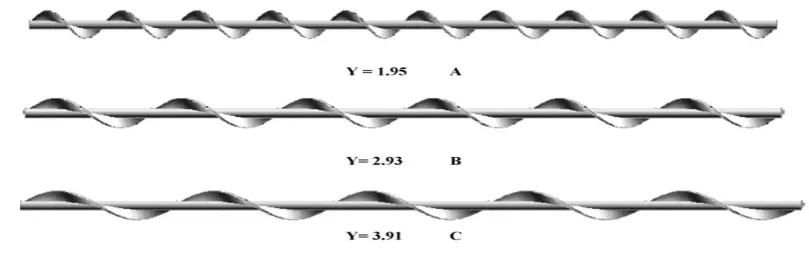
Heat transfer and friction factor characteristics of circular tube fitted with full-length helical screw element of different twist ratio, and increasing and decreasing order of twist ratio set have been studied with uniform heat flux under turbulent flow conditions.
International Journal of Innovative and Emerging Research in Engineering Volume 4, Issue 7, 2017
31 Empirical correlations
Nu = 0.4675Re0.4774PrY-0.2138
f = 32.415Re0.598Y-0.7986
FIG 2:. Helical screw inserts: (a) helical screw inserts of different twist ratio, (b) helical screw inserts of increasing twist ratio and (c) helical screw inserts of decreasing twist ratio.
S. W. Hong et .al (4)
Heat transfer coefficients for laminar flow of water and ethylene glycol in an electrically heated metal tube with two twisted-tape inserts were determined experimentally. The Nusselt number for fully developed flow was found to be a function of tape twist ratio, Reynolds number, and Prandtl number. These Nusselt numbers were as much as nine times the empty tube constant property values. The correlation of these data is in fair agreement with the only available analytical predictions. The friction factor is affected by tape twist only at high Reynolds numbers, in accordance with analytical predictions. The performance of these augmented tubes is compared with that of empty tubes under similar heating conditions.
Nusselt numbers greater than 40 were obtained. The pressure drop data indicate that the friction factor depends primarily on Reynolds number. Swirl flow increases the friction factor somewhat at higher Reynolds number.
III :PROPOSED WORK AND METHODOLOGY
It is proposed to carry out Passive Heat transfer augmentation technique in which wire wound used with varying spaced baffles in pipe flow
Phase I :
Review of literature : Detailed information of existing techniques available for augmentation of forced convection heat transfer.
Phase II :
Determining the diameter of wire wound and size of baffles which are inserted in pipe for heat transfer augmentation and the specifications of component required for the experimental set up.
Phase III :
Fabrication of experimental setup
Phase IV :
Testing of experiment setup by varying spacing of baffles and find result.
Phase V :
Comparison of result obtain from different no of wire wound and different spacing between baffles.
IV: CONCLUTION
The difference in the Nusselt number for the actual and the theoretical values for low Reynolds number (up to 6000) in the smooth tube can be attributed to the natural convection which occurs along with the forced convection. This phenomena is prominent in the case of low Re. In case of higher Re, natural convection is negligible as compared to forced convection.
International Journal of Innovative and Emerging Research in Engineering Volume 4, Issue 7, 2017
32
V : REFERENCES
[1] Deepali Gaikwad and Kundlik Mali , “Heat Transfer Enhancement for Double Pipe Heat Exchanger Using Twisted Wire Brush Inserts”, International Journal of Innovative Research in Science ,Engineering and Technology , Vol. 3, Issue 7, July 2014
[2] S.K. Saha and A. Dutta, Thermo-hydraulic study of laminar swirl flow through a circular tube fitted with twisted tapes. Trans. ASME, J. Heat Transfer, 2001, 123, 417–421.
[3] P. Sivashanmugam and S. Suresh , “Experimental studies on heat transfer and friction factor characteristics of turbulent flow through a circular tube fitted with helical screw-tape inserts” , Appl.Therm.Eng.15March2006
[4] Hong, S. W., and Bergles, A. E., 1976, ‘‘Augmentation of Laminar Flow Heat Transfer in Tubes by Means of Twisted-Tape Inserts,’’ ASME J. Heat Transfer, 98, No. 2, pp. 251–256.
[5] Sundar L. S. and Sarma K. V., “Turbulent heat transfer and friction factor of Al2O3 nanofluid in a circular tube with twisted tape inserts”, International Communications in Heat and Mass transfer 53, pp.1409-1416, 2010.
[6] S.K. Agarwal, M. Raja Rao, Heat transfer augmentation for the flow of a viscous liquid in circular tubes using twisted tape inserts, Int. J. Heat Mass
[7] M.M.K. Bhuiya and M.S.U. Chowdhury , “Heat transfer performance evaluation for turbulent flow through a tube with twisted wire brush inserts”, International Communications in Heat and Mass Transfer Volume 39, pp. 1505-1512, 2012.