Deciding to Adopt
Traceability in Practice
Influencing this decision
Master Thesis
Author F.A. Blaauboer
University University of Twente
Master Business Information Technology
Track Architecture
Internal Supervisors Dr. N. Sikkel Dr. M.N. Aydin External Supervisors Dr. E. Wojcik
Drs. N. De Swart Drs. J. Burkx
Utrecht, July 26th
Preface
Before you lies the result of six months of research, which is to be the “pièce de résistance” of my attempt of obtaining the title of Master of Science. I know that I may have disappointed some people by not finishing this report and presenting its findings on August 4th, as I promised so many people I would be doing from February on. I would hereby like to offer my sincere apologies to these people that in the end I required one week more to be able to present my findings in both this report and my colloquium at the University of Twente on August 11th.
To trace or not to trace, that’s the question. This document is a report on the research performed during the last half year at Ordina N.V. into the “why” and “how” of the adoption of requirements traceability in development projects. This research required the assistance, guidance and contribution of a good many people, which I would all like to thank.
In particular, I would like to thank the people which offered me moral support during the period of this research, consisting of people I could bother on MSN, but also those nearer to me. My parents, for the diners we had every few weeks where I gave another update on how things were coming along but especially to my girlfriend, Marije, who sometimes must have been bored to death with the seemingly never ending stream of things I had to say about my project (does probably does not only apply to her) Luckily I’m finally starting to learn to let go of things and to stop thinking of work all the time.
Klaas Sikkel, my first supervisor, was always available to me. Both the discussions we had about the research and the research process, but even more the confidence he gave me through his support meant a lot to me and were of great help. Mehmet Aydin was very strong in the meetings we had discussing the progress and the work done, I was specifically helped by his critical view on the research process.
Except for the supervision from the university, I also had a lot of help from the people at Ordina. Emiel and Nicole did not only make sure that I did not take any unwanted shortcuts by critically reviewing my deliverables, but Emiel was also of great support when the project got into a dip. He was incredibly supportive with assessing the situation, looking for alternatives and determining how to pursue which of these alternatives. If anything had to be arranged, a contact was required or I simply had to discuss what was going on, nothing seemed to be impossible for Jos Burkx. Thank you Jos, Emiel and Nicole.
With regard to having a sounding board, nobody was as helpful as the person that invented the “flexplekken” at Ordina, where I was constantly surrounded by funny, interesting and very smart professionals who truly helped me a lot by listening to my ideas and coming with very sound suggestions (although not always of course). Harro, Jaap, Quinten, Art, Bert and Linda, special thanks to you for your many contribut ions. I really enjoyed my time at Ordina, both at work, during lunches and all of the events organized (keep that up!).
In the end, this was a very valuable period of my life, which is concluded with this report and of course my colloquium. I learnt (again) what it is like to have a steady rhythm, which took less adaptation then required. Over and over again, I was confronted with the fact that practice is quite different then theory and that one has to question everything. I learnt to pace myself, and to let go of things. I hope you will enjoy reading this report as much as I enjoyed writing it, for me it is time for something else, with this my studies have come to an end. For now.
Utrecht, July 2006
Management Summary
This research has been performed as the concluding part of the curriculum of the study Business Information Technology at the University of Twente in Enschede. The research itself took place at Ordina N.V. Ordina is an IT service provider that focuses on consulting, IT development and integration and outsourcing. ICT Management & Consultancy - Requirements is a business unit at Ordina, focusing on information analysis and functional design of IT systems, with a clear vision on the professionalization of processes. This business unit was the sponsor of the research.
In literature, (requirements) traceability is regarded as a very useful concept. In this research, traceability is seen as “the ability to describe and follow the life of a requirement, in both a forward and backward direction” (Gotel and Finkelstein, 1994). Many experienced practitioners also see the use of traceability. Yet in practice it is not adopted as much as one would expect. This gave rise to the following research:
What are the factors that influence the adoption of requirements traceability in a development project, and how should one go about these factors to influence the adoption of traceability?
Answering this question shows the issues with regard to the adoption of traceability, but also provides ideas about how Ordina should deal with this. To achieve this goal and to answer the central research question, an explorative research study was performed. The research technique chosen here was the use of case studies. First, a theoretical base has been developed, in order to gain an insight into the issues at hand. Subsequently, this theory was confronted with the findings of the empirical research, leading to an adaptation of the theoretical base.
The research showed thatawareness was the most important factor influencing the adoption of traceability. The person making the decision on the adoption of traceability in development projects, the project manager, was often not even aware of the existence of traceability. None of the people that could inform him of this did this either, so there simply was no aware decision in many cases; traceability was not even considered. Awareness of the customer, and more specifically a demand by a customer, also proved to be quite an important influence on the decision. This research showed that a demand for traceability by the customer would always lead to adoption of traceability. Return on investment of traceability, both during the development project and the entire lifespan of the product is also a factor which weighs in heavily on the decision to adopt traceability. However, typically only return on investment during the project is considered, benefits outside the scope are neglected. Finally, the consequences for the flow of the process and the personal preferences of the decision maker are also influencing factors.
There are several ways Ordina can deal with the adoption of traceability in development projects. It can continue to go on as it currently does, not influencing the adoption in any way. On the other hand, traceability does offer an opportunity for Ordina to improve its services for the customer, to be a true strategic partner as its vision statement claims. Improving the adoption of traceability can be done with regard to people being rented out, or for Ordina projects. The latter offers more room for influencing the people, and is recommended. I would change the sequence. The recommendation to Ordina is that the decision regarding the adoption of traceability be embedded into the standard development methods and sales processes. This eliminates awareness as an issue. If traceability is not to be adopted in a particular project, this can only be achieved by a conscious and motivated decision which is an improvement over the general current situation.
Brief Content
PREFACE... V
MANAGEMENT SUMMARY... VII BRIEF CONTENT ...IX
EXTENDED TABLE OF CONTENTS ...XI LIST OF FIGURES... XV
LIST OF TABLES... XVII
1. INTRODUCTION ... 1
2. RESEARCH DESIGN... 5
3. THEORETICAL FRAMEWORK ... 9
4. ADOPTING TRACEABILITY IN PRACTICE ... 33
5. ADOPTION ANALYSIS ... 43
6. TOWARDS IMPROVED ADOPTION ... 55
7. CONCLUSIONS AND REFLECTION ... 69
REFERENCES ... 75
Extended Table of Contents
1.2 PROBLEMEXPLORATION... 2
1.3 RESEARCHGOAL... 3
3.1 REQUIREMENTSTRACEABILITY... 9
3.1.1 Definition ... 9
3.1.2 Traceability Concept... 9
3.1.3 Techniques ... 11
3.1.4 Benefits and Drawbacks... 12
3.2 SOFTWAREDEVELOPMENTPROJECTS... 13
3.2.1 Software Development Methodologies... 13
3.2.2 Projects ... 14
3.2.3 Project Management – PRINCE2 ... 14
3.2.4 The Rational Unified Process and PRINCE2... 16
3.2.5 Traceability in Development Projects... 17
3.3 DECISIONMAKING... 18
3.3.1 Decision Models... 18
3.3.2 Stanford School of Decision Analysis ... 19
3.3.3 The Decision Basis... 20
3.3.4 Using the Decision Basis ... 22
3.4 IDENTIFYINGINFLUENCINGFACTORS... 22
3.4.1 Framework Justification ... 22
3.4.2 Decision Definition ... 23
3.4.3 Problem Identification ... 24
3.4.4 Elicitation... 25
3.4.5 The Decision Basis – Choice... 25
3.4.6 The Decision Basis – Information ... 26
3.4.7 The Decision Basis – Preferences ... 28
3.4.8 Overview of Influencing Factors... 30
4. ADOPTING TRACEABILITY IN PRACTICE... 33
4.1 CASESTUDYRESEARCH... 33
4.1.1 Sources... 33
4.1.2 Case Study Selection ... 33
4.2 DATACOLLECTIONAPPROACH... 34
4.3 DATACOLLECTIONEXPERIENCES... 35
4.4 INTERVIEWRESULTS... 36
4.4.2 Result Informants ... 40
4.5 DATAANALYSIS... 41
5. ADOPTION ANALYSIS ... 43
5.1 VALIDATEDINFLUENCINGFACTORS... 43
5.1.1 Framework of Factors ... 43
5.1.2 Additional Factors ... 48
5.1.3 Framework Completeness... 49
5.2 PROJECTTYPES... 50
5.2.1 Introducing Different Project Types ... 50
5.2.2 Traceability Demanded by the Customer... 51
5.2.3 Adoption through a Positive Project Management Decision ... 52
5.2.4 Negative Project Management Decision... 53
5.2.5 Lack of Awareness ... 53
5.2.6 Control in Different Environments... 53
6. TOWARDS IMPROVED ADOPTION ... 55
6.1 RECOMMENDATIONS... 55
6.1.1 Enforcing Traceability ... 55
6.1.2 Sponsors and Champions... 56
6.1.3 Nature of Work... 57
6.1.4 Dealing with Decisions ... 57
6.1.5 Developing the Business Case ... 58
6.1.6 An Obligated and Informed Decision... 61
6.2 ALTERNATIVEACTIONS... 65
6.2.1 Taking no Action ... 65
6.2.2 Influencing the Decision in Ordina Projects... 65
6.2.3 Influencing the Decision outside Ordina Projects ... 66
6.3 CHOOSING BETWEENALTERNATIVES... 66
7. CONCLUSIONS AND REFLECTION ... 69
7.1 CONCLUSION... 69
7.1.1 Influencing Factors... 69
7.1.2 Influencing the Decision ... 70
7.2 REFLECTION... 71
I. APPENDIXI: ORDINAORGANIZATIONALSTRUCTURE... 81
II. APPENDIXII: SURVEYBUSINESSUNITREQUIREMENTS... 83
III. APPENDIXIII: INTERVIEWPROTOCOL... 85
IV. APPENDIXIV: INTERVIEWQUESTIONNAIRE... 87
V. APPENDIXV: RESPONDENTINTERVIEWREPORTS... 91
Report Interview 2006-05-23 (A)... 91
Report Interview 2006-05-31 (B)... 94
Report Interview 2006-06-02 (C) ... 97
Report Interview 2006-06-07 (D) ...100
Report Interview 2006-06-08 (E)...102
Report Interview 2006-06-07 (F)...106
VI. APPENDIXVI: INTERVIEWREPORTSINFORMANTS...109
Report Interview 2006-05-30 (A)...109
Report Interview 2006-06-01 (B)...112
Report Interview 2006-06-02 (C) ...115
Report Interview 2006-06-07 (D) ...117
Report Interview 2006-06-07 (E)...120
VII. APPENDIXVII: INFLUENCINGROLES... 123
List of Figures
Figure 1 – Structure Ordina (Ordina N.V., 2006a)...1
Figure 2 – Research Model...6
Figure 3 – Requirements Traceability Meta Model...10
Figure 4 – Lower Level Traceability...11
Figure 5 – RUP Disciplines, Phases and Iterations (Rational, 2006) ...14
Figure 6 – The PRINCE2 Process Model (OGC, 2005) ...15
Figure 7 – Embedding RUP phases in the PRINCE2 process model (Norlund, 2003)...17
Figure 8 – The decision analysis process (Howard, 1988) ...19
Figure 9 – Decision Basis (Howard, 1988) ...21
Figure 10 – ROI of Traceability during a Systems Lifecycle (Cleland-Huang et al., 2004) ....30
Figure 11 – The Field of Play for Project Management ...30
Figure 12 – Theoretical Project Types ...50
Figure 13 – Project Types in Practice...51
Figure 14 – Test Project ...60
Figure 15 – Observation Experiment Example ...60
Figure 16 – Ordina Organizational Structure ...81
Figure 17 – Project Complexity vs. Project Size...108
Figure 18 –Application Development and Management Services (Ordina N.V., 2006a) ...125
Figure 19 – Alternative Actions towards Improving the Adoption of Traceability ...127
List of Tables
Table 1 – PRINCE2 Components (OGC, 2005)...16
Table 2 – Factor Representation...23
Table 3 – Decision Definition ...24
Table 4 – Overview of Influencing Factors...31
Table 5 – Basic Information Respondents...37
Table 6 - Respondents – Influences of Identified Factors in Practice ...39
Table 7 – Influencing Roles Identified by Respondents...39
Table 8 – Main Motives for (not) Adopting Traceability...40
Table 9 – Basic Information Informants...40
Table 10 – Informant Opinion of Influencing Factors...41
Table 11 – Possible Influencing Roles Identified by Informants ...41
Table 12 – Overview of Most Important Factors ...49
Table 13 – Factors Influencing Project Type 1 ...51
Table 14 – Factors Influencing Project Type 2 ...52
Table 15 – Factors Influencing Project Type 3 ...53
Table 16 – Factors Influencing Project Type 4 ...53
Table 17 – Advantages and Drawbacks of Traceability ...59
Table 18 – Overview of Recommendations ...67
Table 19 – Overview of Most Important Factors ...70
Table 20 – Survey Analysts on Traceability ...83
Table 21 – Influences Identified by Different Respondents ...123
1. Introduction
1.1 Research Setting
The research project at hand takes place at Ordina N.V., at the headquarters in Nieuwegein. Ordina is an IT service provider with a yearly turnover of €444 million and 4200 employees in 2005, with its base of operations in The Netherlands. A small part of their operations take place in Belgium, as seen in Figure 1 (Ordina N.V., 2005).
Ordina is an ambitious organization which aims to be part of the top three contenders in each of the areas in which it is active. It aims to grow faster then the market itself, achieving an economy of scale and becoming the national champion in IT service provision in the selected areas. To do so, Ordina has segmented the market into five sections, being finance, public, social security, trade, transport & industry (TTI), and energy,
telecom & media (ET&M).Ordina has identified forty preferred clients to do business with on the long run, so called strategic clients. For each of its clients, Ordina wants to be a true partner in the broadest meaning of the word, adding value to its processes instead of being just another IT supplier.
The services Ordina provides can be split into two categories. More then half of its turnover comes from the placement of Ordina employees at other organizations, in line functions. In this case, Ordina functions as a provider of temporary labor. Besides this, there are also complete projects which are performed, where the entire project is the responsibility of Ordina. These projects range from system development and system implementation to management consultancy and a range of other activities.
Ordina N.V. contains Ordina Holding B.V., which is again subdivided. The three lines of business, as well as the different staff departments, are shown in Figure 1. The project at hand takes place within the IT Solutions line of business. This part of the holding deals with the development of custom solutions for its clients, whereas Business & Enterprise Solutions deals more with COTS-products as the solution for a customer. A more complex organization chart, showing the true nature of the matrix organization of Ordina, can be found in appendix I.
IT Solutions, after a recent reorganization, has been split up into four parts, which are found in Figure 1 as well. Systems Integration & Development, where this research takes place, is again subdivided into several parts, being:
ICT Management & Consultancy
ICT Management & Consultancy performs all tasks in software development which are not the actual development of systems, divided into the business units of alignment, requirements,testing,implementation, project managementand technical consultancy. These business units have been clustered towards the competences of the employees, centers of knowledge on the respective areas. This is the part of the organization where the research project takes place, specifically in the requirements business unit. The competence of this business unit is the analysis of the wishes of the customers and creation of software requirements specification as well as functional design. The department consists of around sixty employees with and average age of 34 years and has two responsible business unit managers.
1.2 Problem Exploration
Within the requirements business unit of Ordina, one of the current topics is the professionalization of the service provided and especially the professionalization of the requirements process. One of the issues which has arisen, and not just in the requirements unit, is the notion that changes within a system can be performed a lot faster, and therefore less expensive, when the entire process is performed in a repeatable, but more specifically, traceable, way.
When discussing “the entire process”, this entails both the traditional development process and the management of the IT-application afterwards. Quite often, the management of IT is ignored when looking at applications, whereas this part of an applications life cycle is by far the largest and most modifications are performed here.
Requirements, which are a measurable statement of intent about something that a product must do; or a property that a product must have: or a constraint on a system (Robertson and Robertson, 2004), are the formal basis for software development. Design, code, testing and implementation deliverables all depend on the outcome of the requirements process. The interdependence of development deliverables leads to the aspect of traceability. Requirements traceability is defined by Gotel and Finkelstein as the ability to describe and follow the life of a requirement, in both a forward and backward direction, ideally through the whole systems life cycle(Gotel and Finkelstein, 1994).
Requirements traceability, a much discussed topic in scientific literature, is not something which is standard in every development project. At Ordina, many projects consist with limited or no traceability available. This was also found in an informal survey which can be found in appendix II. Literature, however, claims a high added value. The main added value of requirements traceability, in literature, is twofold. First of all, there is the aspect of change management. Through requirements traceability changes in the context of an application (changing requirements) can easily be analyzed for their impact on the code and test cases and vice versa, which heavily shortens the time required for software maintenance. On the other hand, increased accountability simplifies the verification of a system to its requirements and allows better monitoring of the process.
development process. The exact reason for this is unclear, which is the cause of this research. The organization wishes to know why traceability is not used in so many projects, as well as how to increase the use of it where required.
1.3 Research Goal
The goal of this research is to create an insight into the factors influencing the adoption of requirements traceability in development projects and to draw up recommendations on going about the factors influencing this adoption.
Requirements traceability, for the purpose of this research, is defined as the ability to describe and follow the life of a requirement, in both a forward and backward direction, ideally through the whole systems life cycle(Jarke, 1998). When looking at the adoption of requirements traceability, in this research this is defined asthe process leading to the decision to use requirements traceability in a software development project.
In contrast to other research into the adoption of traceability, such as that of (Ramesh, 1998) which looked at the adoption by a development organization after this decision has been made, this research looks at the stage before this, where the decision to apply the concept of traceability explicitly is to be made. Whereas other literature focuses on the implementation aspects and the technical aspects of the concept, this research focuses on the factors which influence the decision of applying traceability in a project from a management point of view.
1.4 Structure of the Report
This report consists of seven different chapters. This chapter, of which this is the last section, is an introduction to the problem at hand and the organization which constitutes the setting of the research. The methodology of this research is presented in chapter 2, which includes a discussion of the research strategy, the research model and the research questions.
Chapter 3 of this thesis contains the theoretical basis for the research. The research method applied requires a solid basis of theory after which the research continues with a more empirical part of the research, and this basis is presented in this chapter. This chapter leads to the development of an overview of the factors which are to influence the adoption of traceability as found in literature. The next chapter presents the findings of the empirical research, which is confronted with the findings presented in chapter 3. With the data gathered in the research an overview is created that presents the factors influencing the adoption of traceability and which of these factors is most important. This chapter, chapter 5, also presents the different types of projects which can be found in practice and the factors which influence each type of project most.
2. Research Design
The previous chapter introduced the motive and the goal of this research. This chapter provides the reader with an overview of the way in which the research was performed. First, the relevant strategy for this research project is discussed. Next, the used research model is presented in section 2.2. This model presents the different phases of which the research is composed and describes the way these phases are executed. Following the presentation of this model, a central research question has been drawn up, as well as several sub questions of which the answering leads to the achieving the research goal. Chapter 4 deals with the way the data gathering occurred in this research.
2.1 Research Approach
Verschuren and Doorewaard identify two types of research on the highest abstraction level (Verschuren and Doorewaard, 2002). First of all, there is theoretically focused research, whereas on the other hand we have empirically focused research. Empirical research attempts to create a direct contribution to an action which is meant to change an existing situation in practice. Theoretical research attempts to solve a problem in generic theory development. In the case of this research, a general problem is to be explored, categorizing this as theoretical research.
If we reduce the abstraction level, Verschuren and Doorewaard discuss theory developing research and theory testing research. For this research, little or no existing theory on the subject was available, which lead to the effort of attempting to develop new generic theory on the subject. The fact that no theory is available yet makes this research explorative, searching for the corresponding theory to explain the existing situation.
Yin states that case study research is quite well suited for exploratory research, just as histories, experiments, surveys and archival analysis. Case studies, however, are best suited in situations where there is no control required over behavioral events, the focus lies on contemporary events and one is mainly interested in the howand whyof a situation. These questions are more explanatory and look at more then just frequencies and incidence (Yin, 1994). The essence of a case study, the central tendency among all types of case studies, according to Schramm, is that it tries to illuminate a decision or set of decisions: why they were taken, how they were implemented, and with what result (Schramm, 1971). Reviewing the goal of this research, this is exactly what is attempted to be achieved here. The case studies investigate a phenomenon within its context, where the influence of the context is not yet clear. This fact makes the case study a perfect information gathering method for this research. It copes with many different variables of interest and is open to new influences.
Yin identifies four different types of case study. First of all, the difference between case and multi-case studies is distinguished (Yin, 1994). As its name reveals, single-case studies focus merely on one single-case, whereas multi-single-case studies can take along many different influences which are context -dependent and different contexts should be looked into. Second, there is the difference between holistic and embedded studies. Holistic studies consist of one single unit of analysis, yet some studies might focus on more than one unit of analysis. In this case, attention is also given to subunits such as individual projects within a program. That is not the case here however, so we are dealing with a holistic multi-case study in the classification of Yin (Yin, 1994).
2.2 Research Model
This section of the document shows the model which will be used for reaching the research goal. It has been visualized with the method of Verschuren and Doorewaard, and is shown in Figure 2 (Verschuren and Doorewaard, 2002). It should be read from left to right, which is the way the research project shall be executed.
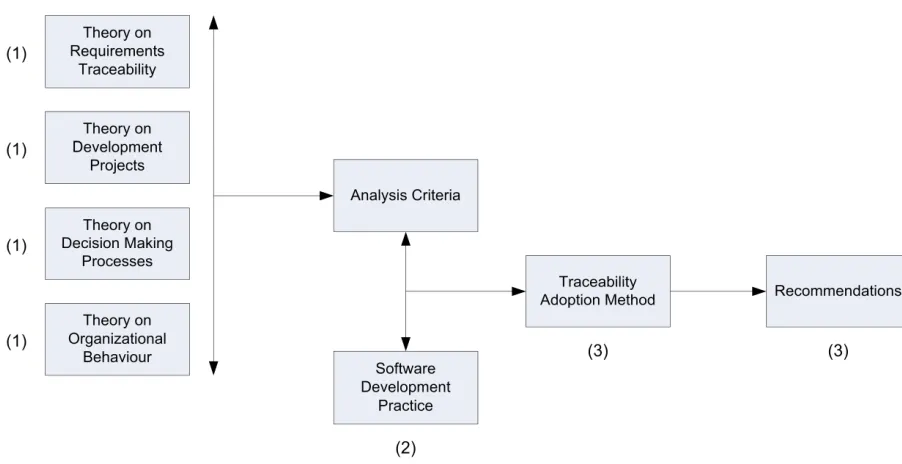
Figure 2 – Research Model
The goal of this research, as presented in section 1.3, is to present a set of recommendations on how to deal with the adoption of requirements traceability in a software development project. To reach this goal, the issues from scientific literature are compared with several cases in which this transfer actually took place. Literature (1) provides the researcher with the factors which are of importance to address in a theoretical framework according to the current scientific literature. With these analysis criteria, the research object (2) is researched. By studying the software development practice, the factors found in literature are validated on their actual influence. On top of that, any issues initially not found in literature can be identified. With these results, a piece of generic theory is developed on how the process of adopting requirements traceability in projects takes place (3). This theory, in its turn, leads to a set of validated recommendations (3), which is the last product of the research.
A note on this research model is that it does not sufficiently illustrate the iterative nature of the research. During the study of the research object, the analysis criteria are altered due to the outcome of the different case studies, which occurs in different iterations.
The literature study, which precedes the empirical part of the research, looks into four different subjects which all contribute to the theoretical framework. This framework is the end result of the theoretical part of the research. The topic of the research, being requirements traceability, is explored through studying existing literature on the subject. The subject of the research goal is defined and the basic concept is described. The context in which the adoption is to take place, the initial phase of a development project, is looked into as well during the literature study. The different actors in this process are identified. Third, theory on decision making processes is studied to further look into the process surrounding the adoption, creating an empty framework of influencing factors. The generic framework from decision making theory is filled out to fit the specific situation in this case, being the adoption of traceability in development projects.
factors identified in the theoretical framework and discover any other influences. The number of interviews, as well as which people should be interviewed, depends on the relevant actors identified. These interviews are subsequently analyzed.
The results of this empirical analysis are compared to the knowledge and insights taken from literature. The issues identified here are then looked into to identify facilitating measures to overcome these issues, which is transformed to a generic theory on adopting requirements traceability in development projects. This leads to the end result: the recommendations.
2.3 Research Questions
The previous section provided a research model, which showed the different parts of the research. To be able to reach the goal of the research, several questions have to be answered. This section gives an overview of the research questions which have been defined and have to be answered. The central research question is the following:
What are the factors that influence the adoption of requirements traceability in a development project, and how should one go about influencing the adoption?
This question requires information on a number of components of the question, which is gathered by answering the following questions:
1. What are the factors of importance that are distinguished in scientific literature influencing the adoption of requirements traceability in development projects?
a. What is requirements traceability in general?
b. Where in the development process should requirements traceability be adopted?
c. Which factors influence the decision making process regarding the adoption of requirements traceability?
d. Which factors influencing the adoption of traceability can be identified in literature on decision making, requirements traceability, development projects and organizational behavior?
2. How do the factors influencing the adoption of requirements traceability in development projects discerned from literature compare to practice?
a. Which factors from literature can also be found in practice?
b. Which factors from literature were not identified in practice and might not be applicable?
c. Were any influencing factors discerned in practice which were not previously identified in the theoretical framework?
3. What are the factors influencing adoption of requirements traceability?
3. Theoretical Framework
Chapter 3 of this thesis covers the theoretical framework used in this research. As the research design presented in the previous chapter has shown, this is the basis for the further research to achieve the research goal. This chapter introduces and explores the concepts which touch the goal of the research, as well as introduces a collection of factors influencing the adoption of traceability, the analysis criteria as presented in the research model.
First of all, the concept of requirements traceability is further explored and discussed. With this knowledge in mind, software development processes are examined to discover their relevant processes and phases with regard to the adoption of traceability. Adopting traceability is regarded as a decision to be made during this development process, leading to the further research of decision making theory. The framework introduced in section 3.3 is used for the discovery and structuring of the factors influencing the adoption of traceability, which results in the identified factors in section 3.4.
3.1 Requirements Traceability
This section provides the reader with an overview of he basic concept of requirements traceability (from now on simply referred to as traceability). The definition and concept of traceability is further explored, and the different underlying techniques are discussed. Finally, a concise overview of the benefits and drawbacks of the use traceability is discussed.
Section 3.1.4 provides a deeper insight into the factors which influence the adoption of traceability, where several of these factors come directly from traceability literature. These factors are lightly touched in this section, but for a further specification one is directed to section 3.4.
3.1.1 Definition
The Oxford dictionary translates the word “trace” asto follow the course oforto find or describe the origin or development of(Oxford University Press, 2006). Traceability exists in many different industries. Think for example of the pharmaceutical industry and the manufacturing industry. Another industry where tracking & tracing is an important topic is the food industry, where for example the origin of meat is tracked. The route of a steak is followed from cattle-fodder to the agrarian and onwards to the supermarket where it is sold. The concept of tracing, both in a backwards direction (back to the source) and in a forwards direction is nothing new, and it’s not new in the software industry either. In 1978, Pierce designed a tool with the purpose of tracing requirements for a large navy unders ea acoustic sensor system (Pierce, 1978).
The complete form of the definition of traceability provided in section 1.2 is the following: “traceability refers to the ability to describe and follow the life of a requirement, in both a forwards and backwards direction (i.e., from its origins, through its development and specification, to its subsequent deployment and use, and through all periods of on-going refinement and iteration in any of these phases)" (Gotel and Finkelstein, 1994). This often used definition shows the different aspects involved with traceability.
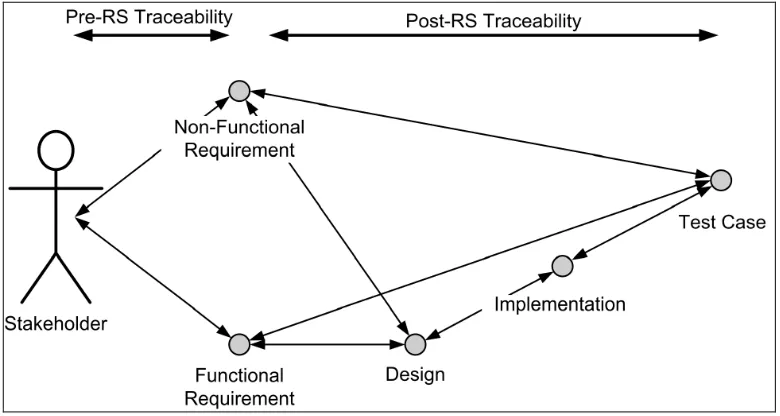
The definition provided by Gotel and Finkelstein shows that traceability exists both in a forward and a backward direction. In that same article, they also distinguish pre- and post-requirements-specification traceability. This is why the concept is called requirements traceability, requirements are seen as the central point in the process.
3.1.2 Traceability Concept
Forward from requirements. Responsibility for requirements achievement must be assigned to system components, such that accountability is established and the impact of requirements change can be evaluated.
Backward to requirements. Compliance of the system with requirements must be verified, and gold-plating (designs for which no requirements exist) must be avoided.
Forward to requirements. Changes in stakeholder needs, as well as in technical assumptions, may require a radical reassessment of requirements relevance.
Backward from requirements. The contribution structures underlying requirements are crucial in validating requirements, especially in highly political settings (Jarke, 1998).
Figure 3 is a meta model of requirements traceability, as it is regarded in the context of this research. The structure provided in this model is only a guideline, due to the fact that specific projects ask for specific traceability, where only some of these items are traced, or new elements are added. This model provides a good overview of the basic traceability items however. The model consists of several different items and the relations between them. A solid line between two items means that there is a traceability relation there, showing that one wants to trace the relation one item has on the other.
Figure 3 – Requirements Traceability Meta Model
The basis of the traceability figure are the requirements, which have been split up into functional and non-functional requirements. Grady has divided requirements using a “functionality, usability, reliability, performance, supportability and others” classification better known asFURPS+. The last four of these classes have been combined and form non-functional requirements (Grady, 1992), which are all statements which a product should adhere to that are not specifically related to a function of the system. Functional requirements, on the other hand, are statements on what a product should do. Both trace back to the demands of stakeholders, which expresses them.
Both functional and non-functional requirements are linked to design elements. These elements, again, are linked to relevant parts of the source code (implementation), and onwards to test cases. The requirements are also directly linked to test cases, for verifications purposes in the functional acceptance tests.
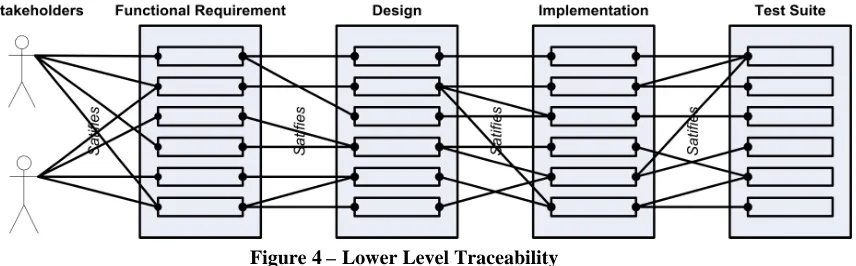
traceability diagram of a system could look like, yet on a very small scale and with only some of the development artifacts and relations taken along.
Figure 4 – Lower Level Traceability
In small projects, people may argue that traceability is not required. They can remember everything in their own head, since they created the links. This is a clear example ofimplicit traceability, where the links do exist but are not documented. The danger of this approach is that the knowledge will slowly disappear, or possibly all at once with the original developer leaving. Due to the fact that more people are involved in larger projects, explicit traceability where these relations are documented is required. Whereas implicit traceability always exists, this research looks only at explicit traceability and that is what is referred to when talking of traceability.
Traceability is a concept advocated to be applied in systems development, as discussed above. In the end, the goal of systems development is to satisfy stakeholder needs by delivering an error-free system on time, within budget and of high quality which satisfies the demands of this stakeholder. Something many authors stress, is the importance of performing requirements traceability throughout the entire lifecycle of a system. Operation, also known as maintenance, is quite an important phase where a lot of the benefits can be reaped so where there should be definite attention to traceability (Ramesh et al., 1995; Palmer, 1997; Candida Pinto et al., 2005). A prerequisite for this, however, is that traceability is consequently performed during the phases preceding this one, since once traceability is lost it requires quite an effort to get it back. The costs of restoring traceability information in a project rises substantially, yet the return on investment of this effort might still be worthwhile (Becker, 2003).
3.1.3 Techniques
Many different techniques exist for tracing requirements, of which Huffman Hayes provided a nice overview (Huffman Hayes et al., 2003). Traceability matrices are quite a common tool for traceability, which works by linking the two dimensions with different artefact instantiations in a matrix and assigning the relations between them to this matrix. The disadvantages of this technique are the high amount of different matrices because they are only two dimensional, and the size that can become a problem as well, spanning more then a page or a screen. For a big system, this will create a high amount of enormous spreadsheets, causing one to lose track of matters quite fast. Linking documents through hypertext is another well-known technique here, but has the disadvantage of not directly showing the contents which is available at the other end of a link (Hull et al., 2005). Another solution which is widely used is the implementation of a traceability database. This database allows development artefacts to be linked to other artefacts and can create overviews similar to traceability matrices but combines them in one structured database. A disadvantage of each of these techniques is that they currently still have to be filled manually which takes a lot of time (Palmer, 1997).
retrieval (IR), which links documents on the basis of similarit y. With information retrieval, one can automate a large part of the link generation process, but one will still have to determine whether or not the traces identified are valid (Antoniol et al., 2002; J. Huffman Hayes et al., 2003). Changes in technology are improving the success rate of this technology rapidly, which seems hopeful for the future. One of the main advantages of IR is the fact that one can pick up traceability with a reasonable success rate during later stages in a project and still get a good rate of return.
There are many tools which support requirements traceability in one way or another. An ongoing survey of the international council on software engineering (INCOSE) shows that more then 25 specialized requirements management tools are available, that is without taking along generic tools (word processors, spreadsheets) and built-in tools (INCOSE, 2006). Each of these tools has its own way of dealing with traceability, yet the number of tools shows the interest which exists in the market.
3.1.4 Benefits and Drawbacks
This section provides a short overview of the main benefits and drawbacks associated with traceability in development projects as found in literature. In literature, most authors approach traceability from a technical perspective, especially when dealing with drawbacks.
Three main advantages of traceability can be discerned. The first of these has to do with the verification of requirements, as discussed by Blaauboer (Blaauboer, 2006). During the verification of requirements, the requirements specification is compared to the system to see whether or not these demands were fulfilled. With traceability this can be made visible, showing that requirements are both covered by test cases as well as by the actual implementation (Palmer, 1997; Antoniol et al., 2002).
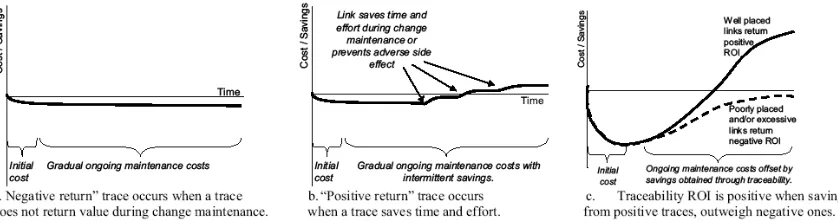
Secondly, a system which has complete traceability in place allows for a lot easier analysis of the impact of changes. The consequences of a change can be traced from requirement to design, code and test cases, drastically shortening and improving this process (Antoniol et al., 2002; Arkley and Riddle, 2005). Changes occur during development, especially when using an iterative or incremental development methodology, but most of the changes to system occur during operation/maintenance. This is why, as stated before, it is important that traceability is used during this phase as well. Niessink and Van Vliet show that the effort connected to a change not only depends on the size of a change, but that the size and complexity of its environment is probably even more important (Niessink and Vliet, 1998). Using traceability to lower this complexity can drop costs due to impact analysis by over 25%, and impact analysis often accounts for over 70% of the entire change effort (Ordina!T Excellence, 2004).
A third benefit of traceability, if that is what one should call it, is compliance to standards and regulations. Both CMM and ISO 9000, two of the most well-known standards for process quality, demand traceability in development processes (ISO 9000-1, 1994; Carnegie Mellon SEI, 1999). The US military has set their own standard for software delivery, which also specifically demands traceability (MIL-STD-498, 1994). A hot topic of the recent days is compliance to acts such as the Sarbanes-Oxley act, which is a requirement for all companies on the NYSE. (US Congress, 2002). Other sets of rules, such as that of Basel II for financial service providers, also demand traceability.
release the resources required in the form of time, tooling and training (Dorfman and Chardon, 2001).
Another problem found in practice with regard to traceability is that it is not clear what should be traced (Lindvall and Sandahl, 1996; Stout, 2001; Arkley and Riddle, 2005). Every traceability link costs money to create and maintain, and it has also been determined that not all requirements are equally critical and not all should be traced (Ramesh and Jarke, 2001). Determining the criticality of an issue depends on both the chance of it changing and the impact this change would have, therefore defining the risk involved with an item. The dynamics of a system and its surroundings heavily influence the chance of occurrence.
3.2 Software Development Projects
The subject of this research is the adoption of traceability in software development projects. This section deals with software development (from now on simply spoken of as development) and projects in general, but also the place of traceability and any related decisions in these projects. In the end, this section provides an overview of development projects and their structure, but more important it shows in what part of the process decisions with regard to the adoption of traceability are taken. With this information, the different factors influencing the adoption and the form of the empirical research can (partly) be determined.
3.2.1 Software Development Methodologies
Software development processes take place whenever a (new) piece of software is developed. In order to define a standard process, which leads to the enablement of repeating a process and increasing its quality, software development process models have been created. These models prescribe in which phases a process should be grouped, in which order such phases should be executed and when iterations and coordination between the work of the different phases should occur (Boehm, 1988; Cernuzzi; et al., 2004). Several different process models have been developed, such as the waterfall model, the incremental model and iterative development (Boehm, 1988; Beck et al., 2001; Cernuzzi; et al., 2004).
3.2.1.1 Rational Unified Process
The standard process model used at Ordina for development projects is the Rational Unified Process (RUP). The Unified Process is a software development approach that is iterative, architecture-centric and use-case driven (Jacobson et al., 1999). RUP is a well-defined and well-structured software engineering process. It clearly identifies who is responsible for what, how things are done, and when to do them, as long as you tailor your process to your projects needs (Kroll and Kruchten, 2003). To achieve this, it has created an overview of disciplines and phases of which a development process consists. Phases can consist of several iterations, working to mitigate the largest risks first.
Figure 5 – RUP Disciplines, Phases and Iterations (Rational, 2006)
3.2.2 Projects
3.2.2.1 Definition
System development is an process which is not a regular everyday activity for an organization which attributes to their core business. It is a finite process which has the aim of improving the organizations processes, which is therefore different from the regular tasks of an organization. For this reason, the organization form of this process differs from regular processes. This kind of activity is performed in a project, which is a temporary organization that is needed to produce a unique and predefined outcome or result at a pre-specified time using predetermined resources(OGC, 2005).
3.2.2.2 Project Management
A “regular” process is managed by a functional manager with a hierarchic position. Projects, however, have been identified as temporary organizations outside the regular organization. These organizations have to be managed as well, however, which is why the separate competence cluster of project management has been identified.
Project management is responsible for the initiation, planning, execution and closing down of a project, in a sense that they are responsible for providing both control and resources to the project (Hoffer; et al., 2002). For this, a project has one or more project managers which perform the actions required. Several methods have been developed for the management of projects, which prescribe a uniform high-level approach to project management. In the Netherlands and the United Kingdom, Prince 2 is the de facto standard for this methodology.
3.2.3 Project Management – PRINCE2
3.2.3.1 History
In 1989 the current Office for Government Commerce (OGC) in the United Kingdom developed the PRINCE project management method. PRINCE was developed from PROMPTII, which was created in 1975. PRINCE (Projects IN Controlled Environments) is a structured method for effective project management, which focuses on IT projects. The current OGC kept developing the method, and in 1996 launched PRINCE2 (OGC, 2005).
a method which is applicable in different environments. The method is supported by trainings, tools and a lot of written material.
3.2.3.2 Projects in PRINCE2
PRINCE2 covers the entire life-cycle of a project, as well as some pre-project preparation, which should be noted is not the same as the products life span. The project life cycle spans from the trigger of a product development to the implementation of it, yet everything before and after this falls out of the scope (such as operation and maintenance).
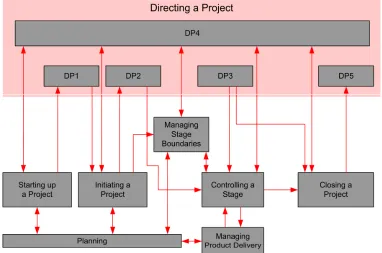
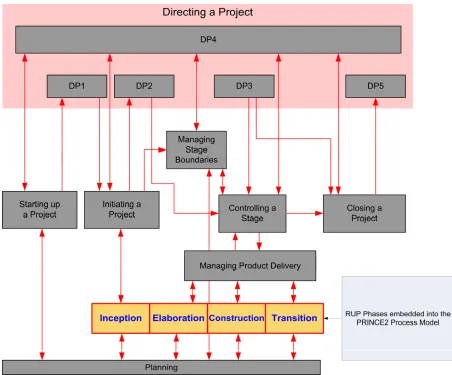
The method of project management consists of processes and components. The eight distinctive processes cover everything from setting the project off correctly to the completion of a project. Figure 6 provides an overview of the different processes identified in PRINCE2, which are all addressed in any run of a project but which have to be tailored to any individual project.
The first process in PRINCE2 isStarting up a Project (SU). This process is in the pre-project phase, preparing the initiation phase of the pre-project. It is a relatively short process which takes a project mandate and then makes sure the required resources for the initiation process are available, amongst which the project board and the project management board.
The main objectives of the next phase,Initiating a Project (IP), are to define how the required product quality will be achieved, to plan and cost the budget, to prepare a justified business case and to provide the baseline for the decision making processes required during the project’s life. At the end of this stage of a project, the startup phase is finished and the implementation work of the project is started.
Figure 6 – The PRINCE2 Process Model (OGC, 2005)
The top of the model in Figure 6 shows theDirecting a Project (DP)process, which has been split up into several parts in the process model. This process is aimed at the project board, which is the group of business, users and suppliers that makes the high level decisions on a project such as authorizing initiation, committing resources and project closure.
Managing Stage Boundaries (SB) is the process which informs the project board allowing them to decide on whether or not to continue with the project at the end of a stage. It reports on the work performed in a stage, and prepares the next Stage Plan when obtaining authority for this. This phase can often be performed quite informally.
When a project has been authorized and the work is underway, project management is responsible for controlling the production to make sure the result is up to standard. Controlling a Stage (CS)is the process identified here in PRINCE2 which assesses progress, captures and examines issues and takes corrective actions or escalates issues where required. To get work done, the project manager works with team managers in the Managing Product Delivery (MP)process. Work packages are conferred, work is done and in the end the work is handed back to the project manager. This process is closely related to controlling a stage, as Figure 6 shows with the double arrow.
The final process identified by PRINCE2 is Closing a Project (CP). The finite character of a project leads to the fact that a project has to end sometime, where the work is either completely successfully or the project is aborted. Several activities, such as defining follow-up actions and correctly archiving an end report, have to be performed in this process (OGC, 2005).
3.2.3.3 PRINCE2 Components
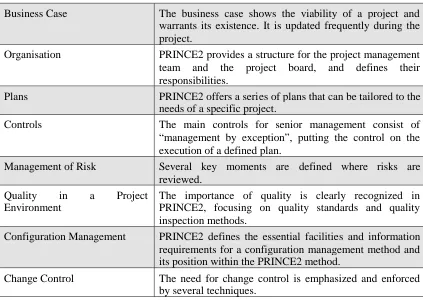
Besides processes, PRINCE2 also defines several components, which are particular subjects that affect project management. PRINCE2 addresses when and how these issues should be addressed. A summarized overview of these components can be found in Table 1.
Business Case The business case shows the viability of a project and warrants its existence. It is updated frequently during the project.
Organisation PRINCE2 provides a structure for the project management team and the project board, and defines their responsibilities.
Plans PRINCE2 offers a series of plans that can be tailored to the needs of a specific project.
Controls The main controls for senior management consist of “management by exception”, putting the control on the execution of a defined plan.
Management of Risk Several key moments are defined where risks are reviewed.
Quality in a Project Environment
The importance of quality is clearly recognized in PRINCE2, focusing on quality standards and quality inspection methods.
Configuration Management PRINCE2 defines the essential facilities and information requirements for a configuration management method and its position within the PRINCE2 method.
Change Control The need for change control is emphasized and enforced by several techniques.
Table 1 – PRINCE2 Components (OGC, 2005)
3.2.4 The Rational Unified Process and PRINCE2
them however, both on the field of organization and matters such as risk management, problem management and quality management.
Aligning RUP with PRINCE2 for the purpose of this research focuses on the processes identified in PRINCE2 and the phases we find in the Rational Unified Process. As shown by (Norlund, 2003), theinception phase in RUP aligns with the initiating a project -process in PRINCE2. The -process preceding this one,starting up a project, lies outside of the scope of development methods and is only found in project management. The same applies for that last process in the series identified in PRINCE2, closing a project. The other phases identified in RUP occur simultaneous with the remaining processes found in PRINCE2, as identified in Figure 7.
Figure 7 – Embedding RUP phases in the PRINCE2 process model (Norlund, 2003)
3.2.5 Traceability in Development Projects
Combining RUP and PRINCE2 to a generic layout of a development project as in Figure 7, we are now able to identifywhere in a project we can find traceability, and which processes and components in a project are related to them, after which the actors involved can be pinpointed.
after creating a project plan, development starts straight away, from which we can derive that adopting traceability should be initiated during the creation of a project plan.
Linking this to project management, and specifically PRINCE2, we see that three processes are of importance with deciding whether or not traceability should be adopted. During both thestartupand theinitiationof a project, the project team determines the way in which the work should be performed. More specific, these processes look amongst others at the quality requirements which are valid for the specific project. The third process involved is the directive process. It is this process in which decisions on accepting or rejecting a project plan are made by the project board. This project board consists of representatives from the business, users and suppliers. It is the two processes discussed previously which provide them with the input in the form of information on which they base their decisions on how the project should be performed. This information consists of plans, which amongst others contain a clear business caseand theproject initiation document. On top of theseplansand processes, PRINCE2 also discusses several components. The Quality in a Project Environment component of PRINCE2 deals with achieving the quality expected by a customer, amongst which traceability could be an item. Configuration Management shows that the interdependencies between sub products should remain aligned and that this should be supported. Finally Change Control is offered by PRINCE2, stating that changes will arise during projects and that these influence all the sub- and byproducts of a project which have to remain intact.
Concluding, we can see that the process of adopting traceability in a project should be started before the actual development is started. The people involved with the start of adoption are the project board, the project manager and the project team involved with the preparation. With this knowledge, the next section of this chapter looks into the decision making process involved with the adoption.
3.3 Decision Making
Adopting traceability is a choice. In a development project, one can either make a choice to trace or choose not to trace during development. A decision isa choice made from available alternatives, which is exactly what is happening when adopting traceability or not (Daft, 2000). This definition is somewhat lacking depth, however. Matheson and Howard defined a decision asan irrevocable allocation of resources that is revocable only at a cost in some resource, such as time or money..Some decisions are inherently irrevocable, such as the amputation of a pianists hand, whereas others such as the decision of a major company to enter a new market is essentially irrevocable (Howard, 1983a; Matheson and Howard, 1983).
This section introduces decision models and explores one specific model for decision making, which is later applied to discovering and structuring the factors influencing the adoption of traceability. Section 3.4 deals with the way this model is used and introduces these factors.
3.3.1 Decision Models
Decision making isthe process of identifying problems and opportunities, and then resolving them (Howard, 1988). People make decisions all the time, although they might not always formally identify them as decisions. They call them choices, something which just happens, but they ignore the effort involved both before and after this choice (Daft, 2000).
Several different schools of decision making have arisen in the recent years. Classical decision making theory (CDM), focuses on four different aspects. These are those of choice, the aspect of modeling the input/output of the different alternatives, that of conceptualizing decision making as a deliberate and analytic process that requires a relatively thorough information search and finally developing abstract, context-free models allowing quantitative testing of alternatives (Lipshitz et al., 2001). Researchers have criticized the rational decision model which was part of CDM, and newer streams were developed adapting this model. They did, however, retain the essential characteristics. Normative models for evaluating decision alternatives were still part of these newer models. Another stream, which is even more recent, is that or naturalistic decision making. This method is more informal and less focused on statistical normative methods (Lipshitz et al., 2001).
In decision making theory there are normative models, which prescribe how to make a decision, and the descriptive models, which are oriented towards understanding and predicting decision making. The classical decision making theory is a normative theory, which stipulates how decisions should be made on a normative basis and what the best outcome would have been (Meredith, 2004). Howard states:
Decision analysis is a normative practice of decision-making. The acceptance of its norms allows me to recognize my decision mistakes. Using decision analysis I can be sure that the decision I make follows the rules I would use to reason in very simple, and therefore transparent, situations, as well as the rules I would follow to reduce complex situations to transparent ones.(Howard, 1988)
This research adapts CDM, and specifically the Stanford school of decision making of which Howard is one of the most published authors (Howard, 1983b). The theories developed here adhere to the standards of classical decision making, focusing on creating transparent situations which can be analysed to reach the correct decision through a structured process.
3.3.2 Stanford School of Decision Analysis
Decision analysis is the name given to analyzing decision processes by Howard. The discipline of this “decision engineering” is defined in the following way: A systematic procedure for transforming opaque decision problems into transparent decision problems by a sequence of transparent steps. In other words, decision analysis offers the possibility to a decision-maker of replacing confusion by clear insight into a desired course of action (Howard, 1988).
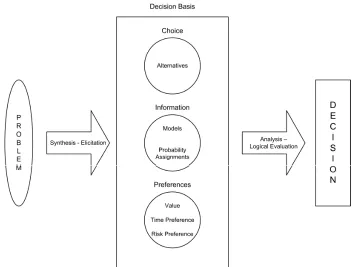
Howard approaches the decision making process by modeling it as a shift from a real decision problem to a real action, including all the actions required to create this shift. This is a process of elicitation and analysis, leading to clarification of the actual problem in a way that it can be acted on in a logical way.. T hese actions have been classified into three separate activities, which can be iterated for further refinement when required. This process has been modeled in Figure 8.
Figure 8 – The decision analysis process (Howard, 1988)
3.3.3 The Decision Basis
Central in the decision making process is the decision basis, which is constructed during the process shown in Figure 8. It is constructed during the “formulate” phase, where the required information is elicited and structured as needed. With this basis, the different solutions can be evaluated and appraised, after which, if required, another iteration of the cycle is performed. This entire cycle is based on the decision basis.
Howard defined this decision basis itself as consisting of three different parts, each influencing the final decision in their own way. As Figure 9 shows, one has to go through an elicitation phase in which this decision basis is formulated, after which the further steps as identified in Figure 8 are performed. In this research, the focus lies on this decision basis and the way in which it is reached. The activities required to reach this basis, as well as the different parts of the basis, are discussed in this section.
3.3.3.1 Problem Identification
The first step required in the decision analysis process, independent of any of the other steps, is answering the question of which decision is to be made (Howard, 1966). To be able to answer this question, however, one needs to know one has a question which has to be answered. without this awareness, no decision process can ever be started. This awareness has to exist even before the elicitation-arrow in Figure 9, because a problem is not a problem until it is recognized as such. On the other hand, a problem only leads to a decision problem if, consistent with the previously supplied definition, there are resources which are to be allocated.
3.3.3.2 Problem Synthesis and Information Elicitation
When the problem is recognized, the first phase of the process is initiated. As Figure 9 shows, the problem is synthesized into the transparent decision problem required for the normative process. For this, the decision basis is developed, yet as with any product it requires input. This input comes from the elicitation-activity which is in this same part of the model. The different stakeholders are required for their input into the decision basis. Stakeholders include the decision maker, yet also other people with an interest in the problem and/or its outcome and people which have information required to properly deduct the optimal decision.
3.3.3.3 Choice
The first of the three elements presented in the decision basis is that of choice. As Figure 9 shows, this aspect deals with the different alternative solutions for the problem at hand, which show the different courses of action open to the decision maker. Without alternatives, there is no choice to be made. Without this choice, there is not decision on how to allocate the resources available.
Figure 9 – Decision Basis (Howard, 1988)
3.3.3.4 Information
The second part of the decision basis is that of information. To be able to judge the alternatives which were formulated, one needs informatio n. This information consists of two different things in Howard’s classification, beingmodelsandprobability assignments.
Models are used to structure the problem and to represent the relationships between the different factors influencing the outcome of a decision. Decision analysts develop a formal mathematical model representing the underlying logical relationships of a decision problem which shows what affects what. These models provide an insight into the consequences of implementing the different alternatives, which can be complex and dynamic, or rather simple (Howard, 1983a).
There are, however, also matters which influence the outcome of a decision which cannot with any certainty be established. Any uncertainty which remains is characterized by probability assignments in this model. Any factor which influences the outcome of a decision in a non-discrete way has to be assigned a probability of occurring. Finally, this part of the decision basis shows uswhat we know.
3.3.3.5 Preferences
The alternatives and information on the outcome of the implementation of these alternatives is not enough for a well-structured decision process. As Figure 8 shows, the third of the three steps in the decision analysis cycle is that of appraisal. Appraisal has to do with assigning values to outcomes, which is required to determine the best of the available courses of action and allocation of resources.
Second, there is the issue of time preference. The time value of money, combined with the required availability of funds, is a much debated issue in business and time value should also be taken along in decisions. The decision maker can have a preference for the value of an outcome instantly rather then somewhere in the future, which influences the final outcome of this decision.
Last, there is the aspect of risk preference. Whereas value and time are certainly important, another quite important aspect is that of risk. People have a natural tendency to reduce, or when possible completely avoid, risks, which is why we have insurance companies in the first place. The amount of risk involved with an alternative, combined with the amount of risk someone is willing to take, influences the final decision as well. Each of these three aspects determinewhat we want.
3.3.4 Using the Decision Basis
As Figure 9 shows, this basis of decisions is analyzed and logically evaluated. With the subsequent appraisal of the alternatives the choice is made to either refine the alternatives or to take real action and implement the decision as we can see in Figure 8. Each of the aspects in the decision basis is required to be able to make a sound decision, and as the first of the two models in this section shows it might be required to adapt the decision basis with new information to be able to make a solidly weighed decision.
3.4 Identifying Influencing Factors
The goal of this research is identifying the factors influencing the adoption of traceability in development projects. Up until now, we have discussed traceability and development projects and the previous section introduced a framework with regard to decision making. Several different authors have already researched the i mplementation of traceability, amongst which Ramesh and Jarke (Ramesh, 1998; Ramesh and Jarke, 2001). They, however, focused on the operational implementation in projects where traceability was implemented, whereas this research looks at the factors influencing the adoption of traceability instead of the implementation of it, which has only been discussed in a fragmented way. This section provides an overview of these factors identified from literature and their placement into a relevant framework.
3.4.1 Framework Justification
The section on development projects showed us that if one wants to adopt traceability in a development project this should be started before the actual development begins. In the project plan the choice has to be made whether or not traceability is to be adopted in a project, and when looking at the first definition of decisions as provided in the previous section we see that the adoption of traceability in this context is just that: a decision. In fact, it is a discrete decision where one has to decide whether or not to adopt traceability.
3.4.1.1 Framework Selection
Literature on both development projects and traceability introduced several aspects which could influence the adoption of traceability. To gather a complete picture of these factors the process in which they play a role is further examined. This process can be clearly identified as a decision making process, which helps us structure the different aspects which influence the process regarding the decision of adopting traceability and helps identifying the factors involved in this. Through the use of a structured method a relatively complete overview of these factors can be developed from the available theory.
3.4.1.2 Framework Use
Classical decision making is, as discussed previously, a normative decision making practice. The theory as discussed by Howard identifies a process by which a decision is structured and should be structured for that matter. The goal of this research, however, is not to define what decision should be made, but how this decision is reached. The model is therefore not used in a normative way, but in a way of describing the process. It is not intended to be followed to see how a decision should be made, but to identify the aspects involved with making this decision.
Identifying factors influencing the adoption of traceability connects closely to the decision basis and its development. As we can see in section 3.3, the decision basis is formulated, evaluated and appraised, where this decision basis and its components are the base for each of these actions. It is only the decision basis which introduces new factors into the equation, the steps following the formulation of this basis add nothing to it and only use the existing alternatives, information and preferences to determine the ideal outcome. Arriving at the decision base, however, offers some interesting prerequisites which constrain the outcome of the decision making process.
With this knowledge the modeled process of decision analysis, and specifically the development of the decision basis, is applied to the decision of adopting traceability in a project to identify the specific realization of the issues identified. The next sections provide an overview of the different factors found when simulating this decision process, after which a complete overview of the different factors identified from theory is presented. The fact that a generic simulation is performed leads to different factors which influence the adoption decision, but they have to be filled in for specific projects to reach the outcome.
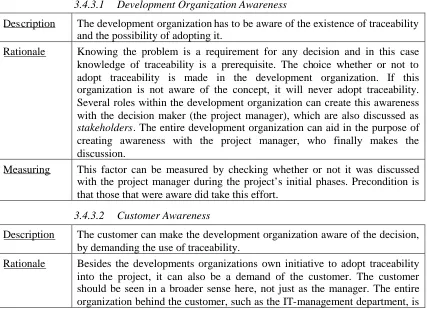
3.4.1.3 Factor Representation