Feature selection and classification of microarray
gene expression data of ovarian carcinoma patients
using weighted voting support vector machine
S.MASOUMAND S.GHAHERI
Department of Analytical Chemistry, Faculty of Chemistry, University of Kashan, I. R. Iran
(Received October 1, 2012; Accepted Feb 18, 2013)
A
BSTRACTWe can reach by DNA microarray gene expression to such wealth of information with thousands of variables (genes). Analysis of this information can show genetic reasons of disease and tumor differences. In this study we try to reduce high-dimensional data by statistical method to select valuable genes with high impact as biomarkers and then classify ovarian tumor based on gene expression data of two patient groups. One group treated by standard therapies and survived, while another group didn’t be cure and die after some times. In the first step we used weighted voting algorithm (WVA) for selecting impressive genes to reduce dimension, therefore eliminate noisy data and make analysis easier and then partial least square – discriminante analysis (PLS-DA) and support vector machine (SVM) methods have been applied for classification of diminished data. Results show that classification by PLS-DA can distinguish two groups somewhat but SVM is more efficient and sufficient classification method.
Keywords: weighted voting algorithm, support vector machine, tumor classification, ovarian cancer, gene expression data.
1. I
NTRODUCTIONIn the past decades, chemometrics methods generally have been used to solve chemical problems. But today, there is an approach for using these methods to analysis of gene expression data [1-3]. DNA microarrays are capable of detecting the expression levels of thousand genes over a few tens of different samples simultaneously [4]. Because of such huge volume of data, there is an increasing attention in data mining field and extraction of precious and helpful information from a huge collection of data [5]. Using statistical method and data mining is necessary to understand the mechanism and process of human deceases. Human demise as cancer and tumor are because of gene expression changes, so
discrimination between different group of samples or between patients and healthy people based on their gene expression is important step to take information out. By classification of individual gene expression, we have a model that can predict the class of a goal sample with unknown class label. The enormous amount of data and small size of individuals is a challenge of this kind of studies, because in such immense data, arrangement is complicated. Also this kind of data usually contains unsuitable and redundancy information [6]. Furthermore, before classification, reduce of dimension is important task. By decreasing dimension and select some genes through whole, we can use selected genes as biomarker to forecast deceases. Researchers introduce many methods for classification and selecting best features. For example, Sarhan developed a method based on artificial neutral network (ANN) and discrete cosine transforms (DCT) [7]. Zheng et al. proposed independent component analysis (ICA) method coupled by sequential floating forward selection (SFFS) technique [8]. Literatures also referred to PLS-DA frequently [9-11]. Furey et al. offered SVM method for classification of gene expression [2]. Other methods that have been used are radial basis function neural network [12] logistic discrimination and quadratic discriminante analysis [13].
Ovarian carcinoma is one of the most common type of gynecological cancers, is fifth reason of cancer demise in women [14]. Standard treatment in ovarian cancer patient is surgery followed by chemotherapy that some patient will be cured while others relapse. If these different patient groups could be identified before therapy, the alternative treatments or strategies might be used instead of standard treatments [15].
The data set have been used in this study is microarray analysis results of ovarian cancer patients. So, studied samples are consisting of gene expressions of two groups. One group didn’t be cure and die after some time and another one are survived after 5 years. All samples are belonging to patients in stage ш ovarian adecarcinoma. We used WVA to reduce dimension and then classify reduced data by PLS-DA and SVM methods.
2. M
ETHODOLOGY1.1.Weighted voting algorithm (WVA)
Sx = ) ( ) ( 2 1 2 1 c c c c (1)
Sx= weighted voting value for every gene
µc = mean of expression values in class 1 and class 2
σc = standard deviation of expression values in class 1 and class 2
The Sx value show how much is correlation of every genes with a particular
distinction. Also it detects genes which have higher variance in one group but low variance in another one. This bias is useful for biological sample. For example, in cancer research, genes in normal tissue work normally and the regulation of which are strict. However, in tumors, genes are deregulated and levels of microarray data expressions vary widely [18]. After dimension reduction, the selected genes were used for classification.
1.2.Partial Least Square – Discriminant Analysis (PLS-DA)
PLS–DA, a special form of partial least square (PLS) modeling, aims to find the variables and direction in multivariate space, which discriminate the known class in training set. In PLS-DA, an indicator Y matrix of category variables is constructed which contains as many columns as there are known class in the training set. In this context, PLS-DA accomplishes a rotation of the projection to latent variable focusing on class separation [19]. PLS-DA score plot show distribution of two classes and root mean square error (RMSE) value reveals validity of separation. RMSEas prediction error parameter defined as below:
RMSE =
n i i i
2) ˆ (
(2)
i
= real class for ith sample
i
ˆ = predicted class for ith sample
n= number of sample
It is obvious that the best parameter for RMSE is 0 when model can predict all classes exactly right.
3.2. Support Vector Machine (SVM)
finite dimension space (linear), separation isn’t possible, a much higher dimension on infinite space is used in combination with kernel techniques such as linear, polynomial, Gaussian radial basis and exponential radial basis function. It’s clear that the hyper-plan
which can classify the two classes of samples suitably isn’t unique. To finding the best hyper-plan, called optimal separating hyperplan (OSH), the concepts of margin, is introduced as distance of hyper-plan to nearest data point of each class (support vectors).
There are many classifiers called hyper-plan that can separate the data, but there is only one that maximizes the margin [21]. Suppose problem of separating the set of training vectors belonging to two separate classes,
D = {(x1, y1), …,( xm ,ym)}, xRn , y (1,-1) (3) The hyperplan is:
w, x + b = 0 (4)
Where w is the normalized weight vector with the same dimension as x and b is the normalized bias of the hyper-plane, any hyper-plane f(x) should meet the following state:
w, x + b 1 for yi =1 (5)
w, x + b -1 for yi = -1 (6) So:
yi (w, x + b ) 1 (7)
Then, the margin between the two paralleled hyper-planes can be written as:
Margin w
2
(8)
Therefore, the structure of OSH can be transformed to the following optimizing problem:
Maximize:
w
2
Subject to: w ,x + b 1
By solving problem and finding OSH, we can classify a new data sample s. A label is assigned in according to its relationship to the decision boundary, and the corresponding decision function is:
f(s) = sign (w,s + b) (9)
4.2. Dataset
variable matrix (the dummy matrix Y) designating membership to given class. The data set was divided into two sets of training (38 samples) and monitoring (16 samples). The training set was used to develop the model. Together with the performance of the training set, the performance of an independent set must also monitored (monitoring set) to obstruct the overtraining phenomena.
All computations and chemometrics analyses were executed with programs in Matlab v. 7. (The mathworks, Inc., Natick, MA, USA). Different algorithm has been proposed in the literature to perform SVM for classification [22-24]. The Lin’s Lib SVM v. 2.33 algorithm was used in the present work [24].
2.
R
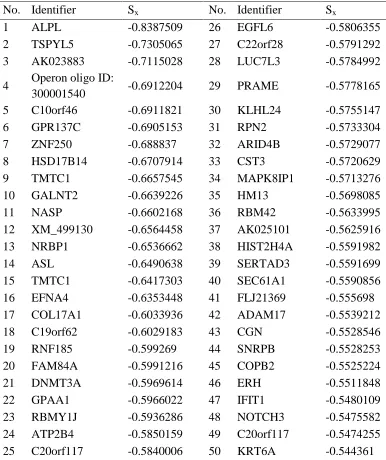
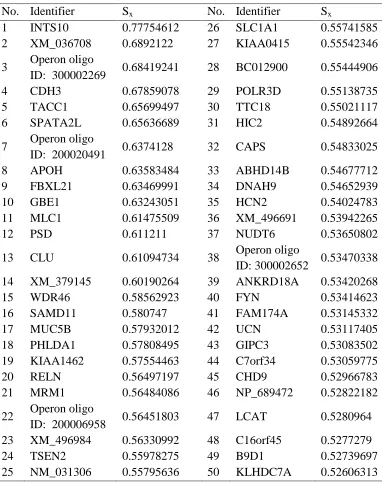
ESULTS AND DISCUSSIONThe weighted voting algorithm makes a weighted linear combination of relevant marker or informative feature obtained in the data set. Fifty probe sets with lowest and fifty probe sets with highest value of Sx were selected as biomarkers are listed in table 1 and 2,
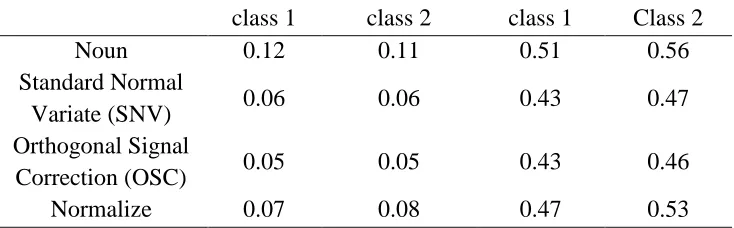
respectively. To evaluate the robustness of these biomarkers, the final step is to classify the data set. There have been many methods for performing the classification task. We used PLS-DA and SVM which have been proved to be very useful and robust to classify the microarray gene expression data.
Previous study on such data set show that three genes are candidate biomarkers: TACC1 (transforming acidic coiled-coil containing protein 1), MUC5B (mucin 5 subtype B) and PRAME (preferentially expressed antigen in melanoma) [15]. The typical function of TACC1 is not accurately known, but observations have shown that the protein is concentrated at centrosomes during mitosis and may play a role in cytokinesis [25,26]. This gene known as a cancer related feature in literature [27-29]. MUC5B belongs to the mucin family of high-molecular-weight glycoproteins found in human epithelial cells. MUC5B, a secreted gel forming mucin, has been studied and play important role in a number of tumor types like breast and gastric cancer [30,31]. The function of PRAME in normal tissue is still unknown, but it encodes an antigen recognized by autologous cytolytic T lymphocytes and its expression is absent or low in normal adult tissue, except male germ cells [32].The effect of this gene, as cancer related gene in ovarian cancer has been verified in some researches [34,35]. Also abnormal expression of this gene is observed in melanoma and neuroblastoma cancer [35,36]. Results show Sx values for these three genes obtained by
weighted voting algorithm are approximately in good agreement with other studies. When gene expression of survivor subgroup compared with remaining tumor, TACC1 and MUC5B are between highest Sx and PRAME is one of fifty genes with lowest Sx. Various
genes with unknown function among the “top 100” (50 in table 1 and 50 in table 2) deserve high priority in future studies, that provide shortcuts in genome-based ovarian cancer research.
3.
C
ONCLUSIONIn this research, we presented WVA and SVM for feature selection and classification of tumor, based on microarray gene expression data. The methodological involve dimension reduction of high-dimensional gene expression data, followed by feature selection using WVA and classification by applying SVM. The results show that our method is effective and efficient in classifying ovarian tumor.
ACKNOWLEDGMENT
Table 1: Fifty Probe Sets with Lowest Sx.
No. Identifier Sx No. Identifier Sx
1 ALPL -0.8387509 26 EGFL6 -0.5806355 2 TSPYL5 -0.7305065 27 C22orf28 -0.5791292 3 AK023883 -0.7115028 28 LUC7L3 -0.5784992
4 Operon oligo ID:
Table 2: Fifty Probe Sets with Highest Sx.
No. Identifier Sx No. Identifier Sx
1 INTS10 0.77754612 26 SLC1A1 0.55741585 2 XM_036708 0.6892122 27 KIAA0415 0.55542346
3 Operon oligo
ID: 300002269 0.68419241 28 BC012900 0.55444906 4 CDH3 0.67859078 29 POLR3D 0.55138735 5 TACC1 0.65699497 30 TTC18 0.55021117 6 SPATA2L 0.65636689 31 HIC2 0.54892664
7 Operon oligo
ID: 200020491 0.6374128 32 CAPS 0.54833025 8 APOH 0.63583484 33 ABHD14B 0.54677712 9 FBXL21 0.63469991 34 DNAH9 0.54652939 10 GBE1 0.63243051 35 HCN2 0.54024783 11 MLC1 0.61475509 36 XM_496691 0.53942265 12 PSD 0.611211 37 NUDT6 0.53650802
13 CLU 0.61094734 38 Operon oligo
ID: 300002652 0.53470338 14 XM_379145 0.60190264 39 ANKRD18A 0.53420268 15 WDR46 0.58562923 40 FYN 0.53414623 16 SAMD11 0.580747 41 FAM174A 0.53145332 17 MUC5B 0.57932012 42 UCN 0.53117405 18 PHLDA1 0.57808495 43 GIPC3 0.53083502 19 KIAA1462 0.57554463 44 C7orf34 0.53059775 20 RELN 0.56497197 45 CHD9 0.52966783 21 MRM1 0.56484086 46 NP_689472 0.52822182
22 Operon oligo
Table 3: PLS-DA results with different preprocessing on reduced data.
Figure.1: Score plot of the first three latent vectors. Training set: 5-year survivor (), dead (), corresponding monitoring set samples (,).
R
EFERENCES1. U. Alon and M. Barkai, Broad patterns of gene expression revealed by clustering analysis of tumor and normal colon tissues probed by oligonucleotide arrays, P. Natl. Acad. Sci. USA. 96 (1999) 67456750.
3. M. Bittner, P. Meltzer, Y. Chen, Y. Jiang, E. Seftor, M. Hendrix, M. Radmacher, R. Simon, Z. Yakhinik and N. Sampask, Molecular classi fcation of cutaneous malignant melanoma by gene expression profling, Nature. 406 (2000) 536540. 4. C.H. Zheng, Y.W. Chong and H.Q. Wang, Gene selection using independent
variable group analysis for tumor classification, Neural. Comput. Appl. 20 (2011) 161–170.
5. J.P. Bigus, Data mining with neural networks: solving business problems from application development to decision support, (McGraw-Hill, Hightstown New Jersey, 1996).
6. A. Osareh and B. Shadgar, Classification and diagnostic prediction of cancers using gene microarray data analysis, J. Appl. Sci. 9 (2009) 452458.
7. A. Sarhan, Cancer Classification Based on Micro array Gene Expression Data Using DCT and ANN, J. Theor. Appl. Inf. Tech. 6 (2009) 208–216.
8. C. Zheng, D. Huang and L. Shang, Feature selection in independent component subspace for microarray data classification, Neurocomputing. 69 (2006) 24072410.
9. G. Musumarra, V. Barresi, D.F. Condorelli and S. Scir , A bioinformatic approach to the identification of candidate genes for the development of new cancer diagnostics, Biol. Chem. 384 (2003) 321–327.
10.M. Pérez-Enciso and M. Tenenhaus, Prediction of clinical outcome with microarray data: A partial least squares discriminant analysis (PLS-DA) approach, Hum. Genet.
112 (2003) 581592.
11.M. Barker and W. Rayens, Partial least squares for discrimination, J. Chemometr.
17 (2003) 166173.
12.A. Castaño, F. Fernández-Navarro, C. Hervás-Martínez and P.A. Gutierrez, Neuro-logistic Models Based on Evolutionary Generalized Radial Basis Function for the Microarray Gene Expression Classification Problem, Neural. Process. Lett. 34
(2011) 117-131.
13.S. Dudoit, J. Fridlyand and T.P. Speed, Comparison of discrimination methods for the classification of tumors using gene expression data, J. Am. Stat. Assoc. 97
(2002) 77–87.
14.I.B. Runnebaum and E. Stickeler, Epidemiological and molecular aspects of ovarian cancer risk, J. Cancer. Res. Clin. 127 (2001) 7379.
15.K. Partheen, K. Levan, L. Osterberg and G. Horvath, Expression analysis of stage III serous ovarian adenocarcinoma distinguishes a sub-group of survivors, Eur. J. Cancer, 42 (2006) 28462854.
17.T. J. MacDonald, K.M. Brown, B. LaFleur, K. Peterson, C. Lawlor, Y. Chen, R.J. Packer, P. Cogen and D. A Stephan, Expression profiling of medulloblastoma: PDGFRA and the RAS/MAPK pathway as therapeutic targets for metastatic disease, Nat. Genet. 29 (2001) 143152.
18.M. Reich, K. Ohm, M. Angelo, P. Tamayo and J.P. Mesirov, GeneCluster 2.0: an advanced toolset for bioarray analysis, Bioinforma. 20 (2004) 17971798.
19.K.P. Singh, A. Malik, D. Mohan, S. Sinha and V.K. Singh, Chemometric data analysis of pollutants in wastewater–a case study, Anal. Chim. Acta. 532 (2005) 15–25.
20.V. Vapnik, the nature of statistical learning theory, (Springer, New york, 1998). 21.http://www.eas.uccs.edu/wang/ECE5990/SVM.pdf, S R. Gunn, 1998.
22.http://www.csie.ntu.edu.tw/~cjlin/libsvm, C.-C. Chang and C.-J. Lin, 2002.
23.H. Li, Y. Liang and Q. Xu, Support vector machines and its applications in chemistry, Chemometr. Intell. Lab. 95 (2008) 188198.
24.http://www.kernel-machines.org/
25.F. Gergely, C. Karlsson, I. Still, J. Cowell, J. Kilmartin and J.W. Raff, The TACC domain identifies a family of centrosomal proteins that can interact with microtubules, P. Natl. Acad. of Sci. USA. 97 (2000) 1435214357.
26.B. Delaval, A. Ferrand, N. Conte, C. Larroque, D. Hernandez-Verdun, C. Prigent and D. Birnbaum, Aurora B -TACC1 protein complex in cytokinesis, Oncogene. 23
(2004) 45164522.
27.L.W. Chu, P. Troncoso, D. a Johnston and J.C. Liang, Genetic markers useful for distinguishing between organ-confined and locally advanced prostate cancer, Gene. Chromosome. Canc. 36 (2003) 303312.
28.K. Partheen, K. Levan, L. Osterberg, K. Helou, G. Horvath, Analysis of cytogenetic alterations in stage III serous ovarian adenocarcinoma reveals a heterogeneous group regarding survival, surgical outcome, and substage, Gene. Chromosome. Canc. 40 (2004) 342348.
29.R. Anbazhagan, H. Fujii and E. Gabrielson, Allelic loss of chromosomal arm 8p in breast cancer progression, Am. J. Pathol. 152 (1998) 815819.
30.N. Berois, M. Varangot, C. Sóñora, L. Zarantonelli, C. Pressa, R. Laviña, J.L. Rodríguez, F. Delgado, N. Porchet, J. P. Aubert and E. Osinaga, Detection of bone marrow-disseminated breast cancer cells using an RT-PCR assay of MUC5B mRNA, Int. J. Cancer. 103 (2003) 550555.
31.M. Perrais, P. Pigny, M.P. Buisine, N. Porchet, J.P. Aubert and I. Van Seuningen-Lempire, Aberrant expression of human mucin gene MUC5B in gastric carcinoma and cancer cells. Identification and regulation of a distal promoter, J. Biol. Chem.
32.H. Ikeda, B. Lethé, F. Lehmann, N. van Baren, J.F. Baurain, C. de Smet, H. Chambost, M. Vitale, A. Moretta, T. Boon and P.G. Coulie, Characterization of an antigen that is recognized on a melanoma showing partial HLA loss by CTL expressing an NK inhibitory receptor, Immunity. 6 (1997) 199208.
33.T.R. Adib, S. Henderson, C. Perrett, D. Hewitt, D. Bourmpoulia, J. Ledermann, C. Boshoff, Predicting biomarkers for ovarian cancer using gene-expression microarrays, Brit. J. Cancer. 90 (2004) 686692.
34.K. Hibbs, K.M. Skubitz, S.E. Pambuccian, R.C. Casey, K.M. Burleson, T.R. Oegema, J.J. Thiele, S.M. Grindle, R.L. Bliss and A.P.N. Skubitz, Differential gene expression in ovarian carcinoma: identification of potential biomarkers, Am. J. Pathol.165 (2004) 397414.
35.K.H. Lu, A.P. Patterson, L. Wang, R.T. Marquez, E.N. Atkinson, K.A. Baggerly, L.R. Ramoth, D.G. Rosen, J. Liu, I. Hellstrom, D. Smith, L. Hartmann, D. Fishman, A. Berchuck, R. Schmandt, R. Whitaker, D.M. Gershenson, G.B. Mills, R.C. Bast and N. Carolina, Selection of Potential Markers for Epithelial Ovarian Cancer with Gene Expression Arrays and Recursive Descent Partition Analysis, Anal. Clin. Cancer. 10 (2004) 32913200.