Avoiding Collateral Surprises:
Managing Multi-Currency CSAs
Anna Barbashova, Numerix - 24 Jan 2013W
ith the derivative markets having changed dramatically since the 2008 financial crisis, regulatory reform and structural changes to the financial markets have resulted in the increased collateralisation of trades and a move to central clearing of vanilla trades. Financial practitioners are witnessing increased usage of collateral as a way to mitigate the risk of counterparty default. Many of these changes have had a dramatic impact on how deriva-tives are fundamentally priced, with collateral choices impacting the discounting curves used in valuations. Adding to the post-crisis drama has been the divergence in rates and significantly widened basis swap spreads. Traders acting on behalf of treasurers and other financial prac-titioners also face challenges surrounding the overwhelming complexity of the Credit Support Annex (CSA) in terms of embedded optionality.This study goes on to give several illustrative examples on how to construct cheapest-to-deliver (CTD) curves and demonstrates how they enable practitioners to select appropriate collateral. It also provides several pricing case studies involving interest rate swaps. As we come to better understand the complexity of current CSA agreements, the article seeks to uncover what the future might look like with the new standard CSA to reduce optionality.
The Complexity of CSA Agreements
A significant number of CSAs allow counterparties to choose collateral from a big list of eligible currencies and securities; furthermore, different currency collateral and types of collateral have different impacts on valuation. Given that almost every CSA agreement is unique, it is no won-der that a lack of transparency prevails and valuation discrepancies between counterparties abound, even for the simplest of trades. Many market participants have come to see that it is nearly impossible to compare prices between dealers.
The Growing Need for a Central Collateral Management Process
The combination of these factors have led many practitioners to realise the importance of developing a central collateral management process, including the ability to identify the CTD collateral. However, many market practitioners face challenges due to disparate systems and varying processes for each over-the-counter (OTC) desk. Difficulties exist when it comes down to validating the large number of CSAs and keeping track of the huge flows of collaterals. Other market participants also face challenges with big data input. In addition, CTD may not always be the most optimal choice. Clearly, practitioners need to consider the massive amounts of rules and requirements surrounding CTD, depending on the funding rates and available assets in the firm. The bottom line: ‘Will it be cheaper to source new collateral or use an existing one?’
PArT I: Case Study - How to Construct aCTD Curve
Most dealers agree that discounting should be based on the CTD collateral in order to enable the best funding benefits and highest rate of return. The CTD curve is a blended collateral discount-ing curve, optimised through the trade life cycle among the different currency collateral curves. The CTD needs to be determined frequently over time, with the choice of the collateral currency becoming crucial in order to optimise profit, effectiveness and liquidity.
When it comes to constructing a CTD curve, each of the following five steps adds an additional layer of complexity. This case study will explore the construction and the complexities involved with CTD, beginning with five basic steps:
Step 1. Construct appropriate curves – Overnight Indexed Swap (OIS), Swap, Basis Curves, Cross-currency (XCCY) curves.
Step 2. Translate curves in different currencies to the trade currency.
Step 3. Pick cheapest throughout the life of the trade.
Step 4. Construct blended CTD curve.
Step 5. Discount cash flows with CTD curve.
The Complexity of CTD Curve Construction and Optionality
What Practitioners Need to Consider: When it comes to CTD and optionality, market participants need to carefully consider various factors, including the choice of currency and collateral type, in addition to calibration; initial margin; up and down thresholds; minimum transfer amounts; and consistency with their counterparties.
Background: Constructing a CTD Curve – Collateral and Corresponding Curves: The basics: The following chart indicates types of collateral/currency and their corresponding curves:
Collateral/Currency USD EUR CAD GBP JPY CHF
Cash USD FedFunds EONIA OIS CORRA OIS SONIA OIS MUTAN OIS TOIS
OIS Curve Curve Curve Curve Curve Curve
Corporate Bonds USD LIBOR+ EURIBOR+ CDOR + GBP LIBOR + MUTAN OIS CHF
[image:2.595.53.495.720.790.2]Spread Spread Spread Spread Curve LIBOR+ Spread Figure 1. The Complexity of CTD Curve Construction.
The Complexity of CTD: 6 Cash Collateral Currencies = 29 Curves to Build!
As the case study unfolds, we will go through the five basic steps outlined earlier for curve construction.
Curve Construction Step-by-Step:
Step 1: Construct Appropriate Curves – OIS, Swap, Basis Curves, XCCY Curves:
First, we will need to construct all the appropriate curves necessary to build OIS curves and standard London Interbank Offered rate (Libor) curves. We need to construct basis curves used in XCCY curve construction and XCCY Basis curves to be used in translat-ing local curves into trade currency.
Step 2: Translate Curves in Different Currencies to the Trade Currency:
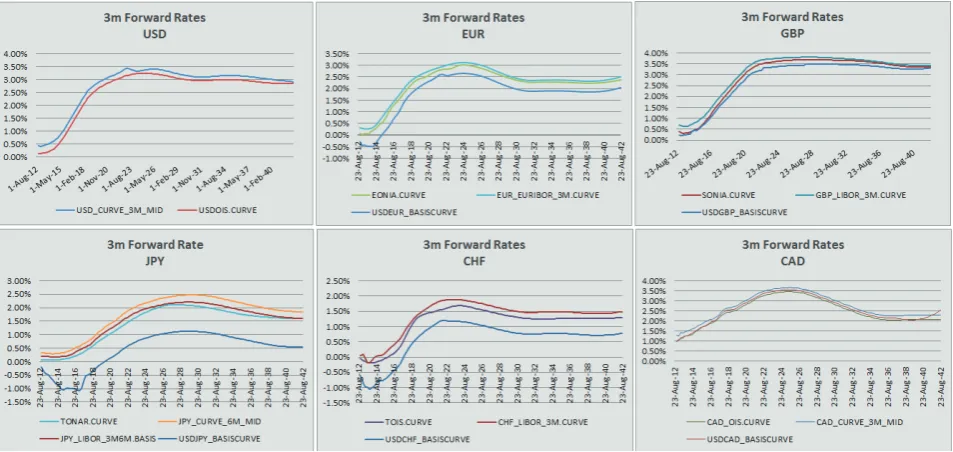
[image:3.595.58.535.317.543.2]Figure 2 below represent an example of curve construction for six currencies, including: US dollar (USD),euro (EUR), pound sterling (GBP), Japanese yen (JPY), Swiss franc (CHF) and Canadian dollar (CAD). As we can see, the graphs illustrate three month forward rates of OIS curves, standard Libor curves and basis curves for each currency, as well as implied XCCY curve for USD vs. appropriate currency basis spreads.
Figure 2. Curve Construction for Six Currencies.
Source: Numerix
Step 3: Pick Cheapest Currency Throughout the Life of the Trade
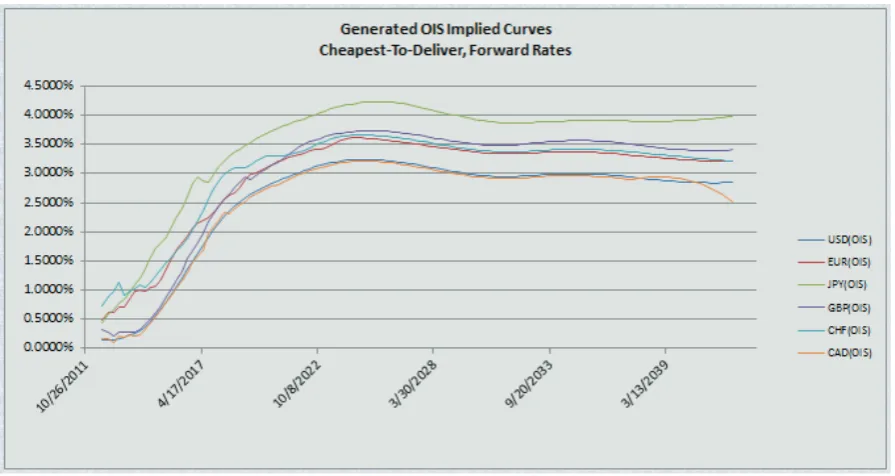
After we obtain all of the appropriate curves in Steps 1-2, we should compare instanta-neous forward discount rates of collateral curves at each point of time and pick the max one, which corresponds to the lowest discount factor. The highest (max) forward rate represents the highest return rate on the corresponding collateral.
Step 4: Construct Blended CTD Curve
Figure 3. OIS Implied Curves, CTD, Forward rates.
Source: Numerix
What Does Your CTD Tell You?
The CTD curve is unique for each counterparty and has become an effective analysis tool for identifying the cheapest collateral. It allows practitioners to incorporate the assumption of frequency of collateral switch, as well as indicating when this cheapest collateral switches to a different one.
With the application of CTD collateral to pricing, we can see the effect of present value (PV) of trades with various counterparties and collateral assumptions, thereby enabling the ability to negotiate and match counterparties. Also, it allows the user to see the risk exposure against different collateral currencies, as well as enabling FX rate sensitivity analysis.
Summarising the Complexities of CTD
PArT II: Pricing Case Studies – Interest rate Swaps
In the examples that follow, we observe how the choice of collateral can significantly affect the price of the trade and ultimately the bottom-line: profit.
Pricing Portfolio
Pricing Case Study 1. The first case study below prices par swaps with different currency cash collateral.
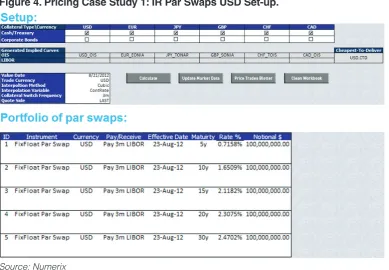
[image:5.595.55.445.294.564.2]The following case study demonstrates a representation, in very simple terms, of how dif-ferent choices of collateral affect interest rate (IR) swap pricing. The example showcases par swaps under USD OIS discounting of different swap maturities (from five years to 30 years). Further, we discount these swaps with different assumptions of collateral posted (i.e. USD, EUR, JPY, CAD, CHF, GBP cash types.) Though this is not a real market case scenario, it provides important insights regarding how much pricing of the trade can vary under different collateral discounting as well as showing explicit numbers without the necessity of scaling by notional, fixed rate, maturity and moneyness of the swap.
Figure 4. Pricing Case Study 1: Ir Par Swaps USD Set-up.
Source: Numerix
Figure 5. Pricing Case Study 1: Ir Par Swaps USD: Different Cash Collateral Assumptions + CTD.
[image:5.595.62.478.621.796.2]Key Highlights and Observations
There are several key observations worth noting in this case study. The main observation is that the difference becomes systematically larger for longer-term swaps. We also observe that a comparison of the actual results of the cheapest collateral in Figure 3 reveals that USD collateral is one of the most expensive.
Therefore, the numbers appearing in the above table in the ‘CTD Cash’ column are
significantly different from the USD cash discounting. Taking these numbers into consideration, we can also observe that the range for running basis points (bps) is between 0-3bps, and that for upfront bps, it goes up to 72 bps (highest forward rates, lowest discount factors).
Pricing Case Study 2. Pricing IR Swaps in EUR VS. JPY
Let us next examine the two cases highlighted in Figure 6 below. In the first case, we have trades in EUR currency against counterparty A, with the CSA agreement allowing us to post collateral in USD, EUR, GBP and cash. The set of trades represents a sample set of IR swaps with various maturities and fixed rates.
The second case below assumes a set of vanilla IR swaps in JPY currency against counterparty B, with the CSA agreement allowing cash collateral in the following set of currencies: USD, EUR, and JPY.
[image:6.595.56.488.443.686.2]We follow the five steps described earlier in our study to construct the CTD curve and apply different assumptions of collateral choices, including the CTD curve to discount these swaps. (Note that CTD discounting is equivalent to the assumption that the counterparty would post collateral in the most efficient way.)
Figure 6. Portfolio of Ir Swaps in EUr and JPY.
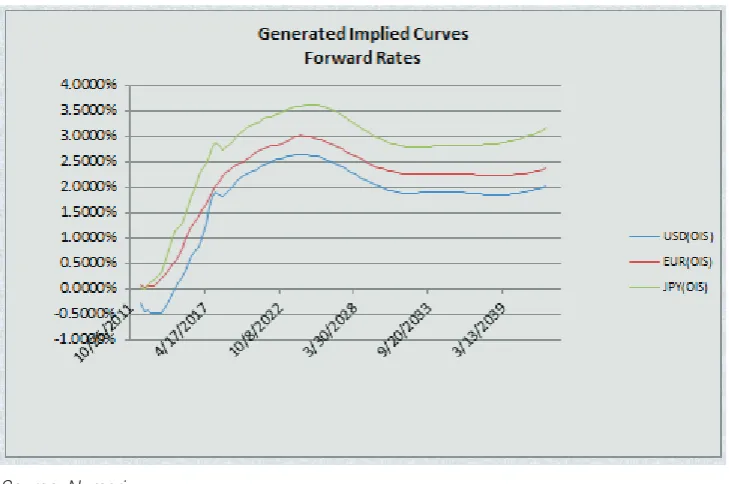
Figure 7. Corresponding Implied Curves for USD, EUr and GBP Collaterals Case 1, Forward rates.
Source: Numerix Source: Numerix
[image:7.595.54.419.381.623.2]Conclusion
In conclusion, as of the 21 August 2012 date where we compare the PVs of swaps and corre-sponding curves of various collaterals, we observe that the cheapest collateral to post would be EUR cash for the next seven years for Case 1; and then we would switch to the GBP cur-rency afterwards. This picture might change with some market shocks in the future. However, we can observe that the results obtained in the curve graphs are reflected in the output PVs of swaps under the different collateral choices.
Also, from the table, we can see that discounting under the CTD curve would lead us to the lowest PV. If we then chose to post collateral in USD dollars for these trades, our portfolio PV would be mispriced by more than 5% compared to the CTD curve price. In addition, we confirm the same observations with JPY currency trades against counterparty B, where the cheapest collateral to post throughout the life of the trades is Japanese Yen; and, this is what we reconfirm by looking at the numbers in the table for Case 2. Please note: this is the snap-shot of market data as of 21 August 2012 for a particular sample CSA agreement. These results may vary significantly throughout the life of the trade, as well as with different CSA agreement assumptions.
Summary
With trade prices varying depending on collateral choices, a central collateral management system is increasingly important in today’s world, including a CTD tool to analyse the optimal col-lateral choices. Cheapest is not always optimal, and practitioners should consider the rules and requirements on top to fully understand what would actually be the most optimal collateral choice.
Can A ‘Perfect World’ of Collateralisation Exist?
Progress is definitely achievable, but perhaps not perfection. The new standard International Swaps and Derivatives Association (ISDA) standard credit support annex (SCSA) agreements should reduce valuation disputes by eliminating the embedded optionality within the existing contracts. However, while the new standard CSA should eliminate optionality, implementation is only just starting. Market practitioners still need to handle existing CSAs that will be on the books for many years to come and will still need to have all the curves for netting.
Clearly, the standard CSA cannot eliminate cross-currency risk and other complexities. For example, there remain concerns about dollar dominance and two systems existing in paral-lel - for old and new cross-currency settlement risk (PVP vs. netting) - in addition to slow initial development. On the positive side, many market practitioners believe that, in time, standard CSAs will help to resolve discrepancies in counterparty valuations and with CTD modelling and optionality, and boost liquidity in the OIS market overall.
*This article follows an earlier related piece: Collateral Discounting: Rethinking the Interest Rate Pricing Framework from its Basic Concepts
Anna Barbashova - Client Solutions, Numerix