DYNAMIC CONDITIONAL CORRELATION –
A SIMPLE CLASS OF MULTIVARIATE GARCH MODELS
Robert Engle
1July 1999
Revised Jan 2002
Forthcoming Journal of Business and Economic Statistics 2002
Abstract
Time varying correlations are often estimated with Multivariate Garch models that are linear in squares and cross products of the data. A new class of multivariate models called dynamic conditional correlation (DCC) models is proposed. These have the flexibility of univariate GARCH models coupled with parsimonious parametric models for the correlations. They are not linear but can often be estimated very simply with univariate or two step methods based on the likelihood function. It is shown that they perform well in a variety of situations and provide sensible empirical results.
1
This research has been supported by NSF grant SBR-9730062and NBER AP group. The author wishes to thank Kevin
I. INTRODUCTION
Correlations are critical inputs for many of the common tasks of financial management. Hedges require estimates of the correlation between the returns of the assets in the hedge. If the correlations and volatilities are changing, then the hedge ratio should be adjusted to account for the most recent information. Similarly, structured products such as rainbow options that are designed with more than one underlying asset, have prices that are sensitive to the correlation between the underlying returns. A forecast of future correlations and volatilities is the basis of any pricing formula.
Asset allocation and risk assessment also rely on correlations, however in this case a large number of correlations are often required. Construction of an optimal portfolio with a set of
constraints requires a forecast of the covariance matrix of the returns. Similarly, the calculation of the standard deviation of today’s portfolio requires a covariance matrix of all the assets in the portfolio. These functions entail estimation and forecasting of large covariance matrices, potentially with thousands of assets.
The quest for reliable estimates of correlations between financial variables has been the motivation for countless academic articles, practitioner conferences and Wall Street research. Simp le methods such as rolling historical correlations and exponential smoothing are widely used. More complex methods such as varieties of multivariate GARCH or Stochastic Volatility have been extensively investigated in the econometric literature and are used by a few sophisticated practitioners. To see some interesting applications, examine Bollerslev, Engle and
assets considered in spite of the apparent need for bigger correlation matrices. In most cases, the number of parameters in large models is too big for easy optimization.
In this paper Dynamic Conditional Correlation (DCC) estimators are proposed that have the flexibility of univariate GARCH but not the complexity of conventional multivariate GARCH. These models, which parameterize the conditional correlations directly, are naturally estimated in two steps – the first is a series of univariate GARCH estimates and the second the correlation estimate. These methods have clear computational advantages over multivariate GARCH models in that the number of parameters to be estimated in the correlation process is independent of the number of series to be correlated. Thus potentially very large correlation matrices can be estimated. In this paper, the accuracy of the correlations estimated by a variety of methods is compared in bivariate settings where many methods are feasible. An analysis of the performance of Dynamic Conditional Correlation methods for large covariance matrices is considered in Engle and Sheppard(2001).
The next section of the paper will give a brief overview of various models for estimating correlations. Section 3 will introduce the new method and compare it with some of the other cited approaches. Section 4 will investigate some statistical properties of the method. Section 5 describes a Monte Carlo experiment with results in Section 6. Section 7 presents empirical results for several pairs of daily time series and Section 8 concludes.
II. CORRELATION MODELS
The conditional correlation between two random variables r1 and r2 that each have mean zero, is
(1)
(
)
( ) ( )
2t, 2 1 t 2 t, 1 1 t t, 2 t , 1 1 t t, 12 r E r E r r E − − − = ρ .
In this definition, the conditional correlation is based on information known the previous period; multi-period forecasts of the correlation can be defined in the same way. By the laws of probability, all correlations defined in this way must lie within the interval [–1,1]. The conditional correlation satisfies this constraint for all possible realizations of the past information and for all linear combinations of the variables.
To clarify the relation between conditional correlations and conditional variances, it is convenient to write the returns as the conditional standard deviation times the standardized disturbance:
(2) hi,t =Et−1
( )
ri2,t , ri,t = hi,tεi,t, i=1,2Epsilon is a standardized disturbance that has mean zero and variance one for each series. Substituting into (4) gives
(3)
(
)
( ) ( )
t 1(
1,t 2,t)
2 t , 2 1 t 2 t, 1 1 t t , 2 t , 1 1 t t , 12 E E E E ε ε ε ε ε ε ρ − − − − = = .Thus, the conditional correlation is also the conditional covariance between the standardized disturbances.
Many estimators have been proposed for conditional correlations. The ever-popular rolling correlation estimator is defined for returns with a zero mean as:
Substituting from (4) it is clear that this is only an attractive estimator in very special circumstances. In particular, it gives equal weight to all observations less than n periods in the past and zero weight on older observations. The estimator will always lie in the [-1,1] interval, but it is unclear under what assumptions it consistently estimates the conditional correlations. A version of this estimator with a 100 day window, called MA100, will be compared with other correlation estimators.
The exponential smoother used by RiskMetrics™ uses declining weights based on a
parameter λ, which emphasizes current data but has no fixed termination point in the past where data becomes uninformative. (5) =
∑
∑
∑
− = − − − = − − − = − − 1 1 2 , 2 1 1 1 2 , 1 1 1 1 , 2 , 1 1 , 12 ˆ t s s s t t s s s t t s s s j t t r r r r λ λ λ ρIt also will surely lie in [-1,1]; however there is no guidance from the data on how to choose lambda. In a multivariate context, the same lambda be used for all assets to ensure appositive definite
correlation matrix. RiskMetrics™ uses the value of .94 for lambda for all assets. In the comparison employed in this paper, this estimator is called EX .06.
Defining the conditional covariance matrix of returns as: (6) Et−1
( )
rtrt' ≡ Ht,these estimators can be expressed in matrix notation respectively as:
(7)
(
)
(
1 1) (
)
11 1 ' , ' 1 − − − = − − − + =
=
∑
n t t t tj
j t j t
t r r and H r r H
n
H λ λ
An alternative simple approach to estimating multivariate models is the Orthogonal GARCH method or principle component GARCH method. This has recently been advocated by
combinations of the series r. Then univariate GARCH models are estimated for some or all of these and the full covariance matrix is constructed by assuming the conditional correlations are all zero. More precisely, find A such that yt = Art, E
(
ytyt')
≡V is diagonal. Univariate GARCH models are estimated for the elements of y and combined into the diagonal matrix Vt. Making the additionalstrong assumption that Et−1
(
ytyt')
=Vt is diagonal, then (8) Ht = A'−1VtA−1In the bivariate case, the matrix A can be chosen to be triangular and estimated by least squares where r1 is one component and the residuals from a regression of r1 on r2 are the second. In this simple
situation, a slightly better approach is to run this regression as a GARCH regression, thereby obtaining residuals which are orthogonal in a GLS metric.
Multivariate GARCH models are natural generalizations of this problem. Many specifications have been considered, however most have been formulated so that the covariances and variances are linear functions of the squares and cross products of the data. The most general expression of this type is called the vec model and is described in Engle and Kroner(1995). The vec model
parameterizes the vector of all covariances and variances expressed as vec(Ht). In the first order case this is given by
(9) vec
( )
Ht =vec( )
Ω +Αvec(
rt−1rt−1')
+Βvec(
Ht−1)
where A and B are n2xn2 matrices with much structure following from the symmetry of H. Without further restrictions, this model will not guarantee positive definiteness of the matrix H.
Useful restrictions are derived from the BEKK representation, introduced by Engle and Kroner(1995), which, in the first order case, can be written as:
Various special cases have been discussed in the literature starting from models where the A and B matrices are simply a scalar or diagonal rather than a whole matrix, and continuing to very complex highly parameterized models which still ensure positive definiteness. See for example Engle and Kroner (1995), Bollerslev, Engle and Nelson (1994), Engle and Mezrich (1996), Kroner and Ng (1998) and Engle and Ding (2001) for examples. In this study the SCALAR BEKK and the DIAGONAL BEKK will be estimated.
As discussed in Engle and Mezrich (1996), these models can be estimated subject to the “variance targeting” constraint that the long run variance covariance matrix is the sample covariance matrix. This constraint differs from MLE only in finite samples but reduces the number of
parameters and often gives improved performance. In the general vec model of equation (9), this can be expressed as
(11)
( ) (
Ω = −Α−Β) ( )
=∑
( )
t t tr
r T S S
vec I
vec , where 1 '
This expression simplifies in the scalar and diagonal BEKK cases. For example for the scalar BEKK the intercept is simply
(12) Ω=
(
1−α −β)
SIII. DYNAMIC CONDITIONAL CORRELATIONS
This paper introduces a new class of multivariate GARCH estimators which can best be viewed as a generalization of Bollerslev(1990)’s constant conditional correlation estimator. In
where R is a correlation matrix containing the conditional correlations as can directly be seen from rewriting this equation as:
(14) Et−1
(
εtεt')
=Dt−1HtDt−1=R, since εt =Dt−1rtThe expressions for h are typically thought of as univariate GARCH models, however, these models could certainly include functions of the other variables in the system as predetermined variables or exogenous variables. A simple estimate of R is the unconditional correlation matrix of the
standardized residuals.
This paper proposes an estimator called dynamic conditional correlation or DCC. The dynamic correlation model differs only in allowing R to be time varying:
(15) Ht =DtRtDt
Parameterizations of R have the same requirements that H did except that the conditional variances must be unity. The matrix Rt remains the correlation matrix.
Kroner and Ng (1998) propose an alternative generalization which lacks the computational advantages discussed below. They propose a covariance matrix which is a matrix weighted average of the Bollerslev CCC model and a Diagonal BEKK, both of are positive definite. They clearly nest the two specifications.
Probably the simplest specification for the correlation matrix is the exponential smoother which can be expressed as:
(16)
[ ]
1
, ,
1
, , 1 1 ,
2 2
, ,
1 1
t s
i t s j t s s
i j t t t t i j
s s
i t s j t s
s s
R
λ ε ε
ρ
λ ε λ ε
−
− −
=
− −
− −
= =
= =
∑
∑
∑
a geometrically weighted average of standardized residuals. Clearly these equations will produce a correlation matrix at each point in time. A simple way to construct this correlation is through exponential smoothi ng. In this case the process followed by the
(17)
(
)
(
) (
)
t , jj t, ii t, j , i t, j , i 1 t , j , i 1 t, j 1 t , i t , j , i q q q , q 1
q = −λ ε − ε − +λ − ρ =
q’s will be integrated.
A natural alternative is suggested by the GARCH(1,1) model. (18) qi,j,t = ρi,j +α
(
εit,−1εjt,−1 −ρi,j) (
+β qi,j,t−1−ρi,j)
Rewriting gives,
(19) , , , , ,
1
1 1
s
i j t i j i t s j t s s
q ρ α β α β ε ε β ∞ − − = − − = + −
∑
The unconditional expectation of the cross product is ρi j, while for the variances: (20) ρii, =1.
The correlation estimator
(21) t j j t i i t j i t j i q q q , , , , , , , , = ρ
will be positive definite as the covariance matrix, Qt =
[ ]
qi,j,t , is a weighted average of a positive definite and a positive semidefinite matrix. The unconditional expectation of the numerator of (21) is,
i j
ρ and each term in the denominator has expected value one. This model is mean reverting as long
as α+β <1 and when the sum is equal to one it is just the model in (17). Matrix versions of these estimators can be written as:
(23) Qt =S
(
1−α −β) (
+α εt−1εt−1')
+βQt−1where S is the unconditional correlation matrix of the epsilons.
Clearly more complex positive definite multivariate GARCH models could be used for the correlation parameterization as long as the unconditional moments are set to the sample correlation matrix. For example, the MARCH family of Ding and Engle(2001) can be expressed in first order form as
(24) Qt =So(ιι'−A−B)+Aoεt−1εt−1'+BoQt−1
where ι is a vector of ones and o is the Hadamard product of two identically sized matrices which is computed simply by element by element multiplication. They show that if A,B,and
(
ιι'−A−B)
are positive semi -definite, then Q will be positive semi -definite. If any one of the matrices is positive definite, then Q will also be. This family includes both of the models above as well as many generalizations.
IV. ESTIMATION
The DCC model can be formulated as the following statistical specification:
(25)
(
)
{ }
{ }
{ }
{ }
{ }
1
2 2
1 1 1
1
1 1 1
1 1
0,
'
( ' ) '
t t t t t
t i i t t i t
t t t
t t t t
t t t t
r N D R D
D diag diag r r diag D
D r
Q S A B A B Q
R diag Q Q diag Q
ω κ λ
ε
ιι ε ε
−
− − −
−
− − −
− −
ℑ
= + +
=
= − − + +
=
:
o o
o o o
The log likelihood for this estimator can be expressed as (26)
(
)
(
)
(
)
(
)
1 1 11 1 1
1
1 1
1 1 1
1
~ (0, )
1 log(2 ) log ' 2
1 log(2 ) log ' 2
1 log(2 ) 2log log ' 2
1 log(2 ) 2log ' ' log ' 2
t t t
T
t t t t t
T
t t t t t t t t t
T
t t t t t
t T
t t t t t t t t t t t t
r N H
L n H r H r
n D R D r D R D r
n D R R
n D r D D r R R
π
π
π ε ε
π ε ε ε ε
− − = − − − = − = − − − = ℑ = − + + = − + + = − + + + = − + + − + +
∑
∑
∑
∑
which can simply be maximized over the parameters of the model. However one of the objectives of this formulation is to allow the model to be estimated more easily even when the covariance matrix is very large. In the next few paragraphs several estimation methods will be presented which give simple consistent but inefficient estimates of the parameters of the model. Sufficient conditions will be given for the consistency and asymptotic normality of these estimators following Newey and McFadden(1994). Let the parameters in D be denoted θ and the additional parameters in R be denoted φ . The log likelihood can be written as the sum of a volatility part and a correlation part: (27) L
( )
θ,φ =LV( )
θ +LC( )
θ,φThe volatility term is
(28)
( )
1(
log 2( )
log 2 ' 2)
2
V t t t t
t
L θ = −
∑
n π + D + r D r−and the correlation component is:
(29) =−
∑
+ − −t t t t t t t
C R R
L (log ' ' )
2 1 ) ,
(θ φ ε 1ε ε ε .
The volatility part of the likelihood is apparently the sum of individual GARCH likelihoods
(30)
∑∑
= + + − = t n
i it
t i t i V h r h L 1 , 2 , , ) log( ) 2 log( 2 1 )
which will be jointly maximized by separately maximizing each term.
The second part of the likelihood will be used to estimate the correlation parameters. As the squared residuals are not dependent on these parameters, they will not enter the first order conditions and can be ignored. The resulting estimator will be called DCC LL MR if the mean reverting formula (18) is used and DCC LL INT with the integrated model in (17).
The two step approach to maximizing the likelihood is to find (31) θˆ=argmax
{
LV( )
θ}
and then take this value as given in the second stage
(32)
{
( )
θ φ}
φ ,
ˆ max LC .
Under reasonable regularity conditions, consistency of the first step will ensure consistency of the second step. The maximum of the second step will be a function of the first step parameter
estimates, so if the first step is consistent, then the second step will be too as long as the function is continuous in a neighborhood of the true parameters.
Newey and McFadden (1994) in Theorem 6.1, formulate a two step GMM problem which can be applied to this model. Consider the moment condition corresponding to the first step as
( )
=0∇θLV θ . The moment condition corresponding to the second step is ∇φLC
( )
θˆ,φ =0. Understandard regularity conditions which are given as conditions i) to v) in Theorem 3.4 of Newey and McFadden, the parameter estimates will be consistent, and asymptotically normal, with a covariance matrix of familiar form. This matrix is the product of two inverted Hessians around an outer product of scores. In particular, the covariance matrix of the correlation parameters is:
(33) V
( )
φ =(
)
1(
{
(
)
[
(
)
]
1}
{
(
)
[
(
)
]
1}
)
(
)
1'
C C C V V C C V V C
E ∇φφL − E ∇φL −E ∇φθL E ∇θθL − ∇θL ∇φL −E ∇φθL E ∇θθL − ∇θL E ∇φφL −
Details of this proof can be found in Engle and Sheppard (2001)
Alternative estimation approaches can easily be devised which are again consistent but inefficient. Rewrite (18) as
(34) ei j t, , =ρi j,
(
1− −α β) (
+ α β+)
ei j t, , 1− −β(
ei j t, , 1− −qi j t, , 1−) (
+ ei j t, , −qi j t, ,)
where ei,j,t =εi,tεj,t. This equation is an ARMA(1,1) since the errors are a Martingale difference by construction. The autoregressive coefficient is slightly bigger if αis a small positive number, which is the empirically relevant case. This equation can therefore be estimated with conventional time series software to recover consistent estimates of the parameters. The drawback to this method is that ARMA with nearly equal roots are numerically unstable and tricky to estimate. A further drawback is that in the multivariate setting, there are many such cross products that can be used for this estimation. The problem is even easier if the model is (17) since then the autoregressive root is assumed to be one. The model is simply an integrated moving average or IMA with no intercept. (35) ∆ei,j,t=−β
(
ei,j,t−1−qi,j,t−1) (
+ ei,j,t −qi,j,t)
,which is simply an exponential smoother with parameter λ β= . This estimator will be called DCC IMA.
V. COMPARISON OF ESTIMATORS
The data generating process consists of two gaussian GARCH models; one is highly persistent and the other is not.
(36)
2 2
1, 1, 1 1, 1 2, 2, 1 2, 1 1,
1, 1, 1, 2, 2, 2, 2,
.01 .05 .94 , .5 .2 .5
1
~ 0, , , ,
1
ε ρ
ε ε
ε ρ
− − − −
= + + = + +
= =
t t t t t t
t t
t t t t t t
t t
h r h h r h
N r h r h
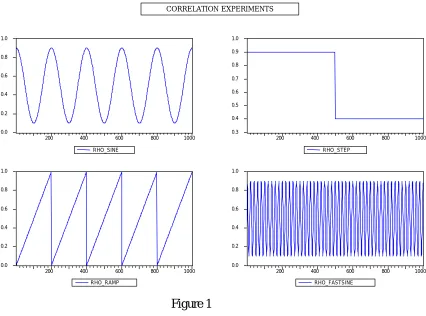
The correlations follow several processes that are labeled as follows: • Constant ρt =.9
• Sine ρt =.5+.4cos
(
2πt/200)
• Fast Sine ρt =.5+.4cos(
2πt/20)
• Step ρt =.9−.5(
t >500)
• Ramp ρt =mod(
t/200)
Figure 1
Eight different methods are used to estimate the correlations – two multivariate GARCH models, Orthogonal GARCH, two integrated DCC models and one mean reverting DCC plus the exponential smoother from RISKMETRICS and the familiar 100 day moving average. The methods and their descriptions are:
• SCALAR BEKK – scalar version of (10) with variance targeting as in (12) • DIAG BEKK- diagonal version of (10) with variance targeting as in (11)
• DCC IMA – Dynamic Conditional Correlation with integrated moving average estimation as in (35)
• DCC LL INT –Dynamic Conditional Correlation by Log Likelihood for integrated process
0.0 0.2 0.4 0.6 0.8 1.0
200 400 600 800 1000 RHO_SINE
0.3 0.4 0.5 0.6 0.7 0.8 0.9 1.0
200 400 600 800 1000 RHO_STEP
0.0 0.2 0.4 0.6 0.8 1.0
200 400 600 800 1000 RHO_RAMP
0.0 0.2 0.4 0.6 0.8 1.0
200 400 600 800 1000 RHO_FASTSINE
• DCC LL MR – Dynamic Conditional Correlation by Log Likelihood with mean reverting model as in (18)
• MA100- Moving Average of 100 days
• EX .06 –Exponential smoothing with parameter=.06
• OGARCH- orthogonal GARCH or principle components GARCH as in (8).
Three performance measures are used. The first is simply the comparison of the estimated correlations with the true correlations by mean absolute error. This is defined as:
(37) =
∑
t − tT
MAE 1 ρˆ ρ
and of course the smallest values are the best. A second measure is a test for autocorrelation of the squared standardized residuals. For a multivariate problem, the standardized residuals are defined as (38) νt = Ht−1/2rt
which in this bivariate case is implemented with a triangular square root defi ned as:
(39)
( )
( )
2, 11 , 1 2 , 22 , 2 , 2 , 11 , 1 , 1 ˆ 1 ˆ ˆ 1 1 / t t t t t t t t t t t H r H r H r ρ ρ ρ ν ν − − − = =
The third performance measure is an evaluation of the estimator for calculating value at risk. For a portfolio with w invested in the first asset and (1-w) in the second, the value at risk, assuming normality, is
(40) VaRt=1.65
(
w H2 11,t+ −(
1 w)
2H22,t +2 *w(
1−w)
ρˆt H11,tH22,t)
and a dichotomous variable called hit should be unpredictable based on the past where hit is defined as:
(41) hitt =I
(
w*r1,t +(
1−w)
*r2,t <−VaRt)
−.05The Dynamic Quantile Test introduced by Engle and Manganelli (2001) is an F test of the hypothesis that all coefficients as well as the intercept are zero in a regression of this variable on its past, on current VaR, and any other variables. In this case 5 lags and the current VaR are used. The number of rejections using a 5% critical value is a measure of model performance. The reported results are for an equal weighted portfolio with w =.5, and a hedge portfolio with weights 1,-1.
VI. RESULTS
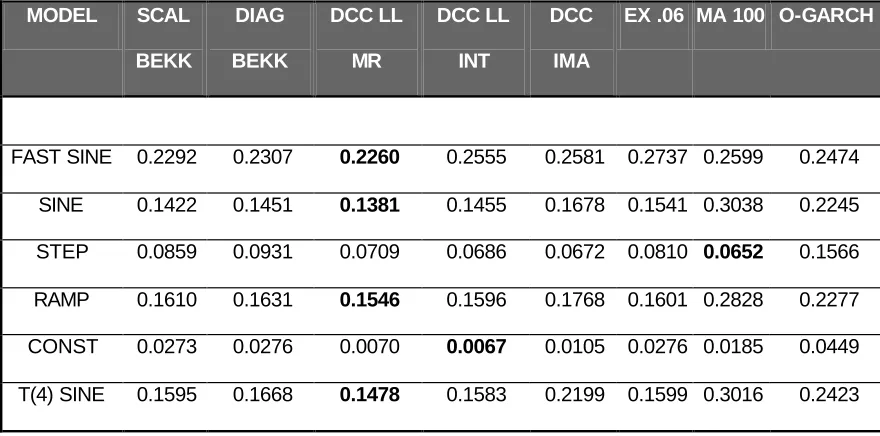
Table I presents the results for the Mean Absolute Error for the eight estimators for 6 experiments with 200 replications. In four of the six cases the DCC mean reverting model has the smallest MAE. When these errors are summed over all cases, this model is the best. Very close second and third place models are DCC integrated with log likelihood estimation, and scalar BEKK.
The test for autocorrelation in the first squared standardized residual is presented in Table III. These test statistics are typically close to 5% reflecting the fact that many of these models are
correctly specified and the rejection rate should be the size. Overall the best model appears to be the diagonal BEKK with OGARCH and DCC close behind.
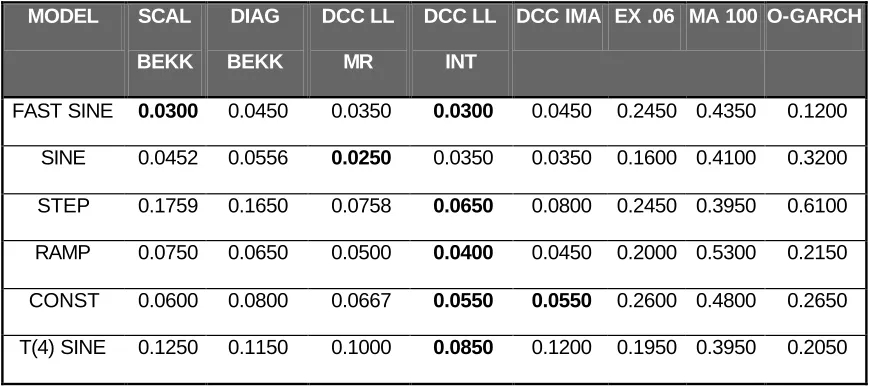
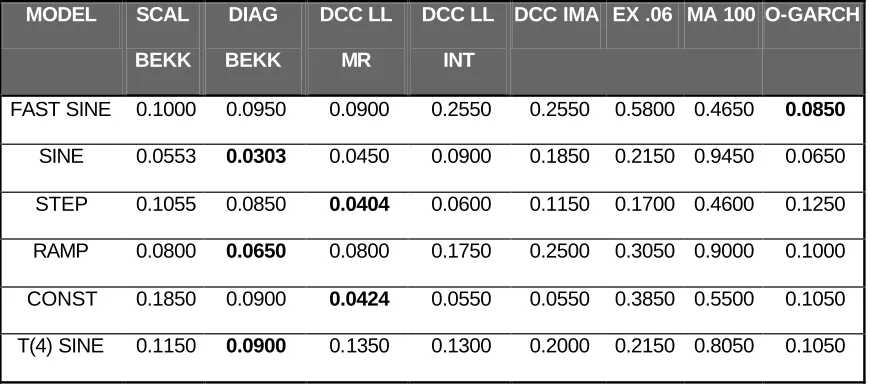
The VaR based Dynamic Quantile Test is presented in Table IV for a portfolio that is half invested in each asset and in Table V for a long-short portfolio with weights plus and minus one. The number of 5% rejections for many of the models is close to the 5% nominal level in spite of
misspecification of the structure. In five out of six cases, the minimum is the integrated DCC log likelihood; and overall, it is also the best method followed by the mean reverting DCC and the IMA DCC.
The value at risk test based on the long short portfolio finds that the Diagonal BEKK is best for 3 out of 6 while the DCC MR is best for two. Overall, the DCC MR is observed to be the best. From all of these performance measures, the Dynamic Conditional Correlation methods are either the best or very near the best method. Choosing among these models, the mean reverting model is the general winner although the integrated versions are close behind and perform best by some criteria. Generally the log likelihood estimation method is superior to the IMA estimator for the integrated DCC models.
TABLE I
MEAN ABSOLUTE ERROR OF CORRELATION ESTIMATES
MODEL SCAL
BEKK
DIAG
BEKK
DCC LL
MR
DCC LL
INT
DCC
IMA
EX .06 MA 100 O-GARCH
FAST SINE 0.2292 0.2307 0.2260 0.2555 0.2581 0.2737 0.2599 0.2474 SINE 0.1422 0.1451 0.1381 0.1455 0.1678 0.1541 0.3038 0.2245 STEP 0.0859 0.0931 0.0709 0.0686 0.0672 0.0810 0.0652 0.1566 RAMP 0.1610 0.1631 0.1546 0.1596 0.1768 0.1601 0.2828 0.2277 CONST 0.0273 0.0276 0.0070 0.0067 0.0105 0.0276 0.0185 0.0449 T(4) SINE 0.1595 0.1668 0.1478 0.1583 0.2199 0.1599 0.3016 0.2423
TABLE II
FRACTION OF 5%TESTS FINDING AUTOCORRELATION IN SQUARED
MODEL SCAL
BEKK
DIAG
BEKK
DCC LL
MR
DCC LL
INT
DCC IMA EX .06 MA 100 O-GARCH
FAST SINE 0.3100 0.0950 0.1300 0.3700 0.3700 0.7250 0.9900 0.1100 SINE 0.5930 0.2677 0.1400 0.1850 0.3350 0.7600 1.0000 0.2650 STEP 0.8995 0.6700 0.2778 0.3250 0.6650 0.8550 0.9950 0.7600 RAMP 0.5300 0.2600 0.2400 0.5450 0.7500 0.7300 1.0000 0.2200
[image:19.612.97.540.477.694.2]STANDARDIZED SECOND RESIDUAL
TABLE III
FRACTION OF 5% TESTS FINDING AUTOCORRELATION IN SQUARED
STANDARDIZED FIRST RESIDUAL
TABLE IV
FRACTION OF 5% DYNAMIC QUANTILE TESTS REJECTING
VALUE AT RISK: Equal Weighted
MODEL SCAL
BEKK
DIAG
BEKK
DCC LL
MR
DCC LL
INT
DCC IMA EX .06 MA 100 O-GARCH
FAST SINE 0.0300 0.0450 0.0350 0.0300 0.0450 0.2450 0.4350 0.1200 SINE 0.0452 0.0556 0.0250 0.0350 0.0350 0.1600 0.4100 0.3200 STEP 0.1759 0.1650 0.0758 0.0650 0.0800 0.2450 0.3950 0.6100 RAMP 0.0750 0.0650 0.0500 0.0400 0.0450 0.2000 0.5300 0.2150 CONST 0.0600 0.0800 0.0667 0.0550 0.0550 0.2600 0.4800 0.2650 T(4) SINE 0.1250 0.1150 0.1000 0.0850 0.1200 0.1950 0.3950 0.2050
MODEL SCAL
BEKK
DIAG
BEKK
DCC LL
MR
DCC LL
INT
DCC IMA EX .06 MA 100 O-GARCH
FAST SINE 0.2250 0.0450 0.0600 0.0600 0.0650 0.0750 0.6550 0.0600 SINE 0.0804 0.0657 0.0400 0.0300 0.0600 0.0400 0.6250 0.0400 STEP 0.0302 0.0400 0.0505 0.0500 0.0450 0.0300 0.6500 0.0250
RAMP 0.0550 0.0500 0.0500 0.0600 0.0600 0.0650 0.7500 0.0400
CONST 0.0200 0.0250 0.0242 0.0250 0.0250 0.0400 0.6350 0.0150
TABLE V
FRACTION OF 5% DYNAMIC QUANTILE TESTS REJECTING
VALUE AT RISK: Long - Short
MODEL SCAL
BEKK
DIAG
BEKK
DCC LL
MR
DCC LL
INT
DCC IMA EX .06 MA 100 O-GARCH
FAST SINE 0.1000 0.0950 0.0900 0.2550 0.2550 0.5800 0.4650 0.0850
SINE 0.0553 0.0303 0.0450 0.0900 0.1850 0.2150 0.9450 0.0650 STEP 0.1055 0.0850 0.0404 0.0600 0.1150 0.1700 0.4600 0.1250 RAMP 0.0800 0.0650 0.0800 0.1750 0.2500 0.3050 0.9000 0.1000 CONST 0.1850 0.0900 0.0424 0.0550 0.0550 0.3850 0.5500 0.1050 T(4) SINE 0.1150 0.0900 0.1350 0.1300 0.2000 0.2150 0.8050 0.1050
VII. EMPIRICAL RESULTS
Empirical examples of these correlation estimates will be presented for several interesting series. First we examine the correlation between the Dow Jones Industrial Average and the NASDAQ composite for ten years of daily data ending in March 2000. Then we look at daily correlations between stocks and bonds, a central feature of asset allocation models. Finally we examine the daily correlation between returns on several currencies around major historical events including the launch of the Euro. Each of these data sets has been used to estimate all of the models described above. The DCC parameter estimates for the integrated and mean reverting models are exhibited with consistent standard errors from (32) in Appendix 1. In this table the statistic referred to as likelihood ratio is the difference between the log likelihood of the second stage estimates using the integrated model and using the mean reverting model. As these are no t jointly maximized
Furthermore, non-normality of the returns would also affect this limiting distribution. A. Dow Jones and Nasdaq.
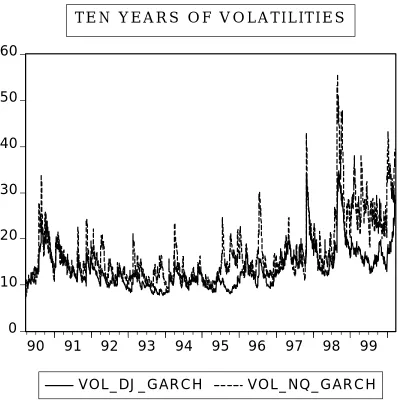
The dramatic rise in the NASDAQ over the last part of the 90’s perplexed many portfolio managers and delighted the new internet start-ups and day traders. A plot of the GARCH volatilities of these series in Figure 8 reveals that the NASDAQ has always been more volatile than the Dow but that this gap widens at the end of the sample.
0
1 0
2 0
3 0
4 0
5 0
6 0
9 0
9 1
9 2
9 3
9 4
9 5
9 6
9 7
9 8
9 9
VOL_DJ_GARCH
V O L _ N Q _ G A R C H
TE N Y EA R S O F V O LA TILITIES
[image:22.612.80.478.242.645.2]
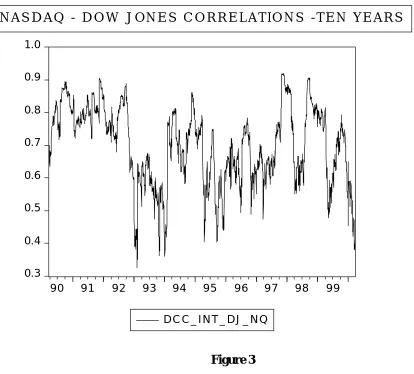
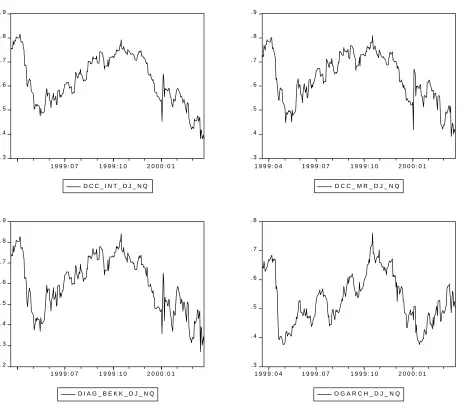
The correlation between the Dow and NASDAQ was estimated with the DCC integrated method, using the volatilities in the figure above. The results are quite interesting.
0.3 0.4 0.5 0.6 0.7 0.8 0.9 1.0
9 0 9 1 9 2 9 3 9 4 9 5 9 6 9 7 9 8 9 9
D C C _ I N T _ D J _ N Q
[image:23.612.85.499.157.531.2]NASDAQ - DOW JONES CORRELATIONS -TEN YEARS
Figure 3
. 3 . 4 . 5 . 6 . 7 . 8 . 9
1 9 9 9 : 0 7 1 9 9 9 : 1 0 2 0 0 0 : 0 1
D C C _ I N T _ D J _ N Q
. 3 . 4 . 5 . 6 . 7 . 8 . 9
1 9 9 9 : 0 4 1 9 9 9 : 0 7 1 9 9 9 : 1 0 2 0 0 0 : 0 1
D C C _ M R _ D J _ N Q
. 2 . 3 . 4 . 5 . 6 . 7 . 8 . 9
1 9 9 9 : 0 7 1 9 9 9 : 1 0 2 0 0 0 : 0 1
D I A G _ B E K K _ D J _ N Q
. 3 . 4 . 5 . 6 . 7 . 8
1 9 9 9 : 0 4 1 9 9 9 : 0 7 1 9 9 9 : 1 0 2 0 0 0 : 0 1
[image:24.612.87.548.115.533.2]O G A R C H _ D J _ N Q C O R R E L A T IO N S 3 / 1 9 9 9 T O 3 / 2 0 0 0
Figure 4
B. Stocks and Bonds
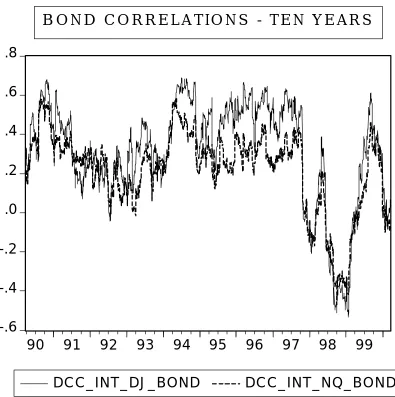
the last ten years. The correlations are generally positive in the range of .4 except for the summer of 1998 when they become highly negative, and the end of the sample when they are about zero. While it is widely reported in the press that the Nasdaq does not seem to be sensitive to interest rates, the data suggests that this is only true for some limited time periods including the first quarter of 2000, and that this is also true for the Dow. Throughout the decade it appears that the Dow is slightly more correlated with bond prices than is the Nasdaq.
-.6
-.4
-.2
.0
.2
.4
.6
.8
9 0
9 1
9 2
9 3
9 4
9 5
9 6
9 7
9 8
9 9
DCC_INT_DJ_BOND
DCC_INT_NQ_BOND
[image:25.612.88.483.239.636.2]B O N D C O R R ELA TIO N S - TEN Y EAR S
C. Exchange Rates
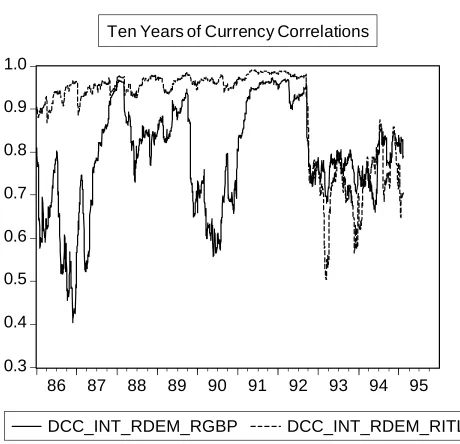
Currency correlations show dramatic evidence of non-stationarity. That is, there are very pronounced apparent structural changes in the correlation process. In Figure 6, the breakdown of the correlations between the Deutschmark and the Pound and Lira in August of 1992 is very apparent. For the Pound this was a return to a more normal correlation while for the Lira it was a dramatic uncoupling.
0.3
0.4
0.5
0.6
0.7
0.8
0.9
1.0
86
87
88
89
90
91
92
93
94
95
DCC_INT_RDEM_RGBP
DCC_INT_RDEM_RITL
[image:26.612.82.542.233.677.2]Ten Years of Currency Correlations
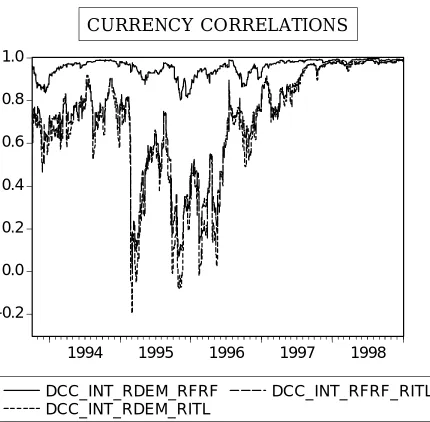
Figure 7 shows currency correlations leading up to the launch of the Euro in January 1999. The Lira has lower correlations with the Franc and Deutschmark from 93 to 96 but then they
gradually approach one. As the Euro is launched, the estimated correlation has moved essentially to one. In the last year it drops below .95 only once for the Franc/Lira and not at all for the other two pairs.
-0.2
0.0
0.2
0.4
0.6
0.8
1.0
1994
1995
1996
1997
1998
DCC_INT_RDEM_RFRF
DCC_INT_RDEM_RITL
DCC_INT_RFRF_RITL
[image:27.612.83.513.239.661.2]CURRENCY CORRELATIONS
From the results in Appendix 1, it is seen that this is the only data set for which the integrated DCC cannot be rejected against the mean reverting DCC. The non-stationarity in these correlations is presumably responsible. It is somewhat surprising that a similar result is not found for the prior currency pairs.
D. Testing the Empirical Models
For each of these data sets, the same set of tests can be constructed that were used in the Monte Carlo experiment. In this case of course, the mean absolute errors cannot be observed, but the tests for residual ARCH can be computed and the tests for value at risk can be computed. In the latter case, the results are subject to various interpretations as the assumption of normality is a potential source of rejection. In each case the number of observations is larger than in the Monte Carlo experiment ranging from 1400 to 2600.
The p-statistics for each of four tests are given in Appendix 2. The tests are the tests for residual autocorrelation in squares and for accuracy of value at risk for two portfolios. The two portfolios are an equally weighted portfolio and a long short portfolio. They presumably are sensitive to rather different failures of correlation estimates. From the four tables, it is immediately clear that most of the models are misspecified for most of the data sets. If a 5% test is done for all the data sets on each of the criteria, then the expected number of rejections for each model would be just over one out of 28 possibilities. Across the models there are from 10 to 21 rejections at the 5% level!
rejections while the DCC LL INT has 14. Probably, these differences are not large enough to be convincing.
If a 1% test is used reflecting the larger sample size, then the number of rejections ranges from 7 to 21. Again the MA 100 is the worst but now the EX .06 is the winner. The DCC LL MR , DCC LL INT and Diag BEKK are all tied for second with 9 rejections.
The implications of this comparison are mainly that a bigger and more systematic comparison is required. These results suggest first of all that real data is more complicated than any of these models. Secondly, it appears that the DCC models are competitive with the other methods, some of which are difficult to generalize to large systems.
VIII. CONCLUSIONS
The main finding in this paper is that the bivariate version of this model provides a very good approximation to a variety of time varying correlation processes. The comparison of DCC with simple multivariate GARCH and several other estimators shows that the DCC is often the most accurate. This is true whether the criterion is mean absolute error, diagnostic tests or tests based on value at risk calculations.
REFERENCES
Alexander, C.O. (1998), “Volatility and Correlation: Methods, Models and Applications,” in Risk Manangement and Analysis: Measuring and Modelling Financial Risk(C.O. Alexander, Ed. ) Wiley.
Alexander, C.O. (2001), “Orthogonal GARCH,” Mastering Risk (C.O. Alexander, Ed.) Volume 2. Financial Times – Prentice Hall pp21-38.
Bollerslev, Tim (1990), “Modeling the Coherence in Short-run Nominal Exchange Rates: A
Multivariate Generalized ARCH Model,” Review of Econo mics and Statistics, 72:498-505. Bollerslev, Tim, Robert Engle and J.M. Wooldridge (1988) “A Capital Asset Pricing Model with
Time Varying Covariances," Journal of Political Economy 96, 116-131.
Bollerslev, Tim, Robert Engle and D. Nelson (1994), “ARCH Mod Handbook of Econometrics, Volume IV, (ed. R. Engle and D. McFadden), (Amsterdam, North Holland), 2959-3038. Ding, Zhuanxin and Robert Engle (2001), “Large Scale Conditional Covariance Matrix Modeling,
Estimation and Testing,” Academia Economic Papers, 29,2 pp157-184.
Engle, Robert and K. Kroner (1995), "Multivariate Simultaneous GARCH," Econometric Theory 11, 122-150.
Engle, Robert and Joseph Mezrich (1996), “GARCH for Groups,” Risk August, Vol. 9, No. 8: pp 36-40.
Engle, Robert and Simone Manganelli (1999), “CAViaR: Conditional Value At Risk By Regression Quantiles,” NBER Working Paper 7341.
Engle, Robert and Kevin Sheppard, (2001), “Theoretical and Empirical properties of Dynamic Conditional Correlation Multivariate GARCH,” NBER Working Paper 8554.
Kroner, Kenneth F. and Victor K. Ng (1998), “Modeling Asymmetric Comovements of Asset Returns,” Review of Financial Studies, pp 817-844.
Kroner, K. F. and S.Claessens (1991), “Optimal Dynamic Hedging Portfolios and the Currency Composition of External Debt,” Journal of International Money and Finance, 10, 131-148. Newey, Whitney and Daniel McFadden (1994), “Large Sample Estimation and Hypothesis Testing,”
Appendix 1
Mean Reverting Model Integrated Model
Asset 1 Asset 2 Asset 1 Asset 2
NQ DJ NQ DJ
Parameter T-stat Log-Likelihood Parameter T-stat Log-Likelihood alphaDCC 0.039029 6.916839405 lambdaDCC 0.030255569 4.66248 18062.79651
betaDCC 0.941958 92.72739572 18079.5857 LR TEST 33.57836423
Asset 1 Asset 2 Asset 1 Asset 2
RATE DJ RATE DJ
Parameter T-stat Log-Likelihood Parameter T-stat Log-Likelihood alphaDCC 0.037372 2.745870787 lambdaDCC 0.02851073 3.675969 13188.63653
betaDCC 0.950269 44.42479805 13197.82499 LR TEST 18.37690833
Asset 1 Asset 2 Asset 1 Asset 2
NQ RATE NQ RATE
Parameter T-stat Log-Likelihood Parameter T-stat Log-Likelihood alphaDCC 0.029972 2.652315309 lambdaDCC 0.019359061 2.127002 12578.06669
betaDCC 0.953244 46.61344925 12587.26244 LR TEST 18.39149373
Asset 1 Asset 2 Asset 1 Asset 2
DM ITL DM ITL
Parameter T-stat Log-Likelihood Parameter T-stat Log-Likelihood alphaDCC 0.0991 3.953696951 lambdaDCC 0.052484321 4.243317 20976.5062
betaDCC 0.863885 21.32994852 21041.71874 LR TEST 130.4250734
Asset 1 Asset 2 Asset 1 Asset 2
DM GBP DM GBP
Parameter T-stat Log-Likelihood Parameter T-stat Log-Likelihood alphaDCC 0.03264 1.315852908 lambdaDCC 0.024731692 1.932782 19480.21203
betaDCC 0.963504 37.57905053 19508.6083 LR TEST 56.79255661
Asset 1 Asset 2 Asset 1 Asset 2
rdem90 rfrf90 rdem90 rfrf90
Parameter T-stat Log-Likelihood Parameter T-stat Log-Likelihood alphaDCC 0.059413 4.154987386 lambdaDCC 0.047704833 2.880988 12416.84873
betaDCC 0.934458 59.19216459 12426.89065 LR TEST 20.08382828
Asset 1 Asset 2 Asset 1 Asset 2
rdem90 ritl90 rdem90 ritl90
Parameter T-stat Log-Likelihood Parameter T-stat Log-Likelihood alphaDCC 0.056675 3.091462338 lambdaDCC 0.053523717 2.971859 11442.50983
Appendix 2
P-STATISTICS FROM TESTS OF EMPIRICAL MODELS
ARCH in SQUARED RESID1
MODEL SCAL BEKK DIAG BEKK DCC LL MR DCC LL INT EX .06 MA100 O-GARCH NASD&DJ 0.0047 0.0281 0.3541 0.3498 0.3752 0.0000 0.2748 DJ&RATE 0.0000 0.0002 0.0003 0.0020 0.0167 0.0000 0.0001 NQ&RATE 0.0000 0.0044 0.0100 0.0224 0.0053 0.0000 0.0090 DM&ITL 0.4071 0.3593 0.2397 0.1204 0.5503 0.0000 0.4534 DM&GBP 0.4437 0.4303 0.4601 0.3872 0.4141 0.0000 0.4213 FF&DM90 0.2364 0.2196 0.1219 0.1980 0.3637 0.0000 0.0225 DM&IT90 0.1188 0.3579 0.0075 0.0001 0.0119 0.0000 0.0010
ARCH in SQUARED RESID2
MODEL SCAL BEKK DIAG BEKK DCC LL MR DCC LL INT EX .06 MA100 O-GARCH NASD&DJ 0.0723 0.0656 0.0315 0.0276 0.0604 0.0000 0.0201 DJ&RATE 0.7090 0.7975 0.8251 0.6197 0.8224 0.0007 0.1570 NQ&RATE 0.0052 0.0093 0.0075 0.0053 0.0023 0.0000 0.1249 DM&ITL 0.0001 0.0000 0.0000 0.0000 0.0000 0.0000 0.0000 DM&GBP 0.0000 0.0000 0.0000 0.0000 0.1366 0.0000 0.4650 FF&DM90 0.0002 0.0010 0.0000 0.0000 0.0000 0.0000 0.0018 DM&IT90 0.0964 0.1033 0.0769 0.1871 0.0431 0.0000 0.5384
DYNAMIC QUANTILE TEST VaR1
MODEL SCAL BEKK DIAG BEKK DCC LL MR DCC LL INT EX .06 MA100 O-GARCH
DYNAMIC QUANTILE TEST VaR2
MODEL SCAL BEKK DIAG BEKK DCC LL MR DCC LL INT EX .06 MA100 O-GARCH