Materials Science and Engineering Publications
Materials Science and Engineering
10-2006
Persistence of 5:3 plates in RE5(SixGe1-x)4 alloys
O. Ugurlu
Iowa State UniversityL. Scott Chumbley
Iowa State University, [email protected]
C. R. Fisher
Iowa State UniversityFollow this and additional works at:
http://lib.dr.iastate.edu/mse_pubs
Part of the
Metallurgy Commons
The complete bibliographic information for this item can be found at
http://lib.dr.iastate.edu/
mse_pubs/135
. For information on how to cite this item, please visit
http://lib.dr.iastate.edu/
howtocite.html
.
Persistence of 5:3 plates in RE5(SixGe1-x)4 alloys
Abstract
Studies of RE5(SixGe1-x)4alloys, where RE equals rare earth, have revealed a second-phase having a thin-plate
morphology in essentially every alloy examined, independent of exact composition and matrix crystal structure. Identified as having a composition approximating Gd5(SixGe1-x)3and a hexagonal crystal structure
in the Gd-based system, it has been suggested that the observed thin-plate second phases seen in this family of rare earth alloys are all most likely of the form RE5(SixGe1-x)3. A number of interesting observations suggest
that the formation of these second-phase plates is somewhat unusual. The purpose of this article is to
investigate the stability of this second phase in Gd- and Er-based compounds. The stability was investigated as a function of thermal cycling and large-scale composition fluctuations. The results of scanning and
transmission electron microscopy (SEM, TEM) studies indicate that the RE5(SixGe1-x)3phase is extremely
stable once it forms in a RE5(SixGe1-x)4matrix.
Keywords
Ames Laboratory
Disciplines
Metallurgy
Comments
This article is fromJournal of Materials Research21 (2006): 2669-2674,doi: 10.1557/jmr.2006.0326.Posted with permission.
http://journals.cambridge.org Downloaded: 09 Sep 2014 IP address: 129.186.176.188
Persistence of 5:3 plates in RE
5(Si
xGe
1-x)
4alloys
O. Ugurlua), L.S. Chumbley, and C.R. Fisher
Department of Materials Science and Engineering, Iowa State University, Ames, Iowa 50011; and Ames Laboratory (DOE), Iowa State University, Ames, Iowa 50011-3020
(Received 29 May 2006; Accepted 19 July 2006)
Studies of RE5(SixGe1-x)4alloys, where RE equals rare earth, have revealed a second-phase having a thin-plate morphology in essentially every alloy examined, independent of exact composition and matrix crystal structure. Identified as having a composition approximating Gd5(SixGe1-x)3and a hexagonal crystal structure in the Gd-based system, it has been suggested that the observed thin-plate second phases seen in this family of rare earth alloys are all most likely of the form RE5(SixGe1-x)3. A number of interesting observations suggest that the formation of these second-phase plates is somewhat unusual. The purpose of this article is to investigate the stability of this second phase in Gd- and Er-based compounds. The stability was investigated as a function of thermal cycling and large-scale composition fluctuations. The results of scanning and transmission electron microscopy (SEM, TEM) studies indicate that the RE5(SixGe1-x)3phase is extremely stable once it forms in a RE5(SixGe1-x)4 matrix.
I. INTRODUCTION
The unusual properties1–6 of RE5(SixGe1-x)4 alloys, where RE equals rare earth, have caused alloys of this type to be the focus of numerous studies in recent years.7 Such studies have included examination of alloys whose compositions and crystal structures ranged from stoichio-metric RE5Si4to RE5Ge4. In the course of these studies a second phase, having a thin-plate morphology, has been seen in essentially every alloy examined, indepen-dent of exact composition and matrix crystal structure. To date this includes RE5(SixGe1-x)4 samples (hereafter referred to as “5:4” alloys) based on Gd, Er, Dy, and Tb.8–11 In studies of Gd5Si2Ge2 and Er5Si4 that used energy dispersive spectroscopy (EDS) and transmission electron microscopy (TEM), this phase was identified as having a composition approximating RE5(SixGe1-x)3and a hexagonal crystal structure.9,12 These results led the authors to suggest that the observed thin-plate second phases seen in the 5:4 family of rare earth alloys are all most likely of the form RE5(SixGe1-x)3 (hereafter re-ferred to as “5:3”), based on the observed morphology and a consideration of the similarities between the phase diagrams of the studied systems. Subsequent studies of single crystal Gd5Ge4identified the orientation and for-mation mechanism for the 5:3 phase in this particular system. In this study it became clear that the formation of the 5:3 occurred as a result of a rapid solid–solid transfor-mation that the authors proposed as being “displacive-diffusional” in nature.13
A number of interesting observations suggest that the formation of the 5:3 plates is somewhat unusual. The presence of 5:3 thin-plates in as-solidified samples using a variety of techniques including arc-melting,8,9 induc-tion melting,10 and single crystal growth11–13 indicates that formation is extremely rapid. The fact that the struc-ture is observed in different matrix crystal strucstruc-tures sug-gests that formation occurs at high temperatures in a common crystal structure that is not represented on cur-rent phase diagrams. The common morphology and crys-tal structure of the 5:3 phase indicates a substantial driv-ing force for formation and implies that a high degree of stability may be associated with this phase once it forms. While small deviations from ideal 5:4 stoichiometry may be the root cause for the presence of the 5:3 phase in samples slightly rich in rare earth, it is somewhat sur-prising that all samples studied thus far contain 5:3. This suggests that either every sample examined has been slightly rare-earth rich, or that formation of 5:3 is rela-tively insensitive to small composition fluctuations.
The purpose of this article is to investigate the stability of the 5:3 phase in Gd5Si2Ge2and Er5Si4samples. The stability was investigated as a function of thermal cycling and large-scale composition fluctuations. The results of scanning electron microscopy (SEM) and transmission electron microscopy (TEM) studies are presented.
II. EXPERIMENTAL PROCEDURES
At room temperature Gd5Si2Ge2 has a monoclinic structure; upon cooling, the crystal structure transforms reversibly to the Gd5Si4-type orthorhombic at approxi-mately −1 °C. When heated the monoclinic structure
a)
Address all correspondence to this author. e-mail: [email protected]
DOI: 10.1557/JMR.2006.0326
http://journals.cambridge.org Downloaded: 09 Sep 2014 IP address: 129.186.176.188
transforms to the Gd5Ge4-type orthorhombic. This trans-formation is more sluggish, occurring at temperatures between 320 °C and 600 °C, and, unlike the low tem-perature counterpart, is irreversible at rapid cooling rates and if the material becomes contaminated with oxygen.14 Single crystal Gd5Si2Ge2samples were used to examine the effect of the structural changes that occur in the ma-trix as a function of temperature on the stability of the 5:3 thin-plates. Samples were prepared using a tri-arc crystal pulling method from high purity starting materials. All the samples for SEM observation were polished me-chanically down to 0.125 m and observed in the as-polished state using backscattered electron imaging (BSE). To test the effect of the low temperature trans-formation on 5:3 stability, one sample was initially ex-amined using SEM, then immersed in a dry-ice + acetone mixture (approximately −70 °C), held for 5 min to allow time for the sample to go through the low temperature monoclinic–orthorhombic transformation, then removed and allowed to warm to room temperature. This cycle was repeated 50 times, followed by SEM examination. To further test temperature effects, TEM samples were
prepared and observed in situ using TEM during both low and high temperature phase transformations using cold and hot stage sample holders, respectively. Samples for TEM studies were mechanically thinned and dimpled, then ion-milled to electron transparency.
The effect of large-scale deviations from the ideal 5:4 stoichiometry was tested using two off-stoichiometric arc-melted Er-Si samples.15Sample A was Er-rich, hav-ing an approximate ratio of Er6.18Si4relative to the stoi-chiometric Er5Si4while Sample B was Er-deficient, with an approximate ratio of Er4.20Si4. Samples were me-chanically polished then examined using BSE imaging in the SEM.
III. RESULTS
A. Thermal effects
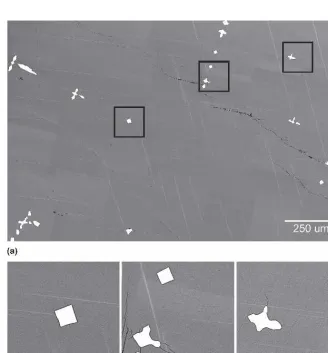
A composite image of the Gd5Si2Ge2 single crystal comprising 49 (7 × 7) micrographs and merged into a single file, taken before the start of thermal cycling, is shown in Fig. 1. The white bulky precipitates scattered throughout the sample were determined to be tungsten
FIG. 1. (a) Composite scanning electron microscopy (SEM) image of a Gd5Si2Ge2sample before thermal cycling; (b)–(d) close-up views of
different regions.
O. Ugurlu et al.: Persistence of 5:3 plates in RE5(SixGe1-x)4alloys
[image:4.616.122.450.365.718.2]http://journals.cambridge.org Downloaded: 09 Sep 2014 IP address: 129.186.176.188
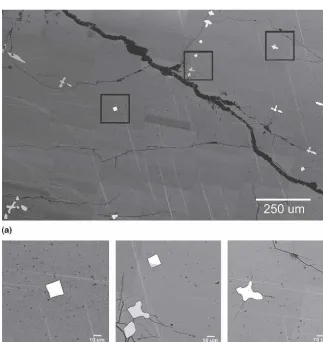
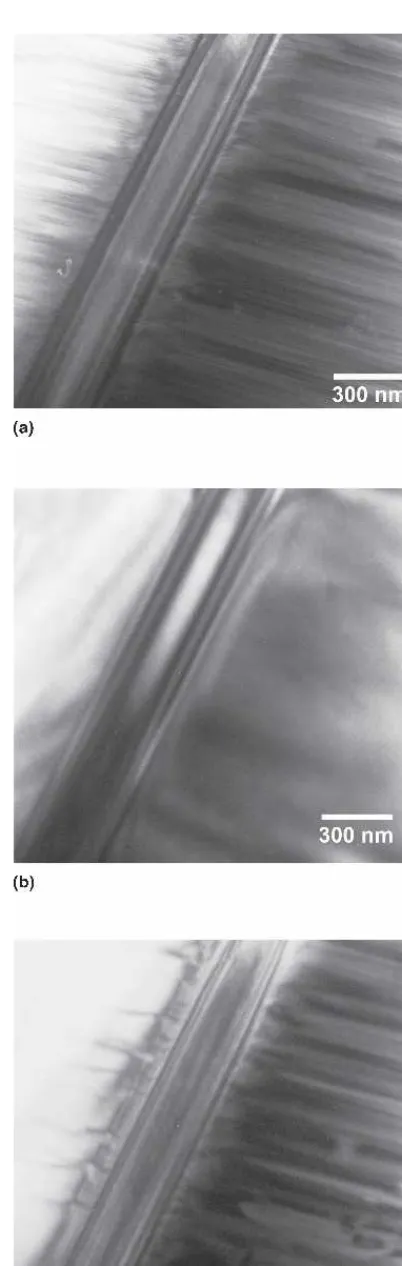
using energy dispersive spectroscopy (EDS). A tungsten crucible was used in the single crystal pulling method used, and similar impurities have been seen in previous studies.10 Their presence was extremely helpful as they served as reference points for microstructure compari-sons before and after cycling, and close-ups of three re-gions are shown in Figs. 1(b)–1(d). The 5:3 phase can be seen quite clearly as a series of thin white lines at fixed angles within the crystal. Figure 2 shows the same crys-tal after cycling, again with close-ups provided in Figs. 2(b)–2(d). If one compares Figs. 1 and 2, no dif-ference is seen when considering the 5:3 thin-plates; their orientation, density, thickness, and lengths are exactly the same as before, at least to within the resolution of the micrograph. The only visible difference between the samples is the formation of new cracks and the propa-gation of existing ones. In situ TEM observations (Fig. 3), of samples cooled below the low temperature (−1 °C) phase transformation point showed no difference in the thin-plate morphology [Fig. 3(b)], at least for the area observed. The 5:3 thin-plates remain unchanged when the sample returns again to room temperature and the matrix assumes the monoclinic structure [Fig. 3(c)].
Also visible in Fig. 3(a) are a series of linear features that run perpendicular to the 5:3 plates. It is interesting to note that these features disappear from the matrix upon transformation from monoclinic to orthorhombic [Fig. 3(b)], then reappear once the structure reversibly transforms back to monoclinic upon heating [Fig. 3(c)], although the position of the features appears to have changed slightly.
A second in situ TEM sample [Fig. 4(a)] was heated to 850 °C through the high temperature transformation from monoclinic to orthorhombic. This transformation starts around 320 °C and should be substantially finished by the time the sample reaches 600 °C. The initial appear-ance of a 5:3 thin-plate is shown in Fig. 4(a). Note that the linear features are visible in this sample also. Upon heating a considerable amount of oxidation of the sample occurs [Fig. 4(b)]. However, the thin-plate morphology of the 5:3 phase was still visible at 850 °C [shown with the arrow, Fig. 4(b)]. Although the poor quality of the image due to oxidation makes it difficult to see, obser-vations in the TEM during the experiment revealed that the linear features seen at room temperature once again disappeared at high temperature.
FIG. 2. (a) Composite scanning electron microscopy (SEM) image of the same Gd5Si2Ge2sample after thermal cycling; (b)–(d) close-up views
of different regions.
O. Ugurlu et al.: Persistence of 5:3 plates in RE5(SixGe1-x)4alloys
[image:5.600.140.464.374.716.2]http://journals.cambridge.org Downloaded: 09 Sep 2014 IP address: 129.186.176.188 B. Composition effects
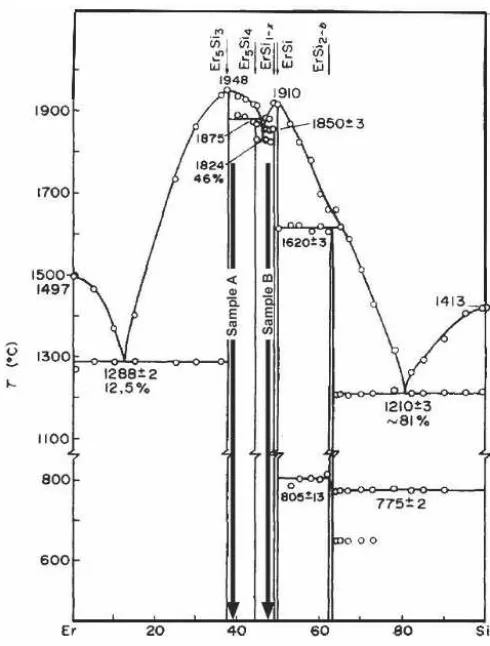
[image:6.616.56.257.71.704.2]According to the phase diagram published in 1996,16 in the Er-Si system 5:3 and 5:4 phases exist as adjacent line compounds (Fig. 5). The sample compositions pre-pared for this study are indicated on this diagram. If one assumes equilibrium conditions, Sample A should con-sist of a two–phase mixture of 5:3 and 5:4 phases. In Fig. 6 it can be seen that these two phases are present, with the Er5Si3compound appearing as both large grains and thin-plates. These results agree with what is expected from the phase diagram. However, the results for Sample
[image:6.616.292.534.78.564.2]FIG. 3. Bright field (BF) transmission electron microscopy (TEM) images of a thin-plate (a) at room temperature, (b) below −1 °C, and (c) at room temperature after cycling.
FIG. 4. Bright field (BF) transmission electron microscopy (TEM) image of a thin-plate (a) at room temperature, and (b) at 850 °C. O. Ugurlu et al.: Persistence of 5:3 plates in RE5(SixGe1-x)4alloys
http://journals.cambridge.org Downloaded: 09 Sep 2014 IP address: 129.186.176.188
B, the Er-deficient sample, are quite different. While from the phase diagram one would again expect a two-phase mixture, this time consisting of Er5Si4and ErSi1-x (or possibly ErSi), a three-phase mixture is encountered. Analysis using EDS indicates the large grains are ErSi and Er5Si4, with thin-plates of Er5Si3again being present within the 5:4 phase. Interestingly, the plates thicken at
the interface of the 1:1 and 5:4 compounds as the 1:1 regions try to lower their rare-earth content by rejecting Er to the rare-earth rich 5:3 (Fig. 7).
IV. DISCUSSION
Thermal cycling to low temperatures appears to have little or no effect upon the structure of the 5:3 plates, although increased cracking of the sample is observed. The reason for that is the∼1.1 Å movement of slabs that occurs during the structure change from monoclinic to the Gd5Si4-type orthorhombic places a large stress on the material.17 However, the formation of 5:3 thin-plates is not associated with these extreme slab movements. TEM studies12,18have shown that the thin-plates grow perpen-dicular to the slab movement direction. Thus, the per-pendicular orientation of the 5:3 plates may cause them to act as a strain source, resulting in more cracking of the matrix. While no cracking was seen around the 5:3 plate in the in situ TEM experiment, it is possible that in these thin TEM samples the strain is simply too low to have any visible effect, either on the 5:3 plates or the matrix. Severe oxidation of the sample during heating pre-vented detailed in situ observations of the 5:3 phase from being made. However, it can certainly be said that heat-ing to a temperature of 850 °C does not cause the 5:3 plates to go into solution or result in the formation of new 5:3 material. Cycling of macroscopic samples similar to what was done for the low temperature phase transfor-mation is impractical since the high temperature transi-tion was irreversible due to oxidatransi-tion of the sample.
[image:7.600.307.550.80.263.2]The linear features that appear perpendicular to the 5:3 thin-plates in TEM samples do appear to be affected by low temperature cycling, and were observed to disappear at high temperatures as well. Meyers et al.19 proposed that these lines could be the macroscopic twins seen in previous x-ray diffraction (XRD) studies7,20 of the
FIG. 5. Binary phase diagram of the Er–Si system.
FIG. 6. Backscatter electron image of the Er-rich Er6.18Si4 sample
[image:7.600.52.297.83.406.2](Sample A).
FIG. 7. Electron backscatter image of the Er-deficient Er4.20Si4
sample (Sample B).
O. Ugurlu et al.: Persistence of 5:3 plates in RE5(SixGe1-x)4alloys
[image:7.600.54.294.436.616.2]http://journals.cambridge.org Downloaded: 09 Sep 2014 IP address: 129.186.176.188
monoclinic structure. Further work is needed to ascertain the exact nature of these features, although a twinning mechanism certainly appears plausible at this time.
The appearance of the 5:3 thin-plates in the rare-earth deficient samples is extremely interesting. If one assumes the proposed phase diagram is correct, the only way one could logically be expected to obtain 5:3 in a cast struc-ture would be through non-equilibrium solidification. While certainly possible, this would require a large de-gree of undercooling. Given the present shape of the phase diagram, and the fact that the rare-earth–rich alloy that was solidified under similar conditions gave no in-dication of high undercooling, this possibility seems un-likely. The appearance of 5:3 within 5:4 in these samples, in the same morphology as previous studies, indicates that the structural relationship that exists between 5:3 and 5:4 as detailed in Ref. 18 is an extremely favorable one for growth and subsequent phase stability. It also adds further evidence that the present phase diagrams for this family of RE5(SixGe1-x)4alloys are incorrect at the high-est temperatures.
V. CONCLUSION
Temperature changes in the range −70 °C to 850 °C did not show any effect on the morphology of 5:3 thin-plates in Gd and Er-based 5:4 compounds, even though the monoclinic matrix phase underwent both reversible (low T) and irreversible (high T) transformations to an orthorhombic structure. This was not true for a suspected twin structure noted in TEM images. In both cases this structure seemed to disappear once the matrix trans-formed. Off-stoichiometric samples prepared to produce rare-earth rich and poor specimens were still found to contain the 5:3 phase within the 5:4 compound even when the equilibrium phase diagram would indicate that this is unlikely. The existence of 5:3 thin-plates in the 5:4 phase regions of rare-earth poor samples, as well as in samples prepared with various cooling rates and matrix crystal structures, is another indication that the current phase diagrams for these systems are inaccurate at high temperatures. It is believed the 5:3 thin-plates are form-ing at higher temperatures (>850 °C), possibly aided by the favorable structural orientation that exists between the 5:4 and 5:3 phases.
ACKNOWLEDGMENTS
This work was performed at Ames Laboratory under contract No. W-7405-Eng-82 with the U.S. Department of Energy. This research was supported by the Office of Basic Energy Sciences, Materials Science Division of the U.S. Department of Energy. The authors thank V.K. Pecharsky and T.A. Lograsso for helpful discussions and D.L. Schlagel for single crystal sample preparation. The authors also thank the Materials Preparation Center
(MPC) at Ames Laboratory for providing high-quality arc-melted samples.
REFERENCES
1. L. Morellon, J. Blasco, P.A. Algarabel, and M.R. Ibarra: Nature of the first-order antiferromagnetic-ferromagnetic transition in the Ge-rich magnetocaloric compounds Gd5(SixGe1-x)4.Phys. Rev. B
62,1022 (2000).
2. L. Morellon, P.A. Algarabel, M.R. Ibarra, J. Blasco, B. Garcia-Landa, Z. Arnold, and F. Albertini: Magnetic-field-induced struc-tural phase transition in Gd5(Si1.8Ge2.2).Phys. Rev. B58,R14721
(1998).
3. E.M. Levin, V.K. Pecharsky, and K.A. Gschneidner, Jr.: Magnetic-field and temperature dependencies of the electrical re-sistance near the magnetic and crystallographic first-order phase transition of Gd5(Si2Ge2).Phys. Rev. B60,7993 (1999).
4. E.M. Levin, V.K. Pecharsky, K.A.J. Gschneidner, and P. Tomlin-son: Magnetic field and temperature-induced first-order transition in Gd5(Si1.5Ge2.5): A study of the electrical resistance behavior.
J. Magn. Magn. Mater.210,181 (2000).
5. L. Morellon, J. Stankiewicz, B. Garcia-Landa, P.A. Algarabel, and M.R. Ibarra: Giant magnetoresistance near the magnetostructural transition in Gd5(Si1.8Ge2.2).Appl. Phys. Lett.73,3462 (1998).
6. V.K. Pecharsky and K.A. Gschneidner, Jr.: Giant magnetocaloric effect in Gd5(Si2Ge2).Phys. Rev. Lett.78,4494 (1997).
7. V.K. Pecharsky and K.A. Gschneidner, Jr.: Phase relationships and crystallography in the pseudobinary system Gd5Si4–Gd5Ge4.
J Alloys Compd.260,98 (1997).
8. O. Ugurlu, L.S. Chumbley, D.L. Schlagel, T.A. Lograsso, and A.O. Pecharsky: Characterization of R5(SixGe1-x)4alloys, where
R is Gd, Tb, Dy and Er: TMS Light Metals (134th TMS Annual Meeting, San Francisco, CA, 2005), p. 1181
9. O. Ugurlu, L.S. Chumbley, D.L. Schlagel, T.A. Lograsso, and A.O. Tsokol: Identification of thin plates seen in R5(SixGe1-x)4
alloys, where R is Gd, Tb, Dy, and Er.Scripta Mater.55,373 (2005). 10. J.S. Meyers, L.S. Chumbley, F. Laabs, and A.O. Pecharsky: De-termination of phases in as prepared Gd5(SixGe1-x)4where x⳱
1/2.Scripta Mater.47,509 (2002).
11. J. Szade, G. Skorek, and A. Winiarski: Surface structure of Gd5(Si,Ge)4crystals.J. Cryst. Growth205,289 (1999).
12. O. Ugurlu, L.S. Chumbley, T.A. Lograsso, and D.L. Schlagel: Characterization of an atypical Widmanstatten structure in Gd5Si3Ge2alloys.Acta Mater.53,3525 (2005).
13. O. Ugurlu, L.S. Chumbley, D.L. Schlagel, and T.A. Lograsso: On the formation of atypical Widmanstaetten plates in the Gd5(Si2Ge1-x)4system.Acta Mater.54,1211 (2005).
14. Y. Mozharivskyj, A.O. Pecharsky, V.K. Pecharsky, and G.J. Miller: On the high-temperature phase transition of Gd5Si2Ge2.J. Am. Chem. Soc.127,317 (2005).
15. Ames Laboratory Materials Preparation Center (MPC), Ames, IA. 16. S.P. Luzan, V.E. Listovnichii, Y.I. Buyanov, and P.S. Martsenyuk: Phase diagram of the binary erbium-silicon system and physical properties of erbium silicides up to 1050 °C. J. Alloys Compd.
239,77 (1996).
17. V.K. Pecharsky and K.A. Gschneidner: Gd5(SixGe1-x)4: An
extre-mum material.Adv. Mater.13,683 (2001).
18. O. Ugurlu, L.S. Chumbley, D.L. Schlagel, and T.A. Lograsso: On the formation of atypical Widmanstaetten plates in the Gd5(Si2Ge1-x)4system.Acta Mater.54,1211 (2006).
19. J.S. Meyers, S. Chumbley, F. Laabs, and A.O. Pecharsky: TEM analysis of Gd5(SixGe1-x)4, where x⳱1/2.Acta Mater.51,61
(2003).
20. J.S. Meyers, L.S. Chumbley, W. Choe, and G.J. Miller: Micro-structural analysis of twinned b-Gd5Si2Ge2. Phys. Rev. B 66,
012106 (2002).
O. Ugurlu et al.: Persistence of 5:3 plates in RE5(SixGe1-x)4alloys