Biogeosciences, 10, 5639–5649, 2013 www.biogeosciences.net/10/5639/2013/ doi:10.5194/bg-10-5639-2013
© Author(s) 2013. CC Attribution 3.0 License.
EGU Journal Logos (RGB)
Advances in
Geosciences
Open Access
Natural Hazards
and Earth System
Sciences
Open Access
Annales
Geophysicae
Open Access
Nonlinear Processes
in Geophysics
Open Access
Atmospheric
Chemistry
and Physics
Open Access
Atmospheric
Chemistry
and Physics
Open Access
Discussions
Atmospheric
Measurement
Techniques
Open Access
Atmospheric
Measurement
Techniques
Open Access
Discussions
Biogeosciences
Open Access Open Access
Biogeosciences
Discussions
Climate
of the Past
Open Access Open Access
Climate
of the Past
Discussions
Earth System
Dynamics
Open Access Open Access
Earth System
Dynamics
Discussions
Geoscientific
Instrumentation
Methods and
Data Systems
Open Access
Geoscientific
Instrumentation
Methods and
Data Systems
Open Access
Discussions
Geoscientific
Model Development
Open Access Open Access
Geoscientific
Model Development
Discussions
Hydrology and
Earth System
Sciences
Open Access
Hydrology and
Earth System
Sciences
Open Access
Discussions
Ocean Science
Open Access Open Access
Ocean Science
Discussions
Solid Earth
Open Access Open Access
Solid Earth
Discussions
The Cryosphere
Open Access Open Access
The Cryosphere
Discussions
Natural Hazards
and Earth System
Sciences
Open Access
Discussions
Saturated CO
2
inhibits microbial processes in CO
2
-vented deep-sea
sediments
D. de Beer1, M. Haeckel2, J. Neumann1, G. Wegener1,3, F. Inagaki4,5, and A. Boetius1,6 1Max Planck Institute for Marine Microbiology, Celsiusstrasse 1, 28359 Bremen, Germany 2Geomar Helmholtz Centre for Ocean Research Kiel, Wischhofstrasse 1–3, 24148 Kiel, Germany 3MARUM – Center for Marine Environmental Sciences, University of Bremen, 28334 Bremen, Germany
4Geomicrobiology Group, Kochi Institute for Core Sample Research, Japan Agency for Marine-Earth Science and
Technology (JAMSTEC), Monobe B200, Nankoku, Kochi 783-8502, Japan
5Geobio-Engineering and Technology Group, Submarine Resources Research Project, JAMSTEC, Monobe B200, Nankoku,
Kochi 783-8502, Japan
6HGF MPG Research Group for Deep Sea Ecology and Technology, Alfred Wegener Institute for Polar and Marine Research,
Am Handelshafen, 27515 Bremerhaven, Germany
Correspondence to: D. de Beer ([email protected])
Received: 10 January 2013 – Published in Biogeosciences Discuss.: 1 February 2013 Revised: 8 July 2013 – Accepted: 8 July 2013 – Published: 26 August 2013
Abstract. This study focused on biogeochemical processes
and microbial activity in sediments of a natural deep-sea CO2 seepage area (Yonaguni Knoll IV hydrothermal
sys-tem, Japan). The aim was to assess the influence of the geo-chemical conditions occurring in highly acidic and CO2
sat-urated sediments on sulfate reduction (SR) and anaerobic methane oxidation (AOM). Porewater chemistry was investi-gated from retrieved sediment cores and in situ by microsen-sor profiling. The sites sampled around a sediment-hosted hydrothermal CO2vent were very heterogeneous in
porewa-ter chemistry, indicating a complex leakage patporewa-tern. Near the vents, droplets of liquid CO2were observed emanating from
the sediments, and the pH reached approximately 4.5 in a sediment depth>6 cm, as determined in situ by microsen-sors. Methane and sulfate co-occurred in most sediment sam-ples from the vicinity of the vents down to a depth of 3 m. However, SR and AOM were restricted to the upper 7–15 cm below seafloor, although neither temperature, low pH, nor the availability of methane and sulfate could be limiting micro-bial activity. We argue that the extremely high subsurface concentrations of dissolved CO2 (1000–1700 mM), which
disrupt the cellular pH homeostasis, and lead to end-product inhibition. This limits life to the surface sediment horizons above the liquid CO2 phase, where less extreme conditions
prevail. Our results may have to be taken into consideration
in assessing the consequences of deep-sea CO2sequestration
on benthic element cycling and on the local ecosystem state.
1 Introduction
The increase in atmospheric CO2will lead to global
warm-ing and acidification of the ocean. One of the possible coun-termeasures considered is to separate CO2 from waste gas
of large production units, such as power plants and cement ovens, and to pump it in liquefied form into the deep seafloor. Depending on in situ pressure and temperature, it will be-come gas hydrate, liquid or supercritical, and may be se-questered during the weathering of sedimentary carbonates and silicates (House et al., 2006; IPCC, 2007; Wallmann et al., 2008). This process of carbon dioxide capture and storage (CCS) would not bind CO2as such, but lead to neutralization
of the acidified seawater. Besides economic costs and safety aspects, the risks of such activities for biodiversity and ele-ment cycling in the deep sea are to be considered (Seibel and Walsh, 2001). Here we focused on the long-term effects of high CO2and low pH on biogeochemical processes in
deep-sea sediments of a natural CO2-venting hydrothermal
sys-tem. CO2emitted from hydrothermal sediments can be
with CCS in the deep-sea floor under realistic environmen-tal conditions and scales. Experimenenvironmen-tal studies of the inter-action of liquid CO2with microorganisms and geochemical
processes in deep-sea sediments remain challenging, because of the high pressure and steep gradients associated with point sources of CO2(Liu et al., 2010).
A main question for CCS risk assessment is as to the ef-fect of high CO2 emissions on the functioning of marine
ecosystems. Numerous studies of seafloor microbial ecol-ogy and biogeochemistry have demonstrated that microbial processes dominate the biogeochemistry of deep-sea sed-iments (Jørgensen and Boetius, 2007; Jørgensen and Nel-son, 2004; Reeburgh, 1983). When not limited by thermo-dynamics or transport, their function may be limited by ki-netics due to physicochemical conditions in the habitat. Mi-crobial metabolic activity can be inhibited and kinetics can be changed by toxic compounds (e.g. strong oxidants, heavy metals, uncouplers of membrane potentials). High tempera-tures (>122◦C) can also degrade enzymatic function. How-ever, highly adapted microorganisms have been found to pop-ulate environments with extremes in pH values, pressure, salinity, and radiation levels. Thus, these parameters do not limit life in general (Stan-Lotter and Fendrihan, 2012); in other words, life has shown to be remarkably adaptive to a very wide range of conditions. Yet it remains unknown if main ecosystem functions such as aerobic and anaerobic remineralization and respiration of matter, autotrophy, and methane oxidation can be maintained under extremely high CO2levels, as will occur at CCS sites in the deep-sea floor.
Here we tested the hypothesis that the main biogeochemical processes mediated by microorganisms can function in CO2
saturated porewater of deep-sea sediments.
The occurrence of liquid CO2 in a natural marine
set-ting has been firstly observed in the Jade hydrothermal field, Okinawa Trough (Sakai et al., 1990), and was subsequently found also at other hydrothermal systems at water depths be-tween 1200 and 1700 m, such as the NW Eifuku hydrother-mal field in the Mariana Arc and the Yonaguni Knoll IV hydrothermal system in the Okinawa Trough. The Yonaguni Knolls are submarine volcanoes located in the southwestern end of the Okinawa Trough (Suzuki et al., 2008). The Yon-aguni Knoll IV hydrothermal system is one of the few sites on earth known where liquid CO2leaks through thick layers
of terrigenous sediments supplied from the Asian continent (Sibuet et al., 1987). It comprises a sedimentary valley sur-rounded by large piles of rock debris, enclosing a string of active hydrothermal vents. A previous characterization of the hydrothermal fluids indicated the generation of liquid CO2
by subsurface phase separation (Konno et al., 2006; Suzuki et al., 2008). Besides their high CO2content, the hydrothermal
fluids exhibit a wide variation in gas composition including H2, CH4, H2S and NH3. Previous studies have focussed on
the distribution of bacterial and archaeal communities of the Yonaguni Knoll IV hydrothermal sediments and overlying bottom waters (Inagaki et al., 2006; Yanagawa et al., 2012;
Nunoura et al., 2010). Here we have investigated the biogeo-chemistry of the CO2vented sediments, focussing on the
dis-tribution of microbial aerobic and anaerobic respiration path-ways. Combining in situ and ex situ analytical techniques, we investigated rates of benthic oxygen consumption, sulfate re-duction (SR) and anaerobic oxidation of methane (AOM) to cover the ecologically important biogeochemical processes in the CO2-impacted system. These data form the basis for a
discussion of the effects of low pH and high CO2conditions
on the functioning of deep-sea ecosystems to be considered in the risk assessment of offshore geological CCS.
2 Methods
2.1 Sampling location and methods
Samples were taken in February–March 2008 during the RV Sonne 196 expedition with ROV QUEST in the project SUM-SUN (“Studies of marine CO2sequestration associated with
a natural hydrothermal CO2system of the northern west
Pa-cific”) (Rehder and Schneider von Deimling, 2008). The area was revisited for a few additional samples during the JAM-STEC NT10-06 Leg 3 cruise with RV Natsushima and ROV Hyper Dolphin in April 2010.
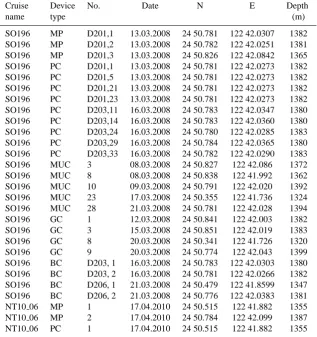
The Yonaguni Knoll IV hydrothermal field is located in the Okinawa Trough (24◦50.70N, 122◦42.00E; 1320–1399 m water depths) (Table 1). The hydrothermal system is part of a sedimentary basin covered by volcanic rocks in its north-eastern part, hosting several large hydrothermal vent chim-neys (Konno et al., 2006; Suzuki et al., 2008). A sedimen-tary venting site characterized by a few holes in the seafloor emitting hot fluids was discovered on the southern end of the hydrothermal field and named “Abyss Vent” (Inagaki et al., 2006). In situ measurements were carried out along a transect from Abyss Vent (i.e. <1 m, 10 m, 100 m, 125 m distance), as well as in sediments near “Swallow Chimney” vent,∼100 m north of the Abyss Vent and a sedimentary site 0.5 km southwest of the hydrothermal system for non-CO2
D. de Beer et al.: Biogeochemistry of deep-sea CO2vents 5641
Table 1. Station list with sampling dates and locations.
Cruise Device No. Date N E Depth
name type (m)
SO196 MP D201,1 13.03.2008 24 50.781 122 42.0307 1382 SO196 MP D201,2 13.03.2008 24 50.782 122 42.0251 1381 SO196 MP D201,3 13.03.2008 24 50.826 122 42.0842 1365 SO196 PC D201,1 13.03.2008 24 50.781 122 42.0273 1382 SO196 PC D201,5 13.03.2008 24 50.781 122 42.0273 1382 SO196 PC D201,21 13.03.2008 24 50.781 122 42.0273 1382 SO196 PC D201,23 13.03.2008 24 50.781 122 42.0273 1382 SO196 PC D203,11 16.03.2008 24 50.783 122 42.0347 1380 SO196 PC D203,14 16.03.2008 24 50.783 122 42.0360 1380 SO196 PC D203,24 16.03.2008 24 50.780 122 42.0285 1383 SO196 PC D203,29 16.03.2008 24 50.784 122 42.0365 1380 SO196 PC D203,33 16.03.2008 24 50.782 122 42.0290 1383 SO196 MUC 3 08.03.2008 24 50.827 122 42.086 1372 SO196 MUC 8 08.03.2008 24 50.838 122 41.992 1362 SO196 MUC 10 09.03.2008 24 50.791 122 42.020 1392 SO196 MUC 23 17.03.2008 24 50.355 122 41.736 1324 SO196 MUC 28 21.03.2008 24 50.781 122 42.028 1394 SO196 GC 1 12.03.2008 24 50.841 122 42.003 1382 SO196 GC 3 15.03.2008 24 50.851 122 42.019 1383 SO196 GC 8 20.03.2008 24 50.341 122 41.726 1320 SO196 GC 9 20.03.2008 24 50.774 122 42.043 1399 SO196 BC D203, 1 16.03.2008 24 50.783 122 42.0303 1380 SO196 BC D203, 2 16.03.2008 24 50.781 122 42.0266 1382 SO196 BC D206, 1 21.03.2008 24 50.479 122 41.8599 1347 SO196 BC D206, 2 21.03.2008 24 50.776 122 42.0383 1381 NT10 06 MP 1 17.04.2010 24 50.515 122 41.882 1355 NT10 06 MP 2 17.04.2010 24 50.784 122 42.099 1387 NT10 06 PC 1 17.04.2010 24 50.515 122 41.882 1355
MP = microprofiler, PC = push core, MUC = multicore, GC = gravity core, BC = benthic chamber, D = QUEST Dive No.
2.2 Porewater extraction and chemical analyses
Porewater was extracted using a low-pressure squeezer (ar-gon at 1–5 bar) at approximately in situ temperature of 4◦C in the ship’s cold room. While squeezing, the porewater was filtered through 0.2 µm polycarbonate Nuclepore filters and collected in vials. Onboard, the collected porewater sam-ples were analyzed for their content of dissolved NH+4, H2S,
and SiO4−4 using standard photometric methods (Grasshoff et al., 1999), and total alkalinity (TA) by titration with 0.01 N HCl against an indicator mixture consisting of methyl red and methylene blue. In addition, subsamples were taken and stored at 4◦C for shore-based analysis of SO2−4 using ion chromatography. Porosity was determined from 5 mL of wet sediment by freeze-drying and weight difference assuming a sediment density of 2.5 g cm−3 and a porewater density of 1.023 g cm−3. An additional 3 mL of sediment was sus-pended in 9 mL of 0.1 N NaOH in a 20 mL vial for methane headspace analysis. Methane was measured using a standard gas chromatograph using a flame ionization detector.
2.3 Microprofiling
Microsensors for O2, H2S, and pH were made and used as
described previously (de Beer et al., 1997; Jeroschewski et al., 1996; Revsbech, 1989). The tip diameters were approx-imately 20 µm, the response time (t90)less than 3 s. A
tem-perature sensor was used (Pt100, UST Umweltsensortechnik GmbH, Th¨uringen, Germany), with a length of 18 cm, a shaft and tip diameter of 3 mm and length of sensing element of 1 cm and a response time of ∼5 s. Microsensors for redox potential (ORP) were made from Pt wire of 50 µm diame-ter, fused in a glass capillary, leaving a length of 100 µm Pt exposed as sensing surface. After mounting, the Pt tip was cleaned in 6 M HNO3 for 10 min, and rinsed with distilled
profiles, with steps of 250 µm, over a depth of 17 cm. The profiler was positioned at the seafloor by a ROV and started by a switch on the profiler. After finishing a profile, the pro-filer could be repositioned and restarted.
The slope of the pH calibration was taken, as during the calibration the pressure induced offset was corrected for with the pH determined from Niskin bottle samples from 50 cm above the sediment surface. The O2sensors were 2-point
cal-ibrated in situ, by using the signal in the bottom water and in the anoxic zones of the sediments. The bottom water O2
con-centration was measured by Winkler titration from the same Niskin bottles. Total sulfide was calculated from the local pH and H2S concentrations, using a pK value for sulfide of 6.92,
as calculated from the local temperature and salinity (Millero et al., 1988). The H2S sensors had detection limits for H2S of
1 µmol L−1. For profile analysis, the surface was taken as the reference point (depth = 0), defined by the steepest slope of the oxygen profile (Gundersen and Jørgensen, 1990). Nega-tive depths indicate positions above the sediment surface.
2.4 Benthic chamber measurements
Methane, dissolved inorganic carbon (DIC), and ammonium fluxes were determined with a cylindrical benthic chamber module as previously described (Felden et al., 2010) oper-ated by the ROV QUEST. Briefly, the stirred chamber (ra-dius 9.5 cm) enclosed a seafloor area of 284 cm2 together with 10–15 cm (equivalent to 4–6 L) of overlying bottom wa-ter. A valve in the chamber lid ensured the release of over-pressure while placing the chamber gently into the sediment. Five water samples were taken with 50 mL syringes at pre-programmed time intervals to determine the fluxes of dis-solved methane, silicate and ammonium. All chemical anal-yses followed standard procedures (Grasshoff et al., 1999). The fluxes were calculated from the linear regressions of con-centration vs. time over the area of the sediment enclosed by the chamber.
2.5 Methane oxidation and sulfate reduction rates
Sediment cores for measurements of anaerobic oxidation of methane and sulfate reduction were subsampled on board with three replicates per sample site. The rates were mea-sured according to previously published protocols (Treude et al., 2005). Briefly, either 25 µL14CH4 (dissolved in water,
2.5 kBq) or 5–10 µL carrier-free35SO2−
4 (dissolved in water,
50 kBq) were injected in 1 cm intervals into the subcores. The sediment was incubated in the dark at in situ temperature for 12–48 h. After the incubation, the reaction was terminated by cutting 1 cm sections of the sediment cores into the respec-tive fixarespec-tive for further analysis in the home laboratory.
3 Results
3.1 Visual observations
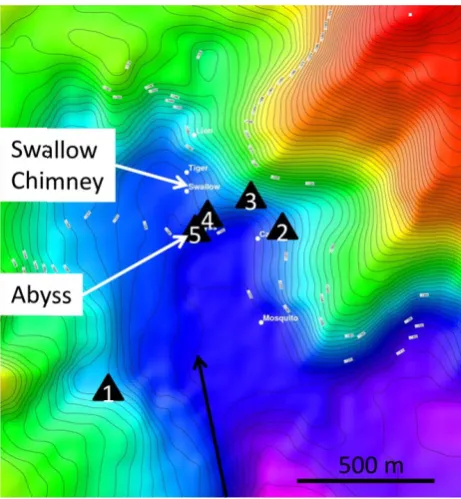
The Yonaguni Knoll IV study area comprises an approxi-mately 1 nautical-mile-wide sedimentary valley surrounded by rocky slopes in the west and northeast. A number of hy-drothermal chimneys are located roughly on a line in the NW–SE-direction (Fig. 1). In addition to the mineral chim-neys through which hot fluids>300◦C escape, we observed pavements of elemental sulfur and amorphous SiO2
precipi-tates associated with holes and cracks in the underlying soft sediments from which hot fluids and liquid CO2emanated.
The seafloor area surrounding the vents and sulfur pavements lacked bottom-dwelling megafauna and showed no typical features of bioturbation, burrows or other traces of life. Only on active chimneys was dense accumulation of chemosyn-thetic fauna observed, including the mussel Bathymodiolus platifrons, the shrimp Alvinocaris longirostris, and the crab Shinkaia crosnieri. No mats of giant sulfide-oxidizing bac-teria typical for sulfide-emitting hydrothermal vents and hy-drocarbon seeps were observed on the rocks or the seafloor. The sedimentary seafloor was flat and featureless; i.e. there were no pockmarks or ebullition holes away from the vents.
In the absence of morphological indications for sub-seafloor CO2 leakage, our sampling strategy was to
sam-ple the sediments in the immediate vicinity of active CO2
-emitting vents, such as the Abyss Vent and the Swallow Chimney vent. When push cores were pulled out of the vented sediments by the ROV arm, liquid CO2droplets
es-caped from the sampling hole. This phenomenon was re-stricted to the<20 m vicinity of the vents. Abyss Vent was marked by a couple of round openings of 10 cm diameter from which hot CO2-rich water (>60◦C) was ejected.
Swal-low Chimney was surrounded by sulfur pavements and emit-ted relatively cold fluids dominaemit-ted by liquid CO2.
3.2 Microprofiles
D. de Beer et al.: Biogeochemistry of deep-sea CO2vents 5643
Fig. 1
Fig. 1. Bathymetric map of the working area. The microprofiler lo-cations are indicated, at 550 m (1, Reference, MP1 2010), 125 m (2, MP2 2010), 100 m (3, MP3 2008), 10 m (4, MP1 2008) and 0.5 m (5, MP2 2008) distance from Abyss Vent. The black arrow indicates the main bottom water current direction.
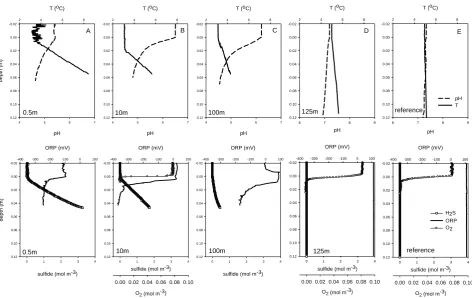
The sites closer to the vent showed increasing effects of fluid advection. The oxygen penetration decreased to 5 mm at the site of 125 m distance from the vent (Fig. 2d) and 1 mm at<10 m distance (Fig. 2b). Sulfide was detected in sedi-ments at 100 m distance (Fig. 2d), and the sulfide profiles became increasingly steeper closer to the vent. Remarkably, they were almost perfectly linear, indicating high transport rates, but relatively low sulfide production in the upper 5 cm. The sediment redox potential decreased rapidly to negative values at the sites closer than 100 m from the vent. The CO2
sensors showed a drastic increase in signal with depth, sur-passing the calibration range of the sensors at<1 cm depth, and hence could not be used for quantification of CO2
con-centrations. The pH profiles became steeper close to the vent, showing a pH of∼4.5>6 cm below the seafloor (cm b.s.f.) at sites closer than 100 m from the vent. Accordingly, the fluxes of oxygen and sulfide increased when approaching the vents (Table 2). At the site 10 m from the Abyss Vent, the diffusive oxygen flux was almost ten times the sulfide flux. Thus other electron donors than sulfide are needed to explain the high oxygen consumption rate in the sediments.
3.3 Geochemistry
Generally, the porewater profiles were surprisingly hetero-geneous, indicating a complex spatial scaling of subsurface transport of hydrothermal fluids and liquid CO2, as well as
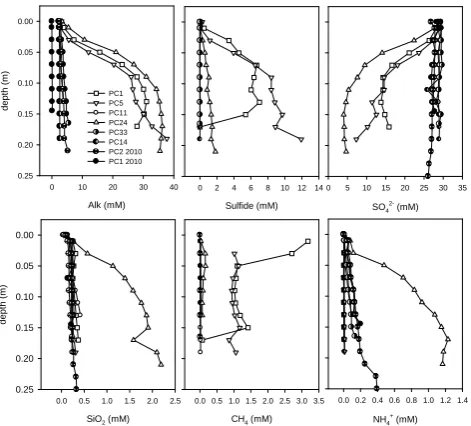
intense reactions with the surface sediments. Porewater pro-files showed elevated concentrations of sulfide, methane, am-monium (Figs. 3 and 4), manganese and iron (not shown), which may serve as electron donors for microbial oxygen consumption and could explain the enhanced oxygen fluxes in vented sediments. The subsurface porewater retrieved from the vents showed increased concentrations of methane compared to the background site (>1 mM, 3 out of 5 sites sampled) and sulfide (>2 mM), but these could not be quan-tified with precision due to the vigorous degassing upon re-trieval on deck. This outgassing was mainly driven by the strong supersaturation of CO2and often continued for 10 to
20 minutes after arrival on deck. The loss of CO2during
re-trieval increased the pH to 6 or 7 in the sediments.
Beyond high gas content and elevated concentrations of reduced compounds, the geochemistry showed further sub-stantial effects of CO2leakage and hydrothermalism in
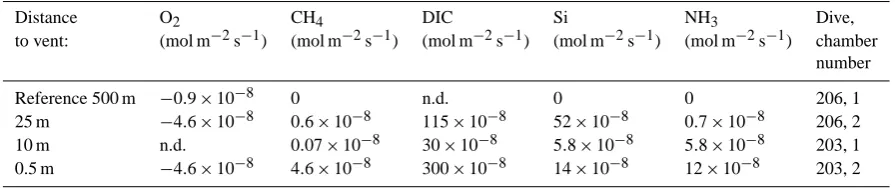
sedi-ments retrieved close to the vent sites (Figs. 3 and 4). These included steep porewater profiles and high total alkalinity (>60 meq L−1), low sulfate, and elevated concentrations of silicate (Figs. 3 and 4). Since the sediments around the Swal-low Chimney were extensively covered with volcanic rock debris and chimney material, sediment samples could only be recovered by gravity coring. The collected porewaters exhib-ited also very high total alkalinity and NH+4, elevated sulfide, dissolved silicate and methane (Fig. 5). Accordingly, ben-thic chamber incubations recorded effluxes of ammonium, methane, DIC and silicate near the vents. None of the sites investigated leaked sulfide to the overlying bottom water.
3.4 Microbial respiration rates
The benthic chamber measurements showed rather low total oxygen consumption rates at and near the vent sites which were, however, higher than at the reference site (Table 3). Similar to porewater geochemistry, the rates of sulfate re-duction and anaerobic methane oxidation were found to be highly heterogeneous (Fig. 6, standard deviations are not shown for clarity). Areal rates in cores, taken less than 40 cm apart, could differ an order of magnitude in SR and AOM rates. Consequently, areal quantification was not possible based on our sparse coring, but trends can be seen. Gener-ally, both SR and AOM rates were higher close to the vents than at the distant sites>20 m away, and hence constituents of the hydrothermal fluids fuelled these microbial processes, even under the conditions of high CO2 concentrations and
[image:5.595.51.282.64.314.2]Table 2. Fluxes of oxygen and sulfide near the sediment–water interface, calculated from the microprofiles using Fick’s law of diffusion, the average integrated areal SR and AOM measured in MUC and PC taken in and near seeps, and fluxes of methane and DIC measured with the benthic chambers. The distances are between the microprofiler and the Abyss Vent. The station code is given in parentheses (see Table 1).
Areal rates and fluxes (mol m−2s−1)
Distance to Abyss Vent: O2 Sulfide SR AOM CH4 DIC
Reference 500 m (MP1 2010) −2×10⁻⁸ 0 0.05×10⁻⁸ 0 0 n.d. 125 m (MP2 2010) −2.3×10⁻⁸ 0 n.d. n.d. n.d n.d. 100 m (MP3 2008) # 1.6×10⁻⁸ 0.15×10⁻⁸ 0 0.6×10⁻⁸ 115×10−8 10 m (MP1 2008) −2.1×10⁻⁷ 3.5×10⁻⁸ n.d. n.d. 0.1×10⁻⁸ 30×10−8 0.5 m (MP2 2008) # 5.8×10⁻⁸ 6×10⁻⁸ 0.1×10⁻⁸ 4.6×10⁻⁸ 300×10−8
(2×10⁻⁸)∗ ∗Disregarding one outlier rate obtained from MUC10.
n.d. = not determined.
Fig. 2
sulfide (mol m-3)
0 1 2 3 4
d ept h ( m ) -0.02 0.00 0.02 0.04 0.06 0.08 0.10 0.12 ORP (mV)
-400 -300 -200 -100 0 100 pH
4 5 6 7
dep th (m ) -0.02 0.00 0.02 0.04 0.06 0.08 0.10 0.12 T (oC)
2 4 6 8
sulfide (mol m-3)
0 1 2 3 4
-0.02 0.00 0.02 0.04 0.06 0.08 0.10 0.12 ORP (mV)
-400 -300 -200 -100 0 100
O2 (mol m-3) 0.00 0.02 0.04 0.06 0.08 0.10
pH
4 5 6 7
-0.02 0.00 0.02 0.04 0.06 0.08 0.10 0.12 T (oC)
2 4 6 8
sulfide (mol m-3)
0 1 2 3 4
-0.02 0.00 0.02 0.04 0.06 0.08 0.10 0.12 ORP (mV)
-400 -300 -200 -100 0 100 pH
4 5 6 7
-0.02 0.00 0.02 0.04 0.06 0.08 0.10 0.12 T (oC)
2 4 6 8
0.5m
0.5m
10m
10m 100m
100m
A B C
sulfide (mol m-3)
0 1 2 3 4
-0.02 0.00 0.02 0.04 0.06 0.08 0.10 0.12 ORP (mV)
-400 -300 -200 -100 0 100
O2 (mol m-3) 0.00 0.02 0.04 0.06 0.08 0.10 -0.02 0.00 0.02 0.04 0.06 0.08 0.10 0.12 pH
6 7 8 9
T (oC)
2 4 6 8
125m 125m
D
sulfide (mol m-3)
0 1 2 3 4
-0.02 0.00 0.02 0.04 0.06 0.08 0.10 0.12 ORP (mV)
-400 -300 -200 -100 0 100
O2 (mol m-3) 0.00 0.02 0.04 0.06 0.08 0.10
H2S ORP O2 -0.02 0.00 0.02 0.04 0.06 0.08 0.10 0.12 pH
6 7 8 9
T (oC)
2 4 6 8
pH T reference
reference E
Fig. 2. In situ microprofiles of oxygen, pH, sulfide, ORP (redox potential) and temperature, measured during two cruises in 2008 (a–c) and in 2010 (d) and (e), at different distances to Abyss Vent. The distances are indicated in the plots; the reference was taken approximately 1 km southwest of the vents. The positions can be found in Table 1. All gradients clearly increase towards the vent.
Chimney, which were sampled in 50 cm intervals, starting at 50 cm b.s.f. (data not shown). Integrated SR rates were on average 6.6×10⁻⁸(±8×10⁻⁸)mol m−2s−1for sites with high CO2 leakage (reaching 60 meq L−1 total alkalinity in
>15 cm sediment depth) around the Abyss Vent and Swal-low Chimney, 0.15×10⁻⁸(±0.16×10⁻⁸) mol m−2s−1for the sites with low CO2 leakage, and negligible at the
ref-erence site. The average of all areal rates of AOM was
0.8×10⁻⁸ (±0.2×10⁻⁸)mol m−2s−1in CO2 vented
sed-iments near seeps, thus almost a magnitude lower than the SR rates. AOM rates were below the detection limit away from the vents and at the reference site. This suggests that most SR is driven by electron-donors other than methane, indeed H2 was found in the vent fluids and sediments. The
[image:6.595.61.534.249.547.2]D. de Beer et al.: Biogeochemistry of deep-sea CO2vents 5645
Fig.3
Alk (mM)
0 10 20 30 40
dept h ( m ) 0.00 0.05 0.10 0.15 0.20 0.25 PC1 PC5 PC11 PC24 PC33 PC14 PC2 2010 PC1 2010 Sulfide (mM)
0 2 4 6 8 10 1214
NH4 + (mM) 0.0 0.2 0.4 0.6 0.8 1.0 1.2 1.4 SiO2 (mM)
0.0 0.5 1.0 1.5 2.0 2.5
depth ( m ) 0.00 0.05 0.10 0.15 0.20 0.25 SO4 (mM)
0 5 10 15 20 25 30 35
CH4 (mM) 0.0 0.5 1.0 1.5 2.0 2.5 3.0 3.5
Fig. 3. Porewater chemistry profiles obtained from sediments re-trieved by the push cores (PC). The reference data, obtained from a core approximately 550 m southwest of the vents, are indicated with black symbols. Other distances from the Abyss Vent: PC1 (1 m), PC5 (1 m), PC11 (10 m), PC33 (0.5 m), PC24 (2 m), PC14 (10 m), and PC1 2010 (100 m).
the sulfide diffusing to the sediment surface does not orig-inate from SR in the upper sediments, but was transported with hydrothermal fluids. Indeed, the highest sulfide concen-tration was found in a deep GC core (GC1) with clear hy-drothermal signatures, such as high dissolved silica and am-monium concentrations (Fig. 5).
4 Discussion
We observed a large heterogeneity of the porewater geo-chemistry and rates of microbial activity, suggesting complex transport processes of CO2 in this area. CO2 is transported
in its supercritical form from hot subsurface strata to the cooler surface seafloor where it liquefies and CO2 hydrates
may form (Konno et al., 2006). Spontaneous release of liquid CO2was observed from the rocky vent chimneys, but rarely
from the sedimentary seafloor. Here, emission of liquid CO2
was induced only upon disturbance of the surface seabed, e.g. by penetrating the top 20 cm with a temperature probe or with coring gear. The heterogeneity of the geochemistry can partially be understood from the different phases in the sed-iments. The density of pure liquid CO2 (Span and Wagner,
1996) is approximately 100 kg m−3lower than that of CO2
-saturated surrounding porewater (1050 kg m−3; (Duan et al., 2008), whereas the CO2 hydrates on the shallow seafloor
have a higher density; thus the system is unstable. Supercrit-ical and liquid CO2 may finger upwards through the
sedi-ments, and may tend to creep inside the sediments from the
Fig. 4
Alk (mM)
0 10 20 30 40 50 60
dep th ( m ) 0.0 0.1 0.2 0.3 0.4 Sulfide (mM)
0 1 2 3 4 5 6 7
NH4 + (mM)
0.0 0.2 0.4 0.6 0.8 1.0
MUC10 MUC28 MUC8 MUC23
SiO2 (mM)
0.0 0.2 0.4 0.6 0.8 1.0 1.2
de pth ( m ) 0.0 0.1 0.2 0.3 0.4 SO4 (mM)
0 5 10 15 2025 30 35
CH4 (mM)
0.0 0.2 0.4 0.6 0.8 1.0 1.2
Fig. 4. Porewater chemistry profiles obtained from sediments re-trieved by the multicorer (MUC). The positions are given in Table 1. The data from the reference site, approximately 550 m southwest of the vents, are indicated with black symbols. The other cores are from the Abyss Vent area. MUC 10 is the only core among all sedi-ments sampled that showed sulfate depletion.
Fig. 5
CH4 (mM) 0.0 0.1 0.2 0.3 0.4 0.5
NH4 +
(mM)
0.0 0.5 1.0 1.5 2.0
Alk (mM)
0 10 20 30 40 50 60 70
de pth ( m ) 0.0 0.5 1.0 1.5 2.0 2.5 3.0 GC1 GC3 GC9 GC8 Sulfide (mM)
0 1 2 3 4 5 6
SiO2 (mM) 0.0 0.2 0.4 0.6 0.8 1.0 1.2
dep th ( m ) 0.0 0.5 1.0 1.5 2.0 2.5 3.0 SO4 (mM)
0 5 10 15 20 25 30 35
Fig. 5. Porewater chemistry profiles obtained from sediments re-trieved by the gravity corer (GC). The data from the reference core (GC 8), taken approximately 1 km southwest of the vents, are indi-cated with black symbols. GC 9 was obtained 50 m south of Abyss Vent; GC 1 and 3 were taken near the Swallow Chimney.
[image:7.595.311.545.60.273.2] [image:7.595.50.286.63.276.2] [image:7.595.309.547.365.579.2]SRR (mol m-3 s-1)
0.0 2.5e-7 5.0e-7 7.5e-7 1.0e-6
SRR MUC10 (mol m-3 s-1)
0 1e-6 2e-6 3e-6 4e-6 5e-6 6e-6
MUC8 PC21 PC29 PC2 2010 MUC3 PC1 2010 MUC10
SRR (mol m-3 s-1)
0.0 2.5e-7 5.0e-7 7.5e-7 1.0e-6
PC1 INSINC
AOM (mol m-3 s-1)
0.00 2.50e-7 1.00e-61.05e-6
de
pth
(m
)
0.00
0.05
0.10
0.15
0.20
0.25
MUC3 MUC10 MUC8 PC23 PC24
Fig. 6
Fig. 6. Microbial rates. (A) AOM rates measured on retrieved cores. Although the scatter was large and rates low despite relatively high methane and sulfate concentrations, AOM activity was detectable in the upper 7 cm. (B) The SR rates measured on retrieved cores. Values from MUC10 were very high and therefore plotted on a separatexaxis above the graph. The SR activities are restricted to the upper 10– 13 cm. (C) In situ measured SR rates show only significant activities above 7 cm b.s.f. The black symbols represent measurements at the reference site.
In situ, at pressures of >130 atm, dissolved CO2
con-centrations in equilibrium with CO2 hydrate, liquid, or
su-percritical CO2may reach 1000–1700 mM (Duan and Sun,
2003; Duan et al., 2006). We estimate that these con-centrations are reached at about 20 cm depth, correspond-ing to our in situ flux measurement by benthic chamber of 300×10−8mol m−2s−1. This flux can be explained by diffusion alone, as the calculated diffusive fluxes range from 200–400×10−8mol m−2s−1, assuming a diffusion distance of 0.2–0.3 m, an effective diffusion coefficient of 0.6–0.8×10⁻⁹m2s−1at the porosity of 0.7 at 1380 m water depth, and a temperature of 5–15◦C. However, fluid convec-tion cells will develop in sediments very close to the seeps, where upward flow close to the hot seeps is compensated by inflow of seawater at some distance around the seeps. The diameter of such cells is thought to be a few metres (Haeckel and Wallmann, 2008). As a result of the complex transport phenomena, the porewater composition is highly variable be-tween vents and seeping sediment sites.
The fluxes of DIC, methane and ammonium far exceed the oxygen uptake, the SR and the AOM rates. Thus, microbi-ological processes hardly influence the geochemistry of the vented sediments. Despite the local variability of heat, fluid, CO2 and energy transport, it is obvious that CO2 leakage
around the vent systems reduces the pH of the sedimentary environment. The enhanced alkalinity and silicate concentra-tions are due to weathering of silicates:
MeSiO3+H2O+2H+→Me2++H4SiO4, (1)
where Me can be Ca2+or Mg2+. The reaction leads to a pH increase, and thus shifts the carbonate equilibrium away from
CO2, as is clear from a more general formulation (Wallmann
et al., 2008):
reactive silicates+CO2→metal cations (2)
+dissolved silica+HCO−3.
As dissolved CO2is indirectly a substrate, this process will
be drastically enhanced at the extremely high CO2levels at
the vented sites, as confirmed by the high subsurface concen-trations of SiO2. Thus the sequestration of liquid CO2in the
deep seabed will indeed lead to enhanced weathering of the sediments, and consumption of protons. However, this prac-tice will also lead locally to strong ecosystem effects. We will further discuss the most severe consequences for microbial life and element cycling.
CO2-enriched hydrothermal fluids of Yonaguni Knoll IV
co-migrate from large depth with CH4, H2S and NH3and H2
(Konno et al., 2006). The concentrations of H2and CH4 in
[image:8.595.101.496.70.259.2]D. de Beer et al.: Biogeochemistry of deep-sea CO2vents 5647
Table 3. In situ fluxes obtained from the benthic chambers near Abyss Vent.
Distance O2 CH4 DIC Si NH3 Dive,
to vent: (mol m−2s−1) (mol m−2s−1) (mol m−2s−1) (mol m−2s−1) (mol m−2s−1) chamber number
Reference 500 m −0.9×10⁻⁸ 0 n.d. 0 0 206, 1 25 m −4.6×10⁻⁸ 0.6×10⁻⁸ 115×10−8 52×10−8 0.7×10⁻⁸ 206, 2 10 m n.d. 0.07×10⁻⁸ 30×10−8 5.8×10⁻⁸ 5.8×10⁻⁸ 203, 1 0.5 m −4.6×10⁻⁸ 4.6×10⁻⁸ 300×10−8 14×10−8 12×10−8 203, 2 n.d. = not determined.
of reduced compounds in surface porewaters (Felden et al., 2010; Ristova et al., 2012). Typically, methane seeps at sim-ilar water depths show oxygen consumption rates of 10– 100×10−8mol.
Furthermore, the interfacial fluxes of sulfide were almost always much higher than the integrated SR rates (with ex-ception of the rates measured in MUC10), thus most of the emitted sulfide originates from hydrothermal processes, and microbial production by SR was only a small fraction of the sulfide budget. This is also clear from the almost linear sul-fide profiles, indicating the dominance of transport and the absence of significant sulfide conversions. Interestingly, both sulfate and methane were consistently present in the sedi-ments, even at larger depths (Fig. 5), and H2was present in
the vent fluids and sediments (Konno et al., 2006), but no sulfate reduction was detected below 15 cm depth (Fig. 6). Only relatively low SR and AOM rates were measured at the vents, as compared to other methane-rich hydrothermal vents and seeps that are not impacted by CO2leakage (Biddle et
al., 2011; Felden et al., 2010).
Hence, an important question is as to what restricts mi-crobial anaerobic respiration to the upper 7–15 cm layer, de-spite the availability of chemical energy. Experiments car-ried out with marine sediments showed the potential for SR up to temperatures of 60◦C (Holler et al., 2011). From extrapolation of the interfacial gradients based on the temper-ature profiles measured with the microprofiler, we estimate that 60◦C is reached at 2.5 m, 0.8 m and 0.6 m b.s.f. at the locations 100 m, 10 m and 0.5 m from the Abyss Vent. This indicates that lethal temperatures are only reached far below the upper 15 cm depth horizons and should not limit micro-bial activity here. Then, possibly, the low pH might constrain AOM and SR. However, shore-based incubation experiments with sediments from the same site showed that SR was not inhibited at a pH value of 4.5 or even at pH 3 (Yanagawa et al., 2012). An essential difference between these ex situ in-cubation experiments with rate measurements under in situ conditions are the CO2levels to which the microbial
com-munities are exposed. It should be noted that at the low am-bient pH, well below the pK1, almost all DIC will be in the
form of CO2. The in situ dissolved CO2 concentrations of
1000–1700 mM far exceed the∼30 mM that can be reached in CO2-saturated seawater at 1 atm.
Liquid and supercritical CO2are highly powerful apolar
solvents that will disintegrate cytoplasmic membranes, and thus are lethal for all life forms. Droplets of liquid CO2were
consistently observed upon retraction of push cores by the ROV arm around the Abyss Vent, indicating that liquid CO2
reached to 20–30 cm b.s.f. In the deeper sediments, where temperature exceeded the critical point of CO2 (i.e. 31◦C),
supercritical CO2was present. However, the liquid and
su-percritical CO2only occupy a fraction of the pore space, as
many ionic species were found in concentrations common for seawater. CO2may be unevenly present in the form of
droplets or bubbles that are retained in the low-permeability hydrothermal sediments. However, also in the porewater near liquid and/or supercritical CO2, most life will be unlikely.
AOM, with its very low energy yield, will not be possible due to end-product inhibition. As H2is present in vent fluids
and sediments, sulfate reduction was expected wherever sul-fate is present. However, sulsul-fate reduction did not occur. The extremely high levels of CO2will be toxic for most forms of
life, as it will pass the membranes, dissipate the1pH across the cell membrane, and thus disrupt the cellular pH home-ostasis. Most microbes need to maintain a near neutral cy-toplasmic pH, and do so even under the most extreme ex-ternal pH levels. Thus cytoplasm acidification will inhibit most microbial activity at pH 4.5 and 1700 mM CO2. The
stalling of biogeochemical processes in deep-sea CO2seeps
and disposal areas will have drastic consequences for the lo-cal ecosystem. The current understanding of physiologilo-cal adaptation strategies to high CO2and of overall ecological
consequences of CO2leakage for seafloor ecosystems is still
limited; however, our observations at the Yonaguni natural CO2vents suggest that the liquid or supercritical CO2
reser-voirs could form one of the harshest environments for life as we know it. It may well be that microbial cells and preserved DNA and RNA are found in such extremely CO2-rich
habi-tats. These cells will be, however, inactive or dead. Further experimental work will be needed for testing the physiologi-cal effects of extremely high CO2levels on pH homeostasis,
Acknowledgements. We thank captain and crew of the RV SONNE
expedition SO196 and the MARUM ROV QUEST team, as well as the captain and crew of the JAMSTEC NT10-06 Leg 3 cruise with RV Natsushima and ROV Hyper Dolphin. We deeply thank K. Yanagawa and K.-I. Nakamura for fruitful discussions on the geobiology of CO2vents. We also thank A. Nordhausen, V. Beier, C. Wiegand, M. Alisch, B. Domeyer, K. Naß, A. Bleyer and G. Rehder for their excellent technical and organisational support. This study was financed by the Bundesministerium f¨ur Bildung und Forschung (BMBF; project SUMSUN, grant no. 03G0196B), by the Japan Society for the Promotion of Science (JSPS) Funding Program for the Next Generation of Wold-Leading Researchers (NEXT Program to F. Inagaki), and by the DFG (Leibniz project to A. Boetius; stipend of the University Bremen International Graduate School for Marine Sciences “Global Change in the Marine Realm” to J. Neumann) as well as the Max Planck Society.
The service charges for this open access publication have been covered by the Max Planck Society.
Edited by: G. Herndl
References
Biddle, J. F., Cardman, Z., Mendlovitz, H., Albert, D. B., Lloyd, K. G., Boetius, A., and Teske, A.: Anaerobic oxidation of methane at different temperature regimes in Guaymas Basin hydrothermal sediments, ISME J., 6, 1018–1031, 2011.
de Beer, D., Schramm, A., Santegoeds, C. M., and K¨uhl, M.: A nitrite microsensor for profiling environmental biofilms, Appl. Environ. Microbiol., 63, 973–977, 1997.
Duan, Z. and Sun, R.: An improved model calculating CO2 solubil-ity in pure water and aqueous NaCl solutions from 273 to 533 K and from 0 to 2000 bar, Chem. Geol., 193, 257–271, 2003. Duan, Z., Sun, R., Zhu, C., and Chou, I.-M.: An improved model for
the calculation of CO2solubility in aqueous solutions containing Na+, K+, Ca2+, Mg2+, Cl−, and SO2−4 , Mar. Chem., 98, 131– 139, 2006.
Duan, Z., Hu, J., Li, D., and Mao, S.: Densities of the CO2-H2O and CO2-H2O-NaCl systems up to 647 K and 100 MPa, Energ. Fuel., 22, 1666–1674, 2008.
Felden, J., Wenzhoefer, F., Feseker, T., and Boetius, A.: Transport and consumption of oxygen and methane in different habitats of the Hakon Mosby Mud Volcano (HMMV), Limnol. Oceanogr., 55, 2366–2380, 2010.
Fenghour, A., Wakeham, W. A., and Vesovic, V.: The viscosity of carbon dioxide, J. Phys. Chem. Ref. Data, 27, 31–44, 1998. Grasshoff, K., Kremling, K., and Ehrhardt, M.: Methods of
Seawa-ter Analysis, Wiley, Weinheim, 600 pp., 1999.
Gundersen, J. K. and Jørgensen, B. B.: Microstructure of diffusive boundary layers and the oxygen uptake of the sea floor, Nature, 345, 604–607, 1990.
Haeckel, M. and Wallmann, K.: Indications for convective flow in-duced by focussed fluid venting at bacterial mats, Geochim. Cos-mochim. Ac., 72, A340–A405, 2008.
Holler, T., Widdel, F., Knittel, K., Amann, R., Kellerman, M. Y., Hinrichs, K. U., Teske, A., Boetius, A., and Wegener, G.: Ther-mophilic anaerobic oxidation of methane by marine microbial consortia, ISME J., 5, 1946–1956, 2011.
House, K. Z., Schrag, D. P., Harvey, C. F., and Lackner, K. S.: Per-manent carbon dioxide storage in deep-sea sediments, P. Natl. Acad. Sci., 103, 12291–12295, 2006.
Inagaki, F., Kuypers, M. M. M., Tsunogai, U., Ishibashi, J., Naka-mura, K., Treude, T., Ohkubo, S., Nakaseama, M., Gena, K., Chiba, H., Hirayama, H., Nunoura, T., Takai, K., Joergensen, B. B., Horikoshi, K., and Boetius, A.: Microbial community in a sediment-hosted CO2lake of the southern Okinawa trough hy-drothermal system, P. Natl. Acad. Sci, 103, 14164–14169, 2006. IPCC: Contribution of Working Group I to the Fourth Assessment Report of the Intergovernmental Panel on Climate Change, Cam-bridge University Press, CamCam-bridge, United Kingdom and New York, NY, USA, 996, 2007.
Jeroschewski, P., Steukart, C., and K¨uhl, M.: An amperometric mi-crosensor for the determination of H2S in aquatic environments., Anal. Chem., 68, 4351–4357, 1996.
Jørgensen, B. B. and Boetius, A.: Feast and famine – microbial life in the deep-sea bed, Nat. Rev. Microbiol., 5, 770–781, 2007. Jørgensen, B. B. and Nelson, D. C.: Sulfide oxidation in marine
sediments: geochemistry meets microbiology, Geol. Soc. Am., 379, 63–81, 2004.
Konno, U., Tsunogai, U., Nakagawa, F., Nakaseama, M., Ishibashi, J., Nunoura, T., and Nakamura, K.: Liquid CO2 vent-ing on the seafloor: Yonaguni Knoll IV hydrothermal sys-tem, Okinawa Trough, Geophys. Res. Lett., 33, L16607, doi:10.1029/2006GL026115, 2006.
Liu, J., Weinbauer, M. G., Maier, C., Dai, M., and Gattuso, J. P.: Ef-fect of ocean acidification on microbial diversity and on microbe-driven biogeochemistry and ecosystem functioning, Aquat. Mi-crob. Ecol., 61, 291–305, 2010.
Millero, F. J., Plese, T., and Fernandez, M.: The dissociation of hydrogen sulfide in seawater., Limnol. Oceanogr., 33, 269–274, 1988.
Nunoura, T., Oida, H., Nakaseama, M., Kosaka, A., Ohkubo, S. B., and Kikuchi, T.: Archaeal diversity and distribution along ther-mal and geochemical gradients in hydrotherther-mal sediments at the Yonaguni Knoll IV hydrothermal field in the Southern Okinawa Trough, Appl. Environ. Microbiol., 76, 1198–1211, 2010. Reeburgh, W. S.: Rates of biogeochemical processes in anoxic
sed-iments, Annu. Rev. Earth Planet Sci., 11, 269–298, 1983. Rehder, G. and Schneider von Deimling, J.: RV Sonne Cruise
Re-port SO 196 SUMSUN 2008, 71, 2008.
Revsbech, N. P.: An oxygen microelectrode with a guard cathode, Limnol. Oceanogr., 55, 1907–1910, 1989.
Sakai, H., Gamo, T., Kim, E. S., Tsutsumi, M., Tanaka, T., and Ishibashi, J.: Venting of carbon dioxide-rich fluid and hydrate formation in mid-Okinawa trough backarc basin, Science, 248, 1093–1096, 1990.
Seibel, B. A. and Walsh, P. J.: Potential Impacts of CO2Injection on Deep-Sea Biota, Science, 294, 319–320, 2001.
Sibuet, J. C., Letouzey, J., Barbier, F., Charvet, J., Foucher, J. P., and Hilde, T. W. C.: Back arc extension in the Okinawa Trough, J. Geophys. Res., 92, 14041–14063, 1987.
Span, R. and Wagner, W.: A new equation of state for carbon diox-ide covering the fluid region from the triple-point temperature to 1100K at pressures upto 800 MPa, J. Phys. Chem. Ref. Data, 25, 1509–1596, 1996.
Applica-D. de Beer et al.: Biogeochemistry of deep-sea CO2vents 5649
tion, Springer, Vienna, New York, 282 pp., 2012.
Suzuki, R., Ishibashi, J. I., Nakaseama, M., Konno, U., Tsunogai, U., Gena, K., and Chiba, H.: Diverse Range of Mineralization Induced by Phase Separation of Hydrothermal Fluid: Case Study of the Yonaguni Knoll IV Hydrothermal Field in the Okinawa Trough Back-Arc Basin, Resource Geol., 58, 267–288, 2008. Treude, T., Kr¨uger, M., Boetius, A., and Jørgensen, B. B.:
En-vironmental control on anaerobic oxidation of methane in the gassy sediments of Eckenfoerde Bay (German Baltic), Limnol. Oceanogr., 50, 1771–1786, 2005.
Wallmann, K., Aloisi, G., Haeckel, M., Tishchenko, P., Pavlova, G., and Greinert, J.: Silicate weathering in anoxic marine sediments, Geoch.Cosmoc.Acta, 72, 2895–2918, 2008.