www.ann-geophys.net/25/779/2007/ © European Geosciences Union 2007
Annales
Geophysicae
VisAn MHD: a toolbox in Matlab for MHD computer model data
visualisation and analysis
P. Daum
Department of Communication Systems, Lancaster University, LA1 4WA Lancaster, UK Received: 30 November 2006 – Accepted: 6 March 2007 – Published: 29 March 2007
Abstract. Among the many challenges facing modern space physics today is the need for a visualisation and analysis package which can examine the results from the diversity of numerical and empirical computer models as well as obser-vational data. Magnetohydrodynamic (MHD) models repre-sent the latest numerical models of the complex Earth’s space environment and have the unique ability to span the enor-mous distances present in the magnetosphere from several hundred kilometres to several thousand kilometres above the Earth surface. This feature enables scientist to study complex structures of processes where otherwise only point measure-ments from satellites or ground-based instrumeasure-ments are avail-able. Only by combining these observational data and the MHD simulations it is possible to enlarge the scope of the point-to-point observations and to fill the gaps left by mea-surements in order to get a full 3-D representation of the pro-cesses in our geospace environment. In this paper we intro-duce the VisAn MHD toolbox for Matlab as a tool for the visualisation and analysis of observational data and MHD simulations. We have created an easy to use tool which is ca-pable of highly sophisticated visualisations and data analysis of the results from a diverse set of MHD models in combi-nation with in situ measurements from satellites and ground-based instruments. The toolbox is being released under an open-source licensing agreement to facilitate and encourage community use and contribution.
Keywords. Magnetospheric physics (Magnetosphere-ionosphere interactions; Solar wind-magnetosphere inter-actions) – Space plasma physics (Numerical simulation studies)
Correspondence to: P. Daum ([email protected])
1 Introduction
et al. (2003) or the Space Weather Explorer (SWX) based on OpenDX. The complexity and the need of high-capacity computer systems as well as the need of special visualisa-tion and analysis software tools have confined the number of users until now. The Community Coordinated Modeling Center (CCMC) a multi-agency partnership provides the in-ternational research community access to modern space sci-ence models and frameworks like the Space Weather Model-ing Framework (SWMF; T´oth et al., 2005). The CCMC ex-ecutes MHD runs on demand and provides the community with output of the model runs in a standardised Common Data Format (CDF) which is a self-describing data format for the storage and manipulation of scalar and multidimen-sional data in a platform- and discipline-independent fashion. This simplifies the aspect of the data formats but the CDF data still include the unique numerical grid structure with the distributed physical parameters. Our approach to these problems has been the development of the VisAn MHD tool-box which processes the MHD model runs so that they can be used on a single processor machine platform-independent from all level of users. The toolbox extends the capabilities of Matlab which is used to ensure a transition between the small confined research community and the application com-munity. The four major aspects of this transition are the abil-ity to visualise the results from complex three dimensional physics based models and to compare the model output to in situ observations, the accessibility for all level of users and the compatibility of the toolbox to pre-existing software. The VisAn MHD toolbox for Matlab provides the users with the infrastructure for sophisticated three dimensional visual-isations as well as the interfaces for model and instrument data analysis utilising common Matlab syntax. A main rea-son for choosing Matlab as base for the tool is that Matlab is widely known in industry and universities so many users are familiar with the syntax, this allows also novice users an uncomplicated start. We provide the users with a manage-able set of functions for accessing and analysing numerical model outputs, time series data sets, as well as the access to the empirical models for comprehensive evaluations against the numerical models.
2 Overview of VisAn MHD
The VisAn MHD toolbox (Version 1.0) for Matlab is spe-cially designed for MHD model run outputs in comparison with in situ measurements. The tool is designed to pro-vide users an easy to use access to MHD models to sub-stitute the boundary constrained empirical models (e.g. the T96 magnetic field model (Tsyganenko, 1995)) which are normally predominant in the application community. On the one hand VisAn MHD is a verification and valida-tion tool for the research community by constraining and evaluate the models against in situ measurements, on the other hand it is a package that provides the application
community straightforward access to sophisticated simula-tions of the geospace environment. The current version of VisAn MHD incorporates interfaces for the following three global MHD simulations; the Block-Adaptive-Tree-Solarwind-Roe-Upwind-Scheme (BATS-R-US model ver-sion 7.73; Powell et al., 1999), the Open Geospace Gen-eral Circulation Model (OpenGGCM; Raeder, 2003), and the GEDAS model (Ogino, 1986) the next version will in-clude interface handles for the Lyon-Fedder-Mobarry model (LFM; Lyon et al., 2004) and the GUMICS (Janhunnen, 1996) model.
2.1 Design goals
Fig. 1. VisAn MHD data flow diagram.
subdomains, streamline visualisations as ribbons, lines, or tubes, and volume plots using isosurfaces.
2.2 Software infrastructure
The inner core of the VisAn MHD toolbox contains theread
andcalcfunctions. The readfunctions of VisAn MHD are designed for the specifications of each MHD model out-put. In the current version of VisAn MHD theread func-tions can handle the Common Data Format (CDF), the Hi-erarchical Data Format (HDF), and the Binary Fortran File Format (BIN). Due to the modularisation of these functions the package can be easily adapted to new data formats or dif-ferent model outputs by only substitute or adding these spe-cial modules. Thecalcfunctions can be used for interpo-lating the model outputs for specified points in space. Thus, the magnetic field components, the current components, the thermal velocity components, the thermal pressure, the den-sity and the energy of a single point in space can be calcu-lated. This can be done for a single point in space or a list of points e.g. along a satellite path, in this case thecalc
function produces two files, a time series list of data file in atxt-file format containing the interpolated values for the given points, the second file contains a Matlab struct object. This struct object contains the header information for the data e.g. MHD model name, original coordinate frame, time for each data point etc. A first simple data acquisition could look like
>> rawdata = readbatsrus( filetoopen ) >> data = calcbatsrus( rawdata,...
xpos,ypos, zpos )
The structure array datacontains now the magnetic field components, the current components, the thermal velocities, the thermal pressure, and density for the given pointxpos,
ypos,zpos(this can be one single point as scalar value or a list of pointsnin form of a one dimensional matrix 1×n; only in this case the two files described above are produced) in a geocentric solar magnetospheric (GSM) reference frame.
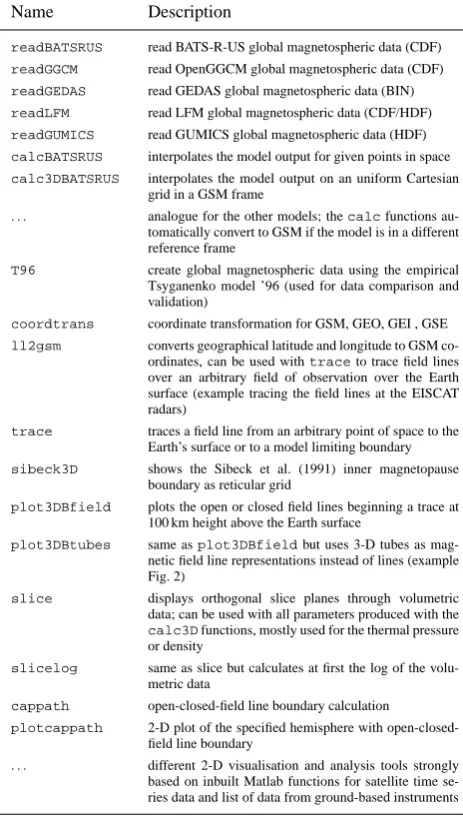
Table 1. VisAn MHD core and add on functions.
Name Description
readBATSRUS read BATS-R-US global magnetospheric data (CDF)
readGGCM read OpenGGCM global magnetospheric data (CDF)
readGEDAS read GEDAS global magnetospheric data (BIN)
readLFM read LFM global magnetospheric data (CDF/HDF)
readGUMICS read GUMICS global magnetospheric data (HDF)
calcBATSRUS interpolates the model output for given points in space
calc3DBATSRUS interpolates the model output on an uniform Cartesian grid in a GSM frame
. . . analogue for the other models; thecalcfunctions au-tomatically convert to GSM if the model is in a different reference frame
T96 create global magnetospheric data using the empirical
Tsyganenko model ’96 (used for data comparison and validation)
coordtrans coordinate transformation for GSM, GEO, GEI , GSE
ll2gsm converts geographical latitude and longitude to GSM
co-ordinates, can be used withtraceto trace field lines
over an arbitrary field of observation over the Earth surface (example tracing the field lines at the EISCAT radars)
trace traces a field line from an arbitrary point of space to the Earth’s surface or to a model limiting boundary
sibeck3D shows the Sibeck et al. (1991) inner magnetopause boundary as reticular grid
plot3DBfield plots the open or closed field lines beginning a trace at 100 km height above the Earth surface
plot3DBtubes same asplot3DBfieldbut uses 3-D tubes as mag-netic field line representations instead of lines (example Fig. 2)
slice displays orthogonal slice planes through volumetric data; can be used with all parameters produced with the
calc3Dfunctions, mostly used for the thermal pressure or density
slicelog same as slice but calculates at first the log of the volu-metric data
cappath open-closed-field line boundary calculation
plotcappath 2-D plot of the specified hemisphere with open-closed-field line boundary
. . . different 2-D visualisation and analysis tools strongly based on inbuilt Matlab functions for satellite time se-ries data and list of data from ground-based instruments
An analogous syntax can be used for the other models. The other major core functions are thecalc3Dfunctions these functions interpolate the model output of the MHD runs on monotonic 3-D plaid grids for a given volume. This transfor-mation step is necessary because of the different numerical grids of the models. Each model utilises a different method for solving the MHD equations, this is done on a diversity of numerical grids, in order to standardise these grids the
[image:3.595.310.542.100.509.2]Fig. 2. 3-D representation of the magnetic field lines in a BATS-R-US run at the CCMC; (a) the shading represents the normalised thermal pressure in the (x,y)-, and (x,z)-planes, the thick solid lines are magnetic field lines traced with the VisAn MHDplot3DBtubesfunction; the plot shows the thickness of the magnetosheath between the inner magnetopause boundary and the inner bow shock region; (b) shows the complete representation of the field inside the magnetosphere.
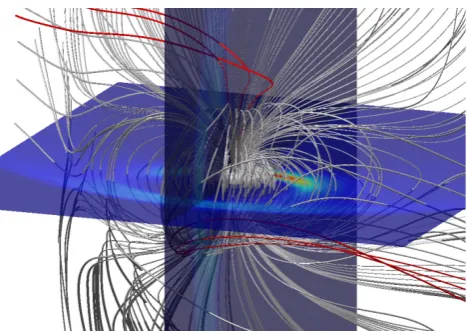
Fig. 3. 3-D representation of the global magnetic field lines of a BATS-R-US run for the 14 February 2001; 10:46 UT. The solid lines indicate the field line configuration, the red lines indicate the open magnetic field topology at the Cluster spacecraft position; the structure coincidents with the postulated structure by Russell and Elphic.
similar and can be processed with the same analysis and vi-sualisation routines. An overview of the data flow is shown in Fig. 1.
The VisAn MHD toolbox comes with a large number of functions which can work on the model outputs designed to provide tools for the novice and advance user. It is not prac-tical to give detailed discussions of each of these functions in this paper. Table 1 provides a brief summary of the core functions and add ons included in VisAn MHD.
A key component of the VisAn MHD package is the trans-formation from the different numerical grids to the uniform Cartesian grid. With this transformation it is possible to make the original raw model data outputs useable for the inbuilt well-tested Matlab functions. These functions allow the use of a wide range of visualisation and analysis tools based on the fast matrix manipulation techniques of Matlab. VisAn MHD comes with numerous functions (see Table 1 and add ons) which provide documentation and examples of how to access the model data, utilise the different tools to conduct detailed analysis and sophisticated visualisations of the model outputs. Obviously we cannot cover all these func-tions in great detail, so we have chosen to highlight the ca-pability of the toolbox by showing one published (Daum and Wild, 2006) example of the 3-D large-scale representation of an flux-transfer-event (FTE; Russell and Elphic, 1979) using the BATS-R-US model (see Fig. 3).
2.3 Analysis/visualisation/results
This simulation result shows the 3-D structure of the open magnetic field lines associated with an FTE reported by Wild et al. (2001). The FTE was seen simultaneous by the Clus-ter spacecraft during an outbound pass through the post-noon high latitude magnetopause region and the CUTLASS radars. The problem is that these in situ measurements only rep-resent point-to-point measurements of the phenomena only by using global MHD models the complete structure of this phenomena can be represented. With VisAn MHD the anal-ysis and visualisation of the structure of this process can be done by invoking just a few functions, here theslice,
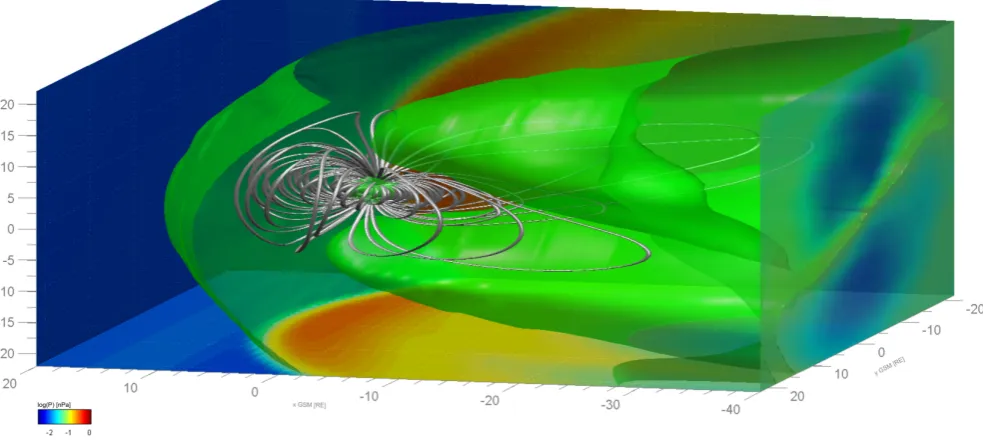
[image:4.595.51.285.316.483.2]Fig. 4. 3-D representation of the global magnetic field lines of a BATS-R-US run for the 8 October 2005; 08:05 UT. The visualisation is done in a bounding box of 40REto 20REinx-direction and−22REto 22REiny- andz-direction with 1.5 Million interpolated cells. The 2-D slices show the colour coded dynamic pressure in a logarithmic scale. The volume plots show the two plasma cavities above and beneath the neutral sheet and the plasma concentration at the bowshock. The streamtubes represent the closed fieldline configuration.
magntic field configuration at the position of the Cluster spacecraft. By combining the functions shown in Table 1 novice and advance users will be able to create with a min-imum effort excellent graphics as well as probe their data or data from another source for interesting results. Figure 4 shows the combination of just a few of these functions in or-der to represent isosurfaces and magnetic field tubes as well as the dynamic pressure. This kind of representation can then be used to create movies from a complete time interval to get a better overview of how the shape of the magnetosphere is influenced directly by the solar-wind, this allows a first inside of new data sets and new results obtained from the various kind of instruments.
2.4 Compatibility and further software packages
The VisAn MHD toolbox is fully compatible with any Mat-lab pre-existing software package and can therefore be easily adapted in projects. As add ons we also provide an open source toolbox for satellite orbit calculations and magnetic footprints (http://www.vissat.net.ms) based on the NORAD models (Hoots and Roehrich, 1980) and the T96/01 inner magnetosphere models. In future versions we plan to pro-vide the users with direct interface functions for the EISCAT analysis tool GUISDAP (Lehtinen and Huuskonen, 1996), the Multi-Instrument Analysis toolbox MIA (Marple and Honary, 2004) and a generalised Cluster satellite data anal-ysis tool based on the Cluster Active Achieve (CAA) data sets. Because of the simplicity and fully compatibility of the
VisAn MHD toolbox with the Matlab standard it is possible to customise the tool for any special need by integrating own data and software into the package or just using it as add on for pre-existing analysis tools.
3 Conclusions
visualisations of the Hall- and Pederson Conductivities over a specified geographical latitude and longitude, to 3-D vi-sualisations of the magnetosphere with inner magnetopause boundary and field line traces. We are currently working on handles for the LFM and the GUMICS models. The add ons are under constant development and can be adapted for any special research need. The entire toolbox is being released to the community under an open-source licensing agreement. Interested users can download the toolbox and examples from http://www.visan.net.ms. The success of this project depends upon continued community contributions; we look forward to meeting the needs of the different com-munities through collaborative work to enhance the capabil-ities and areas of application for VisAn MHD.
Acknowledgements. Simulation results have been provided by the Community Coordinated Modeling Center at Goddard Space Flight Center. The CCMC is a multi-agency partnership between NASA, AFMC, AFOSR, AFRL, AFWA, NOAA, NSF and ONR.
Topical Editor I. A. Daglis thanks two referees for their help in evaluating this paper.
References
Brecht, S. H., Lyon, J. G., Fedder, J. A., and Hain, K.: A time dependent three dimensional simulation of the Earth’s magneto-sphere: Reconnection events, J. Geophys. Res., 87, 6098–6108, 1982.
Daum, P. and Wild, J. A.: MHD Models for Multi-Spacecraft/Ground-based Analysis and Conjunction Visualisa-tions, in: Numerical Modeling of Space Plasma Flows, edited by: Pogorelov, N. V. and Zank, G. P., Conference Series, ASP, 359, 125–130, 2006.
Hilmer, R.: AF Geospace Users Manual, version 1.4 and version 1.4P, U.S. Air Force Base, Hanscom, Mass., 1999.
Hoots, F. R. and Roehrich, R. L.: Spacetrack Report No.3: Mod-els for Propagation of NORAD Element Set, compiled and dis-tributed by T. S. Kelso, 1980.
Janhunen, P.: GUMICS-3 – A global ionosphere-magnetosphere coupling simulation with high iono-spheric resolution, Proc. Environmental Modelling for Space-Based Applications, 18– 20 September (ESTEC, The Netherlands, ESA SP-392, 1996), 1996.
Leboeuf, J. N., Tajima, T., Kennel, C. F., and Dawson, J. M.: Global simulation of the time dependent magnetosphere, Geophys. Res. Lett., 5, 609–612, 1978.
Lehtinen, M. S. and Huuskonen, A.: General incoherent scatter analysis and GUISDAP, J. Atmos. Terr. Phys., 58, 435–452, 1996.
Lyon, J. G., Fedder J. G., and Mobarray, C. M.: The Lyon-Fedder-Mobarry (LFM) global MHD magnetospheric simulation code, J. Atmos. Space Phys., 66, 1333–1350, 2004.
Marple, S. R. and Honary, F.: A Multi-Instrument Data Analysis toolbox, Adv. Polar Upper Atmos. Res., 18, 120–130, 2004. Ogino, T.: A three-dimensional MHD simulation of the interaction
of the solar wind with the Earth’s magnetosphere: The generation of field-aligned currents, J. Geophys. Res., 91, 6791–6806, 1986. Powell, K. G., Roe, P. L., Linde, T. J., Gombosi, T. I., and DeZeeuw, D. L.: A solution-adaptive upwind scheme for ideal magnetohy-drodynamics, JCP, 154, 284–309, 1999.
Raeder, J.: Global Magnetohydrodynamics – A Tutorial, in: Space Plasma Simulation, edited by: Buechner, J., Dum, C. T., and Scholer, M., Lecture Notes in Physics, vol. 615, Springer Verlag, Heidelberg, ISBN 3-540-00698-2, 2003.
Roberts, D. A., Rezapkin, V., Coleman, J., and Boller, R.: Vec-tor and scalar field visualization techniques for multispacecraft space physics missions, Eos Trans. AGU, 84(46), Fall Meet. Suppl., Abstract SM42E-06, 2003.
Russell, C. T. and Elphic, R. C.: ISEE observations of flux transfer events at the dayside magnetopause, Geophys. Res. Lett., 6, 33– 36, 1979.
Sibeck, D. G., Lopez, R. E., and Roelof, E. C.: Solar Wind Control of the Magnetopause Shape, Location, and Motion, J. Geophys. Res., 96, 5489–5495, 1991.
T´oth, G., Sokolov, I. V., Gombosi, T. I., Chesney, D. R., Clauer, C. R., De Zeeuw, D. L., Hansen, K. C., Kane, K. J., Manchester, W. B., Oehmke, R. C., Powell, K. G., Ridley, A. J., Roussev, I. I., Stout, Q. F., Volberg, O., Wolf, R. A., Sazykin, S., Chan, A., Yu, B., and K´ota, J.: Space Weather Modeling Framework: A new tool for the space science community, J. Geophys. Res., 110, A12226, doi:10.1029/2005JA011126, 2005.
Tsyganenko, N. A.: Modeling the Earth’s Magnetspheric Magnetic Field confined within a realistic Magnetpause, J. Geophys. Res., 100, 5599–5612, 1995.
Wild, J. A., Cowley, S. W. H., Davies, J. A., Khan, H., Lester, M., Milan, S. E., Provan, G., Yeoman, T. K., Balogh, A., Dunlop, M. W., Fornacon, K.-H., and Georgescu, E.: First simultaneous observations of flux transfer events at the high-latitude magne-topause by the Cluster spacecraft and pulsed radar signatures in the conjugate ionosphere by the CUTLASS and EISCAT radars, Ann. Geophys., 19, 1491–1508, 2001,