Creative Components Iowa State University Capstones, Theses and Dissertations
Fall 2018
Customized CRM Solution for Improving Product Sales and
Customized CRM Solution for Improving Product Sales and
Customer Support
Customer Support
Allan Kishore Kumar Francis
Iowa State University, [email protected]
Follow this and additional works at: https://lib.dr.iastate.edu/creativecomponents
Part of the Sales and Merchandising Commons
Recommended Citation Recommended Citation
Francis, Allan Kishore Kumar, "Customized CRM Solution for Improving Product Sales and Customer Support" (2018). Creative Components. 59.
https://lib.dr.iastate.edu/creativecomponents/59
1
Customized CRM Solution for
Improving Product Sales and
Customer Support
Creative Component Project Report
By
Allan Kishore Kumar Francis
Master of Science in Information Systems
College of Business
Iowa State University
Submitted in fulfillment for the requirements for the degree of
Master of Science in Information Systems
Date of Submission: 13
thNovember 2018
2
Table of Contents
1.
Abstract ... 3
2.
Introduction ... 4
3.
Problem Statement ... 5
4.
Literature Review ... 6
5.
Benchmarking ... 8
6.
Methodology and Design ... 9
7.
Framework ... 12
8.
Results ... 16
9.
Limitations ... 18
10.
Conclusion ... 19
11.
Recommendation ... 19
12.
Scope for future research... 20
3
1.
Abstract
This creative component paper focuses on capturing all data related to customer
communication both before and after selling the product. The project is a customized
salesforce application that helps the sales team in the company to effectively capture various
data points during customer interaction. The two main areas of focus of this project are
contacts and cases. The main objective of this project is to identify and convert prospective
customers to actual customers. Another main portion of the project is to analyze how the
customers came to know about the company which will help us identify the line of marketing to
focus on in order to attract more customers. Emails can be easily sent to multiple customers
directly from the application, and every email will be tagged to the corresponding customer to
track all form of contacts made with the customer. Call logs can also be captured along with
detailed descriptions and events can be scheduled with the customers such as customer visits
with date, time, agenda, and other parameters. Cases help us capture the reasons as to why
customers reach out to the company. Each customer may have multiple cases tagged to them.
Reports are generated by performing data analysis on the case information to identify the most
commonly occurring product issues, number of cases that are currently open, and many other
such results. This information can be used to improve the current product, increase customer
satisfaction, maintain better customer relationships, understand customers better, and perform
4
2.
Introduction
This creative component project is developed for a startup company that sells a unique
agricultural product to farmers to help them grow crops efficiently. Currently the startup uses a
manual method to capture all customer interactions and it is in the starting stages of identifying
potential customers and converting them to actual customers. On analyzing the customer
interactions logs, customer behaviors, product features, value proposition, marketing
strategies, and future plans of the company, I found that in order to acquire more customers, it
is necessary to capture all customer interactions on to a customer relationship management
(CRM) application and perform data analytics on the captured data to identify trends and
patterns. Now a days there are a number of CRM platforms available in the market and I began
by benchmarking Salesforce platform, the World’s number one CRM platform in the market
with other CRM tools. On analysis I found that it is best to implement a CRM solution on the
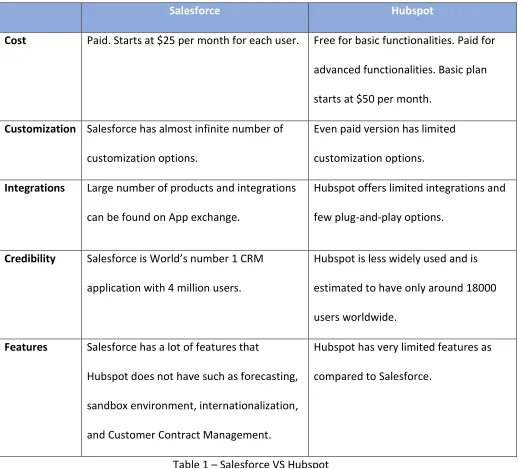
Salesforce platform due to several factors which are discussed in detail in Table 1. Hence a basic
application was designed, and the detailed project plan was discussed with the company and
once it was approved by them, I went ahead with developing the application. I had scheduled
several one-to-one meetings with the company to understand the current functioning of the
sales framework. This helped me to further research Salesforce solutions that would help solve
the current issues faced by the company. I needed access to several key customer information
in order to identify gaps and issues, so that solutions can be created and implemented in
Salesforce. I was granted access and one of the key findings was the grouping of critical
customer information. If this information can be broken down into categories, then data
5
the contacts and cases pages, to capture this information which in later stages was used in the
homepage, reports, and dashboards to analyze captured data.
3.
Problem Statement
The company currently faces several issues at several stages during the customer interaction.
A. The initial stage of converting potential customers to actual customers
B. The second stage of handling customer queries
C. The final stage of retaining customers
At every stage of customer interaction, decisions are made randomly by the company and no
standard approach is followed. The initial phases of customer interaction are very crucial in
understanding the customer and capturing required information in the system. Currently all
customer information is logged in manually and no system is in place. Looking into the various
issues faced, the issues can be categorized as follows.
a. Identifying potential customers
b. Logging customer interactions
c. Communicating easily with customers
d. Scheduling meeting events with customers
e. Perform data analytics on data collected
f. Creating cases for issues faced by customers
g. Identifying which channel is effective for marketing
Customer interactions are currently not tracked systematically, nor is it tagged to the customer
for easy reference. Also, customer visits are handled manually, and this is not tagged with the
6
phone, email, or in person. It is difficult to select a group of customers and send out an email to
them quickly. These email chains are not monitored and hence customer emails tend to get
buried in the inbox among other emails. These emails, phone, and in person conversations are
not tagged to the customer profile as well. After product sales, customers often reach out to
the company regarding various product issues. The after-sales support system is currently not
in place and is handled currently on a case by case basis. Thus, there is no data being captured
so as to identify any patterns or trends in problems occurring.
4.
Literature Review
The research paper by Annie H. Liu., Mark P. Leach., Richa Chugn. (2015) talks about the
development of a sales framework to help businesses in reacquiring customers. This is an
important aspect of business but one which is still neglected by many companies. A study was
conducted on 108 incidents and the four-step sales process was implemented, segmenting lost
customers, analyzing the loss reasons, creating strategy for reacquiring customer, and
implementing the strategy. The four-step process provides a standardized approach to
reacquire customers and helps in increasing the efficiency of customer reacquisition. The paper
published by Luciano Thome Castro., Marcos Fava Neves. (2007) talks about the proposition of
an innovative sales and management framework. In their research they considered three sales
organizations and documented their sales details for over two years. From their analysis they
developed a framework which listed a sequential list of steps on how to plan sales
management. The gaps that they identified among the three organizations were
communication management, conflict management, sales policies, and influence of marketing.
7
order to identify the most effective means of marketing for the company. Barton A. Weitz.
(1981) talks about how a salesperson can be most effective when trying to make a sale. He talks
about the various sales behaviors such as familiarizing with customers, identifying factors that
would influence the customers, identifying techniques that would change the customers’
minds, and ways of controlling the customer sales interaction. The sales person has various
resources at his disposal such as customer information, analytical skills, product information,
and interpersonal skills. The author goes on to talk about how the quality of relationship is very
important for making a sale as well as customers’ interest in having future interactions. The
paper by Zoltners, A., Sinha, P., & Lorimer, S. (2008) talks about the effectiveness of a sales
force framework. This framework can be utilized to identify sales force issues and create
corresponding solutions. This framework is best used when the organization is looking for ways
to improve their sales figures. Ferrell, O., Johnston, M., & Ferrell, L. (2007) in his journal talks
about the framework for personal selling and the ethical decision making in sales management.
The author considered both individual and business factors and developed a framework that
accommodates ethical issue handling, organizational culture, intensity of issues faced, and sales
team structure. All these factors are shown to influence any sales related decisions within the
8
5.
Benchmarking
Salesforce VS Hubspot
Salesforce Hubspot
Cost Paid. Starts at $25 per month for each user. Free for basic functionalities. Paid for
advanced functionalities. Basic plan
starts at $50 per month.
Customization Salesforce has almost infinite number of
customization options.
Even paid version has limited
customization options.
Integrations Large number of products and integrations
can be found on App exchange.
Hubspot offers limited integrations and
few plug-and-play options.
Credibility Salesforce is World’s number 1 CRM
application with 4 million users.
Hubspot is less widely used and is
estimated to have only around 18000
users worldwide.
Features Salesforce has a lot of features that
Hubspot does not have such as forecasting,
sandbox environment, internationalization,
and Customer Contract Management.
Hubspot has very limited features as
[image:9.612.55.573.138.606.2]compared to Salesforce.
Table 1 – Salesforce VS Hubspot
From the above detailed comparison between Salesforce and Hubspot we can clearly see
conclude the following. Hubspot is in its initial stages of CRM and has a long way to go.
9
implemented by four million users including many Fortune 500 companies. The initial
investment in Salesforce is higher than that of Hubspot, but the long-term benefits outweigh
the higher costs. The large number of customization and integration options along with the
features that Salesforce offers, I concluded that it is best to implement the CRM solution for
this startup company using Salesforce platform.
6.
Methodology and Design
In developing a custom application for the startup company there are two approaches that I
had, one was to go with creating custom objects and the other one was to make use of
standard objects and creating customized page layouts to modify the standard objects to
function according to the business needs of the startup. I went with the second approach as it
provides more flexibility to create page layouts and within the timeframe of one semester for
my creative component, I could add more functionalities to the project and provide more tools
and dashboards that would improve customer relationships, identify frequent product issues,
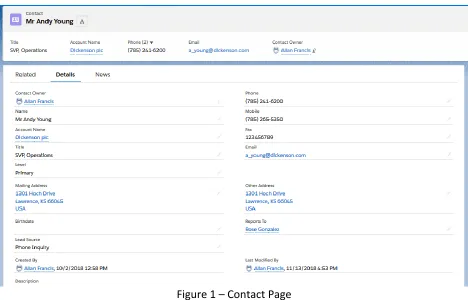
and perform data analytics on the various information captured on customer interaction. Figure
1 Shows a screenshot of the Contact Page from the application. Here we have captured all the
customer information including personal address and farm address which might be different as
in most of the cases. The “Level” field captures whether this contact is a Primary contact who
can make purchasing decisions or whether this contact is Secondary and reports to a Primary
contact. In case of a Secondary contact, the name of the person to whom he is reporting to is
captured in the “Reports to” field. This helps us to capture the hierarchy in the customer’s
organization and helps us tailor our sales approach accordingly. The “Lead Source” field
10
marketing channel that would be most beneficial for the company to invest in. The
“Description” field at the end of the contact page can be used to capture any information about
[image:11.612.72.540.169.469.2]the customer that cannot be captured in any of the above attributes.
Figure 1 – Contact Page
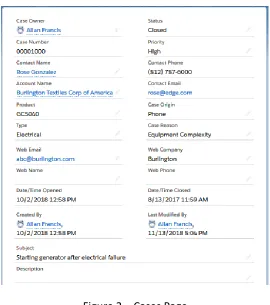
The design of cases page can be seen in Figure 2. In this page we capture the cases, which is
nothing but the issues for which the customer reaches out to the company. This is often related
to issues with the product, maintenance issues, and queries regarding the product. Every case
that is created in the salesforce application has a unique case number that is auto generated by
the application. The status of the case is displayed in the “Status” field which can be “Open”,
11
Figure 2 – Cases Page
Each case has a priority field which will display the various priorities of the cases such as high,
medium, and low. Each priority will have a defined SLA agreement that will have to be met. For
example, a high-level case will have to be addressed within twenty-four hours, and a medium
level case will have to be addressed within 72 hours, and so on. The contact name who owns
the product is captured in this page, so that it can be tagged along in his contact page. Several
other information such as product id, case reason, case category, and timestamps of opening
and closing the cases are captured in the application. Based on the timestamp, the age of each
12
7.
Framework
We clearly saw in the previous section how contact information and case information are
captured and stored in the system. In this section we will focus on how the information stored
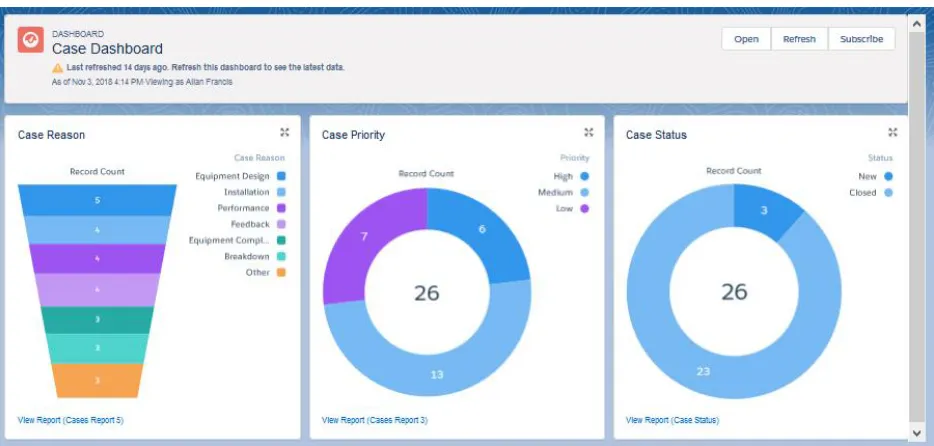
in the system can be used by the startup company. In Figure 3 we can see a screenshot of the
dashboard that has a collection of charts developed from various reports that were created
[image:13.612.73.540.254.477.2]from the data collected in the salesforce application.
Figure 3 – Dashboard Design
The case reason funnel chart is the first chart on the dashboard and it shows the breakdown of
various cases based on reasons. I picked this chart for the dashboard because the product is still
in its research and development phase and monitoring the reasons for which customers are
reaching out to the company is essential to track how the product is performing in the field. For
example, if more and more customers are reaching out for a performance issue, this
information can be used to tweak the performance of the product and thus reduce this issue
13
can focus more on installations to reduce such issues. The second chart is the case priority
donut chart which shows the various cases according to its priorities. I picked this chart for the
dashboard because it is very important for the sales team to know the number of high, and
medium cases being recorded every day. This will help them track whether the product is
having any critical system failures and help prevent customers from leaving the company due to
product dissatisfaction. This information will also help the sales team members to prioritize
their work for the day as different priority cases have different service level agreements (SLAs)
to meet. For example, high priority cases have an SLA of twenty-four hours, medium priority
cases have an SLA of two to three days and low priority cases have an SLA of five to six days.
This is very useful for the sales team to assign various cases based on priorities to sales team
executives and also helps the company to track whether SLAs are being met. The case status
donut chart shows the number of new, in progress, and closed cases. I picked this chart
because it is very important for the sales team to constantly handle customer issues with due
diligence to keep up customer trust and loyalty. If the number of new cases keep piling up, it’s a
very important flag to the sales team, saying that the team must work faster, or even that it is
time to expand the sales team in the organization to handle more cases. This will enable the
sales team to closely follow the number of cases that are open and in progress and prioritize
their daily tasks accordingly. This would also help the sales team manager to identify and track
how many cases are handled by various sales team members and even assign bonuses based on
the number of cases being closed by each member.
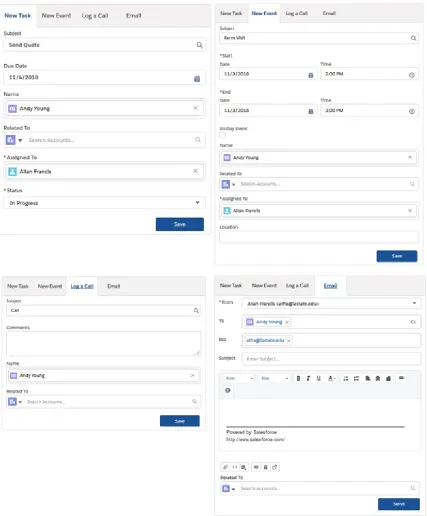
Figure 4 shows the four methods of customer interactions that are captured in the salesforce
14
as sending a quote, showing a demo, and so on. Such random tasks can now be captured in the
salesforce system and this will be tagged to the customer profile, along with due date and
status of the new task. The second activity is the creation of a new events that happen with the
client such as business dinners and farm visits. These events can be scheduled with start and
end dates, and location. This event can also be tagged to a specific customer and then can be
assigned to any of the sales agent. The third activity is the call log wherein every call with the
customer is logged into the system along with subject of the conversation, comments, and
which sales executive made the customer call. These call logs are attached to the customer
profile as well. The final activity is the email functionality wherein emails can directly be sent to
one or multiple customers and every email will be tagged to the corresponding customer
profile. Thus, all these activities will be tracked in salesforce so that every customer interaction
15
16
8.
Results
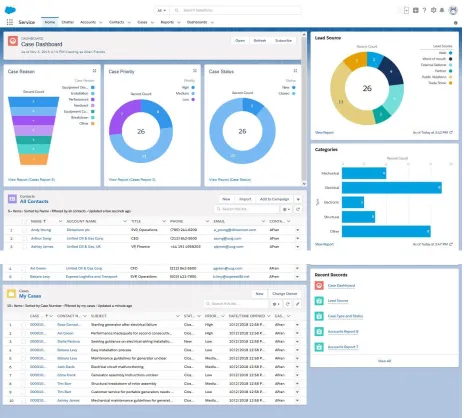
The Home page consists of Case Dashboard, Lead source and Categories charts, Recent
Records, and Contacts and Cases objects. This Home page would be displayed to the sales team
who will reach out to potential customers. When the sales team representative log into
salesforce, he will be able to see a snapshot of the status of cases, and contacts. The first chart
on the report shows a funnel chart representing the various case reasons for which the
customers have been contacted. This chart will help the user understand the recurring case
reasons and can help identify any patterns or trends in the issue. For example, if the product is
constantly having a performance issues, the user can clearly see an increased number of cases
in the Performance reason. This can be communicated to the product development team which
can investigate this recurring issue and prioritize research and development activities. The
second chart on the case dashboard is the case priority chart. This priority is assigned by the
sales user who communicates with potential customers via email or phone. Some cases require
immediate attention from the company and hence will be marked as High. Lower priority cases
can be marked as medium or low based on the criticality of the issue. This chart will help the
user prioritize how much attention he needs to give to the various cases. High priority cases will
often need to be addressed within a short span of time and will need to be closed as soon as
possible. Various SLAs can be established for the various case priorities as desired by the
organization. The third chart on the case dashboard is the case status, wherein the sales person
can see number of cases which are currently open, closed, and in progress. This helps the user
to immediately jump on to open and in progress cases and close those cases soon. This would
17
which shows how long a case has been open. Hence if an open case, or an in-progress case is in
the same status for a long time, it clearly indicates that there is a major issue for which the
solution has not yet been identified. This is quite important in case of this unique product
company as not all problems have solutions yet and the final product is still in the research and
development phase. Lead source chart shows how the potential customer came to know about
the company. This chart shows the most effective ways of reaching out to customers and it
helps to easily identify mediums that work in which the company can invest in marketing. For
example, if most customers find the company online and reach out to us, we can focus on
investing in an online ad campaign on social media to multiply the chances of reaching out to
more customers. The final chart displays the various categories of cases that have been created.
The recent records section provides the list of recently accessed contacts and cases. This is very
useful to the sales user especially if he had logged out of salesforce and logs in again after a
while. This section helps him to quickly resume the work from where he left off. The contact
and case objects provide an easy access for the sales user to quickly access contacts list and
create cases right from the home page. A detailed view of both these pages can be found in
Figures 1 and 2. Thus the company will be having the following benefits:
i. Improved customer service
ii. Increased customer satisfaction
iii. Higher customer retention
iv. Higher product sales
v. Trend / pattern identification
18
Figure 5 – Home page
9.
Limitations
Although this application helps solve various problems faced by the company, there are certain
limitations to the proposed solution. The first limitation would be the volume of data currently
available with the company. Since this is a startup company, the number of customers is
19
This limitation would however be minimized as the company grows and caters to many
customers. The second limitation would be the cost of maintaining the created salesforce
solution on the salesforce platform. As the sales team of the company grows, the number of
licenses needed for the authorized users would increase. This means that a greater number of
user access should be purchased from salesforce that would eventually increase the monthly
subscription fee for the company.
10.
Conclusion
This creative component project will help the startup company handle customers who could be
lost to competitor’s better pricing, better value, better customer service, and better marketing
strategy. The contact and case objects would increase the level of customer satisfaction and
would capture as much as information possible regarding the customer and customer
interactions, in order to deepen our understanding about the customer and to perform data
analytics on the captured data. The data analysis helps us to generate reports and dashboards,
from which the information collected could be analyzed thoroughly to identify any patterns or
trends. Recurring problems can be identified easily, areas of improvement for the product an
be found, potential customers can be identified, cases can be prioritized based on its criticality,
and all customer communications can be captured and tagged to the customer contact page.
11.
Recommendation
Based on the detailed analysis of the startup, findings in this research, and the project
developed in this creative component, I would like to make the following recommendations to
the startup. It is mandatory for the company to invest in salesforce, which is the best suited
20
should be implemented in the company to document every customer interaction and track
every communication made with the customer. This will help the company to better
understand the customer and be very close to the customer in terms of understanding. The
marketing channels should also be focused on as the next phase for the growing startup would
be to multiply its customer base by attracting more customers. Hence various tools available in
salesforce for improving marketing should be utilized. By implementing this solution in the
startup, the company can convert more prospective customers to actual customers, perform
data analysis on the information captured in contact and cases and identify patterns, trends,
and areas of improvement, and perform various activities to improve customer interaction,
product sales, and after sales support.
12.
Scope for future research
Einstein AI is a new business intelligence feature in salesforce framework that uses artificial
intelligence in the organization’s dataset. It can be implemented in the project as an extension
to the existing work to improve data analytics and get more accurate forecasts and predictions.
Einstein AI works best with a large volume of data and hence it is best for the organization only
after it has obtained a large volume of data.
13.
Reference
• Annie H. Liu., Mark P. Leach., Richa Chugn. (2015). A sales process framework to regain
B2B customers. Journal of Business and Industrial Marketing, 30(8), 906-914.
• Luciano Thome e Castro., Marcos Fava Neves. (2007). Innovative Sales Planning and
21
• Dalrymple, D.J., Cron, W.L. (1995). Sales Management: Concepts and Cases. New York:
John Wiley & Sonsm, 5a. ed., 798 p.
• BONOMA, T.V. (1985). Case Research in Marketing: Opportunities, Problems, and a
Process. Journal of Marketing Research. Vol. XXII, 199-208.
• Dawes, P., Massey, G. (2001). Relationships Between Marketing & Sales: The Role of
Power and Influence. Proceedings of the 17th Industrial Marketing and Purchasing
Group Conference, Oslo, Norway.
• BERMAN, B. (1996). Marketing Channels. New York: John Willey & Sons, 663 p.
• Barton A. Weitz. (1981). Effectiveness in Sales Interactions: A Contingency Framework.
Journal of Marketing, Vol. 45, No. 1., pp. 85-103.
• Bagozzi, Richard P. (1978). Salesforce Performance and Satisfaction as a Function of
Individual Difference, Interpersonal, and Situational Factors. Journal of Marketing
Research, 517-531.
• Zoltners, A., Sinha, P., & Lorimer, S. (2008). Sales Force Effectiveness: A Framework for
Researchers and Practitioners. The Journal of Personal Selling and Sales Management,
28(2), 115-131.
• Ferrell, O., Johnston, M., & Ferrell, L. (2007). A Framework for Personal Selling and
Sales Management Ethical Decision Making. The Journal of Personal Selling and Sales
Management, 27(4), 291-299.