Sheremet M. I. Combined effect of gene-gene interaction on the among the function of thyroid gland and the degree of its enlargement in patients of autoimmune thyroiditis and thyroid adenoma in the inhabitants of Northern Bukovina. Journal of
Education, Health and Sport. 2017;7(9):606-620. eISSN 2391-8306. DOI http://dx.doi.org/10.5281/zenodo.1000955
http://ojs.ukw.edu.pl/index.php/johs/article/view/4936
The journal has had 7 points in Ministry of Science and Higher Education parametric evaluation. Part B item 1223 (26.01.2017). 1223 Journal of Education, Health and Sport eISSN 2391-8306 7
© The Authors 2017;
This article is published with open access at Licensee Open Journal Systems of Kazimierz Wielki University in Bydgoszcz, Poland
Open Access. This article is distributed under the terms of the Creative Commons Attribution Noncommercial License which permits any noncommercial use, distribution, and reproduction in any medium, provided the original author(s) and source are credited. This is an open access article licensed under the terms of the Creative Commons Attribution Non Commercial License (http://creativecommons.org/licenses/by-nc/4.0/) which permits unrestricted, non commercial use, distribution and reproduction in any medium, provided the work is properly cited. This is an open access article licensed under the terms of the Creative Commons Attribution Non Commercial License (http://creativecommons.org/licenses/by-nc/4.0/) which permits unrestricted, non commercial
use, distribution and reproduction in any medium, provided the work is properly cited. The authors declare that there is no conflict of interests regarding the publication of this paper.
Received: 15.08.2017. Revised: 10.09.2017. Accepted: 10.09.2017.
COMBINED EFFECT OF GENE-GENE INTERACTION ON THE AMONG THE
FUNCTION OF THYROID GLAND AND THE DEGREE OF ITS ENLARGEMENT
IN PATIENTS OF AUTOIMMUNE THYROIDITIS AND THYROID ADENOMA
IN THE INHABITANTS OF NORTHERN BUKOVINA
M. I. Sheremet
Surgery Department №1, Higher State Educational Establishment of Ukraine
«Bukovinian State Medical University»,
Chernivtsi, Ukraine, Е-mail: [email protected]
Abstract
Was a comprehensive analysis of combined influence of the gene polymorphisms associated with various links in the regulation of apoptosis (BCL-2, CTLA-4 and APO-1 / Fas) on the development of nodular goiter on the background of autoimmune thyroiditis and thyroid adenoma in the surveyed population with regard to changes in the functional activity of the thyroid gland and the degree of the thyroid gland enlargement has been performed. For this purpose, we used the method of Multifactor Dimensions Reduction 3.0.2 – MDR by calculating the prediction potentials.
Key words: nodular goiter, autoimmune thyroiditis, thyroid adenoma, APO-1 /
FAS, CTLA-4 and BCL-2 genes interaction.
Abbreviations: NGAIT - nodular goiter with autoimmune thyroiditis, AIT- autoimmune thyroiditis, TG - thyroid gland, TA - thyroid adenoma.
Introduction
The etiology of Hashimoto’s thyroiditis is considered to be multifactorial, involving the interplay of various environmental and genetic factors. Studies conducted on the genetic associations of Hashimoto’s thyroiditis have shown that the human leukocyte antigen (HLA) region, which plays a major role in other autoimmune disorders, is associated with development of Hashimoto’s thyroiditis [1-5].
Defects in genes that play an important role in thyroid physiology and thyroid hormone synthesis could predispose to the development of goiter, especially in case of borderline or overt iodine deficiency. Such defects could lead to dyshormonogenesis as an immediate response, thereby indirectly explaining the nodular transformation of the thyroid as late consequences of dyshormonogenesis, as a form of maladaptation [6, 7]. The genes that encode the proteins involved in thyroid hormone synthesis, such as the thyroglobulin-gene (TG-gene), the thyroid peroxidase-gene (TPO-gene), the sodium – iodide – symporter-gene (SLC5A5), the Pandered syndrome-gene (SLC26A4), the TSH receptor-gene (TSH-R-gene), the iodothyronine deiodinase (DEHAL 1) and the thyroid oxidase 2 gene3 (DUOX2) are convincing candidate genes in familial euthyroid goiter [6]. Originally, several mutations in these genes were identified in patients with congenital hypothyroidism [7]. However, in cases of less severe functional impairment, with can still be compensated, a contribution of variants of these genes in the etiology of nontoxic goiter is possible.
The next step of our study was the comprehensive analysis of combined influence of the gene polymorphisms associated with various links in the regulation of apoptosis (BCL-2, CTLA-4 and APO-1 / Fas) on the functional activity changes (normal function, subclinical and clinical hypothyroidism) and TG hyperplasia degrees (IB, II and III) in the surveyed population. For this purpose, we used the method of Multifactor Dimensions Reduction 3.0.2 – MDR by calculating the prediction potentials.
Material and methods
95 women with NGAIT were examined in 2013- 2016 in Chernivtsi regional clinical hospital. The age of patients ranged from 23 to 72 years. The diagnosis was made clinically, in laboratory (thyroid peroxidase antibodies (TPAB) - 60-250 U / ml thyroglobulin antibodies (TGAB) - 60-500 U / ml; thyroid-stimulating hormone (TSH) - 4.10 mU / L), using ultrasound and it was confirmed histologically after the surgery.
We singled out a group of 30 women who had been diagnosed with thyroid adenoma after the surgery by ultrasound, fine-needle aspiration biopsy (FNAB) and histological conclusion. The group was identified due to the fact that this pathology is one of the most common forms of nodular goiter. These indicators served as controls. The final confirmation of morphologically unchanged tissue was obtained after the histological conclusion.
The TG functional activity changes (normal function, subclinical and clinical hypothyroidism). The diagnosis is confirmed biochemically by a reduction in serum free T4 with increased serum thyroid-stimulating hormone (TSH; thyrotropin). Subclinical hypothyroidism is a biochemical diagnosis and describes an elevated serum TSH with normal free thyroid hormones. Hypothyroidism is treated by T4 replacement, the aims of treatment being relief of symptoms and restoration of serum TSH to the reference range.
TG hyperplasia degrees (I and II) were analyzed according to the World Health Organization (WHO) classification:
Grade 0: No goiter is palpable or visible.
I degree: palpable goiter, not visible when neck is held in normal position
II degree: a clearly swollen neck (also visible in normal position of the neck) that is consistent with a goiter on palpation.
25 practically healthy donors were examined as well. 10 ml of the peripheral blood drawn from the ulnar vein in the morning on an empty stomach served as the material for the study.
The DNA was isolated by means of a set of reagents Thermo Scientific Gene JET Genomic DNA Purification kit (# K0721, Thermo Fisher Scientific), according to the directions for use, with incubation with proteinase K overnight to complete cell lysis. The purified DNA was diluted in Elution Buffer and evaluated with a spectrophotometer Nanodrop2000C. Only samples with a concentration of not lower than 15 ng / ml and the values of the ratio of A (260/280) between 1.7 and 2.0 were used for genotyping. The obtained extracts were divided into aliquots, one of which was placed in a refrigerator at 4oC until its use, while others were frozen at -20oC.
To normalize the amount of DNA, all samples were brought to a concentration of 2 ng / µL using Nuclease-free water.
To genotype the selected point polymorphism, the TaqMan technology was used. Polymorphisms marked with the reference number SNP ID, according to the database dbSNP have been studied. To test each of the polymorphisms TaqMan® SN Genotyping Assays (40X) (4,351,379, Thermo Fisher Scientific) were used (table 1)
Table 1
The nucleotide sequence of the region including the analyzed polymorphism
Reference number SNP ID
Test number (Assay ID*)
Fragment of the region including the analyzed polymorphism
rs231775 (CTLA4)
C_2415786_20 GCACAAGGCTCAGCTGAACCTGGCT[A/G]CCA
GGACCTGGCCCTGCACTCTCCT rs17759659
(BCL2)
C_33628167_10 TCTTCTTACCAAAGATTCACAATAC[A/G]GTGT
TGATGGGAACGTGACCTAGTT rs2234767
(FAS)
C_12123966_10 CAGAGTGTGTGCACAAGGCTGGCAC[A/G]CCC
AGGGTCTTCCTCATGGCACTAA Note: according to the website www.thermofisher.com.
The volume of the reaction mixture was 5 µL and consisted of: 2.5 µL reagent Taq Man Genotyping Master Mix (20X) (4,371,355, Thermo Fisher Scientific), 0,25 µL of probe solution and 2.25 µL of DNA solution. Genotyping was performed with the instrument Quant Studio 6 (Applied Biosystems, Thermo Fisher Scientific), 384-well block.
Amplification was performed under the following conditions:
Activation 10 min 95oC
Denaturation 15 sec 92oC 40*/60** cycles Annealing / elongation 1 min 60oC
To collect and process the data the software Quant Studio™ Real-Time PCR (v.1.3) was used.
The main part of the statistical analysis was carried out using the software «Statistica 7.0» (SPSS). Nominal data are presented in the form of quantitative values and percentages. The balance Hardy - Weinberg of the genotype distribution was checked using Online Encyclopedia for Genetic Epidemiology Studies (http://www.oege.org/software/hwe-mr-calc.shtml). To compare the distribution of genotypes in the experimental and control groups Pearson's chi-squared test was used. The reliability of differences of averages in groups with different genotypes was determined by the method of univariate analysis of variance (ANOVA). The impact of factors on the development of thyroid pathology was assessed using a binary logistic regression model for the relative risk (RelR), risk ratio (RR) and odds ratio (OR) with 95% confidence interval [95% CI], taking into account the criterion 2 (df = 1). The difference was considered reliable at p <0.05.
Results and discussion
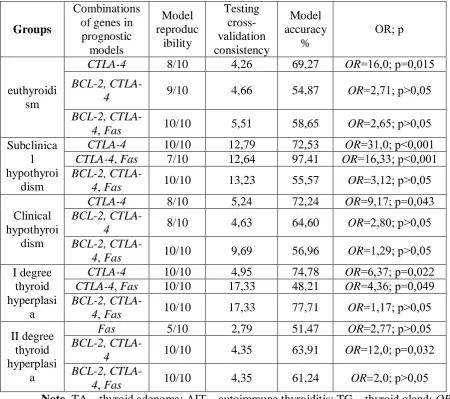
The best models of gene-gene interaction including those, where the TG function and the degree of its enlargement with the highest rates of cross-validation consistency are taken into account, are shown in table 2.
The method of multifactor dimension reduction (MDR) showed the reliability and a high reproducibility of a single-factor model with CTLA-4 gene involvement (table 2), both in the whole surveyed population of patients with risk of thyroid pathology persisted in one-component model involving the CTLA-4 gene as in euthyroidism (80% reproducibility, accuracy 69,27%, OR = 16,0; p = 0.015), somewhat stronger in subclinical and clinical hypothyroidism (100 % and 80% reproducibility, OR = 31,0; p <0.001 and OR = 9,17; p = 0.043, respectively) and the second degree thyroid hyperplasia (100% reproducibility, OR = 6,37; p = 0.022).
In addition, this two-component model (CTLA-4 and Fas) proved to be effective for subclinical hypothyroidism (with the highest accuracy 97,41%; OR = 16,33; p <0.001) and the I-degree thyroid hyperplasia (OR = 4,36; p = 0.049). The two-component model which involved the BCL-2 and CTLA-4 genes also confirmed its classification ability in the forecast of the II-degree thyroid hyperplasia (100% reproducibility; OR = 12,0; p = 0.032).
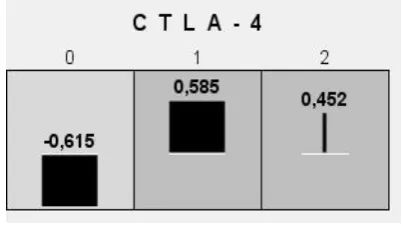
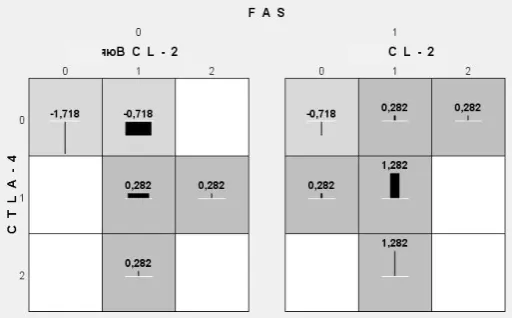
Graphic models of gene-gene interactions in thyroid pathology in the surveyed population (figures 1-3) show a high probability of euthyroidism with minor G-allele of the
Table 2
Models of gene-gene interactions among the surveyed individuals in general and
considering thyroid gland pathology, the TG function and the degree of its enlargement
Groups
Combinations of genes in prognostic models Model reproduc ibility Testing cross-validation consistency Model accuracy % OR; р euthyroidi sm
CTLA-4 8/10 4,26 69,27 OR=16,0; р=0,015
BCL-2,
CTLA-4 9/10 4,66 54,87 OR=2,71; р>0,05
BCL-2,
CTLA-4, Fas 10/10 5,51 58,65 OR=2,65; р>0,05
Subclinica l hypothyroi
dism
CTLA-4 10/10 12,79 72,53 OR=31,0; р<0,001
CTLA-4, Fas 7/10 12,64 97,41 OR=16,33; р<0,001
BCL-2,
CTLA-4, Fas 10/10 13,23 55,57 OR=3,12; р>0,05
Clinical hypothyroi
dism
CTLA-4 8/10 5,24 72,24 OR=9,17; р=0,043
BCL-2,
CTLA-4 8/10 4,63 64,60 OR=2,80; р>0,05
BCL-2,
CTLA-4, Fas 10/10 9,69 56,96 OR=1,29; р>0,05
I degree thyroid hyperplasi
a
CTLA-4 10/10 4,95 74,78 OR=6,37; р=0,022
CTLA-4, Fas 10/10 17,33 48,21 OR=4,36; р=0,049
BCL-2,
CTLA-4, Fas 10/10 17,33 77,71 OR=1,17; р>0,05
II degree thyroid hyperplasi
a
Fas 5/10 2,79 51,47 OR=2,77; р>0,05
BCL-2,
CTLA-4 10/10 4,35 63,91 OR=12,0; р=0,032
BCL-2,
CTLA-4, Fas 10/10 4,35 61,24 OR=2,0; р>0,05
Note. TA – thyroid adenoma; АІТ – autoimmune thyroiditis; TG – thyroid gland; OR -Odds Ratio.
Fig. 1. Polymorphic variants of the
CTLA-4 gene (+49G/A), causing a high (dark grey box) and a low (light grey box) probability of euthyroidism in patients. Note: 0, 1, 2 – polymorphic variants of the CTLA-4 gene- АА (0), AG (1), GG (2)
Fig. 2. Combination of polymorphic variants of CTLA-4 (+49G/A) and BCL-2
(63291411A>G) genes, causing a high (dark grey box) and a low (light grey box) probability of euthyroidism in thyroid pathology in patients. Note: CTLA-4 0, 1, 2 – polymorphic variants of the CTLA-4 gene АА
(0), AG (1), GG (2); 0, 1, 2 Bcl-2 - 0, 1 –
polymorphic variants of the Bcl-2 gene АА
(0), AG (1), GG (2). The white boxes mean
the absence of the combinations of the gene genotypes.
Fig. 3. Combination of polymorphic variants of CTLA-4 (+49G/A), Fas (-1377G/A)
and BCL-2 (63291411A>G) genes, causing a high (dark grey box) and a low (light grey box)
probability of euthyroidism in thyroid pathology in patients. Note: CTLA-4 0, 1, 2 – polymorphic variants of the CTLA-4 gene АА (0), AG (1), GG (2); Fas 0, 1 – polymorphic variants of the Fas GG (0) gene, AG (1); 0, 1, 2 Bcl-2 – polymorphic variants of the Bcl-2
gene АА (0), AG (1), GG (2). The white boxes mean the absence of the combinations of the
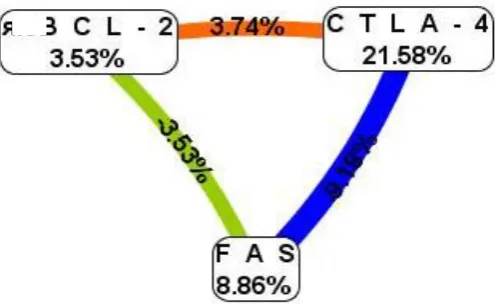
[image:7.595.286.486.71.267.2] [image:7.595.68.270.159.272.2] [image:7.595.89.503.233.671.2]Analyzing the association of the gene polymorphic site with the condition of euthyroidism in patients suffering from thyroid pathology according to the entropy index showed that +49G/A polymorphic locus of the CTLA-4 gene was the most influential (21,58%) (fig. 4). This effect was amplified with synergistic interaction with polymorphic site of the Bcl-2 gene (63291411A> G) by 3.74%. The effects of polymorphisms of Bcl-2 (rs17759659) and Fas (rs2234767) genes on euthyroidism onset in thyroid pathology were independent with entropy share 3,53% and 8,86% respectively.
Fig. 4. Cluster analysis of modeling gene-gene interaction of three genes CTLA-4, Fas and Bcl-2 in patients with thyroid pathology in the condition of euthyroidism. The synergistic interaction is marked in orange, the independent impact is in green and blue.
In patients with thyroid pathology (fig. 5, 6) two-locus model involving AG-genotype (of Fas gene) and G-allele (of CTLA-4 gene) and three-locus model involving AG-genotype (of Fas & Bcl-2 genes) and G-allele (of CTLA-4 gene) proved to be the best ones and increased the risk of subclinical hypothyroidism in the population of Northern Bukovina residents (1,115 and 1,282 respectively).
[image:8.595.174.424.241.393.2]
Fig. 5. Polymorphic variants of the
CTLA-4 (+49G/A) and Fas (-1377G/A) genes, causing a high (dark grey box) and a low (light grey box) risk of subclinical hypothyroidism in thyroid pathology in patients. Note: 0, 1, 2 – polymorphic variants of the
CTLA-4 gene- АА (0), AG (1), GG
(2); Fas 0, 1 – polymorphic variants of the Fas GG (0) gene, AG (1).
Fig. 6. Combination of polymorphic variants of the CTLA-4 (+49G/A), Fas (-1377G/A) and Bcl-2 (63291411A>G) genes, causing a high (dark grey box) and a low (light grey box) risk of subclinical hypothyroidism in thyroid pathology in patients. Note: CTLA-4 0, 1, 2 – polymorphic variants of the CTLA-4 gene АА (0), AG (1), GG (2); Fas 0, 1 – polymorphic variants of the Fas gene GG (0), AG (1); 0, 1, 2 Bcl-2 – polymorphic variants of the
Bcl-2 gene АА (0), AG (1), GG (2). The white boxes mean the absence of the combinations of the gene genotypes.
Fig. 7. Polymorphic variants of the CTLA-4 (+49G/A) and BCL-2 (63291411A>G) genes, cussing a high (dark grey box) and a low (light grey box) risk of clinical hypothyroidism in thyroid pathology in patients. Note: 0, 1 – polymorphic variants of the CTLA -4 gene- АА (0), AG (1); 0, 1, 2 Bcl -2 – polymorphic variants of the
Bcl-2 gene АА (0), AG (1), GG (2). The white boxes mean the absence of the combinations of the gene genotypes.
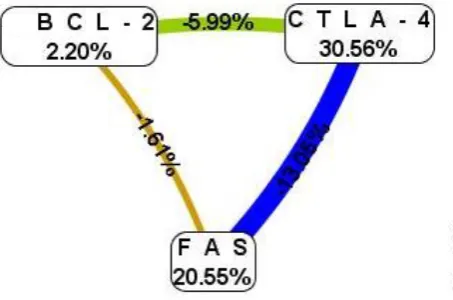
[image:9.595.256.513.71.230.2] [image:9.595.71.243.104.229.2] [image:9.595.266.522.424.561.2] [image:9.595.71.242.432.560.2]According to the results of cluster analysis of modeling gene-gene interaction in subclinical and clinical hypothyroidism the highest share of entropy belonged to polymorphism of the CTLA-4 (+49G/A) and Fas (-1377G/A) genes: 30,56% and 20,55% (fig. 9) and 13,67% and 6,17% (fig. 10), respectively. An independent connection between polymorphic loci of genes was found in subclinical hypothyroidism (from -13,05% to -1,61%) and synergistic one between polymorphic sites of the CTLA-4 (+49G/A) and Bcl-2 (63291411A>G) genes, which increased the risk of clinical hypothyroidism by 7,43% in the population (fig. 10).
Fig. 9. Cluster analysis of modeling gene-gene interaction of three gene-genes CTLA-4, Fas and Bcl-2 in patients with thyroid pathology in the condition of subclinical
hypothyroidism. The independent effect is
[image:10.595.73.300.261.411.2]marked in green, brown and blue.
Fig. 10. Cluster analysis of modeling gene-gene interaction of three gene-genes CTLA-4, Fas and Bcl-2 in patients with thyroid pathology in the condition of clinical
hypothyroidism. The synergistic interaction
is marked in red while the independent effect is in green and brown.
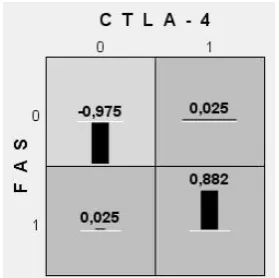
The risk of the І-degree thyroid hyperplasia in AIT and TA (fig. 11, 12) is the highest in three-locus combination of AG-genotype of the CTLA-4 & Fas & Bcl-2 genes (1,025; р>0,05), the two-locus model involving AG- genotype of the CTLA-4 & Fas genes is somewhat weaker but reliable (0,882; р=0,049). The lowest is the risk of the І-degree thyroid hyperplasia in combination of wild alleles in the homozygous state of the CTLA-4 & Fas
[image:10.595.85.515.261.411.2]
Fig. 11. Polymorphic variants of the CTLA-4 (+49G/A) and Fas (-1377G/A) genes, causing a high (dark grey box) and a low (light grey box) risk of І-degree thyroid hyperplasia in patients. Note: 0, 1
CTLA-4 – polymorphic variants of the CTLA-4 gene - АА (0), AG (1); 0, 1 Fas – polymorphic variants of
the Fas GG (0) gene, AG (1).
Fig. 12. Combination of polymorphic variants of the CTLA-4 (+49G/A), Fas (-1377G/A) and Bcl-2 (63291411A>G) genes, causing a high (dark grey box) and a low (light grey box) risk of I-degree
thyroid hyperplasia in patients. Note: CTLA-4 0, 1, – polymorphic variants of the CTLA-4 gene АА (0), AG (1); Fas 0, 1 – polymorphic variants of the Fas gene GG (0), AG (1); 0, 1, 2 Bcl-2 – polymorphic variants of the Bcl-2 gene АА (0), AG (1), GG (2). The white boxes mean the absence of the combinations of the gene genotypes.
The risk of the ІI-degree thyroid hyperplasia in AIT and TA (fig. 13, 14) increases statistically significantly in two-locus combination of AG-genotype of the CTLA-4 & Bcl-2 genes (1,038; р=0,032). The three-locus model of gene-gene interaction involving
AG-genotype of the three CTLA-4 & Fas & Bcl-2 genes proved to be stronger but unreliable (1,538). The lowest risk of I-degree thyroid hyperplasia was in the combination of wild alleles in homozygous state of both two genes CTLA-4 & Bcl-2 (-1,462), and in combination of three genes CTLA-4 & Bcl-2& Fas (-1,462).
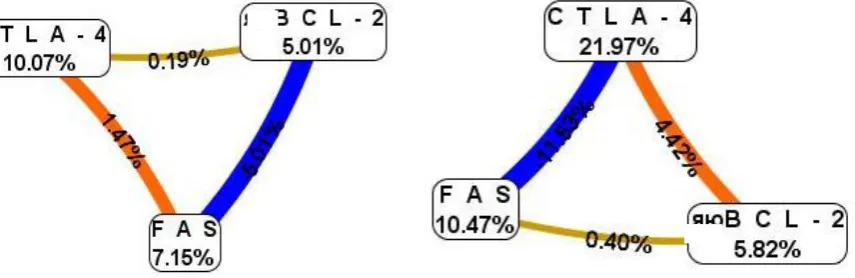
Cluster analysis of gene-gene interaction in I-degree thyroid hyperplasia (fig. 15) indicated the synergistic interconnection between polymorphic sites of the CTLA-4 and Fas
[image:11.595.90.230.70.209.2] [image:11.595.265.521.72.212.2]
Fig. 13. Polymorphic variants of the CTLA-4 (+49G/A) and BCL-2 (63291411A>G) genes, cussing a high (dark grey box) and a low (light grey box) risk of the
ІI-degree thyroid hyperplasia in
patients. Note: 0, 1, 2 – polymorphic variants of the CTLA-4 gene- АА (0), AG (1) GG (2); 0, 1, 2 Bcl-2 – polymorphic variants of the Bcl-2 gene АА (0), AG (1),
GG (2).
Fig. 14. Combination of polymorphic variants of the CTLA-4 (+49G/A), Fas (-1377G/A) and Bcl-2 (63291411A>G) genes, causing a high (dark grey box) and a low (light grey box) risk of ІI-degree
thyroid hyperplasia in patients. Note: CTLA-4 0, 1, 2– polymorphic variants of the CTLA-4 gene АА (0), AG (1), GG (2); Fas 0, 1 – polymorphic variants of the Fas gene GG (0), AG (1); 0, 1, 2 Bcl-2 – polymorphic variants of the Bcl-2 gene АА (0), AG (1), GG (2). The white boxes mean the absence of the combinations of the gene genotypes.
Fig. 15. Cluster analysis of modeling the gene-gen interaction of three genes: CTLA -4, Fas and Bcl-2 in patients with I-degree
thyroid hyperplasia.
Fig. 16. Cluster analysis of modeling the gene-gen interaction of three genes: CTLA -4, Fas and Bcl-2 in patients with ІI-degree hyperplasia.
Note. The synergistic interaction is marked in orange, the independent effect is in blue and brown.
[image:12.595.267.520.71.240.2] [image:12.595.89.243.79.240.2] [image:12.595.90.518.440.579.2] [image:12.595.73.289.441.581.2]49G / A), Fas (-1377G / A) and Bcl-2 (63291411A> G) genes on the onset of the change of thyroid function and degree of hyperplasia in the population of residents of Northern Bukovina.
The classification ability of the created models, despite the high reproducibility (60-100%), confirmed the likelihood of risks for a single-factor model involving the minor G-allele of the CTLA-4 gene (especially of AG-genotype) as well as for two-locus model in the combination of AG-genotype of the CTLA-4 and Fas genes: onset of condition of euthyroidism (exclusively with the participation of CTLA-4 gene, subclinical hypothyroidism, clinical hypothyroidism, I-degree thyroid hyperplasia with the accuracy from 68,12% to 97,41% and testing Cross-validation Consistency from 4,26 to 20,55, respectively. The two-locus combination of AG-genotype of the CTLA-4 & Bcl-2 proved its effectiveness in the ІI-degree thyroid hyperplasia prognosis.
The three-component model involving three genes on the risk of thyroid pathology in the population in general CTLA-4 & Fas & Bcl-2 proved its classification capability. So did the combinations of:
- AG-genotypes of three genes which associates with the risk euthyroidism (1,452), clinical hypothyroidism (1,435), I-degree thyroid hyperplasia (1,025) and that of the II-degree (1,538);
- AG-genotypes of the Fas & Bcl-2 genes and G-allele of the CTLA-4 gene with the risk of АІТ (1,392) and subclinical hypothyroidism (1,282).
Interlocus interaction in thyroid pathology is characterized by pronounced synergistic gene-gene relationship (CTLA-4 & Fas, CTLA-4 & Bcl-2 from 1,47% to 7,43%), or by independent, neutralizing effect (from -13,05% to 0,35%) with the highest entropy rate which is typical for CTLA-4 gene (21,58% – in euthyroidism, 30,56% – in subclinical hypothyroidism, and 13,67% – in clinical hypothyroidism), which indicates its high contribution to the development of thyroid pathology both in general (21,38%), and of some of its nosology’s. Somewhat less significant (by 1,5-5,5 times) is the share in the development of thyroid pathology concerning the entropy rate made by the Fas gene (3,86%): 8,99% – in TA, 12,14% – in АІТ, 8,86% – in euthyroidism, 20,55% – in subclinical hypothyroidism, 6,17% – in clinical hypothyroidism, respectively.
Conflict of interest. The authors declare no conflict of interest concerning this article.
References
1. Dong YH, Fu DG. Autoimmune thyroid disease: mechanism, genetics and current knowledge. Eur Rev Med Pharmacol Sci. 2014;18(23):3611-3618.
2. Tomer Y, Davies TF. Searching for the autoimmune thyroid disease susceptibility genes: from gene mapping to gene function. Endocr Rev. 2003;24(5):694-717.
3. Brix TH, Hegedus L. Twin studies as a model for exploring the aetiology of autoimmune thyroid disease. Clin Endocrinol (Oxf). 2012;76(4):457-464.
4. Lee Y.H, Choi S.J., Ji J.D., Song GG. CTLA-4 and TNF-α promoter-308 A/G polymorphisms and ANCA-associated vasculitis susceptibility: a meta-analysis// Mol Biol Rep. 2012 Jan, 39 (1):319-326.
5. Zhang M, Ni J, Xu WD et al. Association of CTLA-4 variants with susceptibility to inflammatory bowel disease: a meta-analysis// Hum Immunol. 2014; 75(3): 227-233.
6. Camilot M, Teofoli F, Gandini A, Franceschi R, Rapa A, Corrias A, Bona G, Radetti G, Tatò L 2005 Thyrotropin receptor gene mutations and TSH resistance: variable expressivity in the heterozygotes. Clin Endocrinol (Oxf) 63:146–151
7. Tonacchera M, Di Cosmo C, De Marco G, Agretti P, Banco M, Perri A, Gianetti E, Montanelli L, Vitti P, Pinchera A 2007 Identification of TSH receptor mutations in three families with resistance to TSH. Clin Endocrinol (Oxf) 67:712–718.
8. Qiu H., Tang W., Yin P., Cheng F., Wang L. Cytotoxic T-lymphocyte associated antigen 4 polymorphism and Hashimoto's thyroiditis susceptibility: a meta-analysis // Endocrine. 2014; 45(2):198-205.
9. Pastuszak-Lewandoska D., Sewerynek E., Domańska D. et al. CTLA-4 gene poly-morphisms and their influence on predisposition to autoimmune thyroid diseases (Graves' disease and Hashimoto's thyroiditis) // Arch Med Sci. 2012 Jul 4, 8(3):415-421.
10. Sheremet MI, Sydorchuk LP, Shidlovskyi VO, Bedenyuk AD. et all. Effect of APO-1 / FAS, CTLA-4 AND BCL-2 genes polymorphisms on the risk of goiter nodular forms with NGAIT occurrence among the Bukovinian population. Archives of the Balkan Medical Union 2017; 52(2):144-151.
12. Mazziotti G., Sorvillo F., Naclerio C. et al. Type-1 response in peripheral CD4+ and CD8+ T cells from patients with Hashimoto's thyroiditis // Eur J.Endocrinol. 2003; 148:383–388.
13. Leithäuser F, Dhein J, Mechtersheimer G, et al: Constitutive and induced expression of APO-1, a new member of the nerve growth factor/tumor necrosis factor receptor superfamily, in normal and neoplastic cells. Lab Invest. 1993. 69: 415-429.
14. Man-Man Lu, Qian-Ling Ye, Chen-Chen Feng, et al: Association of FAS gene polymorphisms with systemic lupus erythematosus: A case-control study and meta-analysis. Experimental and Therapeutic Medicine. 2012; 4: 497-502.