R E S E A R C H
Open Access
Speaker-adaptive-trainable Boltzmann
machine and its application to non-parallel
voice conversion
Toru Nakashika
*and Yasuhiro Minami
Abstract
In this paper, we present a voice conversion (VC) method that does not use any parallel data while training the model. Voice conversion is a technique where only speaker-specific information in the source speech is converted while keeping the phonological information unchanged. Most of the existing VC methods rely on parallel data—pairs of speech data from the source and target speakers uttering the same sentences. However, the use of parallel data in training causes several problems: (1) the data used for the training is limited to the pre-defined sentences, (2) the trained model is only applied to the speaker pair used in the training, and (3) a mismatch in alignment may occur. Although it is generally preferable in VC to not use parallel data, a non-parallel approach is considered difficult to learn. In our approach, we realize the non-parallel training based on speaker-adaptive training (SAT). Speech signals are represented using a probabilistic model based on the Boltzmann machine that defines phonological information and speaker-related information explicitly. Speaker-independent (SI) and speaker-dependent (SD) parameters are simultaneously trained using SAT. In the conversion stage, a given speech signal is decomposed into phonological and speaker-related information, the speaker-related information is replaced with that of the desired speaker, and then voice-converted speech is obtained by combining the two. Our experimental results showed that our approach outperformed the conventional non-parallel approach regarding objective and subjective criteria.
Keywords: Voice conversion, Boltzmann machine, Unsupervised training, Energy-based model, Speaker adaptation, Non-parallel training, SAT
1 Introduction
In recent years, voice conversion (VC), which is a tech-nique used to change speaker-specific information in the speech of a source speaker into that of a target speaker while retaining linguistic information, has been garnering much attention since the VC techniques can be applied to various tasks [1–5]. Most of the existing approaches rely on statistical models [6, 7], and the approach based on the Gaussian mixture model (GMM) [8–11] is one of the mainstream methods used nowadays. Other sta-tistical models, such as non-negative matrix factorization (NMF) [12, 13], neural networks (NNs) [14], restricted Boltzmann machines (RBMs) [15, 16], and deep learning [17, 18], are also used in VC. However, almost all of the existing VC methods require parallel data (aligned speech
*Correspondence: [email protected]
Graduate School of Information Systems, University of
Electro-Communications, 1-5-1 Chofugaoka, Chofu, 182-8585 Tokyo, Japan
data from the source and the target speakers so that each frame of the source speaker’s data corresponds to that of the target speaker) for training the models, which leads to several problems. First, the data is limited to pre-defined articles (both speakers must utter the same articles). Sec-ond, the trained model is only applied to the speaker pair used in the training, and it is difficult to reuse the model on the conversion of another speaker pair. Third, the training data (the parallel data) is not the original speech data anymore because the speech data is stretched and modified in the time axis when aligned. Furthermore, it is not guaranteed that each frame is aligned perfectly, and the mismatching may cause some errors in training.
Several approaches that do not useparallel data from the source to the target speakers1 have been also pro-posed [19–23]. In [19], for example, the authors model the spectral relationships between two arbitrary speakers (reference speakers) using GMMs and convert the source
speaker’s speech using the matrix that projects the fea-ture space of the source speaker into that of the target speaker through that of the reference speakers. As a result, parallel data from the source and target speakers is not required. In [21, 22], codebooks (eigenvoice) are obtained using the parallel data of the reference speakers, and a many-to-many VC is achieved by mapping the source speaker’s speech into an eigenvoice and the eigenvoice into the target speaker’s speech. The multistep VC [24] is also proposed to reduce the training cost of estimating the mapping functions for each speaker pair.
In this paper, we propose a totally-parallel-data-free2 VC method using an energy-based probabilistic model and speaker adaptive training (SAT). The idea is simple and intuitive. A speech signal of an arbitrary speaker is composed of neutral speech (the speech with the averaged voice calculated from a collection of speech samples from multiple speakers) that directly links to the phonologi-cal information belonging to no one, accompanied with the speaker-specific information. In this assumption, VC is achieved by three steps: decomposing a speech sig-nal into neutral speech and speaker-specific information, replacing the speaker-specific information with that of the desired speaker, and composing a speech signal using the neutral speech and the replaced speaker information. The proposed model, called a speaker adaptive trainable Boltzmann machine (SATBM), is designed to help such a decomposition. The above VC steps can be viewed as a simplified version of the combination of automatic speech recognition (ASR) and text-to-speech (TTS) systems: text estimation from the input speech using the ASR system, followed by speech generation of the target speaker from the text using the TTS system. Although the VC can be realized by this approach, our VC scheme has several advantages. First, in our approach, we can reduce (or omit) the cost of training two different systems. Second, the combination approach requires a large amount of train-ing data of the target speaker in TTS, while our approach does not. Third, the latent phonological features in our approach can be optimized for the VC. Fourth, ideally, the voice-converted speech can be generated in real time by our approach due to the frame-wise conversion.
We attempted the non-parallel training using another probabilistic model named the adaptive restricted Boltz-mann machine (ARBM) [25] in our previous work. The architecture is different from the proposed model in this paper, which makes some differences, e.g., while an ARBM is based on the model-space transformation, a SATBM is based on the constrained model-space transformation. In the following sections, we will discuss this in more detail.
2 Formulation
In general, it is known that the differences of speech signals in terms of speakers can be represented as
multiplication in the cepstrum-based domain. After the general form, we define an acoustic feature vector3xˆrt =
ˆ
x1rt,· · ·,xˆrtD∈RD(Dis the number of dimensions) of a speakerrat timetas follows:
ˆ
xrt=Arxt+br, (1)
wherext =
x1t,· · ·,xDt ∈ RD,Ar ∈ RD×D, andbr ∈
RDdenote the speaker-normalized acoustic feature vector
(acoustic features of the neutral speaker or the averaged speaker), a speaker adaptation matrix, and a bias vector of the speakerr, respectively. Note thatAris a global matrix
for all the phonemes or kinds of speech sounds unlike in MLLR or similar techniques. Here, we assume that
xt is normally distributed with time-varying
(phoneme-dependent) meanμt ∈ RD and time-invariant diagonal variance = diag(σ2),σ2= σ12,· · ·,σD2∈RDgiven a latent phonological vectorht=
h1t,· · ·,hHt ∈BH (B is a binary space andHis the number of dimensions of the latent vector). At this time,xˆrtis also normally distributed;
that is,
ˆ
xrt|ht ∼N(μˆrt,ˆr),
ˆ
μrt =Arμt+br
ˆ
r =ArAr.
(2)
The dependence on ht in Eq. (2) is explained as
fol-lows. The speech of the neutral speaker at a certain time is supposed to be determined by the latent, phonological information that must exist behind but is not observable. For example, if the phoneme /e/ is intended at timet, then the neutral speech attshould correspond acoustically to the phoneme /e/. Therefore, we assume that the mean vec-tor of the neutral speakerμtis determined using a latent phonological vectorhas
μt=Wht+b, (3)
whereW ∈ RD×H andb ∈ RDare a matrix and a bias vector, respectively, that project the phonological space into the acoustic space. Furthermore,bis also regarded as a bias vector to realize the speaker characteristics of the neutral speaker. Incidentally, the conditional probability p(xˆrt|ht)givenhtin Eq. (2) can be calculated as follows:
p(xˆrt|ht)=N(μˆrt,ˆr)
∝e−12(xˆrt− ˆμrt)ˆr−1(xˆrt− ˆμrt)
∝e−
1
2(xˆrt−ˆbr)ˆ−r1(xˆrt−ˆbr)−ˆxrtˆr−1Wˆrht
, (4)
where we introducebˆr=Arb+brandWˆr =ArW.
On the other hand, in this paper, we assume that the phonological information can be determined by the acoustic features as well. It means hjt is Bernoulli-distributed and its parameter πtj ∈ πt (j = 1,· · ·,H)
terms of reducing the number of parameters to use the already-defined parameters. We defineπtas follows:
πt=φ
W−1xt+c
, (5)
whereφ(·)denotes an element-wise sigmoid function and
c ∈ RH is a bias term for the phonological informa-tion that is independent of time. Considering that xt =
A−r1(ˆxrt − br) and −1 = Ar ˆr−1Ar, the conditional
probability,p(ht|ˆxrt)forms incidentally as follows:
p(ht|ˆxrt)=B(πt)
∝e
W−1A−r1(xˆrt−br)+cht
=e−
−ˆxrtˆ−r1Wˆrh−ˆcrh
, (6)
where we use the replacement ofˆcr=c− ˆWrˆr−1br.
Now, we consider the joint probability of xˆrt and ht.
From Eqs. (4) and (6), we notice that the same term
−ˆxrtˆr−1Wˆrhappears in the exponential. Consequently,
the following joint probability satisfies Eqs. (4) and (6):
p(xˆrt,ht)=
1 Ze
−E(xˆrt,ht) E(xˆrt,ht)=
1
2(xˆrt− ˆbr) ˆ−1
r (xˆrt− ˆbr) (7)
− ˆxrtˆr−1Wˆrht− ˆcrht,
where Z = Dhte−E(xˆrt,ht)dDxˆ
rt is a normalization
term. Furthermore, substituting Eq. (1) for Eq. (7) forms
p(xt,ht) = Z1e−E(xt,ht)
E(xt,ht) =
xt−b22 2σ2 −
xt σ2
Wht−cht,
(8)
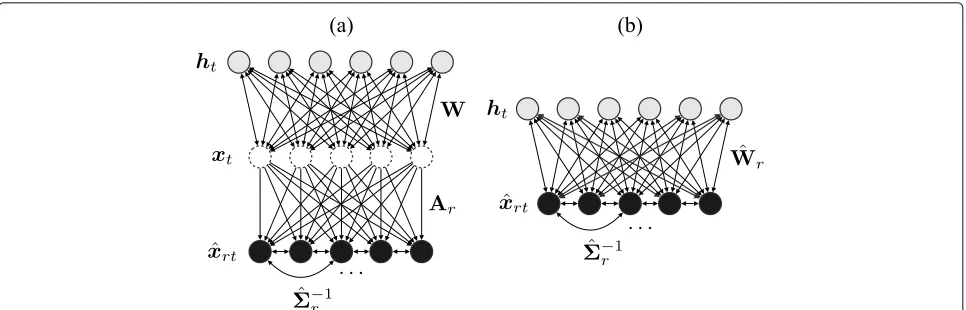
which is nothing more than the definition of a Gaussian-Bernoulli restricted Boltzmann machine (GB-RBM) [26]. In other words, the model defined in Eq. (7) implies that it adapts the neutral speech to that of a speakerrwhen using a GB-RBM with the visible units of acoustic fea-tures of the neutral speaker (or the averaged speaker) and the hidden units of latent phonological features, as shown in Fig. 1a. In another viewpoint, it can be regarded as a sort of semi-RBM [27] since there are shared connec-tionsWˆrbetweenxˆrtandhtand connectionsˆ−r1among
ˆ
xrt but no connections among hˆt (Fig. 1b). The
differ-ence is that the model in Eq. (7) assumes the existdiffer-ence of the neutral speaker and defines additional parameters that enable speaker-adaptive training. In this paper, we call the probabilistic model defined in Eq. (7) speaker-adaptive-trainable Boltzmann machine (SATBM). In our previous work [25], we have proposed another probabilis-tic model named adaptive restricted Boltzmann machine (ARBM), that is an extension of an RBM where only the connection weights between the visible and hidden units are speaker-adaptive. The ARBM is based on a model-space transformation, whereas the SATBM is based on
both a model-space transformation and a feature-space transformation (i.e., constrained model-space transfor-mation), as Eqs. (1) and (2) indicate. Specifically, in the SATBM, the speaker-dependent parameters (means and covariance matrix) of Gaussian visible units are repre-sented as ArWht +Arb+ br of means andArAr of
a covariance matrix. On the other hand, in ARBM, the speaker-dependent parameters of Gaussian visible units are represented as ArWht + b + br of means and
of a covariance matrix. This indicates that the speaker-dependent Gaussian parameters in the SATBM are more strongly influenced by the speaker and changed to adapt to the speaker more than those in the ARBM. In another perspective, the SATBM directly models the correlations between the dimensions in the observed features while the ARBM does not. The observed features take different values every time a specific speaker pronounces the same phoneme, and the extent of the variation depends on the speaker. The SATBM also represents such characteristics of each speaker. For this reason, we expect the SATBM would be superior in acoustic modeling to the ARBM.
2.1 One-hot activation ofht
We can further add constraintsHj=1htt=1 to our model resulting in a one-hot vectorht, which indicates that only
a certain phonological component is activated. In the real speech, only one phoneme, such as /a/ and /e/, should be activated in the background at a certain frame. There-fore, this modification may give better representation for speech. The use of a one-hot representation is inspired by such a phonological reason.
Such constraints give the following conditional proba-bility thathjtis activated (that is,πtj) as
πj t=p
hjt=1|ˆxrt
= ewˆ
j
r ˆr−1xˆrt+ˆcjr
jewˆ
j
r ˆ−r1xˆrt+ˆcj r
=ψwˆjrˆr−1xˆrt+ ˆcjr
, (9)
where wˆjr and cˆjr indicate the jth column vector in Wˆr
and thejth element inˆcr, respectively, andψ(·)denotes a
softmax function (we also defineψ(·)as an element-wise softmax function for convenience). Equation 9 is used when we samplehtinstead of Eq. (5), as discussed in the
following sections.
3 Parameter estimation based on SAT
In this section, we describe the method of the parame-ter estimation in the previously defined model, a SATBM, based on SAT [28]. For convenience, we use symbols
SD = {A
r,br}Rr=1 for SD parameters and SI =
Fig. 1 aProposed model: speaker-adaptive-trainable Boltzmann machine (SATBM) andbits simplified representation, which can be seen as a type of semi-RBM
speech data, X = {Xr}Rr=1, Xr = {ˆxrt}Tt=r1 that is
com-posed ofRspeakers, these parameters are simultaneously estimated so as to maximize the likelihood as
(ˆSD,ˆSI) argmax
(SD,SI)
R
r=1
Tr
t=1
p(xˆrt). (10)
According to the SAT paradigm, the SD parameters
SDundertake the speaker-induced variation, and the SI
parameters SI capture the remaining information, i.e., phonetically relevant variation. Unlike the conventional SAT+MLLR (maximum likelihood linear regression), the SATBM explicitly models the relationships between the speaker-normalized acoustic features and the phonolog-ical information, which implies the possibility that the model represents the speech data better than SAT+MLLR. The parameters are iteratively updated based on gradi-ent descgradi-ent. The partial differgradi-ential of the log-likelihood l= logrtp(xˆrt)=r
tlog
hp(xˆrt,ht))in terms
of a parameterθ ∈ {SD,SI}is derived as follows:
∂l ∂θ =
r
∂E(ˆxrt,ht)
∂θ
data −
∂
E(xˆrt,ht)
∂θ
model
,
where · data and · model denote expectations of the
empirical data and the inner model, respectively. It is generally difficult to compute the expectations of the inner model; however, we can still use contrastive diver-gence (CD) [29] and efficiently approximate them with the expectations of the reconstructed data. We can ana-lytically calculate the partial gradients ∂E(xˆrt,ht)
∂θ for each
parameter as follows:
∂E(xˆrt,ht) ∂Ar = −
1 2
A−r1Crtˆr−1+ ˆ−r1DrtA−r
∂E(xˆrt,ht) ∂br = − ˆ
−1
r (xˆrt− ˆbr− ˆWrht)
∂E(xˆrt,ht)
∂W = −Arˆr−1(xˆrt−br)ht
∂E(xˆrt,ht)
∂σ2 = −12diag
Arˆr−1Ertˆr−1Ar
∂E(xˆrt,ht)
∂b = −Arˆr−1(xˆrt− ˆbr)
∂E(xˆrt,ht)
∂c = −ht, where
Crt= (ˆxrt−br)(ˆxrt− ˆbr−2Wˆrht)
Drt= (ˆxrt− ˆbr)(ˆxrt−br)
Ert = (ˆxrt− ˆbr)(ˆxrt− ˆbr)−2(xˆrt−br)(Wˆ rht).
4 Application to VC
To use the proposed model for the VC, we follow three stages of training, adaptation, and conversion. In the training stage, speaker-independent parameters ˆSI are
obtained as in Eq. (10) usingRreference speakers’ speech (we discard the speaker-dependent parametersˆSD). In
the adaptation stage, new speaker-dependent parameters
SD
i = {Ai,bi}andSDo = {Ao,bo}are estimated using
adaptation data of the source and the target speakers
{ˆxit}Tit=1,{ˆxot}Tot=1while keepingˆSIfixed. That is,
ˆ SD
r argmax
SD r
Tr
t=1
pxˆrt;SDr ,ˆSI
, r∈ {i,o}. (11)
To convert the frame-wise acoustic feature vector of the source speakerxitinto that of the target speakerxot,
we take an ML-based approach. In this approach, xot is
computed so as to maximize the probability given xit,
xot argmax
xot
p(xot|xit)
=argmax xot
htp(ht|xit)p(xot|ht)
argmax
xot
p(hˆt|xit)p(xot|ˆht)
=argmax xot
p(xot|ˆht)
=AoWψ
W−1A−i 1(xit−bi)+c
+Aob+bo,
(12)
where we give hˆt E[p(ht|xit)]. It is worth noting
that the conversion function is based on the non-linear transformation.
5 Experimental evaluation
5.1 System configuration
In our VC experiments, we evaluated the performance of our model, a SATBM, using ASJ Continuous Speech Corpus for Research (ASJ-JIPDEC4). In the training stage where the SI parameters are estimated, we randomly selected and used the speech data of five sentences (approx. 160 k frames) uttered by 56 speakers (26 males and 30 females) from set A in the corpus. For adap-tation and evaluation, a male (identified as “ECL0001”) and female (“ECL1003”) speakers that were not included in the training were used as source and target speakers, respectively, unless otherwise stated. We also evaluated the proposed SATBM using the other speaker pairs, which will be discussed in Section 5.4. The amount of adaptation data was five sentences for each person. As an acous-tic feature vector, we used 32-dimensional mel-cepstral features that were calculated from the 513-dimensional WORLD [30] spectra without dynamic features. In the training of the system, we used up to 64 softmax hidden units, a learning rate of 0.01, a momentum of 0.9, and a batch-size ofR×100(=5600)and set the number of iter-ations as 200. For the evaluation of the proposed method, we used parallel data (of 10 different sentences from the training and adaptation data) of the source and the target speakers, which was created using dynamic programming. But again, note that all speech data used for the training and the adaptation was NOT parallel.
Mel-cepstral distortion (MCD) is generally used for objective evaluation in the VC. However, we used the mel-cepstral distortion improvement ratio (MDIR) instead in this paper because it does not make sense to view the dis-tance between the spectral features in the mel scale of the source and the target speakers when we want to recognize the differences in speaker identities and because the scale of the MCD varies in the evaluation data. For more dis-cussion about the differences between MDIR and MCD, see Section 5.4. The MDIR is defined as follows:
MDIR [ dB]= 10
√
2
ln 10(mo−mi2− mo−mc2)
wheremi,mo, andmcare mel-cepstral features at a frame
of the source speaker’s speech, target speaker’s speech, and converted speech, respectively. The higher the value of MDIR is, the better the performance of the VC is. The MDIR was calculated for each frame from the parallel data of 10 sentences and averaged.
5.1.1 Methods to be compared
It is difficult and unfair to evaluate the proposed method because most of the existing VC approaches use parallel data in training and our method does not. Nevertheless, we can still compare the proposed method with our earlier model, ARBM [25]. In addition, a linear-transform-based approach, which has not been proposed, is interesting to compare with. This approach is simple: the vectorxot is
calculated as
xotAoA−i 1(xit−bi)+bo, (13)
which was derived from the equationxt=A−i1(xit−bi)=
A−o1(xot−bo) starting with Eq. (1). However, it is under
the assumption that thetruefeature space of the neutral speaker was obtained. The parametersArandbrare
esti-mated in SAT using the gradient decent, the same as our proposed method. So, the difference between the linear-transform approach and the proposed model is whether the latent phonological features are modeled or not.
For reference, we also compared our proposed model with a popular GMM-based VC with 8, 16, 32, and 64 mixtures using the parallel data of five sentences.
5.1.2 Optimal number of hidden units
From the pre-experiment, we see the effects of chang-ing the number of softmax hidden units. Figure 2 shows the performance when changing the number of hidden units between 8, 16, 32, and 64. From Fig. 2, the opti-mal number was 16, and the performance degraded as the number of hidden units increased more than 16. This is
2.70 2.80 2.90 3.00 3.10
8 16 32 64
MDIR [dB]
Number of hidden units
since the hidden layer becomes speaker-dependent with a large number of units, and hence, it cannot convert the voice properly. To verify this, we examined how the hidden units were speaker-dependent by analyzing the distribution of the hidden units with the cases ofH =16 (the optimal number of units) and H = 64 (too large a number of units). Figures 3 and 4 show examples of the expected values of the hidden units for the cases of H = 16 andH = 64, respectively, comparing the dis-tributions obtained from the source and target speakers. From Figs. 3 and 4, we observed that more hidden units whenH = 64 were speaker-dependent than those when H = 16. To measure objectively how close the distribu-tions are to each other, we further calculated the Euclidean distances and the cosine similarities between the two dis-tributions obtained from the source and target speakers’ speech, as shown in Table 1. Obviously, Table 1 shows that the two hidden activations of H = 16 are close to each other, more than those of H = 64. A similar discussion can be seen in our previous work using the ARBM [25].
In speech recognition in Japanese, 43 phonemes are often used [31], which consists of seven short vowels, five long vowels, 28 consonants, and three special symbols. These kinds of Japanese phonemes were defined by the Acoustical Society of Japan (ASJ) committee. Comparing these artificial numbers with the optimal number of hid-den units asH=16, we could state that this is reasonable because using the static short-term acoustic features does not represent the consonants and long vowels sufficiently and because the natural speech should contain some allophones.
Considering the above, we will use 16 softmax hid-den units in the following experiments unless otherwise stated.
5.2 Objective comparison
The VC performance of the linear-transform-based approach, the ARBM, and the proposed model (SATBM) is compared using objective criteria, as shown in Fig. 5. Each method was evaluated by varying the number of diagonals of the adaptation matrices used as 1 (that means diagonal matrices), 3 (tridiagonal), 5 (pentadiagonal), 7 (heptadiagonal), and 9 (nonadiagonal). In this experiment, we used 16 softmax hidden units for the SATBM and the ARBM. As shown in Fig. 5, the proposed model per-formed best with any type of the adaptation matrix. The performance of the SATBM and the ARBM was improved when adding the diagonals up to seven. On the other hand, the linear approach barely improved with the number of diagonals. Interestingly, the proposed model achieved a high MDIR even when the diagonal adaptation matrices were used, unlike the ARBM and linear approaches. In the linear approach, the diagonal matrix could not capture the correlations between the dimensions of the mel cep-strum, which makes it impossible to match the vocal tracts among the speakers. Meanwhile, the SATBM could make the source speech resemble the target voice more or less even when a diagonal adaptation matrix was used, due to modeling the latent phonological information. The ARBM models the latent phonological information as well; how-ever, the speaker-dependent Gaussian parameters of the ARBM are not sufficient and failed to represent the speech correctly with the diagonal adaptation matrices.
We also found that the SATBM and the ARBM degraded with nine diagonals and more. This is due to the over-fitting caused by the large number of param-eters. In some literature, such as [32–34], it is known that warping cepstral-based features between different speakers is achieved by linear transformation with an adaptation matrix, and a few diagonal elements (such
0 0.5 1 1.5 2 2.5 3
5 10 15
0 0.5 1 1.5 2 2.5 3
5 10 15
Time [sec.]
(a) From source
(b) From target
# h
# h
0 0.5 1 1.5 2 2.5 3 10
20 30 40 50 60
0 0.5 1 1.5 2 2.5 3
10 20 30 40 50 60
Time [sec.]
(a) From source
(b) From target
# h
# h
Fig. 4The expected values of hidden units obtained fromathe source speaker’s features andbthe target speaker’s features of the same sentence /ureshi: hazuga yuQkuri netemo irarenai/ whenH=64. Thewhiteandblackindicate the high and low values, respectively
as tridiagonal, pentadiagonal, and heptadiagonal) of the adaptation matrix are sufficient for warping the cep-stral features. Therefore, it does not make sense to use adaptation matrices with many diagonal elements (more than seven diagonals) in terms of efficient learning for this speaker pair. For more discussion using the various speaker pairs, see Section 5.4.
The average MDIR of the GMM-based approach was 3.93 with 32 mixtures, which was the best in the GMM-based approach. Unfortunately, it performed better than our approach. However, again, such an approach benefits from using parallel data and should not be compared with the non-parallel approach, just in terms of VC quality.
5.3 Subjective comparison
We also conducted subjective experiments, compar-ing our method with the ARBM and the linear-based approaches. We decoded the converted mel cepstra back to the WORLD spectra using the filter theory [35] and generated signals using the original F0 and aperiodic features of the target speaker since we wanted to com-pare each method in the spectra. In this experiment, seven participants listened to 10 sentences of converted
Table 1Euclidean distance and cosine similarity between the hidden distributions obtained from the source and target
speakers’ speech of Figs. 3 (H=16) and 4 (H=64)
Euclidean dist. Cosine sim.
H=16 0.660 0.526
H=64 0.869 0.337
speech using the linear-based, the ARBM, and the SATBM approaches accompanied with the target speech and voted for the most preferable method for each sentence in terms of the speaker specificity of the target speaker. The num-ber of votes for each method are shown in Fig. 6. The SATBM performed the best of all. It can be said that the SATBM has the ability to produce sounds auditorily closer to the target speech than the other methods.
For reference, we also compared the proposed method with the GMM-based VC in a subjective manner. In this experiment as well, the seven participants were asked to rank the converted speech using a 5-scale (1 poor, 2 fair, 3 good, 4 very good, and 5 excellent) in terms of speech quality (naturalness) and speaker specificity (similarity).
1.50 1.93 2.35 2.78 3.20
1 3 5 7 9
MDIR [dB]
Number of diagonals
SATBM ARBM linear
0 10 20 30 40
SATBM ARBM linear
14 23
33
Number of votes
Fig. 6Subjective performance of non-parallel VC methods
The results are shown in Table 2. From Table 2, the GMM-based VC outperformed the proposed method in both criteria; however, again, the GMM-based VC uses parallel corpora, while the proposed method does not.
5.4 Evaluation using various speaker pairs
We also investigated the performance of the proposed SATBM using various speaker pairs that include four gen-der types: male-to-female (M2F), female-to-male (F2M), male-to-male (M2M), and female-to-female (F2F). For this evaluation, we randomly chose eight pairs from the corpus that were not included in the training, whose iden-tities and the gender types are listed in the first and the second columns of Table 3, respectively. Table 3 com-pares the performance for each speaker pair with different criteria of the MDIR and MCD, using the SATBM with heptadiagonal adaptation matrices. When we compare the VC performance of different speaker pairs using the MCD, we may conclude that the model performed best when converting “ECL0001” to “MIT0001” because this con-version provided the smallest MCD. However, the speech of “ECL0001” and “MIT0001” was already close to each other. To see how effective the model is, we should focus on how much the model improves the original speech. The MDIR measures the extent of how much the model improves, and we can say that the VC model was the most effective when converting “MIT0001” to “ECL1003” according to the MDIR. The MDIR of the cross-gender conversion is higher than that of the within-gender con-version. This is natural because, in general, we can feel the
Table 2Subjective comparison of parallel VC (GMM) and non-parallel VC (SATBM) using the 5-scale tests in terms of speech quality and speaker specificity
Speech quality Speaker specificity
GMM 3.37 3.66
SATBM 2.11 1.91
Table 3MDIR and MCD from various speaker pairs
Source→target Type MDIR [dB] MCD [dB]
ECL0001→ECL1003 M2F 3.12 6.87
MIT0001→ECL1003 M2F 4.03 7.00
ECL1003→CAN0001 F2M 2.77 7.32
NEC1002→MIT0002 F2M 3.48 6.98
ECL0001→MIT0001 M2M 1.48 6.09
ECL0001→MIT0002 M2M 2.02 6.46
CAN1001→ECL1003 F2F 1.28 6.85
NEC1001→ECL1003 F2F 1.55 6.14
extent of how much the source speech was converted from the converted speech of the cross-gender more than from that of the within-gender.
Finally, Fig. 7 shows the VC performance of the pro-posed method for each gender type when changing the types of the adaptation matrix. Each MDIR was aver-aged within the same gender type. As shown in Fig. 7, we achieved better results as the number of diagonals in the adaptation matrices increased and the best when using the heptadiagonal adaptation matrices, except for F2F conversion. The nonadiagonal adaptation matrices per-formed the worse for all gender types. This is because too many parameters are included in the adaptation matrices even though it is not needed for the linear transformation across the speakers and caused overfitting, as discussed in Section 5.2. We also noticed from Fig. 7 that when comparing the cases with F2F and M2M, the diagonal matrix was not so bad for the F2F conversion. This is because the female voice in general varies with the speaker less than the male voice, and only the diagonal elements in the adaptation matrix were enough to represent the differences in the female speakers.
0 1 2 3 4
M2F F2M M2M F2F
MDIR [dB]
diagonal tridiagonal pentadiagonal heptadiagonal nonadiagonal
6 Conclusions
In this paper, we presented a VC method that does not require any parallel data during training and adaptation according to the basic idea of dividing a speech signal into phoneme-relevant and speaker-relevant information and replacing only the speaker-relevant information with the desired one. To model this, we assumed that the neutral speaker’s acoustic features are normally distributed, and its mean is affine-transformed from the latent phonologi-cal features that are Bernoulli-distributed. As a result, we showed that the joint probability of the acoustic features and the phonological features forms a type of Boltzmann machine. We also showed the method of estimating the target speaker’s features given the source speaker’s fea-tures in a probabilistic manner. In our VC experiments, we obtained better performance with our model than the other non-parallel VC approaches in both objective and subjective criteria. However, we still have concerns that the proposed approach fell short of the GMM-based approach that uses parallel data in training. In the future, we will continue to improve the system (hopefully, to the performance level of the GMM-based approach) in the non-parallel VC because non-parallel training has sev-eral merits, e.g., we can freely use most of the existing speech data.
Endnotes
1Note that they still require parallel data among the
reference speakers.
2It means that the method requires neither the parallel
data of a source speaker and target speaker nor the parallel data of the reference speakers.
3In our experiments, we used mel cepstra as the
acous-tic feature vector.
4http://research.nii.ac.jp/src/ASJ-JIPDEC.html
Authors’ contributions
TN designed the speaker-adaptive-trainable Boltzmann machine, performed the experimental evaluation, and drafted the manuscript. YM reviewed the paper and provided some advice. Both authors read and approved the final manuscript.
Competing interests
The authors declare that they have no competing interests.
Publisher’s Note
Springer Nature remains neutral with regard to jurisdictional claims in published maps and institutional affiliations.
Received: 20 October 2016 Accepted: 12 June 2017
References
1. A Kain, MW Macon, inICASSP. Spectral voice conversion for text-to-speech synthesis (IEEE, 1998), pp. 285–288
2. C Veaux, X Robet, inINTERSPEECH. Intonation conversion from neutral to expressive speech (ISCA, 2011), pp. 2765–2768
3. K Nakamura, T Toda, H Saruwatari, K Shikano, Speaking-aid systems using GMM-based voice conversion for electrolaryngeal speech. Speech Commun.54(1), 134–146 (2012)
4. L Deng, A Acero, L Jiang, J Droppo, X Huang, inICASSP. High-performance robust speech recognition using stereo training data (IEEE, 2001), pp. 301–304
5. A Kunikoshi, Y Qiao, N Minematsu, K Hirose, inINTERSPEECH. Speech generation from hand gestures based on space mapping (ISCA, 2009), pp. 308–311
6. R Gray, Vector quantization. IEEE ASSP Mag.1(2), 4–29 (1984) 7. H Valbret, E Moulines, J-P Tubach, Voice transformation using PSOLA
technique. Speech Commun.11(2), 175–187 (1992)
8. Y Stylianou, Cappé, E Moulines, Continuous probabilistic transform for voice conversion. IEEE Trans. Speech Audio Process.6(2), 131–142 (1998) 9. T Toda, AW Black, K Tokuda, Voice conversion based on
maximum-likelihood estimation of spectral parameter trajectory. IEEE Trans. Audio Speech Lang. Process.15(8), 2222–2235 (2007) 10. E Helander, T Virtanen, J Nurminen, M Gabbouj, Voice conversion using
partial least squares regression. IEEE Trans. Audio Speech Lang. Process.
18(5), 912–921 (2010)
11. D Saito, H Doi, N Minematsu, K Hirose, inINTERSPEECH. Application of matrix variate Gaussian mixture model to statistical voice conversion (ISCA, 2014), pp. 2504–2508
12. R Takashima, T Takiguchi, Y Ariki, inSLT. Exemplar-based voice conversion in noisy environment (IEEE, 2012), pp. 313–317
13. R Takashima, R Aihara, T Takiguchi, Y Ariki, inSSW8. Noise-robust voice conversion based on spectral mapping on sparse space (SynSIG, 2013), pp. 71–75
14. S Desai, EV Raghavendra, B Yegnanarayana, AW Black, K Prahallad, in ICASSP. Voice conversion using artificial neural networks (IEEE, 2009), pp. 3893–3896
15. LH Chen, ZH Ling, Y Song, LR Dai, inINTERSPEECH. Joint spectral distribution modeling using restricted Boltzmann machines for voice conversion (ISCA, 2013), pp. 3052–3056
16. Z Wu, ES Chng, H Li, inChinaSIP. Conditional restricted Boltzmann machine for voice conversion (IEEE, 2013)
17. T Nakashika, R Takashima, T Takiguchi, Y Ariki, inINTERSPEECH. Voice conversion in high-order eigen space using deep belief nets (ISCA, 2013), pp. 369–372
18. T Nakashika, T Takiguchi, Y Ariki, Voice conversion using RNN pre-trained by recurrent temporal restricted Boltzmann machines. IEEE/ACM Trans. Audio Speech Lang. Process.23(3), 580–587 (2015)
19. A Mouchtaris, J Van der Spiegel, P Mueller, Nonparallel training for voice conversion based on a parameter adaptation approach. IEEE Trans. Audio Speech Lang. Process.14(3), 952–963 (2006)
20. C-H Lee, C-H Wu, inINTERSPEECH. Map-based adaptation for speech conversion using adaptation data selection and non-parallel training (ISCA, 2006), pp. 2254–2257
21. T Toda, Y Ohtani, K Shikano, inINTERSPEECH. Eigenvoice conversion based on Gaussian mixture model (ISCA, 2006), pp. 2446–2449
22. Y Ohtani, T Toda, H Saruwatari, K Shikano, inNTERSPEECH. Many-to-many eigenvoice conversion with reference voice (ISCA, 2009), pp. 1623–1626 23. D Saito, K Yamamoto, N Minematsu, K Hirose, inINTERSPEECH.
One-to-many voice conversion based on tensor representation of speaker space (ISCA, 2011), pp. 653–656
24. T Masuda, M Shozakai, inICASSP. Cost reduction of training mapping function based on multistep voice conversion (IEEE, 2007), pp. 693–696 25. T Nakashika, T Takiguchi, Y Ariki, inMLSLP 2015. Parallel-data-free,
many-to-many voice conversion using an adaptive restricted Boltzmann machine (ISCA, 2015), pp. 1–4
26. K Cho, A Ilin, T Raiko, inICANN. Improved learning of Gaussian-Bernoulli restricted Boltzmann machines (ENNS, 2011), pp. 10–17
27. R Salakhutdinov, Learning and evaluating Boltzmann machines. Technical report, Technical Report UTML TR 2008-002, Department of Computer Science, University of Toronto (2008)
28. T Anastasakos, J McDonough, R Schwartz, J Makhoul, inICSLP 96. A compact model for speaker-adaptive training, vol. 2 (WASET, 1996), pp. 1137–1140
30. M Morise, inProc. the Stockholm Music Acoustics Conference (SMAC). An attempt to develop a singing synthesizer by collaborative creation (Logos Verlag, Berlin, 2013), pp. 287–292
31. T Kawahara, A Lee, T Kobayashi, K Takeda, N Minematsu, K Itou, A Ito, M Yamamoto, A Yamada, T Utsuro, K Shikano, Japanese dictation toolkit. J. Acoust. Soc. Japan (E).20(3), 233–239 (1999)
32. M Pitz, H Ney, Vocal tract normalization equals linear transformation in cepstral space. IEEE Trans. Speech Audio Process.13(5), 930–944 (2005) 33. E Variani, T Schaaf, inINTERSPEECH. VTLN in the MFCC domain:
band-limited versus local interpolation (ISCA, 2011), pp. 1273–1276 34. T Emori, K Shinoda, Vocal tract length normalization using rapid
maximum-likelihood estimation for speech recognition. Syst. Comput. Japan.33(5), 30–40 (2002)