Adv. Radio Sci., 9, 187–193, 2011 www.adv-radio-sci.net/9/187/2011/ doi:10.5194/ars-9-187-2011
© Author(s) 2011. CC Attribution 3.0 License.
Advances in
Radio Science
Context-based user grouping for multi-casting in heterogeneous
radio networks
C. Mannweiler, A. Klein, J. Schneider, and H. D. Schotten
Chair for Wireless Communications and Navigation, University of Kaiserslautern, Germany
Abstract. Along with the rise of sophisticated smartphones and smart spaces, the availability of both static and dynamic context information has steadily been increasing in recent years. Due to the popularity of social networks, these data are complemented by profile information about individual users. Making use of this information by classifying users in wireless networks enables targeted content and advertise-ment delivery as well as optimizing network resources, in particular bandwidth utilization, by facilitating group-based multi-casting. In this paper, we present the design and imple-mentation of a web service for advanced user classification based on user, network, and environmental context informa-tion. The service employs simple and advanced clustering algorithms for forming classes of users. Available service functionalities include group formation, context-aware adap-tation, and deletion as well as the exposure of group charac-teristics. Moreover, the results of a performance evaluation, where the service has been integrated in a simulator mod-eling user behavior in heterogeneous wireless systems, are presented.
1 Introduction
Group communication is of particular interest in wireless (access) networks, one example being the domain of multi-casting, i.e. simultaneously delivering the same content to multiple recipients. Chalmers and Almeroth (2001), Janic and Van Mieghem (2009), as well as Baumung and Zitterbart (2009), among others, have shown that multi-casting tech-nologies can considerably contribute to more efficiently ex-ploiting available network resources when applied under ap-propriate circumstances. A typical use case for exploiting multi-casting is a large-scale sport event with tens of thou-sands of spectators that can be grouped according to their user profile and context. Based on that classification, dif-ferent groups can receive adapted content. However, a user
Correspondence to: C. Mannweiler
classification service, as required in this use case, can also be exploited for selecting people with particular characteris-tics. Consumers with an affinity to a certain product category could be identified for specific marketing purposes. Both use cases would require a reliable means of data privacy and se-curity as well as the user’s approval.
The remainder of this paper is organized as follows: Sect. 2 presents the algorithms used for our user classification service and Sect. 3 briefly discusses implementation aspects. Section 4 evaluates the algorithms according to a compre-hensive set of criteria. Section 5 concludes the paper with a short summary and outlook.
2 Classification methods
In this section, we will briefly introduce the clustering meth-ods used for a context-aware user classification service. This includes the algorithm of the respective method as well as relevant characteristics such as hard vs. soft mapping or vari-able vs. fixed number of clusters. The notation employed in this paper is defined below:
– C: Set of all clusters,C= {C1,C2,...,Ck}
– N: Set of all cluster centers (nodes),
N= {N1,N2,...,Nk}
– K: Context space,K⊆Rl
– X: Set of observations (user’s context) to classify,
X= {x1,x2,...,xn},xj∈K
– n: Number of observations (users) to classify – k: Number of clusters (nodes)
– l: Dimension of context space
– : Tuple of a clusterCiand an observationxj,
=(Ci,xj)
– µi: Center of clusterCi,µi∈Rl
– wi: Weighing vector of nodeNi (cluster center),
wi∈Rl
– t: Iteration counter
188 C. Mannweiler et al.: Context-based user grouping for multi-casting in heterogeneous radio networks
2.1 Methods with fixed number of cluster centers
Common to the methods presented in this subsection is the requirement to set the number of clusters before the start of the classification algorithm. During runtime, the number of clusters does not change.
2.1.1 K-Means algorithm
K-Means (MacQueen, 1967) is an algorithm that establishes a hard mapping betweenCi and an observationxj, i.e. an observation is unambiguously associated with one cluster. Across multiple iterations, the following error function is minimized:
E= k
X
i=1
X
xj∈Ci
||xj−µi||2 (1)
The iteration steps of the algorithm are:
1. (Random) initialization of k cluster centers (nodes)
– cluster centers are randomly initialized in the l-dimensional context space.
2. Mapping of observations to centers – each observation is mapped to the closest node based on the selected dis-tance metric such as Euclidean disdis-tance.
3. Update of cluster centers – position of nodes is recom-puted based on the observations that are assigned to the node. Go back to step 2.
The algorithm terminates as soon as a specified termina-tion criterion is reached, e.g. the error functermina-tion falls below a threshold. For further details on K-Means, the reader is referred to Steinhaus (1957).
2.1.2 Neural Gas
The Neural Gas algorithms establishes a graph ofk nodes that, independently of each other, move through the context space during the iterations. The core idea is to present avail-able observations to the graph and to accordingly adjust the cluster centers. In brief, the steps of the algorithms are as follows:
1. (Random) initialization of k cluster centers (nodes)
– Cluster centers are randomly initialized in the l-dimensional context space.
2. Presentation of an observation – An observationxc∈X is randomly chosen and presented to the graph. (An observation can be drawn multiple times.)
3. Sorting of nodes – Nodes are sorted according to their Euclidean distance toxc.
4. Adjustment of node positions – The positionwi of the graph’s nodes within the context space is adjusted ac-cording to the following equation:
wi(t+1)=wi(t )+l(t )·hd(i)·(xc−wi(t )) (2) wherel(t )is the learning rate of the current iteration (l(t ) > l(t−1)for allt) andhd(i)the adjustment for an individual node depending on its ranking in step 3. If the termination criterion (e.g. number of iterations) has not been reached yet, the next iteration can begin, starting with step 2. Otherwise, observations are assigned to the closest node.
For further details on the algorithm, the reader is referred to Martinez and Schulten (1991) and Fritzke (1997).
2.1.3 K-Fixed-Means
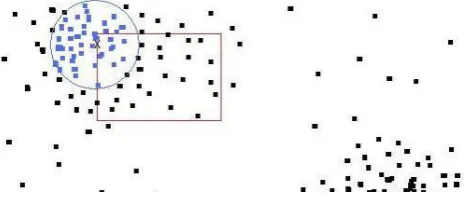
None of the presented algorithms considers fixed cluster cen-ters. However, for some of the use cases described in Sect. 1, this is an important alternative for user classification. There-fore, we have developed the so-called K-Fixed-Means algo-rithm, where the position of a cluster center is fix except for a defined tolerance interval (for each dimension of the con-text space) within which the cluster center can move. More-over, the maximum distance to a center is limited, i.e. some observations may not be assigned to any node at all. Fig-ure 1 depicts the idea of tolerance space (purple rectangle) and maximum distance (blue circle). The basic steps of the algorithm are:
1. Initialization –k cluster centers (nodes) are initialized at the determined (and fix) positions.
2. Mapping of observations to centers – each observation is mapped to the closest node based on the selected dis-tance metric such as Euclidean disdis-tance. Non-assigned observations (i.e. those whose distance is above the de-fined thresholds) are collected in a setU.
3. Adjustment of cluster centers – for each observation in U, it is checked whether there exists a node that, if moved within its tolerance room, can accommodate the given observation. If their exists such a node, it is moved according the following equation:
wi(t+1)=wi(t )+l(t )·d(xc,wi)·(xc−wi(t )) (3) wherel(t )is the learning rate andd(xc,wi)a factor that takes into account the different tolerance intervals. Af-ter all observations inU have been checked, the next iteration starts with step 2, unless the criterion for ter-mination is met.
As for the Neural Gas algorithm, the learning rate decreases in later iterations.
C. Mannweiler et al.: Context-based user grouping for multi-casting in heterogeneous radio networks 189
Mannweiler et al.: Context-based User Grouping for Multi-Casting in Heterogeneous Radio Networks
3
Fig. 1.Concept of K-Fixed-Means Algorithm
2.1.4
Fuzzy-C-Means
In contrast to the algorithms presented so far,
Fuzzy-C-Means can assign an observation to several clusters. The
degree
u
ijof membership of an observation
x
jto a single
cluster
C
ihas to lie within the interval
]0
,
1]
and the sum
of all memberships of an observation must add up to 1, i.e
P
ki=1
u
ij= 1
for any
j
. The algorithm minimizes the
fol-lowing error function:
E
=
k
X
i=1
n
X
j=1
u
mij||
x
j−
µ
i||
2,
1
≤
m
≤ ∞
(4)
The exponent
m
is the so-called ”fuzzifier”. The higher its
value, the fuzzier the mappings of observations to nodes. In
practice, values between 1 and 2.5 have proven to generate
good clustering results (Bezdek, 1981). The basic steps of
the algorithm are:
1.
Initialization
- (Random) initialization of values
u
ij2.
(Re)calculation of cluster centers
- For the current
iter-ation step, the cluster centers are calculated according
to
µ
i=
P
n j=1u
m ij
∗
x
jP
n j=1u
mij(5)
3.
Recalculation of degrees
u
ijof membership
- The
de-gree of membership of an observation
x
jto a cluster
C
iis calculated according to the following equation:
u
ij=
1
P
k l=1||xj−µi|| ||xj−µl||
2 m−1
(6)
4.
Test of termination criterion
- If the termination
crite-rion, e.g. sum of changes of
u
ijfor all combinations
i,j
is below a defined threshold, is not satisfied yet, another
iteration is performed starting with step 2.
The presented algorithm converges to a local minimum
2.2
Methods with Variable Number of Cluster Centers
In contrast to the algorithms presented so far, this class of
al-gorithms is capable of adjusting the number of cluster centers
during runtime. Hence, not only the assignment of
observa-tions to clusters but also the number of clusters is optimized.
Using the algorithms from the previous section, this could
only be achieved by several runs with different amounts of
clusters.
2.2.1
Growing Neural Gas
The Growing Neural Gas algorithm is an extended version
of the Neural Gas algorithm as presented in the previous
sec-tion. By the insertion and aging of edges between cluster
centers (nodes) according to a set of rules, the topology of
the underlying data shall be reflected more precisely. For a
detailed description of the algorithm, the reader is referred to
Fritzke (1995). Here, only a short overview of the algorithm
steps is presented to sketch the basic idea:
1.
Initialization
- Two nodes are randomly put in the
con-text space (without an edge between them).
2.
Selection of observation and calculation of closest
nodes
- From the set of observations, one is picked
(ran-domly) and the closest node (
N
1) as well as the second
closest (
N
2) are determined based on the Euclidean
dis-tance
3.
Insertion of edges
- In case there is no edge between
N
1and
N
2, it is inserted. In any case, the age of the edge is
set to 0.
4.
Calculation of a node’s statistical error value
- For
ev-ery node, the statistical error
E
Niis stored. It represents
the total error of all observations assigned to that node.
For
N
1(as determined in step 2), the value is updated by
adding its Euclidean distance to the current observation
x
c:
E
N1(
t
) =
E
N1(
t
−
1) +
||
w
N1−
x
c||
.
(7)
5.
Adaptation of node positions
- The position of
N
1as
well as its direct topological neighbors is adapted as
fol-lows:
w
i(
t
+ 1) =
w
i(
t
) +
l
∗
(
x
c−
w
i(
t
))
.
(8)
The learning rate
l
, though being constant during all
it-erations, is different for
N
1and its neighbors, i.e. for the
neighbors, it is approximately two orders of magnitude
lower than for
N
1.
6.
Aging of edges
- For all edges originating from
N
1, the
age is incremented by 1. If the age has passed a defined
Fig. 1. Concept of K-Fixed-Means algorithm.2.1.4 Fuzzy-C-Means
In contrast to the algorithms presented so far, Fuzzy-C-Means can assign an observation to several clusters. The degreeuij of membership of an observationxj to a single clusterCi has to lie within the interval ]0,1]and the sum of all memberships of an observation must add up to 1, i.e.
Pk
i=1uij=1 for anyj. The algorithm minimizes the follow-ing error function:
E= k
X
i=1 n
X
j=1
umij||xj−µi||2,1≤m≤ ∞ (4)
The exponentmis the so-called “fuzzifier”. The higher its value, the fuzzier the mappings of observations to nodes. In practice, values between 1 and 2.5 have proven to generate good clustering results (Bezdek, 1981). The basic steps of the algorithm are:
1. Initialization – (random) initialization of valuesuij 2. (Re)calculation of cluster centers – for the current
itera-tion step, the cluster centers are calculated according to
µi=
Pn j=1umijxj
Pn j=1umij
(5)
3. Recalculation of degreesuijof membership – the degree of membership of an observationxj to a clusterCi is calculated according to the following equation:
uij=
1
Pk l=1
||xj−µi||
||xj−µl||
2
m−1
(6)
4. Test of termination criterion – if the termination crite-rion, e.g. sum of changes ofuijfor all combinationsi,j is below a defined threshold, is not satisfied yet, another iteration is performed starting with step 2.
The presented algorithm converges to a local minimum which is not necessarily the optimal solution. Moreover, the results depend on the initialization ofuij.
2.2 Methods with variable number of cluster centers
In contrast to the algorithms presented so far, this class of al-gorithms is capable of adjusting the number of cluster centers during runtime. Hence, not only the assignment of observa-tions to clusters but also the number of clusters is optimized. Using the algorithms from the previous section, this could only be achieved by several runs with different amounts of clusters.
2.2.1 Growing Neural Gas
The Growing Neural Gas algorithm is an extended version of the Neural Gas algorithm as presented in the previous sec-tion. By the insertion and aging of edges between cluster centers (nodes) according to a set of rules, the topology of the underlying data shall be reflected more precisely. For a detailed description of the algorithm, the reader is referred to Fritzke (1995). Here, only a short overview of the algorithm steps is presented to sketch the basic idea:
1. Initialization – two nodes are randomly put in the con-text space (without an edge between them).
2. Selection of observation and calculation of closest
nodes – from the set of observations, one is picked
(ran-domly) and the closest node (N1) as well as the second closest (N2) are determined based on the Euclidean dis-tance
3. Insertion of edges – in case there is no edge betweenN1 andN2, it is inserted. In any case, the age of the edge is set to 0.
4. Calculation of a node’s statistical error value – for ev-ery node, the statistical errorENiis stored. It represents
the total error of all observations assigned to that node. ForN1(as determined in step 2), the value is updated by adding its Euclidean distance to the current observation
xc:
EN1(t )=EN1(t−1)+ ||wN1−xc||. (7)
5. Adaptation of node positions – the position of N1 as well as its direct topological neighbors is adapted as fol-lows:
wi(t+1)=wi(t )+l·(xc−wi(t )). (8) The learning ratel, though being constant during all it-erations, is different forN1and its neighbors, i.e. for the neighbors, it is approximately two orders of magnitude lower than forN1.
6. Aging of edges – for all edges originating fromN1, the age is incremented by 1. If the age has passed a defined threshold, the edge is removed. If this results in a node without any edges, it is removed as well.
190 C. Mannweiler et al.: Context-based user grouping for multi-casting in heterogeneous radio networks
4
Mannweiler et al.: Context-based User Grouping for Multi-Casting in Heterogeneous Radio Networks
7.
Insertion of a new node
- After a defined number of
iterations has passed, the node
N
Emaxwith the
high-est accumulated error
E
maxis determined. Among its
direct topological neighbors, the one with the highest
accumulated error
E
nmaxis chosen and a new node is
placed midway the selected nodes. The edge between
N
Emaxand
N
En,maxis removed and edges between the
new node and
N
Emaxand
N
En,max, respectively, are
inserted. The accumulated error of the old nodes is
de-creased by a factor
α
. The accumulated error of the new
node is set to arithmetic mean of these two (updated)
values.
8.
Reduction of accumulated error
- For all nodes, the
ac-cumulated error is decreased by a factor
β << α
.
9.
Test of termination criterion
- If the termination
crite-rion (e.g. current number of nodes) is not fulfilled, the
next iteration starts at step 2.
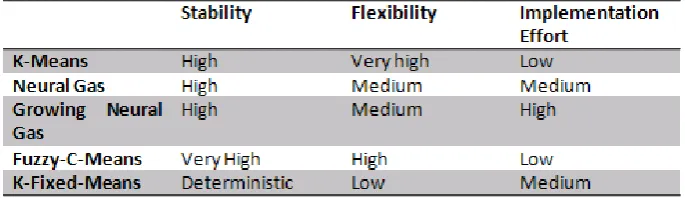
A summarizing overview of the employed algorithms and
their characteristics is given in Fig.2.
Fig. 2.
Overview of Algorithm Characteristics
3
Implementation
Implementation of the user classification service has been
guided by several objectives, most importantly:
–
high availability of the service
–
high scalability
–
simple extensibility
–
usage of widely adopted protocols and data
representa-tion formats
–
adequate latency behavior
Taking these aspects into account, we designed a service
creation and delivery environment utilizing the JavaEE
plat-form in conjunction with the JBOSS Application Server
(ver-sion 5.1.0.GA). Service functionality can be reached via http
requests and, optionally, additional transmission of XML
data. The service hence implements a so-called RESTful
(Tyagi, 2006) interface and can be made available to
basi-cally any hardware/software platform and (almost)
indepen-dently of the kind of access network. Available
functional-ity currently includes group formation, context-aware group
adaptation, and deletion as well as the provisioning of
char-acteristics of active groups.
4
Results and Performance Evaluation
For evaluating the performance of the presented algorithms,
the following set of criteria has been defined:
–
Quality of clustering results - Quality is given by the
total classification error of a given result.
–
Temporal performance - This criteria measures the total
time necessary for a classification.
–
Stability - Evaluates similarity of outcomes for multiple
runs with identical data set.
–
Flexibility - Are algorithms capable of handling other
than metric data?
–
Implementation - Evaluates the amount of effort
neces-sary for algorithm implementation
4.1
Quality and Temporal Performance of Clustering
Methods
For a comprehensive evaluation within the given
multi-casting scenario, every algorithm has been executed 100
times for any given input parameter combination. Input
pa-rameters included number of entities (840 and 8400), number
of groups to be formed (4, 6, 9, 13, 19, 28), and dimension
of context space (2 and 5). We analyzed total execution time
of an algorithm, its variance as well as total accumulated
er-ror. In summary, most important observations and results are
(a more detailed performance analysis of the individual
algo-rithms can be found in Appendix A):
4.1.1
K-Means
K-Means is among the best performing algorithms.
How-ever, computation times significantly increase with higher
number of users and groups. In terms of the absolute
clas-sification error, it achieves the best result of all analyzed
al-gorithms with an average of 133.52 across 100 runs of the
standard scenario.
4.1.2
Neural Gas
Similar to K-Means, Neural Gas is a relatively fast algorithm.
Moreover, runtime decreases significantly for larger amount
of groups because assignment of observations, in contrast to
K-Means, is done only once and not in every iteration.
More-over, with higher numbers of nodes, their final position is
reached much faster. The average classification error was
133.54.
4.1.3
Growing Neural Gas
In terms of both temporal behavior and dependency on entity
as well as group count, the algorithm behaves very similar
to Neural Gas. Moreover, its average classification error was
only slightly higher, averaging at 137.74.
Fig. 2. Overview of algorithm characteristics.
7. Insertion of a new node – after a defined number of it-erations has passed, the nodeNEmax with the highest
ac-cumulated errorEmaxis determined. Among its direct topological neighbors, the one with the highest accu-mulated errorEnmax is chosen and a new node is placed
midway the selected nodes. The edge betweenNEmax
andNEn,maxis removed and edges between the new node
andNEmax andNEn,max, respectively, are inserted. The
accumulated error of the old nodes is decreased by a factorα. The accumulated error of the new node is set to arithmetic mean of these two (updated) values. 8. Reduction of accumulated error – for all nodes, the
ac-cumulated error is decreased by a factorβα. 9. Test of termination criterion – if the termination
crite-rion (e.g. current number of nodes) is not fulfilled, the next iteration starts at step 2.
A summarizing overview of the employed algorithms and their characteristics is given in Fig. 2.
3 Implementation
Implementation of the user classification service has been guided by several objectives, most importantly:
– high availability of the service
– high scalability
– simple extensibility
– usage of widely adopted protocols and data representa-tion formats
– adequate latency behavior
Taking these aspects into account, we designed a service creation and delivery environment utilizing the JavaEE plat-form in conjunction with the JBOSS Application Server (ver-sion 5.1.0.GA). Service functionality can be reached via http requests and, optionally, additional transmission of XML data. The service hence implements a so-called RESTful
(Tyagi, 2006) interface and can be made available to basi-cally any hardware/software platform and (almost) indepen-dently of the kind of access network. Available functional-ity currently includes group formation, context-aware group adaptation, and deletion as well as the provisioning of char-acteristics of active groups.
4 Results and performance evaluation
For evaluating the performance of the presented algorithms, the following set of criteria has been defined:
– Quality of clustering results – quality is given by the total classification error of a given result.
– Temporal performance – this criteria measures the total time necessary for a classification.
– Stability – evaluates similarity of outcomes for multiple runs with identical data set.
– Flexibility – are algorithms capable of handling other than metric data?
– Implementation – evaluates the amount of effort neces-sary for algorithm implementation
4.1 Quality and temporal performance of clustering methods
For a comprehensive evaluation within the given multi-casting scenario, every algorithm has been executed 100 times for any given input parameter combination. Input pa-rameters included number of entities (840 and 8400), number of groups to be formed (4, 6, 9, 13, 19, 28), and dimension of context space (2 and 5). We analyzed total execution time of an algorithm, its variance as well as total accumulated er-ror. In summary, most important observations and results are (a more detailed performance analysis of the individual algo-rithms can be found in Appendix A):
4.1.1 K-Means
K-Means is among the best performing algorithms. How-ever, computation times significantly increase with higher
C. Mannweiler et al.: Context-based user grouping for multi-casting in heterogeneous radio networks 191
Mannweiler et al.: Context-based User Grouping for Multi-Casting in Heterogeneous Radio Networks
5
4.1.4
Fuzzy-C-Means
With regard to performance, the algorithm performs worse
with increasing numbers of observations, variables per
obser-vation and number of groups. Due to its high computational
effort, the algorithm cannot handle more than ten groups in
a timely manner. For the calculation of the average
classifi-cation error (134.69), observations have been assigned to the
node they have had the highest affiliation to.
4.1.5
K-Fixed-Means
Overall, algorithm runtime is on a satisfying level and
com-parable to that of K-Means. For five variables (i.e. a
five-dimensional context space), the algorithm arrives in a stable
state earlier since (with the given set of test observations) the
cluster centers reach their final position faster. A comparison
of the accumulated classification error does not make sense
since some observations were not classified at all.
4.2
Overall Evaluation
A brief summary of the remaining evaluation criteria is
de-picted in Fig. 3.
Fig. 3.
Summary Evaluation of Classification Algorithms
Overall, the K-Means algorithm disposes of the most
ap-propriate characteristics in the given multi-casting use case.
Not only good results in terms of quality and performance
but also its capability to handle nominal data makes it the
de-fault choice for classification requests. Neural Gas is the
pre-ferred algorithm for large entity and group counts; however,
it should not be used for clustering observations with
nom-inal data. In case that the number of groups is not known
yet, Growing Neural Gas, despite its difficult
parametriza-tion, is the best choice. Fuzzy-C-Means is especially
recom-mended if the number of groups remains small and the
struc-ture of the observation set is rather complex. Finally, the
K-Fixed-Means algorithm should be chosen if cluster
cen-ters, i.e. group characteristics, are pre-determined and should
only be marginally changed during execution.
5
Conclusions
This paper has presented an evaluation of different user
classification algorithms for enabling group communication
and multi-casting in wireless networks. Classification tests
have been performed based on simulated context information
about users (such as location, music taste, and age) with
dif-ferent numbers of both users and expected groups. K-Means
and (Growing) Neural Gas as well as the newly developed
K-Fixed-Means have consistently recognized the basic
struc-ture within the set of users and produced fast and stable
clas-sification results with low total errors.
A major aspect of future work is the development of
clas-sification methods that can handle nominal (and ordinal) data
since most of the interesting user data enabling multi-casting
(such as a user’s profile) fall into these categories. Moreover,
the implemented service will be verified in a testbed
envi-ronment where efficiency gains based on the realization of
multi-casting will be analyzed quantitatively.
Appendix A
Algorithms Performance Results
Fig. A1.
Performance of K-Fixed-Means Algorithm
Fig. A2.
Performance of K-Means Algorithm
Fig. 3. Summary evaluation of classification algorithms.
number of users and groups. In terms of the absolute clas-sification error, it achieves the best result of all analyzed al-gorithms with an average of 133.52 across 100 runs of the standard scenario.
4.1.2 Neural Gas
Similar to K-Means, Neural Gas is a relatively fast algorithm. Moreover, runtime decreases significantly for larger amount of groups because assignment of observations, in contrast to K-Means, is done only once and not in every iteration. Moreover, with higher numbers of nodes, their final posi-tion is reached much faster. The average classificaposi-tion error was 133.54.
4.1.3 Growing Neural Gas
In terms of both temporal behavior and dependency on entity as well as group count, the algorithm behaves very similar to Neural Gas. Moreover, its average classification error was only slightly higher, averaging at 137.74.
4.1.4 Fuzzy-C-Means
With regard to performance, the algorithm performs worse with increasing numbers of observations, variables per obser-vation and number of groups. Due to its high computational effort, the algorithm cannot handle more than ten groups in a timely manner. For the calculation of the average classifi-cation error (134.69), observations have been assigned to the node they have had the highest affiliation to.
4.1.5 K-Fixed-Means
Overall, algorithm runtime is on a satisfying level and com-parable to that of K-Means. For five variables (i.e. a five-dimensional context space), the algorithm arrives in a stable state earlier since (with the given set of test observations) the cluster centers reach their final position faster. A comparison of the accumulated classification error does not make sense since some observations were not classified at all.
4.2 Overall evaluation
A brief summary of the remaining evaluation criteria is de-picted in Fig. 3.
Overall, the K-Means algorithm disposes of the most ap-propriate characteristics in the given multi-casting use case. Not only good results in terms of quality and performance but also its capability to handle nominal data makes it the de-fault choice for classification requests. Neural Gas is the pre-ferred algorithm for large entity and group counts; however, it should not be used for clustering observations with nom-inal data. In case that the number of groups is not known yet, Growing Neural Gas, despite its difficult parametriza-tion, is the best choice. Fuzzy-C-Means is especially recom-mended if the number of groups remains small and the struc-ture of the observation set is rather complex. Finally, the K-Fixed-Means algorithm should be chosen if cluster cen-ters, i.e. group characteristics, are pre-determined and should only be marginally changed during execution.
5 Conclusions
This paper has presented an evaluation of different user classification algorithms for enabling group communication and multi-casting in wireless networks. Classification tests have been performed based on simulated context information about users (such as location, music taste, and age) with dif-ferent numbers of both users and expected groups. K-Means and (Growing) Neural Gas as well as the newly developed K-Fixed-Means have consistently recognized the basic struc-ture within the set of users and produced fast and stable clas-sification results with low total errors.
A major aspect of future work is the development of clas-sification methods that can handle nominal (and ordinal) data since most of the interesting user data enabling multi-casting (such as a user’s profile) fall into these categories. Moreover, the implemented service will be verified in a testbed envi-ronment where efficiency gains based on the realization of multi-casting will be analyzed quantitatively.
192 C. Mannweiler et al.: Context-based user grouping for multi-casting in heterogeneous radio networks
Appendix A
Algorithms performance results
Mannweiler et al.: Context-based User Grouping for Multi-Casting in Heterogeneous Radio Networks
5
4.1.4
Fuzzy-C-Means
With regard to performance, the algorithm performs worse
with increasing numbers of observations, variables per
obser-vation and number of groups. Due to its high computational
effort, the algorithm cannot handle more than ten groups in
a timely manner. For the calculation of the average
classifi-cation error (134.69), observations have been assigned to the
node they have had the highest affiliation to.
4.1.5
K-Fixed-Means
Overall, algorithm runtime is on a satisfying level and
com-parable to that of K-Means. For five variables (i.e. a
five-dimensional context space), the algorithm arrives in a stable
state earlier since (with the given set of test observations) the
cluster centers reach their final position faster. A comparison
of the accumulated classification error does not make sense
since some observations were not classified at all.
4.2
Overall Evaluation
A brief summary of the remaining evaluation criteria is
de-picted in Fig. 3.
Fig. 3.
Summary Evaluation of Classification Algorithms
Overall, the K-Means algorithm disposes of the most
ap-propriate characteristics in the given multi-casting use case.
Not only good results in terms of quality and performance
but also its capability to handle nominal data makes it the
de-fault choice for classification requests. Neural Gas is the
pre-ferred algorithm for large entity and group counts; however,
it should not be used for clustering observations with
nom-inal data. In case that the number of groups is not known
yet, Growing Neural Gas, despite its difficult
parametriza-tion, is the best choice. Fuzzy-C-Means is especially
recom-mended if the number of groups remains small and the
struc-ture of the observation set is rather complex. Finally, the
K-Fixed-Means algorithm should be chosen if cluster
cen-ters, i.e. group characteristics, are pre-determined and should
only be marginally changed during execution.
5
Conclusions
This paper has presented an evaluation of different user
classification algorithms for enabling group communication
and multi-casting in wireless networks. Classification tests
have been performed based on simulated context information
about users (such as location, music taste, and age) with
dif-ferent numbers of both users and expected groups. K-Means
and (Growing) Neural Gas as well as the newly developed
K-Fixed-Means have consistently recognized the basic
struc-ture within the set of users and produced fast and stable
clas-sification results with low total errors.
A major aspect of future work is the development of
clas-sification methods that can handle nominal (and ordinal) data
since most of the interesting user data enabling multi-casting
(such as a user’s profile) fall into these categories. Moreover,
the implemented service will be verified in a testbed
envi-ronment where efficiency gains based on the realization of
multi-casting will be analyzed quantitatively.
Appendix A
Algorithms Performance Results
Fig. A1.
Performance of K-Fixed-Means Algorithm
Fig. A2.
Performance of K-Means Algorithm
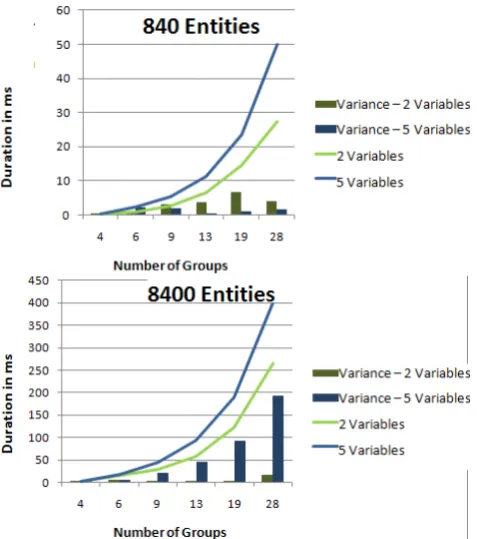
Fig. A1. Performance of K-Fixed-Means algorithm.
Mannweiler et al.: Context-based User Grouping for Multi-Casting in Heterogeneous Radio Networks
5
4.1.4
Fuzzy-C-Means
With regard to performance, the algorithm performs worse
with increasing numbers of observations, variables per
obser-vation and number of groups. Due to its high computational
effort, the algorithm cannot handle more than ten groups in
a timely manner. For the calculation of the average
classifi-cation error (134.69), observations have been assigned to the
node they have had the highest affiliation to.
4.1.5
K-Fixed-Means
Overall, algorithm runtime is on a satisfying level and
com-parable to that of K-Means. For five variables (i.e. a
five-dimensional context space), the algorithm arrives in a stable
state earlier since (with the given set of test observations) the
cluster centers reach their final position faster. A comparison
of the accumulated classification error does not make sense
since some observations were not classified at all.
4.2
Overall Evaluation
A brief summary of the remaining evaluation criteria is
de-picted in Fig. 3.
Fig. 3.
Summary Evaluation of Classification Algorithms
Overall, the K-Means algorithm disposes of the most
ap-propriate characteristics in the given multi-casting use case.
Not only good results in terms of quality and performance
but also its capability to handle nominal data makes it the
de-fault choice for classification requests. Neural Gas is the
pre-ferred algorithm for large entity and group counts; however,
it should not be used for clustering observations with
nom-inal data. In case that the number of groups is not known
yet, Growing Neural Gas, despite its difficult
parametriza-tion, is the best choice. Fuzzy-C-Means is especially
recom-mended if the number of groups remains small and the
struc-ture of the observation set is rather complex. Finally, the
K-Fixed-Means algorithm should be chosen if cluster
cen-ters, i.e. group characteristics, are pre-determined and should
only be marginally changed during execution.
5
Conclusions
This paper has presented an evaluation of different user
classification algorithms for enabling group communication
and multi-casting in wireless networks. Classification tests
have been performed based on simulated context information
about users (such as location, music taste, and age) with
dif-ferent numbers of both users and expected groups. K-Means
and (Growing) Neural Gas as well as the newly developed
K-Fixed-Means have consistently recognized the basic
struc-ture within the set of users and produced fast and stable
clas-sification results with low total errors.
A major aspect of future work is the development of
clas-sification methods that can handle nominal (and ordinal) data
since most of the interesting user data enabling multi-casting
(such as a user’s profile) fall into these categories. Moreover,
the implemented service will be verified in a testbed
envi-ronment where efficiency gains based on the realization of
multi-casting will be analyzed quantitatively.
Appendix A
Algorithms Performance Results
Fig. A1.
Performance of K-Fixed-Means Algorithm
Fig. A2.
Performance of K-Means Algorithm
Mannweiler et al.: Context-based User Grouping for Multi-Casting in Heterogeneous Radio Networks
5
4.1.4
Fuzzy-C-Means
With regard to performance, the algorithm performs worse
with increasing numbers of observations, variables per
obser-vation and number of groups. Due to its high computational
effort, the algorithm cannot handle more than ten groups in
a timely manner. For the calculation of the average
classifi-cation error (134.69), observations have been assigned to the
node they have had the highest affiliation to.
4.1.5
K-Fixed-Means
Overall, algorithm runtime is on a satisfying level and
com-parable to that of K-Means. For five variables (i.e. a
five-dimensional context space), the algorithm arrives in a stable
state earlier since (with the given set of test observations) the
cluster centers reach their final position faster. A comparison
of the accumulated classification error does not make sense
since some observations were not classified at all.
4.2
Overall Evaluation
A brief summary of the remaining evaluation criteria is
de-picted in Fig. 3.
Fig. 3.
Summary Evaluation of Classification Algorithms
Overall, the K-Means algorithm disposes of the most
ap-propriate characteristics in the given multi-casting use case.
Not only good results in terms of quality and performance
but also its capability to handle nominal data makes it the
de-fault choice for classification requests. Neural Gas is the
pre-ferred algorithm for large entity and group counts; however,
it should not be used for clustering observations with
nom-inal data. In case that the number of groups is not known
yet, Growing Neural Gas, despite its difficult
parametriza-tion, is the best choice. Fuzzy-C-Means is especially
recom-mended if the number of groups remains small and the
struc-ture of the observation set is rather complex. Finally, the
K-Fixed-Means algorithm should be chosen if cluster
cen-ters, i.e. group characteristics, are pre-determined and should
only be marginally changed during execution.
5
Conclusions
This paper has presented an evaluation of different user
classification algorithms for enabling group communication
and multi-casting in wireless networks. Classification tests
have been performed based on simulated context information
about users (such as location, music taste, and age) with
dif-ferent numbers of both users and expected groups. K-Means
and (Growing) Neural Gas as well as the newly developed
K-Fixed-Means have consistently recognized the basic
struc-ture within the set of users and produced fast and stable
clas-sification results with low total errors.
A major aspect of future work is the development of
clas-sification methods that can handle nominal (and ordinal) data
since most of the interesting user data enabling multi-casting
(such as a user’s profile) fall into these categories. Moreover,
the implemented service will be verified in a testbed
envi-ronment where efficiency gains based on the realization of
multi-casting will be analyzed quantitatively.
Appendix A
Algorithms Performance Results
Fig. A1.
Performance of K-Fixed-Means Algorithm
Fig. A2.
Performance of K-Means Algorithm
Fig. A2. Performance of K-Means algorithm.
6
Mannweiler et al.: Context-based User Grouping for Multi-Casting in Heterogeneous Radio Networks
Fig. A3.
Performance of Neural Gas Algorithm
Fig. A4.
Performance of Growing Neural Gas Algorithm
Acknowledgements.
Parts of this work were funded by the Federal
Ministry of Education and Research of the Federal Republic of
Ger-many (Foerderkennzeichen 01 BK 0808, GLab). The authors alone
are responsible for the content of the paper.
Fig. A5.
Performance of Fuzzy-C-Means Algorithm
References
Baumung, P., Zitterbart, M.: MAMAS - Mobility-aware Multicast
for Ad-hoc Groups in Self-organizing Networks. In: Zitterbart,
M., Baumung, P. (Ed.): Basissoftware fr drahtlose Ad-hoc- und
Sensornetze, pp. 33-48, Universitaetsverlag Karlsruhe, March
2009.
Bezdek, J.C.: Pattern Recognition with Fuzzy Objective Function
Algorithms. Plenum Press, New York, 1981.
Chalmers, R., Almeroth, K.:Modeling the Branching
Characteris-tics and Efficiency Gains of Global Multicast Trees. Proceedings
of IEEE Infocom, Anchorage (AK) 2001.
Fritzke, B.: A growing neural gas network learns topologies. In:
Tesauro, G. et al.: Advances in Neural Information Processing
Systems 7, MIT Press, Cambridge (MA), pp. 625-632, 1995.
Fritzke, B.: Some Competitive Learning Methods. Java Paper, 1997
[www.neuroinformatik.ruhr-uni-bochum.de/VDM/research/
gsn/JavaPaper/, accessed November 11, 2010].
Janic, M., Van Mieghem, P.: The Gain and Cost of Multicast
Rout-ing Trees. International Conference on Systems, Man and
Cyber-netics (IEEE SMC 2004), The Hague, 2004.
MacQueen, J.: Some methods for Classification and Analysis of
Multivariate Observations: Proceedings of the Fifth Berkeley
Symposium on Mathematical Statistics and Probability, pp.
281-297, 1967.
Martinez, T.M., Schulten, K.J.: A neural gas network learns
topolo-gies. In: Kohonen, T. et al.: Artificial Neural Networks, pp.
397-402, 1991.
Steinhaus, H.: Sur la division des corps matriels en parties. Bull.
Acad. Polon. Sci. 4 (12), pp. 801-804, 1956.
Tyagi,
S.:
RESTful
Web
Services.
Or-acle
Technology
Network,
2006
[java.sun.com/developer/technicalArticles/WebServices/restful/,
accessed November 28, 2010].
6
Mannweiler et al.: Context-based User Grouping for Multi-Casting in Heterogeneous Radio Networks
Fig. A3.
Performance of Neural Gas Algorithm
Fig. A4.
Performance of Growing Neural Gas Algorithm
Acknowledgements.
Parts of this work were funded by the Federal
Ministry of Education and Research of the Federal Republic of
Ger-many (Foerderkennzeichen 01 BK 0808, GLab). The authors alone
are responsible for the content of the paper.
Fig. A5.
Performance of Fuzzy-C-Means Algorithm
References
Baumung, P., Zitterbart, M.: MAMAS - Mobility-aware Multicast
for Ad-hoc Groups in Self-organizing Networks. In: Zitterbart,
M., Baumung, P. (Ed.): Basissoftware fr drahtlose Ad-hoc- und
Sensornetze, pp. 33-48, Universitaetsverlag Karlsruhe, March
2009.
Bezdek, J.C.: Pattern Recognition with Fuzzy Objective Function
Algorithms. Plenum Press, New York, 1981.
Chalmers, R., Almeroth, K.:Modeling the Branching
Characteris-tics and Efficiency Gains of Global Multicast Trees. Proceedings
of IEEE Infocom, Anchorage (AK) 2001.
Fritzke, B.: A growing neural gas network learns topologies. In:
Tesauro, G. et al.: Advances in Neural Information Processing
Systems 7, MIT Press, Cambridge (MA), pp. 625-632, 1995.
Fritzke, B.: Some Competitive Learning Methods. Java Paper, 1997
[www.neuroinformatik.ruhr-uni-bochum.de/VDM/research/
gsn/JavaPaper/, accessed November 11, 2010].
Janic, M., Van Mieghem, P.: The Gain and Cost of Multicast
Rout-ing Trees. International Conference on Systems, Man and
Cyber-netics (IEEE SMC 2004), The Hague, 2004.
MacQueen, J.: Some methods for Classification and Analysis of
Multivariate Observations: Proceedings of the Fifth Berkeley
Symposium on Mathematical Statistics and Probability, pp.
281-297, 1967.
Martinez, T.M., Schulten, K.J.: A neural gas network learns
topolo-gies. In: Kohonen, T. et al.: Artificial Neural Networks, pp.
397-402, 1991.
Steinhaus, H.: Sur la division des corps matriels en parties. Bull.
Acad. Polon. Sci. 4 (12), pp. 801-804, 1956.
Tyagi,
S.:
RESTful
Web
Services.
Or-acle
Technology
Network,
2006
[java.sun.com/developer/technicalArticles/WebServices/restful/,
accessed November 28, 2010].
Fig. A3. Performance of Neural Gas algorithm.
6
Mannweiler et al.: Context-based User Grouping for Multi-Casting in Heterogeneous Radio Networks
Fig. A3.
Performance of Neural Gas Algorithm
Fig. A4.
Performance of Growing Neural Gas Algorithm
Acknowledgements.
Parts of this work were funded by the Federal
Ministry of Education and Research of the Federal Republic of
Ger-many (Foerderkennzeichen 01 BK 0808, GLab). The authors alone
are responsible for the content of the paper.
Fig. A5.
Performance of Fuzzy-C-Means Algorithm
References
Baumung, P., Zitterbart, M.: MAMAS - Mobility-aware Multicast
for Ad-hoc Groups in Self-organizing Networks. In: Zitterbart,
M., Baumung, P. (Ed.): Basissoftware fr drahtlose Ad-hoc- und
Sensornetze, pp. 33-48, Universitaetsverlag Karlsruhe, March
2009.
Bezdek, J.C.: Pattern Recognition with Fuzzy Objective Function
Algorithms. Plenum Press, New York, 1981.
Chalmers, R., Almeroth, K.:Modeling the Branching
Characteris-tics and Efficiency Gains of Global Multicast Trees. Proceedings
of IEEE Infocom, Anchorage (AK) 2001.
Fritzke, B.: A growing neural gas network learns topologies. In:
Tesauro, G. et al.: Advances in Neural Information Processing
Systems 7, MIT Press, Cambridge (MA), pp. 625-632, 1995.
Fritzke, B.: Some Competitive Learning Methods. Java Paper, 1997
[www.neuroinformatik.ruhr-uni-bochum.de/VDM/research/
gsn/JavaPaper/, accessed November 11, 2010].
Janic, M., Van Mieghem, P.: The Gain and Cost of Multicast
Rout-ing Trees. International Conference on Systems, Man and
Cyber-netics (IEEE SMC 2004), The Hague, 2004.
MacQueen, J.: Some methods for Classification and Analysis of
Multivariate Observations: Proceedings of the Fifth Berkeley
Symposium on Mathematical Statistics and Probability, pp.
281-297, 1967.
Martinez, T.M., Schulten, K.J.: A neural gas network learns
topolo-gies. In: Kohonen, T. et al.: Artificial Neural Networks, pp.
397-402, 1991.
Steinhaus, H.: Sur la division des corps matriels en parties. Bull.
Acad. Polon. Sci. 4 (12), pp. 801-804, 1956.
Tyagi,
S.:
RESTful
Web
Services.
Or-acle
Technology
Network,
2006
[java.sun.com/developer/technicalArticles/WebServices/restful/,
accessed November 28, 2010].
6
Mannweiler et al.: Context-based User Grouping for Multi-Casting in Heterogeneous Radio Networks
Fig. A3.
Performance of Neural Gas Algorithm
Fig. A4.
Performance of Growing Neural Gas Algorithm
Acknowledgements.
Parts of this work were funded by the Federal
Ministry of Education and Research of the Federal Republic of
Ger-many (Foerderkennzeichen 01 BK 0808, GLab). The authors alone
are responsible for the content of the paper.
Fig. A5.
Performance of Fuzzy-C-Means Algorithm
References
Baumung, P., Zitterbart, M.: MAMAS - Mobility-aware Multicast
for Ad-hoc Groups in Self-organizing Networks. In: Zitterbart,
M., Baumung, P. (Ed.): Basissoftware fr drahtlose Ad-hoc- und
Sensornetze, pp. 33-48, Universitaetsverlag Karlsruhe, March
2009.
Bezdek, J.C.: Pattern Recognition with Fuzzy Objective Function
Algorithms. Plenum Press, New York, 1981.
Chalmers, R., Almeroth, K.:Modeling the Branching
Characteris-tics and Efficiency Gains of Global Multicast Trees. Proceedings
of IEEE Infocom, Anchorage (AK) 2001.
Fritzke, B.: A growing neural gas network learns topologies. In:
Tesauro, G. et al.: Advances in Neural Information Processing
Systems 7, MIT Press, Cambridge (MA), pp. 625-632, 1995.
Fritzke, B.: Some Competitive Learning Methods. Java Paper, 1997
[www.neuroinformatik.ruhr-uni-bochum.de/VDM/research/
gsn/JavaPaper/, accessed November 11, 2010].
Janic, M., Van Mieghem, P.: The Gain and Cost of Multicast
Rout-ing Trees. International Conference on Systems, Man and
Cyber-netics (IEEE SMC 2004), The Hague, 2004.
MacQueen, J.: Some methods for Classification and Analysis of
Multivariate Observations: Proceedings of the Fifth Berkeley
Symposium on Mathematical Statistics and Probability, pp.
281-297, 1967.
Martinez, T.M., Schulten, K.J.: A neural gas network learns
topolo-gies. In: Kohonen, T. et al.: Artificial Neural Networks, pp.
397-402, 1991.
Steinhaus, H.: Sur la division des corps matriels en parties. Bull.
Acad. Polon. Sci. 4 (12), pp. 801-804, 1956.
Tyagi,
S.:
RESTful
Web
Services.
Or-acle
Technology
Network,
2006
[java.sun.com/developer/technicalArticles/WebServices/restful/,
accessed November 28, 2010].
Fig. A4. Performance of Growing Neural Gas algorithm.
C. Mannweiler et al.: Context-based user grouping for multi-casting in heterogeneous radio networks 193
6
Mannweiler et al.: Context-based User Grouping for Multi-Casting in Heterogeneous Radio Networks
Fig. A3.
Performance of Neural Gas Algorithm
Fig. A4.
Performance of Growing Neural Gas Algorithm
Acknowledgements.
Parts of this work were funded by the Federal
Ministry of Education and Research of the Federal Republic of
Ger-Fig. A5.
Performance of Fuzzy-C-Means Algorithm
References
Baumung, P., Zitterbart, M.: MAMAS - Mobility-aware Multicast
for Ad-hoc Groups in Self-organizing Networks. In: Zitterbart,
M., Baumung, P. (Ed.): Basissoftware fr drahtlose Ad-hoc- und
Sensornetze, pp. 33-48, Universitaetsverlag Karlsruhe, March
2009.
Bezdek, J.C.: Pattern Recognition with Fuzzy Objective Function
Algorithms. Plenum Press, New York, 1981.
Chalmers, R., Almeroth, K.:Modeling the Branching
Characteris-tics and Efficiency Gains of Global Multicast Trees. Proceedings
of IEEE Infocom, Anchorage (AK) 2001.
Fritzke, B.: A growing neural gas network learns topologies. In:
Tesauro, G. et al.: Advances in Neural Information Processing
Systems 7, MIT Press, Cambridge (MA), pp. 625-632, 1995.
Fritzke, B.: Some Competitive Learning Methods. Java Paper, 1997
[www.neuroinformatik.ruhr-uni-bochum.de/VDM/research/
gsn/JavaPaper/, accessed November 11, 2010].
Janic, M., Van Mieghem, P.: The Gain and Cost of Multicast
Rout-ing Trees. International Conference on Systems, Man and
Cyber-netics (IEEE SMC 2004), The Hague, 2004.
MacQueen, J.: Some methods for Classification and Analysis of
Multivariate Observations: Proceedings of the Fifth Berkeley
Symposium on Mathematical Statistics and Probability, pp.
281-297, 1967.
Martinez, T.M., Schulten, K.J.: A neural gas network learns
topolo-gies. In: Kohonen, T. et al.: Artificial Neural Networks, pp.
397-402, 1991.
Steinhaus, H.: Sur la division des corps matriels en parties. Bull.
Acad. Polon. Sci. 4 (12), pp. 801-804, 1956.
Tyagi,
S.:
RESTful
Web
Services.
Or-acle
Technology
Network,
2006
[java.sun.com/developer/technicalArticles/WebServices/restful/,
6
Mannweiler et al.: Context-based User Grouping for Multi-Casting in Heterogeneous Radio Networks
Fig. A3.
Performance of Neural Gas Algorithm
Fig. A4.
Performance of Growing Neural Gas Algorithm
Acknowledgements.
Parts of this work were funded by the Federal
Ministry of Education and Research of the Federal Republic of
Ger-many (Foerderkennzeichen 01 BK 0808, GLab). The authors alone
are responsible for the content of the paper.
Fig. A5.
Performance of Fuzzy-C-Means Algorithm
References
Baumung, P., Zitterbart, M.: MAMAS - Mobility-aware Multicast
for Ad-hoc Groups in Self-organizing Networks. In: Zitterbart,
M., Baumung, P. (Ed.): Basissoftware fr drahtlose Ad-hoc- und
Sensornetze, pp. 33-48, Universitaetsverlag Karlsruhe, March
2009.
Bezdek, J.C.: Pattern Recognition with Fuzzy Objective Function
Algorithms. Plenum Press, New York, 1981.
Chalmers, R., Almeroth, K.:Modeling the Branching
Characteris-tics and Efficiency Gains of Global Multicast Trees. Proceedings
of IEEE Infocom, Anchorage (AK) 2001.
Fritzke, B.: A growing neural gas network learns topologies. In:
Tesauro, G. et al.: Advances in Neural Information Processing
Systems 7, MIT Press, Cambridge (MA), pp. 625-632, 1995.
Fritzke, B.: Some Competitive Learning Methods. Java Paper, 1997
[www.neuroinformatik.ruhr-uni-bochum.de/VDM/research/
gsn/JavaPaper/, accessed November 11, 2010].
Janic, M., Van Mieghem, P.: The Gain and Cost of Multicast
Rout-ing Trees. International Conference on Systems, Man and
Cyber-netics (IEEE SMC 2004), The Hague, 2004.
MacQueen, J.: Some methods for Classification and Analysis of
Multivariate Observations: Proceedings of the Fifth Berkeley
Symposium on Mathematical Statistics and Probability, pp.
281-297, 1967.
Martinez, T.M., Schulten, K.J.: A neural gas network learns
topolo-gies. In: Kohonen, T. et al.: Artificial Neural Networks, pp.
397-402, 1991.
Steinhaus, H.: Sur la division des corps matriels en parties. Bull.
Acad. Polon. Sci. 4 (12), pp. 801-804, 1956.
Tyagi,
S.:
RESTful
Web
Services.
Or-acle
Technology
Network,
2006
[java.sun.com/developer/technicalArticles/WebServices/restful/,
accessed November 28, 2010].
Fig. A5. Performance of Fuzzy-C-Means algorithm.
Acknowledgements. Parts of this work were funded by the Federal
Ministry of Education and Research of the Federal Republic of Ger-many (Foerderkennzeichen 01 BK 0808, GLab). The authors alone are responsible for the content of the paper.
References
Baumung, P. and Zitterbart, M.: MAMAS – Mobility-aware Mul-ticast for Ad-hoc Groups in Self-organizing Networks, in: Ba-sissoftware f¨ur drahtlose Ad-hoc- und Sensornetze, edited by: Zitterbart, M. and Baumung, P., pp. 33–48, Universitaetsverlag Karlsruhe, March 2009.
Bezdek, J. C.: Pattern Recognition with Fuzzy Objective Function Algorithms. Plenum Press, New York, 1981.
Chalmers, R. and Almeroth, K.: Modeling the Branching Char-acteristics and Efficiency Gains of Global Multicast Trees, Pro-ceedings of IEEE Infocom, Anchorage (AK), 2001.
Fritzke, B.: A growing neural gas network learns topologies, in: Advances in Neural Information Processing Systems 7, edited by: Tesauro, G., Tesauro, G., Touretzky, D. S., and Leenet, T. K., MIT Press, Cambridge (MA), pp. 625–632, 1995.
Fritzke, B.: Some Competitive Learning Methods. Java Paper, 1997, http://www.neuroinformatik.ruhr-uni-bochum.de/VDM/ research/gsn/JavaPaper/, accessed 11 November 2010.
Janic, M. and Van Mieghem, P.: The Gain and Cost of Multicast Routing Trees. International Conference on Systems, Man and Cybernetics (IEEE SMC 2004), The Hague, 2004.
MacQueen, J.: Some methods for Classification and Analysis of Multivariate Observations: Proceedings of the Fifth Berkeley Symposium on Mathematical Statistics and Probability, pp. 281– 297, 1967.
Martinez, T. M. and Schulten, K. J.: A neural gas network learns topologies, in: Artificial Neural Networks, edited by: Kohonen, T., M¨akisara, K., Simula, O., Kangas, J. Elsevier, North-Holland, pp. 397–402, 1991.
Steinhaus, H.: Sur la division des corps matiriels en parties, Bull. Acad. Polon. Sci., 4(12), 801–804, 1956.
Tyagi, S.: RESTful Web Services. Oracle Technology Network, 2006, http://www.java.sun.com/developer/technicalArticles/ WebServices/restful/, accessed 28 November 2010.