Abstract
Hyper-realistic masks present a new challenge to security and crime prevention. We have recently shown that people’s ability to differentiate these masks from real faces is extremely limited. Here we consider individual differences as a means to improve mask detection. Participants categorized single images as masks or real faces in a computer-based task. Experiment 1 revealed poor accuracy (40%) and large individual differences (5–100%) for high-realism masks among low-realism masks and real faces. Individual differences in mask categorization accuracy remained large when the Low-realism condition was eliminated (Experiment 2). Accuracy for mask images was not correlated with accuracy for real face images or with prior knowledge of hyper-realistic face masks. Image analysis revealed that mask and face stimuli were most strongly differentiated in the region below the eyes. Moreover, high-performing participants tracked the differential information in this area, but low-performing participants did not. Like other face tasks (e.g. identification) , hyper-realistic mask detection gives rise to large individual differences in performance. Unlike many other face tasks, performance may be localized to a specific image cue.
Keywords:Masks, Disguise, Face perception, Face detection, Face recognition, Deception, Fraud, Passports, Performance enhancement, Individual differences
Significance
The proliferation of Hollywood-style silicone masks has caught the security sector unawares. These whole-face masks allow wearers to transform their facial appearance in seconds and are readily accepted as real faces. The implica-tions for security and crime prevention are potentially far-reaching, as undetected face masks undermine the con-nection between facial appearance and personal identity. Psychological research on face perception has discovered large individual differences in identification ability. The present studies similarly reveal large individual differences in the completely novel task of hyper-realistic mask detec-tion and identify a specific region under the eyes that may drive accurate performance. Our findings raise the interest-ing prospect of selectinterest-ing personnel for very narrow cogni-tive tasks. They also suggest that performance on this particular task may be responsive to training. Either route could improve our ability to distinguish hyper-realistic face masks from real faces.
Background
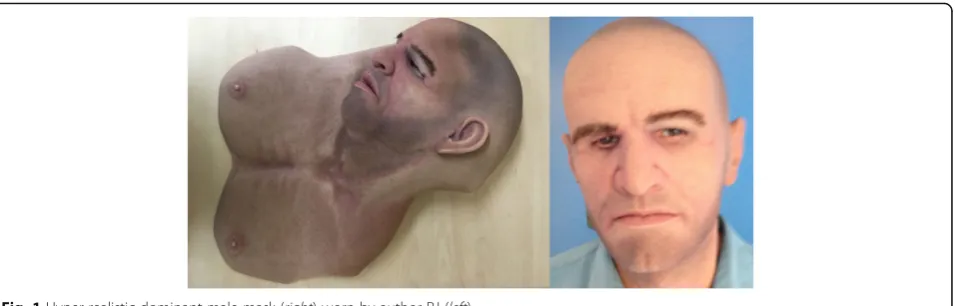
In a number of high-profile criminal cases, offenders have used hyper-realistic face masks (Fig.1) to transform their facial appearance, leading police to pursue suspects who looked nothing like the actual offenders (e.g. different race or age; Bernstein,2010). In a separate incident, an airline passenger wearing a hyper-realistic mask boarded an inter-national flight without the deception being noticed (Zamost,2010). These cases suggest that, in practical set-tings, hyper-realistic face masks can be difficult to distin-guish from real faces. Experimental evidence bears out this conclusion. In a series of studies (Sanders et al.,2017), we examined incidental detection of unexpected but attended hyper-realistic masks in both photographic and live pre-sentations. In all of these studies, viewers accepted hyper-realistic masks as real faces. These findings extend a tradition of research into realism of artificial stimuli. The Uncanny Valley phenomenon originally considered a range of human-like stimuli from puppets to robots (Mori, 1970; Mori, MacDorman, & Kageki,2012). In re-cent years, the focus has shifted somewhat to computer-generated images (e.g. Nightingale, Wade, & Watson,2017), but the very success of computer graphics * Correspondence:[email protected]
Department of Psychology, University of York, Heslington, York YO10 5DD, UK
has raised awareness that on-screen images may be digit-ally generated or enhanced. One of the interesting aspects of hyper-realistic masks is that they also fool the eye in the physical world (Sanders et al., 2017), where digital image manipulation has not yet encroached.
The finding that spontaneous mask detection is unreli-able suggests that specific measures may be required if de-tection rates are to be improved. Here we pursue an individual differences approach to the problem. Over the last decade, individual differences have become an import-ant topic in face perception research, not least because they suggest a route to improving performance in applied set-tings. For face identification, the range of ability is brack-eted by two extremes. At the high end, super-recognizers who rarely make errors (Bobak, Bennetts, Parris, Jansari, & Bate,2016; Robertson, Noyes, Dowsett, Jenkins, & Burton,
2016; Russell, Duchaine, & Nakayama, 2009), and at the low end, people with developmental prosopagnosia who rarely exceed chance performance (Behrmann & Avidan,
2005; Duchaine & Nakayama, 2005). Between these ex-tremes, there is a spectrum of ability on standardized face identification tests (e.g. Burton, White, & McNeill, 2010; Duchaine & Nakayama,2006).
These findings have led some researchers to suggest that personnel selection could play a useful role in optimizing occupational face recognition (White, Kemp, Jenkins, Matheson, & Burton, 2014). For example, Metropolitan Police super-recognizers have been found to score unusually high on a range of face identification tests (Robertson et al.,2016).
For mask detection, the cognitive situation is some-what different. Here the challenge is not individuation at the subordinate level (Rosch, Mervis, Gray, Johnson, & Boyes-Braem, 1976), but rather categorization at the basic level, albeit for the unusual case where one basic category (masks) deliberately mimics the other (faces). As the current task involves face/non-face categorization, it arguably has more in common with face detection than with face identification (see
Bindemann & Lewis, 2013, for a careful dissection of these issues).
The analogy with face detection may have some broad predictive value for the present case. Large individual differ-ences in face detection ability have recently been reported (Robertson, Jenkins, & Burton, 2017) and they appear to dissociate from face identification ability. However, one im-portant difference is that face detection hinges on the pres-ence or abspres-ence of a face-like pattern (e.g. two eyes above a nose above a mouth). That criterion will not help the viewer in the current task, as hyper-realistic face masks and real faces both present face-like patterns. Thus, the intu-ition is that hyper-realistic mask detection will require finer discrimination than face detection tasks demand.
As yet, very little is known about individual differences in this finer perceptual task. For example, we do not know the expected range of ability. Nor do we know any factors that might differentiate high performers from low performers. The present studies address these issues by asking whether some people are better than others at categorizing masks and faces, and what they may be doing that allows them to perform well. The overarching aim is to establish whether an individual differences ap-proach might be as useful in hyper-realistic mask detec-tion as it has been in face identificadetec-tion.
We begin in Experiment 1 by comparing detection of low-realism and high-realism masks in the context of real faces. In Experiment 2, we eliminated low-realism masks to focus participants on the harder comparison (high-realism masks vs real faces). Finally, we undertook an image analysis to compare use of information for high- and low-accuracy subgroups.
Experiment 1
Previous studies of hyper-realistic mask perception have assessed spontaneous detection of masks during an or-thogonal task (social inference ratings; Sanders et al.,
2017). Detection rates approached floor levels in that situation, precluding individual differences analysis. In
Method Ethics statement
Ethics approval for all experiments was obtained from the departmental ethics committee at the University of York.
Participants
Thirty members of the volunteer panel at the University of York (21 women, 9 men; mean age = 22 years, age range = 18–41 years) took part in exchange for a small payment or course credit.
Stimuli and design
To collect images of high-realism masks, we entered the search terms“realistic masks,” “hyper-realistic masks,”and “realistic silicone masks”into Google Images. We selected images that: (1) exceeded 150 pixels in height; (2) showed the mask in roughly frontal aspect; (3) showed the eye region without occlusions; and (4) included real hair eyebrows. We used the same criteria to search the websites of mask manufacturers (e.g. RealFlesh Masks, SPFX, CFX) and topical forums on social media (e.g. Silicone Mask Sickos, Silicone mask addicts). Our aim here was to sam-ple “ambient” photos of hyper-realistic masks that repre-sent the range of the mask images in the visual world (Jenkins et al.,2011). For this reason, we avoided promo-tional studio photographs of the masks and instead used photos of the masks in situ. This search resulted in 37 hyper-realistic mask images that met the inclusion criteria.
For comparison, we collected 37 images of low-realism masks by entering search terms such as “Halloween,” “party,” “mask,” “masquerade,” “face-mask,” and “party mask” in Google Images and selecting the first images that met inclusion criteria 1–3 above.
We also collected 74 real-face images for use as fillers in the mask/face categorization task. To ensure that the demographic distribution among our real face images was similar to that portrayed by the high-realism masks, we entered the search terms “young male,” “old male,” “young female,” and “old female” into Google Images. We then accepted images that met criteria 1–3 until the distribution of faces across these categories was the same as for the high-realism mask images. All photos
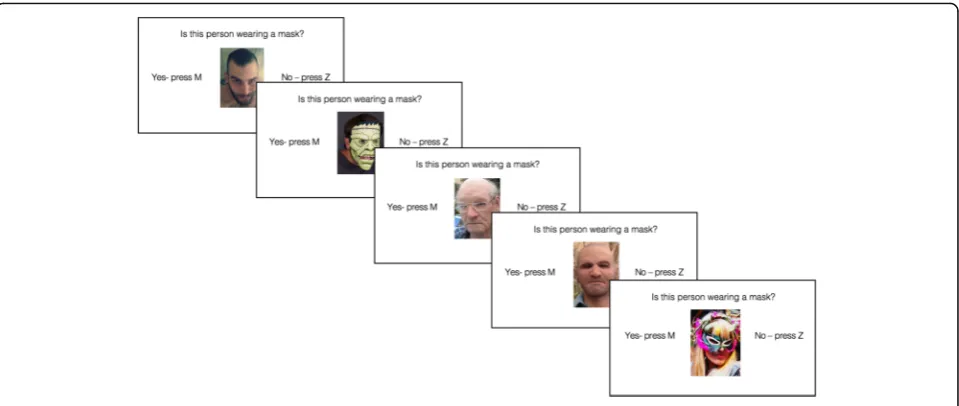
both low-realism masks and high-realism masks. Each trial consisted of a centrally presented image (a mask or a face) together with the prompt“Is this person wearing a mask?”and response options “Yes - Press M” and “No
– Press Z.” The display remained on screen until re-sponse, upon which the following trial began automatic-ally. No time limit was imposed. Participants completed three practice trials, followed by 148 experimental trials in a unique random order. The entire experiment took approximately 10 min to complete.
Results and discussion Group performance
Real face images were correctly classified on 96.3% of tri-als and were not analyzed further. Performance on mask trials is summarized in Fig. 3. As expected, low-realism masks were categorized reliably (M = 98.2%, SE = 0.4, CI = 97.6–99.0). High-realism masks were categorized much less reliably (M = 40.4%, SE = 5.6, CI = 29.2–51.5), mean-ing that the clear majority of these masks (59.6%) were misclassified as real faces. A within-subjects t-test confirmed that this difference in accuracy was statistically significant (t(29) = 10.29,p< 0.001).
Reaction time (RT) data followed a similar pattern. Cor-rect responses to low-realism mask trials were relatively fast (M = 895 ms, SE = 35, CI = 831–959). Indeed, RTs to high-realism masks were twice as long 1629 ms (SE = 142, CI = 1352–1901). Again, the difference between mask conditions was statistically robust (t(29) = 5.86,p< 0.001).
Individual differences
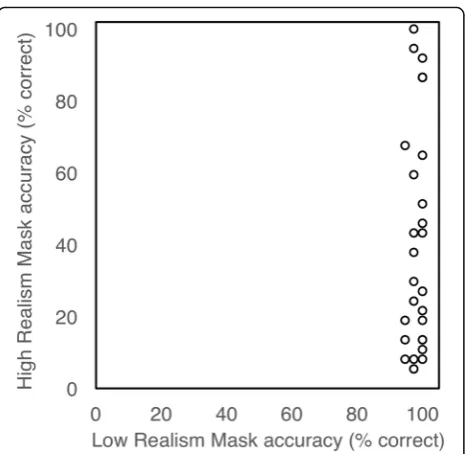
As can be seen in Fig.4, there was little variability in accur-acy in the low-realism mask condition (range 95–100%), with performance compressed against ceiling for this easy task. In contrast, accuracy in the high-realism condition spanned the entire range (5–100%). Unsurprisingly, there was no correlation between high- and low-realism mask trial performance (r= 0.182,p= 0.335).
any hyper-realistic face masks in this experiment, but a few detected nearly all of them.
One possible interpretation of this pattern is that low-realism masks make high-realism masks hard to detect, by encouraging viewers to draw the category boundary in the wrong place ([real faces + high-realism masks] vs [ low--realism masks] as opposed to [real faces] vs [high-realism + low-realism masks]). Prior knowledge of hyper-realistic face masks could protect against this error, leading to high over-all accuracy. To address this possibility, we next repeated the experiment without the low-realism mask condition. We also asked participants whether they had encountered hyper-realistic face masks before the experiment.
Experiment 2
This experiment was the same as Experiment 1, except for the following changes. First, we replaced the low-realism
mask stimuli with high-realism mask stimuli, in order to focus participants on the difficult judgments (real faces vs hyper-realistic face masks). As before, we informed partic-ipants that half of the trials would contain real faces and half of them would contain masks. We expected the new composition of trials to elicit errors in both directions (i.e. masks mistaken for faces and faces mistaken for masks). Our main interest was the distribution of performance in this situation. To test for effects of prior mask knowledge on performance, we also collected self-report ratings at the end of the experiment.
Method Participants
Thirty members of the volunteer panel at the University of York (24 women, 6 men; mean age = 20 years, age
Fig. 2Example of trial sequence in Study 1. Correct responses: Z, M, M, M, M. See main text for details
range = 18–24 years) took part in exchange for a small payment or course credit.
Stimuli and design
Additional stimuli were collected via Internet search, using the method described in Experiment 1. Once again, the proportions of young male, old male, young female, and old female items were matched across real face and high-realism mask images. The final image set consisted of 148 photographs (74 high-realism masks and 74 real faces). Each participant viewed the 148
Results and discussion Group performance
Overall categorization performance is summarized in Fig.6. As can be seen from the figure, classification of real face images was accurate, but not at ceiling (M = 91.2%, SE = 2.0, CI = 87.3–95.1). Accuracy for high-realism masks was relatively low (M = 73.7%, SE = 2.7, CI = 68.3–79.0), indicating that hyper-realistic masks were frequently mis-classified as real faces (26.3%). A within-subjects t-test confirmed that this difference in classification accuracy was statistically significant (t(29) = 6.78,p< 0.001).
To analyze discriminability and bias, we also carried out a signal detection analysis of correct performance (d’=1.56, SE = 0.43, CI = 1.40–1.72,p(correct) = 0.825). This indicates that participants were able to differentiate between masks and real faces. A criterion analysis (C= 0.61, SE = 0.09, CI = −0.97– –0.43) indicates a modest bias towards responding “mask.”After correcting for this bias, the ability to discrim-inate masks from real faces remained (d’corrected =1.36, SE = 0.43, CI = 1.40–1.72,p(correct) = 0.854).
There was no significant difference in reaction times be-tween real face (M = 1301 ms, SE = 93, CI = 1121–1480)
Fig. 4Scatterplotshowing participants’mean categorization accuracy rates in the high-realism and low-realism mask conditions in Study 1
and high-realism mask trials (M = 1283 ms, SE = 71, CI = 1145–1421; [t (29) = 0.34,p= 0.73]).
Individual differences
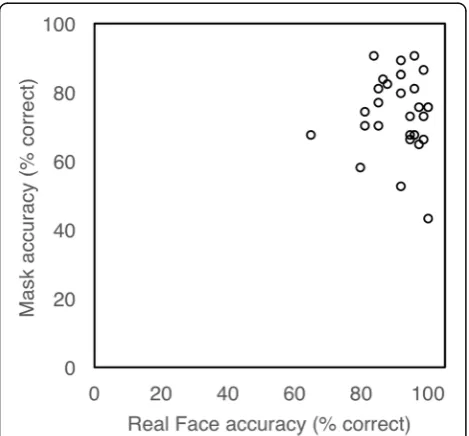
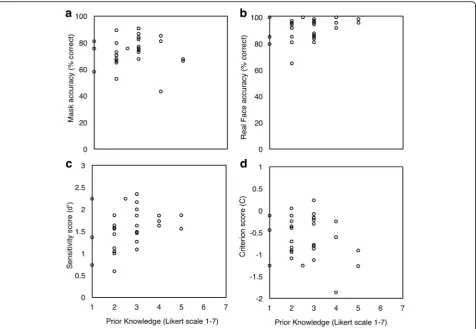
As can be seen in Fig. 7, almost everyone performed above chance in both conditions. Classification accuracy was in the range of 65–100% in the real face condition and 43–91% in the high-realism mask condition. Inter-estingly, there was no correlation in performance be-tween the two conditions (r=−0.04,p= 0.83).
We also measured the individual differences in discriminability between masks and real faces in terms of sensitivity (d’: range = 0.59–2.34) and criterion scores (C: range =−1.86–0.32).
Prior mask knowledge
Self-report ratings of prior mask knowledge were generally low (M = 2.67, SD = 1.03), suggesting little or no exposure to hyper-realistic face masks before the experiment. More importantly, there was no significant correlation between prior mask knowledge and performance in either the high-realism mask condition (r= 0.025, p= 0.898) or the real face condition (r= 0.319, p= 0.092), discriminabil-ity (r= 0.295, p= 0.120), or bias (r=−0.218, p= 0.256) (see Fig. 8).
Overall error rates were high (20%) despite the sim-plicity of the task and despite the fact that partici-pants were informed about the prevalence of mask and real face trials. We note that error rates were somewhat higher in the mask condition (30%) than in the real face condition (10%), meaning that overall, masks were mistaken for faces more often than faces were mistaken for masks. Interestingly, some partici-pants were highly accurate in correctly categorizing the masks. However, accuracy in the mask condition was not explained by accuracy in the real face condi-tion, nor by prior exposure to hyper-realistic face masks. In the final study, we ask whether high-performing individuals are using specific visual cues to support their accurate judgements.
Image analysis
The purpose of the image analysis was to compare the use of visual information by high classification accuracy and low classification accuracy participants in Experiment 2. Our specific interests were: (1) the availability of visual cues—that is, whether mask and face images differed reliably; (2) the nature of any reliable visual cues—specifically, their spatial location; and (3) whether high-performing and low-performing participants made different use of these cues. We
Fig. 6Mean accuracy rates (a) and correct reaction times (b) across participants as a function of experimental condition in Study 2
addressed these issues by using categorization data from Experiment 2.
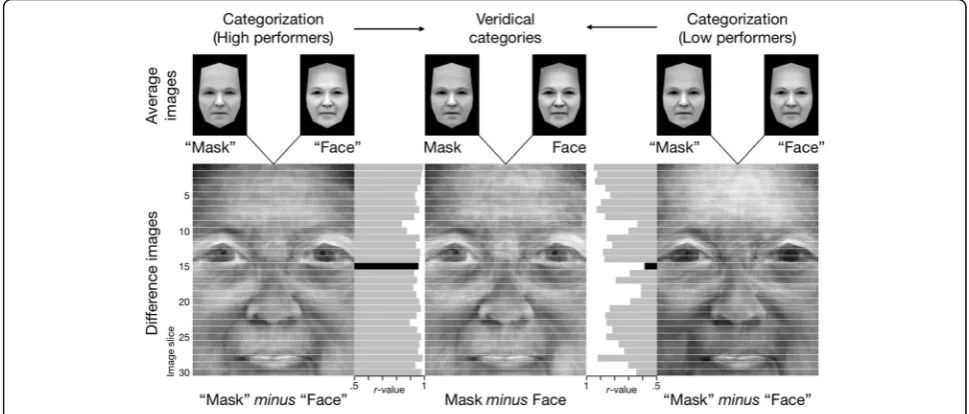
The logic of this image analysis is as follows. The ap-pearance of the mask stimuli and the face stimuli can be summarized by generating an average image for each stimulus category (an average mask and an average face). Systematic differences between these two categories can then be visualized by subtracting the average face from the average mask to create a difference image. This differ-ence image indicates which regions of the stimulus are most informative for mask/face classification. Our hypoth-esis is that high-performing participants tracked this infor-mation more closely than low-performing participants. To test this hypothesis, we used categorization responses from Experiment 2 to generate difference images for the high-performing and low-performing subgroups. This allowed us to compare the perceptual difference images (based on participants’ categorization of the stimuli) against thephysicaldifference image (based on the actual stimulus categories). By undertaking this comparison for different slices of the image, we were able to quantify par-ticipants’tracking of category-level regularities across dif-ferent face regions.
Method
Participant subgroups
To establish a strong manipulation of the independ-ent variable (categorization accuracy for masks), we divided participants into performance quintiles (N= 6 per subgroup) and contrasted the highest and lowest quintiles. A 2 × 2 mixed ANOVA with the within-subject factor image type (mask, real face) and the between-subjects factor of subgroup (high, low) confirmed that these subgroups were statistically distinct with respect to their classification scores. Consistent with the whole-group analysis, we found a significant main effect of image type, with higher accuracy for real face trials (M = 90.0%, SE = 1.4, CI = 83.6–95.7) than for mask trials (M = 72.5%, SE = 1.5, CI 65.9– 79.1), (F(1,10) = 13.76, p= 0.004, η2 = 0.58). More im-portantly, there was also a significant main effect of subgroup, with the high-accuracy group (M = 90.2%, SE = 0.8, CI = 86.7–93.8) reliably outperforming the low-accuracy group (M = 72.1%, SE = 2.1, CI = 62.9– 81.2), (F(1,10) = 85.44, p< 0.001, η2 = 0.89). There was no significant interaction between these factors (F(1,10) = 1.78, p= 0.212).
Face averages
We next constructed six average images (Burton, Jenkins, Hancock, & White, 2005) from the following six image sets: (1) actual masks (N= 74); (2) actual faces (N= 74); (3) perceived masks for high performers; (4) perceived faces for high performers; (5) perceived masks for low per-formers; and (6) perceived faces for low performers (weighted averages of images as classified; N> 50 for all). Seven images (five masks, two real faces) were excluded from this analysis because the camera angle did not allow accurate landmarking of the photographs (see Kramer, Jenkins, & Burton,2017 for implementation details). The six weighted texture averages for the remaining images are shown in Fig.9.
Difference images
To ask what distinguishes masks from real faces, we next computed a difference image (average mask minus aver-age face) separately for the veridical categories, the high-performance group, and the low-performance group. These three difference images are shown in Fig.9(lighter regions indicate greater difference). The veridical differ-ence image (Fig.9, center) indicates that the surrounding of the eye is especially informative, presumably because the eye holes in the mask can produce local anomalies in appearance (e.g. surface discontinuities if the mask is not flush with the wearer’s face; complexion discontinuities if the skin around the wearer’s eyes is exposed). The ques-tion is whether observers pick up on these subtle cues. Visual comparison confirms that the difference image for the high-performer group (Fig. 9, left) closely resembles
the veridical difference image (Fig.9, center). The differ-ence image for the low-performer group (Fig.9, right) re-sembles the veridical difference image less closely. This global pattern is perhaps to be expected, given the forma-tion of the subgroups: if high performers did not track the veridical categories, they would not be high performers. However, local variations in this pattern may reveal spe-cific cues that high performers exploit, and that low per-formers overlook. We investigated this possibility by comparing correlations between different image slices.
Image correlations
To avoid spurious inflation of correlation values by black background pixels, we first cropped the background from each difference image to create rectangular face image (300 × 228 pixels) that retained all of the internal features. To allow direct comparison across equally sized regions, we then divided each rectangular image into 30 horizontal slices (10 × 228 pixels; see Fig. 9). Successive rows of pixels can be concatenated to form a single vec-tor of pixels for each slice (1 × 2280 pixels), in which the grayscale intensity of each pixel is specified by an integer value between 0 (black) and 255 (white). These intensity values formed the input to the correlation analysis.
Figure9 shows the results of these image correlations (r values), separately for each slice. As can be seen from the figure, correlations between the veridical difference image and the high-performer image are consistently high across image slices (range = 0.87–0.99). The corre-lations between the veridical difference image and the low-performer image are lower overall and much more
Fig. 9Summary image analysis in Study 3. Average images show mean pixel intensities across images in each category, separately for high
appear to use information below the eye in a way that low performers do not. What information could be in this re-gion? We suggest two possibilities. First, in a real face, the region below the eyes normally includes the lower eye-lashes—an area of high local contrast. The masks in our stimulus set do not include eyelashes. If the mask covers the wearer’s eyelashes, it will typically reduce local contrast. Reduced local contrast under the eye may be a cue to mask detection. Second, in a real face, skin complexion below the eyes normally changes gradually on a local scale. The masks in our stimulus set do not necessarily match the complex-ion of the wearer. If the mask exposes any skin below the wearer’s eyes, it may cause an apparent discontinuity in skin coloration. Discontinuity in complexion under the eye may be a cue to mask detection. Each of these possibilities sug-gests that the precise fit of the mask around the wearer’s eyes is critical. Shade from the brow will tend to conceal cues in the upper eye region, at least under normal illumin-ation conditions (light source above). However, the same il-lumination conditions will tend to highlight cues in the lower eye region, making them more salient.
General discussion
Across three studies, we investigated individual differ-ences in hyper-realistic mask detection—specifically, the ability to categorize images as masks or real faces. In Ex-periment 1, we found large individual differences in a mask/face categorization task for high-realism masks, low-realism masks, and real faces. Although low-realism masks (and real faces) were categorized accurately over-all (> 98% correct), high-realism masks were not (40% correct). More importantly, from an individual differ-ences perspective, accuracy in the high-realism condition ranged from floor (5%) to ceiling (100%), despite the consistently high accuracy for other stimulus types.
In Experiment 2, we discarded the low-realism mask condition to focus exclusively on the difficult categorization—hyper-realistic masks vs real faces. Per-haps surprisingly, removing the easy condition improved performance in the difficult condition considerably (74% correct). This seemingly paradoxical result underscores the importance of the context in which a categorization decision is taken. The absence of an obvious category
differences in hyper-realistic mask detection, in the sense that some people were much more accurate than others at categorizing masks and real faces. These findings sug-gest that stable differences in ability may be worth pur-suing. It is too early to say whether some individuals exhibit a special talent for this task. Conclusive evidence would require estimates of test–retest reliability and consistently high performance across a range of tasks (Russell et al., 2009; Robertson et al., 2016). Until then, we suggest another possible route to improved detection rates—one that does not depend on screening for high-aptitude individuals. In our image analysis, we asked what high performers are doing that low per-formers are not. This analysis revealed a candidate visual cue that these subgroups used differently—the area under the eyes. Hyper-realistic mask images and real face images diverged more strongly in this area than in other areas. Moreover, high performers and low per-formers diverged strongly in the extent to which the area under the eyes predicted their responses. This intriguing finding raises the question of whether mask detection could be improved by drawing attention to this region. If so, it could pave the way for a simple training interven-tion. This is a tantalizing prospect, especially as benefits of training in face identification tasks have proven diffi-cult to pin down (Towler, White, & Kemp, 2014, 2017; White et al., 2014). Eye-tracking data in combination with accuracy rates, before and after training, should elucidate the potential of this approach.
expect that, in a more interactive context, additional cues from speech and movement could increase detection rate, but that is a matter for future studies.
Across these studies, we show that distinguishing hyper-realistic masks from real faces is a difficult task. Some people are much better than others at picking out hyper-realistic masks, and these large individual differ-ences are not readily explained by correct categorization of real faces or by prior exposure to hyper-realistic masks. We suggest that they may be explained by differ-ential use of specific visual cues and identify the region under the eyes as a promising candidate.
Abbreviation RT:Reaction time
Acknowledgments
We thank Ailish Byrne for coding data and the FaceVar lab group for discussions on earlier versions of this work.
Funding
Economic and Social Research Council (Studentship ES/J500215/1), Prins Bernhard Cultuurfonds (grant E/30/30.13.0630/HVH/IE), and University of York Research Priming Fund (H0022034) to Rob Jenkins.
Availability of data and materials
Data and materials are available upon request.
Authors’contributions
JGS, and RJ conceived and designed the experiments. JGS performed the experiments. JGS and RJ analyzed the data. JGS and RJ contributed reagents/ materials/analysis tools. JGS and RJ wrote the paper. Both authors read and approved the final manuscript.
Ethics approval and consent to participate
Ethical approval was granted by the departmental ethics committee at the University of York. All participants provided informed consent in advance.
Competing interests
The authors declare that they have no competing interests.
Publisher’s Note
Springer Nature remains neutral with regard to jurisdictional claims in published maps and institutional affiliations.
Received: 3 January 2018 Accepted: 31 May 2018
References
Behrmann, M., & Avidan, G. (2005). Congenital prosopagnosia: Face-blind from birth.Trends in Cognitive Sciences,9(4), 180–187.
Bernstein, S. (2010). Masks so realistic they’re arresting the wrong guy. Retrieved fromhttp://articles.latimes.com/2010/dec/08/business/la-fi-mask-20101209. Accessed 4 Oct 2017.
Bindemann, M., & Lewis, M. B. (2013). Face detection differs from categorization: Evidence from visual search in natural scenes.Psychonomic Bulletin & Review,
20(6), 1140–1145.
Bobak, A. K., Hancock, P. J., & Bate, S. (2016). Super‐recognisers in action: Evidence from face‐matching and face memory tasks.Applied Cognitive Psychology,
30(1), 81–91.
Burton, A. M., Jenkins, R., Hancock, P. J., & White, D. (2005). Robust representations for face recognition: The power of averages.Cognitive Psychology,51(3), 256–284. Burton, A. M., White, D., & McNeill, A. (2010). The Glasgow face matching test.
Behavior Research Methods,42(1), 286–291.
Duchaine, B., & Nakayama, K. (2005). Dissociations of face and object recognition in developmental prosopagnosia.Journal of Cognitive Neuroscience,17(2), 249–261.
Duchaine, B., & Nakayama, K. (2006). The Cambridge face memory test: Results for neurologically intact individuals and an investigation of its validity using inverted face stimuli and prosopagnosic participants.
Neuropsychologia,44(4), 576–585.
Jenkins, R., White, D., Van Montfort, X., & Burton, A. M. (2011). Variability in photos of the same face.Cognition,121(3), 313–323.
Kramer, R. S., Jenkins, R., & Burton, A. M. (2017). InterFace: A software package for face image warping, averaging, and principal components analysis.Behavior Research Methods,49(6), 2002–2011.
Mori, M. (1970). The uncanny valley.Energy,7(4), 33–35.
Mori, M., MacDorman, K. F., & Kageki, N. (2012). The uncanny valley: The original essay by Masahiro Mori. IEEE Spectrum.
Nightingale, S. J., Wade, K. A., & Watson, D. G. (2017). Can people identify original and manipulated photos of real-world scenes?.Cognitive research: principles and implications,2(1), 30.
Robertson, D. J., Jenkins, R., & Burton, A. M. (2017). Face detection dissociates from face identification. Visual Cognition,7–8, 740–748.
Robertson, D. J., Noyes, E., Dowsett, A. J., Jenkins, R., & Burton, A. M. (2016). Face recognition by metropolitan police super-recognisers.PLoS One,11(2), e0150036. Rosch, E., Mervis, C. B., Gray, W. D., Johnson, D. M., & Boyes-Braem, P. (1976). Basic
objects in natural categories.Cognitive Psychology,8(3), 382–439. Russell, R., Duchaine, B., & Nakayama, K. (2009). Super-recognizers: People with
extraordinary face recognition ability.Psychonomic Bulletin & Review,16(2), 252–257.
Sanders, J. G., Ueda, Y., Minemoto, K., Noyes, E., Yoshikawa, S., & Jenkins, R. (2017). Hyper-realistic face masks: A new challenge in person identification.Cognitive Research: Principles and Implications,2(1), 43.
Towler, A., White, D., & Kemp, R. I. (2014). Evaluating training methods for facial image comparison: The face shape strategy does not work.Perception,43(2–3), 214–218.
Towler, A., White, D., & Kemp, R. I. (2017). Evaluating the feature comparison strategy for forensic face identification.Journal of Experimental Psychology: Applied,23(1), 47.
White, D., Kemp, R. I., Jenkins, R., Matheson, M., & Burton, A. M. (2014). Passport officers’errors in face matching.PLoS One,9(8), e103510.