Disambiguating Latent Variables ABSTRACT
In contrast to Borsboom (2008) who distinguishes between manifest and latent variables on epistemic grounds in terms of “epistemic accessibility,” I advocate a demarcation on pragmatic grounds. The latter way of understanding this distinction does justice to the intuitions driving Borsboom’s account, but avoids unnecessary epistemic complications. I then turn to two cases, the Flynn Effect and the case of psycho-educational assessment, and show an equivocal understanding of one latent variable, Spearman’s g, has led some
Disambiguating Latent Variables
1. Introduction: Variables Latent, Variables Manifest
Latent variables are ubiquitous in the social and behavioral sciences. Some claim they are an indispensable part of social and psychological research (Sobel 1994). We may distinguish between variables that are manifest and variables that are latent. Manifest variables are, at first pass, distinguished by being observed; at least this is one popular way of distinguishing them from latent variables. Suppose we set out to measure the lengths of various objects. With a meter stick in hand, we get to work: the length of the swimming pool is 100 meters, the ceiling is three meters from the floor, etc. In these cases, length is a manifest variable. It is also an observed property of the objects who length we measure. Some methodologists claim that what distinguishes manifest from latent variables is whether the quantity in question is observed or is inferred from some observed measure, respectively. While being observed and being manifest are seemingly concomitant properties, I will argue that this concomitance is not philosophically significant, and, furthermore, by avoiding a criterion that demarcates latent and manifest variables in terms of whether a property instance is observed, certain quagmires can be sidestepped.
subjects on the SES index. SES is not observed directly, it is a composite score based on values for manifest variables. Similarly for psychometric research on cognitive ability, a battery of tests is administered to an individual and the test-scores are manifest variables the correlations among which are explained by positing a latent variable, g (taken to denote general intelligence). Epistemic access to g is mediated by measuring its manifest indicators; no direct measure of general intelligence is available, though some indicators are taken to be better measures of it than others.
Variables considered to be manifest in one context would be considered latent in a different context if they figure in as a latent variable in a latent variable model. A latent variable model specifies the relationship between various observable indicators (manifest variables) and a latent variable or class of latent variables. Hence, height, though a manifest variable in the examples considered earlier, could be a latent variable depending on one’s measurement methods. For example, we may want to assess the heights of adolescents in a town where there are no meter sticks, rulers, or other devices for measuring height directly. Instead we may record their weights and shoe sizes (as indicated by the label in the shoe) and use those values to infer values for height. On the basis of those measures we should be able to predict with good accuracy the length of the adolescents since the values for the manifest variables are known to correlate highly with height in adolescents; note that in this context there was no appeal to observation as a distinguishing characteristic.
particular instance. The latent/manifest distinction does not track or commit one to the so-called “observable/unobservable” or “observational/theoretical” distinctions. This is all the better for latent variable modelers that the legitimacy of their method not piggyback on controversial distinctions.
Latent variables form a heterogeneous bunch, united only by the fact that they are not manifest. I will restrict my investigation of latent variables to the social and behavioral sciences and the inferential problems introduced by positing latent variables, namely how we go from latent variables to quantities in nature. Specifically I will be concerned with latent variables in psychometrics, a branch of psychology devoted to the investigation of
psychological traits and the structure of individual and group differences in psychological traits. I will devote considerable attention to the general factor of intelligence, i.e., the g-factor and also consider latent variables in other disciplines such as socioeconomics.
Unsurprisingly there are alternative views on how to understand the distinction between latent and manifest variables. Borsboom (2008) argues that the distinction is epistemic; it maps onto the differential evidential gap between data and their causes. Borsboom uses the term ‘observed’ to mean ‘manifest’. On this account, in the case of manifest variables, we assign probability equal to one to the measurement outcome; in the case of latent variables, we assign probabilities less than one to measurement outcomes.
error, even if for each time I concatenate I believe that I have done so without error. Using a ruler to measure the length of a standard sheet of paper (or another ruler) is one thing, but measuring moderately large distances is another. On Borsboom’s account, length becomes latent once my confidence drops below one. But here charges of arbitrariness arise: why must confidence amount to probability equal to one for the variable to be an “observed” variable? Without justifying that threshold, it seems arbitrary to set it at certainty and unnecessarily stringent.
I suggest that we demarcate variables pragmatically: simply read off their status from the measurement or structural equation model. If in the model length is treated as a latent variable, then length is a latent variable in that model (e.g., in the structural equation modeling package LISREL, the variable is indicated by an ellipse instead of a rectangle, or such as a regression coefficient in a regression model). This approach is contextualist: a variable’s status depends upon the measurement context. It seems that in many circumstances drawing the distinction in this way will make sense of Borsboom’s idea that we seem to have better epistemic access to manifest variables, or perhaps vice versa: Borsboom’s idea
2. Interpretation and Latent Variables
Though latent variables may be invoked to refer to unobservable objects, such as electrons or quarks, as they factor in psychometrics and the social sciences, latent variables are typically taken to refer to properties, e.g., personality characteristics such as “extraversion” and abilities such as “general intelligence.” I will assume that properties, or at least property instances, have causal powers. Thus, if a latent variable successfully refers to a property or property instance, then the variable’s referent has causal powers (i.e., it is causally
efficacious). This commitment rules out the possibility of epiphenomenal latent variables, and this might seem suspect given that I am dealing with latent variables that purportedly refer to mental properties. Psychometrics seems to presuppose that epiphenomenalism is false, since psychological attributes, the referents, of latent variables are alleged to be causally efficacious if they exist at all.1
1 However, some psychometricians believe that a psychological attribute, A, is causally
efficacious only if there is actual variability in A. That is, a disposition to effect change is not strong enough. This variability in position on A is manifested in test behavior. See Borsboom (2005) and Holland (1986). One interesting consequence of this position is that general intelligence, the purported referent of the g-factor, is not causally efficacious since it exhibits no variability within individuals, i.e., there is no intraindividual variability. The severity of this consideration for theories of intelligence that take general intelligence to be a central theoretical posit and whether interindividual variation is sufficient to save general
One may advance a wholesale rejection of psychometric constructs as meaningless or mere statistical artifacts. However, my starting point is psychometric practice, for it is this practice that I wish to clarify. Rejecting the entire discipline would be not only a disservice to a scientific discipline which shows no sign of losing steam, but it would also be a disservice to the philosophy of science which potentially stands to gain from careful examinations into psychological measurement (see Trout 1999; Sesardic 2000).
2.1 Latent Variable Modeling as Data Reduction
Factor analysis is one statistical procedure for discovering latent variables (exploratory factor analysis) and confirming latent variable models (confirmatory factor analysis). The utility of factor analysis is manifold. First, factor analysis is a data reduction technique. Suppose you
have a pp correlation matrix. The correlated items may be performance on psychometric tests or what have you. The larger p is, the greater the number of correlations in the matrix and also the more unwieldy the matrix becomes. Sometimes it might be useful to express the information contained in the correlation matrix with a smaller number of variables. For
example, it may be more economical and cognitively tractable to deal with a 520 factor matrix expressing the relationship between the manifest variables and a compendious set of
latent factors, rather than a 2020 correlation matrix. To illustrate analysis, consider the
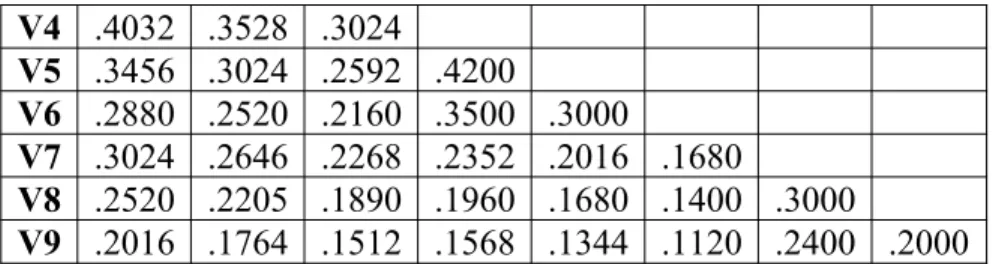
following 88 correlation matrix from Jensen (1998, 80):
V1 V2 V3 V4 V5 V6 V7 V8
V2 .5600
V4 .4032 .3528 .3024
V5 .3456 .3024 .2592 .4200
V6 .2880 .2520 .2160 .3500 .3000
V7 .3024 .2646 .2268 .2352 .2016 .1680
V8 .2520 .2205 .1890 .1960 .1680 .1400 .3000
V9 .2016 .1764 .1512 .1568 .1344 .1120 .2400 .2000 Table 1: Hypothetical correlation matrix of intelligence test data
As the number of variables increases, so does the utility of being able to represent the information in terms of a few latent variables. Note that some of the indicators (the V’s) correlate more strongly with each other than with others. For example, V1, V2, and V3 are more strongly mutually correlated than they are with other variables. The correlations
between variables can be expressed more economically in terms of a correlation with a latent variable. Factor analysis enables us to transform the correlation matrix above into a factor matrix expressing the correlation between each test and an “underlying” factor (table 2).
1st order 2nd order
Variable F1 F2 F3 g
V1 .3487 0 0 .72
V2 .3051 0 0 .63
V3 .2615 0 0 .54
V4 0 .42 0 .56
V5 0 .36 0 .48
V6 0 .30 0 .40
V7 0 0 .4284 .42
V8 0 0 .3570 .35
V9 0 0 .2856 .28
The number of factors can be as many as the number of variables (though this would simply reproduce the original matrix). The correlation between an indicator and a latent variable is that indicator’s factor loading. Table 2 depicts three first-order factors (F1, F2, and F3) that account for correlations in the nine manifest variables, and the correlation between the three primary factors (i.e., latent variables) is accounted for by a second-order factor, g.
3. Interpretations and Equivocations: ‘g’
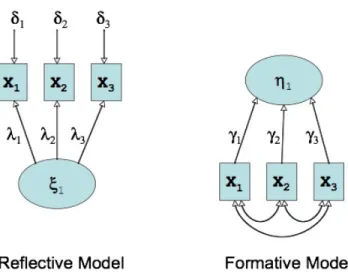
Figure 1. Reflective and formative measurement models.
Appropriating the terminology of Edwards and Bagozzi (2000) and Borsboom (2005), I will refer to the model on the left side of figure 1 as a reflective model and to the model on the right as a formative model. Each Xi is a manifest (i.e., observed) variable or indicator such as
an item response or test variable. and are latent variables, each i is the factor loading of
each indicator in the left-hand model, and each i is a weight of the indicator with respect to
the latent variable.2 Each i is an error term for the relevant indicator. The reflective model is the typical unidimensional measurement model found in psychometrics. In the measurement of general intelligence, each Xi would be, for example, a subtest (or item) of a test of
cognitive ability and performance on each subtest (or item) would be seen as a function of position on the latent variable g; it is differences in positions on g which, it is claimed, cause differences in performance on the indicators (hence the direction of the arrows). This is, of
2 The factor loading of an indicator X with respect to a factor F is an estimated (Pearson)
course, a simplified model, but it should be sufficient for illustrative purposes. Formative models, on the other hand, are popular in sociological research. For example, socioeconomic status (SES) is often modeled formatively. In the formative model the direction of causal influence is reversed, running from the indicators to the latent variable. The latent variable is regressed on its indicators, not the other way around. One (or a population) occupies a position on SES because of the values of the indicators, such as gross yearly income, and SES is interpreted as summary of the observed measures; no ontological commitment regarding SES independent of its indicators is required. We may even use one’s SES score to predict one’s level on some unmeasured indicator, but even this does not entail that SES is being treated as existing independently of its indicators.
Some latent variables are generated by variability between persons (interindividual variation) and others are generated by variability within persons (intraindividual variability). g represents the former kind of variability. Proponents of g-factor models of intelligence cite
the robustness of g across different factor analytic techniques, biological correlates with g, and the apparent impossibility of constructing a test of cognitive ability that does not load on g as evidence that there is a single dominant mental ability underlying all cognitive tasks (or
cautionary tale I now turn to a discussion of how various prominent researchers have fallen prey to such confusions.
The four different notions that are sometimes run together under the term ‘g’ are 1. g-factor: the most general and latent statistical factor that accounts for some
portion of the correlation between variables,
2. g-score: the weighted sum of an individual’s scores on variables that comprise the g-factor; i.e., one’s position on the latent variable, the g-factor,
3. general mental ability: the trait or attribute said to be measured by accepted tests of mental ability which load heavily on the g-factor; the purported latent cause of variability in between-subject scores on tests of mental ability,
4. g-loading: the correlation between a variable indicating performance (i.e., a variable in a matrix of correlations) and the g-factor.
As I will show, running these four related concepts together can lead to serious confusion and odd results.
3.1 Case 1: The Flynn Effect
not been accompanied by corresponding gains in academic and occupational achievement (Deary 2001; Flynn 1999), which is a counter-intuitive result given that academic and occupational achievement are correlated with mental ability.
A popular response to this objection to g-factor theories of intelligence (Miele 2002; Rushton 1999) is to claim that the IQ gains are hollow in the sense that the gains reflect improved performance on just the non-g-loaded sections of the IQ tests. The rationale behind this suggestion is that if the gains in IQ can be accounted for by performance on those sections or items of the test that are not g-loaded, then performance is increasing on those sections or items of IQ tests that are not measuring mental ability. This response is an
instance of a general strategy for countering the Flynn Effect—to acknowledge that there are IQ-gains, but to deny that there are corresponding gains in general mental ability. This response may seem ad hoc and difficult to reconcile with the fact that IQ-gains are most pronounced on Raven’s Progressive Matrices, the psychometric test said to be the “purest” measure of general mental ability, i.e., the Raven’s measures general mental ability and little else.
There is another response that follows the aforementioned general strategy, and though it may avoid charges of arbitrariness or ad hoc-ness, the response is marred by equivocation. The response typically goes as follows: if the individual differences, i.e., between-subject variability, in performance on psychometric tests (or the correlations
only makes sense when interpreted as meaning the g-factor (a between-subject statistic), whereas in the second occurrence it is intended in the sense of general mental ability (a within-subject phenomenon).
3.2. Case 2: Psycho-educational Assessment
One dramatic instance of g-ambiguity comes from research in psycho-educational research, particularly research on learning disabilities in high-IQ children. The classic operational definition of learning disabilities is a discrepancy between IQ and achievement (Kavale and Forness 1995). In the field of educational psychology there has been a growing concern over misdiagnoses of learning abilities in gifted children. Under the classical operational
definition of a learning disability, gifted children are at an increased risk for being diagnosed with learning disabilities—a surprising result. If mental abilities are more differentiated (i.e., less strongly correlated) in populations at the high end of the ability spectrum, then ability and achievement are also more likely to be more discrepant, leading to increased learning disability diagnosis rates. There are reasons to think that gifted children are not at an
increased risk for learning disabilities, but that they are at an increased risk for misdiagnoses of learning disabilities (Lovett and Lewandowski 2006).
g-loading is conflated with general mental ability, the paradoxical conclusion follows that gifted (high ability) children have a lower general mental ability than the rest of the population. Indeed, some psychologists have made this inference on the basis of such this confusion. For example, Ulric Neisser (1999, 131) writes:
Generally speaking, g accounts for less and less of the variance as one moves to individuals with higher and higher scores. This means that more intelligent people have more diverse sets of specific abilities; those in the lower range have not developed those abilities and must use what little they have for virtually every test. Less intelligent people have relatively more g!
The first occurrence of ‘g’ in the passage quoted above refers to the g-factor; however, the second occurrence of ‘g’ is intended to refer to general mental ability. Detterman (1991) gestures toward this inference (though he does not make it) when he points out that Spearman may have been committed to the paradoxical result:
In this passage, the first and second occurrences of ‘g’ refer to general mental ability, the fourth occurrence refers to the g-loading of the tests administered, and the third and fifth occurrence refers to general mental ability. Conflating these different concepts leads to the paradoxical result that general mental ability is “stupidity.” Notice also that the
aforementioned paradoxical result entails that IQ tests, purported measures of mental ability, do not measure mental ability, at least not in any meaningful way.
4. Disambiguating g
The source of the confusion in the previous two examples is the conflation of levels of mental ability with the variance accounted for by g. A person’s level of general mental ability, i.e., what is represented by a person’s g-score, need not be commensurate with the amount of variance that the g-factor captures in a collection of scores on mental ability tests. The percentage of variance accounted for (g-loading) is not a meaningful statistic for an individual and, hence, cannot indicate an individual’s g-score or an individual’s level of ability. The assumption that the models constructed to represent the structure of variability in the population also fit the individuals within is known as local homogeneity (Borsboom 2005). The quoted passages above seem presuppose local homogeneity, and some psychologists explicitly make the assumption as an idealizing principle. Consider the following passage from Anderson:
seems irrelevant. It is taken to be a parsimonious assumption that these differences in scores are to be explained with reference to the same mechanism. Thus, for example, higher synaptic efficiency makes one individual more intelligent, and increasing synaptic efficiency with age makes us more intelligent as we develop (1992, 2).
Nevertheless it makes little sense to appeal to local homogeneity in the context of intelligence research as it conflicts with another commitment typically held by proponents of g-factor theories of intelligence, namely the stability of an individual’s performance over
time on tests of ability. If performance is stable, there is no variability to model; g is, by its nature, an interindividual statistic that arises when a diverse battery of mental ability tests are administered to a large population. The claim that the g-factor is an indicator of general mental ability in individuals (to a greater or lesser extent) is logically independent from its statistical nature. If g has any empirical significance, it is as an indicator that individual differences in test scores can be modeled along a single dimension. Bartholomew (2004) likens g to longitude in this respect. Longitude is a dimension along which geographical points can differ. The Eiffel Tower and Lenin’s sarcophagus, for example, differ along this dimension. Each of these objects occupies a point on this dimension and their locations can be partially described by specifying their “score” on that dimension. However, the location of the Eiffel Tower on its own is insufficient for constructing the dimension of longitude as the Eiffel Tower stays put.
I have drawn attention to several problems in the conceptual foundations of psychological measurement. First I argued for a pragmatic distinction between latent and manifest variables. This account avoids the controversy concerning the so-called
“observable/theoretical” distinction associated with the realism debates. I then turned to equivocal notions of the g-factor. The diagnosis of the ambiguity is that it results from a tacit assumption of local homogeneity, which, in turn, leads to a conflation of several distinct statistical and psychological concepts. Once teased apart, no paradox arises; however,
echoing others including Borsboom (2005), I noted that if g denotes general mental ability, it seems that no individual has it, for g is an interindividual statistic. As a dimension of
variability, psychometricians can assign individuals scores on that dimension, though doing so involves substantive empirical assumptions and merely provides an ordinal standing of that individual relative to the relevant population.
References
Anderson, M. 1992. Intelligence and Development. Cambridge: Blackwell.
Bartholomew, D. 2004. Measuring Intelligence: Facts and Fallacies. New York: Cambridge. Borsboom, D. 2005. Measuring the Mind: Contemporary Issues in Psychometrics.
Cambridge: Cambridge University Press.
Deary, I. J., and Claudia Pagliari. 1991. "The Strength of g at Different Levels of Ability: Have Detterman and Daniel Rediscovered Spearman's ‘Law of Diminishing Returns’?" Intelligence 15: 247-250.
Detterman, D. K. 1991. "Reply to Deary and Pagliari: Is g Intelligence or Stupidity?" Intelligence 15: 251-255.
Detterman, D. K., and Mark H. Daniel. 1989. "Correlations of Mental Tests with Each Other and with Cognitive Variables are Highest for Low IQ Groups." Intelligence 13:349-359.
Edwards, J. R. and R. P. Bagozzi. 2000. "On the Nature and Direction of Relationships between Constructs and Measures." Psychological Methods 5:155-174.
Flynn, J. R. 1984. "The Mean IQ of Americans: Massive Gains." Psychological Bulletin 95:29-51.
Flynn, J. R. 1987. "Massive IQ Gains in 14 Nations: What IQ Tests Really Measure." Psychological Bulletin 101:171-191.
Flynn, J. R. 1999. "Searching for Justice: The Discovery of IQ Gains Over Time." American Psychologist 54:5-20.
Jensen, A. 1998. The g Factor. Westport: Praeger.
Kavale, K. A., and S. R. Forness. 1995. The Nature of Learning Disabilities: Critical Elements of Diagnosis and Classification. Mahwah, NJ: Erlbaum.
Miele, Frank. 2002. Intelligence, Race, and Genetics: Conversations with Arthur Jensen. Boulder, CO: Westview Press.
Neisser, U. ed. 1998. The Rising Curve. Washington DC: American Psychological Association.
Neisser, U. 1999. "Two Views About the g Factor: The Great g Mystery." Contemporary Psychology APA Review of Books 44:131-133.
Rushton, J. P. 1999. "Secular Gains in IQ Not Related to the g Factor and Inbreeding Depression Unlike Black-White Differences: A Reply to Flynn." Personality and Individual Difference 26:381-389.
Sesardic, Neven. 2000. "Philosophy of Science That Ignores Science: Race, IQ and Heritability." Philosophy of Science 67:580-602.
Sobel, S. E. 1994. "Causal Inference in Latent Variable Models." In Latent Variables Analysis, ed. A. von Eye and C.C. Clogg, 3-35. Thousand Oaks: Sage.
Spearman, Charles. 1927. The Abilities of Man: Their Nature and Measurement. New York: Macmillan.