*Corresponding author: Zulfakar
Education Administration Program, Faculty of Science Education, Institute of Teacher Training and Education Mataram, Lombok
ISSN: 0976-3031
Research Article
INSTITUTIONAL LOGICS
Zulfakar
1and Fahruddin
21
Education Administration Program, Faculty of Science Education, Institute of Teacher Training and
Education Mataram, Lombok West Nusa Tenggara, Indonesia
2
Secretary of Graduate Program, Educational Administration, University of Mataram- Lombok-
West Nusa Tenggara-Indonesia
DOI: http://dx.doi.org/10.24327/ijrsr.2018.0904.1942
ARTICLE INFO ABSTRACT
There is an ever-increasing volume of studies investigating institutional logics, and yet qualitative methods for studying this phenomenon are not clear. In this essay, we examine how qualitative scholars convince their readers that they are actually studying institutional logics. We identify three different, but non-exclusive techniques that have been employed: pattern deducing, pattern matching, and pattern inducing. For each of these approaches, we explain the ontological assumptions, methodological techniques, challenges, and benefits. In addition, we provide examples of how specific studies have analyzed and presented qualitative data to improve theory about institutional logics.
INTRODUCTION
The concept of institutional logics has become increasingly popular in the organization studies literature, starting with a trickle in the early 1990s to a veritable flood of articles in the 2010s. Of the 601 articles published between 1991 and 2014, 66% employ qualitative data (Jones and Lee, 2015). Qualitative methods hold great promise for investigating institutional logics, which are “socially constructed, historical patterns of cultural symbols and material practices, assumptions, values and beliefs by which individuals produce and reproduce their material subsistence, organize time and space, and provide meaning to their daily activity” (Thornton et al., 2012: 51). Logics are contextual and translated by members for their time and place, and theoretically they elaborate a structural theory of culture by focusing on the patterns of and interplay among symbols, beliefs, norms, and practices (Jones et al., 2013). Logics, which are revealed through language, practices, and manifested in symbols and materials, are naturally suited to qualitative data and methods that demand immersion in the phenomenon. When studying logics, researchers must ground their insights and abstractions to the context through quotes,
observations, and thick description. Within these qualitative studies, different authors reveal and interpret institutional logics in diverse ways, and despite the large volume of studies about logics, there is very limited discussion about how they can be identified, described, and measured a research process that we call “capturing.” Understanding research approaches to capturing logics is critically important since most scholars discern and compare multiple competing logics that exist within an organization or field. This situation is called institutional complexity, and it arises out of institutional pluralism where different societal sectors are at play (Greenwood et al., 2011). Thus, we address the important question of how such research can be accomplished by reviewing the different methods currently in use and exposing their underlying assumptions, strengths, and weaknesses.
In this essay, we provide a framework to show different analytic techniques, and we aim to inspire new thoughts about how to analyze institutional logics based on qualitative data. Our method was simple. We drew on our own experiences and also identified scholars who had published articles on logics, asking them to tell us how they qualitatively captured
International Journal of
Recent Scientific
Research
International Journal of Recent Scientific Research
Vol. 9, Issue, 4(E), pp. 25855-25863, April, 2018
Copyright © Zulfakar and Fahruddin, 2018, this is an open-access article distributed under the terms of the Creative Commons Attribution License, which permits unrestricted use, distribution and reproduction in any medium, provided the original work is properly cited.
DOI: 10.24327/IJRSR
CODEN: IJRSFP (USA)
Article History:
Received 17th January, 2018 Received in revised form 21st February, 2018
Accepted 05th March, 2018 Published online 28th April, 2018
Key Words:
institutional logics, focusing on explanations about their data, methods, and challenges. We thank these authors for taking time to contribute and for their comments and our dialogue, which we experience as enriching not only our own research methods but hopefully those of other researchers. We focus on “capturing” rather than measuring or operationalizing logics because scholars who employ qualitative data seek to capture a phenomenon, as in (1) capture as engage the audience’s interest in a topic and phenomenon and (2) capture as “to paint a likeness of” and reveal a phenomenon through thick description (e.g. Van Maanen, 1995). We identify three techniques currently in use that range in their epistemology and ontology to studying logics: (1) pattern deducing, (2) pattern matching, and (3) pattern inducing. We use the term pattern to describe a set of symbols and beliefs expressed in discourse (verbal, visual, or written), norms seen in behaviors and activities, and material practices that are recognizable and associated with an institutional logic or logics.
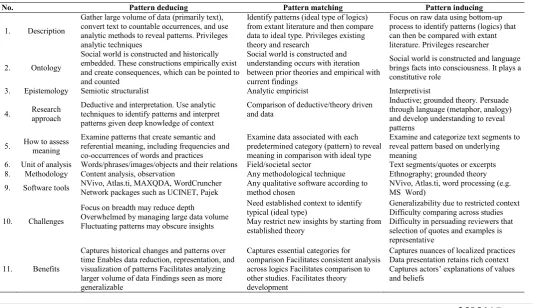
We recognize that all three techniques could be present in one study. Authors may employ mixed methods, utilize qualitative and quantitative data, and cycle between inductive and deductive approaches. However, we believe that by focusing here on these three techniques as analytically distinct, we can better identify their respective ontological assumptions, epistemology, methodologies, challenges, and benefits as shown in Table 1. We hope that this will enable scholars to hone a particular technique or better integrate two or more techniques when qualitatively capturing institutional logics. We also aim to generate at least a little controversy believing that active conversations lead to advancement for the field. The identification of these three different techniques has caused us (Trish and Candy) to debate and reflect on similarities and differences across the categories and our own techniques.
As we have engaged others in our discussions, debates and reflections have continued, and we hope that further conversations among a broader group of scholars will continue to raise new insights and approaches to research.
Pattern deducing: Counting occurrences and co-occurrences to reveal patterns
Some scholars capture institutional logics through pattern deducing (e.g. using reason or logic to discern a pattern and arrive at a conclusion of whether and which logic is in use). These scholars focus on large volumes of qualitative data, primarily texts, use computer programs to convert the data to countable occurrences, and employ analytic methods to reveal patterns that capture logics, which are explained based on their context (see Jones and Livne Tarandach, 2008; Mohr and Duquenne, 1997; Ruef, 1999). Pattern deducing is based on semiotics from linguistics (De Saussere, 2008) and the philosophy of language (e.g. Pierce, 1977) where meaning and logics are created and revealed through the occurrence, co-occurrence, and non-occurrence among symbols such as words, images, practices, and actors. For example, the meaning of and the logic guiding the use of the same word such as “family” are revealed through co-occurrences of words, practices, and actors such as physician, exam, and healthcare, revealing a medical profession logic, whereas “family” that occurs with pastor, service, and church reveals a religious logic. To reveal patterns in text, scholars formalize and systematize counting through programs such as MAXQDA or topic analysis in statistical programs such as R that create word frequencies, ratios, and co-occurrences, indicating a word’s centrality in discourse and its relationships with other words to reveal their cultural meaning (Chandler, 2007; Jockers, 2014; Krippendorff, 2004).
Table 1 Approaches To Qualitatively Capturing Institutional Logics
No. Pattern deducing Pattern matching Pattern inducing
1. Description
Gather large volume of data (primarily text), convert text to countable occurrences, and use analytic methods to reveal patterns. Privileges analytic techniques
Identify patterns (ideal type of logics) from extant literature and then compare data to ideal type. Privileges existing theory and research
Focus on raw data using bottom-up process to identify patterns (logics) that can then be compared with extant literature. Privileges researcher
2. Ontology
Social world is constructed and historically embedded. These constructions empirically exist and create consequences, which can be pointed to and counted
Social world is constructed and understanding occurs with iteration between prior theories and empirical with current findings
Social world is constructed and language brings facts into consciousness. It plays a constitutive role
3. Epistemology Semiotic structuralist Analytic empiricist Interpretivist
4. Research
approach
Deductive and interpretation. Use analytic techniques to identify patterns and interpret patterns given deep knowledge of context
Comparison of deductive/theory driven and data
Inductive; grounded theory. Persuade through language (metaphor, analogy) and develop understanding to reveal patterns
5. How to assess
meaning
Examine patterns that create semantic and referential meaning, including frequencies and co-occurrences of words and practices
Examine data associated with each predetermined category (pattern) to reveal meaning in comparison with ideal type
Examine and categorize text segments to reveal pattern based on underlying meaning
6. Unit of analysis Words/phrases/images/objects and their relations Field/societal sector Text segments/quotes or excerpts
8. Methodology Content analysis, observation Any methodological technique Ethnography; grounded theory
9. Software tools NVivo, Atlas.ti, MAXQDA, WordCruncher
Network packages such as UCINET, Pajek
Any qualitative software according to method chosen
NVivo, Atlas.ti, word processing (e.g. MS Word)
10. Challenges
Focus on breadth may reduce depth
Overwhelmed by managing large data volume Fluctuating patterns may obscure insights
Need established context to identify typical (ideal type)
May restrict new insights by starting from established theory
Generalizability due to restricted context Difficulty comparing across studies Difficulty in persuading reviewers that selection of quotes and examples is representative
11. Benefits
Captures historical changes and patterns over time Enables data reduction, representation, and visualization of patterns Facilitates analyzing larger volume of data Findings seen as more generalizable
Captures essential categories for comparison Facilitates consistent analysis across logics Facilitates comparison to other studies. Facilitates theory development
Institutional logics scholars who use pattern deducing tend to focus on language (written or verbal) and examine vocabulary structure “the combination of word frequencies, word-to-word relationships, and word-to-example relationships that demarcates a system of cultural categories … [and] … points to new ways for assessing how logics are constructed and evolve” (Loewenstein et al., 2012: 42, 74).
The ontological assumption of pattern deducing is that phenomenon, whether words, practices, behaviors, or people, exists and can be discerned by researchers and counted. The epistemological approach of scholars studying logics using pattern deducing is to use analytic methods, such as counting and comparing, matrices, or Boolean algebra to discern co-occurrence and non- occurrences that reveal the codes and conventions that generate structure (Mohr and Duquenne, 1997). Formal structural analysis is privileged in this approach (Table 1) because researchers believe that computers excel at discerning patterns in complex and large textual datasets, whereas human judgment is rife with cognitive biases when processing information such as availability, anchoring, and representativeness (Bazerman, 1991). Thus, an underlying principle of the pattern- deducing technique is that without computer-based analysis, researchers are more likely to discern patterns where they do not empirically exist and formal techniques provide a means to reflect on and check cognitive biases when analyzing qualitative data.
The technique of deducing patterns to capture logics has three steps. First, researchers identify appropriate texts or sites which are recognized as relevant to and reflect the context and actions of those studied. Mary Dunn and Candy Jones explain that in our study of changes in medical education, we used physicians’ professional journal, the Journal of the American Medical Association. This journal discussed medical education and contained the annual report by the Liaison Committee for Medical Education which surveyed medical schools and oversaw curriculum content and licensure content (Dunn and Jones, 2010), whereas other medical journals did not. For McPherson and Sauder (2013), who were interested in jurisdictional interaction, the ethnography of a drug court with multiple professions that negotiated a criminal’s sentence was the relevant site. The issue corresponds to face validity in research: ensuring that the text and site seem plausible for the goals of the study.
Second, researchers prepare texts for coding and analysis. This means ensuring that texts can be read, coded, and analyzed by a computer program, or for ethnography that interactions are recorded so that they can be coded and comparable. Third, researchers develop a coding scheme, either inductively through immersion in the texts and context or deductively through theory. Fourth, scholars define the unit of analysis word in text utterances in interactions, images, or practices— then measure the numbers of units, and standardize counts for comparison. Useful sources are Krippendorff (2004) and the University of Georgia website on content analysis (http:// www.terry.uga.edu/management/contentanalysis/research/).
To glean insights into research on logics using pattern deducing, we focus on and include insights from the authors of Dunn and Jones (2010) and McPherson and Sauder (2013). These papers codify and count different qualitative data and
deduce distinct relational patterns to reveal logics. As Candy explains, Dunn and Jones’ (2010) research began as a qualitative, historical narrative. Through reading historical reports, and by reading medical historians, we noticed that care and science were continually referred to as two approaches to medicine. In semiotics, such contrasts, called binary contrasts, are how collectives create meaning. Our historical narrative drew on primary texts to identify the logics, historical events, and key actors. Qualitatively, we showed that the two logics of medicine were consistently present, but early in medical education a science logic dominated medical discourse, and as women entered medical schools and public health schools arose as rivals to medical schools, care began to dominate medical education discourse. In our case, the editor and reviewers were interested in but not convinced by the strictly qualitative historical analysis. They asked us to hypothesize and quantitatively test these relations, such as relations between the rise of women in medical school and public health schools and shift from the primacy of science to care logics.
Thus, we needed to demonstrate convincingly to reviewers that our inductive, qualitative insights of science and care were both reliable and explanatory. We focused on words the “smallest” and most “reliable” recording unit for written documents (Krippendorff, 2004: 104) and analyzed the most frequent words that co-occurred with “care” and “science” in the Liaison Committee Annual Report on medical education published in the Journal of the American Medical Association. We found that “science” co-occurred with the words sciences, basic, research, hospital, and laboratory, indicating a logic of scientific training that treated specific diseases. In contrast, “care” co-occurred with the words clinical, clerkship, family, community, and physicians, indicating a logic of training in the practice of medicine that treated the whole person. The occurrence and repeated relations among these words show patterns associated with two coherent logics that existed throughout decades. We were therefore able to show the dynamics that supported and drove shifts in both the science and care logics and that both logics are essential to educating physicians, and relatively stable when institutionally supported by professional schools that acknowledge the necessity of both logics, even if the emphasis of these logics shifts overtime.
facilitated coordination and built goodwill. They also identified constraints when a logic was invoked: (1) procedural constraints, where cases had clear circumstances that made negotiation inappropriate (87% of cases); (2) definitional constraints that led the logic to be applied consistently, such as when the professionals defined a situation as criminal punishment which led consistently to increases in sentences for the defendant rather than reduction in sentences; and (3) positional constraints that shaped professionals’ likelihood to invoke multiple logics; for example, probation officers were central to communications and used multiple logics, whereas clinicians were peripheral and used their logic of rehabilitation almost exclusively.
Chad McPherson and Mike Sauder told us about their challenges in researching logics and convincing reviewers that they had qualitatively captured logics (personal communication from the authors). They explained that the first challenge was demonstrating that the four logics discussed were empirically distinct from one another and used in work activities. We responded to this challenge by (1) linking logics with the specific professionals such as criminal punishment with probation officers, rehabilitation with clinicians, and efficiency with state attorneys; (2) following the prior work of Thornton and Ocasio (1999) to identify the elements of logics such as basis of legitimacy, organizational attention, and strategy; and (3) providing examples of words, phrases, and arguments by professionals that were tied to each logic, such as “sound investments,” “financial payoff,” and “use of resources” for the efficiency logic. The second challenge was “convincing readers of the prevalence of logics and then balancing the qualitative and quantitative findings.” By providing comparative tables that displayed what professionals uttered which logics, it was possible to show that clinicians used their rehabilitation logic, whereas probation officers switched among logics. The third challenge was “convincing readers that what we were seeing and showing was logics and not simply, for example, cognitive frames.” We had to build the case that logics are historical patterns of cultural symbols and material practices; they are not simply cognitive frames (e.g. mental schemata that organize a person’s thoughts and information). Logics are also realized in actors’ material practices: what people do and how they do it. We can only capture logics when they are expressed as patterns in language (cultural symbols that are verbalized or inscribed into objects) and material practices. When logics are taken for granted, the pattern of cultural symbols and material practices will be hard to discern. This suggests that to capture logics, we must engage in comparative research that enables us to discern a pattern.
In addition to the challenges outlined above, there are significant benefits of the pattern-deducing technique. First, by counting cultural symbols such as words and material practices, we can better discern whether a set of words and practices cohere into a pattern that indicates a logic and differentiates among logics. In Dunn and Jones (2010), the care logic was given meaning and elaborated by the words that co-occurred systematically across texts with “care” such as clinical, family, physician in contrast to the science logic of laboratory, hospital, and research. Second, pattern deducing enables data reduction and comparison so that patterns can be shown to be, and be more easily interpreted by readers, just as McPherson and Sauder’s table of who enacted which logics illuminated
distinct patterns of parole officers switching among logics versus clinicians staying within their professional logic. Third, the deducing pattern technique can help check whether quotes and examples selected by the researcher are used because they represent the pattern of data not simply because they are vivid and more likely to trigger cognitive attention. Fourth, this technique relies on count data and thus facilitates the management of large amounts of data, enabling complementary analysis for large datasets such as network analysis that visually represents and reveal patterns (as more qualitative packages are now doing such as MAXQDA or Atlas. ti) and qualitative comparative analysis (QCA), which enables researchers to identify patterns of cultural symbols and material practices across multiple case studies (see Livne Tarandach et al. (forthcoming) for a review of QCA in qualitative studies).
Pattern matching: Comparison to “ideal type”
In contrast to pattern deducing, some researchers describe and evaluate institutional logics based on the identification and comparison of actual data to “ideal types.” This technique requires researchers to first identify and explain the pattern of behaviors associated with the ideal type of a particular logic and then evaluate their data to determine how well it matches with the ideal type. Thornton and Ocasio (1999), Thornton (2004), Thornton et al. (2005), and Thornton et al. (2012) are the key researchers who developed an analytic framework to determine ideal types for each logic. They did this by drawing on the concept of “ideal type” from Max Weber and combining it with an understanding of societal logics as set out by Friedland and Alford (1991). Friedland and Alford identified five sectors or institutional orders family, state, market, religion, and capitalism (economic system) that comprise society and may conflict with one another. Thornton and Ocasio (1999) added professions as a sixth order. In the ideal type framework developed by Thornton and colleagues, these institutional orders or logics are situated on what they term “the x-axis” (e.g. market, professions, family religion). In contrast, they present “the y-axis” to show components or aspects of logics such as motivation and sources of legitimacy or authority that are “elemental categories or building blocks” and “represent cultural symbols and material practices particular to that order” (Thornton et al., 2012: 54). For example, motivation in the ideal type family logic is characterized by love and support, compared with the motivation of profit in the ideal type market logic. Therefore, the cell contents of the matrix created by combining the x- and y-axes are the ideal type behaviors for each logic; it is these ideal types against which actual empirical data are compared. For example, in the ideal type market logic, firms act as rivals to compete for customers, but in empirical data we may find that firms collude against customers. This would be an example of a poor match with the ideal type.
et al., 2012: 52). One of the key challenges of the ideal type approach is “how to quantify the distance” between ideal type and empirical (Thornton et al., 2012), and another is the requirement of stable expectations to guide action such as how firms compete in markets, which may not be either stable or clear in highly dynamic or emerging contexts.
Using her previous study of changes in the publishing industry, Pat Thornton (2004: 24–36) explicitly illustrates how an ideal type analytic approach can be accomplished. She explained how she drew on historical documents and preliminary interviews with key informants to identify the ideal types of the editorial and market logics within the field of higher education publishing. Her first step was to use prior research and theory to guide what elemental categories were used and what behaviors were expected within each cell. By doing so, she identified the y-axis: elemental categories such as economic system, organizational identity, legitimacy, and authority structure, explaining how each elemental category guides behavior and provides meaning. Next, she gathered her data and compared her findings to cell contents (ideal types). The comparison of ideal type behaviors versus actual behaviors generated new insights: that the field of publishing was previously guided by an editorial logic but shifted to a market logic, despite the greater resource competition during the editorial logic, where resource competition was not expected and which focused on quality of product due to its craftform drawn from professions.
In their study of changes in pharmacists’ practices, Goodrick and Reay (2011) first drew on the relevant literature in professions and logics such as models developed by Thornton (2004) and Freidson (2001) to develop all aspects of the ideal type of relevant institutional logics and then evaluated their data in terms of closeness to the “ideal type.” As Beth Goodrick explained, to develop the attributes of pharmacists’ behavior if it were guided only by the professional logic (i.e. the ideal type), based on extant theory, we determined that pharmacists would conduct their work based entirely on abstract expert knowledge, the content and boundaries of their work would be set purely by professional standards, they would be self-employed, and the professional association would have full control over entry to practice, educational standards, quality of service, and prices charged. This process was repeated for the other three logics: market, corporate, and state (for more details, see Goodrick and Reay (2011: 382–387, see especially Table 1).
Beth explained further: next, we analyzed the empirical data in terms of closeness to the “ideal type.” To do this, we first excerpted text segments showing common practices for pharmacists in each historical era. We then evaluated how close, on a scale of 1–5 (where 5 represented very close and 1 was not at all close), the common practice was to the ideal type for each attribute of the four logics. For example, if the practice was very close to the ideal type, we assigned a value of 5. If it was very dissimilar, we assigned a value of 1. Similarly, we assigned 2, 3, or 4 for increasing levels of closeness. This evaluation process resulted in a matrix of numbers that reflected the strength of each attribute in each era. We then calculated the mean value of attributes for each logic in each era of our study to determine the changes over time in closeness to ideal type for each logic. By doing so, we generated new insights into
how a profession could be guided by a constellation of logics rather than one dominant logic as espoused in previous research.
This article’s overall conclusions about relationships among logics within a constellation rely on these evaluations of closeness to ideal type across logics and over time. Beth notes that our goal was to understand how the mix (constellation) of multiple logics guiding behavior could change over time, and we therefore needed to examine changes over a very long time period which our archival dataset allowed us to do. We also needed to show relative strengths of co-existing logics, which is why we ultimately decided that numeric ratings (with multiple coders and high inter-rater reliability) were required to convince our reviewers that we were, in fact, able to make claims about the extent to which each logic was guiding pharmacist behavior. These numeric indicators of strength also allowed us to show that logics were not necessarily competitive because our data indicated that two logics could both increase in strength.
Beth said that “the most challenging thing is be systematic. An ideal type approach requires very careful thinking about the components of each logic to develop the ideal type and then make clear comparisons.” She noted, “The reviewers pushed us to clearly describe our findings in reference to the ideal types and to be consistent in the way that we evaluated the empirical findings across logics.”
Overall, we (Trish and Candy) see that there are both challenges and benefits of the pattern matching technique comparing observed patterns with that of the ideal type. First, there are challenges associated with determining the “ideal type.” In some situations, the ideal type for a particular logic can be determined from the established literature. For example, in determining the ideal type for the market logic, academics such as Adam Smith provide well-accepted descriptions of expected behavior. In other situations, as Pat Thornton’s study of the publishing industry illustrates, researchers must first fully investigate the context to develop an understanding of the ideal type and then focus analysis on the observed behaviors. Therefore, this approach requires an exceptionally large commitment of time and effort in conducting analyses. The second challenge of this approach is that the focus on comparing to ideal type may constrain researchers’ insights to those connected to established theory because this is the intent of the approach.
observable changes in behavior show changes in guiding logics. For example, using this approach, Thornton showed how the logic guiding higher education publishing shifted from an editorial to a market logic. Third, the ideal type approach provides the basis for comparing logics and theorizing what mechanisms drive differences among and changes in logics over time. For example, Thornton et al. (2005) demonstrate how structural overlap of architects and engineers drove a pattern of oscillating between an aesthetic versus efficiency logic, depending on whose knowledge was most important in building; in contrast, changes in regulations control- ling accountants, such as limiting consulting work, drove change processes that were characterized as punctuated shifts in accounting work.
Pattern inducing: Interpretivist analysis
The third and final technique that we consider in this essay is that of “pattern inducing.” This technique is used by many researchers to capture logics by analyzing qualitative data from a bottom up, inductive approach. To use this technique, researchers gather empirical textual data that range from interview to direct observation and often include personal experience. They then identify logics by analyzing and coding (grouping) text in ways that show behavior or beliefs guided by particular logics, attempting to draw on the concept of logics as both symbolic and material (Friedland and Alford, 1991). This bottom-up approach means that patterns associated with logics emerge inductively from the data and then, as part of a constant comparative process within qualitative analysis, can be considered in relationship to findings from other studies or in comparison across cases within the study. In some ways, it is easiest to distinguish the “pattern-inducing” category by what it is not. Researchers do not convert text to numbers that can be treated as variables. Neither do they impose externally derived frameworks and test for fit. Instead, researchers capture logics by showing as much of the raw data as they can; text segments taken directly from interview transcripts, observational field notes, or documents are grouped into meaningful categories that constitute a pattern or set of behaviors associated with one or more logics.
In using the “pattern-inducing” technique, researchers commonly follow a grounded theory or ethnographic methodology, within an interpretivist tradition grounded in the assumption that meaning is tightly intertwined with context and “the only way [to] understand a particular social or cultural phenomenon is to look at it from the ‘inside’” (Myers, 2013: 38). Thus, researchers begin with a general guiding research question about institutional logics and select a research site where they believe that interesting answers to the question may be found. For example, Smets et al. (2012) selected the legal services field where they suspected that different types of professionalism (English legal and German legal) were being brought together. After selecting a site, researchers collect data usually through interviews and ethnographic observations to gain an understanding of actors’ opinions, explanations, stories, and so on. Once data are collected, researchers must engage in the “endlessly creative and interpretive” process of analysis (Denzin and Lincoln, 2011:14). Analysis is based on the development of categories through reflective engagement with the data and relies on framing arguments in conjunction with extant theory to provide new insights. As we show in Table 1,
this process of “grouping” to induce patterns is grounded in an interpretivist (or constructivist) ontology that multiple truths exist (Guba and Lincoln, 1994; Myers, 2013). Therefore, researchers must immerse themselves in the data, examining and categorizing text segments to reveal the existing underlying meanings and thus identify patterns of behaviors and beliefs associated with particular logics.
In the old days, coding data meant that scholars used scissors to cut up transcribed interviews and then arranged (and re-arranged) the pieces of paper until they found explanations for the phenomenon observed. Now, most researchers use qualitative software such as NVivo or Atlas.ti to accomplish the virtual “cutting into pieces” and the arranging and re-arranging of those pieces until meaningful categories emerge. Some researchers conduct this same process with word processing software such as MS Word. No matter which of the above tools are used to assist with analyzing the text, the critical component of data analysis is that researchers cluster text segments in meaningful categories that they believe reveal actor behaviors that are guided by identifiable institutional logics.
Researchers must work through the inductive process of analysis, writing and re-writing their findings as they make sense out of the grouped data. Once they have developed explanations about the categories and patterns of behavior that are meaningful to the researchers, the next challenge is to convince readers that the categories developed appropriately show sets of behaviors or practices that reflect the influence of particular guiding logic(s). As Van Maanen (1995) and other qualitative researchers have pointed out, presenting research findings involves the effective use of rhetoric as well as other figures and diagrams to persuade and bring facts into consciousness. For example, tables can be effective mechanisms to display reasonably large numbers of data extracts, with examples of explanations, behavior, or practice grouped to show that collectively they give a con- vincing picture of an institutional logic. Some researchers use a more stylized “Gioia-type” figure to show raw data and the categorization process (see Gioia et al. (2012); Langley and Abdallah (2011) for descriptions). In many cases, scholars also employ an argument of comparison by showing different patterns at different points in time or different patterns in different situations. All of these ways to present findings are meant to highlight and explain the distinguishing feature of pattern inducing which is the identification or capturing of logics based on ground level data and a process of upward theory building.
reporting on their actions and expressing their beliefs underlying those actions. Therefore, we could collect a large volume of rich textual data that held potential to illuminate the influence of multiple logics. Following a grounded theory approach, we worked from the “bottom up.” That is, we identified all text segments that showed values or beliefs guiding each key field level actor and arranged them chronologically within actor categories. We were then able to group the data to show government attempts to change the field’s dominant logic; we could also show the resilience of the medical professionalism logic for physicians. Our strategy for convincing readers (reviewers) about the nature of the different institutional logics was to develop tables showing “representative statements of field-level actor” side by side with our description of the “institutional logic supported by key actor.” As part of the constant comparative approach associated with grounded theory, we specifically drew on conceptualizations of DiMaggio (1983) and Friedland and Alford (1991) to develop our table showing “belief systems and associated practices” for the logics of medical professionalism and business-like healthcare. Instead of making comparisons to the “ideal types” of logics, our tables allowed us to show the differences between a field guided by a logic of medical professionalism compared with one guided by business like healthcare and ultimately served as the groundwork to show that (at the end of our study) the field was stuck in what we called an “uneasy truce” because some field-level actors were guided by the business-like healthcare logic, while others chose to be guided by medical professionalism.
A more recent example of pattern inducing is Smets et al. (2012), where the authors explained how change occurred in the dominant logic of a legal services field from a German (fiduciary) logic to an Anglo-German hybrid (expertise/client service) logic. Smets and colleagues presented short excerpts from their interview and ethnographic data that they categorized into “elements of practice enacting the professional logic” and arranged these elements to show similarities and differences across three versions of a professional logic (see Smets et al. (2012): 885 (Table 3)). By showing these groupings of direct quotations with rich explanations about the influence of guiding logics, the authors highlighted not only practices but also stated beliefs. In his personal communication to us, Michael Smets noted that their ability to “give rich, accessible examples of how everyday practices enact specific logics” enabled them to convince reviewers that their interpretation was trustworthy. He also told us that reviewers pushed for clear evidence of an “institutional” story we were focused on studying everyday practices and we had to make sure to link our operationalization to institutional sources, which we accomplished by drawing on scholarly articles from the fields of law and management.
In addition to tables, Smets et al. also used a Gioia-type diagram to show the inductive process they followed in identifying the pattern of a new hybrid logic. It is through all of these procedures that they very effectively convince readers of their theoretical contribution a new model of institu- tional change where “change originates in the everyday work of individuals but results in a shift in field-level logic” (Smets et al., 2012: 877).
As is the case with the techniques of “pattern deducing” and “pattern matching” explained above, there are both challenges and benefits associated with following a “pattern-inducing” approach. The nature of an interpretivist methodology means that explanations are relevant to the context of the study, but it is not known (and it is not the point of the study) whether findings are generalizable beyond the s specific context. In addition, by maintaining a close connection between raw data and the context, the design of a pattern-inducing study is tailored to each particular case, making it difficult to make comparisons across cases. And finally, as Michael Smets noted, it can be difficult to persuade readers (reviewers) that quotes or other data segments selected are representative of characteristics of logics and logics themselves.
In addition to challenges, we see four particular benefits of following a pattern-inducing approach to capturing institutional logics. First, researchers are able to provide nuanced descriptions of localized practices or statements of beliefs from which a pattern associated with a particular logic can be shown. Second, by presenting direct quotations and text excerpts, researchers can show readers at least some of the data together with the rich context of the study. Third, this approach allows scholars to provide insights into actors’ explanations for particular behavior, thus helping to show values and beliefs that may guide practices. And fourth, the pattern-inducing approach can be a particularly interesting way to build new theory, particularly in terms of linking micro-level phenomenon to institutional concepts.
CONCLUSION
Our brief article reveals that there are a variety of ways in which scholars qualitatively capture logics, and as we noted in the introduction, scholars can use the techniques pattern deducing, pattern matching, and pattern inducing alone or in various combinations. In each of the different techniques, scholars must engage and immerse themselves in their data through a variety of qualitative sources interviews, documents, ethnography, or, more likely, a combination of these. Our experiences, together with those of the authors of studies presented here, reveal that our understanding of institutional logics is continuing to grow through these multiple approaches. As we have noted, our separation of these three techniques is somewhat artificial, but we have done so to provide focused attention on each. Many researchers combine techniques, as Chad McPherson noted in his comments to us:
We utilized deductive methodological strategies to capture logics, however, our “counts” of qualitative data and presentation of the quantitative findings was meant to be a form of analytic triangulation as well as a way of summarizing the data. Our deductive strategy emerged out of our qualitative analysis which was, fundamentally, an inductive approach.
base. We realize that not everyone will agree with our categorization of these techniques. It has been both challenging and illuminating to both of us to examine our own taken-for-granted beliefs about the different techniques and to (mostly) agree on characteristics that distinguish one technique from another. In our discussions with the authors of studies we use as examples in this essay, we have generated provocative disagreements about the value and usage of each technique separately or in combination. We hope that this essay will encourage further debate and discussion and that our understanding of institutional logics will improve as a result.
Funding
This research received no specific grant from any funding agency in the public, commercial, or not-for-profit sectors.
References
Bazerman, M. H. (1991) Judgment in Managerial Decision Making, 3rd edn. New York: John Wiley & Sons. Chandler, D. (2007) Semiotics: The Basics, 2nd edn.
London: Routledge.
De Saussere, F. (2008) General Course in Linguistics, 19th edn. Peru, IL: Open Court Classics.
Denzin, N. and Lincoln, Y. (2011) “Introduction: The Discipline and Practice of Qualitative Research,” in N. Denzin and Y. Lincoln (eds) The Sage Handbook of Qualitative Research, 4th edn, pp. 1-6. Thousand Oaks, CA: Sage.
DiMaggio, P. (1983) “State Expansion and Organizational Fields,” in R. H. Hall and R. E. Quinn (eds) Organizational Theory and Public Policy, pp. 147-61. Beverly Hills, CA: Sage.
Dunn, M. B. and Jones, C. (2010) “Institutional Logics and Institutional Pluralism: The Contestation of Care and Science Logics in Medical Education, 1967–2005,” Administrative Science Quarterly 55: 114-49.
Freidson, E. (2001) Professionalism: The Third Logic. Chicago, IL: University of Chicago Press.
Friedland, R. and Alford, R. (1991) “Bringing Society Back In: Symbols, Practices, and Institutional Contradictions,” in W. W. Powell and P. J. DiMaggio (eds) The New Institutionalism in Organizational Analysis, pp. 232–63. Chicago, IL: University of Chicago Press.
Gioia, D. A., Corley, K. G. and Hamilton, A. L. (2012) “Seeking Qualitative Rigor in Inductive Research: Notes on the Gioia Methodology,” Organizational Research Methods 16(1): 15-31.
Goodrick, E. and Reay, T. (2011) “Constellations of Institutional Logics: Changes in the Professional Work of Pharmacists,” Work and Occupations 38: 372-416. Greenwood, R., Raynard, M., Kodeih, F., Micelotta, E. R.
and Lounsbury, M. (2011) “Institutional Complexity and Organizational Responses,” Academy of Management Annals 5: 317-71.
Guba, E. G. and Lincoln, Y. S. (1994) “Competing Paradigms in Qualitative Research,” in N. K. Denzin and Y. S. Lincoln (eds) Handbook of Qualitative Research, pp. 105-17. London: Sage.
Jockers, M. L. (2014) Text Analysis with R for Students of Literature. Quantitative Methods in the Humanities and
Social Sciences, pp. 3-10. Springer: International Publishing Switzerland.
Jones, C. and Lee, T. (2015) “What is a Professional Logic?: Review and Theoretical Framework,” in Alberta Institutions Conference PhD Workshop, Banff, AB. Jones, C. and Livne-Tarandach, R. (2008) “Designing a
Frame: Rhetorical Strategies of Architects,” Journal of Organizational Behavior 29: 1075-99.
Jones, C., Boxenbaum, E. and Anthony, C. (2013) “The Immateriality of the Material in Institutional Logics,” Research in the Sociology of Organizations 39: 51- 75. Krippendorff, K. (2004) Content Analysis: An Introduction
to its Methodology, 2nd edn. Beverly Hills, CA: Sage. Langley, A. and Abdallah, C. (2011) “Templates and Turns
in Qualitative Studies of Strategy and Management,” in D. D. Bergh and D. J. Ketchen (eds)
Building Methodological Bridges Research
Methodology in Strategy and Management, pp. 201-35. Bingley, UK: Emerald Group Publishing Limited. Livne-Tarandach, R., Hawbaker, B., Lahnneman, B. and
Jones, C. (forthcoming) “Qualitative Comparative Analysis: Opportunities for Case-based Research,” in K. Elsbach and R. Kramer (eds) Handbook of Innovative Qualitative Research Methods: Pathway to Cool Ideas and Interesting Papers. New York: Routledge.
Loewenstein, J., Ocasio, W. and Jones, C. (2012) “Vocabularies and Vocabulary Structure: A New Approach Linking Categories, Practices, and Institutions,” Academy of Management Annals 6: 41-86. McPherson, C. and Sauder, M. (2013) “Logics in Action:
Managing Institutional Complexity in a Drug Court,” Administrative Science Quarterly 58(2): 165-96.
Mohr, J. W. and Duquenne, V. (1997) “The Duality of Culture and Practice: Poverty Relief in New York City,1888–1917,” Theory and Society 26(2/3): 305-56. Myers, M. (2013) Qualitative Research in Business and
Management. London: Sage.
Pierce, C. (1977) Semiotics and Significs (ed C. Hardwick). Bloomington, IN: Indiana University Press.
Reay, T. and Hinings, C. R. (2005) “The Recomposition of an Organizational Field: Health Care in Alberta,” Organization Studies 26 (3): 349-82.
Ruef, M. (1999) “Social Ontology and the Dynamics of Organizational Forms: Creating Market Actors in the Healthcare Field, 1966-1994,” Social Forces 77 (4): 1403-32.
Smets, M., Morris, T. and Greenwood, R. (2012) “From Practice to Field: A Multilevel Model of Practice driven Institutional Change,” Academy of Management Journal 55: 877-904.
Thornton, P. H. (2004) Markets from Culture: Institutional Logics and Organizational Decisions in Higher Education Publishing. Stanford, CA: Stanford University Press.
Thornton, P. H. and Ocasio, W. (1999) “Institutional Logics and the Historical Contingency of Power in Organizations: Executive Succession in the Higher Education Publishing Industry, 1958-1990,” American Journal of Sociology 105(3): 801-43.
Publishing,” in C. Jones and P. H. Thornton (eds) Research in the Sociology of Organizations, vol. 23, pp. 127-32. Bingley: Emerald Group Publishing.
Thornton, P. H., Ocasio, W. and Lounsbury, M. (2012) The Institutional Logics Perspective: A New Approach to Culture, Structure and Process. New York: Oxford University Press.
Van Maanen, J. (1995) “Style as Theory,” Organization Science 6: 133-43.
How to cite this article:
Zulfakar and Fahruddin.2018, Institutional Logics. Int J Recent Sci Res. 9(4), pp.25855-25863. DOI: http://dx.doi.org/10.24327/ijrsr.2018.0904.1942