*Corresponding author: Umamaheswari C ISSN: 0976-3031
Research Article
DEVELOPING AUTOMATIC CERAMIC TILES INSPECTION SYSTEM USING THE
OPTIMIZED DATA MINING WITH IMAGE PROCESSING TECHNIQUES
Umamaheswari C
1*., Bhavani R
2and Thirunadana Sikamani K
31,2
Department of Computer Science, Annamalai University
3Department of Computer Science, Anna University
DOI: http://dx.doi.org/10.24327/ijrsr.2017.0810.1041
ARTICLE INFO ABSTRACT
Ceramic tiles inspection placed an important role in various fields such as construction, architecture and so on. The quality of the ceramic tiles leads to improve the overall efficiency of the user defined application area. The manual inspection of the ceramic tiles fails to detect the quality of the tiles with effective manner. So, in this paper introduces the automatic ceramic tiles inspection process using the optimized data mining and image processing technology. The data mining techniques analyse the different tiles features using various optimization techniques and feature extraction methods that reduce the error rate while inspecting the ceramic tiles from the collection of tiles. In addition to this data mining technique, the image processing techniques examines the tiles images by utilizing the pre-processing, segmentation and feature extraction process. From the extracted features, tiles are inspected by applying the optimized data mining techniques such as artificial neural networks (ANN), probabilistic neural networks (PNN) and back propagation neural networks (BPNN). Thus the paper examines the comparative study of the ceramic tiles inspection process using the sensitivity, specificity and accuracy metrics.
INTRODUCTION
Now day’s ceramic tiles are playing a vital role in various industrial, construction and architectural application due to the distinct characteristics of the marbles, knock sand, travertine and other stone items [1]. Depending on the characteristics of the ceramic tiles, it has been utilized for the texture, surface, shading and creating pattern while making the building rooms, house, industries and other construction process. Different types of ceramic tiles such as Wall Tile, Glazed Ceramic Tile, Porcelain Tile, Color body Porcelain Tile and Scratch Hardness based tiles which are used to manage the several business related applications [2]. The developed ceramic tiles are sometimes shade in reliability, accuracy of the tiles is difficult to identify by using the human eye also the precision level of the tiles should be difficult to manage. Then the visual inspection system [3] has been used to inspect the tiles by processing the tiles which consumes few pitfalls such as requires skilled person, difficult to maintain the details about the tiles, time consuming process, chance to miss few operator inevitability, difficult to maintain new type of defects, inspection may be unreliable and difficult to reproduce the
inspection result. Due to the various disadvantages present in the visual inspection process, automatic ceramic tiles inspection system [4] has been developed for overcoming the above issues. The automatic system is developed by using the image processing and data mining techniques because the image processing techniques analyze the entire ceramic tiles images with the help of pixel by pixel which reduces the problems faced by visual inspection. In addition to this, data mining techniques are placed an essential role while examining the ceramic tiles. Data mining technique[5] analyze the entire ceramic tiles image by using the different processing steps pre- processing, data collection from various resource also this technique selects the optimized ceramic features from the huge amount of features with effective manner that reduces the error. In addition, to the concept, mining technique [6] analyze the tiles according to the marketing concept which eliminates the low quality tiles in the beginning stage, cost of the inspection has been reduced due to the enormous collection of data’s, it determines the optimized control parameter while examining the data and the ceramic manufacturing information has been effectively managed. Due to the various advantages [7], the data mining concept is used for automatic ceramic tiles
Recent Scientific
Research
International Journal of Recent Scientific Research
Vol. 8, Issue, 10, pp. 21271-21276, October, 2017
Copyright © Umamaheswari C et al, 2017, this is an open-access article distributed under the terms of the Creative Commons Attribution License, which permits unrestricted use, distribution and reproduction in any medium, provided the original work is properly cited.
DOI: 10.24327/IJRSR
CODEN: IJRSFP (USA)
Article History:
Received 17th July, 2017
Received in revised form 21st
August, 2017
Accepted 05th September, 2017
Published online 28th October, 2017
Key Words:
Ceramic tiles inspection, data mining, image processing, segmentation, feature extraction, artificial neural networks (ANN),
Optimized Data Mining With Image Processing Techniques
inspection process to ensuring the high efficiency, Then the different techniques such as Normalized cross
approach, Statistical moments approach, Edge detection approach, Local linear transforms approach,
based approach, support vector machine, neural networks, principle component analysis method are introduces to processing the ceramic tiles successfully. So, in this work utilizes the various image processing techniques [8] such as median filter, wiener filter, soble edge detection
with the data mining concepts Gray scale level co
matrix(GLCM) and classifiers are helps to inspecting the ceramic tiles. After that the comparison has been made with the data mining based ceramic tiles classifiers. Then
of the system is examined with the help of the experimental results and discussions. The remaining section is organized as follows, section 2 analyze the different research opinions about the ceramic tiles inspection, section 3 discusses abo proposed ceramic tiles inspection process, section 4 evaluate the efficiency of the proposed classifiers and concludes with section 5.
Related Works
In this section analyze the different research that about the ceramic tiles inspection and related processing methodologies. In [9] developing the automatic ceramic tiles defects detection system by using the image processing techniques such as median filter, weiner filter, canny edge segmentation,
filter and so on. These image processing tech
each ceramic features, cracks, color, and corner for detecting the fault in the developed ceramic tiles. The efficiency of the system is examined with the help of the experimental results. The author introduced system works better when
the human eye based inspection process.
In [10] tiles and ceramic defects are recognized by applying the fuzzy thresholding and morphological process. The methods examine the noise present in the image using the surface detection process, coloring detection and crack detection method. From the detected information different information are derived by author defined techniques which are helps to prevent the cracks and defects present in the tiles image. The efficiency of the system is examined with t
experimental results and discussions.
In [11] developing the automatic morphological filtering based tiles inspection system for eliminating the defects present in the tiles. Initially the tiles images are gathered noise has been removed by applying dilation and erosion based morphological operator. After that the particular region has been
with the help of the different homogeneity based segmentation process. From the detected area, the defects are identified by applying the pin hole concept. This process is repeated eliminate the defects from the ceramic tiles. Based on the various authors opinions the ceramic tiles have been detected by applying the image processing techniques. Further it has been improved with the help of the data mining process which is implemented in our work that was discussed as
Proposed Data mining based Ceramic Tiles Recognition
In this section examines about the proposed ceramic tile inspection or recognition process [12] which
Optimized Data Mining With Image Processing Techniques
ensuring the high efficiency, Then the different techniques such as Normalized cross-correlation approach, Statistical moments approach, Edge detection approach, Local linear transforms approach, histogram, region support vector machine, neural networks, analysis method are introduces to processing the ceramic tiles successfully. So, in this work the various image processing techniques [8] such as detection method along with the data mining concepts Gray scale level co-occurrence classifiers are helps to inspecting the ceramic tiles. After that the comparison has been made with the data mining based ceramic tiles classifiers. Then the efficiency help of the experimental results and discussions. The remaining section is organized as section 2 analyze the different research opinions about discusses about the proposed ceramic tiles inspection process, section 4 evaluate the proposed classifiers and concludes with
In this section analyze the different research that about the processing methodologies. In [9] developing the automatic ceramic tiles defects detection using the image processing techniques such as median filter, weiner filter, canny edge segmentation, Gaussian filter and so on. These image processing techniques analyze color, and corner for detecting the fault in the developed ceramic tiles. The efficiency of the examined with the help of the experimental results. The author introduced system works better when compared to
In [10] tiles and ceramic defects are recognized by applying the process. The methods examine the noise present in the image using the surface detection and crack detection method. From the detected information different information are derived by author defined techniques which are helps to in the tiles image. The efficiency of the system is examined with the help of the
In [11] developing the automatic morphological filtering based the defects present in the tiles. Initially the tiles images are gathered noise has been applying dilation and erosion based morphological operator. After that the particular region has been segmented with the help of the different homogeneity based segmentation detected area, the defects are identified by ole concept. This process is repeated to eliminate the defects from the ceramic tiles. Based on the tiles have been detected by applying the image processing techniques. Further it has data mining process which is implemented in our work that was discussed as follows.
Proposed Data mining based Ceramic Tiles Recognition
In this section examines about the proposed ceramic tile inspection or recognition process [12] which consists of
different processing steps such as image pre segmentation, feature extraction
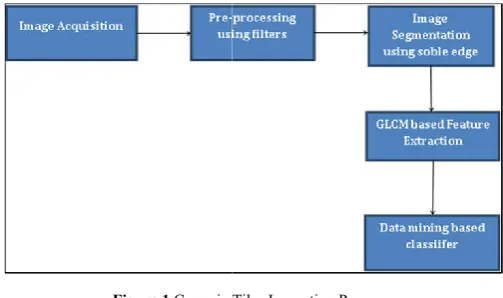
plays a vital role while examining the ceramic tiles related images. The structure of the ceramic tiles recognition process is shown in the figure 1.
Figure 1 Ceramic Tiles Inspection Process
According to the above figure 1, first the ceramic tiles images are collected which may contains the
the entire efficiency of the system. So, the collected images are processed step by step for improving the overall excellence of the automatic tiles inspection process which is
follows.
Image Pre-processing
The first step of the ceramic tiles inspection is to eliminate the noise present [13] in the image
Initially the images are collected; noise has been modelled as follows,
C(x,y)=A(x,y) +B(x,y)
Where A(x, y) is the original image pixel value and B(x, y) is the noise in the image and C(x, y) is the
After modelling the image, the noise present in the images is further examined with the help of the median filter [14] which analyzed each and every pixel present in the image. Each is compared with the neighboring pixel value, if the pixel is corrupted by the noise that has been
the median value. The median value is estimated by arranging all the pixels in the sorting order and the median value is calculated. The calculated pixel value is used to replace corrupted pixel value. This process is repeated until to eliminate the noisy pixel value. After that
further enhanced with the help of the continuous adaptive histogram equalization proce
analyzes the images by dividing into multiple region and normalize the pixels present in the image which are done by using the following eqn (2).
Where Pout denotes the normalized pixel value, Pin denotes the current pixel value, b is the upper
pixel value, d denotes the uppermost pixel value of input image and signify the smallest pixel value of input tile image. This process is repeated to normalize entire pixel present image. Then the particular edges and regions have to be
fferent processing steps such as image pre-processing, segmentation, feature extraction and inspection. Each step plays a vital role while examining the ceramic tiles related structure of the ceramic tiles recognition process is
Ceramic Tiles Inspection Process
According to the above figure 1, first the ceramic tiles images are collected which may contains the noise that leads to reduces the entire efficiency of the system. So, the collected images are step by step for improving the overall excellence of the automatic tiles inspection process which is explained as
The first step of the ceramic tiles inspection is to eliminate the noise present [13] in the image by using the filtering concept. Initially the images are collected; noise has been modelled as
C(x,y)=A(x,y) +B(x,y) (1) Where A(x, y) is the original image pixel value and B(x, y) is
e noise in the image and C(x, y) is the resulting noise image. After modelling the image, the noise present in the images is with the help of the median filter [14] which analyzed each and every pixel present in the image. Each pixel mpared with the neighboring pixel value, if the pixel is corrupted by the noise that has been replaced with the help of the median value. The median value is estimated by arranging in the sorting order and the median value is calculated pixel value is used to replace the corrupted pixel value. This process is repeated until to eliminate the noisy pixel value. After that the image contrast is further enhanced with the help of the continuous adaptive process. The histogram process analyzes the images by dividing into multiple region and the pixels present in the image which are done by
segmented for improving the further ceramic tiles inspection process which are explained as follows.
Image Segmentation
The next step is segmentation [15] which is
soble edge segmentation process. Initially ceramic tiles edges have to be analyzed with the help of the soble operator that helps to increase the overall efficiency of the system. During the edge segmenting process, the sobel operator
assumption about the edges discontinuity and gradient value of the image. By considering these assumptions, the images are examined with the help of the gradient value using following approximation values.
Where
dx
and are measure distance along the x and ydirections respectively. In discrete images, one can consider and in terms of numbers of pixel between two points.
dx
= =1 (pixel spacing) is the point at coordinates are (i, j) thus,In order to detect the presence of a gradient discontinuity, one could calculate the change in the gradient at (i, j).
done by finding the following magnitude measure and the gradient direction θ is given by
Based on the approximation and magnitude values, the edges are extracted with effective manner. From the segmented edges, it has to be verified by applying the Otsu’s method which compares each edge pixel with the neighboring pixels probability value and mean intensity measures. This process repeated continuously for determining the edges of the ceramic tiles with effective manner.
Feature Extraction
The next important step is feature extraction in which the important details are derived from the extracted image edges. Before extracting the features, Un-Decimated Discrete Wavelet Transform (UDWT) [16] is applied to the image for sampling the images with low and high frequency components. wavelet method examines the images, and divided into different lower and higher level components that reduce the array size decimation issues while examining the different features. The decomposed wavelet images consists of different bands of information such as low-low, low –
high –high of image information. After decompose the images into different levels, different features are derived from the image using the GLCM method [17]. Then the derived features are listed in the table 1.
ceramic tiles inspection
The next step is segmentation [15] which is done by using the Initially ceramic tiles edges have to be analyzed with the help of the soble operator that increase the overall efficiency of the system. During the edge segmenting process, the sobel operator consider the assumption about the edges discontinuity and gradient value of considering these assumptions, the images are examined with the help of the gradient value using the
(3)
(4) are measure distance along the x and y directions respectively. In discrete images, one can consider
dx
in terms of numbers of pixel between two points. =1 (pixel spacing) is the point at which pixel
(5) (6) In order to detect the presence of a gradient discontinuity, one gradient at (i, j). This can be done by finding the following magnitude measure
(7)
(8) Based on the approximation and magnitude values, the edges
From the segmented edges, it has to be verified by applying the Otsu’s method edge pixel with the neighboring pixels e and mean intensity measures. This process is repeated continuously for determining the edges of the ceramic
The next important step is feature extraction in which the extracted image edges. Decimated Discrete Wavelet (UDWT) [16] is applied to the image for sampling the images with low and high frequency components. This wavelet method examines the images, and divided into the components that reduce the array size decimation issues while examining the different decomposed wavelet images consists of different –high, high-low and gh of image information. After decompose the images different features are derived from the image using the GLCM method [17]. Then the derived features
Based on the above table 1 value, various features from the segmented images, which
ceramic tiles by using the data mining based classifiers which are explained as follows. Ceramic tiles classification using data mining techniques The last step is ceramic tiles inspect classification which are done by utilizing the different data mining techniques such as linear discriminate analysis (LDA), artificial neural networks (ANN),
(PNN) and back propagation neural networks (BPNN). The listed data mining techniques are effectively analyzing each and every pixel involved in the ceramic tiles
process. Each and every method is discussed as follow,
Linear Discriminant Analysis (LDA)
Linear Discriminant Analysis (LDA) [18] is a for data classification and dimensionality
of LDA is to preserve most of the class discriminatory information without losing any data. It has been used majorly in many real time applications such as image retrieval, face recognition, microarray data classification etc. In PCA, the shape and the location of the original data
transformed to different spaces whereas LDA doesn’t change the location but only tries to provide more class separation and draw decision between the given classes. In this
of the scatter matrices namely within
class (Sb) matrices quantify the quality. According to LDA computation between-class scatter is maximized while within class scatter is minimized. Such a transformation should reduce the variation caused due to sources
maintain large amount of class separation.
Where is with in class scatter and
Artificial Neural Networks (ANN)
The next important classifier is Artificial Neural Networks (ANN) [19], it is one of the supervised
which helps to separates the defected and non
features with effective manner. During the inspection process, the algorithm utilizes the three layers input, hidden and output layers. The input layer consumes the extracted features as the input which is processed by different
the output is generated with the help of the defined classes. The Artificial Neural Network (ANN) is connected with extracted Based on the above table 1 value, various features are derived from the segmented images, which are helps to inspect the ceramic tiles by using the data mining based classifiers which Ceramic tiles classification using data The last step is ceramic tiles inspection or classification which are done by utilizing the different data mining techniques such as linear discriminate analysis (LDA), artificial neural networks (ANN), probabilistic neural networks (PNN) and back propagation neural networks (BPNN). The mining techniques are effectively analyzing each and every pixel involved in the ceramic tiles classification process. Each and every method is discussed as follow,
Linear Discriminant Analysis (LDA)
Linear Discriminant Analysis (LDA) [18] is a technique used for data classification and dimensionality reduction. Principle of LDA is to preserve most of the class discriminatory any data. It has been used majorly in many real time applications such as image retrieval, face recognition, microarray data classification etc. In PCA, the shape and the location of the original data sets changes when transformed to different spaces whereas LDA doesn’t change only tries to provide more class separation and ision between the given classes. In this analysis, two of the scatter matrices namely within-class (Sw) and between quantify the quality. According to LDA class scatter is maximized while within mized. Such a transformation should reduce the variation caused due to sources namely illumination and maintain large amount of class separation.
(9) is with in class scatter and is between class scatter.
Artificial Neural Networks (ANN)
Optimized Data Mining With Image Processing Techniques
feature values for automatic defect detection in
The highly parallel dynamic system of ANN is consisting of several simple units that can execute transformation by their input information. The input features are defined as,
the desired output is
and the activation
Function is defined as sigmoid. Where n denotes number of input neurons j in the hidden layer.
Where in output layer neuron k is in number of input m.
is threshold levels
The given neuron weight is defined as and error gradient is defined as,
where = .[1- ].
weightcorrection is where
This process repeated to inspect the all ceramic tiles features with effective manner.
Probabilistic Neural Networks (PNN)
The next data mining based classifier is probabilistic neural networks (PNN) [20] which effectively examines each features present in the feature extraction process using the probability density function as the training algorithm. The PNN network recognizes each feature present in the network using the competitive manner that helps to determine according winner concept that is done by using the 4 layers such as input, hidden, pattern and decision layer. The input layer consumes the features from the previous step that are transmitted to the hidden layer. The hidden layer trains the feature using
kernel function and fed into the pattern layer in which the features are categorized according to the target value. The weight values coming from each of the hidden neurons adds up by denominator summation unit. Numerator summation unit adds up the weight values multiplied by the
for each hidden neuron. In decision layer, PNN networks the decision layer compares the weighted votes for each target category accumulated in the pattern layer and uses the vote to predict the target category. This process is repeated for examining the ceramic tiles with effective manner.
Back propagation Neural Networks (BPNN)
The last data mining based classifier is back propagation neural networks (BPNN) [21], it is one of the
multi-neural network that uses the three different layers, input, hidden and output layer. The input layer receives input from the previous feature extraction step which is
the input features that is fed into the hidden layer. The resul of the hidden layer is simulated which is defined as follows, The simulated result has been used to estimate the output value according to the input features which is defined as follows,
Optimized Data Mining With Image Processing Techniques
feature values for automatic defect detection in ceramic tiles. The highly parallel dynamic system of ANN is consisting of execute transformation by their input information. The input features are defined as,
the desired output is
and the activation
Function is defined as sigmoid. Where n denotes number of
(10)
(11)
Where in output layer neuron k is in number of input m.
θ(12) The given neuron weight is defined as
and error gradient is defined as, .[1- ]. and the . ceramic tiles features
The next data mining based classifier is probabilistic neural examines each features present in the feature extraction process using the probability as the training algorithm. The PNN network recognizes each feature present in the network using the competitive manner that helps to determine according to the 4 layers such as input, hidden, pattern and decision layer. The input layer consumes the previous step that are transmitted to the hidden layer. The hidden layer trains the feature using the RBF kernel function and fed into the pattern layer in which the to the target value. The weight values coming from each of the hidden neurons adds up denominator summation unit. Numerator summation unit actual target value for each hidden neuron. In decision layer, PNN networks the compares the weighted votes for each target category accumulated in the pattern layer and uses the largest This process is repeated for examining the ceramic tiles with effective manner.
Back propagation Neural Networks (BPNN)
The last data mining based classifier is back propagation neural -layer feed forward neural network that uses the three different layers, input, output layer. The input layer receives input from the previous feature extraction step which is transformed into the input features that is fed into the hidden layer. The resultant
is simulated which is defined as follows, (13) The simulated result has been used to estimate the output value
defined as follows,
Where,
When the error has been occurred during the inspection process, the gradient descent function is
weights and bias values that helps to Finally the output value is estimated as follows,
According to the above process, the derived features are successfully fed into the data mining based
inspecting the ceramic tiles which reduces the error rate that improves the overall efficiency of the system as well as the further user defined applications. Then the efficiency of the system is evaluated with the help of the experimental results and discussions defined in the following
Performance Analysis
In this section examines the efficiency of the proposed data mining based classifier such as linear
(LDA), artificial neural networks (ANN), probabilistic neural networks (PNN) and back propagation neural networks (BPNN) for inspecting the ceramic tiles. The effectiveness of the proposed ceramic tiles inspe
running the algorithm in MATLAB tool. The
analyzed by applying the image segmentation process on the ceramic tile image because it has the valuable information about the inner cells. From the image the efficien
proposed system efficiency is evaluated with the help of the true positive, true negative, false positive,
sensitivity, specificity and accuracy metrics. By using the above ceramic tile images, the efficiency of the medical image segmentation process is analyzed using the following performance metrics. The performance metrics that have been employed in this research work for analyzing the
of the proposed ANN classification is described below.
Sensitivity
Sensitivity is a measure used to find out how the proposed system correctly classifies the image pixels
manner. The sensitivity is measured as follows,
Specificity
Specificity measures how the proposed system correctly identifies the negative classifiers during the
segmentation process which is measured as follows,
Images
Sensiti True positive
(Tp)
True negati (T
PNN 93
BPNN 91
LDA 97
ANN 97
(14)
When the error has been occurred during the inspection process, the gradient descent function is used to updating the weights and bias values that helps to reduce the error rate.
value is estimated as follows,
(15)
(16) According to the above process, the derived features are successfully fed into the data mining based classifiers for inspecting the ceramic tiles which reduces the error rate that efficiency of the system as well as the fined applications. Then the efficiency of the system is evaluated with the help of the experimental results and discussions defined in the following section
In this section examines the efficiency of the proposed data classifier such as linear discriminate analysis (LDA), artificial neural networks (ANN), probabilistic neural back propagation neural networks (BPNN) for inspecting the ceramic tiles. The effectiveness of proposed ceramic tiles inspection system is analyzed by running the algorithm in MATLAB tool. The defects have been analyzed by applying the image segmentation process on the because it has the valuable information about the inner cells. From the image the efficiency of the proposed system efficiency is evaluated with the help of the true positive, true negative, false positive, false negative, sensitivity, specificity and accuracy metrics. By using the the efficiency of the medical image segmentation process is analyzed using the following metrics. The performance metrics that have been employed in this research work for analyzing the effectiveness of the proposed ANN classification is described below.
is a measure used to find out how the proposed system correctly classifies the image pixels with efficient manner. The sensitivity is measured as follows,
(17) Specificity measures how the proposed system correctly negative classifiers during the image segmentation process which is measured as follows,
21(18) nsitivity/Specificity
True negative Tn)
Falsepositive (Fp)
False negative(Fn)
32 28 29
38 31 31
28 25 21
Accuracy is statistical measure which is used to analyses how well the binary classifier recognizes the affected region in an optimized way. In addition, the accuracy is the proportion of the true results that includes both true positives and true negatives among the total number of cases examined. Then accuracy value is calculated as follows,
The accuracy value also has been determined by the sensitivity and specificity values which is defined as follows,
Based on the above performance metrics the obtained results are shown as follows Table 2 Sensitivity and Specificity Values of Ceramic tile Images The above table 2 clearly shows that the ceramic image efficiently recognize the affected region and eliminates the false region when compared to the other ceramic image in an effective manner that has been recognized successfully using the data mining techniques.
graph representation is shown in the figure 2
Figure 2 Performance analysis
The proposed system achieves the higher accuracy while segmenting the ceramic tile images which is shown in the table 3
Table 3 Classification Accuracy for Different Segmentation Techniques
S.No Segmentation Techniques
Classification Accuracy
1 LDA 89.6
2 PNN 92.2
3 BPNN 93.7
4 ANN 98.37
From the above table 3 clearly shows that the Histogram threshold sobel segmentation method achieving the better result 98. 37% when compared to the other existing segmentation methods and the related graph representation is shown in the figure 3.
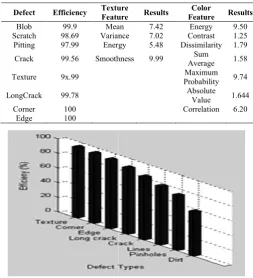
From the figure it clearly shows that the proposed data mining based classifiers successfully inspects the tiles due to effective segmentation of edges and parts form the images which done by applying the soble detection and adaptive histogram enhancement approach. Table 4 and figure 4 results show the proposed system classification has better efficiency of texture and color feature results. The proposed system displays the promising results in different types of ceramic tiles defects. Accuracy is statistical measure which is used to analyses how
the affected region in an optimized way. In addition, the accuracy is the proportion of that includes both true positives and true negatives among the total number of cases examined. Then the
(21) The accuracy value also has been determined by the sensitivity
as follows,
(22) Based on the above performance metrics the obtained results
Table 2 Sensitivity and Specificity Values The above table 2 clearly shows that the ecognize the affected region and eliminates the false region when compared to the other ceramic has been recognized successfully using the data mining techniques. The related
The proposed system achieves the higher accuracy while is shown in the table Classification Accuracy for Different Segmentation
Classification Accuracy (%)
89.6 92.2 93.7 98.37
From the above table 3 clearly shows that the Histogram achieving the better result 98. 37% when compared to the other existing segmentation the related graph representation is shown in the
From the figure it clearly shows that the proposed data mining the tiles due to effective segmentation of edges and parts form the images which are the soble detection and adaptive histogram Table 4 and figure 4 results show that the proposed system classification has better efficiency of proposed system displays omising results in different types of ceramic tiles defects.
Figure 3 Performance of the Accuracy
Table 4 Classification Efficiency
Defect Efficiency TextuFeatu
Blob 99.9 Mea
Scratch 98.69 Varian
Pitting 97.99 Energ
Crack 99.56 Smooth
Texture 9x.99
LongCrack 99.78
Corner 100
Edge 100
Figure 4 Classification Efficiency
Figure 4 show the efficiency of the proposed work, with sensitivity results 83.86% and specificity results with 99.99 %, these two experimental results shows the
terms of tile defect detection accuracy with
proposed data mining techniques with image processing techniques successfully inspecting the ceramic tiles with highest accuracy that reduces the further problems in different user preferred applications.
CONCLUSION
Thus the paper examining the different data mining techniques such as linear discriminate analysis
networks (ANN), probabilistic neural networks (PNN) and back propagation neural networks (BPNN) for inspecting the ceramic tiles. Initially the cer
noise present in the images are eliminated with the help of the median filter. From the noise
segmented using the soble method which is enhanced by
Performance of the Accuracy
Classification Efficiency ure
ure Results
Color
Feature Results
ean 7.42 Energy 9.50
ance 7.02 Contrast 1.25
gy 5.48 Dissimilarity 1.79
hness 9.99 Sum
Average 1.58
Maximum
Probability 9.74
Absolute
Value 1.644
Correlation 6.20
Classification Efficiency
ncy of the proposed work, with and specificity results with 99.99 %, experimental results shows the promising result in terms of tile defect detection accuracy with 98.44 %. Thus the proposed data mining techniques with image processing techniques successfully inspecting the ceramic tiles with highest accuracy that reduces the further problems in different
Optimized Data Mining With Image Processing Techniques
adaptive histogram approach. After that the images are decomposed into different sub images and GLCM features derived efficient manner. The extracted features are analyzed using the defined data mining techniques which successfully analyze the features in terms of applying the training algorithm, activation function, weights and bias values. At last the efficiency of the system is examined using the experimental results. Due to the advantages of the data mining technique, the defined classifiers successfully inspect the ceramic tiles.
References
1. R. Gonydjaja, Bertalya, T.M. Kusuma, Rectangularity defect detection for ceramic tile using morphological techniques. ARPN J. Eng. Appl. Sci. 9(11) (2014) 2. Y. Zhao, D. Wang, D. Qian, Machine vision based
image analysis for the estimation of pear external quality. In Second International Conference on Intelligent Computation Technology and Automation, IEEE, Oct 2009, pp. 629–632. ISBN: 978-0-7695-3804-4
3. R. Singh, G.C.Yadav, Corner defect detection based on inverse trigonometric function using image of square ceramic tiles. Int. J. Eng. Computer. Sci. 03(09), 8047– 8055 (2014). ISSN:2319-7242
4. Ž. Hocenski, T. Keser, Failure detection and isolation in ceramic tile edges based on contour descriptor analysis. In Proceedings of the 15th Mediterranean Conference on Control and Automation, 27 July 2007, pp. 1-6. ISBN: 978-1-4244-1282-2
5. Richard Bridge, “Computer Image Processing”. Tessella Support Services PLC, Oxon, England, Issue V1.R2.M0, June, 2003.
6. Stewart Coe, “Automatic Tile Inspection”. Surface Inspection Limited, International Ceramics, Bristol, U.K., Issue 1, 2000.
7. Xien Cheng and JinghuaZheng-Novel Approach of Surface Unfolding for Ceramic Bowls‖, I.J. Engineering and Manufacturing 2011, 3, 1-6.
8. Md. Maidul Islam, Md. RowshanSahriar and Md. Belal Hossain-An Enhanced Automatic Surface and Structural Flaw Inspection and Categorization using Image Processing Both for Flat and Textured Ceramic Tiles‖, International Journal of Computer Applications (0975- 888)Volume 48-No.3, June 2012.
9. Sameer Ahamad, Bhaskara Rao, “Analysis and Detection of Surface Defects in Ceramic Tile Using Image Processing Techniques”, Microelectronics, Electromagnetics and Telecommunications pp 575-582. 10. Meysam Siyah Mansoory; Hojjat Tajik; Gelareh
Mohamadi ; Mohsen Pashna, “Edge Defect Detection in Ceramic Tile Based on Boundary Analysis Using Fuzzy Thresholding and Radon Transform”, Signal Processing and Information Technology, 2008.
11. Rashmi Mishra, and C.L. Chandrakar, “Surface Defects Detection For Ceramic Tiles Using Image Processing And Morphological Techniques”, IJDW.
12. Yang Mingqiang, KpalmaKidiyo and Ronsin Joseph-A Survey of Shape Feature Extraction Techniques‖, IETRINSA, UMR-CNRS 6164, 35043 Rennes, Shandong University, 250100, Jinan.
13. R.C. Gonzalez, R. E. Woods, “Digital Image Processing”, Pearson Education (Singapore), Pte. Ltd., Indian Branch, 482 F.I.E, Partapgang, 2005 2006. 14. Xien Cheng and JinghuaZheng-Novel Approach of
Surface Unfolding for Ceramic Bowls‖, I.J. Engineering and Manufacturing 2011, 3, 1-6.
15. T. Sitamahalakshmi, Dr.A.Vinay Babu, M. Jagadeesh, Dr.K.V.V.Chandra Mouli, “Performance Comparison of Radial Basis Function Networks and Probabilistic Neural Networks for Telugu Character Recognition”, Global Journal of Computer Science and Technology Volume 11 Issue 4 Version 1.0 March 2011.
16. Neha Sharma and Hari Om, “Usage of Probabilistic and General Regression Neural Network for Early Detection and Prevention of Oral Cancer”, Hindawi Publishing Corporation Scientific World Journal, Volume 2015. 17. N. Elavarasan, Dr. K.Mani, “A Survey on Feature
Extraction Techniques”, International Journal of Innovative Research in Computer and Communication Engineering”, Vol. 3, Issue 1, January 2015.
18. Kyoung-Mi Lee and W. Nick Street, “An Adaptive Resource-Allocating Network for Automated Detection, Segmentation, and Classification of Breast Cancer Nuclei Topic Area:Image Processing and Recognition”, IEEE Transactions On Neural Networks, Vol. 14, No. 3, pp 680-687.
19. Jean-Luc Bouchot, GernotStubland Bernhard Moser -A template matching approach based on the discrepancynorm for defect detection on regularly textured surfaces‖, https://www.academia.edu.
20. R. Mishra, D. Shukla, An automated ceramic tiles defect detection and classification system based on artificial neural network. Int. J. Emerg. Technol. Adv. Eng. 4(3) (2014). www.ijetae.com; ISSN 2250-2459, ISO 9001:2008 Certified Journal
21. National Instruments, NI, ni.com, and Lab VIEW are trademarks of National Instruments Corporation. Refer to the Overview of the PID and Fuzzy Logic Toolkit, June 2009 Part Number 351286B-01
*******
How to cite this article:
Umamaheswari C et al.2017, Developing Automatic Ceramic Tiles Inspection System Using the Optimized Data Mining With Image Processing Techniques. Int J Recent Sci Res. 8(10), pp.21271-21276.