*Corresponding author: Prashanth H.K.
Department of Mechanical Engineering, R.R.Institute of Technology, Bengaluru, India
ISSN: 0976-3031
Research Article
SOLID WASTE SEPARATOR DESIGN FOR EFFECTIVE WASTE MANAGEMENT SYSTEM
Prashanth H.K.*., Keerthy Prasad B., Manjunatha G D
and M. Gururaj Naik
Department of Mechanical Engineering, R.R.Institute of Technology, Bengaluru, India
DOI: http://dx.doi.org/10.24327/ijrsr.2018.0907.2372
ARTICLE INFO ABSTRACT
Solid waste refers to multiple range of garbage waste which comes from animal and human activities that are left as unwanted and useless. Solid waste is also generated from industrial, residential and commercial activities and may be handled in a variety of ways. As such, landfills which typically classified as sanitary, municipal, construction and demolition or industrial wastes. Wastes are classified based on material such as plastic, paper, glass etc. This problem continues to grow with growth of population and development of industries. Disposal of solid wastes on land is most commonly used method in most of countries and accounts for more than 90 percent of the world’s municipal disposal. This work is concerned to design, model, and developing the systematic, economical and environmental friendly device which can be used to segregate the solid waste there by overcoming the problem associated with solid waste disposal majorly in urban areas.
INTRODUCTION
Semisolid or solid which are given by human or animal activities which are to be disposed because of hazardous nature of the waste is nothing but the solid waste. Most of the solid wastes, like woody, paper, plastic containers, bottles, cans, and even used cars and electronic goods are not biodegradable, which means they do not get broken down through inorganic or organic processes. Therefore they bring health problems and also very hazardous to our environment, decaying wastes also attract household pests and result in urban areas becoming unhealthy and dirty. Moreover, it also causes damage to terrestrial organisms, while also reducing the uses of the land for other, more useful purposes.
Since, World economy is growing day by day thus waste are produced in huge quantities there by producing economically unbalanced healthy nature. As per the regulation of international trade in waste has been uncompromising, and public opinion has become increasingly environmentally conscious, industrialized countries compulsorily need to develop something which deals with the waste they producing. Conventional waste management strategies include reusing the waste materials produced, recovering materials through recycling, incineration and landfills. In recent years recycling has become the preferred choice of waste disposal for many industries. Due to a shortage of research on its possible
economic and environmental friendly, the practice of reusing materials remains in very low range and every method of waste disposal has its drawbacks.
Waste reduction and reuse
Waste reduction and reusing of wastes are common method in waste controlling. They eliminate the production of waste at the source and control the need for large scale treatment and disposal facilities and investments. Methods of waste reduction include manufacturing products with less packaging which includes plastics, non bio degradable products, encouraging end users to bring their own reusable bags for packaging, encouraging the public to choose reusable products such as cloth napkins and reusable plastic and glass containers, backyard composting and sharing and donating any unwanted items rather than discarding them. All of the methods of waste prevention mentioned require public participation. In order to get the public onboard, training and educational programme need to be undertaken to educate the public about their role in the process. Also the government needs to regulate and control the types and amount of packaging used by manufacturers and make the reuse of shopping bags mandatory (Abhimanyu Singh et al, 2014.)
Recycling
Recycling refers to the removal of items from the waste stream to be used as raw materials in the manufacture of new products.
Available Online at http://www.recentscientific.com
International Journal of
Recent Scientific
Research
International Journal of Recent Scientific Research
Vol. 9, Issue, 7(D), pp. 27991-27995, July, 2018
Copyright © Prashanth H.K. et al, 2018, this is an open-access article distributed under the terms of the Creative Commons Attribution License, which permits unrestricted use, distribution and reproduction in any medium, provided the original work is properly cited.
DOI: 10.24327/IJRSR
CODEN: IJRSFP (USA)
Article History: Received 4th April, 2018 Received in revised form 25th May, 2018
Accepted 23rd June, 2018 Published online 28th July, 2018
Key Words:
This recycling occurs in three phases: first the waste is and recyclables collected, the recyclables are used to create raw materials. These raw materials are then used in the production of new products. The separation of recyclables may be done at the source for selective collection by the municipality o dropped off by the waste producer at recycling centers. The pre-sorting at the source requires public participation. Also a system of selective collection by the government can be costly. It would require more frequent circulation of trucks within neighborhood or the importation of more vehicles to facilitate the collection.
Waste collection
Waste from domestics is generally collected by local authorities like BBMP in Bengaluru through regular waste collection procedure or by special collections for recycling. Within hot climates such as that of the Caribbean the waste should be collected at least twice a week to control fly breeding, and the harboring of other pests in the community. Other factors to consider when deciding on frequency of collection are the odors caused by decomposition and the accumulated quantities (Abhimanyu Singh et al,
Treatment & Disposal
Waste treatment techniques are concerned in transforming the waste products into a form which is manageable; reduce toxicity of the waste thus making the waste easier for the disposal. Treatment methods are selected based on composition of the waste, quantity, and form of the waste material. Some waste treatment methods being used today include subjecting the waste to extremely high temperatures, dumping on land or land filling and use of biological processes to treat the waste.
Methodology of the Design-Working Procedure
Manual Solid Waste Segregation is a very tedious and very time-consuming job. Considering the need for automatic Solid waste segregation especially in cities like Bengaluru, Hyderabad and other major cities, where tons of garbage is produced on daily basis, an idea is proposed where house hold solid waste is segregated automatically and is collected at different collection points. The house hold waste mainly consists of Paper, Paper clips, Plastic, Pins, Nails, Bottles, Solid Waste etc. The idea for the current work is to segregate the household waste based on three different criterions, namely
Figure 1 Solid waste management hierarchy
Better option to reduce the waste
Re-Using the Produced wastes
Recycling/Compost
Combining with energy Efficient and Recovery agency
Incineration
Underground Burying (Not Recomonded)
This recycling occurs in three phases: first the waste is sorted and recyclables collected, the recyclables are used to create raw materials. These raw materials are then used in the production of new products. The separation of recyclables may be done at the source for selective collection by the municipality or to be dropped off by the waste producer at recycling centers. The sorting at the source requires public participation. Also a system of selective collection by the government can be costly. It would require more frequent circulation of trucks within a neighborhood or the importation of more vehicles to facilitate
Waste from domestics is generally collected by local authorities like BBMP in Bengaluru through regular waste collection procedure or by special collections for recycling. Within hot climates such as that of the Caribbean the waste east twice a week to control fly breeding, and the harboring of other pests in the community. Other factors to consider when deciding on frequency of collection are the odors caused by decomposition and the
et al, 2014.)
Waste treatment techniques are concerned in transforming the waste products into a form which is manageable; reduce toxicity of the waste thus making the waste easier for the disposal. Treatment methods are selected based on the composition of the waste, quantity, and form of the waste material. Some waste treatment methods being used today include subjecting the waste to extremely high temperatures, dumping on land or land filling and use of biological processes
Working Procedure
Manual Solid Waste Segregation is a very tedious and very consuming job. Considering the need for automatic Solid especially in cities like Bengaluru, Hyderabad and other major cities, where tons of garbage is produced on daily basis, an idea is proposed where house hold solid waste is segregated automatically and is collected at hold waste mainly consists of Paper, Paper clips, Plastic, Pins, Nails, Bottles, Solid Waste etc. The idea for the current work is to segregate the household waste based on three different criterions, namely
a. Ferro-metallic scrap material b. Light weight waste material c. Centrifugal separation
This Design explains in depth the design principle
Design principle Stage Module Concept
The main intention of adding modular design principle is described below briefly. When designing a system synthetically (such as an electronic machinery, a biological enzyme or a building), the system could be designed by two broad ways. The first way would be to design the complete system using the known theories and use the system as
conditions. An alternative way would be to design the different components of the system separately and test each component in separate conditions. Modular design or "modularity in design” is an approach that subdivides a system
parts (modules) that can be independently created and then used in different systems to drive multiple functionalities. A modular system can be characterized by the following:
Functional partitioning into discrete scalable, reusable modules consisting of isolated, self
elements.
Rigorous use of well including object-oriented functionality.
Ease of change to achieve technology transparency and to the extent possible, make
key interfaces.
Stage1: Hopper
The main concept behind hopper is to ease out the flow of solid waste and house the waste into enter into magnetic chamber.
Stage2: Magnetic Waste Separator
The main concept behind this stage
magnetic waste by using permanent magnets and electro magnet.
Stage3: Blower
The main concept behind this stage is to separate out the light waste like paper, plastic bags etc. by blowing technique.
Stage 4: Centrifugal Separator
The main concept behind this stage is to separate out heavy waste from the light waste by using the centrifugal concept.
Solid waste management hierarchy Better option to reduce the waste
Using the Produced wastes
Combining with energy Efficient and
Underground Burying (Not Recomonded)
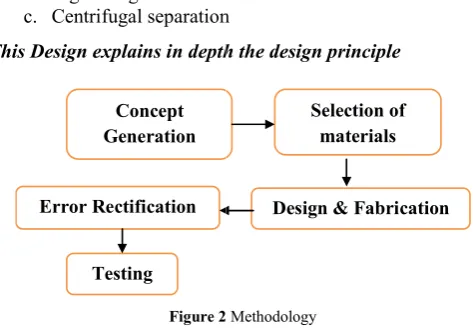
Figure 2
Concept Generation
Testing Error Rectification
metallic scrap material te material Centrifugal separation
This Design explains in depth the design principle
The main intention of adding modular design principle is When designing a system synthetically (such as an electronic machinery, a biological enzyme or a building), the system could be designed by two broad ways. The first way would be to design the complete system using the known theories and use the system as it is designed in the real conditions. An alternative way would be to design the different components of the system separately and test each component in separate conditions. Modular design or "modularity in design” is an approach that subdivides a system into smaller parts (modules) that can be independently created and then used in different systems to drive multiple functionalities. A modular system can be characterized by the following:
Functional partitioning into discrete scalable, reusable isolated, self-contained functional Rigorous use of well-defined modular interfaces, oriented descriptions of module Ease of change to achieve technology transparency and to the extent possible, make use of industry standards for
The main concept behind hopper is to ease out the flow of solid waste and house the waste into enter into magnetic chamber.
Stage2: Magnetic Waste Separator
The main concept behind this stage is to separate out the magnetic waste by using permanent magnets and
electro-The main concept behind this stage is to separate out the light waste like paper, plastic bags etc. by blowing technique.
Stage 4: Centrifugal Separator
The main concept behind this stage is to separate out heavy waste from the light waste by using the centrifugal concept.
Figure 2 Methodology
Selection of materials
International Journal of Recent Scientific Research Vol. 9, Issue, 7(D), pp. 27991-27995, July, 2018
27993 |
P a g e
Selection of material
Design and fabrication
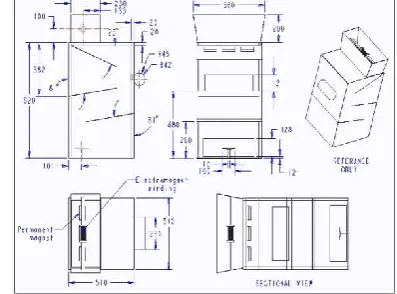
The system is designed stack up-type modular design. The basic module with minimal modular requirement will contain hopper, magnetic separator, blower and centrifugal modules stacked vertically. Additional module added will increase the height of the system without affecting the floor space. The minimum system has a total height of 120cm and cross section of 51*51cm throughout the height.
Figure 3 Basic Structure
Figure 4 Frame
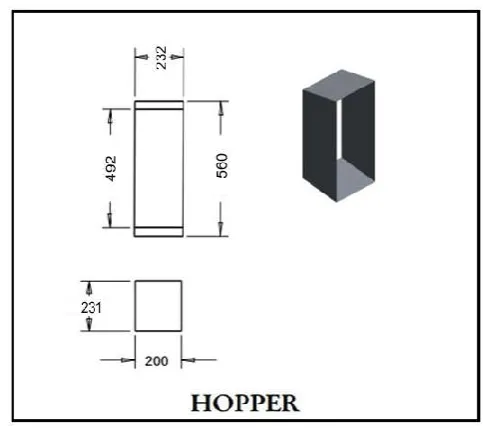
Hopper
The hopper is a four walled chamber which is objectively designed so as to ease flow of the waste material and to send the garbage inside the bin in batches. The above mentioned functions are the primary purpose of the hopper. This makes it simpler to send it to the next level of segregation (or sorting) and thus the efficiency of the separation increases.
Design Aspects: Hopper is a four walled box which is designed based on simplicity. It is in square shape, since it is easy to manufacture/handle and also helps to easily design and fit the inner components.
Constructional Details
Figure 5 Hopper
This is simple in construction, four side outer walls are constructed by using 18-gauge Galvanized sheet metal having a thickness of 1.214mm, they joined by using Electric arc welding process and made it as invert truncated pyramid in shape for easy flow of waste materials to the next stage. From the view shown in the figure the length of the hopper is 51cm and the height is 20 cm, material used is 18gauge Galvanized sheet metal having a thickness of 1.214mm.
Magnetic separator
The function of this particular module is self-explanatory. The name of this section suggests or gives an idea about the function it performs. That is, it separates out Ferro metallic wastes. Solid waste material consists of metallic scraps which can be recycled. For that reason, the need for separating out metallic scrap is very crucial. Small paper clips, screws, staple pins, hair clips, needles, soft drink tin cans are some of the examples of waste consist of metallic waste.
Design Aspects: This stage is designed in such a way that it collects the magnetic waste. The chamber which collects the magnetic waste is designed such that when the door opens all the magnetic waste can be collected at the exit door. In order to avoid the waste from escaping the fiber glass a sheet metal guide is provided at the collection tray of light particles (blower).
Material used: Electromagnet, permanent magnets and sheet metal.
Table 1Selection of material
Sl. No. Components/Materials
1 Sheet metal (18 gauge)
2 M.S Square pipe (16 gauge)
3 Electromagnet and Permanent magnet
4 Blower
5 D C motor
6 Battery (12V DC)
7 Nut and Bolt
8 Centrifugal plate
Table 2 Basic Structural Dimension
Sl. No. Stage Height (in cm) Cross section (cm)
1 Hopper 20 51*23
2 Magnetic material
separator 20 51*51
3 Blower 40 51*51
4 Centrifugal separator 40 51*51
Constructional Details
Figure 6 Magnetic Separator
The electromagnet employed uses a 15mm Ms round of length 10 cm. The ends of round are welded with collars of diameter 60 mm. The bar is winded with 600 copper winding turns. The electromagnet is fixed at the hopper section which welded to the frame by electric arc welding.
Blower
Blower is the basic separation technique for separating light particles. In this stage on of blower which continuously blow air at high velocity. Since the waste materials can be of different kinds, so the light materials like paper, wrappers and small plastic pieces are collected in this stage.
Design Aspects: The design is just as simple as the farming technique in which the rice is separated from husk. When the rice grains are dropped from a height and the wind blowing in that direction carries away the dust and husk. In the same way the garbage which comes from the hopper has light materials which can be easily blown.
So we have arranged motor with blower/fan (car duct) on one side of a square box. So that when the garbage is slowly released from hopper into blower stage then the light particles are blown away and these light particles are collected in a bin which is located just below on the opposite wall of the blower. The rest of the materials falls down due to gravity and gets separated accordingly.
Material and components used: a) 12 V motor 1 for blower b) Sheet metal for blower case.
Centrifugal separator
The main purpose of the Centrifugal separator as the name implies is to separate the waste based on mass. The heavy particles flyaway whereas the light part will be in the centrifuge itself. One more purpose of the centrifuge separator is to allow the heavy particles to be blown away in only one direction i.e. only along the way of the door.
Figure 7 Blower
Centrifugal separator
The main purpose of the Centrifugal separator as the name implies is to separate the waste based on mass. The heavy particles flyaway whereas the light part will be in the centrifuge itself. One more purpose of the centrifuge separator is to allow the heavy particles to be blown away in only one direction i.e. only along the way of the door.
Design Aspects: For the design of the centrifuge first thing to be considered is the threshold value of the weight that should be thrown away and the weight that should be within. This value is calculated using trial and error method. Diameter and the height of the centrifuge were determined in the same way. RPM of the motor was first fixed then the diameter of the cone was determined. To avoid the heavy waste from spilling in every direction aligning ramps are provided. These are designed by measuring the distance from the cone to the end of the box after fixing the cone with the motor.
Material and component used: a) 12V, 300rpm DC Motor for turning the plate. b) MS plate with thickness 5mm.
Construction details
The motor used is a 12 V 300 RPM high torque motor which is fixed to the base with the help sheet metal clamps. The diameter of the cone is 37 cm and half cone angle is 65 cm. The height of the base of the cone from the base wood is 10 cm. There is convex plate which is motored by a motor of 300 RPM coupled to 10 mm shaft. The shaft and the plate are fastened by electric arc welding.
International Journal of Recent Scientific Research Vol. 9, Issue, 7(D), pp. 27991-27995, July, 2018
27995 |
P a g e
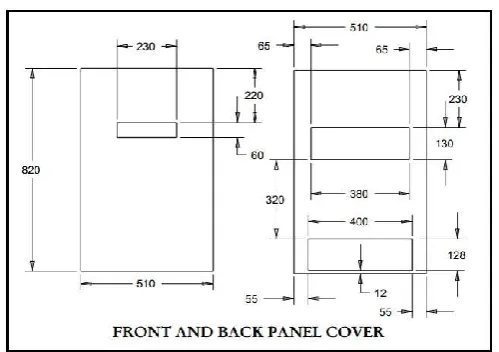
Figure 9 Front and back panel cover
CONCLUSION
Solid Waste Separator design has been successfully done for the separation of waste into different categories like metallic, dry and heavy weight waste at domestic level. This design can be used to modeling and fabrication of solid waste segregation system for neat, Non hazardous and healthy environment, also improvements can be done to this design to obtain automation.
References
1. Abhimanyu Singh, Jamshed Zaidi, DivyaBajpai, Gunjan, (2014), Municipal solid waste management challenges and health risk problematic solutions at Agra city, U. P., India, By Institute of Environment & Development Studies, Bundelkhand University, Jhansi, India.
2. RanjithAnnepu (2014), Solid Waste Management – India’s Burning, Solid Waste Management, November 6, 2014, India.
3. Sunil Kumar , (2005), Municipal Solid Waste Management in India: Present Practices and Future Challenge,15 August 2005
4. SudhaGoel, (2000), Journal of Environ.science & Engg. ‘Municipal solid waste management(MSWM) in India-A critical review’, Vol.50,No.4,P.319-328,October 2000 5. Decision Makers’ Guide to, Municipal Solid Waste, Incineration,(1999) The International Bank for Reconstruction and Development / THE WORLD BANK1818 H Street, N.W.Washington, D.C. 20433, U.S.A
6. International Directory of Solid Waste Management, (1998-1999), The ISWA Year book
7. Report of the National commission on urbanization, (1988), Vol. IV.
8. World Health Organization Technical Report Series No. 484, Solid Waste Disposal & Control, Report Of W.H.O. Expert Committee
9. United Nations Environment Programme International Source Book on Environmentally Sound Technologies (ESTs) for Municipal Solid Waste Management (MSWM)
10. What a waste, solid waste management in Asia, (1999), Urban Development Sector Unit East Asia and Pacific Region.
11. Santoshkumar Garg, Sewage Disposal & Air pollution Engg, Environmental Engineering Vol-2
How to cite this article:
Prashanth H.K. et al. 2018, Solid Waste Separator Design for Effective Waste Management System. Int J Recent Sci Res. 9(7), pp.27991-27995. DOI: http://dx.doi.org/10.24327/ijrsr.2018.0907.2372