August 2018
Minimal Graphs with a Specified Code Map Image
Paul Feit
University of Texas of the Permian Basin, [email protected]
Follow this and additional works at:https://digitalcommons.georgiasouthern.edu/tag Part of theDiscrete Mathematics and Combinatorics Commons
This article is brought to you for free and open access by the Journals at Digital Commons@Georgia Southern. It has been accepted for inclusion in Theory and Applications of Graphs by an authorized administrator of Digital Commons@Georgia Southern. For more information, please contact [email protected].
Recommended Citation
Feit, Paul (2018) "Minimal Graphs with a Specified Code Map Image,"Theory and Applications of Graphs: Vol. 5 : Iss. 2 , Article 4. DOI: 10.20429/tag.2018.050204
Cover Page Footnote
The author thank Dr. C.Kang for suggesting that graphs be studied based on the image of their code maps.
Abstract
LetGbe a graph ande1,· · · , enbendistinct vertices. Letρbe the metric onG. The
code map on vertices, corresponding to this list, isc(x) = (ρ(x, e1),· · · , ρ(x, en)). This
paper introduces a variation: begin withV ⊆Zn for somen, and consider assignments
of edges E such that the identity function on V is a code map forG= (V, E). Refer to such a setE as a code-match.
An earlier paper classified subsets of V for which at least one code-match exists. We prove
• If there is a code-match E for which (V, E) is bipartite, than (V, E) is bipartite for every code-matchE.
• If there is a code-matchE for which (V, E) is a tree, thenE is unique.
• There exists a code-matchE such that (V, E) has a (2n−1+ 1)-vertex-coloring.
Keywords: Metric Dimension; Distance in Graph; Coloring; Trees AMS Classification: Primary 05C12, Secondary 05C62
Introduction
Assume all graphs are undirected and contain no multiple edges nor loops. For all other basic terminology, see [2]. We denote the shortest path distance function on vertices of G
by ρG or, when the graph is clear from context, ρ. Let G be a graph and letw1,· · · , wn an
irredundant list of n vertices ofG. Define the code map of this selection to be the function fromV to n-tuples of integers given by
c:v 7→(ρ(v, wn),· · · , ρ(v, wn)).
We refer to the image of v under this as its code.
Given n ∈ N and V ⊆ Zn, we say V is codeable if there is a set of edges E for which
(V, E) becomes a connected graph andV contains a list of n vertices whose associated code map is the identity function. Such a set E is said to code-match V.
In [4], codeable set are characterized. A result is that if V is codeable, there are many choices for code-matches. Given a codeable set V, we pose the question: can we select a code-match for which (V, E) has certain properties? This paper proves three results in this direction.
(1.a) If there is a code-match E for which (V, E) is bipartite, than (V, E) is bipartite for
every code-matchE.
(1.b) If there isE for which (V, E) is a tree, then that E is unique.
(1.c) There is E for which (V, E) is (2n−1+ 1)-vertex-colorable.
The bound 2n−1+ 1 should be something that can be improved for large n. For n= 2, this
1
Notation and Formal Details
Forn ∈N, let Ind(n) be the set of natural numbers from 1 to n, inclusive.
Let G = (V, E) be a graph. We model each edge as an unordered pair of two different vertices. Forx∈V, let NG(x) be the neighbors of x. When the graph is clear from context,
write N(x) forNG(x).
Let n ∈ N. We consider members of Zn as vertices of graphs. In this context, when we use a variable x to represent a member of Zn, then, for each i ∈ Ind(n), we represent the
i-th coordinate in x byxi. An edge is an unordered pair of n-tuples.
The earlier paper restricts the set of unordered pairs that can be edges in the constructions of interest. Let Ed(n) be the set of unordered pairs of membersxy from Zn such that
(2.a)x6=y, and
(2.b) for i∈Ind(n), |xi −yi| ≤1.
Let V ⊆ Zn be a finite, non-empty subset. Define Ed(V) to be all xy ∈ Ed(n) such that x, y ∈V. We say V is codeable (of rank n) if there is E ⊆Ed(V) for which
(3.a) (V, E) is a connected graph, and
(3.b) there is a list e1,· · ·, en ∈ V with respect to which the code map is the identity
function.
Furthermore, any suchE is said tocode-match V. We refer toG= (V, E) asself-coded graph
(of rank n).
Let V ⊆ Zn be a codeable subset and let E ⊆ Ed(V). We say E meets the match criterion (for V) if and only if
(4) for every i ∈ Ind(n) and every x ∈ V for which xi > 0, there is y ∈ V for which xy∈E and yi =xi−1.
We paraphrase Definition 2.1 and Proposition 2.1 from [4] as follows:
Proposition 1.1. Let V ⊆Zn be a codeable set. Let W ⊆V, and let E ⊆Ed(W).
(A)If E satisfies the match criterion for W, then W is codeable.
(B)Suppose W is codeable. Then E code-matches W if and only if it satisfies the match criterion for W.
Clearly, not every subset V ⊆ Zn is codeable. Any member of a codeable set V must
have non-negative entries. Furthermore, for each i ∈ Ind(n), exactly one member (which must be the ei of (3)) has 0 for itsi-th coordinate.
Codeable sets are characterized in [4]. In particular, Corollary 1.1 of that paper states that
(5) The image of a code map on a connected graph and a choice ofnvertices is codeable.
2
Future and History
The primary purpose of this paper is to argue that minimal code-matchs merit more study. In passing, we identified two questions, one concerning homotopy and the other about coloring. An important motivation for the present author wasHernando et al.[6]. Those mathe-maticians obtained a tight bound on the maximum size of graph of dimensionnand diameter
d by constructing, in the current language, a codeable set of n-tuples in which every coor-dinate was d or less. The set of all such tuples is not codeable. However, a step in [6] constructs the largest such set (and establishes that its size is maximum). That paper re-quired a “maximal” code-match of edges. The set of edge needed to be large in order to imply that the diameter of the graph is d. (In a graph in which every member is d units from a fixed vertex, the diameter could be as large as 2d. )
This powerful result, and a problem posed by Dr. Cong Kang. spurred the current investigation of codeable sets.
Are there implications about metric dimension, if we switch from maximal choices (of vertices and edge)s to minimal choices? The history of metric dimensions suggests that small changes to a graph can change dimension radically. Eroh et al. in [3] give examples in which an added edge can wildly alter dimension. The same paper considers a family of graphs for which an additional edge has a very predictable effect. Examples in Section 2 of [4], and the discussion about Figure 1 above, show that there are many ways to assign edges to a specific codeable set. This flexibility on edges gives a heuristic reason to doubt that a general assertion related to metric dimension can be formulated in the present language.
There are two limited problems for which solutions might lead to results related to metric aspects.:
(6.a) Let E be a minimal code-match for a codeable set V. Let d be the maximum value of any coordinate of any member of V. Under a reasonably broad hypothesis, is there a lower bound for the diameter of (V, E) which is significantly greater thand? Likewise, is there an upper bound which is significantly <2d?
(6.b) Let V be a codeable of rank n. For each list ω =w1,· · · , wn−1 of n−1 members of
V and each code-match E, define the following set. Let f be the code map for ω. Let δ(ω, E) be all v ∈V for which there isx=6 v such that f(x) =f(v). Now let ∆ be the minimum of all sizes of all δ(ω, E). Under a reasonably broad hypothesis, is there an bound for ∆/|V|?
3
Minimal Submatchs
Let V ⊆ Zn be a codeable set. For E a code-match, we refer to a subset of E that is also
a code-match as a submatch. Refer to a code-match E as minimal if there is no proper submatch. Then every code-match contains at least one minimal submatch.
A general challenge is to identify graph properties of (V, E) in which E is a minimal code-match.
Lemma 3.1. Let G= (V, E) be a self-coded graph of rank n. Fix i ∈Ind(n). Then G is a tree if and only if
(7.a)For xy∈E, xi 6=yi, and
(7.b)For x ∈V such that xi >0, there is a unique y ∈V such that yi =xi −1 and xy∈E.
Proof. Recall that a graph G is not a tree if and only if there is a circuit of G that uses some edge exactly once. Furthermore, if G is not a tree, there is a circuit in which no edge is repeated.
We have a series of cases. Let ei be thei-th generator of the code map. That is, ei is the
unique member ofV whose i-th coordinate is 0.
Suppose xy ∈ E and xi =yi. Consider the circuit which starts with a geodesic from ei
to x, then xy, and then a geodesic from y to ei. The circuit traverses the edge xy exactly
once. Hence, there is a non-degenerate circuit in G, and G is not a tree.
Suppose y, z are different neighbors ofx such that yi =xi−1 =zi. Consider the circuit
composed of a geodesic from ei to y, then yx and xz, and then a geodesic from z to ei. In
this circuit, yx and xz are each traversed exactly once.
Conversely, suppose that C is a circuit in which no edge is repeated. Let x ∈ C be a vertex for which ρ(x, ei) =xi is a maximum among vertices in C. Then x has two different
neighbors in C, andρ(y, ei) isxi orxi−1 for each neighbory. Hence, at least one of (7.a,b)
fails.
Theorem 3.2. Let V be a codeable set of rank n. Then there is at most one code-match E for V such that G= (V, E) is a tree.
Proof. First, suppose the rankn of V is odd. Letn = 2k+ 1.
We start with notation. Let P(n) be the set of subsets of {1,· · · , n}. Let x∈V. Define
f(x) =
n X
i=1
xi .
ForJ ∈P(n), let x(J) be the n-tuple such that, for each index i,
(8.a)x(J)i =xi−1 if i∈J, and
(8.b)x(J)i =xi+ 1 ifi /∈J.
Observe thatf(x(J))> f(x) if and only if|J| ≤k, and that f(x(J))< f(x) otherwise. Suppose that E code-matches V, and G = (V, E) is a tree. By Lemma 3.1, for x ∈ V, each neighbor of x inG isx(J) for exactly one J ∈P(n).
Let S(x) be the set of i∈Ind(n) for which xi >0. The matching criterion and Lemma
3.1 imply that there is an indexed partition J1,· · · , Jr of S(x) such that the neighborhood
of x is
Note that we allow Ju =∅ for at most one index u.
We proceed by contradiction. Suppose thatE1 and E2 are different two code-matches for
V. For j = 1,2, let Gj = (V, Ej). We let Nj(x) be the neighborhood of x∈V with respect
toGj. Assume each Gj is a tree. Let X be the set ofx∈V such that N1(x)6=N2(x).
Assume X 6=∅. Let x∈X so thatf(x) is maximal for f restricted to X. Then there are partitions J1,· · · , Jr and K1,· · · , Ks of S(x) such that
N1(x) ={x(J1),· · · , x(Jr)} and N2(x) = {x(K1),· · · , x(Ks)} .
Without loss of generality, assume J1 is not equal to any Kv.
If, for any index u, Ju has size ≤k, then x(Ju) is a neighbor of x and f(x(Ju))> f(x).
The choice ofx implies thatx(Ju) is a neighbor in bothG1 and G2. Consequently,Ju =Kv
for some index v. Likewise, eachKv with k or fewer members must beJu for some index u.
It follows that
(9.a)|J1| ≥k+ 1,
(9.b) For 2≤u≤r,|Ju|< k and Ju =Kv for some index v.
(9.c) We can renumber theKv list so that for some indext≥2, the sublistK1,· · · , Kt
lists all members not in the J-partition and this sublist is a partition of J1 which
does not contain J1.
But then there is some Kv which is a non-empty subset of J1 with ≤k members. This Kv
would also appear in the J partition, which contradicts the partition property.
It remains to address the assertion when n is even. We resolve this case by embedding it in the n+ 1 case.
Let G= (V, E) be self-coded graph of rank n, wheren is even. For i∈Ind(n), let ei be
the member ofV with 0 for its i-th coordinate. Define H= (W, F) to be the graph created by adding (toG) a new vertex, labeleden+1, and a single edgeenen+1. The tuple represented
byen is
en = (a1,· · · , an−1,0).
Letc be the code map forH based on the list e1,· · · , en, en+1. Then
(10.a) The image of x= (x1,· · · , xn)∈V is c(x) = (x1,· · · , xn, xn+ 1).
(10.b)c(en+1) = (a1+ 1,· · · , an−1+ 1,1,0).
(10.c) Let V+ = c(W) and E+ = {c(x)c(y) : xy ∈E}. Note that V+ depends only
on V.
(10.d) Then G+ = (V+, E+) is a self-coded graph and c is a graph isomorphism
H −→G+.
(10.e)G is a tree if and only if G+ is a tree.
Now suppose V is codeable of rank n and E1, E2 are code-matching sets that generate two
trees Gj = (V, Ej). Then (V+, E1+) and (V+, E2+) are trees based on the same codeable set.
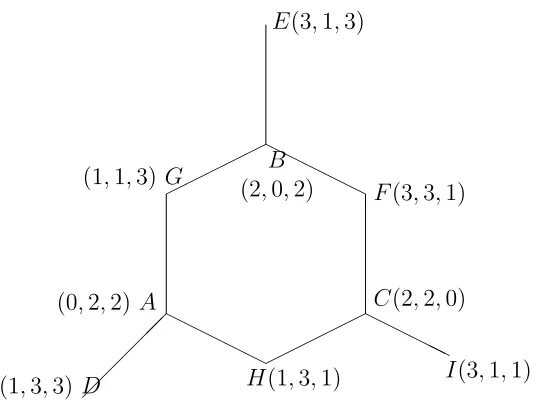
Figure 1: An Initial Graph
(1,3,3) D
(0,2,2)A H
H H
H H
H(1,3,1) (1,1,3) G
B
(2,0,2)
E(3,1,3)
C(2,2,0)
H H
H H
H F(3,3,1)
H H
H HH
I(3,1,1)
3.1
Minimal and Not a Tree
An example illustrates the variability among minimal matches. Consider the following code-able set of rank 3. We assign a varicode-able name to each vertex:
A(0,2,2), B(2,0,2), C(2,2,0), D(1,3,3), E(3,1,3), F(3,3,1), G(1,1,3), H(1,3,1), I(3,1,1).
The list of vertices for the canonical code map is A, B, C. Each of the other triples has at least one coordinate equal to 1, which indicates it has an edge to the corresponding member of A, B, C. Figure 1 illustrates the graph created by adjoining these edges. As it happens, this initial choice of edges is a code-match.
Now consider adding a new vertexP(2,2,2). Here are three ways to expand the edges:
(11.a) AddP D, P E and P I, or
(11.b) AddP D and P F, or
(11.c) Add P F and P H.
These options result in three non-isomorphic graphs. Each is minimal. Note that the number of edges is not the same for the three.
Adding six edges
also produces a code-match. This observation shows that the minimality condition identifies comparatively simple graphs among all that arise from code-matches.
There is variation among minimal matches. But how varied?
Question 1. For eachn ∈N, is there a codeable setV which has two different minimal code matches, of which one is a tree?
In our previous example, we generated distinct minimal submatchs by adjusting edges attached to a single vertex. Lemma 3.1 suggests that creating a second minimal match on vertices from a tree is much more complicated. The lemma reduces the criterion for being a tree to a feature attached to afixed index i. But, to fail to be a tree, there must be a “bad” edge for every i. The failure for all indices cannot be shifted to a lone vertex.
4
Coloring
By a coloring of a graphG= (V, E), we mean a proper vertex coloring; that is, each vertex is assigned a color so that no edge links vertices of the same color.
We open this section with an observation related to Question 1. Suppose there is a codeable set V which has a code-match that determines a tree. A comment in [4] implies that every code-match is bipartite! We briefly expand (15) from that paper into a formal theorem.
Proposition 4.1. LetV be a codeable set of rankn. The following assertions are equivalent
(13.a)There is a code-match E such that (V, E) is bipartite.
(13.b)For each x = (x1,· · ·, xr) ∈ V, either xi−xj is even for all indices i 6=j or xi−xj is odd for all i6=j.
(13.c)For every code-match E, (V, E) is bipartite.
Proof. In this argument, define theparity of a natural number to be its congruence mod(2). First, let Gbe connected graph and x∈V(G). Let EvG(x) andOddG(x) be the subsets
of vertices whose distance from x is even and odd, respectively. If G is bipartite, then the unordered pair {EvG(x), OddG(x)} is the unique partition of V(G) into two sets such that every edge has an end in each subset.
Assume (13.a). LetG= (V, E) for the specifiedE. Leti, j be two different indices. Letei
and ej be the corresponding members in the list for the canonical code map for V. For each
x∈V, xi and xj are distances from ei and ej, respectively. By our first observation, xi and xj must always have the same parity or must always have opposite parity. This translates
to condition (13.b)
Assume (13.b). Suppose E is any code-match. Let xy ∈ E. There is some index i for which |xi−yi| = 1. In other words, yi has the parity opposite to xi. An easy consequence
of (13.b) is that for any other index j, xj and yj must have opposite parity. In particular, the parity of y1 is opposite to that of x1. It follows that {EvG(e1), OddG(e1)} is a bipartite
decomposition for (V, E).
A general, if trivial, fact is
Lemma 4.1. Let V be a codeable set of rank n. Let E be a code-match for V. Then G= (V, E) can be colored with 2n colors.
Proof. Assign a different color c(S) to each subset S ⊆ Ind(n). Color each x ∈ V using
C(S) where
S ={ i∈Ind(n) : xi is even} .
The proof of Proposition 4.1 in [4] offers an example in which 2n colors are needed. It provides a set V, a code-match E and a number b, so that (x1,· · ·, xn)∈V for every tuple
in which eachxi ∈ {b−1, b, b+ 1}. Just the tuples with coordinates b or greater yield a copy
of K2n in (V, E).
The previous example uses anEwith every possible edge. That leaves open the possibility that a smaller choice of edges might allow for a smaller covering. We prove a result of this kind.
Proposition 4.2. LetV be a codeable set of rank n. Then there exists a code-match E such that G= (V, E) is (2n−1 + 1)-vertex-colorable.
When n= 2, it is simple to find an example which requires 21 + 1 = 3 colors. However,
the author expects that the bound can be improved for larger n.
Proof. The assertion is trivial ifn = 1. Assume n≥2. Let
V1 ={(x1,· · ·, xn−1) :∃y ∈Z, (x1,· · · , xn−1, y)∈V} .
There is an alternate description. For i∈Ind(n), let ei be the only member of V with 0 as
its i-component. Then V1 is the image of the code map based on e1,· · · , en−1. This map is
not injective, but (5) implies that V1 is codeable.
In this argument, represent a member (x1,· · · , xn)∈V as (α;xn) where
α= (x1,· · ·xn−1)∈V1 .
We select a code-match in two stages. First, let A be the set of edges (α;y)(β;z) ∈Ed(V) in which α 6= β. Now let W be those x ∈ V such that xn > 0 and there is no xy ∈ A for
which yn=xn−1. Since V is codeable, the match criterion implies that if (α;t)∈W, then
(α;t−1)∈V. Let B be the set of edges (α;t)(α;t−1) for which (α;t)∈W.
Let E = A∪B. Then E satisfies the matching criterion with respect to V. Put G = (V, E). The remainder of the arguments refers to this choice of graph.
Let c(S) be a function which assigns a color to each subset S ⊆I(n−1). For purposes of discussion, assume none of the c(S) is black. Assign a color to each x∈V the color
c({i∈Ind(n−1) : xi is even} .
We refer to this as the preliminary coloring. It is clear that if x∈V \W, then no neighbor of x has the same color as x. Put
In particular, (α, t)∈V is inC if (α, t+ 1)∈W and (α, t+ 2) is a tuple that does not belong toV. We prove that changing the color of these vertices to black creates a proper coloring.
Claim A. Suppose (α;t),(β;u)∈W such thatα 6=β. Then (α;t−1) and (β;u−1) are not neighbors in (V, E).
Proof of Claim. We argue by contradiction. Assume (α;t),(β;u) ∈W such that α 6=β
and
(α;t−1)(β;u−1)∈E .
Without loss of generality, we may assume that t≥u. Then αβ ∈Ed(V1).
(14.a) Suppose that u=t. Then (β;u−1) = (β;t−1) and (α;t)(β, t−1) is an edge in A. But, by choice of W, (α;t)∈/ W which contradicts assumption.
(14.b) Suppose that u = t −1. Then (α;t)(β;u) ∈ A. Once again, this violates (α;t)∈/ W.
The claim is now established.
Claim B. Assume (α;t)∈W such that (α;t−1)∈W. Then (α;t−2)∈/ W.
Proof of Claim B.Again, we proceed by contradiction. Assume (α;t),(α;t−1),(α;t−2)∈ W for some parametersα andt. Expand (α;t−1) = (x1,· · · , xn−1, t−1). Note thatx1 6= 0,
because only one tuple in V has first coordinate 0. By the matching criterion, there is
(β;u) = (y1,· · · , yn−1, u)∈V
for which
(15.a)y1 =x1−1, and
(15.b) (α;t−2)(β;u)∈A.
Consider possible values foru. Note that |u−(t−2)| ≤1.
(16.a) If u=t−1, then (α;t)(β;t−1)∈A would imply that (α;t)∈/ W.
(16.b) If u=t−2, then (α;t−1)(β;t−2)∈A would imply that (α;t−1)∈/ W.
(16.c) If u=t−3, then (α;t−2)(β;t−3)∈A would imply that (α;t−2)∈/ W.
We have a contradiction. This establishes the second claim.
We return to the set C and the modified coloring. Now suppose xy is an edge in G for which x and y have the same colors with respect to the modified assignment.
(17.a) Suppose thatx and yare both black. Express x= (α, t) andy= (β, u). Then (α, t+ 1) and (β, u+ 1) belong to W. If α 6=β, the latter pair share an edge. This situation violates Claim A. Hence, α = β and u 6= t. Without loss of generality, assume u = t+ 1. Then (β, u+ 1) = (α, t+ 2) ∈ W violates the assumption that
(17.b) Suppose neither x nor y is black. In other words, each has the color assigned in the initial assignment. We may assume x = (α, t) ∈ W \C and y = (α, t−1). Since y /∈C, (α, t+ 1)∈W. But then Claim B implies that x has color black.
The approach of the previous proof is easy to describe: color vertices by the first n−
1 coordinates, look for all situations in which neighbors have the same color, and find a corrective. It seems likely that a similar approach could give an estimate that began with a color based on the first 2n−2 coordinates; however, there would be a greater variety of
neighborhoods with a conflict in the coloring. The author hopes that there is a bound depending less on case-by-case study.
Question 2. Forn ∈N, find the smallest number`(n) such that for any codeable set V
of rankn, there is a code-match E and a `(n)-coloring of (V, E)
References
[1] G. Chartrand, L. Eroh, M. A. Johnson and O. R. Oellermann, Resolvability in graphs and the metric dimension of a graph, Disc. Appl. Math, 105: p99–113 (2000)
[2] P. Chartrand and G. Zhang, Introduction to Graph Theory. (reprint Paperback)
McGraw-Hill India, (2007)
[3] L. Eroh, P. Feit, C.X. Kang, E. Yi, The effect of vertex or edge deletion on the metric dimensions of graphs. J. Combinatorics, Vol 6, No. 4 : p433-444 (2015)
[4] P. Feit, Classifying Resolving Lists by Distances between Members. Theory and Appl of Graphs, Vol. 3: Iss. 1, Article 7. (2016)
[5] F. Harary, R.A. Meltzer, On the Metric dimension of a graph. Ars Combin.Vol 2: p191–195 (1976)