OHM SHRI RAGAVENDRAYA NAMAH JAYA JAGANNATHA
Lesson – 5
R
R
R
A
A
A
S
S
S
I
I
I
OOORRRS
S
S
I
I
I
G
G
G
N
N
N
Those who know that the day of Brahmaa lasts one thousand Yugas (or 4.32 billion years) and that his night also lasts one thousand Yugas, they are the knowers of day and
night. Bagavat Gita – Chapter 8, Verse 17.
O scion of Bharata, you should understand that I am also the knower in all bodies, and to understand this body and its knower is called knowledge. That is My opinion. – Bagavat
Gita – Chapter 13, Verse 3.
I
I
I
n
n
n
t
t
t
r
r
r
o
o
o
d
d
d
u
u
u
c
c
c
t
t
t
i
i
i
o
o
o
n
n
n
This lesson will focus on describing and developing the vast arenas of influence held by the Rasi, or signs. Developing a solid base of understanding of the rasi is vital for continued study into more diverse areas of the Vargas, Argala, Rasi Dasa etc.
Out of kindness for each person’s curiosity a simple description of these areas will be offered wherever necessary.
R
R
R
a
a
a
s
s
s
i
i
i
The whole universe has been divided into twelve equal portions, representing the twelve adityas or the twelve months of the Sun’s movement. They are 30 degrees each.
total span of 360 degrees. These are called the twelve Sun Signs (Dwadas Aditya). These signs are fixed (unlike that used in the western astrology) although the names and other significations, nature etc are similar to that used in Western astrology.
Rasi or signs are one of the two primary components of Jyotish, next to the grahas or planets.
As we’ve learned planets are variable in nature like all animate things and are ever changing and dynamic. In Jyotish planets represent various personalities each of which can be modified by other factors and relationships. For example, Venus may represent a lady and Venus associated with Sun may represent a lady of royal nature or of a lady in Government. Whereas signs are non-living nouns like places or objects.
The rasis have boundaries and limitations. Depending on the situation, a rasi may represent a house, a city, an organization, universe, country or continent etc.
Rasis have two main roles. One role is as a sign itself, which we are going to see in this lesson. The second role is how it, the rasis, comes to represent a Bhava, also known as a house or sthana. Both (rasi and bhava) are inseparable and at the same time they are two different identities.
We are not going to see the working of Bhavas in detail here. But, as rasi and bhava are inseparable, we will come across numerous references to bhavas herein. For the benefit of the beginners, Bhavas, or houses, are like portfolios representing the 12 different areas of life starting from what is called the Ascendant, Lagna or rising rasi.
D
D
D
e
e
e
f
f
f
i
i
i
n
n
n
i
i
i
t
t
t
i
i
i
o
o
o
n
n
n
o
o
o
f
f
f
R
R
R
a
a
a
s
s
s
i
i
i
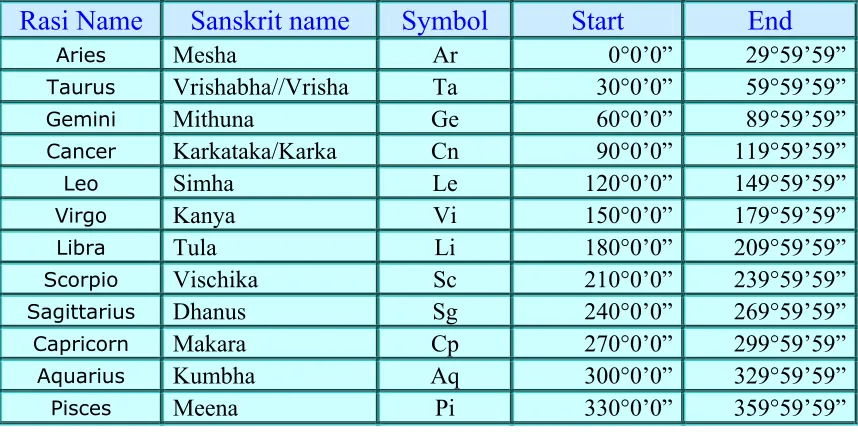
The zodiac (sky) lasts 360° as mentioned above and it is divided into 12 equal parts. They are called “rasis” (signs). English names, Sanskrit names, two-letter symbols and values of the start longitude and the end longitude (in degrees, minutes and seconds) of all twelve rasis are given in Table 1.] Ref.1
Table 1: Definition of Rasis
Rasi Name
Sanskrit name
Symbol
Start
End
Aries Mesha Ar 0°0’0” 29°59’59”
Taurus Vrishabha//Vrisha Ta 30°0’0” 59°59’59”
Gemini Mithuna Ge 60°0’0” 89°59’59”
Cancer Karkataka/Karka Cn 90°0’0” 119°59’59”
Leo Simha Le 120°0’0” 149°59’59”
Virgo Kanya Vi 150°0’0” 179°59’59”
Libra Tula Li 180°0’0” 209°59’59”
Scorpio Vischika Sc 210°0’0” 239°59’59”
Sagittarius Dhanus Sg 240°0’0” 269°59’59”
Capricorn Makara Cp 270°0’0” 299°59’59”
Aquarius Kumbha Aq 300°0’0” 329°59’59”
Pisces Meena Pi 330°0’0” 359°59’59”
T
TThhheee tttwwwooo sssyyysssttteeemmm ooofff zzzooodddiiiaaaccc rrreeeccckkkooonnniiinnnggg: We have seen about Tropical (sayana) zodiac and Sidereal (nirayana) zodiac in lesson 1. The difference between the two types is called the Ayanamsa or the precession of the zodiac as the solar system revolves around a fixed point called the Brahma Nabhi. Both the zodiacs have been referred to in the Vishnu Purana and the Sayana or tropical zodiac is used for determining weather and season changes as it affects the solar system and is limited to the anariksha (i.e. the sky till the area of space housing the Navagraha (nine planets) and not beyond). The Niryana zodiac on the other hand, is unlimited by space and extends beyond the solar system encompassing the fixed stars, the Brahma Nabhi and the entire universe. It is for this reason that the Tropical (Sayana) zodiac can be used for season & weather etc, whereas the Nirayana Zodiac is used for Jataka (horoscopy) etc.
I
I
I
m
m
m
p
p
p
o
o
o
r
r
r
t
t
t
a
a
a
n
n
n
c
c
c
e
e
e
o
o
o
f
f
f
R
R
R
a
a
a
s
s
s
i
i
i
Before going into the characteristics of the Rasis we should know their importance. Jyotish is meant for the animate things, especially the human being.
their environments. It doesn’t matter if people see or take part in any action, ultimately the effect of every action is felt by all.
What happened at the World Trade Center (WTC) has influenced the people of Afghanistan and in varying degrees the people of the whole world.
When we are living in peace in our homes and all of a sudden our neighbour’s home becomes a site of daily parties, our peace will definitely be affected. We cannot meditate in a bar where it is full of smoke, beer, music, noise and flash lights. Whereas, it is possible to meditate at a quite seashore.
Hence, our day-to-day life depends on the laws enacted by the ruling government, society and culture. Such inanimate influences can be read from the Rasi.
The logic of twelve-fold division of Zodiac can be applied to any place or object. Rasi is also called a kshetra or place. Similarly, our body is also called as kshetra, where the soul resides. Hence, our body also has been divided into 12 portions. Mesha or Aries refers to Head and Rishaba or Taurus refers to face/mouth etc. Now, take the case of Rishaba or Taurus, where Bulls reside on the farm and where crops are grown. So, Taurus represents the farm or cultivating areas nearer to the living places. In olden days, wealth or dhana was measured in terms of crops, cultivating lands and the cattle.
It is for these reasons that the 2nd Bhava is called dhana bhava. We eat the crops and vegetables from the farm, so mouth is represented by the 2nd Bhava, i.e. Taurus. So, similar inferences can be made to our body, our city, our organization, or our country. Hence, wherever, food or farms are exists, those places can be taken as Taurus or when Taurus is in question, we can consider it to indicate the foods, farms etc.,
Similarly, Scorpio, the 8th sign in natural Zodiac and 7th or opposite sign from the 2nd sign, is indicated by insects like Scorpio. Where do these insects predominant? In a place where garbage, waste or refuse is disposed. In our body, it represents the parts of excretion. So, 2nd house is mouth the input, its opposite 8th house is excretion parts, the output.
Hence, if we meditate on the symbols and names of the signs, we will get to understand the various parts and places represented by the signs.
graha. Let us see some of them, which have a direct link with rasi like, Rasi dasa, Rasi sandhi, badhaka. A brief introduction to these concepts will prepare you for further study.
1.Charecterstics
:
Below are listed some of the uses of the characteristics of the Rasi, which is summarized along with other characteristics at the bottom of this lesson.
Body parts and health: As per Chapter 4 sloka 4-4 ½ of BPHS, the 12 Signs represent various body parts of Kalapurusha1. The same body parts can be considered for the human beings, starting from Mesha (Aries). In the same cycle, starting from lagna, each sign indicates the body parts of Kalapurusha. For example, if Aquarius is lagna, for stomach we should look at Leo, the 5th sign of Natural Zodiac and Gemini, the 5th sign from Lagna.
All the characteristics of a Rasi influence our body and health directly or indirectly. However, the following 2 factors: the element and gunas have a direct impact on our body and health matters.
I - Elements:– Vaata (Windy), Pitta(Bilious), Kapha (Phlegmatic). Aries, Leo, Sagittarious (Dharma Trikona) are Pitta; Taurus, Virgo, Capricorn (Artha Trikona) are Vaata; Gemini, Libra, Aquarius are Tridhatu (mixer of these 3 elements) (Kama Trikona); and Cancer, Scorpio, Pisces (Moksha trikona) are Kapha constitutions.
{Note: Vataa, Pitta and Kapha have extensive meaning than mere windy, bilious and phlegmatic translation}.
These elementary characteristics are identical with the Pancha (five) Tatwa of the signs. Pitta signs are Agni or fiery; Vaata signs are Bhoo or earthy; Tridhatu signs are Vaayu or airy; and Kapha signs are Jala or watery. The 5th Tatwa which is missing is Aakash tatwa, which pervades
in all the signs like MahaVishnu. Elements have direct impact on the body costituitions, whereas tatwas influences the characteristics of the native.
II – Guna: All Chara (movable) Rasis are Rajo Guni, all Sthira (fixed) Rasis are Tamo Guni and all Dwisbava (dual) Rasis are Satwik Guni. (please refer to the attachment file of Lesson 4 for the meanings of 3 Gunas)
The combination of these two factors of a sign determines the predominant constitution of the sign. This combination is basic and serves as a background for the sign in respect of health or body type. On top of this compound background, the influences of other signs through Rasi Drishti and influences of other planets through lordship, aspect, conjunction etc., makes the final molding of the health or body part.
For general health and body constitution matters, Lagna or Ascendant has to be considered, for other parts’ strength and affliction; the respective sign has to be considered. Chandra lagna (moon sign) also to be assessed to know the mental drive and character.
In addition to these two factors, watery signs make a person stout and dry signs makes a person thin or lean. Similarly, long or short signs make the respective body parts short or long.
For the various body parts and the afflictions to those parts, Drekkana or D-3 divisional chart also has to be checked. We will see more about this when we go to the divisional charts.
Identification of the places and objects: From the nature of the sign, we can infer the places and the objects represented by the signs. Many of the Jyotishas think and use this concept mostly in Prasna (Horari) Jyotish. For example, if Aquarius is in question, water tanks are presumed.
However, as we have seen from several mails and books of Gurudeva Pt.Sanjay Rath, these signs can also be used for our regular natal reading and the signs will indicate the places or the nature of the organization etc.
When we look at a planet in a chart, we should visualize the personalities behind that planet. Similarly, when we look at a Rasi in a chart, we should visualize the places or environment behind that rasi. This visualization or imagination cannot be taught to the students, this has to be developed by the students themselves by pondering over the nature and characters of the signs repeatedly. This visualization is not fixed or static, it depends on the query raised.
Direction: Rasis indicate the directions. Direction also mainly used in the Horary Astrology, but the same can be applied for the natal reading as demonstrated in COVA (Ref.2) in many places. Rasi’s directions are used in judging the travel direction, change of residence and in Vasthu, (house building). Agni rasis are East, Bhoo rasis are south, Vaayu rasis are west and Jala rasis are North.
running, we predict mobility. Similarly, we have to predict, for sthira rasi, the person represented by the planet placed in the sign is from the nearby place. Travel and change of place also has to be understood from the mobility of the rasi. For example, if a planet is in chara rasi, a distance place to be understood and if it is in dwiswabava, not far away place can be assumed.
The relative duration of any Yoga (positive combination) or Dosha (negative affliction) depends on the sign involved in this yoga or dosha.
Similarly, the possibility of removing any dosha depends on the sign involved. Suppose, a dosha or affliction happens in a fixed sign, then the propitiation of the respective lord or mantras must be taken seriously, and even after such severe methods it is difficult to assure the elimination of such doshas.
Rising of rasis: Some rasis rise with their head and such rasis are called Seershodaya rasis. Some rasis rise with their back and such rasis are called Prishtodaya rasis. Rising nature of each sign is given at the end of the lesson. As the name implies, front and back rising, wherever, initiation comes into picture, we should assume that in Seershodaya rasis, it happens in the beginning or first, whereas in Prishtodaya rasis, it will happen in the end or later part.
As per Ref. 4, “a planet in a Seershodaya sign yields fruit at the initial portion of the period of life influenced by the planet. But the same planet in a Prishtodaya sign does it at the final stage. But if he should be in a sign which has both the characteristics, he becomes fruitful at all times”.
Benefic or Malefic Rasis: Odd Rasis are malefic and even Rasis are benefic counted from Aries. Benefic or malefic nature has been wrongly understood as good and bad. But, I feel that the correct meaning must be Soft or Hard. Malefics also give material gain and will punish the native.
Similarly, benefics also give material gain and punish. But, their ways and methods are different. In fact good and bad or soft and hard are relative terms.
My elder son weeps for unnecessary reasons. My wife used to beat him or shout at him to control the weeping. He didn’t change his attitude even after the beating. I told my wife, “if he cries for whatever reason, I will forego the next meal and convey this to our son.” At that moment onwards he controlled himself. Here, the soft punishment is more powerful than the beating; he could not bear his father starving. What my wife did was malefic nature and what I did was benefic nature. Motives are same, but the methods are different.
person is working in an iron & steel industry, apart from Saturn (karaka for iron and steel) dhatu rasi should also influence the Karmasthana (10th house) and the artha trikona in Rasi and dasamasa.
Other Characteristics are easy to understand and interpret, so I am leaving them to the students. All characteristics are listed at the bottom of this lesson.
2. Influence of the sign and its divisions on the planets:
As mentioned earlier, the mix of planets and signs produce a compound effect which yields a net result on a native. The Rasi influences the planets in a greater degree. When you go through ancient astrological texts, you can come across many slokas or verses, explaining many good or bad yogas, which might not have reference to a particular Rasi. However, in such cases, the effect of such yoga or dictum get modified depending on the Rasi and bhava involved. So, we cannot apply the dictum in general for all the signs. It is implied that the Jyotisha should know the rules and dictums with reference to the sign.
Let us see an example. Sloka 5 of Chapter 13 of BPHS as per Santhanam’s translation (Chapter 15 of BPHS – G.C.Sharma translation) says
“5. If the lord of Dhana (second bhava) is in an angle (Kendra) while Labha (11th bhava) lord is in a trine (kona) thereof or is drishtied (aspected) by or yuti (association) with by Guru (Jupiter) and Shukra (Venus), the subject will be wealthy.”
Suppose for an Aries lagna person, the second lord Venus is placed in Taurus and the 11th bhava lord, Saturn is placed in Aquarius the wealth will be mostly through business and the effect of this sloka is sure to happen. Because, the planets involved are friends and are disposed in their own moolatrikona rasi and aspects each other through rasi drishti. Whereas, for the same Aries lagna, if Venus is placed in Cancer and Saturn is in Scorpio, the eighth house, the wealth can be through inheritance and the person has to work hard to get the wealth. As the planets are placed in enemies’ rasis and both are jala rasis, the obtainment of wealth is not easy and it will be volatile in nature.
Thus, Rasis play a very very important role in influencing the planets.
in Lesson – 4 Planets – all the planets have their own qualities. But, it gets modified completely by the signs, its divisions and by other planets.
Let us see, how a sign influences a planet.
(1) RASI ITSELF: The characteristics or nature of the rasi.
As we have seen in Lesson – 4, planets have their own rasis, moolatrikona signs, exaltation and friendly sings. These are not fixed arbitrarily. These are depending on the planets’ nature and the nature of the sign. An amusement park will be a comfortable place for a youngster like Mercury and it will be a happiest place for materialistic person, who wants to enjoy the world like Rahu would. But, a saint like Ketu will feel uncomfortable in an amusement park.
So, if we know why a planet get exalted in a rasi and why it owns a sign etc., we can easily judge what it will do when it is disposed in such places.
As we discussed earlier, both planets and signs are intertwined with each other. A planet influences a sign and a sign influences a planet. Nature and character of signs get changed depending on the planets conjoined in the sign and aspects received. Similarly, planet’s nature and character gets modified depending on the sign in which it is sitting.
Hence, a planet’s disposition in a sign is important and It highly influences the bhava ruled by the planet.
In 1993-94, in a native’s organization, a new person joined as a General Manager, and he gave a hell a lot of problems to the native in order to bring his girl friend to the native’s position. Until then the native was leading a very peaceful life, but, after he joined it became dreadful, he even tried to create fake documents to defame the native. The boss also was supporting the GM, as he needed him desperately at that time.(as per Narayana Dasa, this condition can be clearly explained from the native’s chart, but, as dasa is advance at this stage I am leaving the astrological implication, now). The native was not even able to concentrate on any family matters and the whole family was shattered by the native’s condition.
Apply this analogy to a planet and imagine that if the native is a planet, placed in an enemy house (the orgainsation) and conjoined an inimical planet (the GM), how is it possible for this planet to look after its houses (native’s health and family).
house owned by that planet also gets affected because of this modification.
(2) VARGAS OR DIVISIONS:
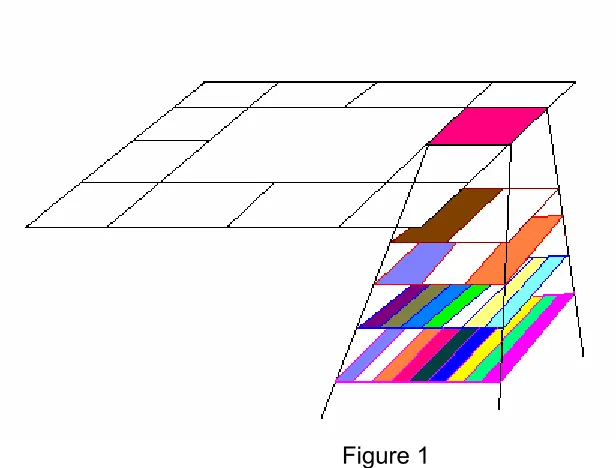
The characteristics of the vargas or divisions of the rasi where planet is placed, influences the planets. We will see more about the divisional charts’ computation and lordship probably in the next lesson as per the Parasara’s schedule of chapters.
Here, a few words will be said about the Varga for the benefit of those who do not know about the Rasi divisions.
Each Rasi is divided into different groups or divisions. Based on the rasis occupied by planets in various divisions, “divisional chart” are drawn. In every division, we divide the rasi into different parts, find the part containing each planet and see the rasi to which that part is related.
Let us take Drekkana Chart or 3 fold division. Here each rasi is divided into 3 equal parts of 10 degree each. Planets in the first 10 degree are placed in drekkana chart in the same rasi. Planets in the middle 10 degree are placed in drekkana chartin the 5th from the rasi. Planets in the last 10 degree are placed in drekkana chart in the 9th from the rasi. Similarly, different divisional charts have different set of rules for the varga chart formation.
Different aspects of life are seen in different charts. For example, this Drekkana chart is to know the siblings related issues. This is one utility of the divisional chart and it is the primary utility, wherein a divisional chart is to be examined individually, as a stand alone chart with respect to the signification of that varga or division.
Figure 1
The primary utility is used in the horizontal level as a stand alone individual chart. Whereas, the Secondary utility is used in the vertical level, wherein, a particular point in a zodiac passes through different signs in various divisional charts. As such, a point’s or planet’s quality and character becomes unique.
To explain it further about the secondary utility, suppose a person lives in a city. The different groups or divisions in the city to which the person belongs, which affect or influence the person’s personality and day-to-day affairs. A person can be a batsman of a cricket team, a secretary of a recreation club, member of a religious association, a staff member of an organization, a son of his father’s family, father of his own family. All these positions mould his character, personality and his decisions.
Various Nadi and Brighu readings are based on this specific property only.
We may not be able to comprehend the full nature of the planet by its placements in all divisions or vargas till Nadiamsa. However, we must try our level best to understand the impact of these divisions from Hora, Drekkana, Navamsa, Dwadasamsa and trimsamsa, from vedic texts like Brihat Jataka of Varahamihira. As it is given in many texts, at least we must see the disposition of a planet in Navamsa.
As we are all in the Kaliyuga and comprehension of such compound results is not simple and easy. For this purpose, Vimshopakabala and Vaisashikamsa are given by Sage Parasara. (We will explain these terminologies in details, when we go to divisional charts).
Definition of drishti is simply an aspect or glance. As shown below there are certain rules about which signs aspect each other. These rules are:
A movable rasi aspects all fixed rasis except the one adjacent to it. A fixed rasi aspects all movable rasis except the one adjacent to it. A dual rasi aspects all other dual rasis.
The importance of Rasi drishti and its application has already been explained by Grudeva Pt.Sanjay Rath in his books. I am just trying to explain in a much simpler way here. We all know about graha drishti or planetary aspect which is explained in almost all the Vedic astrology text books. But, this Rasi aspect has been left out by many. As we have seen earlier, planets represent animate things and planetary aspect is depends on the desire/wish of the planet, it is the iccha of the planet. Whereas, rasi aspect is permanent.
Each person has in general two types of power or influence. One is individual power, depending on his personality like “Mother Teresa, Mahatma Gandhi, and Osama bin laden. They are known by their individual power, not because of a position they held. Another source of power is positional power and this depends on the position a person holds. George Bush has power and he influences many countries and people just because he is the President of USA. Indians must be aware of their former Chief Election Commissioner Mr.T.N.Seshan. He was using the full power of the post CEC and he was dreadful for all the politicians. His power was associated with his position, once he was no longer in that position he had not power.
Similarly, a planet has its own power shed over many houses in different proportions. Like, Mars aspects the following houses from its position with the proportion given against the house.
This proportion of influence is fixed for Mars irrespective of the sign it is placed in. It is purely the individual power or influence of Mars and it is under its own discretion. Depending on the dasa running and depending on other planetary influence and cooperation, Mars decides its discretion.
Whereas, Rasi aspects are permanent and indeed, the rasi is the one, which is casting the aspect. As we have seen in our example, the powers of President of USA are permanent and fixed irrespective of the person who holds the post. But, how effectively and how qualitatively a person uses this power depends on the individual nature of the person. Hence, the planets posited in a sign acquires the aspect of the rasi and casts or shed the influence on to other rasis or planets.
A yoga or dhosa formed out of this Rasi aspect is permanent in nature.
(4) ARGALA: Another influence based on the rasi is Argala. [Argala is the
intervention brought about by signs and/or planets in the 2nd, 4th or 11th from a isgn (or planet). This intervention tends to pormote the affairs ruled by the sign (or planet) by fair or foul means depending on the nature of the signs and planets invloved. This intervention in the 2nd, 4th or 11th house is obstructed by the signs (or planets) in the 12th, 10th, or 3rd house respectively. Malefics in the third house, while simultaneously obstructing the intervention in the 11th house, also themselves cause argala (or intervene).] Ref.3. The definition and application etc., has been explained very well in books given in Ref. 2 and 3. So, I am not going into the detail here. But, let me explain argala with an analogy.
For example, a contract is approved to a contractor but unless the finance department releases the money in time, the execution of the contractual job will be blocked. Here, though finance is not the primary department (like, engineering, quality control, surveyors, supervisors, project manager) its intervention can either help or hinder the contractor. The finance department could reject a bill simply because a coma is missing. So, to succeed the contractor needs to have full support of the Finance department. Here, the influence of Finance Department can be mapped to the Argala of a Rasi. This is how the Argala or intervention works in association with the primary astrological factors like, placement, conjunction, aspect etc.
How does this Argala influences various houses has been explained in detail in COVA, Ref. 2.
(5) SIGN BEING VARIOUS BHAVAS: When the rasi becomes a bhava, house or sthana, its value and outlook changes. The word bhava, house or sthana, brings life to the sign. A plain ground is without life, but, when we construct a house, it has all the feelings of happy, anger, sorrow, celebrations, festival times, etc. One may imagine such feelings if he or she returns home after a long time. Similarly, when we say a bhava, all the attached karakatwa or signification of that bhava should come to our mind while keeping the nature of the sign in the background.
When a sign become a bhava, the nature of the bhava changes. When a dictum says so and so planet in 2nd bahava will get X effect, this X effect will change according to the sign, which is 2nd bahava. All signs will not yield a same result when they become a particular bhava.
To understand this clearly, the characteristics of a person changes depending on the lagna being in different Rasis. There are many slokas, on the Lagna, which will be seen in detail when we go to Lagna bhava. We should first understand, why such difference exists for different signs and intelligently, we should apply such differences to the other bhavas too.
3.Miscellaneous:
(a) Rasi dasas: Dasas are of numerous types and are periods of time when
particular influences are strong. As we have long way to go before getting into the dasas. However this subject has relevance to Rasi. Mostly ududasas or Nakshatra based dasas are in use and especially Vimshottari dasa is predominantly used. As I have explained in the opening paragraph, off late due and equal importance has not been given for Rasi as it has been given for planets. Rasis are equally important and they play major role in Jyotish. So, dasa systems based on Rasi or sign are more valuable in explaining many life areas. Among the Rasi dasas, Narayana dasa is now popular and it is a versatile phalita dasa. The advantage of the Rasi dasa is that whenever a dasa of a sign is running, we can consider that sign as 1st house or lagna and interpret the whole chart, until that dasa complete. This flexibility gives new dimensions to the chart.(c) Rasi sandhi: End degrees of a rasi are called rasi sandhi; and are not
favorable and may be dangerous. If lagna falls in such sandhi degrees, health of the native may not be strong. In particular the rasi sandhi of Cancer, Scorpio and Piscess are more dangerous.The effects of the Rasis through the bhavas like Kendra, Kona, Upachaya, dusthana, etc. can be left for for the Bhava lesson.
S
S
S
u
u
u
m
m
m
m
m
m
a
a
a
r
r
r
y
y
y
o
o
o
f
f
f
t
t
t
h
h
h
e
e
e
C
C
C
h
h
h
a
a
a
r
r
r
a
a
a
c
c
c
t
t
t
e
e
e
r
r
r
i
i
i
s
s
s
t
t
t
i
i
i
c
c
c
s
s
s
o
o
o
r
r
r
N
N
N
a
a
a
t
t
t
u
u
u
r
r
r
e
e
e
o
o
o
f
f
f
R
R
R
a
a
a
s
s
s
i
i
i
s
s
s
.
.
.
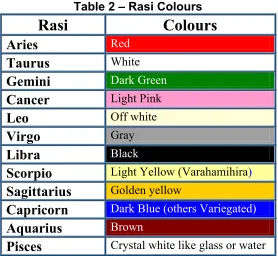
Rasi colours are given in Table 2 and Figure 2. Some of the characteristics are listed in Table 3 andothers are listed by sign wise in the bottom.
Rasi Colours: Given below are the colour references followed by SJVC parampara and there are some minor differences in opinion. But, students are advised to follow the SJVC teaching.
Table 2 – Rasi Colours
Rasi Colours
Aries
RedTaurus
WhiteGemini
Dark GreenCancer
Light PinkLeo
Off whiteVirgo
GrayLibra
BlackScorpio
Light Yellow (Varahamihira)Sagittarius
Golden yellowCapricorn
Dark Blue (others Variegated)Aquarius
BrownFigure 1
Table 3. The Characteristics of the Signs
Sign Triplicity Quadruplicity Sex Ruler No Name Elements Direction Dhatu Mobility Guna
1 Aries Fire East Pitta Movable Rajas Male Mars 2 Taurus Earth South Vaata Fixed Tamas Female Venus 3 Gemini Air West Tridatu Dual Satwa Male Mercury 4 Cancer Water North Kapha Movable Rajas Female Moon 5 Leo Fire East Pitta Fixed Tamas Male Sun 6 Virgo Earth South Vaata Dual Satwa Female Mercury 7 Libra Air West Tridatu Movable Rajas Male Venus 8 Scorpio Water North Kapha Fixed Tamas Female Mars & Ketu
9 Sagittarius Fire East Pitta Dual Satwa Male Jupiter 10 Capricorn Earth South Vaata Movable Rajas Female Saturn
11 Aquarius Air West Tridatu Fixed Tamas Male & RahuSaturn 12 Pisces Water North Kapha Dual Satwa Female Jupiter
1.Aries – Mesha-
Place indicated by this Rasi : Surface of earth containing precious stones and yielding minerals. The places, where goats roam around and hills.
Short/medium/long : Short
Day or Night strong : Strong during night
Rising of Rasi : Prishtodaya or rises with its back
Watery/Dry Rasi : Dry
Foot or padha : Quadruped sign.
Class or Varna : Royal or Kshatriya
Dhatu/Moola/Jeeva : Mineral or Dhatu
Body part : Head
2.Taurus - Rishaba
Symbol of this Rasi : Taurus or Bull.
Place indicated by this Rasi : The table land, farms, the cow station
and the forest.
Short/medium/long : Short
Day or Night strong : Strong during night
Rising of Rasi : Prishtodaya or rises with its back
Watery/Dry Rasi : Water resorter
Foot or padha : Quadruped sign.
Class or Varna : Vaishya or Businessmen
Dhatu/Moola/Jeeva : Vegetables or Moola
Body part : Face/mouth
3.Gemini - Mithuna
Symbol of this Rasi : A (couple) male and a female holding a
mace and lute.
Place indicated by this Rasi : The gambling house and pleasure haunts such as park or Garden.
Short/medium/long : Medium
Day or Night strong : Strong during night
Rising of Rasi : Shrishtodaya or rises with its head
Watery/Dry Rasi : Water reorter
Foot or padha : Biped sign.
Class or Varna : Sudra or worker
Dhatu/Moola/Jeeva : Animals
Body part : Arms/Chest
4.Cancer - Karkataka
Symbol of this Rasi : Cancer or Karkataka.
Place indicated by this Rasi : A lake or pond or a sand-bank in the
midst of water.
Short/medium/long : Medium
Day or Night strong : Strong during night
Watery/Dry Rasi : Watery
Foot or padha : Centipede sign.
Class or Varna : Brahmin or Wise
Dhatu/Moola/Jeeva : Mineral or Dhatu
Body part : Heart
5.Leo - Simha
Symbol of this Rasi : Leo or lion or Simha.
Place indicated by this Rasi : Deep mountain-caves and dense
forests.
Short/medium/long : Long
Day or Night strong : Strong during Day
Rising of Rasi : Seershodaya or rises with its head
Watery/Dry Rasi : Dry
Foot or padha : Quadruped sign.
Class or Varna : Royal or Kshatriya
Dhatu/Moola/Jeeva : Vegetables or Moola
Body part : Stomach
6.Virgo - Kanya
Symbol of this Rasi : A women standing in a boat carrying
with her corn and fire.
Place indicated by this Rasi : A pasture-land or the pleasure room of
a women.
Short/medium/long : Long
Day or Night strong : Strong during day
Rising of Rasi : Seershodaya or rises with its head
Watery/Dry Rasi : Water resorter
Foot or padha : Biped sign.
Class or Varna : Vaishya or Businessmen
Dhatu/Moola/Jeeva : Animal or Jeeva
Body part : Hip
7.Libra - Thula
Symbol of this Rasi : A person with a balance in his hand.
Place indicated by this Rasi : The bazaar of a city abounding in all kinds of valuable things.
Short/medium/long : Long
Day or Night strong : Strong during day
Rising of Rasi : Seershodaya or rises with its head
Watery/Dry Rasi : Dry
Foot or padha : Biped sign.
Class or Varna : Sudra or worker
Dhatu/Moola/Jeeva : Mineral or Dhatu
8.Scorpio - Vrischika
Symbol of this Rasi : Scorpio or Vrischika.
Place indicated by this Rasi : A region abounding in flint, or holes or
noxious reptiles.
Short/medium/long : Long
Day or Night strong : Strong during day
Rising of Rasi : Seershodaya or rises with its head
Watery/Dry Rasi : Watery
Foot or padha : Centipede
Class or Varna : Brahmin or Wise
Dhatu/Moola/Jeeva : Vegetables or Moola
Body part : Private parts
9.Sagittarius - Dhanus
Symbol of this Rasi : A man armed with a bow and arrow,
the hinder part of the body is that of a horse.
Place indicated by this Rasi : The camp or barrack containing horses
chariots and elephants.
Short/medium/long : Medium
Day or Night strong : Strong during night
Rising of Rasi : Prishtodaya or rises with its back
Watery/Dry Rasi : Dry
Foot or padha : Biped for 1st 15 degrees and
quadruped for the next 15 degrees.
Class or Varna : Royal or Kshatriya
Dhatu/Moola/Jeeva : Animal or Jeeva
Body part : Thighs
10.Capricorn - Makara
Symbol of this Rasi : A shark with the face of a deer.
Place indicated by this Rasi : The river or other water-abounding
region, like paradise where, deer and crocodile lives.
Short/medium/long : Medium
Day or Night strong : Strong during night
Rising of Rasi : Prishtodaya or rises with its back
Watery/Dry Rasi : Watery
Foot or padha : Quradruped for 1st 15 degrees and
footless for the next 15 degrees.
Class or Varna : Vaishya or Businessmen
Dhatu/Moola/Jeeva : Mineral or Dhatu
Body part : Knees
11.Aquarius - Kumbha
Symbol of this Rasi : A man holding a pot.
Place indicated by this Rasi : Water-pot and the receptacles of
Short/medium/long : Short
Day or Night strong : Strong during day
Rising of Rasi : Seershodaya or rises with its head
Watery/Dry Rasi : Water-resorter
Foot or padha : Biped
Class or Varna : Sudra or Worker
Dhatu/Moola/Jeeva : Vegetables or Moola
Body part : Calves
12.Pisces - Meena
Symbol of this Rasi : Two fishes with their tails and heads in
reverse position.
Place indicated by this Rasi : River, sea and similar collection of
water.
Short/medium/long : Medium as per Jataka Parijata and
Short as per Saravali.
Day or Night strong : Strong during day
Rising of Rasi : Seershodaya and Prishtodaya or rises
with both head and back
Watery/Dry Rasi : Watery
Foot or padha : Footless
Class or Varna : Brahmin or Wise
Dhatu/Moola/Jeeva : Animal or Jeeva
Body part : Feet
Apart from the details of the signs given above, Mr.PVR Narasimha Rao has given the various indications of a sign in a digest form in his Book see Ref. 5. and the same has been reproduced here.
[Indications of Rasis:
Aries: Dynamic, enterprising, valiant, ruddy, head, forests, large forehead, hasty, impulsive, restless, thick eyebrows, leadership, overbearing, dry lean, tall.
Taurus: Beautiful, face, stable, sluggish, loyal, meadows, plains, luxury halls, dining halls, eating places, fine teeth, large eyes, luxurious, faithful, thick hair, stout.
Gemini: Chest, garden, communication, journalism, schools, colleges, study
rooms, cables, telephone, newspapers, tall, well-built, prominent cheeks, thick hair, broad chest, curious, learned, jovial.
Leo: Stomach, digestion, navel, mountains, forests, caves, deserts, palaces, parks, forts, boilers, steel factories, thin, dry, hot, royal, self-pride, insolent, domineering.
Virgo: Hip, appendix, lush gardens, fields, orchards, libraries, bookstores, farms, intelligent, sharp, orator, nervous, physically weak, discretion, tactfulness.
Libra: Groins, Businessmen, markets, trade centers, banks, hotels, amusement
parks, entertainment, toilets, cosmetics, balanced, wise, good talker.
Scorpio: Private parts, holes, deep caves, mines, garages, small build, dusky
complexion, bright eyes, secretive, scheming, occult, best friend or a worst enemy, peevish, sensitive.
Sagittarius: Thighs, royal, attorneys, government offices, aircraft, falling, sparse hair, muscular, deep eyes, upright, honest, genial, gambler.
Capricorn: Knees, marshlands, watery places, alligators, beasts, bushes,
slender build, long neck, prominent teeth, witty, perfectionist, patient, organizer, cautious, secretive, pragmatic.
Aquarius: Ankles, charity, philosophy, tall, body, small eyes, mountain spring, places with water, ill-formed teeth, coarse hair, hard-working, stoic, honest.
Pisces: Feet, oceans, seas, prisons, hospitals, hermitages, short, plump, large eyes, large eyebrows, lazy, emotional, timid, honest, irresolute, talkative, intuitive.] Ref: 5.
E
E
E
X
X
X
A
A
A
M
MP
M
P
PL
L
LE
E
E
C
C
C
H
HA
H
A
AR
R
RT
T
T
.I have taken here a very simple example and we shall look at only one area of Rasi implication, that is, nature of carrier industry. Dasamsa (D-10) divisional chart is considered to assess the native’s carrier industry. In this example, the lagna lord of Dasamsa is in a chara Rasi with Rahu in the 12th house. The 10th lord Saturn (Airy planet) in a Jala Rasi in 3rd Bhava, which signifies short travel. The dispositor of Saturn, Moon is in Thula, which represents business, with Ketu, who represents Aeroplane. 7th and 12th lord, Mars is in 9th house and aspects 9th and 10th lord Saturn. Many planets are in Chara rasi, which shows movement, plus all the Bhavas who are significators for travel, 3rd, 7th 9th and 12th bhavas influences the Lagna and 10th lord.
In the advent of Saturn dasa, this native, who is having Post graduate degree in Mathematics, who had no clue or idea of travel business, got a job in Travel industry as accountant (Mercury aspecting 10th lord) and looked after the sales too, (7th lord aspecting 10th lord), Later became the manager of the travel agency, (Mars apecting 10th lord).
Natal Chart
Date: November 12, 1965 Time: 22:50:00
Time Zone: 5:30:00 (East of GMT) Longitude: 78 E 36' 00"
Latitude: 9 N 33' 00" Altitude: 0.00 meters
Body Longitude Nakshatra Pada Rasi Navamsa ChKarak
Rahu 11 Ta 52' 47.80" Rohini 1 Ta Ar BK Ketu 11 Sc 52' 47.80" Anuradha 3 Sc Li -
+---+ |HL |GL |Rah AL |Moo JupR | | | | | | | | | | | | | | | | | | | | | |---+---+---| |SatR | |Asc Glk | | | | | | | | | | | | | | | | | |---| Rasi |---| | | |Mnd | | | | | | | | | | | | | | | | | |---+---+---| |Mar Ven |Mer Ket |Sun | | | | | | | | | | | | | | | | | | | | | | +---+
+---+ |SatR |Rah |Mar Mnd |Sun | | | | | | | | | | | | | | | | | | | | | |---+---+---| |Glk | | | | | | | | | | | | | | | | | | | |---| Navamsa |---| |Moo | |Ven | | | | | | | | | | | | | | | | | |---+---+---| |Mer JupR | |Ket |Asc GL | |HL AL | | | | | | | | | | | | | | | | | | | +---+
Rah Rah 1958-03-17 Jup 1960-11-13 Sat 1963-03-27 Mer 1966-01-16 Ket 1968-07-22 Ven 1969-08-04 Sun 1972-07-19 Moo 1973-06-08 Mar 1974-11-30 Jup Jup 1975-12-13 Sat 1978-01-19 Mer 1980-07-19 Ket 1982-10-13 Ven 1983-09-14 Sun 1986-05-01 Moo 1987-02-13 Mar 1988-06-07 Rah 1989-05-09 Sat Sat 1991-09-20 Mer 1994-09-07 Ket 1997-05-03 Ven 1998-06-06 Sun 2001-07-20 Moo 2002-06-27 Mar 2004-01-18 Rah 2005-02-20 Jup 2007-12-13
Assignment:
1.In your chart or any chart, explain how a lagna sign’s characteristics and planets connected with that lagna sign influence the native’s personality and health.
2.Explain the reason for the exaltation and ownership signs of all the planets, See lesson # 4 as a reference.
3.Take the dual rasis owned by the non-luminous planets and compare the characteristics of their two rasis. Find out how the lordship gets altered for these two rasis because of the difference in characteristics.
4.List the words and terminologies, which you do not understand in this lesson (even after searching in texts).
References:
1. Page 5, Vedic Astrology – An Integrated Approach, authored by PVR.Narasimha Rao.
2. Crux of Vedic Astrology – authored by Pt.Sanjay Rath
3. Page 5, Jaimini Maharishi's Upadesa Sutras - By Pt.Sanjay Rath.
4. Sloka 24 – chapter 18, page 1016, Jataka Parijata – By V. Subramaniya Sastri.
5. Page 23, Vedic Astrology – An Integrated Approach, authored by PVR.Narasimha Rao.