Diploma Programme
Theory of knowledge guide
Published April 2013
Published on behalf of the International Baccalaureate Organization, a not-for-profit educational foundation of 15 Route des Morillons, 1218 Le Grand-Saconnex, Geneva,
Switzerland by the
International Baccalaureate Organization (UK) Ltd Peterson House, Malthouse Avenue, Cardiff Gate
Cardiff, Wales CF23 8GL United Kingdom Website: www.ibo.org
© International Baccalaureate Organization 2013
The International Baccalaureate Organization (known as the IB) offers four high-quality and challenging educational programmes for a worldwide community of schools, aiming to create a better, more peaceful world. This publication is one of a range of materials produced to support these programmes.
The IB may use a variety of sources in its work and checks information to verify accuracy and authenticity, particularly when using community-based knowledge sources such as Wikipedia. The IB respects the principles of intellectual property and makes strenuous efforts to identify and obtain permission before publication from rights holders of all copyright material used. The IB is grateful for permissions received for material used in this publication and will be pleased to correct any errors or omissions at the earliest opportunity.
All rights reserved. No part of this publication may be reproduced, stored in a retrieval system, or transmitted, in any form or by any means, without the prior written permission of the IB, or as expressly permitted by law or by the IB’s own rules and policy. See http://www.ibo.org/copyright.
IB merchandise and publications can be purchased through the IB store at http://store.ibo.org. General ordering queries should be directed to the Sales and Marketing Department in Cardiff.
Email: [email protected]
IB mission statement
The International Baccalaureate aims to develop inquiring, knowledgeable and caring young people who help to create a better and more peaceful world through intercultural understanding and respect.
To this end the organization works with schools, governments and international organizations to develop challenging programmes of international education and rigorous assessment.
These programmes encourage students across the world to become active, compassionate and lifelong learners who understand that other people, with their differences, can also be right.
IB learner profile
The aim of all IB programmes is to develop internationally minded people who, recognizing their common humanity and shared guardianship of the planet, help to create a better and more peaceful world.
IB learners strive to be:
Inquirers They develop their natural curiosity. They acquire the skills necessary to conduct inquiry and research and show independence in learning. They actively enjoy learning and this love of learning will be sustained throughout their lives.
Knowledgeable They explore concepts, ideas and issues that have local and global significance. In so doing, they acquire in-depth knowledge and develop understanding across a broad and balanced range of disciplines.
Thinkers They exercise initiative in applying thinking skills critically and creatively to recognize and approach complex problems, and make reasoned, ethical decisions.
Communicators They understand and express ideas and information confidently and creatively in more than one language and in a variety of modes of communication. They work effectively and willingly in collaboration with others.
Principled They act with integrity and honesty, with a strong sense of fairness, justice and respect for the dignity of the individual, groups and communities. They take responsibility for their own actions and the consequences that accompany them.
Open-minded They understand and appreciate their own cultures and personal histories, and are open to the perspectives, values and traditions of other individuals and communities. They are accustomed to seeking and evaluating a range of points of view, and are willing to grow from the experience.
Caring They show empathy, compassion and respect towards the needs and feelings of others. They have a personal commitment to service, and act to make a positive difference to the lives of others and to the environment.
Risk-takers They approach unfamiliar situations and uncertainty with courage and forethought, and have the independence of spirit to explore new roles, ideas and strategies. They are brave and articulate in defending their beliefs.
Balanced They understand the importance of intellectual, physical and emotional balance to achieve personal well-being for themselves and others.
Reflective They give thoughtful consideration to their own learning and experience. They are able to assess and understand their strengths and limitations in order to support their learning and personal development.
Contents
Introduction
1
Purpose of this document 1
The Diploma Programme 2
Coherence in the core 4
TOK and the learner profile attributes 6
TOK at a glance 8
Nature of the subject 10
Aims 14
Assessment objectives 15
Syllabus
16
Knowledge in TOK 16
Knowledge claims and knowledge questions 20
Ways of knowing 23
Areas of knowledge 28
Assessment
50
Assessment in the Diploma Programme 50
Assessment outline 51
Assessment details 52
Introduction
Purpose of this document
This publication is intended to guide the planning, teaching and assessment of theory of knowledge (TOK) in schools. TOK teachers are the primary audience, although it is expected that teachers will use the guide to inform students and parents about the course.
This guide can be found on the TOK page of the online curriculum centre (OCC) at http://occ.ibo.org, a password-protected IB website designed to support IB teachers. It can also be purchased from the IB store at http://store.ibo.org.
Teachers are not obliged to follow the suggested examples and ideas presented here; this guide offers a framework rather than prescribed content. Teachers should consider the examples and ideas provided and then construct their own unique TOK course around key TOK concepts that include, but are not limited to, the nature of knowledge, ways of knowing and areas of knowledge. When designing a TOK course, teachers must above all consider the aims and objectives of TOK.
This guide is to be read in conjunction with the teacher support material (TSM) available on the OCC which will help teachers design a TOK course.
Additional resources
Additional resources such as subject reports, assessment exemplars, past prescribed essay titles and sample TOK presentations can also be found on the OCC.
Teachers are encouraged to check the OCC for additional resources created or used by other teachers. Teachers can provide details of useful resources, for example: websites, books, videos, journals or teaching ideas.
Acknowledgment
The IB wishes to thank the educators and associated schools for generously contributing time and resources to the production of this guide.
Introduction
The Diploma Programme
The Diploma Programme is a rigorous pre-university course of study designed for students in the 16 to 19 age range. It is a broad-based two-year course that aims to encourage students to be knowledgeable and inquiring, but also caring and compassionate. There is a strong emphasis on encouraging students to develop intercultural understanding, open-mindedness, and the attitudes necessary for them to respect and evaluate a range of points of view.
The Diploma Programme
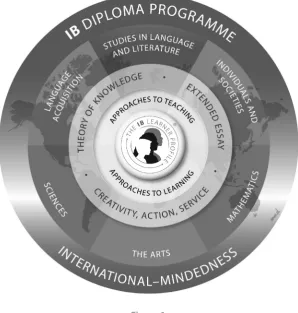
The course is presented as six academic areas enclosing a central core (see figure 1). It encourages the concurrent study of a broad range of academic areas. Students study: two modern languages (or a modern language and a classical language); a humanities or social science subject; an experimental science; mathematics; one of the creative arts. It is this comprehensive range of subjects that makes the Diploma Programme a demanding course of study designed to prepare students effectively for university entrance. In each of the academic areas students have flexibility in making their choices, which means they can choose subjects that particularly interest them and that they may wish to study further at university.
Figure 1
The Diploma Programme
Choosing the right combination
Students are required to choose one subject from each of the six academic areas, although they can choose a second subject from groups 1 to 5 instead of a group 6 subject. Normally, three subjects (and not more than four) are taken at higher level (HL), and the others are taken at standard level (SL). The IB recommends 240 teaching hours for HL subjects and 150 hours for SL. Subjects at HL are studied in greater depth and breadth than at SL.
At both levels, many skills are developed, especially those of critical thinking and analysis. At the end of the course, students’ abilities are measured by means of external assessment. Many subjects contain some element of coursework assessed by teachers. The courses are available for examinations in English, French and Spanish, with the exception of groups 1 and 2 courses where examinations are in the language of study.
Special educational needs
Schools must ensure that equal access arrangements and reasonable adjustments are provided to candidates with special educational needs that are in line with the IB documents Candidates with special assessment needs and Special educational needs within the International Baccalaureate programmes.
The core of the programme model
All Diploma Programme students participate in the three elements that make up the core of the programme model. Reflection on all these elements is a principle that lies at the heart of the thinking behind the Diploma Programme.
Coherence in the core
Introduction
The three elements of the core (TOK, CAS and the extended essay) were introduced by the original curriculum designers of the Diploma Programme as a way to educate the whole person. The core consists of three separate elements, but links and relationships are evident between them even if these links have not previously been clearly articulated.
Strongly committed to the principle of developing the whole person, the IB believes that this is best achieved by identifying and developing clearer and more explicit aims for and relationships between TOK, CAS and the extended essay. Specifically, the IB believes a coherent view of the core will:
• support the interconnectedness of learning • support concurrency of learning
• support the IB continuum of education and the learner profile • support a broader view of the subject disciplines.
Coherence does not mean similarity. Coherence in this context refers to the three elements of the core complementing each other and working together to achieve common aims. All three elements of the core should be grounded in three coherent aims:
• to support, and be supported by, the academic disciplines • to foster international-mindedness
• to develop self-awareness and a sense of identity.
Supporting, and being supported by, the academic
disciplines
The core is seen as the heart of the Diploma Programme. The academic disciplines, while separate to the core, are nonetheless linked to it. The core relies on the disciplines to provide enrichment, and individual subjects should be nourished by the core. Teachers in each of the three elements of the core need to think about, and plan carefully, how TOK, CAS and the extended essay can feed into a deeper understanding of the subject matter studied by Diploma Programme students. This might include, for example:
• transferring the critical thinking process developed in TOK to the study of academic disciplines • developing service learning opportunities in CAS that will build on a student’s existing subject
knowledge and contribute to the construction of new and deeper knowledge in that subject area • exploring a topic or issue of interest which has global significance in an extended essay through one
Coherence in the core
Fostering international-mindedness
The core has a responsibility to foster and nurture international-mindedness, with the ultimate goal of developing responsible global citizens. To a large extent, the core should be driven by the IB’s mission “to develop inquiring, knowledgeable and caring young people who help to create a better and more peaceful world through intercultural understanding and respect” and “encourage students across the world to become active, compassionate and lifelong learners who understand that other people, with their differences, can also be right” (IB mission statement).
To this end, the core should encourage an exploration of issues of global significance and in so doing allow students to examine links between the local and the global. It should encourage students to consider the contexts and views of others, and should ensure that the principles and values developed by students are reflected upon throughout their lifetime. This might include, for example:
• emphasizing different cultural perspectives in TOK and how different cultural traditions have contributed to our current constructions of knowledge
• considering a service project that reflects an issue of global significance, but is explored from a local perspective
• encouraging students to write a world studies extended essay—an interdisciplinary extended essay on a global theme.
Developing self-awareness and a sense of identity
The core should strive to make a difference to the lives of students. It should provide opportunities for students to think about their own values and actions, to understand their place in the world, and to shape their identity. This might include, for example:• providing opportunities in TOK for students to have conversations with others from different backgrounds and with different viewpoints, thereby challenging their own values
• encouraging students in CAS to evaluate their commitment to helping those in need and exploring the notion of advocacy
Introduction
TOK and the learner profile attributes
The table below shows some of the links between TOK and the learner profile attributes.
Attribute Link to TOK
Inquirers TOK students seek to find out how knowledge is constructed using various ways
of knowing and by considering what constitutes knowledge in various areas of knowledge. It is a fundamental premise of TOK that personal knowledge should not result from simple acceptance of knowledge claims without sufficient inquiry and evidence.
Knowledgeable TOK students strive to be knowledgeable about the nature of knowledge. This
means becoming knowledgeable about the methods of inquiry of a variety of subject areas, from a number of perspectives. Students are encouraged to explore the processes by which individuals arrive at their own knowledge and understanding of the world and the presuppositions that underpin this understanding.
Thinkers TOK students examine thinking in order to understand what constitutes good
thinking and also to recognize potential flaws in thought processes. Students also think about what thinking is required in a variety of situations, as well as how thinking relates to emotional processing and intuition.
Communicators TOK students are required by the TOK assessment tasks to communicate their
understanding and perspective in both oral and written form. Students also study the language that is used to develop a body of knowledge, so they learn what gives language its power as well as what causes failures of communication.
Principled TOK students scrutinize knowledge in a critical manner, leading to what could be
called principled knowledge. Students are required to examine the relationship between possessing knowledge and the moral obligations that this carries. Learning to see the world from a TOK perspective challenges students to think about acting in principled ways.
Open-minded TOK students need to be open-minded about knowledge claims they encounter.
They will learn not to simply accept claims at face value, but to consider the factual accuracy of any proposition and the potential emotional, social or cognitive bias of any person making a proposition. At the same time, they must learn to balance skepticism with belief, and recognize that in many situations there is a need to make decisions without possessing absolute certainty.
Caring TOK students are asked to care about how they use their knowledge. This
TOK and the learner profile attributes
Attribute Link to TOK
Risk-takers TOK students must be willing to risk questioning what they hold to be true.
This means that they must be willing to risk being wrong. When we are willing to accept being wrong then we make progress towards correcting existing misconceptions and increasing our knowledge and understanding of the world. The word “judgment” is central in TOK, and students should be prepared to take the risks involved in making judgments in matters where the evidence does not definitively favour one view or another, while at the same time acknowledging the provisional nature of these judgments.
Balanced TOK students are committed to viewing knowledge claims from different
perspectives. They are also required to consider a range of areas of knowledge. TOK requires a balance of ability in speaking and writing, and a balance of ability in drawing general conclusions from specific examples and in drawing on specific examples to demonstrate general claims.
Reflective TOK students learn to reflect on the degree to which their own and other people’s
Introduction
TOK at a glance
Knowing about knowing
TOK is a course about critical thinking and inquiring into the process of knowing, rather than about learning a specific body of knowledge. It is a core element which all Diploma Programme students undertake and to which all schools are required to devote at least 100 hours of class time. TOK and the Diploma Programme subjects should support each other in the sense that they reference each other and share some common goals. The TOK course examines how we know what we claim to know. It does this by encouraging students to analyse knowledge claims and explore knowledge questions. A knowledge claim is the assertion that “I/we know X” or “I/we know how to Y”, or a statement about knowledge; a knowledge question is an open question about knowledge. A distinction between shared knowledge and personal knowledge is made in the TOK guide. This distinction is intended as a device to help teachers construct their TOK course and to help students explore the nature of knowledge.
The ways of knowing
While there are arguably many ways of knowing, the TOK course identifies eight specific ways of knowing (WOKs). They are language, sense perception, emotion, reason, imagination, faith, intuition, and
memory. Students must explore a range of ways of knowing, and it is suggested that studying four of these eight in depth would be appropriate.
The WOKs have two roles in TOK:
• they underlie the methodology of the areas of knowledge • they provide a basis for personal knowledge.
Discussion of WOKs will naturally occur in a TOK course when exploring how areas of knowledge operate. Since they rarely function in isolation, the TOK course should explore how WOKs work, and how they work together, both in the context of different areas of knowledge and in relation to the individual knower. This might be reflected in the way the TOK course is constructed. Teachers should consider the possibility of teaching WOKs in combination or as a natural result of considering the methods of areas of knowledge, rather than as separate units.
The areas of knowledge
Areas of knowledge are specific branches of knowledge, each of which can be seen to have a distinct nature and different methods of gaining knowledge. TOK distinguishes between eight areas of knowledge. They are mathematics, the natural sciences, the human sciences, the arts, history, ethics, religious knowledge systems, and indigenous knowledge systems. Students must explore a range of areas of knowledge, and it is suggested that studying six of these eight would be appropriate.
The knowledge framework is a device for exploring the areas of knowledge. It identifies the key
TOK at a glance
Assessment
There are two assessment tasks in the TOK course: an essay and a presentation. The essay is externally assessed by the IB, and must be on any one of the six prescribed titlesissued by the IB for each examination session. The maximum word limit for the essay is 1,600 words.
Introduction
Nature of the subject
TOK plays a special role in the Diploma Programme by providing an opportunity for students to reflect on the nature of knowledge. The task of TOK is to emphasize connections between areas of knowledge and link them to the knower in such a way that the knower can become aware of his or her own perspectives and those of the various groups whose knowledge he or she shares. TOK, therefore, explores both the personal and shared aspects of knowledge and investigates the relationships between them.
The raw material of TOK is knowledge itself. Students think about how knowledge is arrived at in the various disciplines, what the disciplines have in common and the differences between them. The fundamental question of TOK is “how do we know that?” The answer might depend on the discipline and the purpose to which the knowledge is put. TOK explores methods of inquiry and tries to establish what it is about these methods that makes them effective as knowledge tools. In this sense TOK is concerned with knowing about knowing.
The individual knower has to try to make sense of the world and understand his or her relationship to it. He or she has at his or her disposal the resources of the areas of knowledge, for example, the academic disciplines studied in the Diploma Programme. He or she also has access to ways of knowing such as memory, intuition, reason and sense perception that help us navigate our way in a complex world.
It is easy to be bewildered by the sheer diversity of the knowledge on offer. For example:
• In physics, experiment and observation seem to be the basis for knowledge. The physicist might want to construct a hypothesis to explain observations that do not fit current thinking and devises and performs experiments to test this hypothesis. Results are then collected and analysed and, if necessary, the hypothesis modified to accommodate them.
• In history there is no experimentation. Instead, documentary evidence provides the historian with the raw material for interpreting and understanding the recorded past of humanity. By studying these sources carefully a picture of a past event can be built up along with ideas about what factors might have caused it.
• In a literature class students set about understanding and interpreting a text. No observation of the outside world is necessary, but there is a hope that the text can shed some light upon deep questions about what it is to be human in a variety of world situations or can act as a critique of the way in which we organize our societies.
• Economics, by contrast, considers the question of how human societies allocate scarce resources. This is done by building elaborate mathematical models based upon a mixture of reasoning and empirical observation of relevant economic factors.
• In the islands of Micronesia, a steersman successfully navigates between two islands 1,600 km apart without a map or a compass.
In each case above there is clearly knowledge at work, although the collection as a whole illustrates a wide variety of different types of knowledge. The task of TOK is to examine different areas of knowledge and find out what makes them different and what they have in common.
At the centre of the course is the idea of knowledge questions. These are questions such as: • what counts as evidence for X?
Nature of the subject
• how do we judge which is the best model of Z? • how can we be sure of W?
• what does theory T mean in the real world? • how do we know whether it is right to do S?
While these questions could seem slightly intimidating in the abstract, they become much more accessible when dealt with in specific practical contexts within the TOK course. They arise naturally in the subject areas, the extended essay and CAS. The intention is that these contexts provide concrete examples of knowledge questions that should promote student discussion.
Discussion forms the backbone of the TOK course. Students are invited to consider knowledge questions against the backdrop of their experiences of knowledge in their other Diploma Programme subjects but also in relation to the practical experiences offered by CAS and the formal research that takes place for the extended essay. The experiences of the student outside school also have a role to play in these discussions, although TOK seeks to strike a balance between the shared and personal aspects of knowledge.
Recognizing the discursive aspect of the course, the TOK presentation assesses the ability of the student to apply TOK thinking to a real-life situation. The TOK essay gives the opportunity to assess more formal argumentation prompted by questions of a more general nature.
TOK is a course in critical thinking but it is one that is specifically geared to an approach to knowledge that is mindful of the interconnectedness of the modern world. “Critical” in this context implies an analytical approach prepared to test the support for knowledge claims, aware of its own weaknesses, conscious of its perspectives and open to alternative ways of answering knowledge questions. It is a demanding course but one that is an essential component not only of the Diploma Programme but of lifelong learning.
TOK and international-mindedness
“Teachers open the door, but you must enter by yourself.”Chinese proverb
Knowledge can be seen as the shared legacy of mankind, a legacy which has been shaped and influenced by a wide range of cultures. This era of increased global interconnectedness promises unprecedented possibilities for interaction and enhancement of mutual understanding arising from the nurturing of international-mindedness.
The Chinese anticipated a period of “Tai”, a time when communication between individuals and the world at large is totally open and people are receptive to new ideas. The TOK course provides an ideal vehicle for such global exchange and beneficial action through its examination of shared and personal knowledge in an atmosphere of critical and reflective inquiry.
We have inherited rich traditions from indigenous knowledge systems, stretching back to the origins of our societies and cultures. Africa, where the human adventure began, has transmitted a treasure trove of wisdom. The Swahili proverb akili ni mali (“intelligence is wealth”) and the Gikuyu saying, “wisdom is ahead of might”, represent the clear call for the primacy of good thinking for humans to survive and flourish. Early African cultures celebrated diversity, a model for our times. The Asante proverb from West Africa tenabea nyinaa nse reminds us that all dwelling places are not alike and the Swahili kila ndege huruka na mbawa zake encourages every bird to fly with its own wings.
Nature of the subject
Ancient Asian civilizations have bequeathed profound insights which continue to guide our thinking. The Chinese were among the first cultures to recognize knowledge (“Shi”), its power, and the deep respect for learning and the wise sage figure permeates educational systems in that part of the world. The understanding of the self is seen as the essential foundation to effective membership and action in ever expanding spheres of community. The Indian concept of “Brahman” links the individual knower to a boldly conceived “universal spirit”, a sense of human and cosmic unity.
The Chinese sage, Confucius, inspired a tradition of inclusive and merit-based education allied to critical thinking: “A gentleman can see a question from all sides without bias”. Inheriting the inquiring spirit of Indian Vedanta, the Buddha boldly linked human suffering and dissatisfaction not only to a craving for physical and worldly pleasures but also to an attachment to ideas, opinions, and beliefs, to be replaced by a more dynamic and open-minded approach to knowledge construction. Greek thinkers introduced the notion of political democracy and the important foundations of modern science and mathematics, while their dramatists confronted audiences with complex characters and multiple perspectives. The deep understandings of these traditions were preserved and enriched in the golden age of Islamic civilization in the 10th to 12th centuries CE, a renaissance of learning and artistic flowering that continues to inspire our knowledge quest.
Students and teachers today are the inheritors of this grand journey. The path ahead, as usual, presents us with both opportunities and challenges. The TOK classroom invites a unique partnership of learning, for global controversies often rest on significant knowledge questions that can provide useful starting points for TOK explorations and TOK, in turn, can contribute significantly to the understanding of these large questions. The IB vision of internationally minded individuals implies a global engagement, embodying a commitment to address these 21st century challenges. TOK exists at the very core of the quest, as we strive toward an enlightened and fulfilled humanity.
Engaging with sensitive topics
Studying TOK allows the opportunity for students to engage with exciting, stimulating and personally relevant topics and issues. However, it should be noted that often such topics and issues can also be sensitive and personally challenging. Teachers should be aware of this and provide guidance to students on how to approach and engage with such topics in a responsible manner.
Concurrency of learning
The TOK course requires at least 100 hours in the classroom spread over two years of the Diploma Programme. It would not be possible to teach all the different topic suggestions in this guide to the same depth in this time, therefore teachers will have to select which topics to cover in more detail and which in less detail. The important point is that coverage should be broad enough to provide a balanced outlook.
Prior learning
Nature of the subject
Links to the Middle Years Programme
The programmes of the IB place the student at the centre of the models. This underscores the IB’s belief in educating the whole person and placing importance on student inquiry as the driving force for learning. The embodiment of the characteristics of the learner profile are the aim of IB programmes; they are brought into focus in the Primary Years Programme (PYP), refined and developed through the Middle Years Programme (MYP) and exemplified in the Diploma Programme and the Career-related Certificate.
The process of inquiring into subject content through the different perspectives provided by MYP global contexts enables students to develop a deeper understanding of both the subject and the dimensions of the global contexts. Through the inquiry cycle of understanding and awareness, reflection and action, students engage in reflection and metacognition, which can lead them from academic knowledge to thoughtful action, helping to develop positive attitudes and a sense of personal and social responsibility. Alongside the development of thinking skills, MYP students are prepared for TOK in the Diploma Programme in many ways, three of which are the ability to think critically, to reflect and to make connections.
• MYP students are asked to question and challenge information and arguments. These critical thinking skills will help students in TOK understand that there are different ways of thinking about knowledge claims.
• Self-evaluation is important in the MYP. Students are encouraged to reflect at different stages in the learning process. Active reflection on one’s own perspectives is an important attribute of a TOK student.
Introduction
Aims
The overall aim of TOK is to encourage students to formulate answers to the question “how do you know?” in a variety of contexts, and to see the value of that question. This allows students to develop an enduring fascination with the richness of knowledge.
Specifically, the aims of the TOK course are for students to:
1. make connections between a critical approach to the construction of knowledge, the academic disciplines and the wider world
2. develop an awareness of how individuals and communities construct knowledge and how this is critically examined
3. develop an interest in the diversity and richness of cultural perspectives and an awareness of personal and ideological assumptions
4. critically reflect on their own beliefs and assumptions, leading to more thoughtful, responsible and purposeful lives
Introduction
Assessment objectives
It is expected that by the end of the TOK course, students will be able to:
1. identify and analyse the various kinds of justifications used to support knowledge claims 2. formulate, evaluate and attempt to answer knowledge questions
3. examine how academic disciplines/areas of knowledge generate and shape knowledge
4. understand the roles played by ways of knowing in the construction of shared and personal knowledge 5. explore links between knowledge claims, knowledge questions, ways of knowing and areas of
knowledge
6. demonstrate an awareness and understanding of different perspectives and be able to relate these to one’s own perspective
Knowledge in TOK
Syllabus
Knowledge is the raw material of the TOK course. It is important that students and teachers have a clear idea of what might be meant by the term “knowledge”, however, this is not such a simple matter. Thinkers have wrestled with the problem of a simple definition of knowledge since before the time of Plato, without substantial consensus. How can we expect students to be able to tackle this question satisfactorily?
TOK is not intended to be a course in philosophy. While there might be a certain degree of overlap in the terms that are used, the questions that are asked, or the tools that are applied to answer these questions, the approach is really quite different. It is not a course of abstract analysis of concepts. TOK is designed to apply a set of conceptual tools to concrete situations encountered in the student’s Diploma Programme subjects and in the wider world outside school. The course should therefore not be devoted to a technical philosophical investigation into the nature of knowledge.
It is useful for students to have a rough working idea of knowledge at the outset of the course. Towards the end of the course this picture will have become more rounded and refined. A useful metaphor for examining knowledge in TOK is a map. A map is a representation, or picture, of the world. It is necessarily simplified—indeed its power derives from this fact. Items not relevant to the particular purpose of the map are omitted. For example, one would not expect to see every tree and bush faithfully represented on a street map designed to aid navigation around a city—just the basic street plan will do. A city street map, however, is quite a different thing to a building plan of a house or the picture of a continent in an atlas. So knowledge intended to explain one aspect of the world, say, its physical nature, might look really quite different to knowledge that is designed to explain, for example, the way human beings interact.
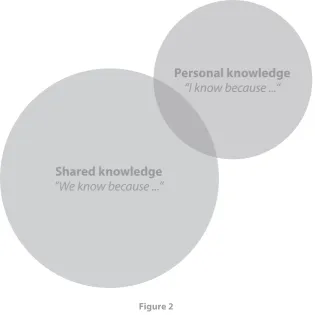
Knowledge can be viewed as the production of one or more human beings. It can be the work of a single individual arrived at as a result of a number of factors including the ways of knowing. Such individual knowledge is called personal knowledge in this guide. But knowledge can also be the work of a group of people working together either in concert or, more likely, separated by time or geography. Areas of knowledge such as the arts and ethics are of this form. These are examples of shared knowledge. There are socially established methods for producing knowledge of this sort, norms for what counts as a fact or a good explanation, concepts and language appropriate to each area and standards of rationality. These aspects of areas of knowledge can be organized into a knowledge framework.
Shared and personal knowledge
Knowledge in TOK
Shared knowledge
“We know because ...”
Personal knowledge
“I know because ...“
Figure 2
Shared knowledge
Shared knowledge is highly structured, is systematic in its nature and the product of more than one individual. Much of it is bound together into more or less distinct areas of knowledge such as the familiar groups of subjects studied in the Diploma Programme. While individuals contribute to it, shared knowledge does not depend only upon the contributions of a particular individual—there are possibilities for others to check and amend individual contributions and add to the body of knowledge that already exists.
Examples are easy to come by.
• Physics is a subject discipline with knowledge that is shared. Many have access to it and can contribute to it. Much of the work done is by teams of people building on existing knowledge. While individuals can and do contribute to this body of knowledge, the work of individuals is subject to group processes such as peer review and replication of experimental results before it becomes part of the corpus. • The knowledge required to build a computer is also shared. It is unlikely that there is an individual
who has the knowledge of building such a device from scratch (rather than simply assembling it from pre-constructed components). Yet we know how to make computers. A computer is the result of a complex worldwide cooperative effort.
Shared knowledge changes and evolves over time because of the continued applications of the methods of inquiry—all those processes covered by the knowledge framework. Applying the methodology belonging to an area of knowledge has the effect of changing what we know. These changes might be slow and incremental—areas of knowledge possess a certain stability over time. However, they could also be sudden and dramatic, revolutionary shifts in knowledge or paradigm shifts, as an area of knowledge responds to new experimental results, say, or advances in the underlying theory.
Knowledge in TOK
We are all members of other smaller groups too. We are members of ethnic groups, national groups, age groups, gender groups, religious groups, interest groups, class groups, political groups, and so on. There might be areas of knowledge that we share as members of these groups which are not available to those outside, such as knowledge that is anchored in a particular culture or in a particular religious tradition. This might raise questions regarding the possibility of knowledge transgressing the boundaries of the group. Here are some examples of such questions:
• Is it really possible to have knowledge of a culture in which we have not been raised?
• Are those outside a particular religious tradition really capable of understanding its key ideas?
• Does there exist a neutral position from which to make judgments about competing claims from different groups with different traditions and different interests?
• To what extent are our familiar areas of knowledge embedded in a particular tradition or to what extent might they be bound to a particular culture?
Thinking about shared knowledge allows us to think about the nature of the group that does the sharing. It allows international-mindedness into our exploration of knowledge questions.
Personal knowledge
Personal knowledge, on the other hand, depends crucially on the experiences of a particular individual. It is gained through experience, practice and personal involvement and is intimately bound up with the particular local circumstances of the individual such as biography, interests, values, and so on. It contributes to, and is in turn influenced by, an individual’s personal perspective.
Personal knowledge is made up of:
• skills and procedural knowledge that I have acquired through practice and habituation • what I have come to know through experience in my life beyond academia
• what I have learned through my formal education (mainly shared knowledge that has withstood the scrutiny of the methods of validation of the various areas of knowledge)
• the results of my personal academic research (which may have become shared knowledge because I published it or made it available in some other way to others).
Personal knowledge therefore includes what might be described as skills, practical abilities and individual talents. This type of knowledge is sometimes called procedural knowledge, and refers to knowledge of how
to do something, for example, how to play the piano, how to cook a soufflé, how to ride a bicycle, how to paint a portrait, how to windsurf, how to play volleyball and so on.
Compared to shared knowledge, personal knowledge is often more difficult to communicate to others. Sometimes it has a stronger linguistic component and is communicable to others, but often it cannot easily be shared. For example, an experienced tea taster who has developed their palette through years of experience of tasting different teas will have a complex knowledge of tea tastes. But the tea taster might find it difficult to describe the taste of a particular tea in words in a way that can be understood by others. The taster might use metaphor and simile to try to relate the experience of drinking this tea to others but the task is a difficult one. In this way personal knowledge is frequently characterized by this difficulty in sharing.
Knowledge in TOK
Like shared knowledge, personal knowledge is not static, but changes and evolves over time. Personal knowledge changes in response to our experiences. What is known by an 18-year-old could be quite different to what he or she knew at only 6 years of age. The various ways of knowing covered in the TOK course contribute to these changes.
Links between shared and personal knowledge
Clearly there are links and interactions between shared knowledge and personal knowledge. These are discussed in more depth in the knowledge framework.
Consider the example of a scientist such as Albert Einstein who has contributed much to modern physics. Clearly, he had some personal qualities that enabled him to see further than some of his peers. He had personal knowledge, a way of looking at things perhaps, that he was able to use to propel his exploration of the difficult questions that characterized the physics of the early 20th century. But his insights had to go through a thorough process of review before being accepted as part of the shared body of knowledge that is the discipline of physics.
There were disciplinary-specific methods that placed demands on Einstein’s thought. For example, his ideas had to be logically consistent, had to conform to previous experimental findings and had to go through a process of peer review. They also had to provide predictions that could be independently tested and verified (for example, the predictions made about the visibility of stars normally obscured by the sun in the solar eclipse of 1919). Only then could Einstein’s vision become an accepted part of physics. This illustrates how personal knowledge leads to advances in shared knowledge.
The reverse process can and does occur. Shared knowledge can have a big effect on our personal view of the world. Not only do the familiar areas of knowledge impinge on our personal experiences—someone studying economics might regard everyday shopping in a different light as a result of studying economics— but shared knowledge as membership of our cultural, ethnic, gender and other groups might influence our world view. This is what we call perspective. Membership of such groups provides a horizon against which the significance of the events of our lives is measured. Acknowledgment of such perspectives is an important goal of the TOK course.
From an individual perspective, shared knowledge often appears in the form of an authority—a source of knowledge whose justification is not immediately available to the individual. An example here is the authority of medical science to the patient who is not trained in medicine.
Balance between shared and personal knowledge
It is important that the TOK course reflects the balance between shared knowledge and personal knowledge. Too much emphasis on the personal at the expense of the shared is likely to result in a course that is oriented towards the subjective experiences of the students and does not look at knowledge beyond the individual to how knowledge is constructed in the wider world. There is a tendency for such a course to become a succession of personal anecdotes strung together with little or no analysis.
Biasing the course in the opposite direction risks losing the important links between the areas of knowledge and the individual knower. Shared knowledge has a significance and value for the individual that gives it relevance and importance. There is a danger that such a TOK course could become too arid and fact-oriented. Making the distinction central to the course brings the balance of these two elements to the forefront.
Syllabus
Knowledge claims and knowledge questions
Knowledge claims
In TOK there are two types of knowledge claims.
• Claims that are made within particular areas of knowledge or by individual knowers about the world. It is the job of TOK to examine the basis for these first-order claims.
• Claims that are made about knowledge. These are the second-order claims made in TOK that are justified using the tools of TOK which usually involve an examination of the nature of knowledge. Here are some examples:
• “There are an infinite number of prime numbers.” This is a first-order knowledge claim because it resides firmly inside the area of knowledge mathematics. It is established using the method of mathematical proof.
• “Mathematical knowledge is certain.” This is a second-order knowledge claim because it is about mathematical knowledge. We establish this by examining the methods of mathematics themselves using the tools of TOK.
Both types of knowledge claims might be found in TOK. The first type will feature in examples offered in the essay and presentation illustrating the manner in which areas of knowledge go about the business of producing knowledge. The second type will constitute the core of any piece of TOK analysis.
Knowledge questions
TOK is primarily concerned with knowledge questions. This phrase is used often in describing what is seen in a good TOK presentation or a good TOK essay. An essay or presentation that does not identify and treat a knowledge question has missed the point. It also occurs in the assessment descriptors that examiners use to mark the essay and that the teacher uses to mark the presentation. To put it briefly, the whole point of the presentation and essay tasks is to deal with knowledge questions.
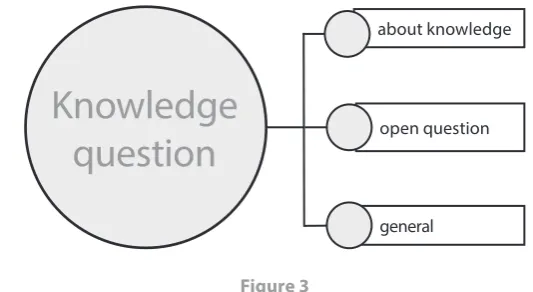
Knowledge questions are questions about knowledge, and contain the following features.
• Knowledge questions are questions about knowledge. Instead of focusing on specific content, they focus on how knowledge is constructed and evaluated. In this sense, knowledge questions are a little different from many of the questions dealt with in the subject classrooms. In this way, they are considered second-order questions in TOK.
Knowledge claims and knowledge questions
• Knowledge questions should be expressed in general terms, rather than using subject-specific terms. For example, instead of a question focusing on a specific model in development economics, such as the Harrod-Domar model, a knowledge question might focus on the reliability of modelling as a method of gaining knowledge in economics.
open question about knowledge
general
Knowledge
question
Figure 3
It might be worth considering and discussing with students why questions of knowledge are open and therefore so interesting. Why is it that the typical TOK question does not have one straightforward correct answer? Students might find themselves facing this sort of question in class. Perhaps a typical response might start with “it depends what we mean by ...” In other words, the first task in trying to answer a TOK question is to establish an understanding of the key concepts involved. There may be a number of different ways of thinking about these concepts. Each might give rise to a different analysis and ultimately a different answer to the question.
It is inevitable that personal perspectives will play a part in the judgments made in any analysis. The intellectual resources that each of us has to draw upon might well be different and lead us to different or even diametrically opposed conclusions.
The possibility of a lack of unanimity in answering TOK questions can be initially challenging for students. After all, in mathematics a student getting a different answer to his or her neighbour can be a cause for concern, prompting the thought that one or other has made a mistake. In a TOK question it is perfectly conceivable that the answers differ. What is important is that the analysis is thorough and that there are good reasons to back it up. It is possible that both conclusions are true. It is tempting to explain the plurality of good answers to knowledge questions in terms of a type of truth relativism: “it is just a matter of perspective”. A more likely explanation is that different interpretations of key ideas account for the different conclusions or that the weighting of different factors in the argument differ.
Knowledge questions are general questions about knowledge
Another challenging aspect of TOK is the requirement that a knowledge question is somehow more general than the particular examples which illustrate it. This requirement springs from the idea that TOK deals with second-order questions.
For example:
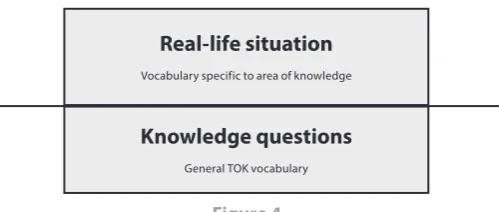
• In physics, one deals with questions about the material world. In TOK, we ask questions about knowledge in physics. How can the physicist be sure of his or her conclusions given that they are based on hypothesis and experiment? The student in TOK is not talking in physical terms because he or she is not talking about the physical world but the discipline of physics. Therefore, it is necessary to use a different, more generalized vocabulary. The physicist uses terms like particle, energy, mass and charge. In TOK, the student uses terms such as hypothesis, experimental data, interpretation, anomaly, induction, certainty, uncertainty, belief and knowledge. So knowledge questions should employ these terms, not the terms of physics.
Knowledge claims and knowledge questions
Real-life situation
Vocabulary specific to area of knowledgeKnowledge questions
General TOK vocabularyFigure 4
Examples of knowledge questions
You can find knowledge questions underlying almost any issue. They are sometimes difficult to formulate precisely but they often lurk underneath popular and often controversial subjects that are discussed in the media, for example. It is a very useful exercise to try to tease out knowledge questions underlying articles in the media. Here are two examples of a topic that has been discussed in newspaper articles and possible knowledge questions associated with the topic.
Example 1:Future population growth in Africa
• Not a knowledge question: “How can we predict future population growth in Africa?” This is not a knowledge question because it is a technical question within the discipline of population studies. • Good knowledge question: “How can a mathematical model give us knowledge even if it does not
yield accurate predictions?” This is now sufficiently general and explores the purpose and nature of mathematical modelling.
Example 2:The placebo effect and its impact on the medical profession
• Not a knowledge question: “How does the placebo effect work?” An answer to this might involve a technical explanation in psychology. This therefore sits above the line in figure 4.
• A good knowledge question: “How could we establish that X is an ‘active ingredient’ in causing Y?” This question is actually a rather general one about how we can know about causal links. It is a classic knowledge question.
Knowledge questions and assessment
Knowledge questions are at the heart of the assessment of TOK. The presentation and the essay both deal with knowledge questions.
The diagram in figure 4 can help explain the two assessment tasks in TOK. The TOK presentation starts above the line with a real-life situation described in “real-life” terms. At a certain point in the presentation the student is required to identify the underlying knowledge question (below the line). This is then explored using the language of TOK and a conclusion is reached which is translated back into real-life terms.
The TOK essay follows a path that is in some sense a mirror image of this. The prescribed titles for the essay are expressed in rather general TOK language; they sit below the line. The student is required to identify knowledge questions connected to the prescribed title. The student must then give them some concrete form by finding examples (above the line) which illustrate them. These examples are explored using the tools of TOK (which might require some excursions back below the line). Finally, a general conclusion to the essay will be located in TOK language below the line.
Syllabus
Ways of knowing
The TOK course identifies eight specific ways of knowing (WOKs). They are: • language
• sense perception • emotion
• reason • imagination • faith • intuition • memory.
Students must explore a range of WOKs. It is suggested that studying four of these eight in depth would be appropriate. The WOKs selected for detailed study should be carefully selected to ensure a coherent and balanced approach.
There are two central purposes to the WOKs in TOK. On the one hand they are the tools that answer the question “how do we know?” and on the other hand they help us answer the question “how do I know?” For example, we can analyse the role of imagination in the construction of shared knowledge in terms of scientific discovery, but we can also discuss imagination in the context of personal knowledge and understanding.
While there may be a place in a TOK course to analyse WOKs and their impact on how individuals construct their own personal knowledge, TOK teachers are encouraged to explore WOKs, not in isolation, but from the perspective of their contribution to understanding different areas of knowledge.
Specific ways of knowing
Below is a brief introduction to each WOK. The questions preceding the description of each WOK are simply stimulus questions, designed to promote discussion and raise awareness of the individual WOKs and their impact on knowledge.
Language
How does language shape knowledge? Does the importance of language in an area of knowledge ground it in a particular culture? How are metaphors used in the construction of knowledge?
Ways of knowing
part of our daily lives, but is also filled with potential problem areas, for example, ambiguity, sarcasm, irony and translation issues.
Language plays an important role in communicating knowledge. However, some see language as having an even more central role, arguing that language doesn’t just describe our experiences of the world but in fact actually structures those experiences. In the section on the knowledge framework there is a discussion about whether certain types of knowledge are actually constituted by language—the idea that language is part and parcel of the knowledge claim itself and not merely a description of something that exists independently of language. The view that facts about the world might be determined by the language is called linguistic determinism.
Sense perception
How can we know if our senses are reliable? What is the role of expectation or theory in sense perception? What is the role of language in sense perception?
Sense perception is the process by which we can gain knowledge about the outside world. Traditionally, there were believed to be five senses: sight, touch, smell, taste and hearing. However, many now argue that there are others such as a sense of heat, sense of pain, sense of movement, sense of balance and the senses of hunger and thirst, or a sense of where our body parts are.
Historically, the view that the senses provide the basis for all our knowledge was challenged by the idea that prior concepts might be needed before any perception takes place at all. Indeed, it is common now to view sense perception as an active process of interpreting the world according to prior expectations, conceptual frameworks and theories. There is, therefore, some disagreement as to whether we directly perceive the world as it is, or whether perception is an active process where we supply much of the content of our experiences ourselves.
Emotion
Are emotions universal? Can/should we control our emotions? Are emotions the enemy of, or necessary for, good reasoning? Are emotions always linked to belief?
The naturalistic view of emotions is that they are the products of natural processes, with physiological causes and effects. One supporter of this view was Darwin, who believed that emotions are purely physiological and therefore universal and experienced across all cultures. However, there seem to be many examples of culturally bound emotions, for example, the Chinese notion of “sad love”. The opposite view is therefore that of the social constructionists, who argue that emotions depend on a social consciousness, and have no natural basis at all. For example, emotions such as shame seem to presuppose a notion of right and wrong. Emotion has sometimes been regarded as an unreliable way of knowing. Emotions have, for example, been criticized as being irrational obstacles to knowledge that distort our picture of reality. However, others believe that not only do emotions help make sense of social and cultural experiences and behaviours, but they are also the source of social, ethical and political knowledge by helping us form an understanding of the world around us.
Reason
What is the difference between reason and logic? How reliable is inductive reasoning? Are we predictably irrational?
Ways of knowing
grounded in culture. Areas of knowledge might set their own requirements for the types of reasoning that are accepted.
Inductive reasoning is the process of supporting general statements by a series of particular ones—the reverse of deductive reasoning which tends to proceed from the general to the particular. Inductive reasoning is by its nature inferential. Statements involving the word “all” are often not strictly provable given the difficulties in making observations of an infinite set of particulars. This is of importance in the natural sciences but also in human sciences such as psychology and economics.
Imagination
What is the role of imagination in producing knowledge about a real world? Can imagination reveal truths that reality hides? What is the role of the imagination in understanding others?
Imagination is often identified in a narrow sense as the capacity to form a mental representation of something without the stimulus of sense experience. Traditionally imagination has been associated with imagery and making a mental image of something. However, more recently interest in the imagination has also focused on exploring propositional imagining, or “imagining that”. The importance and power of the imagination is highlighted by a number of medical conditions which impact upon it, for example, conditions which can impair imagination such as severe autism, or conditions which can cause delusions such as severe schizophrenia.
Imagination is sometimes viewed in a broader way as being associated with creativity, problem-solving and originality. Here it might be the making of connections between otherwise disparate ideas in order to solve problems. This might be useful in model making or theory creation in the sciences and solving structural problems in the arts. Imagination is, however, also sometimes distrusted, in part because it is regarded as something that is derived in the mind of the individual and therefore subjective. Imagining is also sometimes associated with counterfactual reasoning; imagining “what would happen if …”, or “what would have happened if …”.
Imagination is also sometimes associated with possibility, in that it can be argued that only things which are possible can be imagined. In this way, the imagination is seen by some to provide evidence of what is and is not possible. In daily life, imagination has a particularly prominent role in entertainment, for example, fictional films or television programmes. However, it can be argued that imagination also plays a deeper role, for example, in moral education, developing empathy, or providing opportunity for self-expression and an increased understanding of the self.
Faith
Should humanism or atheism be described as a faith? Can theistic beliefs be considered knowledge because they are produced by a special cognitive faculty or “divine sense”? Does faith meet a psychological need?
The term “faith” is most frequently used to refer specifically to religious faith, but can also be used in a secular sense as a synonym for trust. Although most associated with belief in a God or gods, faith can be religious without being theistic, for example, in Buddhism. Alternatively it can be seen as a commitment to a particular interpretation of experience and reality which is not necessarily religious at all, such as humanism. Logical positivism claims that statements of faith have no meaningful cognitive content, so it doesn’t make sense to speak of faith as a way of knowing. However, for many people faith is a key way in which they try to understand and explain the world.
Ways of knowing
interdependent, for example, natural theology argues that it is only possible to access God through reason, and many religions regard reason as a God-given gift.
Some would argue that the criticism and controversy surrounding the evidence for faith claims is misplaced, arguing that faith is an act of trust and is an example of knowledge which is not evidence based. Indeed, in some traditions belief that is not based on evidence is seen as superior to belief that is based on evidence, the demand for concrete evidence being seen to signify a lack of faith. Given this controversy, teachers should provide the opportunity for a critical discussion of faith as a way of knowing. Its inclusion as a way of knowing should not be seen as an excuse for unthinking acceptance of knowledge claims in religion or other areas of knowledge.
Intuition
Why are some people considered more intuitive than others? Are there certain things that you have to know prior to being able to learn anything at all? Should you trust your intuition?
Intuition is sometimes described as immediate cognition, or knowledge which is immediately evident without prior inference, evidence or justification. Intuition is often contrasted with reason, as it is regarded as knowing without the use of rational processes. Jung (Psychologische Typen 1921) famously referred to intuition as perception via the unconscious, highlighting the idea that intuition is often seen as beliefs which are known without understanding how they are known.
Intuition is sometimes associated with the concepts of instinct and innate knowledge. For example, some would argue that although we do not have innate knowledge of any particular language, we have an intuitive capacity to use language. Intuition has been much discussed in the field of ethics in terms of whether we have moral intuition, or a kind of innate sense of right and wrong. It is also seen by some to play an important role in scientific advances.
To know something by intuition is to know something through introspection or an immediate awareness. In this way, some argue that it is impossible to justify, or that as it is immediately evident it requires no further justification. Some people are regarded as more intuitive than others, with intuitive people often being said to make quick instinctive decisions without having any identifiable rationale for those decisions. However, some have denied the existence of intuition as a separate way of knowing. For example, it has been suggested that intuition is a term which is often used to describe a combination of other ways of knowing, such as prior experience, heightened sense perception and an active imagination.
Memory
Can we know things which are beyond our personal present experience? Is eyewitness testimony a reliable source of evidence? Can our beliefs contaminate our memory?
Many discussions of knowledge tend to focus on how beliefs and knowledge are formed rather than on how they are remembered by the individual. However, most of the knowledge that individuals have is in the form of memory and therefore how we retain information and how past events and experiences are reconstructed is an important aspect of how personal knowledge is formed.
Ways of knowing
“storage unit” for existing knowledge, memory can also be a mechanism that allows us to process new and unique situations.
The importance of memory can be highlighted by imagining the challenges that would be presented by losing our memory. Because so much of our personal knowledge is in the form of memory, issues surrounding the reliability of memory are also crucial. Memory retrieval is often regarded as unreliable, for example, because it is seen to be subjective or heavily influenced by emotion. However, we rely on our memory every day and because many of our memories seem to be reliable, this gives us confidence that our other memories are reliable.
Ways of knowing do not operate in isolation
Syllabus
Areas of knowledge
How do we know things? We know things because we use a range of methods of inquiry that incorporate ways of knowing to help construct knowledge in different areas of knowledge (AOKs).
The theory of knowledge course distinguishes between eight AOKs: • mathematics
• natural sciences • human sciences • history
• the arts • ethics
• religious knowledge systems • indigenous knowledge systems.
Students must explore a range of AOKs. It is suggested that six of these eight would be appropriate. While this guide identifies eight broad AOKs, students should be encouraged to think about individual academic disciplines, that is, to think about the nature of knowledge in their own specific IB subjects, such as chemistry, geography and dance.
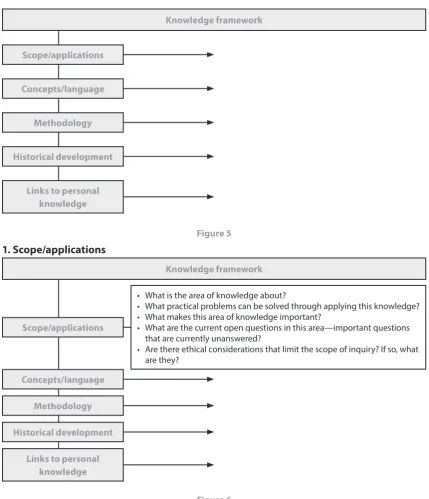
Knowledge framework
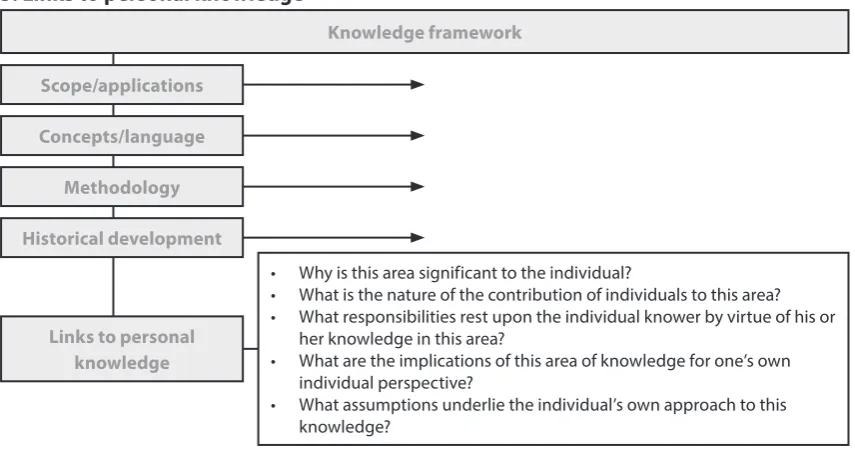
One effective way to examine the AOKs is through a knowledge framework. A knowledge framework is a way of unpacking the AOKs and provides a vocabulary for comparing AOKs.
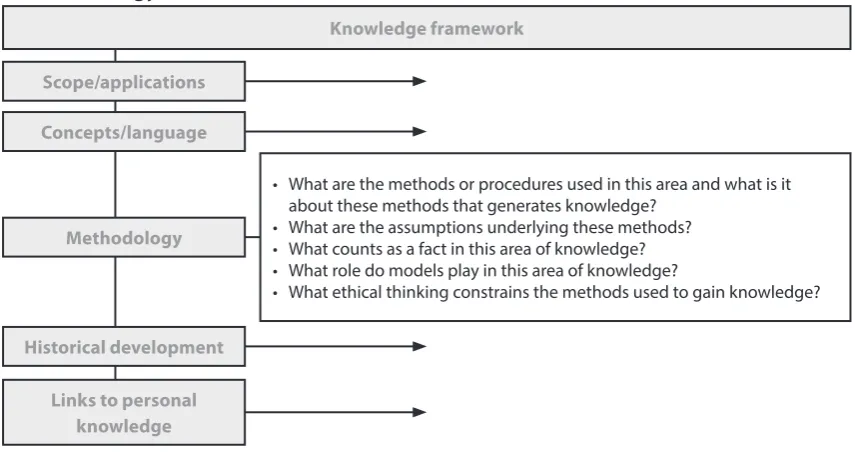
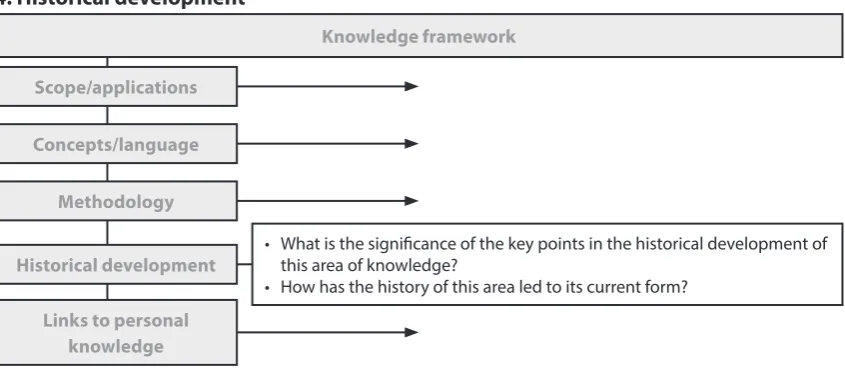
For each AOK the following can be examined: • scope, motivation and applications • specific terminology and concepts • methods used to produce knowledge • key historical developments
• interaction with personal knowledge.
Within this knowledge framework, key features of each area are identified, as are specific terminology and concepts which shape that area of knowledge. The key historical developments that have influenced and shaped each area are identified, as well as the ways that each makes use of particular methodology. Finally, there is opportunity for reflection on the interaction between shared and personal knowledge in each area. Knowledge frameworks are a very effective device to compare and contrast areas of knowledge.
Areas of knowledge
Comparison of different AOKs is not purely a descriptive task. It is analytical in the sense that the student should link the practices of inquiry to the knowledge that comes out in the end. For example, the reliability of knowledge within an AOK will depend critically upon the methods used to produce it. Making links of this sort is what is meant by analysis in TOK.
Scope/applications
Knowledge framework
Concepts/language
Methodology
Historical development
Links to personal knowledge
Figure 5
1. Scope/applications
Scope/applications
Knowledge framework
Concepts/language
Methodology
Historical development
Links to personal knowledge
• What is the area of knowledge about?
• What practical problems can be solved through applying this knowledge? • What makes this area of knowledge important?
• What are the current open questions in this area—important questions that are currently unanswered?
• Are there ethical considerations that limit the scope of inquiry? If so, what are they?
Figure 6
This component attempts to explore the range of the specific AOK within the totality of human knowledge and how that knowledge is used. Scope refers to the definition of the AOK in terms of subject matter, and the form that an AOK takes depends critically upon the nature of the problems it is trying to answer. For example:
• biology studies living organisms and is mainly concerned with how they function • mathematics is the study of quantity, space, shape and change
Areas of knowledge
• music might not seem concerned with solving practical problems at all but the composer has to solve the “musical engineering” problems of building a piece of music; it has to be a unified whole and yet at the same time there has to be some sort of inherent contrast there to provide tension and energy and, for the listener, interest.
Exploration of the scope and applications of a particular AOK can lead to interesting discussions of the ethical considerations that have to be taken into account. Practitioners in a particular AOK might not be permitted to explore all the aspects that are of interest. There might be moral and ethical limits on the sort of investigations they undertake and experiments they perform.
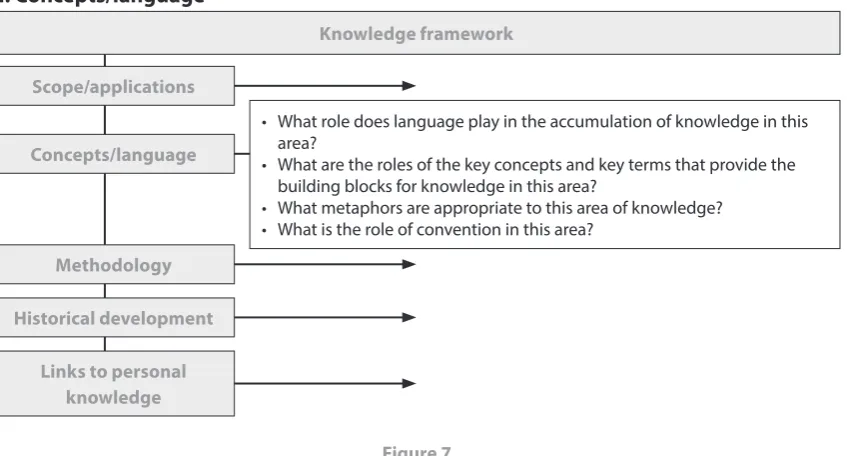
2. Concepts/language
Scope/applications
Knowledge framework
Concepts/language
Methodology
Historical development
Links to personal knowledge
• What role does language play in the accumulation of knowledge in this area?
• What are the roles of the key concepts and key terms that provide the building blocks for knowledge in this area?
• What metaphors are appropriate to this area of knowledge? • What is the role of convention in this area?
Figure 7
This element explores the way in which language is used in the production of knowledge in each AOK. The key idea is that language does not just communicate pre-existing “non-verbal” knowledge but that, in many cases, the language used actually constitutes knowledge. Take language away and there is nothing left. One of the reasons for this is that the language names concepts—these are the building blocks for knowledge. An AOK is a system of relationships between its key concepts. Different building blocks build quite different AOKs and produce different ways of thinking about the world.
For example:
• in physics key concepts in