Foros de discusión en programas de aprendizaje
mixto del inglés como lengua extranjera
Diana Isabel Cantor Barragán
*1Universidad Nacional de Colombia, sede Bogotá
This paper reports on a study conducted at Universidad Nacional de Colombia in the ALEX Virtual English program. It shows the main characteristics of discussion boards when used as a main activity in an EFL blended course. The study took place in the second semester of 2008 when the program was in the piloting stage and it illustrates the importance of the discussion board tool in the transition from face-to-face education to virtual education. The research followed the qualitative principles and shows the use given to discussion boards by some of the students of the program. Students’ perceptions of the tool are registered as a description to give the reader the opportunity to develop her/his own perception on its use.
Key words: Discussion boards, ALEX Virtual English program, autonomy, blended modality, teachers’ accompaniment
Este artículo reseña un estudio realizado en la Universidad Nacional de Colombia en el programa
ALEX Virtual – inglés. Se muestran algunas características de los foros de discusión como actividad principal en un curso mixto (presencial y virtual) de inglés como lengua extranjera. El estudio se realizó en el segundo semestre del 2008, cuando el programa aún estaba en fase de pilotaje y ejemplifica la importancia de los foros de discusión en la transición de la modalidad presencial a virtual. La investigación siguió los principios cualitativos y muestra el uso que dan algunos estudiantes del programa a los foros de discusión. Se describen las percepciones de los estudiantes sobre la herramienta para que el lector pueda desarrollar su propio punto de vista sobre el uso de esta.
Palabras clave: Foros de discusión, programa ALEX Virtual – inglés, autonomía, modalidad mixta, acompañamiento del profesor
* E-mail: [email protected]
Address: Calle 18B 5-44 Sur, Bogotá, Colombia.
Introduction
In the last few years the world has seen a con-siderable rise in the use of ICT (Information and Communication Technologies), especially due to the Internet spreading. With globalization, infor-mation culture and new technologies in commu-nication, societies are forced to evolve and involve as many users as possible. Colombian society and the Universidad Nacional de Colombia have tried to move along with such development by imple-menting projects involving new technologies.
The task of getting to know and effectively using new technologies is not easy, even more in countries still in the development process but efforts to gradually become part of the world’s technological societies are constantly made. Through technological and pedagogical resources, students of the Universidad Nacional are offered the ALEX Virtual English program, which aims at providing students with a successful learning process of English as a foreign language in a virtual blended modality.
In the program, one of the first virtual tools developed is still being used: the discussion board. This and some other tools (chat, video-chat) were meant to facilitate the gradual change from face-to-face to virtual modalities in the program. These tools gave students and teachers the experience and confidence necessary to consolidate the two pillars of the ALEX Virtual program: autonomous and virtual learning. During the time in which the research took place the program was in a piloting stage in order to permit changes in it and to make it easier to turn to the blended learning methodology, which would contribute to the success of the program.
The changes of modality led to changes in methodology and strategies; this means the role of both students and teacher was reconsidered. The study aimed at showing how the use of
discussion boards in four groups of the second level of the ALEX Virtual English Program can typify the conjuncture of the change of modality by encouraging autonomy as well as allowing the teacher to guide the student in the process. Furthermore, the study intended to project the use of the tool in the program.
The Study
The research project was carried out during the second term of 2008 with 4 groups (groups number 13 to 16) of students of the ALEX Virtual English program, second level. I took part in the project as both researcher and tutor of the four groups. The program was launched in 2008-I, and for that term and the following semester (2008-II), it was under a piloting stage. Before ALEX Virtual, the university used to offer students face-to-face English courses (the regular modality in its education system) but the high demand of places to study English led the Foreign Languages Department to seek another option to solve this problem. Besides offering an English program, the Department aimed at developing a new program which could renew the concept of language learning and that’s how ALEX Virtual was conceived.
In ALEX Virtual’s first phase (2008-I), the program offered levels I and II and was then in a phase of testing and improvement. For 2008-II, the program offered levels I to IV, increasing considerably the coverage of students, which also evidenced the success of the first phase.
Superior Universitario). Since the approval of the act, students of the University have been learning different languages in courses based on an autonomous methodology. University students have registered in the courses and taken them successfully, especially in English language courses. This led to an over demand of these courses since they consider English the most useful language for their professional development. The over demand of English led to the creation of ALEX Virtual, a different modality of English learning at the University in 2007.
However, changing from face-to-face ses-sions to only virtual learning is neither easy nor pedagogically appropriate (since students will feel lost as regards knowledge without a semi-permanent guide). In order to consolidate the program, including the virtual and a face-to-face component, the designers of the course decided to make it blended, with a wide virtual compo-nent and tutorial sessions to provide face-to-face meetings which could ensure students real un-derstanding on the topics.
ALEX Virtual is a blended program which, according to Bonk & Graham (2002), is a hybrid of online and face-to-face courses, in which a substantial proportion of the content is delivered online; it typically uses online discussions and typically has some face-to-face meetings. These meetings make the program different from one hundred percent online programs since they represent 30 percent of the courses’ grade (15% attendance for tutorial sessions and 15% cultural events participation, these elements will be explained in detail afterwards).
The methodology of ALEX Virtual consists of the following four main elements (GDA, 2004):
1. Autonomous work by the students. It is
done through the use of the contents designed
for the program (modules in Blackboard) and materials available in the Resources Center.
2. Face-to-face component. This component
consists of one hour of face-to-face tutorial sessions a week with a teacher responsible for a group of 25 students maximum. Each group also has a tutor, who is an English philology student, who supports the teacher’s work with the group. The tutor has four hours per week for on-line (video-chat) and four hours for face-to-face tutorial sessions. These hours are devoted to answering questions students have about the platform or the course and for the oral practice of the language. Students can also communicate with teachers and tutors via internal mail on the platform or ask for help of auxiliary students (English language students) at the Resources Center. The auxiliary students assist students’ work at the Resources Center since they not only facilitate materials to students but also know all the materials available and can recommend different activities according to the needs of the students. They can also answer language, history, literature and other questions about topics closely related to the language studied.
3. Academic and Cultural Events. These
are spaces provided by the University and the Program in which the students, guided by teachers and tutors, develop project works and show the result of their work in an event. Presentations, exhibitions, competences and games are part of the projects students can participate in.
4. Evaluation. The courses have two
pass-ing the exam is a requirement for passpass-ing the course (Departamento de Lenguas Extranjeras - Foreign Languages Department, 2007). The breakdown of the grades corresponded to the percentages indicated in the following chart. The participation in discussion boards is in-cluded in 30% of activities.
Table1. ALEX Virtual grading system.
Item Percentage Final Grade
Activities, participation and
quizzes
30%
Tutorial sessions
attendance 15% 60%
Project work and cultural events
participation
15%
Final Exam (having stood the two progress tests is compulsory to
be able to stand this exam)
40% 40%
Discussion Boards
The discussion board is an asynchronous tool which allows the exchange of ideas, debates and collaborative learning. Due to the characteristics of the tool (flexibility as regards time and open field of expression), boards are largely used by teacher-tutor (mentioned this way throughout the text since both decide on discussion board usage) and, therefore, deserve research to examine whether they actually help students of a blended course by allowing accompaniment and encouraging students’ autonomy or not.
ALEX Virtual runs on the Blackboard plat-form which in its base plat-form includes the discus-sion board application. “Language teachers have
found that students at many different levels ben-efit from the extra writing done in discussion forums and from its use to communicate mean-ingfully in real contexts” (Godwin-Jones, 2003, p. 1). That’s why the designing team decided that this application had to be explored and used by students and guided by teachers, but it was the teachers’ and tutors’ decision regarding when and how to use it.
Discussion boards are widely used in many programs and specifically in ALEX Virtual because they “facilitate group exchanges, and they maintain automatically a log of all messages in a threaded, hierarchical structure. Some instructors find that students consider language structure somewhat more in contributing to discussion forums (as a form of semi-public display) than in writing e-mail (a quick and easy private and informal system). Discussion forums are often seen as an equalizing tool, which encourages universal participation in discussion compared to face-to-face dialogue” (Godwin-Jones, 2003, p. 1).
The options for defining discussion boards are as varied as discussion boards themselves. Basically, a discussion board can be defined as a web application where people can discuss different topics through individual (whether personal or scientific information) posts.
There are specific discussion boards that are designed to join people with similar characteristics (students of a certain major or university) and similar knowledge backgrounds to discuss more technical information and even give opinions and make predictions about the state of the art and the future of the field being discussed. In this way, discussion boards become not only banks of information but generate ideas and trigger potentialities.
it provides a practice and reflection space make it an excellent tool for blended courses. This is an excellent reason why designers decided to include participation in discussion boards as one of the significant tasks for ALEX Virtual courses.
Furthermore, “These discussions allow for dynamic growth, development, and interchange of ideas among students, and therefore can play an important role in student learning” (Barbour & Collins, 2005; Wu & Hiltz, 2004). This interchange and meaningful communication help improve writing skills and autonomy but, overall, they promote the critical thinking that characterizes the Universidad Nacional de Colombia’s students. Now that the concept of discussion boards has been defined and described in terms of their characteristics and function, it is important to describe their elements or users. A discussion board is made up of a creator and/or administrator, as well as participants and their interventions (participation, ideas, and writings).
• A creator, which most of the time is the administrator or moderator, is the person who starts a discussion by making a post or asking a question of people who know about the topic or are part of a group with a common interest. The creator can enable other users such as administrators to propose discussion topics, delete or modify contents and block or remove users who break the rules of participation, are discourteous or sabotage in any way the functioning of the board. In ALEX Virtual English program the creators are always the teachers or the tutors since they meet ahead of time and think of a topic according to the contents studied during the time the board will be available as well as propose the topic which can help students review it and widen their knowledge.
• A discussion board can be open or restricted (in that case the participants must have a subscription to an organization or page). In ALEX Virtual only students registered in the corresponding group have access to the board. The participants are given an issue and must answer a question or reply to an opinion with information from different sources or original ideas. In some forums participants can create discussion threads; in other forums they can only answer threads proposed by the administrator and the interventions of other participants. The participants comprise the “soul” of discussions because their participation conditions the success of the discussion of a topic.
Some threads aim at getting information about students’ learning processes, feelings, impressions and difficulties; others do not have a specific aim but, instead, attempt to give students the opportunity to express themselves freely, to get to know other students while developing critical thinking and shared learning through the possibility of seeing what partners have said about a topic and replying to this in the best way possible, but with the condition of maintaining meaningful, pertinent, friendly and overall respectful communication.
The teacher or tutor has the option of allowing or disallowing students to create sub-forums or only adding “sequences” as replies to the main topic or to others’ opinions. The teacher can add sequences, answer specific interventions, modify sequences and limit the time the discussion board is available for students’ participation (after deadlines, students cannot participate in certain boards).
main topic or reply to specific people through open intervention in the board or by sending private internal e-mails (on the same platform of the course, Blackboard). Students cannot modify other students’ interventions or delete them. Students can express their opinions, add referenced information and links to external websites related to the topic discussed as well as attach files, images and videos, etc.
According to Tagg (1994) as cited by Anderson & Kanuka (1997), the administrator or moderator of a discussion board must be “a person who motivates, provides support and stimulates… guides or “weaves” the topic in order to keep it on the right track”. Anderson & Kanuka (1997) also say that the moderator makes use of strategies and techniques to make sure that the discussion will keep flowing, be continuous and “humanize technology” since it is a medium still considered by some people as a threat to the human interaction and, additionally, makes them feel comfortable with the use of these technological tools. However, this proposal for the role of the moderator seems to be more appropriate for long term discussions and with people or students who are not involved in processes of autonomy awareness and still need the moderator or teacher to assume the leadership of the learning process.
In accordance with the face-to-face modality of the ALEX program at the Universidad Nacional de Colombia as regards the autonomy of students, and in order to give them the responsibility of their learning processes, teachers assumed a more distant position and restricted their participation to the posting of the topic, giving some answers and corrections to students when asked and adding more sequences in order to organize ideas that were moving from the topic and distracting students’ attention from the original proposed issue. The student must not have the
impression he/she is interacting only with the teacher–tutor. Hence, ALEX Virtual is interested in allowing students to interact with each other; the teacher answers or makes interventions only when necessary.
It is also important to have only one or two discussion boards available for students; having more boards can distract students and make them feel the pressure to participate more times than he/she actually has to.
Participation in discussion boards must have a specific percentage in the whole course grade. Students participate more actively when they know the activity not only contributes to his/ her learning process but to the final grade. ALEX Virtual is a blended course and is still in the piloting phase, so encouraging participation on the boards is acceptable. Establishing a demand of a certain amount of interventions per week to get the points is a good strategy to guarantee students’ participation.
Methodology of the Study
The study reported on in this article is an exploration of the use given by students of the ALEX Virtual English program to discussion boards. According to Bell (1993), the qualitative researcher’s function is “to collect facts and study the relationship of one set of facts to another”. The research has both quantitative and qualitative data but it has a descriptive, qualitative approach, since the facts of participation and use and the opinions given by the students in the survey should portray patterns common to the four groups or differences produced by different phenomena to be studied in further works of research.
also a case study, which is defined as “a specific example, frequently designed to illustrate a more general principle” (Cohen, Manion & Morrison, 2000).The program is divided into four levels, each level with ten groups. This study took four groups of the same level that were guided by the same teacher and tutor and, therefore, with the same topics in the discussion boards. However, the participants represent a big population of the program and, as such, their participation in the discussions represents frequent uses of the tool in the whole program.
The four groups the study was based on (groups 13 to 16, ALEX Virtual, Level II) were all led by one teacher and one tutor. The teacher and tutor also worked together in the first semester of 2008; they were in charge of four groups of level I. During the first semester they posted one activity and one discussion board weekly; there was a permanent board called “Questions and doubts about the platform and the course” as well as non-permanent boards which were available for students from Monday to Sunday (these non-permanent boards were the ones in which there was a greater emphasis). After that time (Monday morning) the topic was not available for students anymore and a new topic was posted. Among the topics were questions about topics studied in the virtual modules, reflections about students own learning processes, discussions about the changes faced by the University and, during the second half of the term, discussions about the topics, information and procedures to develop a project to be exhibited in the Cultural Event.
The study was focused on students’ participa-tion in one of the main activities: weekly discus-sion boards. The research aimed at describing and analyzing the use given by students to this tool. The study also aimed at examining this tool in the learning process and in the encouragement of
autonomy as well as the collaboration or accom-paniment of teacher-tutor, which are both part of the philosophy of ALEX Virtual program since it belongs to the blended modality.
To carry out the study there were two instruments for collecting the data:
• A survey for students about their perceptions and use of discussion boards.
• Statistics of the groups’ participation in the boards posted weekly.
The results of the three instruments used for data collection were analyzed both individually and in relation to each other and the findings about common patterns of usage among most students from the four groups are reported in the following section.
Findings
The surveys answered by 55 students who participated in the study consisted of 9 questions about their actual use and perceptions on the discussion boards.
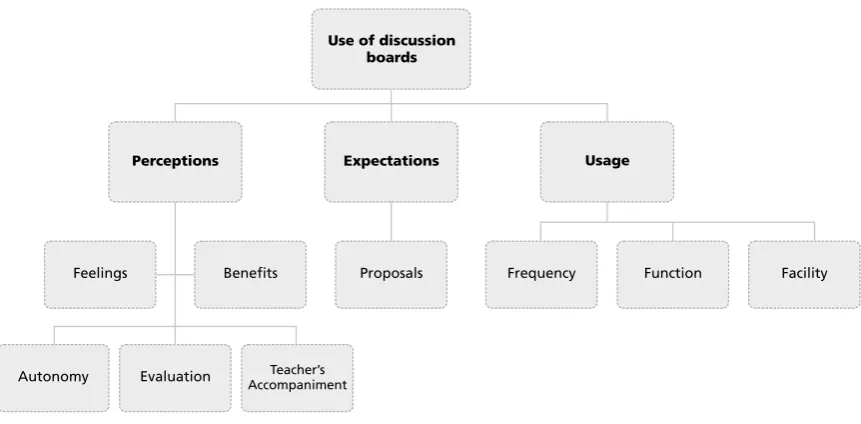
From those questions the study was divided into the following three categories: perceptions, expectations and usage of the tool (as showed in Figure 1).
posted on the board. These perceptions reported by students were contrasted and corroborated with the statistics of participation of each group, provided by the programs’ coordination and available on each group’s administrator page.
Perceptions
Feelings and benefits
In relation to feelings, most students reported they felt free to express their ideas in the discussion boards and gave some reasons. A small percentage of the students do not feel free to express ideas on the boards. The only person who answered “no” to this question argues that the use of a foreign language reduces the vocabulary available to write and, therefore, the expression of ideas becomes more limited than expression in the mother tongue.
Students tend to feel free because there are no restrictions such as limits of participation
Figure 1. Categories from the research on the use of virtual discussion boards.
or bans and they do not feel that partners or teacher-tutors judge or criticize their opinions. Some students reported that the tool is by nature a space of free expression of ideas and opinions and that fact makes them feel comfortable when using it. A significant amount of students said they feel free because there is respect from partners towards diversity of opinion. This is probably a consequence of kind and respectful words and a low level of expression of disagreement.
Autonomy
Autonomy refers to an approach to support or guide the learning process. Students were supposed to evidence autonomy when participating in discussions by the following: investigating or getting informed about the topic, searching for new words, organizing ideas about the topic and, after participating, analyzing and reflecting on their intervention and other students’ interventions. All these activities could be done individually by using only the platform and virtual tools such as on-line dictionaries and web pages. By doing these activities students can substantially improve their writing as was manifested by students who reported the following:
“There is autonomy because I have to make an effort to investigate the topics studied and to make valuable contributions to the discussion” (Milton Miranda, group 13) or “Yes, it helps to develop autonomy because it allows me to start the habit of becoming responsible for making short interventions in any free time I have” (Catalina Serrato, group 13).
A significant number of students reported they do not believe the use of discussion boards helps them to develop autonomy in English learning. The reasons these students gave were as follows: participation is obligatory or rewarded with points (grade) so there is no autonomy in participation and the amount of participation does affect the grade. They also reported the tool helps but it is not enough given that developing autonomy is a very long and complex process which demands the integration of many aspects. Students who considered participation in discussion boards helped them to develop au-tonomy did so mainly because it makes them re-sponsible for the time destined to participate as there is no participation limit or ban. The other strong reason was that each student can decide on the amount of effort made in order to
partici-pate since the quality of the writing is not graded. Making understandable and interesting inter-ventions tends to reflect how committed and in-terested the student is with the learning process.
Teacher’s accompaniment
Since ALEX Virtual is a blended program with face-to-face and virtual components, being the virtual bigger than the face-to-face, students should be able to count on the teacher’s accompaniment through the different tools. On these boards the main objective was not to assess; thus, the teacher’s attention was centered on student-student interaction. Students were asked in the survey about their perceptions on the teacher’s accompaniment in general and in each forum, both from a quantitative perspective (assign a number).
The majority of students do not consider there is a significant-relevant accompaniment of the teacher-tutor through this tool. Actually, accompaniment was thought of in the tool as a “control” of students’ participation in the activity (for developing writing skills could done in other activities such as the written assignment in the same degree). The results of the survey showed less than half of the students believe there is a good or very good accompaniment. The results of this question and the study as a whole suggest that students’ perceptions about the teacher’s accompaniment could change (increase-improve) with the implementation of feedback on the writing of the participants, which was not a relevant aspect for the objectives of teacher-tutor in this case, since students receive feedback and suggestions on written assignments.
Evaluation
Students evaluated the first five topics posted on the discussion boards according to four parameters which were as follows:
• Interest in the topic
• Practice of topics from the modules • Time (duration and frequency)
• Teacher’s accompaniment (analyzed in the previous subcategory)
Students did not access the boards in order to grade the parameter. This lack of rigor is the reason the evaluation was located in the category perceptions instead of being in a single category. The perceptions given by the students are supported on the question number four from students’ survey. In this question students had to grade from 1 to 5 four aspects of the boards, being 1 the least and 5 the most.
In this category the study confirmed there is a directly proportional relationship between the interest students have in the topic and their participation in same. There is also an increase in the participation in the boards which students consider help them to review and even solve doubts about the contents of the modules. Another finding is that students participate more during the week than during the weekend, which led us to think that the boards should have only one sequence available all the week and the weekend and, instead of posting a second sequence, the teacher could guide the topic through more interventions in the first and only sequence throughout the week.
But how can a teacher define what topics to post in the boards? It is necessary to achieve a balance involving students’ interests (what they want to debate) and the course needs (contents of the modules) since they both proved sufficient to arouse active participation. In the following
category we will see some expectations students had about discussion topics.
Expectations
Since students were not asked at the beginning of the course about the expectations they had from the tool discussion board, these expectations were analyzed (deduced) from some topics they proposed for future discussions (which is what students expected to discuss and still have not found posted but would like to find in the future).
Some students suggested posting more con-troversial topics. This reflects that students did not think the topics allowed a real discussion (based on argumentation) among students but an exchange of ideas (dialogues).
Usage
Function
Finally, and related to their use of the tool, students were asked if they knew the tool and its function; they were asked to grade from 1 to 5 (being 1 very difficult and 5 very easy) the level of difficulty to use the tool; lastly they were asked the frequency they used the tool. According to the results, all the students knew the tool and had a clear idea of its main uses, these being as follows: allowing interaction among students, allowing participation, practicing writing and argumentative skills and simply answering questions posed by the teacher-tutor. The most common answer was that the tool gives students the opportunity to participate and interact with their partners and teacher-tutor. Fewer students thought it was meant to practice the writing skill and a small minority took into account the possibility of providing a space to answer questions in the discussion boards.
The teacher-tutor intended to use the board mainly as a participatory tool in which students could feel free to express some of their own ideas and by doing so, get more familiar with the language. Interaction student-student is also very important when posting a topic.
Facility
Regarding the facility to use the tool, a few students reported that the tool was not easy to use, but the great majority of the students
reported it was easy or very easy to use. This opinion was very likely to appear true since the statistics of the first board showed that students participated that week as much as in the rest of the week, which means they already knew how to use the tool or learnt to use it the first week.
The discussion boards comprise one of the tools included in the basic version of the platform Blackboard, which supports the ALEX Virtual program. The tool is easy to use and students had an explanation of it during the induction session at the beginning of the course. Students from these groups also have an explanation of the general function of the tool on a weekly basis. They get a Word document where they can find the activities assigned for the week, including the discussion board and the instructions for participating (posting).
Frequency
Students were also asked about frequency of use. Many of them participated fewer times than required by the teacher (3 per week). Most students marked that they participated 3 times, which was the amount required by the teacher and a few students reported they participate 4 or 5 times; that is to say, more than required. Nobody reported more than five interventions per week. However, this may not be entirely true since, statistically, the number of posts does not correspond to three interventions per person. Besides, only 13 or 14 students were interviewed as a group, which means we are not counting their interventions (with those numbers, the average would decrease even more).
and almost disappeared at the end of the semester. In the semester in which the research took place, this tendency did not appear; instead, there was the tendency to decrease the participation from the first sequence to the second.
In the first discussion boards the participation in the first sequence was lower than in the last boards except for the first board. In the majority of boards the number of participants was more than half the number of students who took the course in each group, which means it is an important activity for students and, through the tool, teachers can develop more activities like deciding on and planning other activities (for example, the Academic and Cultural Event).
The participation rates for the first week were very similar to the participation of the rest of the boards, so it is certain that the tool (as the survey showed) is very easy to use and teachers can start effective discussions and activities from the very beginning of the course.
The teacher and the tutor tended to think that participation was going to decrease with the passing of time since students got involved in more courses and started all their classes and partial exams. The statistics showed that the highest participation rates were in the last two boards (weeks 4 and 5), when the students had already started all their classes and had had their first partial exams. Even in ALEX Virtual, where they had the Progress Test in the fifth week, it was the week in which board number five (the one with the highest participation) took place.
The participation was not affected in week number three, the week of the University’s cultural week. The irregular functioning of the University did not affect the activities, probably because students could carry out these activities from different places outside the University. The semester when the research took place was not
affected by University strikes as is usual in the institution; however, it is advisable to do research projects under abnormal academic situations to see if the participation is really affected by those events. Research under those conditions could help to propose alternative strategies and activities to continue with the courses when facing strikes and University closures.
According to the contrast made between the first and second sequences of every board, the days when students participated most were Mondays, and especially, Tuesdays and Wednesdays. This conclusion was reached since in the majority of boards (6 out of 20 sequences), the first sequence had higher participation than the second. The days were deduced because the first sequence is usually available for students from Monday afternoon to Wednesday night, while the second sequence is available from Thursday morning to Sunday night. That is to say, students participated more in two and a half days than in four complete days. This result was unexpected because many students argue that they do not have time during the week to study the modules or send the activity so they study on weekends, when their participation proved to be lower.
The second sequence of each discussion board was meant by the teacher and tutor to keep the flow of the discussion going by posing new questions and aspects touched on in the first sequence. However, according to the statistics, the strategy was not effective as the number of participants was not significant in most of the second sequences.
The number of students who participated in the discussion boards proved that the boards are key tools in virtual language learning. They proved to be a tool students really take advantage of; they participated in a group activity, interacted with other students and practiced topics studied in the modules, which comprise the center of the course.
Conclusions
The study reported on found that the tool discussion board was used to create dialogues and debates among the students and to give them the opportunity to express their ideas about certain topics. Students’ interaction is one of the most important functions of the tool for students.
Teacher-tutor posted the topics not only with the objective of generating discussions but also to provide a space to review the topics studied in the modules (another pillar of the program). Although these functions (discussing and reviewing) were important for students, the study concluded that it is necessary to include a straighter-more direct accompaniment by the teacher (through interventions on the boards and feedback of grammar, vocabulary, coherence and cohesion) to motivate the use of the tool and make students feel a closer accompaniment by the teacher.
With respect to time, it proved to be a relevant aspect for the discussion. Students participated more from Monday to Wednesday; that is to say, during the first question or thread posted.
The other main issues of the study were students’ autonomy and teacher’s accompaniment. Students reported different perceptions which led us to conclude that they could develop autonomy through the use of this tool; for example, the importance they gave to responsibility, organization of time to participate and effort to communicate effectively by searching for new words were all convincing. These strategies that students used when participating in the boards were not suggested by the program or teacher, which means students are taking responsibilities and control (decisions) over their learning. However, the number of interventions per student in each week was the one required by the teacher and this fact (asking for a number of interventions) may interfere with students’ real autonomy in participation and time organization. Collaborative learning was studied only in one perspective: teacher–student relationship. The students of the program did not feel the tool allowed teacher’s accompaniment to their learning process. The lack of feedback is the factor which determines this perception on students’ part. It is advisable for teachers to establish policies on discussions feedback and decide together when and how to give feedback on the writing in order to facilitate teachers’ work as well as to give students the option of improving their writing skills more through the use of the boards.
the face-to-face component missing in the modality and create tolerance as well as an affective link among students).
Limitations of the Study and Further Research
The use of the discussion boards was depicted from students’ perspective; nevertheless, further study should be carried out on teachers’ points of view towards this and other tools of the virtual component of the course.
Discussion boards were described in four groups but it would be interesting to compare the different uses made by different teachers, since they decide how to use the tool at different levels. A comparative analysis may lead to conclusions on qualitative and quantitative evidence of how to use discussion boards or other tools with specific purposes, such as increasing students’ participation/raising autonomy awareness/im-proving writing skills, etc.
Throughout the study it was possible to see that students had very different expectations about the topics to be discussed. It is necessary to encourage action research projects in order to get a balance between what has to be taught and discussed and what the student can and wants to do. More interesting and controversial topics could have permitted more dynamic participation and interaction among students, optimizing the use of the tool and the potentiality of students’ autonomy.
Finally, it is important to remark that no efforts concerning students’ involvement in learning through new technologies are enough. New tools are developed every day and teachers have to update their knowledge about them and negotiate their role (teacher’s role and technologies’ role as a medium) and students’ role not to delegate or
ease off on their jobs but to motivate students and improve interdisciplinary learning (NTIC’s and English), preparing them for a technological and multilingual world.
References
Anderson, T., & Kanuka, H. (1997). On-Line Forums: New Platforms for Professional Development and Group Collaboration. Edmonton, Alberta: Office of learning technologies, Human Resources. Barbour, M. K., & Collins, M. A. J. (2005). Online
writing as an indicator of student performance.
Retreived September 25, 2008 from International Journal of Instructional Technology and Distance Learning, http://www.itdl.org/Journal/Aug_05/ article02.htm
Bell, J. (1993). Doing your research project: A guide for first time researchers in education and social science. Buckingham: Open University Press. Bonk, C. J., & Graham, C. R. (2002). Handbook of
blended learning: Global perspectives, local designs. SanFrancisco, CA: Pfeiffer Publishing.
Cohen, L., Manion, L., & Morrison, K. (2000). Research methods in education. London: Routledge Falmer. Colombia. Universidad Nacional de Colombia
[UN]. (2001). Reglamentación en el proceso de institucionalización del Programa ALEX. Acuerdo 023 de 2001(Acta 021 del 10 de diciembre de 2001). Bogotá: Consejo Superior Universitario. Departamento de Lenguas Extranjeras, Universidad
Nacional de Colombia. (2007). Folleto divulgativo,
ALEX Virtual.
Godwin-Jones, B. (2003). Emerging Technologies. Blogs and Wikis: Environments for On-line Collaboration. Retrieved October 21, 2008, from http://llt.msu.edu/vol6num3/emerging/default. html
Grupo de Desarrollo Académico Programa ALEX. [GDA]. (2004). Modalidades de Trabajo y Evaluación en el Programa ALEX. Proyectos, documento para formación de profesores. Bogotá, D.C., Universidad Nacional de Colombia. Wu, D., & Hiltz, R.S. (2004). Predicting learning
About the Author