Profiling agricultural engineering technologies for mechanizing
smallholder agriculture in Uganda
J. Wanyama
1*, N. Banadda
1, F. Kiyimba
2, S. Okurut
2, A. Zziwa
1, I. Kabenge
1,
C. Mutumba
2, P. Tumutegyereize
1, A. J. Komakech
1, N. Kiggundu
1(1.Department of Agricultural and Bio-systems Engineering, College of Agricultural and Environmental Sciences, Makerere University,
P.O. Box 7062, Kampala, Uganda
2. Agricultural Engineering and Appropriate Technology Research Centre, National Agricultural Research Organization, P.O. Box 7144,
Kampala, Uganda)
Abstract: Developing countries are grappling with numerous challenges including feeding rapidly growing populations, alleviating poverty, protecting the environment, and mitigating adverse impacts of climate change. For the coming years, one of the main agricultural development agenda for Sub-Saharan Africa (SSA) should be to increase agricultural productivity and production to achieve food security through agricultural mechanization with Agricultural Engineering Technologies (AETs) as major inputs. However, there is paucity of information on the status of existing AETs and their contribution to mechanizing smallholder agriculture which is crucial to effective planning and strategy formulation. Therefore, the overarching objective of this paper is to review the past and present status, the constraints to adoption and future of AETs in Uganda in the context of mechanizing smallholder agriculture. Several proven AETs developed through research institutions and universities have been profiled in different areas of farm power and mechanization systems, agro-processing for value addition; renewable energy systems; and water harnessing and utilization. Availability and prudent use of these AETs along the value chain has the potential to enhance labor use and efficiency, provide greater precision and timeliness in farm operations, reduce postharvest loses, contributing to adding value to products and profitability of farming through proper handling, drying, cleaning, grading, processing, preservation, packaging and storage. The future of AETs in Uganda is hinged on addressing the aspects on appropriateness of the AETs in the smallholder agriculture context and standardizing of AET. Furthermore, human resource capacity development through enhancement of technical skills in AE, increased private sector engagement, economic incentives and innovation protection should be an integral part of the future strategies for development and increased adoption of AETs.
Keywords: agricultural engineering, mechanization, smallholder farmers, food security
Citation: Wanyama, J., N. Banadda, F. Kiyimba, S. Okurut, A. Zziwa, I. Kabenge, C. Mutumba, P. Tumutegyereize, A. J. Komakech, and N. Kiggundu. 2016. Profiling agricultural engineering technologies for mechanizing smallholder agriculture in Uganda. Agricultural Engineering International: CIGR Journal, 18(4):40-51.
1 Introduction
1Developing countries are grappling with numerous
challenges of feeding rapidly growing populations,
alleviating poverty, protecting the environment and
mitigating adverse impacts of climate change (Kienzle et
al., 2013; Mrema et al., 2014). According to UN
Received date: 2016-05-14 Accepted date: 2016-10-05 *Corresponding author: Joshua Wanyama, Department of Agricultural and Bio-systems Engineering, Makerere University, Uganda. Email: [email protected]。 Tel: +256 779 864036
projections, the population of Sub-Saharan Africa (SSA)
is expected to grow from the current level of over 818
million to between 1.5 and 2 billion in 2050 (United
Nations, 2013). Some 218 million people in Africa,
around 30% of the total population, are suffering from
chronic hunger and malnutrition (FAO 2009; Obura et al.,
2015). However, Africa has enormous potential, not only
to feed itself and eliminate hunger and food insecurity,
but also to be a major player in global food markets
(Aksoy and Beghin, 2004; Clover, 2003). For the coming
December, 2016 Profiling agricultural engineering technologies for mechanizing smallholder agriculture in Uganda Vol. 18, No. 4 41
should be to increase smallholder agricultural
productivity and production to achieve food security
through agricultural mechanization with Agricultural
Engineering Technologies (AETs) as major inputs
(Collier and Dercon, 2014; Salami et al., 2010).
According to Mrema et al. (2014), agricultural
mechanization embraces use of appropriate Agricultural
Engineering (AE) tools, implements and machines for
agricultural land development, crop production, harvesting,
preparation for storage, and on-farm processing. In the
case of SSA, it is classified into mainly three power
sources namely, Hand-Tool Technology (HTT) that
encompasses tools and implements which use human
muscle as the main power source; Draught Animal
Technology (DAT) that encompasses implements, and
equipment powered by animals including horses, oxen,
buffalo and donkeys and Mechanical-Power Technology
(MPT) which is the highest level of mechanization
powered by engines using petrol or diesel and/or electric
motors to power threshers, mills, centrifuges, harvesters
and irrigation pumps (Mrema et al., 2014).
Most developing countries have an economy
strongly dominated by the agriculture sector
(Intarakumnerd et al., 2002); this is not any different in
Uganda. Agriculture sector in Uganda contributes about
24.6% of the Gross Domestic Product (GDP), provides
occupation for over 72% of the total economically active
population and provides most of the raw materials to the
mainly agro-based industrial sector (UBOS, 2015).
Nearly all the agricultural production in Uganda comes
from the country’s smallholder farmers who practice
predominantly subsistence rainfed agriculture
characterized by small landholdings with a national
average holding size of 1.1 ha, low level of
mechanization, low use of inputs and low crop yields
(UBOS, 2010). It is thus not surprising that agriculture in
Uganda is still labour-intensive. The Ministry of
Agriculture, Animal Industry and Fisheries (MAAIF)
estimated that about 90% of farmers in Uganda are still
relying on use of human muscle powered tools and
methods for all farming operations and only 10% of the
farmers have access to improved mechanized farm power
for agriculture; out of 10%, 80% are using DAT
purposely for primary land preparations and transport,
whereas the remaining 20% use MPT (MAAIF, 2012).
Agricultural production using the current level of
technology in Uganda is constrained to ensure food
security and increase income for a population rapidly
growing at about 3% annually. The shortage of farm
labour as a result of increasing rural-urban migration by
mainly the youth and rising rural wages are forcing
farmers to seek for labour saving technologies (FAO,
2013). The Government of Uganda has thus, identified
labour saving AETs as key inputs to increasing
agricultural production and productivity for ensuring food
security and providing surplus produce for sale to earn
incomes and afford improved quality of life (GOU, 2010).
However, there is paucity of information on the status of
existing AETs and their contribution to mechanizing
smallholder agriculture which is crucial to effective
planning and strategy formulation. The overarching
objective of this paper is to review the past and present
status, constraints to adoption and future of AETs in
Uganda in the context of mechanizing smallholder
agriculture.
2 AE research in Uganda
AE research in Uganda was put at the fore front with
the establishment of Agricultural Engineering and
Appropriate Technology Research Institute (AEATRI)
through the National Agricultural Research Organization
(NARO) Statute No. 51 of 1995. AEATRI was
mandated to carry out applied and adaptive research to
develop AETs to address the following constraints: a)
inappropriate and inadequate farm tools and implements;
equipment and methods; c) insufficient water supply for
agricultural production; and d) scarce energy sources and
inefficient energy use. Later, agricultural research was
restructured and liberalized to the current National
Agricultural Research Systems (NARS) under the
Agricultural Research Act (GOU, 2005) leading to the
merger of AEATRI with other specialized laboratory
based service units at the then Kawanda Research
Institute (KARI) to become National Agricultural
Research Laboratories (NARL), Kawanda. This
restructuring exercise downgraded AEATRI to a research
centre (AEATREC) but maintained its original mandate.
Universities under their research mandate are also
continuously carrying out AE research either individually
or in collaboration with AEATREC.
Research in AETs is guided by farmers’ derived
needs. The research employs a participatory technology
development approach that involves participation of
farmers in the needs assessment, prioritization and
evaluation of technologies (Kiyimba, 2011). Overall, the
development of AETs interventions begins with a
series of surveys, to collect data on AE from farmers.
Based on identified constraints, very often AEATREC
and universities link up with both regional and
international research institutes to source technologies
that could be adapted for local conditions. The design
process entails development, evaluation and
modification of prototypes. A completed AET
undergoes two types of evaluations: on-station
evaluation and on-farm evaluation. The on-station
evaluation of prototypes allows designers to evaluate
the design’s overall effectiveness and make any
modifications before subjecting it to field conditions. It
targets mainly the engineering performance of the
AETs, focusing on the efficient operation of the various
components, checking for areas of weakness and the
output of the machine. On-farm evaluation, on the other
hand, allows assessment of the AETs by the users,
focusing on operation procedures, maintenance, safety
issues as well as rate at which the AETs ease a
particular production activity. This enriches the
iteration process of technology development with the
targeted users’ input/modifications, which can enhance
the uptake and use of the finished AETs. The need for
additional modification of prototypes normally arises
from the users’ views on the prototypes that
emerge during on-farm evaluation. To enhance
contribution of AETs to mechanization of smallholder
agriculture, the technology development process
requires building end users’ capacity to demand and
strengthening the feedback process between designer
and users (Kiyimba, 2011).
3 Proven AE technologies for smallholder
farmers in Uganda
Several AE proven technologies have been
developed through research at AEATREC and Makerere
University in different areas of farm power and
mechanization systems, agro-processing for value
addition; renewable energy systems; and water harnessing
and utilization.
3.1 Farm tools and implements
Several farm tools and implements have been
adapted locally in the areas of ploughing, planting,
weeding, harvesting and on-farm transport. These
technologies have the potential to reduce drudgery in
farm operations and promote subsequent timely
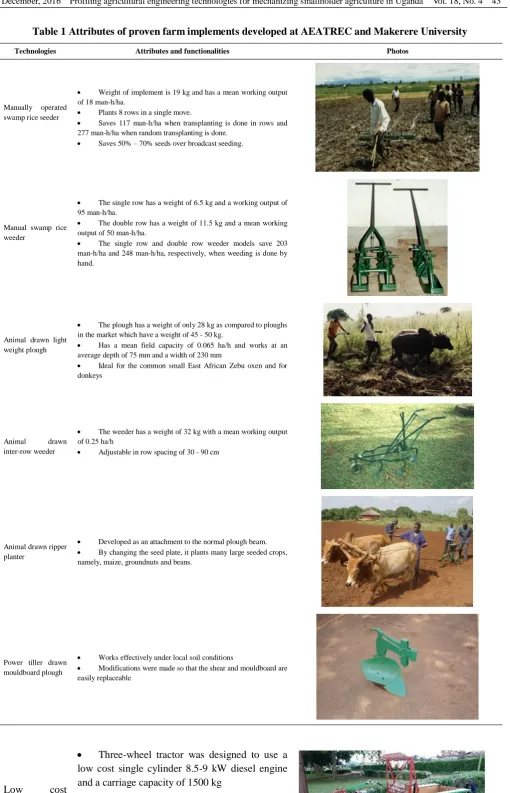
operations. The attributes of these tools and implements
December, 2016 Profiling agricultural engineering technologies for mechanizing smallholder agriculture in Uganda Vol. 18, No. 4 43
Table 1 Attributes of proven farm implements developed at AEATREC and Makerere University
Technologies Attributes and functionalities Photos
Manually operated swamp rice seeder
Weight of implement is 19 kg and has a mean working output of 18 man-h/ha.
Plants 8 rows in a single move.
Saves 117 man-h/ha when transplanting is done in rows and 277 man-h/ha when random transplanting is done.
Saves 50% – 70% seeds over broadcast seeding.
Manual swamp rice weeder
The single row has a weight of 6.5 kg and a working output of 95 man-h/ha.
The double row has a weight of 11.5 kg and a mean working output of 50 man-h/ha.
The single row and double row weeder models save 203 man-h/ha and 248 man-h/ha, respectively, when weeding is done by hand.
Animal drawn light weight plough
The plough has a weight of only 28 kg as compared to ploughs in the market which have a weight of 45 - 50 kg.
Has a mean field capacity of 0.065 ha/h and works at an average depth of 75 mm and a width of 230 mm
Ideal for the common small East African Zebu oxen and for donkeys
Animal drawn inter-row weeder
The weeder has a weight of 32 kg with a mean working output of 0.25 ha/h
Adjustable in row spacing of 30 - 90 cm
Animal drawn ripper planter
Developed as an attachment to the normal plough beam.
By changing the seed plate, it plants many large seeded crops, namely, maize, groundnuts and beans.
Power tiller drawn mouldboard plough
Works effectively under local soil conditions
Modifications were made so that the shear and mouldboard are easily replaceable
Low cost
Three-wheel tractor was designed to use a low cost single cylinder 8.5-9 kW diesel engine and a carriage capacity of 1500 kg
3.2 Agricultural processing and value addition
technologies
AETs in agro-processing and value addition
technologies are aimed at reducing high post-harvest
losses, improving quality and market value of grains and
labour productivity of farmers (Candia et al., 2012). The
attributes of AE processing and value addition
technologies are provided in Table 2.
Technologies Attributes and functionalities Photos
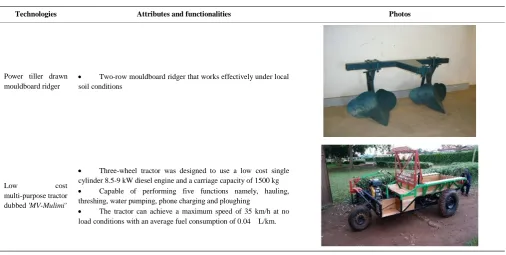
Power tiller drawn mouldboard ridger
Two-row mouldboard ridger that works effectively under local soil conditions
Low cost multi-purpose tractor dubbed 'MV-Mulimi'
Three-wheel tractor was designed to use a low cost single cylinder 8.5-9 kW diesel engine and a carriage capacity of 1500 kg
Capable of performing five functions namely, hauling, threshing, water pumping, phone charging and ploughing
The tractor can achieve a maximum speed of 35 km/h at no load conditions with an average fuel consumption of 0.04 L/km.
Table 3 Attributes of proven agro processing and value addition equipment developed at AEATREC and
Makerere University
Technologies Attributes and functionalities Photos
Hand cranked maize shellers
Removes maize from the cob and uses humans as source of power with an output capacity of 50-60 kg/h.
With zero level of broken grain, the hand cranked maize sheller is ideal for shelling home saved seed
Ideal for small scale farmers including persons with disabilities who grow up to 1 ha of maize per season
Motorized maize sheller
Used to remove maize from the cobs
Driven by a 7 hp diesel engine with an output capacity of 1.2-1.4 t/h of clean grain for 1 L of diesel fuel
Has shelling efficiency of 99.5%, with 1.2% – 1.8% broken grain. Ideal for medium scale commercial farmers who grow at least 20 ha per season
Farmers can hire out several units of the sheller at a fee through which they earn additional income
Motorized rice thresher
A hold-on-and release rice thresher is used to thresh rice Has a weight 85.3 and 70 kg with and without engine, respectively Has an output capacity of 500-600 kg/h, using 1 L of fuel Has threshing efficiency of 99.9%
Farmers using the thresher are able to save 102.4 kg/ha of paddy usually lost through beating method, reduce their threshing time by 58% and reduce threshing labour costs by 59.2%.
45 September, 2016 AgricEngInt: CIGR Journal Open access at http://www.cigrjournal.org Vol. 18, No. 3
Technologies Attributes and functionalities Photos
Manual forage chopper
Used for cutting forage to small pieces of 25-50 mm
Has an output of 170-220 kg/h of chopped feed of equal size and chops all types of common fodder in the country
Ideal for smallholder dairy farmers with a maximum of 20 heads of cattle when it is operated 6 h per day
Reduces forage wastage and chopping time by about 15%
Motorized forage chopper
Chops all types of common fodder and cereal stovers
Used to cut forage to small pieces varying between 25-50 mm for 60% of feed material
Driven by a 3.5 hp petrol engine, with an output capacity of 350-450 kg/h depending on fodder type and operator’s experience, using 0-5-1 L of fuel. Best for dairy farmers having at least fifteen zero-grazed animals
Motorized cassava chipper and grater
Used for slicing cassava to small pieces to increase rate of drying Driven by a 3.5 hp engine, with an output capacity ranging from 450 – 600 kg/h of grated/chipped tubers for 1 L of fuel
Manual groundnut decorticator
Uses T-bars as the decorticating mechanism providing a very small surface area with the kernels as opposed to the ordinary U-belly groundnut decorticator which causes very high level of broken kernels often reaching 35%.
Reduces the level of broken grain percentage from 35% to 5%.
Cocoa seed de-huller
Powered by a 2 hp single phase electric motor
Has capacity of 30-45 kg/h with an average output efficiency of 72% compared to less than 10 kg/h by hand
Eliminates human contact with seeds after roasting thus improving hygiene
Manual soya milk machine
Ninety (90)% wooden and good for any household without electricity to buy the powered ones which are expensive
Good for daily soya milk production at household level since 0.5 kg is able to give 2 L and above depending on the concentration one needs leaving the cake that can be used as food either for human or animals.
Double ribbon feed mixer
Feed mixer capacity is 120 kg/h.
It is powered by a single phase 1.5 hp geared motor 98 r/min output speed A mixer that blends animal feed ration uniformly unlike the traditional mixers
A reasonably bigger capacity, appropriate for large-sized farms Ergonomically variable machine
Reproducible and affordable
Green house type solar dryer Able to dry high valve products within a short time Has a fan driven by wind or by a 60 W solar panel
3.3 Water harnessing and utilization technologies
Agriculture frequently suffers from water stress
despite Uganda having vast natural water resources
(Nsubuga et al., 2014). To adapt to this phenomenon
research initiatives have focused on developing
technologies to provide water for crops, livestock and fish.
The water harnessing technologies are aimed at
improving access to water, saving time and labour for
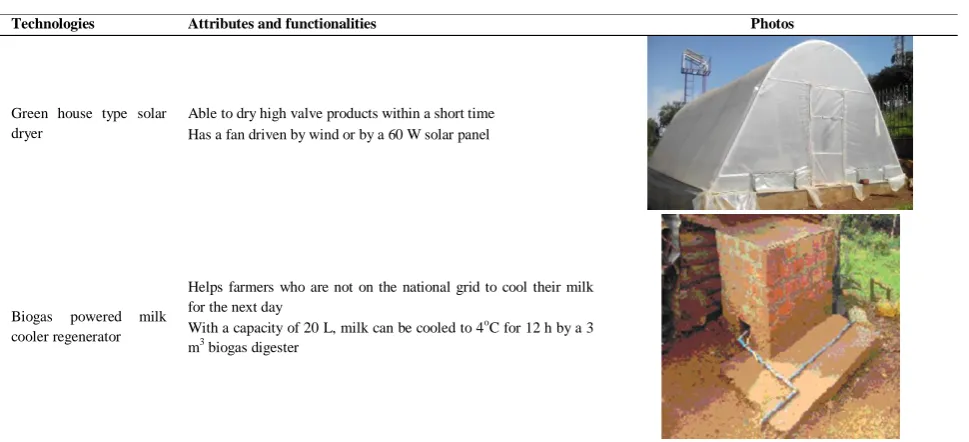
collecting water. Attributes of water harnessing and
utilization technologies are described in Table 3.
Technologies Attributes and functionalities Photos
Green house type solar dryer
Able to dry high valve products within a short time Has a fan driven by wind or by a 60 W solar panel
Biogas powered milk cooler regenerator
Helps farmers who are not on the national grid to cool their milk for the next day
With a capacity of 20 L, milk can be cooled to 4oC for 12 h by a 3 m3 biogas digester
Table 3 Attributes of water harnessing and utilization technologies developed at AEATREC and Makerere
University
Technologies Attributes and functionalities Photos
Treadle pump
Can pump to total head of 6 m and discharge of 80-100 L/min Can be operated by all gender
Contributes to reducing the rate of silting in the water reservoir dams which is due to bad traditional livestock watering practices
Adaptable for small-scale irrigation
Wind powered pump system for water delivery
Developed for livestock watering from communal dams.
The total capacity of the system is 83 to 97 L/min for wind speeds (3-4 m/s) and (5-6 m/s) respectively, all based on a water head of 6 m.
Consists of four interconnected plastic water storage tanks with total capacity of 40 m3 situated at about 6 m elevation from the water source. By gravity flow, water from the storage tanks goes through a control gate valve to the drinking troughs situated at a lower level
Consists of an array of five watering troughs sparsely distributed at 60-70 m apart with a total water holding capacity of 15 m3
The system is scheduled to provide 100-120 m3 of water over a 24 h period and able to service about 4,500-5,000 animals per day
Reduces silting rate of the dams
Cost effective since animals are watered at zero energy and labour cost
Low head hydraulic ram pump
Pump is powered by water
Water can be raised to a delivery head of 45-50 m at a fall of 2-5 m Pumps 0.5-1 L/s and can thus irrigate 0.2-0.4 ha per day
47 September, 2016 AgricEngInt: CIGR Journal Open access at http://www.cigrjournal.org Vol. 18, No. 3
4 Private sector in AET development, use and
dissemination
The AE technology private sector is made up of
local equipment producers, importers of equipment,
suppliers and service providers of spare parts and repairs.
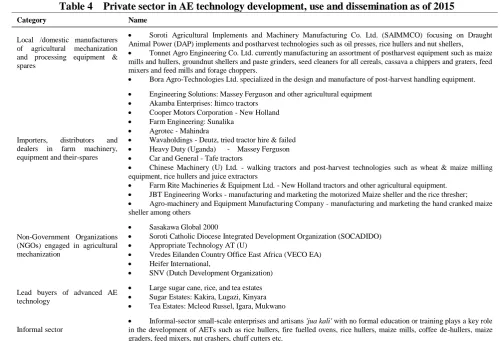
The key private sector players are categorized in Table 4.
5 Constraints to adoption of AETs
Adoption of AETs has remained very low in Uganda
despite documented benefits (Kasirye, 2012). The major
challenges include:
5.1 Lack of financial resources by farmers
Most small-holder farmers do not have the financial
capacity to effectively invest in AETs. The high cost of
AETs has led to many technologies remaining on shelf
instead of benefiting farmers to promote food security.
Farmers’ capacity to invest in mechanized farming is
affected by the low producer prices. This is partly
because agriculture is considered a high-risk venture to
attract development loans for purchase of AETs. Most
banks in Uganda attach stringent conditions and high
interest rates to agricultural loans making borrowing very
difficult. In the past, governments and donors provided
credit through agricultural development banks and credit
projects, but all these were phased out, resulting in a
funding gap. Although leasing and hire purchase are
becoming increasingly available they still are relatively
unknown or inaccessible to most of the farmers.
5.2 Inadequate trained and skilled personnel
According to MAAIF (2012), the country lacks
trained and skilled machinery operators, mechanics and
equipment managers, and hence, poor equipment repair
and maintenance service in Uganda. Many technical
institutions have been converted into universities which
has affected the pool of skilled personnel. Lack of
well-trained operators and mechanics for agricultural
machinery usually leads to poor workmanship and more
Table 4 Private sector in AE technology development, use and dissemination as of 2015
Category Name
Local /domestic manufacturers of agricultural mechanization and processing equipment & spares
Soroti Agricultural Implements and Machinery Manufacturing Co. Ltd. (SAIMMCO) focusing on Draught Animal Power (DAP) implements and postharvest technologies such as oil presses, rice hullers and nut shellers,
Tonnet Agro Engineering Co. Ltd. currently manufacturing an assortment of postharvest equipment such as maize mills and hullers, groundnut shellers and paste grinders, seed cleaners for all cereals, cassava a chippers and graters, feed mixers and feed mills and forage choppers.
Bora Agro-Technologies Ltd. specialized in the design and manufacture of post-harvest handling equipment.
Importers, distributors and dealers in farm machinery, equipment and their-spares
Engineering Solutions: Massey Ferguson and other agricultural equipment
Akamba Enterprises: Itimco tractors
Cooper Motors Corporation - New Holland
Farm Engineering: Sunalika
Agrotec - Mahindra
Wavaholdings - Deutz, tried tractor hire & failed
Heavy Duty (Uganda) - Massey Ferguson
Car and General - Tafe tractors
Chinese Machinery (U) Ltd. - walking tractors and post-harvest technologies such as wheat & maize milling equipment, rice hullers and juice extractors
Farm Rite Machineries & Equipment Ltd. - New Holland tractors and other agricultural equipment.
JBT Engineering Works - manufacturing and marketing the motorized Maize sheller and the rice thresher;
Agro-machinery and Equipment Manufacturing Company - manufacturing and marketing the hand cranked maize sheller among others
Non-Government Organizations (NGOs) engaged in agricultural mechanization
Sasakawa Global 2000
Soroti Catholic Diocese Integrated Development Organization (SOCADIDO)
Appropriate Technology AT (U)
Vredes Eilanden Country Office East Africa (VECO EA)
Heifer International,
SNV (Dutch Development Organization) Lead buyers of advanced AE
technology
Large sugar cane, rice, and tea estates
Sugar Estates: Kakira, Lugazi, Kinyara
Tea Estates: Mcleod Russel, Igara, Mukwano Informal sector
Informal-sector small-scale enterprises and artisans 'jua kali' with no formal education or training plays a key role in the development of AETs such as rice hullers, fire fuelled ovens, rice hullers, maize mills, coffee de-hullers, maize graders, feed mixers, nut crashers, chuff cutters etc.
frequent break-downs of the machinery. This leads to
added costs of repair and reduced life spans of the
machinery making the whole venture very expensive and
unattractive. An average number of 15-20 agricultural
engineers are passed out yearly from each of the three
universities of Makerere, Gulu and Busitema. However,
not all AE professionals are currently employed in
agricultural mechanization activities. In addition, many
potential employers are yet to adequately appreciate the
role of AE graduates since it is a relatively new
profession in Uganda. Thus the apparent
“miss-employment” of a proportion of AE skilled
personnel into other areas develops a shortage of required
man-power to successfully support the integration of
AET with farmers’ activities.
5.3 Weak linkages between technology developers and
end users
There is a weak link in the research and
development systems between technology development
agencies, manufacturers, distributors and the farmers
leading to poor commercialization of developed
technologies. Significant research in agricultural
mechanization has been undertaken by NAROs
AEATREC, Makerere University's Department of
Agricultural Engineering, private sector and NGOs.
However, most of the research findings in appropriate
machinery and equipment have not been put into
production for effective application due to limited
linkages between the researchers, the technology users,
the private sector and industrialists.
5.4 Limited awareness on proven AETs
Experience has shown that end-users adopt
technologies after seeing that the technology works. It is
therefore essential for the company to carry out wider
demonstrations and sensitization for effective uptake of
the technologies. There is also need for media education
on mechanization (radio, television, newspapers and all
potential education media) covering such aspects of
machinery use, safety, efficiency, regulations and
standard; and energy saving devices to the farmers.
5.5 Weak extension with respect to knowledge of
mechanized agriculture and limited after sales
services
AETs in rural areas often breakdown and are
rendered unusable due to lack of after sales services.
Repair, maintenance and servicing workshops /
agricultural machinery shades both fixed and mobile need
to be established closer to areas with high agricultural
machinery populations for service provision.
5.6 Land tenure systems and fragmentation
Sitting tenants and bone-fide occupants in Mailo
lands are faced with land ownership insecurity, which
limits investment in mechanization and AETs. Communal
and customary land tenure systems lead to fragmentation
with increasing population and inheritance culture. The
fragmentation does not favour efficient field
mechanization and exploitation of economies of scale in
the use of Agricultural Mechanization. Small and
fragmented farm holdings need to be consolidated if the
benefits of AETs are to be realized.
5.7 Poor rural infrastructure
Many areas of Uganda lack affordable transportation
to transport agricultural produce in a proactive manner to
respond to market needs and demands. Transportation
connects products to markets, people to education, and
supplies to businesses and farms. However, SSA
generally has poor road infrastructure (Tiffen, 2003). As
such 90% of the transportation of agricultural produce
from field to home and/or local markets is done on the
heads of women and children (Boserup and Kanji, 2007).
Habitants spend a significant percentage of their time
transporting agricultural products and water manually,
over rough terrain and long distances, and it can be
difficult to get fresh produce to markets where it can be
sold before spoilage occurs. In sub-Saharan rural Africa,
where adults on average spend 1.0 to 2.5 h/d to transport
their produce, the transportation problem can be solved
December, 2016 Profiling agricultural engineering technologies for mechanizing smallholder agriculture in Uganda Vol. 18, No. 4 49
6 Future strategies for development and
increased adoption of AETs in Uganda
The future of AETs in Uganda is hinged on the
interaction of these technologies with key drivers that
include policy, social, economic, environmental, research
and institutional partnerships. The future strategies for
development and increased adoption of AE technologies
should address the following aspects:
6.1 Appropriateness of the AETs
In the context of smallholder farming appropriate
AETs should be as simple as possible, cost-effective,
replicable in numerous units, readily operated, maintained
and repaired and readily accessible to low-income people
(FAO 2013). Locally-available materials must be
incorporated in fabricating machines to reduce the
manufacturing costs. Gender considerations in the design
and use of these AETs should also be taken into
consideration (Lubwama 1999).
6.2 Standardizing of AETs
Standards on material selection and production of
AETs should be developed and enforced by the Uganda
National Bureau of Standards (UNBS) for quality control
and as a means for easy access to spare parts and repairs
in the open market. The standards will help in organizing
the informal sector and standardizing their production.
Testing standards are necessary for agricultural
machinery and implements to verify the manufacturer's
claims as outlaid in the technical specification and assess
its performance under local conditions.
6.3 Human resource capacity development through
enhancement of technical skills in AE
There should be a deliberate strategic invention by
Government to develop technical skills as a key aspect in
ensuring sustainable development, safe and correct use of
AE technologies. Comprehensive practical programs
should be provided to enhance the skills of agricultural
machinery operators, agricultural mechanics and farmers
to effectively utilize the agricultural technologies for farm
production. The Government should liaise with
institutions responsible for mechanization training to
ensure that curricula are periodically reviewed to address
the mechanization needs of different levels of farmers.
Targeted rural artisan training for personnel to handle
fabrication, maintenance and repair of smallholder
mechanization technologies should be carried out. Carry
out systematic training of farmers in mechanization
aspects related to their farming. Effective agricultural
sector mechanization requires well trained technicians
and operators to provide appropriate maintenance.
Technicians are a key linkage to the farmers to relay
holistic knowledge not only about the AET but also best
farming practices. Farmers not having enough training
about the principles and application of mechanization
results in failure of an agricultural mechanization
program. Government institutions need to take the lead in
the process of imparting agricultural mechanization
knowledge to the farmers. The farmers need training
programs to provide the required principles and
understanding of agricultural mechanization and business
aspects of farming. Government input in this regards
should be in various ways including setting up model farms, sponsoring the training of “champion” farmers,
establishment of farmers training centers provided with
demonstration land and equipped with tractors and
implements, funding higher institutional extension
services and development of agricultural information
desks at the local government level.
6.4 Increased private sector engagement
Working partnerships with private sector agricultural
machinery and agro-processing equipment manufacturers,
rural artisans and blacksmiths is very vital for mass
production, marketing and after sale service of proven
AETs for the beneficiaries especially farmers.
Consequently, Public–Private Partnerships (PPPs) are
proposed where objectives, efforts and benefits are shared.
This arrangement allows synergies to develop through the
Public Sector leveraging Private Sector strengths. This
arrangement provides favorable policy frameworks,
and possibility of the Private Sector to tap into the public
resources in a socially responsible way. PPPs offers ways
for government to lower costs and risks in the provision
of services, and by enabling better efficiency and
effectiveness, and promoting equal access, as well as
good accountability. A lot of innovations in AE never see
the light of the day because they remain at prototype
stage. The private sector is profit driven but it is very hard
for any technology to make profit at the onset.
Government should be willing to invest money in an
innovation before private sector picks interest. Therefore
sustained support to researchers in the domain of AE is
very key in stimulating innovations. Another proven
model is when the private sector sponsored research
delivers a product whose market is already developed or
can be developed. This has inroads with IPRs
enforcement and protection.
6.5 Enforcement of Intellectual Property (IP) rights
Enforcement of IP rights is inevitably an incentive
for innovation and creativity which is crucial in the
development and improvement of AE technologies (De
Beer et al., 2014). Moreover, the developed prototypes
have not been subjected to tests, scrutiny and approval for
patenting by local, national, and international professional
bodies.
6.6 Economic incentives
Government needs to consider economic incentives
towards credible farmers and farming communities that
have the potential to and are making efforts towards
agricultural mechanization (Sims and Kienze, 2015).
Such incentives may vary from setting up mechanization
funds for long term financing, establishing special
financing rates for bankable farmers to acquire tractors
and working with banks to guarantee bankable farmers
6.7 Proven models of introducing mechanization to
farming communities
Government engages a lead farmer who is in essence
a business person who takes ownership for the AET. The
Lead farmer uses the AET to farm personal land while at
the same time hiring it out to other farmers. Financing for
the lead farmer is organized by the Government and the
arrangement is strictly executed as a business. Due to the
relatively low average land area for the Ugandan farmers,
economic viability of owning some AET is limited to a small proportion of the farmers’ population. Thus,
establishment of AET hiring centers enables the small
land area farmers to access the benefits of using AETs at
a fee. In addition, technical desks should be formulated
that avail required information for the farmers, not only
about agricultural mechanization but also agronomic and
business requirements of farming.
7 Conclusions and recommendations
There is a general consensus that the availability and
prudent use of AETs along the value chain has the
potential to enhance labour use and efficiency, provide
greater precision and timeliness in farm operations,
reduce postharvest loses, contributing to adding value to
products and profitability of farming through proper
handling, drying, cleaning, grading, processing,
preservation, packaging and storage. The need to
maximize agricultural productivity and profitability on a
sustainable basis and with minimum drudgery on the
farmers necessitates engineering interventions in form of
appropriate AETs. The future strategies for development
and increased adoption of AETs should address the
aspects on appropriateness of the AETs in the smallholder
agriculture context and standardizing of AET.
Furthermore, human resource capacity development
through enhancement of technical skills in AE, increased
private sector engagement, economic incentives and
enforcement of intellectual property rights should be an
integral part of the strategies. Government should
formalize an exclusive agricultural mechanization policy
and create portfolio for AE professionals at District Local
Governments’ to promote AE. Furthermore, technical
skills development to carry out farms operations that are
technology driven will improve the face of AE and its
December, 2016 Profiling agricultural engineering technologies for mechanizing smallholder agriculture in Uganda Vol. 18, No. 4 51
References
Aksoy, M. A., and J. C. Beghin. 2004. Global agricultural trade and developing countries: World Bank Publications. The World Bank, Washington D.C.
Boserup, E., and N. Kanji. 2007. Woman's role in economic development: Earthscan. Retrieved from
www.erae.oxfordjournals.org/.../5... on 29/Mar/16.
Candia, A., S. Okurut, and T. E. Oker. 2012. Research Contribution To Agricultural Mechanization. Uma ética para quantos?
33(2):81–87.
Clover, J. 2003. Food security in sub-Saharan Africa. African Security Studies, 12(1):5-15.
Collier, P., and S. Dercon. 2014. African Agriculture in 50Years: Smallholders in a Rapidly Changing World? World Development, 63(1):92-101.
De Beer, J., C. Armstrong, C. Oguamanam, and T. Schonwetter. 2014. Innovation and Intellectual Property: Collaborative Dynamics in Africa. Cape Town: UCT Press. p. 433.
FAO. 2009. “2050 – Africa’s Food Challenge.” Retrieved September 28, 2015
http://www.fao.org/news/story/en/item/35770/icode/.
FAO. 2013. Mechanization for Rural Development : A Review of Patterns and Progress. edited by Josef Kienzle, John E. Ashburner, and Brian G. Sims.
GOU. 2005. The National Agricultural Research Act, 2005. Government of Uganda (GOU). Kampala, Uganda.
GOU. 2010. National Development Plan (2010-2035). Government of Uganda (GOU). Kampala, Uganda.
Intarakumnerd, P., P. Chairatana, and T. Tangchitpiboon. 2002. National innovation system in less successful developing countries: the case of Thailand. Research Policy, 31(8):1445-1457.
Kasirye, I. 2012. Constraints to Agricultural Technology Adoption in Uganda. pp.90–107.
Kienzle, J., J. E. Ashburner, and B. Sims. 2013. Mechanization for rural development: A review of patterns and progress from around the world: FAO, Rome (Italy).
Kiyimba, F. L. 2011. Tools for Women’s Empowerment? The Case of the Forage Chopper for Smallholder Dairy Farmers in Uganda. Retrieved.
http://papers.ssrn.com/sol3/papers.cfm?abstract_id=2046017). Lubwama, F. B. 1999. Socio-Economic and Gender Issues
Affecting the Adoption of Conservation Tillage Practices.
Conservation tillage with animal traction. A Resource Book of the Animal Traction for Eastern and Southern Africa
(ATNESA) 173.
Lumkes, J. H. 2015. Manufacturing agricultural utility vehicles in sub-saharan Africa. Agricultural Engineering International: CIGR Journal, Special Issue: 18th World Congress of CIGR
MAAIF. 2012. Framework Implementation Plan of the Agricultural Mechanisation Taskforce. Implementation of the Non-ATAAS Component of the Development Strategy and Investment Plan, pp.121, Kampala, Uganda.
Mrema, G., P. Soni, and R. S. Rosa. 2014. A Regional Strategy for Sustainable Agricultural Mechanization: Sustainable Mechanization across Agr-Food Chains in Asia and the Pacific Region. Rome, Italy: Food and Agriculture Organization.
Nsubuga, F. N. W., E. N. Namutebi, and M. Nsubuga-ssenfuma. 2014. Water Resources of Uganda : An Assessment and Review. Journal of Water Resource and Protection
6(6):1297–1315.
Obura, J. M., N. Banadda, J. Wanyama, and N. Kiggundu. 2015. A Critical Review of Selected Appropriate Traditional Evaporative Cooling as Postharvest Technologies in Eastern Africa. Agricultural Engineering International: CIGR Journal,
17(4):345–353.
Salami, A., A. B. Kamara, and Z. Brixiova. 2010. Smallholder agriculture in East Africa: trends, constraints and opportunities: African Development Bank Tunis, Tunisia. Retrieved from www.afdb.org/.../WORKING%20105%20%2. on 28th/march/2016.
Sims, B., and J. Kienze. 2015. Mechanisation of Conservation Agriculture for Smallholders: Issues and Options for Sustainable Intensification Review. Environments, 2015(2):1399-1466.
Tiffen, M. 2003. Transition in sub-Saharan Africa: agriculture, urbanization and income growth. World Development, 31(8):1343-1366.
UBOS. 2010. Summary Report on Uganda Census of Agriculture 2008/2009. 62.
UBOS. 2015. Statistical Abstract 2015. Uganda Bureau of Statistics (UBOS) 353.