control of animal behavior in hot climates
Diogo Rezende Coelho
1*, Fernanda Campos Sousa
1, Fátima Baptista
2, Vasco Fitas
Cruz
2, Ilda Fátima Tinôco
1, Cecilia Fátima Souza
1(1. Departamento de Engenharia Agrícola, Universidade Federal Viçosa, Viçosa, Brasil;
2. Departamento de Engenharia Rural/Instituto de Ciências Agrárias e Ambientais Mediterrânicas- ICAAM, Universidade de Évora, Évora, Portugal)
Abstract: The world production of meats is mainly concentrated in the countries with a hot climate. Among these countries, Brazil, considered "world's breadbasket", is located in the intertropical zone, with hot climates and presents lower thermal amplitude. Brazilian poultry is a leader in the production and export of broilers. Brazil has the second largest cattle herd in the world, has the largest commercial herd besides being the largest exporter of beef. Brazilian swine breeding, among the most advanced production chains in the world, occupy the position of fourth largest producer of pork in the world. Projections for Brazil's meat production sector indicate strong growth in the coming years, with countries in hot climates that will continue to sustain future growth in world meat production, ensuring food security in many countries. One of the factors responsible for the success or failure of animal production is the environment, defined by the sum of all physical and biological factors that affect animals. In these regions of hot climates, climatic factors are among the main limiting factors to the development of animal production, which may compromise animal welfare and productivity indices. Behavioral information can aid in the analysis of problems arising from environmental conditions unfavorable to animals, helping both decision making and the use of different environmental conditioning systems. The introduction of technification in the animal behavior evaluation processes, through the use of video cameras and image processing programs, allowed a better interpretation of the behavioral responses, quickly, accurately and non-invasively, gradually being used with greater frequency in the animal production sectors. The study of animal behavior assumes an important role in animal production, since, to rationalize the breeding methods, management, feeding and facilities techniques have been developed that interfere with animal behavior. In this context, the use of digital image analysis techniques, where the animals themselves are used as biosensors in response to environmental conditions, contributes to the analysis of animal behavior, and consequently also to the assessment of the internal environment of the production in hot weather.
Keywords: animal production, animal welfare, information technology
1 Introduction
1World meat production is mainly concentrated in warm-weather countries, in tropical and subtropical areas, it is
estimated that more than 50% of the world's total meat production areas (Renaudeau et al., 2012). Among these countries,
Brazil, considered "world's granary", is located in the intertropical zone, with hot climates and presents a lower thermal
amplitude, conditions that favor animal production.
Brazilian poultry is a leader in the production and export of broilers. Brazil is among the world's three largest
Received date: 2017-10-10 Accepted date: 2018-01-22
producers of chicken meat, together with the United States and China, with more than a billion head of broilers and has
been maintaining the position of largest exporter for more than a decade the world, shipping to more than 150 countries
(IBGE, 2016). The sector employs more than 3.6 million people, directly and indirectly, accounting for almost 1.5% of the
national Gross Domestic Product (ABPA, 2016).
Brazil has the second largest cattle herd in the world, behind only India. It has the largest commercial herd with
214 million heads in 2015. It is the largest exporter of beef, with 20% of the total produced placed in the international
market for more than 150 countries. The productive chain of beef with 9.5 million tons produced generates approximately
7 million jobs in Brazil (IBGE, 2016).
Brazilian pig farms, among the most advanced production chains in the world, with high technology and total
control of processes with high quality standards. The animals are raised in confinement systems, allowing full sanitary
control, in addition to respect the international requirements of animal welfare. The cost of production of Brazilian pork is
considered the lowest in the world when compared to the largest producers. For all this, Brazil has established itself as the
fourth largest producer and exporter of pork in the world. Producing 3.3 million tons annually, of which 600 thousand tons
are exported to more than 70 countries (ABPA, 2016).
Projections for Brazil's beef industry indicate strong growth in the coming years, with countries in hot climates
that will continue to sustain future growth in world meat production, ensuring food security in many countries. One of the
main factors responsible for the success or failure of animal production is the environment, defined by the sum of all
physical and biological factors affecting animals (Baêta and Souza, 2010; Neves et al., 2010). In these regions of hot
climates, climatic factors are among the main limiting factors to the development of animal production, which may
compromise animal welfare and productivity indices (Renaudeau et al., 2012).
Animal welfare is one of the main needs that producers must meet in order to ensure both consumer interests and
greater market share. Production and quality in animal husbandry are related to animal welfare, therefore, breeding systems
must raise their levels and production methods, while meeting the needs of animals.
As the physiological variables are difficult to measure, under field conditions, the study of behavior has shown to
be the most feasible to infer about the welfare levels of the animals housed. As the animal is strongly influenced in its
behavior by the external environment, knowing how it acts on the animal through behavior, it is possible to identify and
quantify the welfare of animals.
Behavioral information can aid in the analysis of problems arising from environmental conditions unfavorable to
animals, helping both decision making and the use of different environmental conditioning systems (Berckmans, 2013;
Shao and Xin, 2008). The introduction of technification in the animal behavior evaluation processes, through the use of
video cameras and image processing programs, allowed a better interpretation of the behavioral responses, in a fast, precise
and non-invasive way, gradually being used with greater frequency in the animal production sectors.
The study of animal behavior assumes an important role in animal production, since, to rationalize the breeding
methods, management, feeding and facilities techniques have been developed that interfere with animal behavior. In this
context, the use of digital image analysis techniques, where the animals themselves are used as biosensors in response to
environmental conditions, contributes to the analysis of animal behavior, and consequently also to the evaluation of the
internal environment of the production in hot climate.
Animal behavior until recently was measured by visual observation of animals, which consumed more time, was
subjective and very susceptible to human error, a method that due to human presence the birds may have their natural
behavior inhibited, generating non-response reliable (Abrahamsson, 1996; Falco, 2010).
Among the methods used to study the behavior of animals, the analysis of images has been highlighted.
Automation, through video cameras and image-interpretation programs, has made it possible to better interpret animal
behavior without the need to be around them or to bother them (Kashiha et al. 2013).
According to Shao and Xin (2008), the evaluation and the interactive controls of the thermal comfort of the animals
by the image analysis overcome the problems inherent to the conventional method, since the animals themselves are used
as biosensors in response to the reflexes of the environment through behavioral analysis.
Image analysis is the set of methods and techniques through which computational systems can be able to interpret
images, providing accurate measurements based on pixel count (Filho and Neto, 1999). The main objective of image
analysis, whether performed by a human observer or by a computer analysis system, is to extract useful and relevant
information for each desired application (Sergeant et al., 1998; Esquef et al., 2003), so there is no standard formula for all
situations.
A set of specific algorithms is necessary in the analysis and interpretation of images, where these algorithms use
different techniques, and their sequence generates results for a specific set of images, and can’t be generalized to other
studies (Gonzalez and Woods, 1992).
It can be said that the analysis of images is the process of quantitative measurement of a certain aspect of the
image, in order to generate information. While in the other processes of image processing the input and output of the
system are images, in the analysis the output may not be an image, but a graphic or a value referring to the property of the
image to be estimated.
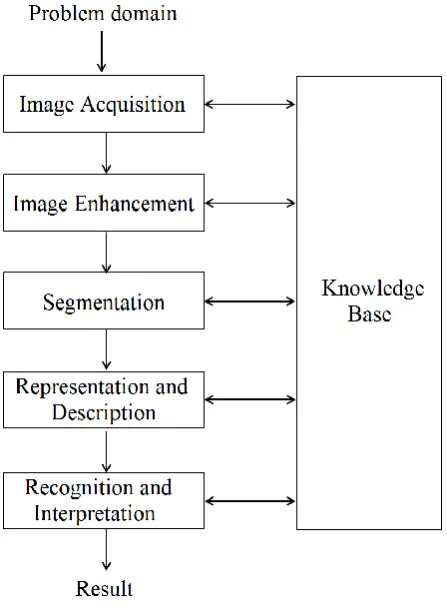
Image processing and analysis consists of several steps, illustrated in Figure 1, such as: acquisition, preprocessing,
segmentation, representation and description, recognition and interpretation, all of which are steps associated with a
knowledge base, which is depending on the application, the size and complexity of which may vary significantly (Pedrini
Figure 1. Stages of image processing system.
3. System of acquisition and processing of images
According to XIN et al. (1998), a system for the analysis of images should consist of a camera, an image capture
card installed in a computer and a program that performs the acquisition and all image processing.
Devices play an important role in an image processing system, and can be used for acquisition, storage, processing,
transmission and display of images (Pedrini and Shwartz, 2008).
In artificial vision there are one-dimensional cameras (line scan cameras) and two-dimensional cameras (area
cameras). Most of the applications in which image analysis and processing are used are area cameras. Within the camera
classes there are numerous choices to make such as, for example, color or monochrome, angle of view, field of view,
resolution, among others (Albuquerque et al., 2012).
The acquisition board is a generic term for the interface of the camera to the computer and must be determined by
camera characteristics, computer hardware (the card must be compatible mechanically and functionally as a computer
system used) and whether or not it has image processing integrated (Albuquerque et al., 2012).
The processing of images after acquisition can be performed by the capture card itself or by software that has this
purpose, where the choice of suitable software is in function of the purpose and speed of the image processing.
Images require high storage capacity. For example, a 1024 x 1024-pixel color image requires, 3 Mbytes for storage,
and a 1 minute video, consisting of 512 x 512 pixel images, displayed at a rate of 30 images per second, each pixel
Represented by 24 bits, requires around 1.4 Gbytes of storage space (Pedrini and Shwartz, 2008), with this there is need
of computers and storage devices with great capacities.
Factors such as the research objective, characteristics of the location of the images (type of illumination), device
4. Analysis and processing of digital images
Acquisition and storage
The acquisition step captures the image by means of devices or sensors and converts it into a suitable
representation for subsequent processing. The main devices for acquisition of images are video cameras, medical
tomographs, satellites and scanners. Among the aspects involved in this step is the choice of sensor type, scene lighting
conditions, resolution and the number of gray levels or colors of the scanned image. The acquisition devices may have
very different characteristics in terms of spatial resolution, operating speed, accuracy and cost (Pedrini and Shwartz, 2008).
Preprocessing
The image after the acquisition may present imperfections or degradations due to the lighting conditions or
depending on the chosen device. Therefore, the preprocessing step has the function of improving image quality through
the application of techniques for noise performance, correction of contrasts or gloss and smoothing of certain properties
of the image (Pedrini and Shwartz, 2008).
The techniques involve two main categories: methods that operate in the spatial domain and methods that operate
in the frequency domain. Techniques in the spatial domain refer to the image plane, and the approaches in this category
are based on the direct manipulation of the pixel of the image, while the techniques of processing in the frequency domain
are based on the modification of the image with application of the Fourier transform (Marcelo, 2007; Pedrini and Shwartz,
2008).
It is common to highlight certain characteristics of an image to combine different techniques (filter application,
grayscale transformation) and are in these two categories.
Segmentation
The segmentation stage performs the extraction and identification of areas of interest contained in the image. The
purpose of segmentation techniques is to divide the image into its various constituent parts or segments (objects and
regions). The level or number of divisions applied in the image varies according to the application, and is usually performed
until a sufficient separation level is reached between the objects of interest in the analyzed scene (Gonzalez and Woods,
1992).
A segmentation process that correctly identifies the location, topology, and shape of objects is a critical
requirement for information resulting from an image analysis system to be reliable. After segmentation, attributes with
area, shape and texture can be extracted from the objects and used in the analysis process (Pedrini and Shwartz, 2008).
Segmentation is considered, among all stages of image processing, the most critical stage of information
processing. Segmentation algorithms are based on the discontinuity (detection of isolated points, lines and edges) and
similarity (thresholding and segmentation of regions) (Cordeiro et al., 2010).
This step plays a very important role in image processing, it is usually the first vital step to complete before a
series of tasks such as feature extraction, classification, description, etc. can be performed. Targeted objects are generally
referred to as the foreground and the rest of the image in the background (Solomon and Breckon, 2013).
Processor an image so as to segment a number of objects, possibly in different sizes and shapes, is a difficult task and
segmentation methods that distort object shapes, compromising their recognition, such that distinct regions could be
incorrectly identified as a single region, otherwise a homogeneous region could be divided into smaller regions (Pedrini
and Shwartz, 2008).
Representation and description
After the image has been segmented into objects and regions, resulting pixel groupings are usually represented
and described in a format appropriate for the later step. An object can be represented in terms of its external characteristics
(edges) or internal characteristics (pixels that make up the object). The description depends on the representation adopted
and should allow the characterization of its form without ambiguity with a reduced number of characteristics or measures
extracted from the object (Pedrini and Shwartz, 2008).
Adequate representational structures should be used to store and manipulate the segmented objects of interest in
the image, in addition to simplifying the calculation of certain descriptors. The description process aims at the extraction
of characteristics or properties that can be used in the discrimination between classes of objects (Pedrini and Shwartz,
2008). The descriptors are divided into two groups: edge descriptors and region descriptors.
Edge descriptors, sensitive to image resolution, are based on geometric properties, and most edge detectors are
fundamentally based on the use of differential gradient filters (Pedrini and Shwartz, 2008; Solomon and Breckon, 2013).
However, these filters do not determine the edges themselves, merely indicate their likely occurrence. In real edge detection
factors may complicate identification such as edge strength, noise effects and edge discontinuity (Solomon and Breckon,
2013).
In region-based descriptors, according Pedrini and Shwartz (2008), the pixels located inside the region or object
are considered in the descriptor calculation, instead of using only the pixels that form the border of the region.
Recognition and interpretation
The last step involves recognizing and interpreting the components of an image. Recognition or classification is
the process that assigns an identifier or label to the objects of the image, based on the characteristics provided by its
descriptors. The interpretation, however, consists in assigning a meaning to the set of recognized objects (Pedrini and
Shwartz, 2008).
5. Use of analysis and image processing in poultry
The image processing of birds housed inside aviaries or in research environments is of great importance in the
advancement of studies and development of poultry activity.
In the different steps in the image processing, several algorithms can be elaborated, with different intentions, for
example: to develop classifiers capable of separating the images in two classes, being birds in comfort (condition of well
being) and birds in thermal discomfort (absence of well-being, analyze the density of birds in a given region (feeder and
water fountain), determine the body mass of birds, among others.
Most analysis of images of the poultry environment is of interest to birds, where the "bottom" of the image will
include the feeders, drinking fountains and floor. Several works have been developed in the analysis of the behavior of the
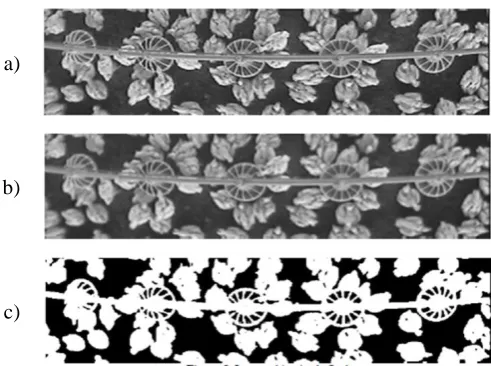
Mogami (2009) through image analysis developed a methodology to evaluate the welfare of broiler chickens; For
that purpose, created two frequency indices at the feeder, the ICRC (feeder competition index), in order to measure the
number of chickens present in the feeder region, and the ICEC (effective feeder competition index) to determine the
number of heads inside the feeder. Figure 2 shows the images in the processing step.
a)
b)
c)
Figure 2. Intermediate images during processing. In sequence: a) resized image, b) filtered image and c) binarized image. Source: Mogami (2009).
Cordeiro et al. (2011) analyzed and quantified the behavior of chicks of broilers kept under heating, using
descriptors of grouping characteristics and dispersion in the image processing. For this study, it used video cameras with
a resolution of 510 x 492 pixels, and the implementations of the algorithms in the MATLAB R12® computer program.
Figure 3 shows the grayscale (a) and binarized (b) images of the image analysis process.
(a) (b)
Figure 3. Gray scale images (a) and binarized (b). Source: Cordeiro et al. (2011).
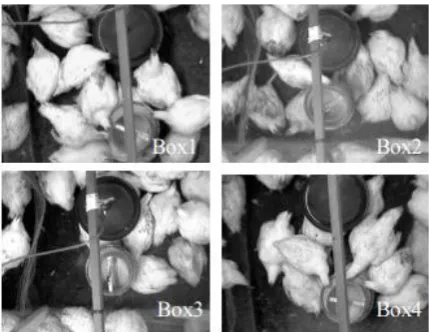
Sevegnani et al. (2005) by means of images evaluated the feeding behavior of broiler chickens in relation to the
Figure 4. Images analyzed in the Video Cap® software. Source: Sevegnani et al. (2005).
Figueiredo et al. (2003) developed a methodology for evaluating poultry behavior through an artificial vision
system to extract the response to temperature and feeding behavior of commercial poultry. Two different types of
surveillance cameras were used to acquire the images, the images were stored and the algorithms implemented in the
LabVIEW 6.1 and MATLAB Release 13 programs, respectively. In Figure 5 the images are shown during processing.
Figure 5. Temporary images during processing. Source: Figueiredo et al. (2003).
Rodrigues et al. (2007) developed a methodology to evaluate the behavior of laying hens under different stress
conditions, observing behavioral profiles and dynamics of the birds in a space-time relation with the application of
computational vision and use of colors in the evaluation of the behavior of the animals in large aviaries.
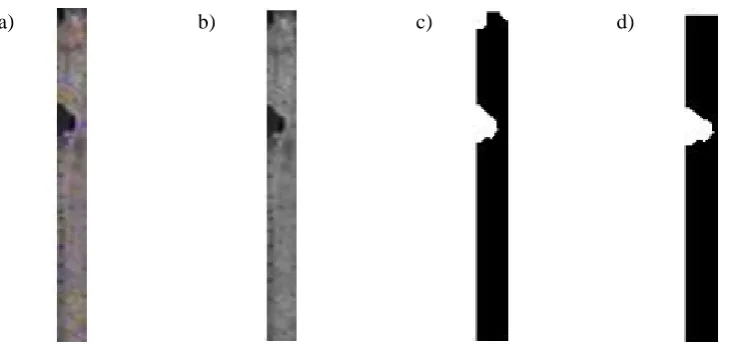
Amaral (2012) developed a methodology based on the analysis of digital images to verify the feeding behavior of
European quails cut in different environmental conditions. The algorithm implemented in the software MATLAB 6.5®
measured the frequency of use of the feeder to verify the influence of the thermal environment on the feeding behavior of
a) b) c) d)
Figure 6. Image of an isolated feeder (a), represented in gray scale (b), in binary image with presence of noise (c) and, image ready for counting objects (d).
Source: Amaral (2012).
6. Final considerations
The study of animal behavior assumes an important role in poultry production, since in order to rationalize the
breeding methods, management, feeding and facilities techniques have been developed that interfere and are also
influenced by the behavior of the birds.
In this context, the use of digital images analysis of the birds contributes to the analysis of the animal behavior,
and consequently also in the evaluation of the internal environment of the aviary, functioning as an indicator of
improvement in the production system.
References
ABPA, 2016. Relatório Anual 2016, Associação Brasileira de Proteína Animal, 136p.
Abrahamsson, P. Furnished cages and aviaries for laying hens: Effects on production, health and use of facilities. Swedish University of Agricultural Sciences, Upsala. Department of Animal Nutrition and Management, 1996.
Abreu, P. G. Período frio exige manejo adequado. 1999.
Abreu, P. G.; Abreu, V. M. N. Lanternim: função e construção. Embrapa. 2000.
Abreu, V. M. N.; Abreu, P. G. Diagnóstico Bioclimático: qual sua importância na produção de aves? Avicultura Industrial, Porto Feliz, ano 91, n.09, 16-20, edição 1093, 2001.
Abreu, V.M.N.; Abreu, P.G. 2011. Os desafios da ambiência sobre os sistemas de aves no Brasil. Revista Brasileira de Zootecnia, 40: 1-14. Abreu, P.G. Sistemas de Produção de Frangos de corte. EMBRAPA - Suínos e Aves. Boletim técnico. 2003
Amaral, A.G. Processamento de imagens digitais para avaliação do comportamento e determinação do conforto térmico de codornas de corte. Thesis (Doutorado). Viçosa – MG. Universidade Federal de Viçosa, 2012.
Albuquerque, M.P.; Caner, E.S.; Mello, A.G.; Albuquerque, M.P. Análise de imagens e visão computacional. Centro Brasileiro de Pesquisas Físicas. 2012.
Baêta, F.C. Planejamento de instalações avícolas considerando as variações de temperatura. 1995. In: Simpósio Internacional de Ambiência e Instalação na Avicultura Industrial, 1995, Campinas. Anais... Campinas: FACTA, 123-9.
Baêta, F. C.; Souza, C. F. Ambiência em edificações rurais – Conforto animal. Viçosa, MG: UFV, 2010. 2a ed. 269 p.
Bichara, T. Aviário azul e dark house para frangos de corte. 2009. In: X Simpósio Brasil Sul de Avicultura and I Brasil Sul Poultry Fair, Chapecó, SC, Brasil: 74-84.
Bulla, A. Aviários de alvenaria mudam cenário do setor. 2011.
Castro, A.C. Avaliação da eficiência térmica de materiais utilizados como sistemas de cobertura em instalações avícolas. M.S. diss., Piracicaba. Escola Superior de Agricultura Luiz de Queiroz, 2012.
Conceicao, M.; Alves, S. P.; Júnior, A. T.; Silva, I. J. O.; Piedade, S. M. S.; Júnior, H. S.; Tonoli, G. 2008. Desempenho de telhas de escoria de alto forno e fibras vegetais em protótipos de galpões. Revista Brasileira de Engenharia Agrícola e Ambiental, 12(5), 536.
Cordeiro, M. B.; Tinôco, I. F. F.; Mesquita Filho, R. M.; Sousa, F. C.Análise de imagens digitais para a avaliação do comportamento de pintainhos de corte. 2011. Engenharia Agrícola (Impresso), 31: 418-426.
Cordeiro, M.B., Tinôco, I. De F.F., Silva, J.N. Da, Vigoderis, R.B., Pinto, F. De A. De C., Cecon, P.R. 2010. Conforto térmico e desempenho de pintos de corte submetidos a diferentes sistemas de aquecimento no período de inverno. Rev. Bras. Zootec., 39: 217–224.
Costa, R.B. Dark house: Mais barato que o convencional. 2008.
Curtis, S. E. Environmental management in animal agriculture. Ames: The Iowa State University Press, 1983. p.410.
Damasceno, F.A.; Schiassi, L.; Saraz, J.A.O.; Gomes, R.C.C.; Baêta, F.C. 2010. Concepções arquitetônicas das instalações utilizadas para a produção avícola visando o conforto térmico em climas tropicais e subtropicais. PUBVET, Londrina, 4(42), ed. 147, Art. 991. Englert, S. Avicultura: tudo sobre raças, manejo, alimentação e sanidade. 6.ed. Porto Alegre: Agropecuária, 1987. 288 p.
Esquef, I. A.; Albuquerque, M. P.; Albuquerque, M. P. Processamento Digital de Imagens. Centro Brasileiro de Pesquisas Físicas. 2003. Falco, D. C. Estudo comportamental de frangos de corte criados sob diferentes condições de densidade e manejo higiênico. Presidente
Prudente: Unoeste, 2010.
Franca, M. L.; Camerini, N. L.; Mendes, L. B.; Silva, V. R.; Furtado, D. A. 2007. Diagnóstico bioclimático para aves de corte no município de campina grande - PB. Revista Educação Agrícola Superior, 22: 53-56.
Ferreira, R.A. Maior produção com melhor ambiente para aves, suínos e bovinos. Viçosa, MG: Aprenda Fácil, 2005. 371p.
Figueiredo, G. F.; Dickerson, T. W. Benson, E. R.; Van Wicklen, G. L.; Gedamu, N. Development of machine vision based poultry behavior analysis system. (ASAE Paper, 033083) In: ASAE Metting, Las Vegas, USA. 2003.
Filho, O.M., Neto, H.V. Processamento Digital de Imagens. Rev. Bras. Geofísica 21/03, 331, 1999.
Furtado, D.A.; Azevedo, P.V.; Tinôco, I.F.F. 2003. Análise de conforto térmico em galpões avícolas com diferentes sistemas de acondicionamento. Revista Brasileira de Engenharia Agrícola e Ambiental, 7 (3): 559-564.
Fussel, L.W.; Diplomate, M.A.M.; Rosi, A. 2003. Iluminação e programas Cobb 500 no desempenho das aves. Technical Focus, 1. Gallo, B. B. Dark house: Manejo x desempenho frente ao sistema tradicional. 2009.
Ghelfi Filho; Silva, I.J.O.; Moura, D.J.; Consigliero, F.R. 1991. Indíce de conforto térmico e da CTR para diferentes materiais de cobertura em três estações do ano. IN. XX Congresso Brasileiro de Engenharia Agrícola, 94-110.
Guimarães, M.C.C. Inventário de características arquitetônicas-ambientais associado a sistemas de acondicionamento térmico de galpões avícolas. Ph.D. thesis. Viçosa-MG. Universidade Federal de Viçosa. 2009.
Givens, R.L. Height of artificial shades for catlle in sourtheast. 1965. Transactions of the ASAE, 3(3): 312-313. Gonzalez, R. C.; Woods, R. E. Digital image processing. Addison Wesley, 1992. New York. 716p.
Hardoin, P.C. 1995. Qualidade do ar. Sistemas de ventilação natural e artificial na exploração Avícola. In: Simpósio Internacional sobre Ambiência e Instalação na Avicultura Industrial, Campinas, 1995. Anais... Campinas: FACTA: 89-98.
Hassab, P.; Timmons, M. Climate control principles for open type housing. Pigs, Netherlands, v.5, n.4, p.20-23, 1989.
Herrera, Q.J.A. 2008. Aplicação da climatologia dinâmica ao estudo do comportamento térmico das edificações, caso específico: telhas produzidas a partir da reciclagem de caixas acartonadas. M.S. diss., Escola de Engenharia de São Carlos – Universidade de São Paulo, São Carlos.
IBGE, 2016. Indicadores IBGE: Estatísticas da Produção Pecuária, Instituto Brasileiro de Geografia e Estatística - IBGE. Março 2017. Kashiha, M.; Bahr, C.; OTT, S.; Moons, C. P.H.; Niewold, T. A.; Tuyttens, F.; Berckmans, D. 2013. Automatic monitoring of pig activity
using image analysis. In: Precision Livestock Farming ’13, Leuven, Belgium, pp. 351-359.
Kelly, C.F.; Bond, T.E. 1971. Bioclimatic factors and their measurements. In: National Academy of Sciences, (Ed.) A guide to environmental research on animals. Washington: National Academy of Sciences, 71-92.
Kelly, C.F.; Bond, T.E.; Ittner, N.R. 1957. Cold spots in the skay help cool livestock. Agricultural Engineering, 38(10): 726-729.
Melo, T.V. Avaliação de diferentes materiais de cobertura, inclinações e exposições de telhado na temperatura interna em modelos reduzidos de instalações zootécnicas. Ph.D. thesis. Universidade Estadual Paulista, 2010.
Michels, C.; Lamberts, R.; Güths, S. 2008. Evaluation of heat flux reduction provided by the use of radiant barriers in clay tile roofs. Energy and Buildings, Belgrade, 40: 445-451.
Mogami, C. A. Desenvolvimento de metodologias para determinação do bem-estar e massa corporal de frangos de corte por meio de análise digital de imagens. Ph.D. thesis. Viçosa: Universidade Federal de Viçosa, 2009.
Moraes, S. R. P. Conforto térmico em modelos reduzidos de galpões avícolas, para diferentes coberturas, durante o verão. 1999. 73p. M.S. diss., Viçosa: Universidade Federal de Viçosa, Viçosa, 1999.
Moura, D.J. Ambiência na avicultura de corte. 2001. In: SILVA, I.J.O. Ambiência na produção de aves em clima tropical. Jaboticabal: SBEA, 75-149.
Neves, D.P., Nääs, I. De A., Baracho, M.S. 2010. Ambiente de alojamento e equipamentos de alimentação na avicultura industrial brasileira - uma revisão. BioEng, 4 :1–11.
Nowicki, R.; Butzge, E.; Otutumi, L.K.; Piau-júnio, R.; Alberton, L. R.; Merlini, L.S.; Mendes,T.C.; Dalberto, J.L.; Gerônimo, E.; Caetano, I.C.S. 2011. Desempenho de frangos de corte criados em aviários convencionais e escuros. Arq. Ciênc. Vet. Zool. UNIPAR, Umuarama, 14(1): 25-28.
Oliveira, P.C.; Sacco, S.R. 2014. Dark House como sistema de produção de frango de corte. Revista Científica Eletrônica de Medicina Veterinária, 23.
Pedrini, H.; Schwartz, W.R. Análise de imagens – princípios, algoritmos e aplicações. 1ed. São Paulo. 2008.
Perdomo, C.C. Controle do ambiente e produtividade de frangos de corte. In: Reunião anual da sociedade brasileira de zootecnia, 38. Simpósio sobre avicultura e suínocultura, 2001, Piracicaba.
Pereira, C.L. Avaliação do conforto térmico e do desempenho de frangos de corte confinados em galpão avícola com diferentes tipos de coberturas. 2007. 103 p. M.S. diss., Faculdade de Zootecnia e Engenharia de Alimentos, Universidade de São Paulo, Pirassununga, 2007. Renaudeau, D.; Collin, A.; Yahav, S.; Basilio, V.; Gourdine, J.L.; Collier, R.J. 2012. Adaptation to hot climate and strategies to alleviate heat stress in livestock production, In: Sustainable Animal Production in the Tropics (SAPT). SAPT - Symposium “Sustainable animal production in the tropics,” Guadeloupe, France: 707–728.
Resende, O.; Batista, J.A.; Rodrigues, S. 2008. Caracterização de instalações avícolas em diversos municípios do estado de Rondônia. Global Science and Technology, 1(9): 71 - 81.
Rosa, Y.B.C.J. 1984. Influência de três materiais de cobertura no índice de conforto térmico em condições de verão, para Viçosa - MG. M.S. diss., Viçosa. Universidade Federal de Viçosa, 77.
Rodrigues, E.H.; Araújo, R.C. 1996. Influencia da inclinação e do beiral do telhado sobre o conforto térmico em instalações para frangos de corte. IN: XXV Congresso Brasileiro de Engenharia Agrícola, Anais. 116.
Rodrigues, E. H. V. Desenvolvimento e avaliação de um sistema de resfriamento evaporativo, por aspersão intermitente, na cobertura de aviários usando modelos de escala distorcida. 1998. 178p. Ph.D. thesis., FEAGRI/UNICAMP, Campinas.
Rodrigues, V. C.; Barbosa Filho, J. A. D.; Silva, I. J. O. 2007. Visão Computacional: Distribuição espacial de aves poedeiras em condições de conforto e estresse. Engenharia Rural, 18: 09-16.
Santos, R.C.; Tinôco, I.F.F.; Paulo, M.O. Cordeiro, M.B.; Silva, J.N. 2002. Análise de coberturas com telhas de barro e alumínio, utilizadas em instalações animais para duas distintas alturas de pé-direito. Revista Brasileira Engenharia Agrícola Ambiental, Campina Grande, 6: 142-146.
Sergeant, D.; Boyle, R.; Forbes, M. Computer visual tracking of poultry. 1998. Computers and Electronics in Agriculture, New York, 21: 1-18.
Sevegnani, Kelly B.; Caro, I. W.; Pandorfi, H.; Silva, I. J. O.; Moura, D. J. 2005. Zootecnia de precisão: análise de imagens do comportamento de frangos de corte em estresse térmico. Revista Brasileira de Engenharia Agrícola e Ambiental, 9(1): 115-119.
Silva, I.J.O.; Sevegnani, K.B. 2001. Ambiência na produção de aves de postura. In: Silva, I. J. O. Ambiência na produção de aves em clima tropical. Piracicaba: FUNEP: 150-214.
Solomon, C.; Breckon, T. Fundamentos de processamento digital de imagens: uma abordagem prática com exemplos em Matlab. 1 ed. Rio de Janeiro. 2013.
Souza, P. 2005. Avicultura e clima quente: como administrar o bem-estar às aves? Avicultura Industrial, Porto Feliz, 4: 52-58.
Tinôco, I.F.F. Efeito de diferentes sistemas de acondicionamento de ambiente e níveis de energia metabolizável na dieta sobre o desempenho de matrizes de frangos de corte, e condições de verão e outono. 1996. 169 p. Ph.D. thesis. Universidade Federal de Minas Gerais, Belo Horizonte, 1996.
Tinoco, I. F. F. 2001. Avicultura Industrial: Novos Conceitos de Materiais, Concepções e Técnicas Construtivas Disponíveis para Galpões Avícolas Brasileiros. Revista Brasileira de Ciência Avícola. 3(1): 1-26.
Tinoco, I. F. F. A granja de frangos de corte. 2004. In: Mendes, A. A.; Naas, I. de A.; Macari, M. Produção de frangos de corte. Campinas: FACTA: 55-82.
Tinoco, I. F. F., Osorio, J. A. 2008. Control ambiental y la agroindustria de produccion animal en el Brasil y America Latina. In: Congresso Nacional de Ingenieria Agricola, Medellin..
Ubabef, 2014. Relatório anual 2014. União Brasileira de Avicultura, 106.
Vittorino, F.; Sato, N.M.N.; Akutsu, M. 2003. Desempenho térmico de isolantes refletivos e barreiras radiantes aplicando em coberturas.
Revista de Tecnologia da Construção – Téchne, São Paulo, 75: 66-70.
Wangenheim A. V.; Comunello E. Visão computacional: Seminário Introdução à Visão computacional. The Cyclops Project. PPGCCINE- UFSC. 2005.
Xin, J.; Beck, H.; Halsey, L.; Fletcher, J.; Zazueta, F. 1998. Using digital cameras and the internet to identify plant insect and disease problems.
In: International Conference on Computers in Agriculture, 17, 1998. Orlando. Proceedings... Orlando: ASAE: 327-329.
Xin, H.; Shao, J. 2002. Real time assessment of swine thermal comfort by computer vision. In: World Congress of Computers in Agriculture and Natural Resources, 2., 2002, Foz do Iguaçu. ASAE: 362-369.