M E T H O D O L O G Y
Open Access
An open source software for fast grid-based
data-mining in spatial epidemiology (FGBASE)
David M Baker
1,2*and Alain-Jacques Valleron
1,2Abstract
Background:Examining whether disease cases are clustered in space is an important part of epidemiological research. Another important part of spatial epidemiology is testing whether patients suffering from a disease are more, or less, exposed to environmental factors of interest than adequately defined controls. Both approaches involve determining the number of cases and controls (or population at risk) in specific zones. For cluster searches, this often must be done for millions of different zones. Doing this by calculating distances can lead to very lengthy computations. In this work we discuss the computational advantages of geographical grid-based methods, and introduce an open source software (FGBASE) which we have created for this purpose.
Methods:Geographical grids based on the Lambert Azimuthal Equal Area projection are well suited for spatial epidemiology because they preserve area: each cell of the grid has the same area. We describe how data is projected onto such a grid, as well as grid-based algorithms for spatial epidemiological data-mining. The software program (FGBASE), that we have developed, implements these grid-based methods.
Results:The grid based algorithms perform extremely fast. This is particularly the case for cluster searches. When applied to a cohort of French Type 1 Diabetes (T1D) patients, as an example, the grid based algorithms detected potential clusters in a few seconds on a modern laptop. This compares very favorably to an equivalent cluster search using distance calculations instead of a grid, which took over 4 hours on the same computer. In the case study we discovered 4 potential clusters of T1D cases near the cities of Le Havre, Dunkerque, Toulouse and Nantes. One example of environmental analysis with our software was to study whether a significant association could be found between distance to vineyards with heavy pesticide. None was found. In both examples, the software facilitates the rapid testing of hypotheses.
Conclusions:Grid-based algorithms for mining spatial epidemiological data provide advantages in terms of computational complexity thus improving the speed of computations. We believe that these methods and this software tool (FGBASE) will lower the computational barriers to entry for those performing epidemiological research.
Keywords:Computational epidemiology, Cluster, Environmental factors, Software, Geographical grid, Type 1 diabetes
Background
Examining whether disease cases are clustered in space is an important part of epidemiological research (see [1-6]). Another important part of spatial epidemiology is testing whether patients suffering from a disease are more, or less, exposed to some environmental factors of interest (see [7-11]). Cluster search fits into a hypothesis-free ap-proach, while testing the effect of specific environmental factors fits into a hypothesis-driven approach. Both these
approaches are important: the hypothesis-driven approach generally provides higher statistical power since fewer stat-istical tests are performed, whereas the hypothesis-free ap-proach can discover associations which researchers did not think of. Searching for clusters consists simply in lo-cating regions where the number of cases (relative to con-trols or relative to the population at risk) is larger than would be expected by chance. This is a data-driven ap-proach in the sense that the researcher does not formulate any a priori hypothesis regarding the data. Instead the data is examined to see if it exhibits any patterns, which may not have been immediately visible. If such patterns are * Correspondence:[email protected]
1
Institut National de la Santé et de la Recherche Médicale (U986), Bicêtre Hospital, Paris-Sud University, Paris, France
2
Université Pierre et Marie Curie, Paris, France
discovered, they may suggest further specific explorations, and help identify unexpected environmental risk factors.
Testing the effect of specific environmental factors re-quires the researcher to specify environmental entities (factories, waste dumps, freeways, etc.). The disease im-pact of the exposition to these spatial entities is often quantified using odds ratios, and when possible, dose-response effects which may suggest a causal relationship. Because the researcher must formulate an a priori hypoth-esis, namely the existence of link between a set of spatial entities and the disease, this fits into a hypothesis-driven approach. After the hypothesis is chosen, the data is exam-ined to see whether or not it supports the hypothesis.
In practice, both approaches benefit from the populariza-tion of geographic informapopulariza-tion systems. Addresses of pa-tients with a disease of interest are routinely geolocalized, dozens of databases inform on air and water quality, soil cover, climate, local social environment, etc.. with an al-ways increasing spatial resolution. Using exact locations (as opposed to grouping by administrative units, as in the past) comes at a computational cost, which can be quite large particularly for cluster searches. A popular method for performing a cluster search involves moving a shape (called a scanning window) across the region of study and counting the number of cases and controls in the scanning window. A common method used for example by the soft-ware SaTScan™ [12,13] is to use circular (or elliptical) scanning windows. After each move, the number of cases and the number of controls (or the population at risk) enclosed in the scanning window is evaluated and a statis-tic is computed. The statisstatis-tic is used to evaluate whether the number of cases in the scanning window is large enough to be unlikely due to chance. The window is gen-erally circular, so every time it moves, the distance be-tween its center and each case/control must be calculated. In order to yield good results, the scanning window should take many different positions on the map. In addition, sev-eral different sized scanning windows should be used in order to detect small as well as large clusters. The statistic derived by Kulldorff in [1] is well suited for this purpose. Kulldorff derives a statistical likelihood ratio test for clus-ter zones based on a binomial model. Let p be the prob-ability of an individual inside the zone Z being a case, and q the probability of an individual outside this zone Z being a case. Letnzbe the number of individuals inside the zone
Z and letczbe the number of cases inside the zone Z.
Fi-nally let C be the total number of cases in the region of study and N the total number of individual in the region of study. The null hypothesis is that the zone Z is not a clus-ter (i.e.H0:p=q) and the alternative hypothesis is that the
zone Z is a cluster (i.e.H1:p>q). The likelihood ratio is:
L1ðz;p;qÞ L0ðz;p;qÞ¼
supp>qL zð ;p;qÞ L zð ;p;pÞ
As the denominator of the likelihood ratio is the same for all zones, only the numerator matters when looking for the most likely clusters.
Kulldorff shows that if cz
nz>
C−cz
N−nz then supp>qL(z,p,q) equal to:
cz
nz cz
nz−cz
nz
nz−cz
C−cz
N−nz
C−cz
N−nz−ðC‐czÞ
N−nz
N−nz−ðC‐czÞ
And if cz
nz≤
C−cz
N−nz then supp>qL(z,p,q) is equal to pc(1−p)N−C.
Circular scanning windows and distance calculations works well when cases are localized to a small number of administrative units. However, when each case and each control is localized to its exact location, the com-putational time involved can become very large. Con-sider the following example, which gives an order of magnitude of the amount of calculations involved. When collection of scanning windows scans the map of France with 1km steps, a fixed size window will take over half a million positions. Multiply that by six to allow for differ-ent sized windows. Recall that after each move the dis-tance from the scanning window to every case/control must be computed. For a population study of 10,000 in-dividuals, this amounts tothirty billion distance calcula-tions. The computational burden is compounded by the fact that these are not simply Euclidian distances, but distances on a sphere which are more computationally intensive.
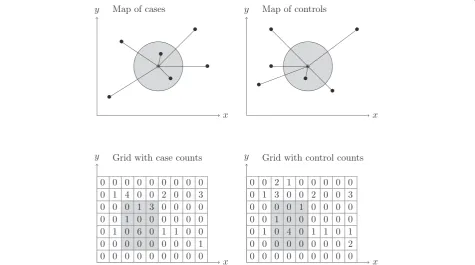
The initial motivation of this work was to downsize this computational issue by developing a grid approach that we found requires considerably less computational time (see Figure 1). The goal of this paper is to introduce the corresponding open source software that we have developed to perform grid-based algorithms for cluster detection and case-control spatial epidemiology. We will present the principles of the software, its conditions of use, and will describe in some detail its application to the search of candidate environmental factors of Type 1 Diabetes.
Methods
Description of FGBASE
FGASE was devised to meet the needs of environmental epidemiologists in the two directions above mentioned:
– “Data driven”where the epidemiologist searches if there are clusters of cases which can later be interpreted. In this case, the data consists of the positions of the patients and the positions of the controls (or the density of the underlying at risk population).
differently exposed than controls to environmental factors which are geographically specified. In this case the data are the positions of the patients and of the controls on the map, and the positions of the environmental points of interest.
The principle of the method is to use a high-resolution grid to avoid the computer costly computations of dis-tances, as outlined in the introduction.
Representation of geographical information in FGBASE
Choosing a geographical grid standard Although the software will run with any type of grid, the use of equal area grids based on the Lambert Azimuthal Equal Area (LAEA) projection system is encouraged. This type of grid is recommended by the Directive 2007/2/E, which was adopted by the European Parliament in March 2007. This directive aims at establish an Infrastructure for Spatial Information in the European community (INSPIRE) for environmental policies [14]. The INSPIRE directive rec-ommends the use of the Lambert Azimuthal Equal Area (ETRS89-LAEA) projection for pan-European spatial ana-lysis and reporting when true area representation is re-quired [15]. For each European country, population grids
of this type can be downloaded from the European Com-mission’s Eurostat website [16].
Projecting the data onto the geographical grid Epi-demiological data generally involves geographical coordi-nates encoded in the WGS84 coordinate system. WGS84 is the World Geodetic System established in 1984, which is well known through its use in the Global Positioning System (GPS). To project WGS84 coordinates to a grid based on the Lambert Azimuthal Equal Area (LAEA) projection system, the first step is to convert WGS84 coordinates to LAEA coordinates. This coordinate trans-formation can be done with the GDAL (Geospatial Data Abstraction Library) see [17]. One needs to know the EPSG codes of the source and target coordinate systems, which are (EPSG: 4326) for WGS84 and (EPSG: 3035) for ETRS89-LAEA. We provide a python script with which users can project their WGS84 coordinate data to ETRS89-LAEA grid coordinates for use in FGBASE
soft-ware. The software FGBASE displays the geographical
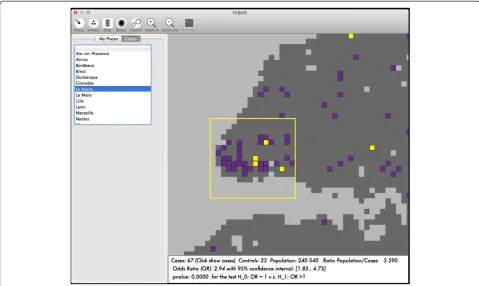
grid as an interactive map (see Figure 2).
Representing the points of interest in the hypothesis driven approachThe grid-based approach is well suited
Figure 1Comparison of the use of point locations with distance computations versus the use of the grid-based approach when
searching for clusters.(Above): Setting where cases and controls data consists of points (identified by latitude and longitude). Determining
for examining the effect of specific environmental fac-tors, when these environmental factors can be located to specific points on the map. These can be isolated points (such as factories or waste dumps). More generally, curves and surfaces can be modeled as collections of points though sampling. This enables the grid-based approach to be applied to the study of the possible environmental hazards associated with a highway, a river, or specific agricultural cover using pesticides.
Using FGBASE to test specific environmental factors in the hypothesis-driven approach
Three data sets are necessary: (i) locations of cases (ii) loca-tions of controls (iii) localoca-tions of the environmental points of interest (e.g. pollution source points). These spatial entities can be labeled with an attribute, that we call“class” in order to group all those which share a same characteris-tic that the user will specify, based on his domain specific knowledge. For example (see the case study, below), the
“entities” are factories that emit pollutants. A “class” is a
category of polluting chemical (e.g. hydrazine). All
“entities”(factories) that emit hydrazine belong to the same
“class”. This is being used by the software when comparing the distances of cases and controls to the entities (factories) that are of the same class (emitting hydrazine).
For each environmental under study, three levels of exposure are defined: (H = high, M = medium or L = low exposure). The distance to the point of interest deter-mines these exposure levels based on user-defined thresholds. Individuals located in cells which are close to an entity in the class, are classified as highly exposed. Individuals located in cells which are a bit farther from an entity in the class, are classified as having medium level of exposure. Individuals located in cells, which are yet farther from an entity in the class, are classified as having a low level of exposure. Finally, individuals even farther out are classified as not exposed. Then the software computes a case control 2x2 contingency table for each level of exposition (H, M and L) versus the exposition 0, finally, the software computes the odds ratio and their 95% confidence intervals, and a test for tendency to check if there is a dose-response relationship. If (OR/H) > (OR/M) > (OR/L) significantly, then there is indication of a dose dependent association. The environmental factors Figure 2Interactive map of the software FGBASE.The interactive map (centered here on the city of Le Havre, France) displays the cells of the grid. These square cells are color coded according to user defined criteria. Here the following color codes are used: light grey if the square is uninhabited, dark grey if the square is inhabited, purple if the square contains cases of the disease, yellow if the square contains 2 or more cases
are displayed on the interactive map of the software FGBASE (see Figure 3 and Figure 4).
Using FGBASE to find cluster of cases using the data-driven option
In this option, the locations of cases are examined in the context of either a set of control locations or an under-lying population density. A cluster search is performed to determine areas where the number of cases is much larger than would be expected by chance. Two datasets are necessary: (i) locations of cases (ii) locations of controls or appropriate population density data. For example, for all European countries, population grids can be downloaded from the European Commission’s Eurostat website [16]. (For non-European countries a solution could be to use the LandScan™population density distribution see [18], but the user must ensure his/her cases and controls are projected to the same grid as the one used by LandScan™).
Results
A case study with FGBASE: patients with type 1 diabetes (T1D)
The development of FGBASE was driven by a program of search of possible environmental factors of Type 1 Diabetes (T1D). Indeed, in several European countries,
the incidence of T1D continues to progress rapidly and has doubled since the 80′s in children aged less than 5 years [19]. The reason for this cannot be genetic as the observed variations occurred during a short time when the genetic structure of the population did not change. Numerous case-control studies of environmental associ-ations with T1D have examined specific candidate fac-tor approaches ([20-23]) but no single facfac-tor has gained further credit in the causation of T1D ([24,25]).
The population used in this example is made with the participants of “Isis-Diab”, an ongoing prospective cohort of T1D patients recruited since 2007 by the Isis-Diab Network composed of 99 diabetic centers covering almost all French regions (see description and list of participating centers in Additional file 1: Table S1). The main objective of the Isis-Diab program is the exploration of environmen-tal and gene-environment interaction in patients with T1D. Inclusion criteria for the current study were T1D occurring in children aged less than 15 years. T1D was defined according to the American Diabetes Association [26], and by positive autoantibodies to GAD, insulin, and/ or IA2. All studied patients were born in France. Data consist of clinical, genomic, and environmental expo-sures. Here, in the example shown to exemplify the
“hypothesis”driven option of FGBASE, we do not consider
the clinical and genetic characteristics of the patients
and we focus on a single source of pollution described in the next section.
The environmental exposures analyzed
In France, all industrial polluting industries are registered and must provide data on the polluting emissions they are responsible of. Data are in the IREP database (see [27]) that contains comprehensive data (=93 809) on polluting emissions regarding 159 registered chemicals. The data set consists of three database tables. The first table contains a list of industrial entities such as factories. (total: n = 12 173) Each entity comes with a numerical identifier (enti-tyID), as well as its geographical coordinates. The second table provides a list of 160 chemicals, each one having a numerical identifier (chemID). The third table contains a comprehensive list of chemical emissions over a period of 10 years (from 2000 to 2009). Each emission is provided with its date, its entityID and its chemID. This data set naturally fits into the framework of spatial entities grouped into classes. Here the classes are the registered chemicals (m = 160), and each class is associated to the entities that have emitted that chemical. The entities are mapped to the grid using their geographical coordinates.
“Hypothesis driven” option: In the hypothesis driven
option cases must be compared to controls. Here we
have defined “virtual controls” that are randomly taken
over France in places of comparable density to those of cases. Strength of this method is that the definition of controls, and the sampling issues, can be addressed by replicating the algorithm as many times that needed. In the example, we chose to take 100 series of 4507 virtual controls, each series being compared to the cases. The algorithm will test each class separately, one after the other. This ensures stronger statistical power but is submitted to the classical false discovery issues.
Using the data-driven option, zones most likely to be clusters of T1D cases where discovered in the vicinity of the cities of Le Havre, Dunkerque, Toulouse and Nantes (see Table 1).
Results with the hypothesis driven option
Using the hypothesis driven option and correcting for multiple comparisons, the polluting chemicals in the IREP dataset did not show a statistically significant asso-ciation with T1D.
Discussion
Comparisons with the SaTScan™software
studies). Despite its quality and wide user base, SaTScan™ has a certain number of drawbacks which warrant the ex-istence of alternative software tools such as FGBASE. The first drawback is that while SaTScan™is freely download-able, it is not open source. This strongly limits its custo-mizability, as the users cannot add and modify features to fit their needs. For example, we (the authors) have bene-fited from being able to customize the source code of the open source genomic analysis tool Plink [29] to add cer-tain statistical tests which we needed but were not imple-mented in the original software. Another advantage of open source software is that after a while, user scrutiny of the source code reduces the number of bugs and security flaws in the software [30]. The benefits of open source software in the area of geographical information systems has been studied in [31].
A second drawback of SaTScan™is that it uses circles.
From the SaTScan™ user guide [28]: “With latitude/
longitude coordinates, what planar projection is used?
No projection is used. SaTScan™ draws perfect circles
on the spherical surface of the earth”. As discussed in this paper, the use of circles and distance calculations, is computationally much slower than using grid
projec-tions. Increasing the speed of SaTScan™ through the
use of cloud services has been proposed in [13], it is clear however that using faster algorithms is a prefera-ble (and less expensive) solution.
A third limitation of SaTScan™ is the lack of
carto-graphic output [32], while this can be addressed though the use of an external macro [32], an integrated map as the one available in FGBASE, increases the ease of use when viewing clusters. Finally a fourth limitation of SaTScan™, is that it addresses only cluster searches and not the testing of environmental factors. By combining both types of analyses (cluster searches and testing of environmental factors) in a single software, FGBASE facilitates the interpretation of clusters in terms of
environmental factors (both clusters and environmental factors are displayed on the same map).
Types of environmental factors handled by FGBASE
The “hypothesis driven” grid-based algorithm described
in this paper and implemented in the companion soft-ware (FGBASE) is well suited in the case of environmen-tal factors, which can be located at specific points. By sampling curves and surfaces as collections of points, these are also well handled. The key aspect is that the environmental factors studied should be of a binary na-ture, in other words at any given location the factor should either be present or absent. This is the case for factories, power lines, highways and fields of specific crops. This is not the case for factors of a continuous nature such as temperature, atmospheric concentrations of a given gas or particle, or ultraviolet index.
Conclusions
Grid-based algorithms for mining spatial epidemiological data provide advantages in terms of computational com-plexity and improve the speed of computations. This work starts by examining suitable geographical grids, and how epidemiological data is projected to such a grid. Based on this framework, data-mining algorithms are in-troduced which enable both a data-driven approach and a hypothesis-driven approach. These algorithms enable rapid discovery of clusters of cases as well the testing of specific environmental factors. A new open-source software tool (FGBASE) implementing these algorithms, is presented together with a case study of its use on the“Isis-Diab” co-hort of French T1D cases. We hope that these methods and this software tool (FGBASE) will lower the computa-tional barriers to entry for those performing epidemio-logical research.
FGBASE can be accessed at http://www.fgbase.org. Table 1 Candidate clusters of T1D cases discovered by the FGBASE using cases from the Isis-Diab cohort
Cluster candidate Cluster candidate 1 Cluster candidate 2 Cluster candidate 3 Cluster candidate 4
Location Next to Le Havre Next to Dunkerque Next to Toulouse Next to Nantes
LAEA -ETRS89 grid coordinates of the rectangular zone:
[(3610,2979), (3610,2981), (3608,2981), (3608,2979)]
[(3774,3126), (3774,3130), (3783,3130), (3783,3126)]
[(3627,2313), (3627,2315), (3631,2315), (3631,2313)]
[(3446,2746), (3446,2750), (3453,2750), (3453,2746)]
WGS84 coordinates of rectangular zone:
[(0.15368,49.4943), (0.150047,49.5121), (0.122639,49.5097), (0.126282,49.4919)]
[(2.19376,50.9823), (2.18771,51.018), (2.31538,51.0265), (2.32132,50.9908)]
[(1.40999,43.5677), (1.40733,43.5856), (1.45649,43.5897), (1.45914,43.5718)]
[(1.59501,47.2094), (-1.60299,47.2449), (-1.51148,47.2548), (-1.5035,47.2192)]
Number of cases 8 cases 13 cases 13 cases 41 cases
Number of controls 3 controls 0 controls 4 controls 16 controls
log of the numerator of Kulldorff’s likelihood ratio:
-6240.36 -6235.35 -6238.47 -6235.09
Additional file
Additional file 1: Table S1.List of the 95 diabetic centers participating to the Isis-Diab network by alphabetic order. The Isis-Diab study is coordinated by the INSERM unit 986. The principal investigators of the Isis-Diab study are Pierre Bougnères and Alain-Jacques Valleron (see http://www.isis-diab.org/ for an interactive map showing the geographical repartition of the centers, and the numbers of patients followed by each center).
Competing interests
The authors declare that they have no competing interests.
Authors’contributions
DB and AJV designed the grid-based method and the FGBASE software. DB implemented the FGBASE software. DB and AJV wrote the manuscript and approved the final version of the manuscript.
Acknowledgements
This research was supported by grant MRES-PRNPE-1-CVS-014 from the (French Ministry of Environment, and the Programme Hospitalier de Recherche Clinique of the French Ministry of Health (AOM08049), Inserm, NovoNordisk Laboratory. We acknowledge the participation of the pediatricians of the diabetes centers contributing to the Isis-Diab cohort (see list of participating centers in Additional file 1: Table S1). We gratefully thank Sofia Meurisse for the geocoding of patients. We thank the patients and parents who participated in the study. Finally we would like to thank the two anonymous reviewers for their helpful comments and suggestions.
Received: 12 August 2014 Accepted: 24 September 2014 Published: 30 October 2014
References
1. Kulldorff M:A spatial scan statistic.Commun Stat-Theor Methods1997,
26(6):1481–1496.
2. Kulldorff M, Nagarwalla N:Spatial disease clusters: detection and inference.Stat Med1995,14(8):799–810.
3. Waller LA, Gotway CA:Applied spatial statistics for public health data.
Hoboken, New Jersey: John Wiley & Sons; 2004.
4. Lawson AB, Denison DG:Spatial cluster modelling.CRC press; 2010. 5. Lawson A, Biggeri A, Böhning D, Lesaffre E, Viel J-F, Bertollini R:Disease
mapping and risk assessment for public health.John Wiley & Sons; 1999. 6. Assuncao R, Costa M, Tavares A, Ferreira S:Fast detection of arbitrarily
shaped disease clusters.Stat Med2006,25(5):723–742.
7. Bithell J:Statistical methods for analysing point-source exposures.
InGeographical and Environmental Epidemiology: Methods for Small Area Studies.USA: Oxford University Press; 1992:221–230.
8. Bithell JF, Stone RA:On statistical methods for analysing the geographical distribution of cancer cases near nuclear installations.J Epidemiol Community Health1989,43(1):79–85.
9. Diggle PJ:A point process modelling approach to raised incidence of a rare phenomenon in the vicinity of a prespecified point.J R Stat Soc A Stat Soc1990,153:349–362.
10. Stone RA:Investigations of excess environmental risks around putative sources: statistical problems and a proposed test.Stat Med1988,
7(6):649–660.
11. Jacquez GM, Greiling DA:International Journal of Health Geographics. Int J Health Geogr2003,2:4.
12. Kulldorff M:Information Management Services, Inc. SaTScanTM v8. 0: Software for the spatial and space-time scan statistics; 2009 [http://www.satscan.org/] 13. Price RC, Pettey W, Freeman T, Keahey K, Leecaster M, Samore M, Tobias J, Facelli JC:SaTScan on a Cloud: On-Demand Large Scale Spatial Analysis of Epidemics.Online J Public Health Inform2010,2(1).
14. Fleming DM, Schellevis FG, Falcao I, Alonso TV, Padilla ML:The incidence of chickenpox in the community. Lessons for disease surveillance in sentinel practice networks.Eur J Epidemiol2001,17(11):1023–1027. 15. Annoni A, Bernard L, Lillethun A, Ihde J, Gallego J:Short Proceedings of the
1st European Workshop on Reference Grids; 2004.
16. Epstein PR:Climate change and infectious disease: stormy weather ahead?Epidemiology2002,13(4):373–375.
17. GDAL - Geospatial Data Abstraction Library: Version 1.10.1.Open Source Geospatial Foundation; 2014 [http://www.gdal.org/]
18. Dobson JE, Bright EA, Coleman PR, Durfee RC, Worley BA:LandScan: a global population database for estimating populations at risk. Photogramm Eng Remote Sens2000,66(7):849–857.
19. Patterson CC, Dahlquist GG, Gyürüs E, Green A, Soltész G:Incidence trends for childhood type 1 diabetes in Europe during 1989–2003 and predicted new cases 2005–20: a multicentre prospective registration study.Lancet2009,373(9680):2027–2033.
20. Mohr S, Garland C, Gorham E, Garland F:The association between ultraviolet B irradiance, vitamin D status and incidence rates of type 1 diabetes in 51 regions worldwide.Diabetologia2008,51(8):1391–1398. 21. Knip M, Virtanen SM, Seppä K, Ilonen J, Savilahti E, Vaarala O, Reunanen A,
Teramo K, Hämäläinen A-M, Paronen J:Dietary intervention in infancy and later signs of beta-cell autoimmunity.N Engl J Med2010,363(20):1900–1908. 22. Karlén J, Faresjö T, Ludvigsson J:Could the social environment trigger the induction of diabetes related autoantibodies in young children?Scand J Public Health2012,40(2):177–182.
23. Hober D, Alidjinou EK:Enteroviral pathogenesis of type 1 diabetes: queries and answers.Curr Opin Infect Dis2013,26(3):263–269.
24. Forlenza GP, Rewers M:The epidemic of type 1 diabetes: what is it telling us?Curr Opin Endocrinol Diabetes Obesity2011,18(4):248–251.
25. Nokoff N, Rewers M:Pathogenesis of type 1 diabetes: lessons from natural history studies of high‐risk individuals.Ann N Y Acad Sci2013,
1281(1):1–15.
26. Association AD:Diagnosis and classification of diabetes mellitus.Diabetes Care2009,32(Suppl 1):S62–S67.
27. D’Agostino RBSR, Massaro JM, Sullivan LM:Non-inferiority trials: design concepts and issues - the encounters of academic consultants in statistics.Stat Med2003,22(2):169–186.
28. Kulldorff M:SaTScanTM User Guide; 2006 [http://www.satscan.org/] 29. Purcell S, Neale B, Todd-Brown K, Thomas L, Ferreira MA, Bender D, Maller J,
Sklar P, De Bakker PI, Daly MJ:PLINK: a tool set for whole-genome association and population-based linkage analyses.Am J Hum Genet
2007,81(3):559–575.
30. Hoepman J-H, Jacobs B:Increased security through open source. Commun ACM2007,50(1):79–83.
31. Steiniger S, Hay GJ:Free and open source geographic information tools for landscape ecology.Ecol Inform2009,4(4):183–195.
32. Abrams AM, Kleinman KP:A SaTScan™macro accessory for cartography (SMAC) package implemented with SAS® software.Int J Health Geogr
2007,6(1):6.
doi:10.1186/1476-072X-13-46
Cite this article as:Baker and Valleron:An open source software for fast
grid-based data-mining in spatial epidemiology (FGBASE).International
Journal of Health Geographics201413:46.
Submit your next manuscript to BioMed Central and take full advantage of:
• Convenient online submission
• Thorough peer review
• No space constraints or color figure charges
• Immediate publication on acceptance
• Inclusion in PubMed, CAS, Scopus and Google Scholar
• Research which is freely available for redistribution