45
ENSURING DISTRIBUTED ACCOUNTABILITY FOR
DATA SHARING IN THE CLOUD
KARUMANCHI VEERAIAH CHOWDARY1, SAYEED YASIN2
1
Student, Dept.of CSE, Nimra Institute of Science & technology, Ibrahimpatnam, VJA
2Assoc.Prof &Head of Dept, Dept.of CSE, Nimra Institute of Science & technology, Ibrahimpatnam
ABSTRACT
Cloud computing enables highly scalable services to be easily consumed over the Internet on an as-needed basis. A major feature of the cloud services is that users’ data are usually processed remotely in unknown machines that users do not own or operate. While enjoying the convenience brought by this new emerging technology, users’ fears of losing control of their own data (particularly, financial and health data) can become a significant barrier to the wide adoption of cloud services. To address this problem, in this paper, we propose a novel highly decentralized information accountability framework to keep track of the actual usage of the users’ data in the cloud. In particular, we propose an object-centered approach that enables enclosing our logging mechanism together with users’ data and policies. We leverage the JAR programmable capabilities to both create a dynamic and traveling object, and to ensure that any access to users’ data will trigger authentication and automated logging local to the JARs.
INTRODUCTION
46 First, data handling can be outsourced by the direct cloud service provider (CSP) to other entities in the cloud and theses entities can also delegate the tasks to others, and so on. Second, entities are allowed to join and leave the cloud in a flexible manner. As a result, data handling in the cloud goes through a complex and dynamic hierarchical service chain which does not exist in conventional environments. To overcome the above problems, we propose a novel approach, namely Cloud Information Accountability (CIA) framework, based on the notion of information accountability [44]. Unlike privacy protection technologies which are built on the hide-it-or-lose-it perspective, information accountabilhide-it-or-lose-ity focuses on keeping the data usage transparent and track able. Our proposed CIA framework provides end-to end accountability in a highly distributed fashion. One of the main innovative features of the CIA framework lies in its ability of maintaining lightweight and powerful accountability that combines aspects of access control, usage control and authentication. By means of the CIA, data owners can track not only whether or not the service-level agreements are being honored, but also enforce access and usage control rules as needed. Associated with the accountability feature, we also develop two distinct modes for auditing: push mode and pull mode. The push mode refers to logs being periodically sent to the data owner or stakeholder while the pull mode refers to an alternative approach whereby the user (or another authorized party) can retrieve the logs as needed.
Currently, we focus on image files since images represent a very common content type for end users and organizations (as is proven by the popularity of Flickr [14]) and are increasingly hosted in the cloud as part of the storage services offered by the utility computing paradigm featured by cloud computing. Further, images often reveal social and personal habits of users, or are used for archiving important files from organizations. In addition, our approach can handle personal identifiable information provided they are stored as image files (they contain an image of any textual content, for example, the SSN stored as a .jpg file).
CLOUD PRIVACY AND SECURITY
end-47 to-end trust management and accountability problem in federated systems. The authors’ focus is very different from ours, in that they mainly leverage trust relationships for accountability, along with authentication and anomaly detection. Further, their solution requires third-party services to complete the monitoring and focuses on lower level
monitoring of system resources.
Researchers have investigated accountability mostly as a provable property through cryptographic mechanisms, particularly in the context of electronic commerce [10], [21]. Are presentative work in this area is given by [9]. The authors propose the usage of policies attached to the data and present a logic for accountability data in distributed settings. Delegation is complementary to our work, in that we do not aim at controlling the information workflow in the clouds. In a summary, all these works stay at a theoretical level and do not include any algorithm for tasks like mandatory logging. To the best of our knowledge, the only work proposing a distributed approach to accountability is from Lee and colleagues [22]. The authors have proposed an agent-based system specific to grid computing. Distributed jobs, along with the resource consumption at local machines are racked by static software agents. The notion of accountability policies in [22] is related to ours, but it is mainly focused on esource consumption and on tracking of sub-jobs processed at multiple computing nodes, rather than access control.
CLOUD INFORMATION ACCOUNTABILITY
In this section, we present an overview of the Cloud Information Accountability framework and discuss how the CIA framework meets the design requirements discussed in the previous section. The Cloud Information Accountability framework proposed in this work conducts automated logging and distributed auditing of relevant access performed by any entity, carried out at any point of time at any cloud service provider. It has two major components: logger and log harmonizer.
MAJOR COMPONENTS:
There are two major components of the CIA, the first being the logger, and the second being the log harmonizer. The logger is the component which is strongly coupled with the user’s data, so that it is downloaded when the data are accessed, and is copied whenever the data are copied. It handles a particular instance or copy of the user’s data and is responsible for logging access to that instance or copy.
48 view but not to modify the data. The logger will control the data access even after it is downloaded by user X.
DATA FLOW:
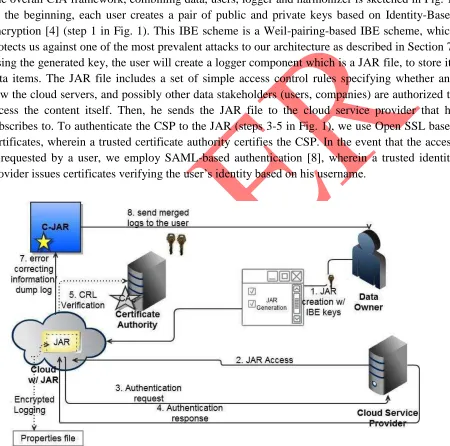
The overall CIA framework, combining data, users, logger and harmonizer is sketched in Fig. 1. At the beginning, each user creates a pair of public and private keys based on Identity-Based Encryption [4] (step 1 in Fig. 1). This IBE scheme is a Weil-pairing-based IBE scheme, which protects us against one of the most prevalent attacks to our architecture as described in Section 7. Using the generated key, the user will create a logger component which is a JAR file, to store its data items. The JAR file includes a set of simple access control rules specifying whether and how the cloud servers, and possibly other data stakeholders (users, companies) are authorized to access the content itself. Then, he sends the JAR file to the cloud service provider that he subscribes to. To authenticate the CSP to the JAR (steps 3-5 in Fig. 1), we use Open SSL based certificates, wherein a trusted certificate authority certifies the CSP. In the event that the access is requested by a user, we employ SAML-based authentication [8], wherein a trusted identity provider issues certificates verifying the user’s identity based on his username.
Fig. 1. Overview of the cloud information accountability framework
49 automatically generate a log record, encrypt it using the public key distributed by the data owner, and store it along with the data (step 6 in Fig. 1). The encryption of the log file prevents unauthorized changes to the file by attackers. The data owner could opt to reuse the same key pair for all JARs or create different key pairs for separate JARs. Using separate keys can enhance the security (detailed discussion is in Section 7) without introducing any overhead except in the initialization phase. In addition, some error correction information will be sent to the log harmonizer to handle possible log file corruption (step 7 in Fig. 1). To ensure trustworthiness of the logs, each record is signed by the entity accessing the content. Further, individual records are hashed together to create a chain structure, able to quickly detect possible errors or missing records. The encrypted log files can later be decrypted and their integrity verified. They can be accessed by the data owner or other authorized stakeholders at any time for auditing purposes with the aid of the log harmonizer (step 8 in Fig. 1).
AUTOMATED LOGGING MECHANISM
In this section, we first elaborate on the automated logging mechanism and then present techniques to guarantee dependability.
THE LOGGER STRUCTURE:
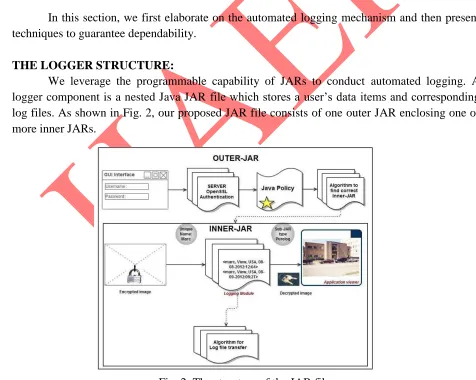
We leverage the programmable capability of JARs to conduct automated logging. A logger component is a nested Java JAR file which stores a user’s data items and corresponding log files. As shown in Fig. 2, our proposed JAR file consists of one outer JAR enclosing one or more inner JARs.
50 The main responsibility of the outer JAR is to handle authentication of entities which want to access the data stored in the JAR file. In our context, the data owners may not know the exact CSPs that are going to handle the data. Hence, authentication is specified according to the servers’ functionality (which we assume to be known through a lookup service), rather than the server’s URL or identity. For example, a policy may state that Server X is allowed to download the data if it is a storage server. As discussed below, the outer JAR may also have the access control functionality to enforce the data owner’s requirements, specified as Java policies, on the usage of the data. A Java policy specifies which permissions are available for a particular piece of code in a Java application environment. The permissions expressed in the Java policy are in terms of File System Permissions. However, the data owner can specify the permissions in user-centric terms as opposed to the usual code-user-centric security offered by Java, using Java Authentication and Authorization Services. Moreover, the outer JAR is also in charge of selecting the correct inner JAR according to the identity of the entity who requests the data.
PUSH AND PULL MODE:
To allow users to be timely and accurately informed about their data usage, our distributed logging mechanism is complemented by an innovative auditing mechanism. We support two complementary auditing modes: 1) push mode; 2) pull mode.
Push mode: In this mode, the logs are periodically pushed to the data owner (or auditor) by the harmonizer. The push action will be triggered by either type of the following two events: one is that the time elapses for a certain period according to the temporal timer inserted as part of the JAR file; the other is that the JAR file exceeds the size stipulated by the content owner at the time of creation. After the logs are sent to the data owner, the log files will be dumped, so as to free the space for future access logs. Along with the log files, the error correcting information for those logs is also dumped. This push mode is the basic mode which can be adopted by both the Pure Log and the Access Log, regardless of whether there is a request from the data owner for the log files. This mode serves two essential functions in the logging architecture: 1) it ensures that the size of the log files does not explode and 2) it enables timely detection and correction of any loss or damage to the log files.
Pull mode: This mode allows auditors to retrieve the logs anytime when they want to check the recent access to their own data. The pull message consists simply of an FTP pull command, which can be issues from the command line. For naive users, a wizard comprising a batch file can be easily built. The request will be sent to the harmonizer, and the user will be informed of the data’s locations and obtain an integrated copy of the authentic and sealed log file.
ALGORITHMS:
51 if the data are not pushed out frequently enough, the log file may become very large, which may increase cost of operations like copying data (see Section 8). The pushing mode may be preferred by data owners who are organizations and need to keep track of the data usage consistently over time. For such data owners, receiving the logs automatically can lighten the load of the data analyzers. The maximum size at which logs are pushed out is a parameter which can be easily configured while
creating the logger component. The pull strategy is most needed when the data owner suspects some misuse of his data; the pull mode allows him to monitor the usage of his content immediately. A hybrid strategy can actually be implemented to benefit of the consistent information offered by pushing mode and the convenience of the pull mode. Further, as discussed in Section 7, supporting both pushing and pulling modes helps protecting from some nontrivial attacks.
52 Fig. 3. Push and pull Pure Log mode.
The log retrieval algorithm for the Push and Pull modes is outlined in Fig. 3. The algorithm presents logging and synchronization steps with the harmonizer in case of Pure Log. First, the algorithm checks whether the size of the JAR has exceeded a stipulated size or the normal time between two consecutive dumps has elapsed. The size and time threshold for a dump are specified by the data owner at the time of creation of the JAR. The algorithm also checks whether the data owner has requested a dump of the log files. If none of these events has occurred, it proceeds to encrypt the record and write the error-correction information to the harmonizer. The communication with the harmonizer begins with a simple handshake. If no response is received, the log file records an error. The data owner is then alerted through e-mails, if the JAR is configured to send error notifications. Once the handshake is completed, the communication with the harmonizer proceeds, using a TCP/IP protocol. If any of the aforementioned events (i.e., there is request of the log file, or the size or time exceeds the threshold) has occurred, the JAR simply dumps the log files and resets all the variables, to make space for new records.
PERFORMANCE STUDY
In this section, we first introduce the settings of the test environment and then present the performance study of our system.
EXPERIMENTAL SETTINGS:
We tested our CIA framework by setting up a small cloud, using the Emu lab test bed [42]. In particular, the test environment consists of several Open SSL-enabled servers: one head node which is the certificate authority, and several computing nodes. Each of the servers is installed with Eucalyptus [41]. Eucalyptus is an open source cloud implementation for Linux-based systems. It is loosely based on Amazon EC2, therefore bringing the powerful functionalities of Amazon EC2 into the open source domain. We used Linux-based servers running Fedora 10 OS. Each server has a 64-bit Intel Quad Core Xeon E5530 processor, 4 GB RAM, and a 500 GB Hard Drive. Each of the servers is equipped to run the Open JDK runtime environment with IcedTea6 1.8.2.
EXPERIMENTAL RESULTS :
53 LOG CREATION TIME:
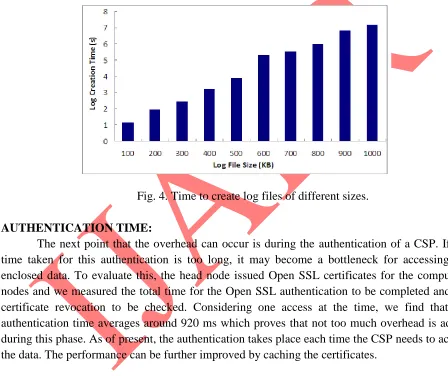
In the first round of experiments, we are interested in finding out the time taken to create a log file when there are entities continuously accessing the data, causing continuous logging. Results are shown in Fig. 4. It is not surprising to see that the time to create a log file increases linearly with the size of the log file. Specifically, the time to create a 100 Kb file is about 114.5 ms while the time to create a 1 MB file averages at 731 ms. With this experiment as the baseline, one can decide the amount of time to be specified between dumps, keeping other variables like space constraints or network traffic in mind.
Fig. 4. Time to create log files of different sizes.
AUTHENTICATION TIME:
The next point that the overhead can occur is during the authentication of a CSP. If the time taken for this authentication is too long, it may become a bottleneck for accessing the enclosed data. To evaluate this, the head node issued Open SSL certificates for the computing nodes and we measured the total time for the Open SSL authentication to be completed and the certificate revocation to be checked. Considering one access at the time, we find that the authentication time averages around 920 ms which proves that not too much overhead is added during this phase. As of present, the authentication takes place each time the CSP needs to access the data. The performance can be further improved by caching the certificates.
LOG MERGING TIME:
54 to the number of files and size of files, with the least time being taken for merging two 100 KB log files at 59 ms, while the time to merge 70 1 MB files was 2.35 minutes.
Fig. 5. Time to merge log files.
SIZE OF THE DATA JAR FILES:
55 Fig. 6. Size of the logger component.
CONCLUSION AND FUTURE RESEARCH
We proposed innovative approaches for automatically logging any access to the data in the cloud together with an auditing mechanism. Our approach allows the data owner to not only audit his content but also enforce strong back-end protection if needed. Moreover, one of the main features of our work is that it enables the data owner to audit even those copies of its data that were made without his knowledge.
In the future, we plan to refine our approach to verify the integrity of the JRE and the authentication of JARs [23]. For example, we will investigate whether it is possible to leverage the notion of a secure JVM [18] being developed by IBM. This research is aimed at providing software tamper resistance to Java applications. In the long term, we plan to design a comprehensive and more generic object-oriented approach to facilitate autonomous protection of traveling content. We would like to support a variety of security policies, like indexing policies for text files, usage control for executable, and generic accountability and provenance controls.
REFERENCES
[1] P. Ammann and S. Jajodia, “Distributed Timestamp Generation in Planar Lattice Networks,”
ACM Trans. Computer Systems, vol. 11, pp. 205-225, Aug. 1993.
[2] G. Ateniese, R. Burns, R. Curtmola, J. Herring, L. Kissner, Z. Peterson, and D. Song,
“Provable Data Possession at Untrusted Stores,” Proc. ACM Conf. Computer and Comm.
Security, pp. 598- 609, 2007.
[3] E. Barka and A. Lakas, “Integrating Usage Control with SIP-Based Communications,” J.
Computer Systems, Networks, and Comm., vol. 2008, pp. 1-8, 2008.
[4] D. Boneh and M.K. Franklin, “Identity-Based Encryption from the Weil Pairing,” Proc. Int’l
Cryptology Conf. Advances in Cryptology, pp. 213-229, 2001.
[5] R. Bose and J. Frew, “Lineage Retrieval for Scientific Data Processing: A Survey,” ACM
Computing Surveys, vol. 37, pp. 1- 28, Mar. 2005.
56 [8] OASIS Security Services Technical Committee, “Security Assertion Markup Language
(saml) 2.0,” http://www.oasis-open.org/ committees/tc home.php?wg abbrev=security, 2012. [9] R. Corin, S. Etalle, J.I. den Hartog, G. Lenzini, and I. Staicu, “A Logic for Auditing Accountability in Decentralized Systems,” Proc. IFIP TC1 WG1.7 Workshop Formal Aspects in
Security and Trust, pp. 187-201, 2005.
[10] B. Crispo and G. Ruffo, “Reasoning about Accountability within Delegation,” Proc. Third Int’l Conf. Information and Comm. Security (ICICS), pp. 251-260, 2001.
[11] Y. Chen et al., “Oblivious Hashing: A Stealthy Software Integrity Verification Primitive,” Proc. Int’l Workshop Information Hiding, F. Petitcolas, ed., pp. 400-414, 2003.
[12] S. Etalle and W.H. Winsborough, “A Posteriori Compliance Control,” SACMAT ’07: Proc.
12th ACM Symp. Access Control Models and Technologies, pp. 11-20, 2007.
[13] X. Feng, Z. Ni, Z. Shao, and Y. Guo, “An Open Framework for Foundational Proof-Carrying Code,” Proc. ACM SIGPLAN Int’l Workshop Types in Languages Design and
Implementation, pp. 67-78, 2007.
[14] Flickr, http://www.flickr.com/, 2012.
[15] R. Hasan, R. Sion, and M. Winslett, “The Case of the Fake Picasso: Preventing History Forgery with Secure Provenance,” Proc. Seventh Conf. File and Storage Technologies, pp. 1-14,
2009.
[16] J. Hightower and G. Borriello, “Location Systems for Ubiquitous Computing,” Computer,
vol. 34, no. 8, pp. 57-66, Aug. 2001.
[17] J.W. Holford, W.J. Caelli, and A.W. Rhodes, “Using Self- Defending Objects to Develop
Security Aware Applications in Java,” Proc. 27th Australasian Conf. Computer Science, vol. 26,
pp. 341-349, 2004.
[18] Trusted Java Virtual Machine IBM, http://www.almaden.ibm. com/cs/projects/jvm/, 2012.
[19] P.T. Jaeger, J. Lin, and J.M. Grimes, “Cloud Computing and Information Policy:
Computing in a Policy Cloud?,” J. Information Technology and Politics, vol. 5, no. 3, pp.
269-283, 2009.
[20] R. Jagadeesan, A. Jeffrey, C. Pitcher, and J. Riely, “Towards a Theory of Accountability and Audit,” Proc. 14th European Conf. Research in Computer Security (ESORICS), pp. 152-167,
57 [21] R. Kailar, “Accountability in Electronic Commerce Protocols,” IEEE Trans. Software Eng.,
vol. 22, no. 5, pp. 313-328, May 1996.
[22] W. Lee, A. Cinzia Squicciarini, and E. Bertino, “The Design and Evaluation of Accountable Grid Computing System,” Proc. 29th
IEEE Int’l Conf. Distributed Computing Systems (ICDCS