Volume 8
Issue 1 Winter 2020 Article 8
January 2020
Master’s and Doctoral Occupational Therapy Students’
Master’s and Doctoral Occupational Therapy Students’
Perceptions of Research Integration in Their Programs
Perceptions of Research Integration in Their Programs
Jeffrey Sargent
Gannon University - USA, [email protected]
Ashley Wermers
Gannon University - USA, [email protected]
Lauren Russo
Gannon University - USA, [email protected]
Kristin Valdes
Gannon University - USA, [email protected]
Follow this and additional works at: https://scholarworks.wmich.edu/ojot
Part of the Educational Assessment, Evaluation, and Research Commons, Occupational Therapy Commons, and the Scholarship of Teaching and Learning Commons
Recommended Citation Recommended Citation
Sargent, J., Wermers, A., Russo, L., & Valdes, K. (2020). Master’s and Doctoral Occupational Therapy Students’ Perceptions of Research Integration in Their Programs. The Open Journal of Occupational Therapy, 8(1), 1-10. https://doi.org/10.15453/2168-6408.1614
This document has been accepted for inclusion in The Open Journal of Occupational Therapy by the editors. Free, open access is provided by ScholarWorks at WMU. For more information, please contact
Abstract Abstract
This is a pilot study with the intent of identifying occupational therapy doctorate (OTD) and master’s (MOT) students’ perceptions of research in their coursework. A cross-sectional study was conducted through a survey of OTD and MOT students. The Student Perception of Research Integration
Questionnaire (SPRIQ) was emailed to graduate occupational therapy programs in the United States. An unpaired single tailed t-test was used to compare the mean scores between the MOT and OTD student responses for each scale and subscale. Two hundred and twenty-six students filled out the questionnaire. Both the OTD and MOT students had a favorable perception of the integration of research into the
curriculum with a mean score of 3.63 (MOT) and 3.85 (OTD) out of five. An independent t-test found there was a statistically significant difference between the mean scores for two of the subscales for research integration (current research subscale p = .000 and motivation subscale p = .02) and for the beliefs scale (p = .002). Students enrolled in both MOT and OTD programs have a favorable perception of research being integrated into their curriculums. The OTD students have a more favorable perception of the integration of research in their curriculums, with a 0.30 mean difference between all items on the scale.
Comments
The authors report that they have no conflicts of interest to disclose.
Keywords Keywords
research, perception, occupational therapy, SPRIQ
Credentials Display
Jeffrey Sargent, OTD/S; Ashley Wermers, OTD/S; Lauren Russo, OTD/S; Kristin Valdes, OTD, OT/L, CHT
Copyright transfer agreements are not obtained by The Open Journal of Occupational Therapy (OJOT). Reprint permission for this Topics in Education should be obtained from the
corresponding author(s). Click here to view our open access statement regarding user rights and distribution of this Topics in Education.
DOI: 10.15453/2168-6408.1614
Graduate student perceptions of research have the potential to influence how current and future occupational therapists embrace implementing evidence-based practice (EBP) in clinical settings. EBP is the “conscientious, explicit, and judicious use of current best evidence in making decisions about the care of individual patients” (Sackett, Rosenberg, Gray, Haynes, & Richardson, 1996, p. 71). It has been reported that it takes an average of 17 years for research evidence to be implemented and to effect clinical practice (Westfall, Mold, & Fagnan, 2007). Physical therapists, occupational therapists, nurses, and medical students in an acute geriatric setting reported a significantly higher capacity to formulate questions and appraise research than the health professionals employed at the facility (Boström, Sommerfeld, Stenhols, & Kiessling, 2018).To facilitate the translation of scientific discoveries to benefit patients more quickly, it is imperative that new practitioners have a thorough understanding of the research process. Professional societies encourage health care professionals to stay current through the use of EBP in clinical settings and to generate research. Student involvement in research experiences during graduate coursework is the first step of this process.
Prior to the American Occupational Therapy Association’s (AOTA) Vision 2025, the Centennial Vision called for occupational therapy (OT) to be a “science-driven, and evidence-based profession” (AOTA, n.d., para. 1). Vision 2025 (AOTA, 2017) includes five pillars; notably, the Effective pillar states that “occupational therapy is evidence based, client centered, and cost-effective” (AOTA, p. 1). The Leaders Pillar states that “occupational therapy is influential in changing policies, environments, and complex systems” (AOTA, 2017, p. 1). To reach this goal, each OT student must understand how research influences and guides practice (Van Lew & Singh, 2009). OT students and occupational therapists must be able to exemplify Vision 2025 through proficiency in developing, interpreting, and implementing research to optimize practice. In a survey study of physical therapy (PT) and OT students, Kamwendo and Tornquist (2001) found:
There appears to be overwhelming consensus by both [occupational therapists] and [physical therapists] that research is vital for the professions, that it should go hand in hand with clinical practice, and that failure to achieve this constitutes a threat to the very existence of the
professions. (p. 296)
To support and exemplify Vision 2025 for the profession of OT, it is crucial to gauge current student perceptions of research and EBP. Kamwendo and Tornquist (2001) also found in their study that “students had a positive attitude towards research, particularly for the activity ‘read research literature to update knowledge’ and ‘apply research findings to improve practice’” (p. 295). Other health care
professions have also explored students’ general attitudes toward research. Steele and Rawls (2015) found that master’s level counseling students do not believe research plays an integral role in their clinical proficiency. The counseling students feared learning, using, and analyzing statistics (Steele & Rawls, 2015). Student attitudes concerning quantitative research was also not highly valued (Steele & Rawls, 2015). The findings of Royalty, Gelso, Mallinckrodt, and Garrett (1986) suggest that psychology programs vary in the level of impact research coursework played, ranging from striking to a modest impact, with few programs inhibiting interest. Royalty and Reising (1986) found the most substantial positive influences concerning interest in research for students were the interactions with research advisors or role models.
There is minimal research available regarding OT students’ views about the integration of research into their coursework and how this may influence their views regarding EBP once they transition into practitioners. A survey study regarding research and EBP was completed by Connolly, Lupinnaci, and Bush (2001) on PT students and 1 year later, after they became practicing physical therapists. The authors found that the students’ self-reported knowledge and behavior toward research increased over time (Connolly, Lupinnaci, & Bush, 2001). The new physical therapists believed that they had accepted the responsibility of staying current in the research literature (Connolly et al., 2001). However, the authors also reported that new graduates may not see EBP (e.g., the application of research to patient care) being applied in the clinical setting (Connolly et al., 2001). In a qualitative study
regarding the integration of EBP concepts by OT students, Stube and Jedlicka (2007) found that EBP was initially “hidden” to the OT students in clinical settings. This finding was compounded when the OT students identified barriers to using EBP rather than solutions to increase the application of EBP in the clinical setting (Stube & Jedlicka, 2007). In a survey of newly graduated occupational therapists, researchers found the therapists felt less prepared for EBP than they did for tasks involving interpersonal skills (Gray et al., 2012).
OT students returning from fieldwork experiences have reported a disconnect between theory and practice and claim a lack of evidence-driven interventions (Towns & Ashby, 2014). A recent survey of OT fieldwork educators found that the educators did not feel that EBP was directly applicable to their site for a few reasons, including time and practice setting (Ryan et al., 2018). Although the educators acknowledged that EBP was a useful tool, it was not a priority (Ryan et al., 2018). It is important to understand OT students’ perceptions of research and EBP to determine if all practitioners entering the profession value research and EBP similarly. This study aimed to assess current OT students’
perceptions of research integrated into coursework to facilitate and support future efforts in preparing students for EBP and to become evidence-based practitioners.
Method
This study is a cross-sectional study that was conducted through a survey of occupational therapy doctoral (OTD) students and masters of occupational therapy (MOT) students. The Student Perception of Research Integration Questionnaire (SPRIQ) was emailed to 205 graduate OT programs in the United States. The university’s independent review board granted consent for the study. The cover letter asked that students who had participated in research classes in their program provide their perspectives. Each participant gave consent at the beginning of the survey for their responses to be used.
The Survey Instrument
The SPRIQ was used in this study to quantify student perceptions (see Appendix). The SPRIQ includes 40 questions, the original subscale, and the final subscale. The SPRIQ has been used previously to gather information regarding the way psychology students perceive research integration into their coursework (Visser-Wijnveen, van der Rijst, & van Driel, 2016). The final subscale was used in the current study to assess OT students’ perceptions of research.
The final model includes three scales: research integration, which consists of four subscales,
quality, and beliefs (each 3 items). The four research integration subscales are as follows:
reflection (4 items), participation (5 items), current research (5 items), and motivation (4 items). The subscale reflection includes items focusing on attention being paid to the research process leading to research results. The subscale participation includes items on the involvement of
2 https://scholarworks.wmich.edu/ojot/vol8/iss1/8
students in and their contribution to scientific research. Current research is a combination of items concentrating on getting to know the current research from their teachers and in general.
Motivation consists of items concerning an increase in student’s enthusiasm and interest for the domain. Quality deals with items related to elements deemed important for good quality
teaching, and beliefs captures students’ beliefs about the importance of research integration for their learning. (Visser-Wijnveen et al., 2016, p. 480-481)
All questions were scored on a 5-point Likert scale; 36 of the questions were on a frequency scale that ranged from very rarely to very frequently. The remaining four questions of the belief scale were scored on an agreement scale that ranged from strongly disagree to strongly agree.
Data Analysis
Demographic data provided by the respondents were gathered and potential differences in baseline demographics between groups were analyzed using X2 tests of independence for categorical data. Likert scale items are created by calculating a composite score (sum or mean) from four or more Likert-type items; therefore, the composite score for Likert scales were analyzed using the interval measurement scale (Boone & Boone, 2012). Descriptive statistics recommended for interval scale items include the mean for central tendency and standard deviations for variability (Boone & Boone, 2012). An unpaired single tailed t-test was used to comparethe OTD and MOT mean scores scales of the SPRIQ scale. P < 0.05 was considered statistically significant.
Results Participants
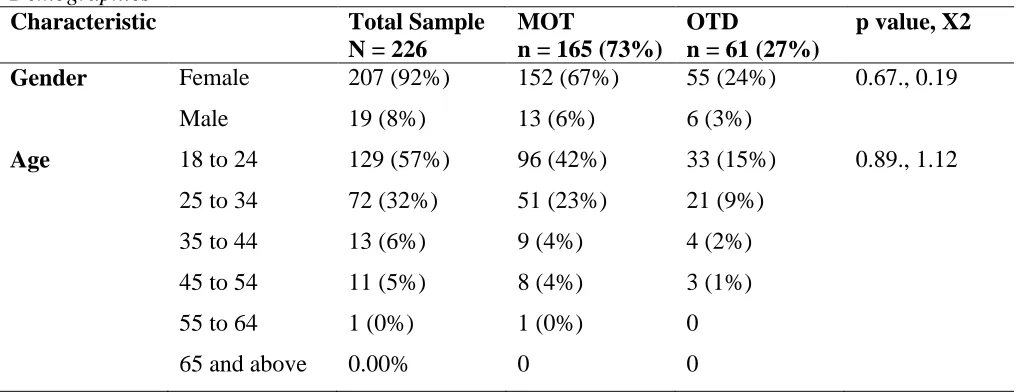
All of the participants who completed the SPRIQ survey were enrolled in a MOT or OTD program at the time of the study distribution and completion. Three hundred and twenty-seven participants responded to the survey; however, only 226 subjects completed the survey for a survey completion rate of 70%. Of those that completed the survey, 165 (73%) were MOT students and 61 (27%) were OTD students. Of the study participants, 207 (92%) were female and 19 (8%) were male. Approximately 60% of the subjects were between 18 and 24 years of age and the remainder of the subjects fell within the 25 to 34 years of age range (see Table 1). No differences in any characteristic were found at baseline between the groups.
Table 1
Demographics
Characteristic Total Sample MOT OTD p value, X2
N = 226 n = 165 (73%) n = 61 (27%)
Gender Female 207 (92%) 152 (67%) 55 (24%) 0.67., 0.19
Male 19 (8%) 13 (6%) 6 (3%)
Age 18 to 24 129 (57%) 96 (42%) 33 (15%) 0.89., 1.12
25 to 34 72 (32%) 51 (23%) 21 (9%)
35 to 44 13 (6%) 9 (4%) 4 (2%)
45 to 54 11 (5%) 8 (4%) 3 (1%)
55 to 64 1 (0%) 1 (0%) 0
65 and above 0.00% 0 0
Statistical Analysis of SPRIQ Scores
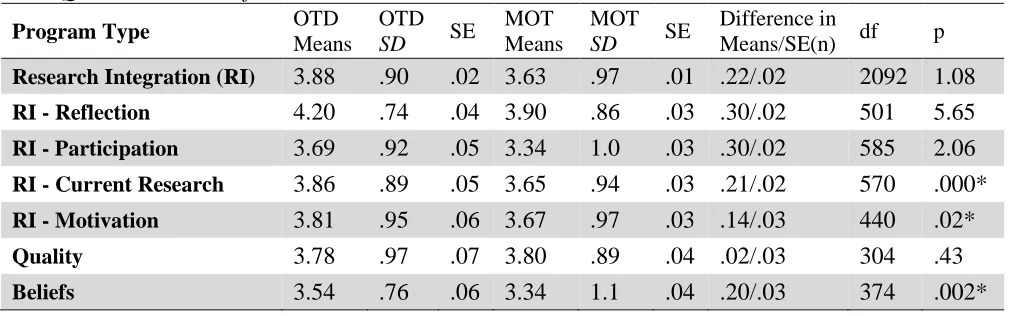
An independent t-test was used to compare the OTD and MOT students’ mean scores regarding the perception of research coursework. Each scale measure consisted of multiple questions centered around a theme. Table 2 provides a breakdown of the students’ response means (M), standard deviation (SD) of those responses, standard error of mean (SE), one-tailed t-test, and degrees of freedom (DF). Two of the three scales showed statistically significant difference between OTD and MOT students’ mean scores (see Table 2). Two of the six subscales demonstrated statistical significance between the means. Table 2 is broken down by scale and subscale and is divided by program type.
Table 2
SPRIQ Subscale Means from OTD And MOT Students
Program Type OTD
Means
OTD SD SE
MOT Means
MOT SD SE
Difference in
Means/SE(n) df p
Research Integration (RI) 3.88 .90 .02 3.63 .97 .01 .22/.02 2092 1.08
RI - Reflection 4.20 .74 .04 3.90 .86 .03 .30/.02 501 5.65
RI - Participation 3.69 .92 .05 3.34 1.0 .03 .30/.02 585 2.06
RI - Current Research 3.86 .89 .05 3.65 .94 .03 .21/.02 570 .000*
RI - Motivation 3.81 .95 .06 3.67 .97 .03 .14/.03 440 .02*
Quality 3.78 .97 .07 3.80 .89 .04 .02/.03 304 .43
Beliefs 3.54 .76 .06 3.34 1.1 .04 .20/.03 374 .002*
Discussion
The aim of this study was to gauge the similarities and differences of perceptions toward research coursework between the OTD and MOT students who are currently enrolled in OT graduate programs in the United States. This is the first study conducted that assesses the similarities and differences between OTD and MOT students’ perceptions of research coursework using a validated measure. This study shows that the OTD students have a more favorable perception of the integration of research in their curriculum, with a 0.30 mean difference between all items on the SPRIQ. There was a statistically significant difference between the OTD and MOT students’ mean scores for current
research, motivation, and beliefs. Overall, the students in both programs had favorable responses toward the overall integration of research in their coursework demonstrated by a mean score of 3.63 (MOT) and 3.85 (OTD) out of five. The quality scale had the smallest difference in means (0.02) between program types. These results indicate the students’ positive perspectives of their respective faculty and the type of instruction delivered concerning research and EBP. This may be, in part, because of the rigorous
accreditation standards to which all OT schools must adhere.
The beliefs scale measured the students’ beliefs about the importance of research in learning (Visser-Wijnveen et al., 2016). The difference in means was 0.20 with the OTD students having stronger beliefs in the importance of research integration for their learning. This difference between means was statistically significant. The current research has items that concentrate on students knowing about the current research from their teachers (Visser-Wijnveen et al., 2016). There was a statistically significant difference (p = .000) between the mean scores of this scale, as well. Perhaps this is because it is required to have a doctoral degree to teach in a doctoral program and faculty members with doctoral degrees may
4 https://scholarworks.wmich.edu/ojot/vol8/iss1/8
generate more research than faculty members with a master’s degrees. Motivation consists of items concerning an increase in students’ enthusiasm and interest for the domain (Visser-Wijnveen et al., 2016). The mean difference between the scores in this scale were also statistically significant (p = .02). Perhaps this difference is because the OTD students design and implement a research study versus completing just one aspect of the study, which is a MOT requirement. The information that students receive in the classroom may contribute to the understanding of the importance of research, which may also increase the enthusiasm and interest in the topic. Both the MOT and the OTD students perceived that research is an important aspect in the learning environment.
When the mean scores reported in the current study are compared to the scores reported by Visser-Wijnveen, van der Rijst, and van Driel (2016), the mean scores from both the MOT and the OTD students were higher. Their scores ranged from 1.88 my research contribution mattered to 3.43 my teachers taught in an appropriate manner for me personally. The lowest mean score from this study was 3.34 and the highest was 4.20. This difference may be because the Visser-Wijnveen et al. (2016) study was conducted with undergraduate students and the current study was conducted with graduate level students who may value research more. The SPRIQ scores of the current study were similar to the mean scores of 2.44 to 3.75 reported by Veriijken, van der Rijst, van Driel, and Dekke (2018), who studied research perceptions of first-year medical students. Findings from another study that used the SPRIQ found that student motivation for research is strongly related to merging current research into teaching and that student beliefs about research are related to achievement (Vereijken, van der Rijst, de Beaufort, van Driel, & Dekker, 2018).
The research process is currently an integral portion of both the MOT and OTD curriculums. Prior to 1999, OT clinicians were not offered the formal instruction needed to develop EBP, which is congruent with the Accreditation Council for Occupational Therapy Education (ACOTE) standards during that time (Nichols, 2017). Changes to OT curriculums can be seen in the current ACOTE standards.The MOT standards mention that students will be able to understand and use basic statistical methods and implement one or more aspects of research methodology, which may be simulated or applied in an actual project (ACOTE, 2013). In addition, it is not required for MOT students to have a culminating research project, while it required is for OTD students. The OTD ACOTE standards state that OTD students will be able to select, apply, and interpret applicable statistical methods, as well as design and implement a research study that evaluates service delivery, professional issues, and clinical practice (ACOTE, 2013). Moreover, OTD students will write scholarly reports that can be published in a peer-reviewed journal and/or for presentation. Finally, OTD students are required to complete a
culminating project that relates to practice or theory that displays competence and synthesis in an advanced practice area (ACOTE, 2013). These differences in research coursework between OTD and MOT students are one of many examples of the standards aimed at preparing OT students for
competence with EBP in academia and in the clinical setting.
Previous studies show that there is a lack of confidence in practitioners and students to analyze and obtain research to implement in practice (Bennett et al., 2003; McClusky, 2003). In a study
conducted by Bennett et al. (2003), the authors indicated that those surveyed (current practitioners) were not confident in their skills of interpreting and analyzing EBP. Dubouloz, Egan, Vallerand, and von Zweck (1999) stated, “occupational therapists sometimes expressed a very strong feeling of lack of expertise and knowledge required to carry out research” and that “lack of research expertise led to feelings of guilt” (p. 449). In a study by McClusky (2003), the author reported findings that suggested
students in entry-level OT programs lacked confidence in their skill of appraising and searching
research. Thomas and Law (2013) conducted a scoping review on the use of EBP in practice settings and found that among factors that support the use of research, academic degree was one of the strongest. A recent paper on graduate student mental health suggested that students should be encouraged to take on research or activities that provide a sense of meaning and usefulness to them to improve student mental health (Barreira, Basilico, & Bolotnyy, 2018).
Finally, the importance of participating and using EBP in clinical decision-making is currently an important aspect in clinical settings. For a successful transition to the clinical setting, entry-level
occupational therapists should be able to articulate professional reasoning and design programs and interventions that are supported by OT theories and evidence (Ryan et al., 2018). There is a disconnect occurring between theory and practice reported by students returning from fieldwork “claiming a lack of occupation-based, evidence-driven, client-centered interventions promoted in the classroom” (Ryan et al., 2018, p. 1). Students, facility, and fieldwork educators need to establish clear expectations and standards, have an open line of communication, and provide collaborative learning opportunities to close the gap between the classroom (didactic) and clinical experiences (practice). Some suggestions for faculty are that they should develop materials that connect the theory to practice; have access to clinical books; assign skill videos to link clinical books to case studies; and provide concrete steps, application examples, and evidence-based practice references to illustrate theoretical concepts (Flood & Robina, 2014). Suggestions for clinical faculty include linking didactic concepts to practice, reviewing board-style questions, discussing their connection to clinical experience, and sharing EBP articles that directly relate to didactic topics and discussing how to integrate them into practice (Flood & Robina, 2014).
Limitations
A limitation of this survey is that it is a cross-sectional design. The design of this study is not longitudinal in nature and does not allow us to account for or appraise students’ changes in perceptions over time. It is also unknown if the differences in perceptions between the MOT and OTD students is because the individual programs differ or because the personal characteristics between OTD and MOT students differ. Other influences that may alter perceptions were not considered. This study also did not gather information regarding the amount of time that the students were in their OT programs. It was unknown if the students had simply taken research classes or if they had been involved in research projects when they filled out the survey. The perceptions of the students that did not respond was not attained. Finally, the number of OTD students who responded to this survey was less than the number of MOT students who responded. While this may serve as a limitation, there currently are fewer accredited OTD programs.
Future Recommendations for Study
Future research should assess if perspectives on research integration change during the time spent while in the OT education program. Some recommendations for future studies would be obtaining a larger sample to get a better representation of the OTD and MOT student perceptions. The SPRIQ questionnaire that was emailed out to schools could also be opened for a longer period and have a follow up email for current students to increase the response rate. Future studies should examine the effect on student participation in research projects compared to completing a research course. Additional research should be conducted to determine the perceptions of research and EBP among new OT graduates.
6 https://scholarworks.wmich.edu/ojot/vol8/iss1/8
Conclusion
Students enrolled in both the MOT and OTD programs have a favorable perception of research being integrated into their curriculums. The OTD students have a more favorable perception of the integration of research in their curriculums, with a 0.30 mean difference between all items on the scale. Statistical significance was found in the subscales of current research and motivation and the beliefs scale in OTD students compared to MOT students. This identifies that students positively perceive current research in the field as well as their professors’ participation in research, EBP, and incorporation of research into the classroom but that there is a difference between OTD and MOT students. It also showed that the OTD students were more motivated when being taught research in the classroom and became more interested in the topic. The education provided in a doctoral program has shown an increase in the students’ beliefs of the learning process regarding the OT profession.
References
Accreditation Council for Occupational Therapy Education. (2013). 2011 Accreditation Council for Occupational Therapy Education (ACOTE®) standards and interpretive guide. Retrieved from https://www.aota.org/~/media/Corporate/Files/E ducationCareers/Accredit/Standards/2011-Standards-and-Interpretive-Guide.pdf
American Occupational Therapy Association. (n.d.). The road to the Centennial Vision. Retrieved from https://www.aota.org/aboutaota/centennial-vision.aspx
American Occupational Therapy Association. (2017). Vision 2025. American Journal of Occupational Therapy, 71, 7103420010.
https://doi.org/10.5014/ajot.2017.713002 Barreira, P., Basilico, M., & Bolotnyy, V. (2018).
Graduate student mental health: Lessons from American economics departments (Working Paper). Cambridge, MA: Harvard University. Retrieved from
https://scholar.harvard.edu/files/bolotnyy/files/bb b_mentalhealth_paper.pdf
Bennett, S., Tooth, L., McKenna, K., Rodger, S., Strong, J., & Ziviani J., . . . Gibson, L. (2003).
Perceptions of evidence-based practice: A survey of Australian occupational therapists. Australian Occupational Therapy Journal, 50(1), 13-22.
https://doi.org/10.1046/j.1440-1630.2003.00341.x
Boone, H. N., Jr., & Boone, D. A. (2012). Analyzing Likert data. Journal of Extension, 50(2). Boström, A.-M., Sommerfeld, D. K., Stenhols, A. W., &
Kiessling, A. (2018). Capability beliefs on and use of evidence-based practice among four health professional and student groups in geriatric care: A cross sectional study. Public Library of Science One, 13(2).
https://doi.org/10.1371/journal.pone.0192017 Connolly, B. H., Lupinnaci, N. S., & Bush, A. J. (2001).
Changes in attitudes and perceptions about research in physical therapy among professional
physical therapy students and new graduates.
Physical Therapy, 81(5), 1127-1134. https://doi.org/10.1093/ptj/81.5.1127
Dubouloz, C.-J., Egan, M., Vallerand, J., & von Zweck, C. (1999). Occupational therapists’ perceptions of evidence-based practice. American Journal of Occupational Therapy, 53(5), 445-453.
https://doi.org/10.5014/ajot.53.5.445 Flood, L. S., & Robina, K. (2014). Bridging the gap:
Strategies to integrate classroom and clinical learning. Nurse Education in Practice, 14(4), 329-332.
https://doi.org/10.1016/j.nepr.2014.02.002 Gray, M., Clark, M., Penman, M., Smith, J., Bell, J.,
Thomas, Y., & Trevan-Hawke, J. (2012). New graduate occupational therapists feelings of preparedness for practice in Australia and Aotearoa/New Zealand. Australian Occupational Therapy Journal, 59(6), 445-455.
https://doi.org/10.1111/j.1440-1630.2012.01029.x
Kamwendo, K., & Tornquist, K. (2001). Do occupational therapy and physiotherapy students care about research? A survey of perceptions and attitudes to research. Scandinavian Journal of Caring Science, 15(4), 295-302.
https://doi.org/10.1046/j.1471-6712.2001.00041.x
McCluskey, A. (2003). Occupational therapists report a low level of knowledge, skill and involvement in evidence-based practice. Australian
Occupational Therapy Journal, 50(1), 3-12.
https://doi.org/10.1046/j.1440-1630.2003.00303.x
Nichols, A. (2017). Changes in knowledge, skills, and confidence in fieldwork educators after an evidence-based practice short course. The Open Journal of Occupational Therapy, 5(1). https://doi.org/10.15453/2168-6408.1204 Royalty, G. M., Gelso, C. J., Mallinckrodt, B., & Garrett,
K. D. (1986). The environment and the student in counseling psychology: Does the research
training environment influence graduate students’ attitudes toward research? The Counseling Psychologist, 14(1), 9-30.
https://doi.org/10.1177/0011000086141002
Royalty, G. M., & Reising, G. N. (1986). The research training of counseling psychologists: What the professionals say. The Counseling Psychologist,
14(1), 49-60.
https://doi.org/10.1177/0011000086141005
Ryan, K., Beck, M., Ungaretta, L., Rooney, M., Dalomba, E., & Kahanov, L. (2018). Pennsylvania
occupational therapy fieldwork educator practices and preferences in clinical education.
The Open Journal of Occupational Therapy,
6(1). https://doi.org/10.15453/2168-6408.1362 Sackett, D. L., Rosenberg, W. M. C., Gray, J. A. M.,
Haynes, R. B., & Richardson, W. S. (1996). Evidence-based medicine: What it is and what it isn’t. British Medical Journal, 312(7023), 71-72. https://doi.org/10.1136/bmj.312.7023.71 Steele, J. M., & Rawls, G. J. (2015). Quantitative research
attitudes and research training perceptions among master’s-level students. Counselor Education and Supervision, 54(2), 134-146. https://doi.org/10.1002/ceas.12010
Stube, J. E., & Jedlicka, J. S. (2007). The acquisition and integration of evidence-based practice concepts by occupational therapy students. American Journal of Occupational Therapy, 61(1),53-61. https://doi.org/10.5014/ajot.61.1.53
Thomas, A., & Law, M. (2013). Research utilization and evidence-based practice in occupational therapy: A scoping study. American Journal of
Occupational Therapy, 67(4), e55-e65. https://doi.org/10.5014/ajot.2013.006395 Towns, E., & Ashby, S. (2014). The influence of practice
educators on occupational therapy students’
understanding of the practical applications of theoretical knowledge: A phenomenological study into student experiences of practice education. Australian Occupational Therapy Journal, 61(5), 344-352.
https://doi.org/10.1111/1440-1630.12134 Van Lew, S., & Singh, N. (2010). Integrating the
centennial vision into an evidence-based fieldwork-learning experience. Occupational Therapy in Health Care, 24(1), 68-73.
https://doi.org/10.3109/07380570903410852
Visser-Wijnveen, G. J., van der Rijst, R. M., & van Driel, J. H. (2016). A questionnaire to capture students’ perceptions of research integration in their courses. Higher Education, 71(4), 473-488. https://doi.org/10.1007/s10734-015-9918-2 Vereijken, M. W. C., van der Rijst, R. M., de Beaufort, A.
J., van Driel, J. H., & Dekker, F. W. (2018). Fostering first-year student learning through research integration into teaching: Student perceptions, beliefs about the value of research and student achievement. Innovations in Education and Teaching International, 55(4), 425-432.
https://doi.org/10.1080/14703297.2016.1260490
Vereijken, M. W. C., van der Rijst, R. M., van Driel, J. H., & Dekker, F. W. (2018). Student learning outcomes, perceptions, and beliefs in the context of strengthening research integration into the first year of medical school. Advances in Health Sciences Education, 23(2), 371-385.
https://doi.org/10.1007/s10459-017-9803-0 Westfall, J. M., Mold, J., & Fagnan, L. (2007).
Practice-based research—“Blue Highways” on the NIH roadmap. Journal of the American Medical Association, 297(4), 403-406.
https://doi.org/10.1001/jama.297.4.403
8 https://scholarworks.wmich.edu/ojot/vol8/iss1/8
Appendix
Note. Adapted from “A Questionnaire to Capture Students’ Perceptions of Research Integration in their Courses,” by G. J.
Visser-Wijnveen, R. M. van der Rijst, and J. H. van Driel, 2016, Higher Education, 71(4), 473-488.
10 https://scholarworks.wmich.edu/ojot/vol8/iss1/8