Vol. 2, No. 2, 2012, 114-128
ISSN: 2279-087X (P), 2279-0888(online) Published on 24 December 2012
www.researchmathsci.org
114
Some Algorithms on Cactus Graphs
Kalyani Das
Ramnagar College, Depal, Purba Medinipur Midnapore – 721102, India.
email: [email protected]
Received 3 September 2012; accepted 18 December 2012
Abstract. A cactus graph is a connected graph in which every block is either an edge or a cycle. In this paper we give a brief idea how to design some optimal algorithms on cactus graphs in O(n) time, where n is the total number of vertices of the graph. The cactus graph has many applications in real life problems, specially in radio communication system.
Keywords: Design of algorithms, analysis of algorithms, all-pair shortest paths, dominating set, 2-nbd covering set, independent set, spanning tree, coloring, cactus graph.
AMS Mathematics Subject Classification (2010): 05C78, 68R10
1. Introduction
In graph theory, a cactus graph is a connected graph in which any two simple cycles have at most one vertex in common. Equivalently, every edge in such a graph belongs to at most one simple cycle. Equivalently, every block (maximal subgraph without a cutvertex) is an edge or cycle.
Let G=(V,E) be a finite, connected, undirected simple graph of
n
verticesm
edges, where V is the set of vertices and E is the set of edges. A vertex u is called a cutvertex if removal of u and all edges incident on u disconnect the graph. A connected graph without a cutvertex is called a non-separable graph. A block of a graph is a maximal non-separable subgraph. A cycle is a connected graph (or subgraph) in which every vertex is of degree two. A block which is a cycle is called a cycliced block. A cactus graph is a connected graph in which every block is either an edge or a cycle. A weighted graph G is a graph in which every edge is associates with a weight. Without loss of generality we assume that all weights are positive. A weighted cactus graph is a weighted, connected graph in which every block containing two vertices is an edge and three or more vertices is a cycle.115
these graphs by Kodi Husimi. Cactus graph has many applications. These graphs can be used to model physical setting where a tree would be inappropriate. Examples of such setting arise in telecommunications when considering feeder for rural, suburban and light urban regions [33] and in material handling network when automated guided vehicles are used [34]. Moreover, ring and bus structures are often used in local area networks. The combination of local area network forms a cactus graph.
Because of various applications in real life situation and telecommunication problem, cactus graphs have extensive studied during last decade. Some well known problems like all-pair shortest path problem, domination problem, coloring and labeling problems, covering problems etc. are solved in polynomial time on cactus graphs efficiently. Lot of algorithms have been design to solve various graph theoretic problems, some of them are available in [48-59].
To solve some problems on cactus graphs, a tree is constructed, called TBC
tree, which is described below.
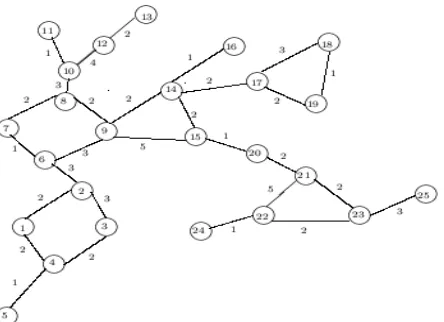
Figure 1: A weighted cactus graph G.
2. Formation of the tree TBC
In this thesis we use a method in which blocks and cutvertices of the graph G are determined using DFS technique and there after form an intermediate graph G′ i.e.,
) , ( = V E
G′ ′ ′ where V′={B1,B2,K,BN} and E′={(Bi,Bj):i=/ j, i, j
N , 1,2,
= K , Bi and Bj are adjacent blocks }.
Now the tree TBC is constructed from G′ as follows:
We discard some suitable edges from G′ in such a way that the resultant graph becomes a tree. The procedure for such reduction is given below:
116
one to find the vertices which are adjacent to them but unmarked. These vertices are taken as children of the corresponding vertices of level one and are placed at level two. These children at level two are marked and if there be any edge between them then they are discarded. This process is continued until all the vertices are marked. Thus the tree TBC =(V′,E′′) where V′={B1,B2,K,BN} and E′′⊂E′ is obtained.
For convenience, we refer the vertices of TBC as nodes. We note that each
node of this tree is a block of the graph G=(V,E). The parent of the node Bi in the
tree TBC will be denoted by Parent(Bi).
3. Different Problems on Cactus Graphs and its Solutions
3.1. Computation of All-Pairs Shortest Paths on Weighted Cactus Graphs Let
G
=
(
V
,
E
)
be a finite, connected, undirected, simple graph of n vertices andm
edges, where V is the set of vertices and E is the set of edges. A path of a graph G is an alternating sequence of distinct vertices and edges which begins and ends with vertices in G. The length of a path is the sum of the weights of the edges in the path. A path from vertex u to v is a shortest path if there is no other path from u to v with lower length. The distanced
( v
u
,
)
between vertices u andv is the length of shortest path between u and v in G.
For any general graph with
n
vertices, solution to the all-pair shortest path problem takes ( 3)n
O time [1]. A lot of work have been done in improving this running time using randomization and probabilistic methods for general as well as special kinds of graphs. Ahuja et.al. [2] have given a faster sequential using Radix
heap and Fibonacci heap for single source shortest path problem in O(m+n logC) time for a network with n vertices and m edges and non-negative integers are costs bounded by C . In [47], Seidal has given an
O
(
M
(
n
)
logn
)
time sequential algorithm for all-pair shortest path problem for an undirected and unweighted arbitrary graph withn
vertices, where M(n) is the time (best value of M(n) is) (n2.376
O necessary to multiply two
n
×
n
matrices of small integers.Alon et. al. [3] have reported a sub-cubic algorithm for computing APSP on directed graph with edge length which require O(Mnγ)time, where
γ
=
(3
+
ω
)/2
,3 <
ω
and M is the largest edge length. Galil and Margalit [16] have improved the dependence of M and have also given an O(Mω+1)/2nωlogn) algorithm for undirected graph. Ravi et. al. [42] have given a sequential algorithm to solve all-pair shortest path (APSP)on interval graph in O(n2)time. Pal and Bhattacharjee in [41]have given an O(n2) time algorithm for finding the distance between all pair of vertices on interval graphs.
117
first compute the distance between
x
and all other vertices in this root. Then we compute the distance fromx
to vertices (other thanx
) of the blocks corresponding to the nodes in level one as follows. Let Bi be a node at level one. Then ei is itsentry point. We compute the distances of every vertex
v
of Bi from ei and adding) , (x ei
d with these distances we obtain the distance and so shortest path of the
vertices of the block Bi from
x
. Similarly, we compute the distance fromx
to other vertices of the blocks at level one. For the nodes, i.e., blocks of the remaining levels, the distance from x can be computed by the same process.In general, let us consider a block Bj at level ‘i’ and assume that the distance
between
x
and all vertices of the blocks at level ‘i−1’ have been calculated. The entry point of Bj is ej. Then d(x,ej) is known as ej belongs to a block at level‘ i−1 ’. We now compute d(ej,v) for all v∈Bj . Then
) , ( ) , ( = ) ,
(x u d x e d e u
d j + j for all u∈Bj. This determine the distance between x and any vertex of any block at level ‘i’.
This procedure takes
O
(n
)
time. Thus to compute all-pair shortest path onweighted cactus graphs, O(n2) time is required.
3.2. Finding a Minimum Dominating Set
Let G=(V,E) be a finite, connected, undirected, simple graph of
n
vertices and m edges, where V is the set of vertices and E is the set of edges. A subset D of V is said to dominate V if every vertex in V−D is adjacent to at least one vertex in D. In this case D is called a dominating set of the graph G. The set D is called a minimum dominating set if the cardinality of D is minimum among all dominating sets of the graph G.The problem of determining a minimum cardinality dominating set has been discussed in [11], and has obvious application in the optimum location of facilities in a network. When restricted to interval graphs, the minimum dominating set problem along with several related variants, becomes polynomial time solvable [6, 7]. Kratsch et al. [32] first presented polynomial time algorithm which takes O(n6) time for domination problems on cocomparability graphs. These algorithms are valid for the cardinality case only. In [43], we get a fast algorithm for domination problems on permutation graphs which takes O(m+n) time.
In this problem we construct a tree TBC using the blocks and cutvertices and applying the Euler Tour we obtain a sequence of nodes. Consider the nodes of that sequence one by one and find the dominating vertices from each node.
118
method and obtain the dominating sets for each node.
This process takes O(n) time for computing minimum dominating set on cactus graph G.
3.3. Finding a Minimum 2-Neighbourhood Covering set
The k-neighbourhood-covering (k-NC) problem is a variant of the domination problem. A vertex x k-dominates another vertex y if
d
(
x
,
y
)
≤
k
. A vertex z is k-NC of an edge (x,y) if d(x,z)≤k and d(y,z)≤k i.e, the vertex z k -dominates bothx
and y. Conversely if d(x,z)≤k and d(y,z)≤k then the edge(
x
,
y
)
is said to be k-neighbourhood covered by the vertex z . A set of vertices C⊆V is a k-NC set if every edge in E is k-NC by some vertices in C . The k-NC numberρ
(
G
,
k
)
of G is the minimum cardinality of all k-NC sets. For k =1, Lehel et al. [35] have presented a linear time algorithm for computing,1) (G
ρ
for an interval graph G. Chang et al. [12] and Hwang et al. [22], have presented linear time algorithms for computingρ
(G,1) for a strongly chordal graph provided that strong elimination ordering is known. Hwang et al. [22] also proved thatNC
k− problem is NP-complete for chordal graphs. Mondal et al. [38] have presented a linear time algorithm for computing 2-NC problem for an interval graph. Also a linear time algorithm for trapezoid graph has presented by Ghosh et al. [17]. In this Problem we construct a tree TBC using blocks and cutvertices of G. Thereafter applying Euler tour on that tree we obtain a sequence of nodes. There are two types of nodes, some are leaf nodes and some are interior nodes. Depending upon the number of vertices of cycles and paths we determine the number of covering vertices from each node as well as the graph G.
Thus the algorithm which finds the 2-neighbourhood covering (2-NC) set of the graph G in
O
(n
)
time. The algorithm also takesO
(n
)
space.3.4. Finding a Maximum Weight 2-Colour Set on Weighted Cactus Graphs The graph colouring problem (GCP) plays a central role in graph theory and it has direct applications in real life problems [5], and is related to many other problems such as timetabling [13, 37], frequency assignment [19] etc. A k-colouring (assignment) of an undirected graph G=(V,E), where V is the set of |V|=n
119
partition of the set of nodes into k sets C1,C2,K,Ck such that no edge exists between two nodes from the same colour class.
The graph colouring problem is NP-complete. Hence, we need to use approximate algorithmic methods to obtain solutions close to the absolute minimum in a reasonable execution time.
The maximum weight k-colourable Subgraph (MWKC) problem is related to the following problem. The input to this problem consist of an integer number k and an undirected graph
G
=
(
V
,
E
)
, where each vertex v has a non-negative weight wv.The goal is to pick a subset V′⊆V, such that there exists a colouring c of G[V′]
with k colours, and among all such subsets, the value v V v
w
∑
′ ∈, wv is maximum.
This problem is NP-hard for general graph even for split graph [20].
The maximum weight k-colouring problem is same as the maximum weight k-independent set (MWKIS) problem. The maximum k-independent set problem on G is to determine k disjoint independent sets S1,S2,K,Sk in G such that
k S S
S1
U
2U
K is maximum. The MWKIS problem is NP-complete for generalgraphs [20].
Many work on colouring problem has been done previously. Local search in large neighbour and iterated local search for GCP are described in [9, 4]. The maximum weight 2-colouring problem or the maximum weight 2-independent set (MW2IS) problem, which is a special case of the (MWKIS) problem, is also NP-complete for general graphs and it applications have been studied in the last decade [23, 24, 36]. In [23], Hsiao et.al. have solved the two-track assignment problem by solving the M2IS problem on circular arc graph. In [36], Lou et. al. have solved the maximum 2-chain problem on a given point set, which is the same as the MW2IS problem on permutation graph.
In this problem we find odd and even blocks and form block-cutvertex graph G′′ using the odd blocks only from the graph G. Next represent G′′ in terms of edge weight(weight of the cutvertex) and vertex weight(weight of the minimum weight vertex) and form a tree TBQ. The method of finding maximum weight 2-coloured set is to delete such a vertex from each odd block so that minimum weight is dicarded. Also in this problem we find minimum weight feedback vertex set. Here we select minimum weight vertices or cutvertex from both even and odd blocks.
Thus the algorithm which finds the 2-coloured set as well as the minimum feedback vertex of the graph G takes
O
(n
)
time. The algorithm also takesO
(n
)
space.3.5. Finding a Maximum Independent Set and Maximum 2-Independent Set Let
G
=
(
V
,
E
)
be a finite, connected, undirected, simple graph of n vertices and120
are adjacent. The maximum independent set (MIS) problem on G is to determine a maximum size independent set on G. The MIS problem is NP-complete for general graphs [18], but it can be solved in polynomial time for many special graphs [28]. The maximum k-independent set (MKIS) problem on G is to determine k disjoint independent sets S1,S2,K,Sk in G such that S1
U
S2U
KSk is maximum. The MKIS problem is NP-complete for general graphs [20].The maximum 2-independent set (M2IS) problem, which is a special case of the MKIS problem, is also NP-complete for general graphs and it applications have been studied in the last decade [23, 36]. In [23], Hsiao et. al. have solved the two-track assignment problem by solving the M2IS problem on circular arc graph. In [36], Lou et. al. have solved the maximum 2-chain problem on a given point set, which is the same as the M2IS problem on permutation graph.
In this problem, MKIS problem is considered on a non-weighted cactus graph for 1
=
k and k=2.
In this problem a tree TBC is constructed using blocks and cutvertices of the
graph G. There after apply Euler Tour to find a sequence of nodes to consider one by one from leaf to root node. For leaf nodes and interior nodes separate techniques are used to find vertices for independent set. For the 2-independent set problem one vertex from each odd cycle is removed so that alternate vertices from cycles and paths of the graph G form 2-independent set.
Thus the algorithms for the above two problems take O(n) time.
3.6. Finding Maximum and Minimum Height Spanning Trees
Let
G
=
(
V
,
E
)
be a finite, connected, undirected, simple graph of n vertices andm
edges, where V is the set of vertices and E is the set of edges. A tree is a connected graph without any circuits. A tree T is said to be a spanning tree of a connected graph G if T is a subgraph of G and T contains all vertices of G. The longest distanceld
( v
u
,
)
and distanced
( v
u
,
)
between two vertices u andv
are the length lp( vu, ) andρ
( vu, ) in G if such paths exist.Note that ld( uu, )=0, ld(u,v)=ld(v,u) and ld(u,v)≤ld(u,w)+ld(w,v). Also
d
( u
u
,
)
=
0
,d
(
u
,
v
)
=
d
(
v
,
u
)
andd
(
u
,
v
)
≤
d
(
u
,
w
)
+
d
(
w
,
v
)
.The elongation of a vertex
u
in a graph G is the longest distance from vertex u to a vertex furthest from u i.e., el(u)=max{ld(u,v):v∈V}. Vertex v is said to be a furthest vertex ofu
if ld(u,v)=el(u).The eccentricity of a vertex u in a graph G is the longest distance from the vertex
u
to a vertex furthest fromu
i.e,e
(
u
)
=
max
{
d
(
u
,
v
)
:
v
∈
V
}
.121
spanning tree whose height is maximum among all spanning trees of a graph. The height of the maximum height spanning tree of a graph G is denoted by
} : ) ( { = )
(G max el u u V
Hmax ∈ .
Suppose v be the vertex for which Hmax(G) is attained and v′ its furthest
vertex, then the longest path i.e., lp( vv, ′) is called as maximum height path )
,
( vv ′ and denoted by MHP( vv, ′).
A minimum height spanning tree is a spanning tree whose height is minimum among all spanning tree of a graph. The height of the minimum height spanning tree of a graph G is denoted by Hmin(G)=min{e(u):u∈V}. The vertex x for which
) ( = ) (G e x
Hmin is called the center of G.
Some related works are discussed here: In [44], a spanning tree of maximal weight and bounded radius is determined from a complete non-oriented graph G=(V,E)
with vertex set V and edge set E with edge weight in ( 2) n
O time,
n
is the total number of vertices in G. In [39], the minimum spanning tree problem is considered for a graph with n vertices and m edges. They introduced randomized search heuristics to find minimum spanning tree in polynomial time with out employing global techniques of greedy algorithms. In [26], the authors find a spanning tree T that minimizes DT =Max(i,j)∈EdT(i, j) where dT(i, j) is the distance between iand j in a graph
G
=
(
V
,
E
)
. The minimum restricted diameter spanning tree problem is to find spanning tree T such that the restricted diameter is minimized. It is solved in O(logn) time. In [27], the minimum diameter spanning tree problem on graphs with non-negative edge lengths is determined which is equivalent for finding shortest paths tree from absolute 1-center problem of the general graph is solvable in) log
( 2
n n mn
O + time [34].
In this Problem, we find the maximum height spanning tree by finding the elongation and the longest path MHP( vu, ). Then deleting one edge from each cycle which is not consider during the calculation of elongation and MHP( vu, ) the maximum height of the spanning tree is obtained whose height is equal to
) , ( vu
MHP . Also we find the minimum height spanning tree by finding the eccentricity and the radius of the graph G and deleting one edge from each cycle so that the radius is the minimum height of the spanning tree.
These algorithms find the maximum height spanning tree and minimum height spanning tree in
O
(n
)
time.3.7. L(2,1)-labelling of cactus graphs
122
-labelling is the difference between the largest and the smallest frequences assigned to the vertices. The L(2,1)-labelling number of a graph G, denoted by
λ
(G), is the least integer k such that G has anL
(2,1)
-labelling of span k.Several results are known for L(2,1)-labelling of graphs, but, to the best of our knowledge no result is known for cactus graph.
The lower bound for
λ
(G) is ∆+1, which is achieved for the star K1,∆. Griggsand Yeh [15] prove that
λ
(G)≤∆2+2∆ for general graph and improve this upperbound to ( )≤∆2+2∆−3 G
λ
when G is 3- connected andλ
(G)≤∆2 when G is diameter 2 (diameter 2 graph is a graph where all nodes have either distance 1 or 2 each other). Jonas [29] improves the upper bound toλ
(G)≤∆2+2∆−4 if ∆≥2, by constructive labelling schemes. Chang and Kuo [10] further decrease the bound to∆ + ∆2
. Further, Kral and Skrekovski [31] improves this bound
λ
(G)≤∆2+∆−1for any graph G. The best known result till date is
λ
(G)≤∆2+∆−2 due to Goncalves [14]To label the vertices of a cactus graph, we first label the vertices of all induced subgraphs of the cactus graph. We obtained the following results.
Let H be a subgraph of G, then obviously
λ
(H)≤λ
(G) [10].If G and H are two graphs and if VG
I
VH =φ
then)} ( ), ( { = )
(G H max
λ
Gλ
Hλ
U
and2 )} ( 1, | {| )} ( 1, | {| = )
(G+H max VH −
λ
G +max VH −λ
H +λ
[10].Also, )} ( ), ( { )
(G H max G H
v
λ
λ
λ
U
≥ , where {v}=VGI
VH.For any star graph K1,∆,
λ
(K1,∆)=∆+1, which is equal ton
, wheren
is the number of vertices.For any cycle Cn of length
n
,λ
(Cn)=4=∆+2 [15].Suppose a graph G contains two cycles Cn and Cm joined by a cutvertex v0, then
1 = 5 = ) ( 0 + ∆ m v n C C
U
λ
.Let a graph G1 contains
n
number of triangles with a common cutvertex. Then2 1
= )
(G1 ∆+ or∆+
λ
according as n is even or odd, where ∆ is the degree of the cutvertex.Let a graph G contains
n
number of cycles of length 3 andm
number of cycles of length 4. If they have a common cutvertex with degree ∆, then1 = ) (G ∆+
λ
.Let G be a graph which contains finite number of cycles of any length and finite number of edges. If v0 be the common cutvertex with degree ∆ then
1 = ) (G ∆+
123
Let G be a graph, contains a cycle of any length and finite number of edges, they have a common cutvertex v0 . If ∆ be the degree of the cutvertex then,
1 = ) (G ∆+
λ
.Let G be a graph contains a cycle of any length and each vertex of the cycle has another cycle of length three. If ∆ is the degree of G then
λ
(G)=∆+3.For any caterpillar graph the value of
λ
lies between ∆+1 and ∆+2.Let G1 and G2 be two cactus graphs. If ∆1+1≤λ(G1)≤∆1+3 and 3
) (
1 2 2
2+ ≤ ≤∆ +
∆ λ G , then, ∆+1≤
λ
(G)≤∆+3, where G=G1 G2 vU
. The time complexity of the proposed algorithm to label a cactus graph using L(2,1)-labelling technique takes O(n) time, where n is the total number of vertices of the cactus graph.3.8. L(0,1)-labelling of cactus graphs
An L(0,1)-labelling of a graph G is an assignment of nonnegative integers to the vertices of G such that the difference between the labels assigned to any two adjacent vertices is at least zero and the difference between the labels assigned to any two vertices which are at distance two is at least one. The span of an L(0,1)-labelling is the maximum label number assigned to any vertex of G. The
L
(0,1)
-labellingnumber of a graph G, denoted by
λ
0,1(G), is the least integer k such that G hasan L(0,1)-labelling of span k. This labelling has an application to a computer code assignment problem. The task is to assign integer control codes to a network of computer stations with distance restrictions.
Some results are available on
L
( k
h
,
)
-labelling problem. Here we discusssome particular cases. When h=0 and k=1 then we get L(0,1)-labelling problem. Several results are known for L(0,1)-labelling of graphs, but, to the best of our knowledge no result is known for cactus graph. In this section, the known result for general graphs and some related graphs of cactus graph are presented.
The upper bound for
λ
0,1(G) of any graph G is ≤∆ −∆ 2 0,1(G)λ
[30], where ∆ is the degree of the graph.Here we label the vertices of a cactus graph by
L
(0,1)
-labelling and haveshown that, ∆−1≤
λ
0,1(G)≤∆ for a cactus graph, where ∆ is the degree of thegraph G. Here we start the labelling by the labelling the subgraphs of the cactus graph. And we obtained some results which are stated below.
If we label a star graph K1,∆ by L(0,1) -labelling, then we get
1 = ) ( 1,
0,1 K ∆ ∆−
λ
. For any cycle Cn of length n,λ
0,1(Cn)=1, when n=4k, where k is a positive integer, andλ
0,1(Cn)=2 for other cases [8].124
cutvertex. If ∆ be the degree of G, then,
λ
0,1(G)=∆, when two cycles are of length3 and ∆−1, for others. This result is true for the graph contains
n
number of cycles of any lengths, joined with a common cutvertex.For the graph which contains finite number of cycles of any length and finite number of edges, then
λ
0,1(G)=∆−1.If the graph is a sun graph with 2n vertices,then we proved that
λ
0,1(S2n)=2=∆−1. Suppose G contains a cycle of anylength and each vertex of the cycle has another cycle of any length, then ∆
≤ ≤
−
∆ 1
λ
0,1(G) .It is proved for caterpillar, lobster and tree the value of
λ
0,1 is ∆−1.Finally, by arranging all the results, we can conclude that for a cactus graph ∆
≤ ≤
−
∆ 1
λ
0,1(G) .3.9. (2,1)-total labelling of the cactus graph
A (2,1)-total labelling of a graph G=(V,E) is an assignment of integers to each vertex and edge such that: (i) any two adjacent vertices of G receive distinct integers, (ii) any two adjacent edges of G receive distinct integers, and (iii) a vertex and its incident edge receive integers that differ by at least 2. The span of a (2,1)-total labelling is the maximum difference between two labels. The minimum span of a (2,1)-total labelling of G is called the (2,1)-total number and denoted by
) ( 2 G t
λ
.Motivated by frequency channel assignment problem Griggs and Yeh [15] introduced the L(2,1) -labelling of graphs. The notation was subsequently generalized to the L(p,q)-labelling problem of graphs. Let p and q be two non-negative integers. An
L
(
p
,
q
)
-labelling of a graph G is a functionc
from its vertex set V(G) to the set {0,1,K,k} such that |c(x)−c(y)|≥p if x and y are adjacent and |c(x)−c(y)|≥q ifx
and y are at distance 2. The L(p,q)-labelling number
λ
p,q(G) of G is the smallest k such that G has an L(p,q)-labelling
c
with max{c(v)|v∈V(G)}=k.This labelling is called (2,1)-total labelling of graphs which introduced by Havet and Yu [21] and generalized to the (d,1)-total labelling, where d≥1 be an integer. A k-(d,1)-total labelling of a graph G is a function
c
from V(G)∪E(G) tothe set
{0,1,
K
,
k
}
such thatc
(
u
)
≠
c
(
v
)
if u and v are adjacent and de c u
c( )− ( )|≥
| if a vertex u is incident to an edge e. The (d,1)-total number,
denoted by
λ
td(G), is the least integer k such that G has a k -(d,1)-total labelling.It is shown in [40] that for any cactus graphs, ∆+1≤
λ
2,1≤∆+3. Now in this125 labelling and it is shown that ∆+1≤
λ
t2≤∆+2[21].
We label the vertices and edges of a cactus graph by (2,1)-total labelling procedure and have shown that, ∆+1≤
λ
t2(G)≤∆+2 for a cactus graph, where ∆ is the degree of the graph G. First we label the vertices of different subgraphs of cactus graph by (2,1)-total labelling.If H is a subgraph of G, then
λ
t2(H)≤λ
t2(G). For any star graph K1,∆,
2 = ) ( 1,
2 K ∆ ∆+ t
λ
. If we label the cycle Cn, then we get, 2( n)=4t C
λ
.When a graph contains two or more cycles joined with a common cutvertex, then the value of
λ
t2 equal to ∆+2, if all cycles are of even lengths and ∆+1, for others.Let G be a graph, contains a cycle of any length and finite number of edges and they have a common cutvertex v0. If ∆ be the degree of the cutvertex, then
2 = ) (
2 G ∆+ t
λ
, if the cycle is of even length and ∆+1, for other cases. For any sun S2n, the value oft 2
λ
is ∆+2. If graph is obtained from S2n by adding an edge to each of the pendent vertex of S2n, thenλ
2t =∆+2for that graph. For a graph which contains a cycle of any length and each vertex of the cycle contain another cycle of any length, then
λ
t2 equal to ∆+2. Thet 2
λ
value of the path, caterpillar graph and lobster are same and equal to ∆+2. One of the important result of(2,1)
-total labelling of cactus graph is described below.Let G1 and G2 be two cactus graphs. If ∆1+1≤
λ
2t(G1)≤∆1+2 and2 )
(
1 2 2 2
2+ ≤ ≤∆ +
∆
λ
t G , then ∆+1≤ 2(G)≤∆+2 tλ
, G is the union of two graphs G1 and G2, they have only one common vertex v and max{∆1,∆2}2 1+∆
∆ ≤ ∆
≤ .
Combining all the results, we conclude that
If ∆ is the degree of a cactus graph G, then ∆+1≤ 2(G)≤∆+2. t
λ
REFERENCES
1. Aho, A., Hopcroft, J. and Ullman, J., The Design and Analysis of Computer Algorithms, Addison-Wesley, Reading, MA, 1974.
2. Ahuja, R. K., Mehlhorn, K., Orlin, J.B., and Tarjan, R. E., Faster algorithms for the shortest path problem, J. ACM, 37 (2) (1990) 213-223.
3. Alon, N., Galil, Z., and Margalit, O., On the exponent of the all-pairs shortest path problem, proc. 32th IEEE FOCS, IEEE (1991) 569-575.
126
Colouring and its Generalizations, Ithaca, New York, USA, 2002.
6. A. A. Bertossi, Total domination in interval graphs, Information Processing Letters, 23(1986) 131-134.
7. K. S. Booth and J. H. Johnson, Dominating sets in chordal graphs, SIAM J. comput. 11(1992) 191-199.
8. A.A. Bertossi and M.A. Bonuccelli, Code assignment for hidden terminal interference avoidance in multihope packet radio networks, IEEE/ACM Transactions on Networking, 3 (4) (1995), 441-449.
9. Chiarandini, M.and St¨utzle, T., An application of iterated local search to graph coloring. In D. S. Johnson, A. Mehrotra, and M. Trick, editors, Proceedings of the Computational Symposium on Graph Coloring and its Generalizations, Ithaca, New York, USA, 2002 pages 112-125.
10. G. J. Chang and David Kuo. The L(2,1)-labelling problem on graphs, SIAM J. Discrete Math.,
9(2)
(1996)
309-316.11. Corneil, E. J and Hedetniemi, S. T., Optimal domination in graphs, IEEE Trans, circuits & System, 22 (1975) 855-857
12. Chang, G. J., Farber M. and Tuza, Z., Algorithmic aspects of neighbourhood numbers, SIAM J. Discrete Math., 6 (1993) 24-29.
13. de Werra, D., An introduction to timetabling. European Journal of Operation Research, 19 (1985) 151-162.
14. D. Goncalves, On the L( p,1)-labelling of graphs, in: EuroCom 2005, Discrete Mathematices and Theoretical Computer Science Proceedings, vol. AE (2005) 81-86.
15. J. R. Griggs and R. K. Yeh, Labelling graphs with a condition at distance two, SIAM Journal on Discrete Math., 5(4) (1992) 586-595.
16. Galil, Z., and Margalit, O., All pair shortest distance for graphs with small integer length edges, Information and Computing 134 (1997) 103-139.
17. Ghosh, P. K. and Pal, M., An Optimal algorithm to solve 2-neighbourhood covering problem on trapezoid graph, Advanced Modeling and Optimization, 9 (1) (2007) 15-36.
18. Garey, M. R. and Johnson, D. S., Computer and Intractability: A Guide to the theory of NP-Completeness (Freeman, San Francisco, CA, 1978).
19. Gamst, A., Some lower bounds for a class of frequency assignment problems. IEEE Transactions of Vehicular Technology, 35(1) (1986) 8-14.
20. Gavril, F. and Yannakakis, M., The maximum k-colorable subgraph problem for chordal graphs, Information Processing Letter, 24 (1987) 133-137.
21. F. Havet and M. L. Yu, ( p,1)-total labelling of graphs, Discrete Math., 308 (2008) 496-513.
22. Hwang, S. F. and Chang, G. J., k-neighbourhood- covering and independence problems for chordal graphs, SIAM J. Discrete Math., 11 (4) (1998) 633-643. 23. Hsiao, J. Y., Tang, C. Y. and Chang, R.S., An efficient algorithm for finding a
maximum weight 2-independent set on interval graphs, Information Processing Letters, 43 (1992), 229-235.
127
problem, Proceedings of 27th Allerton Conf. on Communication, Control and Computing, (1989) 91-300.
25. Hota, M., Pal, M. and Pal, T. K., An efficient algorithm to generate all maximal independent set on trapezoid graphs, Intern. J. Computer Mathematics, 70 (1999), 587-599.
26. Hassin, R. and Levin, A., Minimum restricted diameter spanning tree, Discrete Applied Mathematics, 137 (2004) 343-357.
27. Hassin, R. and Tamir, A., On the minimum diameter spanning tree problems, Information Processing Letters, 53(2) (1995) 109-111, 1995.
28. Johnson, D. S., The NP-completeness Column: An on going guide, J.Algorithms, 6 (1985) 434-451.
29. K. Jonas, Graph Coloring Analogue With a Condition at Distance Two: L(2,1)-labellings and List
λ
-labellings. Ph. D. thesis, University of South Carolina, Columbia, (1993).30. X. T. Jin and R.K. Yeh, Graph distance-dependent labelling related to code assignment in compute networks, Naval Research Logistics, 51 (2004) 159-164. 31. D. Kral and R. Skrekovski, A theorem on channel assignment problem, SIAM J.
Discrete Math., 16(3) (2003) 426-437.
32. D. Kratsch and L. Stewart, Domination on cocomparability graphs, SIAM J. Discrete Math. 6(3) 400-417.
33. Koontz, W. L. G., Economic evaluation of loop feeder relief alternatives, Bell System Technical J., 59 (1980) 277-281.
34. Kariv, O. and Hakimi, S. L., An algorithmic approach to network location Problems, Part 1: The p-center, SIAM J. Appl. Math, 37 (1979) 513-537. 35. Lehel, J. and Tuza, Z., Neighbourhood perfect graphs, Discrete Math., 61
(1986) 93-101.
36. Lou, R. D., Sarrafgadeh and Lee, D. T, An optimal algorithm for the maximum two-chain problem, SIAM J, Discrete Math., 5 (1992) 285-304.
37. Leighton, F. T., A graph coloring algorithm for large scheduling problems. Journal of Research of the National Bureau of Standards, 85 (1979) 489-506. 38. Mondal, S., Pal, M. and Pal, T. K ., An optimal algorithm to solve
2-neighbourhood covering problem on interval graphs, Intern. J. Computer Math. 79 (2) (2002) 189-204.
39. Neumann, F. and Wegener, I., Randomized local search, evolutionary algorithms and the minimum spanning tree problem, Theoretical Computer Science , 2007, Article in Press.
40. N.Khan, A.Pal and M.Pal,
L
(2,1)
-labelling of cactus graphs, communicated, 2010.41. Pal, M., and Bhattacharjee, G. P., An optimal parallel algorithm for all-pairs shortest paths on unweighted interval graphs, Nordic Journal of Computing, 4 (1997) 342-356.
42. Ravi, R., Marathe, M.V., and Pandu, R.,C., An optimal algorithm to solve the all-pairs shortest paths on unweighted interval graphs, Networks, 22 (1992) 21-35.
128
algorithm for finding minimum weight dominating set in permutation graphs, SIAM J. Comput. (1994).
44. Scrdjukov, A.I., On finding a maximum spanning tree of bounded radius, Discrete Applied Mathematics, 114 (2001) 249-253.
45. Saha, A. and Pal, M., Maximum weight k-independent set on permutation graphs, Intern. J. Computer Mathematics, 80 (12) (2003), 1477-1487.
46. Sarrafgadeh, M. and Lee, D. T., A new approach to topological via minimization, IEEE Trans. Computer Aided Design, 8 (1989) 890-900.
47. Seidal, R., On the all pairs shortest path problem, in : Proc. of 24th ACM STOC. ACM Press, (1992) 745-749.
48. Pal, M. and Bhattacharjee, G.P., Sequential and parallel algorithms for computing the center and the diameter of an interval graph, Intern. J. Computer Mathematics, 59(1+2) (1995) 1-13.
49. Pal, M. and Bhattacharjee, G.P., Parallel algorithms for determining edge-packing and efficient edge domination sets in an interval graph, Parallel Algorithms and Applications, 7 (1995) 193-207.
50. Pal, M. and Bhattacharjee, G.P., A sequential algorithm for finding a maximum weight k-independent set on interval graphs, Intern. J. Computer Mathematics, 60 (1996) 205-214.
51. Pal, M. and Bhattacharjee, G.P., A data structure on interval graphs and its applications, Journal of Circuits, System and Computers, 7(3) (1997) 165-175. 52. Saha, A. and Pal, M., An algorithm to find a minimum feedback vertex set of an
interval graph, Advanced Modeling and Optimization, 7(1) (2005) 99--116. 53. Pal, M., Efficient algorithms to compute all articulation points of a permutation
graph, The Korean J. Comput. Appl. Math., 5(1) (1998) 141-152.
54. Bera, D., Pal, M. and Pal, T.K., An optimal parallel algorithm for computing cut vertices and blocks on permutation graphs, Intern. J. Computer Mathematics, 72(4) (1999) 449--462.
55. Hota, M., Pal, M. and Pal, T.K., An efficient algorithm for finding a maximum weight k-independent set on trapezoid graphs, Computational Optimization and Applications, 18 (2001) 49-62.
56. Bera, D., Pal, M. and Pal, T.K., An efficient algorithm for generate all maximal cliques on trapezoid graphs, Intern. J. Computer Mathematics, 79 (10) (2002) 1057--1065.
57. Bera, D., Pal, M. and Pal, T.K., An optimal PRAM algorithm for a spanning tree on trapezoid graphs, J. Applied Mathematics and Computing, 12(1-2) (2003) 21--29.
58. Barman, S.C., Mondal, S. and Pal, M., An efficient algorithm to find next-to-shortest path on trapezoidal graph, Advances in Applied Mathematical Analysis, 2(2) (2007) 97-107.