A Study of Super-Nonlinear
Motion of a Simple Pendulum
Haiduke Sarafian
Two identically charged simple pendulums are allowed to swing in a vertical plane, acted upon by gravity and their mutual electrostatic interactive repulsive forces. We show that the inclusion of the electrostatic interaction makes the movement of the pendulums highly nonlinear. To describe the motion, we quantify the relevant time-dependent kinematic and dynamic quantities. Our analysis also includes an extended study of equal and oppositely charged pendulums. Motivated by the outcomes of the calculation, the author manufactured a real-life replica of the study demonstrating the features of the interactive pendulums; a photograph of the replica is included.
‡
Introduction and Motivation
The motion of a simple pendulum under the pull of gravity has been studied for ages. Most standard science and engineering texts have chapters devoted to the analysis of this problem. However, a thorough literature search reveals that the description of the motion of one such pendulum when perturbed by exotic forces is much less extensive. Among many feasible potential scenarios of perturbing the motion of a pendulum in a controlled and quantifiable manner is to cross-pollinate mechanics with electrostatics using a pair of charged pendulums. Based on the results of this analysis, one may argue that the answers to the “what-if” scenarios of this project would have remained unresolved before the advent of the Mathematica era.
composed of a point-mass m, electric charge q, and string length {. Swing the pendulums symmetrically about the vertical reference line that passes through their common pivot and hold them horizontal. Drop them simultaneously and let them swing under gravity. Then analyze the motion of each pendulum in terms of the parameters m, q, and {.
‡
General Strategy
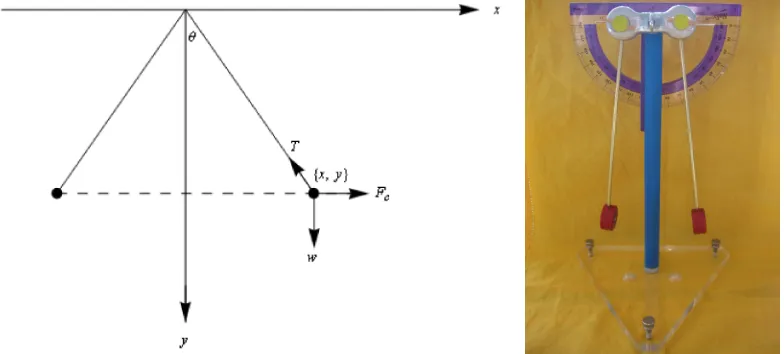
Figure 1 (left) is a sketch of the problem. It shows the pendulums at an instant where each line makes an angle q with the vertical reference position. One strategy of analyzing the problem is to identify the forces acting on each mass. Later we consider the alternate en-ergy approach. Because of the symmetry of the assembly, it suffices to consider just one of the point-like masses, say the one on the right. In addition to mechanical forces such as
weight wØ and tension TØ, we include the electrostatic repulsive force FØc. The imposed
sym-metry confines the orientation of the FØc to the horizontal plane. The analysis in this article
can easily be extended to study more challenging asymmetrical cases. Having identified the forces acting on the mass (the free-body diagram), we can apply Newton’s laws of
mo-tion. Our strategy is to consider the components of Newton’s second law Fnet
Ø
=m aØ along the x and y axes, which gives two separate equations of motion. However, because of the geometrical constraints (i.e., the mass is connected to the pivot with an unstretchable string), the coordinates of the mass xHtL and yHtL are interrelated. This correlation reduces the number of independent equations of motion from two to one. Solving the resulting equation yields the time-dependence of one of the coordinates. The relation between xHtL
and yHtL then gives the other coordinate, thus leading to the entire kinematics and dynam-ics of the problem. The details follow.
Ú Figure 1. (left) The schematic of a pair of charged pendulums with relevant forces: weight (w), ten-sion (T), and the electrostatic repulsion (Fc). (right) Digital photo of the actual replica of the study; details are given at the end of the article in the Conclusion.
‡
Analysis
We begin with Newton’s second law, Fnet
Ø
=m aØ. Because of the planar motion of the mass, we project this equation along the horizontal and vertical directions. This gives
HFnetLx
Ø
=m ax
Ø
and HFnetLy
Ø
=m ay
Ø
. There are advantages to confining the motion of the mass within the first quadrant; we select the downward direction as the positive y axis. These two equations yield
(1)
Fc-Tsinq =m x ..
,
(2)
m g-Tcosq =m y..,
where g is the acceleration of gravity, T is the tension in the line, and Fc= k q 2
4x2 is the
elec-trostatic force, with q being the charge and x the horizontal coordinate of the mass. The ac-celerations of the mass along the x and y axes are x.. and y... According to standard notation,
x° ª d
dt x, and so on. We rearrange these equations and find their ratio:
(3)
Tsinq Tcosq =
Fc-m x ..
m g-m y...
Since, according to Figure 1, tanq = x
y, equation (3) yields
(4)
g-y..= y x
Fc
m -x ..
.
Because the length of the string is constant, we write x2+y2={2, which gives
y= + {2-x2. Differentiating the latter twice with respect to time yields
(5)
-y.. =Bx x..+x°2+Hx x°L2I{2-x2M-1F I{2-x2M -1 2.
Substituting equation (5) into equation (4) and simplifying the result gives
(6) {2x2x..+ x
3{2
{2-x2 x
°2+g x3 {2-x2 - k q 2
4m I{
Define a dimensionless variable x = x{, which gives x° = x{° and x..= x ..
{. Substituting these into equation (6) yields
(7)
x2x..+ x 3
1- x2 x °2
+ax3 1- x2 -bI1- x2M=0,
where the two auxiliary constant parameters are a= g
{ and b=
k q2
4m{3. The parameter a is
purely mechanical while b is influenced by both mechanics and electrostatics. For pendulums charged with equal and opposite charges and those with no charge, the counter equations of equation (7) are, respectively,
(8)
x2x..+ x 3
1- x2 x °2
+ax3 1- x2 +bI1- x2M=0,
(9)
x..+ x
1- x2 x °2
+ax 1- x2 =0.
Equations (7), (8), and (9) are second-order and highly nonlinear differential equations. For a set of chosen practical values of a and b we apply DSolve; Mathematica fails to produce symbolic solutions. We then apply NDSolve along with the relevant initial conditions, namely, xHt=0L={ and x°Ht=0L=0. The solutions are shown in Figure 2.
values=9{Ø1.0, mØ5µ10-3, qØ 2µ10-6, kØ9µ109, gØ9.8=;
8a, b<=:g {,
k q2
4 m{3> ê. values
89.8, 1.8<
eqns@n_D:=
x@tD2x''@tD+ x@tD 3
1- x@tD2 x'@tD
2+ax@tD3 1- x@tD2 +
n bI1- x@tD2M ê. values
soleqns=
TableANDSolveA9eqns@nDã0, xA1µ10-8EãNA1-10-7, 10E,
x'A1µ10-8Eã0=, x@tD,
9t, 1µ10-6, If@nã -1, 3.0, If@nã0, 0.6, 0.55DD=E,
8n, -1, 1<E;
ShowATableAPlotAEvaluate@x@tD ê. soleqnsPmTD,
9t, 1µ10-6, If@mã1, 3.0, 0.6D=, AxesLabelØ8t, "x"<, PlotStyleØ[email protected], [email protected] mD,
If@mã1, Dashing@81, 0.0001<D, [email protected], 0.001<mDD<,
PlotRangeØ8Automatic, 80, 1<<E, 8m, 1, 3<EE
0.0 0.5 1.0 1.5 2.0 2.5 3.0 t
0.2 0.4 0.6 0.8 1.0
x
Ú Figure 2. The solid, long-dashed, and short-dashed curves plot x (i.e., the x coordinate of the mass versus time t) for the repulsive, attractive, and uncharged pendulums, respectively.
Having identified the horizontal coordinate of the pendulum, we evaluate y= + {2-x2 .
Figure 3 displays the pair 8xHtL,yHtL<.
ShowB
PlotB:Evaluate@x@tD ê. soleqnsP1TD,
1-Hx@tD ê. soleqnsP1TL2 >,9t, 1µ10-6, 1.2=,
AxesLabelØ8t, Row@8x@tD, ", ", y@tD<D<,
PlotStyleØ[email protected], GrayLevel@0D<<,
[email protected], [email protected]<<F,
GridLinesØ8Range@0, 1.2, 0.1D, Automatic<F
0.2 0.4 0.6 0.8 1.0 1.2 t
0.2 0.4 0.6 0.8 1.0 xHtL,yHtL
Ú Figure 3. The plot of the coordinates of the pendulum 8xHtL,yHtL< versus t for the repulsive electro-static force. The black and gray curves are xHtL and yHtL, respectively.
The curves in Figure 3 show the features of the coordinates of the pendulum that one would intuitively expect. The black xHtL and gray yHtL curves are completely out of phase. The pendulum begins from its horizontal extreme xHt=0L=1 (the black curve) while its vertical coordinate begins from its zero height extreme yHt=0L=0 (the gray curve). When the pendulum falls, it approaches the vertical reference position. At the instant when it is closest to the other pendulum (the minimum of the black curve), its distance from the vertical position reaches its maximum (the tip of the gray curve).
To confirm that our computation sets the pendulum in a circular path, we apply
ParametricPlot to graph its traversed path.
ParametricPlotB
FlattenB:Evaluate@x@tD ê. soleqnsP1TD,
EvaluateB- 1-Hx@tD ê. soleqnsP1TL2 F>F, 9t, 1µ10-6, 0.8=,
AxesLabelØ8x@mD, y@mD<, PlotRangeØ880, 1<, 80, -1.0<<, GridLinesØAutomatic,
PlotStyleØ[email protected], GrayLevel@0D<, ImageSizeØ250F
0.2 0.4 0.6 0.8 1.0xHmL
-1.0
-0.8
-0.6
-0.4
-0.2
0.0 yHmL
Ú Figure 4. The circular path traversed by the pendulum.
Note that 8xHtL,yHtL< are given numerically, not analytically. Even so, Mathematica lets us evaluate the time derivatives related to kinematic quantities, such as 9x°HtL,x..HtL= and
9y°HtL,y..HtL=. We display these in Figure 5.
8xcoordinate, xspeed, xacc<=
Table@D@x@tD ê. soleqnsP1T, 8t, n<D, 8n, 0, 2<D;
8ycoordinate, yspeed, yacc<=
ColumnB::
PlotB8xcoordinate, 0.5 xspeed, 0.03 xacc<, 8t, 0.001, 3.0<,
PlotStyleØ[email protected], GrayLevel@0D<,
[email protected], GrayLevel@0D, [email protected]<D<,
[email protected], GrayLevel@0D, [email protected]<D<<,
AxesLabelØ:t, RowB:x, ", ", x°, ", ", x"..">F>,
PlotRangeØAll, ImageSizeØ275F,
PlotB8ycoordinate, 0.5 yspeed, 0.08 yacc<, 8t, 0.01, 1.2<,
PlotStyleØ[email protected], GrayLevel@0D<,
[email protected], GrayLevel@0D, [email protected]<D<,
[email protected], GrayLevel@0D, [email protected]<D<<,
AxesLabelØ:t, RowB:y, ", ", y°, ", ", y"..">F>,
PlotRangeØAll, ImageSizeØ275F>>F
:
0.5 1.0 1.5 2.0 2.5 3.0 t
-1.5
-1.0
-0.5
0.5 1.0 1.5 2.0
x,x°,x..
,
0.2 0.4 0.6 0.8 1.0 1.2 t
-1.0
-0.5
0.5 1.0
y,y°,y..
>
Ú Figure 5. In both graphs, the solid, short-dashed, and long-dashed curves correspond to position coordinates and their associated speed and acceleration, respectively. For the sake of clarity, in the left graph x° and x.. are scaled down by a factor of 0.5 and 0.03, respectively. In the right graph, y° and y.. are scaled down by a factor of 0.5 and 0.08, respectively.
Graphically speaking, speed is the slope of the position with respect to time; acceleration is the slope of the speed with respect to time. A close inspection of the depicted plots underlines the graphical interrelationships of the corresponding quantities. The author speculates the “noise” in the y..HtL signal (the long-dashed curve) originated from the second-order numerical derivative procedure. The double-hump of y..HtL would have re-mained undetected had it not been depicted graphically.
Graphically speaking, speed is the slope of the position with respect to time; acceleration is the slope of the speed with respect to time. A close inspection of the depicted plots underlines the graphical interrelationships of the corresponding quantities. The author speculates the “noise” in the y..HtL signal (the long-dashed curve) originated from the second-order numerical derivative procedure. The double-hump of y..HtL would have re-mained undetected had it not been depicted graphically.
‡
An Alternative Approach Using Polar Coordinates
Since each individual mass swings along a circular path, this suggests that the problem might be more efficiently analyzed in polar coordinates.
Earlier, we introduced a dimensionless variable x = x
{. According to Figure 1, x =sinq. We then evaluate x. = q°cosq and x..= q..cosq - q°2sinq. Substituting these into equation (7) and simplifying yields the equation of motion in the polar coordinate system,
(10)
q..+asinq -b cosq
sin2q =0.
Replacing b by -b or 0 results in counterparts of equations (8) and (9), respectively. In the absence of electric charge, b=0 and equation (10) describes the motion of an uncharged simple pendulum. For small angles, sinq>q and the corresponding linearized equation assumes a textbook form: q..+ g
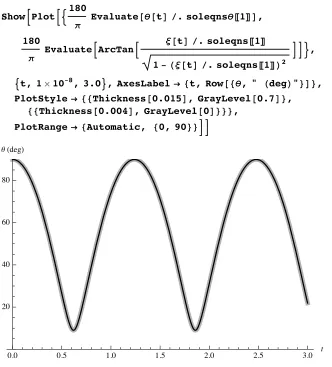
{ q =0. For a charged pendulum b¹≠0 and, irre-spective of the oscillation amplitude, equation (10) describes the motion of a highly super-nonlinear pendulum. As in the previous section, applying DSolve fails to generate symbolic output, so again we use the same set of initial conditions and solve the equation numerically. The solution of the equation of motion in the polar coordinate system should match the Cartesian results. As shown in Figure 6, the agreement is perfect.
eqnsq@n_D:= q''@tD+a Sin@q@tDD+n b Cos@q@tDD Sin@q@tDD2
soleqnsq =
TableBNDSolveB:eqnsq@nDã0, qA1µ10-8Eã p 2,
ShowBPlotB:180
p Evaluate@q@tD ê. soleqnsqP1TD, 180
p EvaluateBArcTanB
x@tD ê. soleqnsP1T
1-Hx@tD ê. soleqnsP1TL2
FF>,
9t, 1µ10-8, 3.0=, AxesLabelØ8t, Row@8q, " HdegL"<D<, PlotStyleØ[email protected], [email protected]<,
[email protected], GrayLevel@0D<<<,
PlotRangeØ8Automatic, 80, 90<<FF
0.0 0.5 1.0 1.5 2.0 2.5 3.0 t
20 40 60 80
qHdegL
Ú Figure 6. The solid and gray curves show the solutions of equations (7) and (10), respectively.
It is instructive to visually quantify the impact of the super-nonlinearity of the motion. In Figure 7, we plot the angular positions of the charged and the uncharged cases. For the un-charged pendulum, for the sake of comparison only, we assume the pendulum oscillates without colliding with the other uncharged pendulum. According to Figure 7, the impact of nonlinearity is twofold: (1) it decreases the oscillation amplitudes; and (2) it slows the oscillations. The second property is shown by a time-delayed phase shift.
ShowBPlotB:180
p Evaluate@q@tD ê. soleqnsqP2TD, 180
p EvaluateBArcTanB
x@tD ê. soleqnsP1T
1-Hx@tD ê. soleqnsP1TL2
FF>,
9t, 1µ10-8, 3.0=, AxesLabelØ8t, Row@8q, " HdegL"<D<, PlotStyleØ[email protected], [email protected]<,
[email protected], GrayLevel@0D<<<,
PlotRangeØ8Automatic, 8-90, 90<<FF
0.5 1.0 1.5 2.0 2.5 3.0 t
-50
50
qHdegL
Ú Figure 7. The black and gray curves represent the angular positions of the charged and un-charged pendulums, respectively.
Knowing the value of qHtL, we evaluate related physical quantities such as the angular speed w ª q°HtL and angular acceleration a ª q..HtL. Here again we emphasize the usefulness of Mathematica: it enables us to differentiate a nonanalytic function. Figure 8 displays the
:qHtL,q°HtL,q..HtL> for b¹≠0.
repulsive=8qcoordinate, qspeed, qacc<=
PlotB:180
p qcoordinate, 180
p 0.4qspeed, 180
p 0.02qacc>,
8t, 0.001, 3.0<,
PlotStyleØ[email protected], GrayLevel@0D<,
[email protected], GrayLevel@0D, [email protected]<D<,
[email protected], GrayLevel@0D, [email protected]<D<<,
AxesLabelØ:t, RowB:q, ", ", q°, ", ", ".."q >F>,
PlotRangeØAllF
0.5 1.0 1.5 2.0 2.5 3.0 t
-50
50
q,q°,q..
Ú Figure 8. The solid, short-dashed, and long-dashed curves correspond to qHtL, q°HtL, and q..HtL for b¹≠0, respectively.
As we mentioned in the previous section, graphically, the angular speed and the angular ac-celeration are to be interpreted as the slope of the angular position with respect to time and the slope of the angular speed with respect to time, respectively. The short-dashed and long-dashed curves depicted in Figure 8 agree with these interpretations.
‡
Phase Diagrams
In the section Analysis, we evaluated a set of kinematic quantities such as qHtL, q°HtL, and
q..HtL to describe the oscillations of the masses. Now, by suppressing the time variable, t, we apply ParametricPlot and graph subsets of these quantities, namely 9q,q°=, :q,q..>,
:q°,q..>, and :q,q°,q..>. We also display the same sets for the uncharged pendulums. These
are all shown in Figure 9.
neutral=8qcoordinate, qspeed, qacc<=
Table@D@q@tD ê. soleqnsqP2T, 8t, n<D, 8n, 0, 2<D;
s12=
ShowA9ParametricPlotAFlatten@8neutralP1T, neutralP2T<D,
9t, 1µ10-8, 3=,
PlotStyleØ[email protected], GrayLevel@0D<E,
ParametricPlotAFlatten@8repulsiveP1T, repulsiveP2T<D,
9t, 1µ10-8, 3=,
PlotStyleØ[email protected], GrayLevel@0D, [email protected]<D<E=, ImageSizeØ250,
AxesLabelØ9q, q°=, AspectRatioØ1E;
s13=
ShowB9ParametricPlotAFlatten@8neutralP1T, neutralP3T<D,
9t, 1µ10-8, 3=,
PlotStyleØ[email protected], GrayLevel@0D<E,
ParametricPlotAFlatten@8repulsiveP1T, repulsiveP3T<D,
9t, 1µ10-8, 3=,
PlotStyleØ[email protected], GrayLevel@0D,
[email protected]<D<E=, ImageSizeØ250, PlotRangeØAll,
AxesLabelØ:q, ".."q >, AspectRatioØ1F;
s23=
ShowB9ParametricPlotAFlatten@8neutralP2T, neutralP3T<D,
9t, 1µ10-8, 3=,
PlotStyleØ[email protected], GrayLevel@0D<E, ParametricPlotA
Flatten@8repulsiveP2T, 0.4 repulsiveP3T<D,
9t, 1µ10-8, 3=,
PlotStyleØ[email protected], GrayLevel@0D,
[email protected]<D<E=, ImageSizeØ250, PlotRangeØAll,
s3D123= ShowB
9ParametricPlot3DA
Flatten@8neutralP1T, neutralP2T, 0.4 neutralP3T<D,
9t, 1µ10-8, 3=,
PlotStyleØ[email protected], GrayLevel@0D<E, ParametricPlot3DA
Flatten@8repulsiveP1T, repulsiveP2T, 0.4 repulsiveP3T<D,
9t, 1µ10-8, 3=,
PlotStyleØ[email protected], GrayLevel@0D,
[email protected]<D<E=, ImageSizeØ250, PlotRangeØAll,
AxesLabelØ:q, q°,".."q >, AspectRatioØ1, BoxRatiosØ1F;
Show@GraphicsGrid@88s12, s13<, 8s23, s3D123<<D, ImageSizeØ350D
-1.5 -1.0 -0.5 0.5 1.0 1.5 q
-4
-2
2 4
q°
-1.5 -1.0 -0.5 0.5 1.0 1.5 q
20 40 60
q..
-4 -2 2 4 q
° -10 -5 5 10 15 20 25 q.. -1 0 1 q -4
-2 0
2 4 q° 0 10 20 q ..
Ú Figure 9. The solid and the dashed curves are the “phase diagrams” of the uncharged and the charged pendulums, respectively.
With the exception of the top-left graph, a traditional phase diagram, the other three dia-grams have seldom, if ever, been discussed in literature. These three graphs are examples demonstrating how Mathematica can be deployed to explore fresh ideas. Their descriptive interpretations are explicit; they are useful graphs assisting our understanding of the physics of the problem. One of the objectives of this article is to demonstrate the impact of the electrostatic interactions of the charged pendulums on the oscillations of the masses. The two scenarios are distinguished from one another by the presence of electric charge. Hence, to avoid the auxiliary potential side effects, such as mechanical collisions of the uncharged masses, we assume the uncharged pendulums pass through each other when they meet. Therefore, the solid curve in the top-left plot of Figure 9 is symmetrically extended to the q <0 domain. The charged and the uncharged pendulums begin from the same horizontal position, q = pê2. Their respective angular position q and the angular speed q° change accordingly. Beyond q = pê2, the super-nonlinearity of the oscillations causes these two curves to diverge. In addition, the abscissa of the dashed curve is the smallest separation angle of the charged pendulums.
With the exception of the top-left graph, a traditional phase diagram, the other three dia-grams have seldom, if ever, been discussed in literature. These three graphs are examples demonstrating how Mathematica can be deployed to explore fresh ideas. Their descriptive interpretations are explicit; they are useful graphs assisting our understanding of the physics of the problem. One of the objectives of this article is to demonstrate the impact of the electrostatic interactions of the charged pendulums on the oscillations of the masses. The two scenarios are distinguished from one another by the presence of electric charge. Hence, to avoid the auxiliary potential side effects, such as mechanical collisions of the uncharged masses, we assume the uncharged pendulums pass through each other when they meet. Therefore, the solid curve in the top-left plot of Figure 9 is symmetrically extended to the q <0 domain. The charged and the uncharged pendulums begin from the same horizontal position, q = pê2. Their respective angular position q and the angular speed q° change accordingly. Beyond q = pê2, the super-nonlinearity of the oscillations causes these two curves to diverge. In addition, the abscissa of the dashed curve is the smallest separation angle of the charged pendulums.
‡
Conclusion
The analysis of the characteristics of perturbed motion of a simple pendulum as presented in this article illustrates the features of nonlinear dynamics and its interface with mechanics and electrostatics. The author’s extensive search of the literature indicated that this analysis is new. The proposed project accomplishes several instructional and research-oriented objectives. The author applied the basic principles of mechanics that are being taught in introductory physics and engineering courses and laid the foundation one step at a time to develop the equations describing the physics of the problem. A quick review of the article will convince the reader that the concept of the project is not hard to grasp; however, its detailed analysis leading to a quantifiable understanding hinges upon the solutions of the challenging equations of motion. Without Mathematica’s powerful and flexible tools, such as NDSolve, as well as its numerical and especially its graphics utilities, the analysis of this project, the super-nonlinear motion of the pendulum, might have remained unnoticed.
cluded in Figure 1 (right).
‡
Reference
[1] S. Thornton and J. Marion, “Classical Dynamics of Particles and Systems,” 5th ed., Belmont, CA: Brooks/Cole, 2003.
H. Sarafian, “A Study of Super-Nonlinear Motion of a Simple Pendulum,” The Mathematica Journal, 2011. dx.doi.org/doi:10.3888/tmj.13–14.
About the Author
Haiduke Sarafian is the John T. and Paige S. Smith Professor of Science at the Pennsylva-nia State University at the York campus of the University College. He received his Ph.D. in theoretical nuclear physics from Michigan State University in 1983. In 1999 he was a Mathematica Visiting Scholar. He is also an independent Mathematica trainer (www.wolfram.com/services/training/sarafian.html).
Haiduke Sarafian
The Pennsylvania State University University College
York, PA 17403 [email protected]