3626
Mitigating Risk In E-Shopping: A Structural
Modeling Approach
Sanjeev K. Sharma, Pooja Chopra
Abstract : The aim of this study is to formulate and test the empirical model to discover the association between various constructs of perceived risk and e-shopping intentions. A structured questionnaire was framed to collect data from four major metropolitan cities of India, namely Delhi, Kolkata, Bengaluru and Mumbai. Data was analyzed using descriptive statistics and structural equation modeling approach. The results revealed that perceived risk had a significant impact on e-shopping intentions. Accordingly, e-tailers are suggested to consider customer’s risk while designing their business strategies. Risk mitigating strategies are recommended for gaining consumers’ confidence and increasing e-shopping intentions to enhance their success in e-tailing business as reluctance to do so might lead to loss in business.
Key Words : Association, Consumers’ Confidence, e-shopping Intentions, e-tailing, Perceived Risk, Risk Mitigating Strategies, Structural Equation Modeling.
—————————— ——————————
1
INTRODUCTION
Technology based innovations have opened new vistas as a paradigm shift is taking place in the retail industry landscape. Retailers are embracing the digital technologies with open arms. Digitally influenced shopping has revamped the way business is done and is fast gearing up to spur the demand for goods sold online. Conventional brick and mortar outlets are orchestrating to become brick and click stores to offer merchandise that cater to ever increasing demands of consumers [1]. Through omnichannel presence, retailers try to harmonize the touch points propelling a seamless buying experience [2]. e-shopping is one of the power house driven by modern technology to heighten the consumer’s interest and participation. It has revolutionized the way shopping is done due to cheaper data rates, increased mobile phone penetration, improved logistics, comfortable payment mechanism and is destined to increase manifold. A platform has been developed for mammoth US $1.9 trillion e-shopping market to blossom in leaps and bounds across the globe [3]. Technology based inventions like digital advertisements, real-time logistic statistics, data driven marketing, integrating info graphics for enriching customer engagement and e-payments would ensure exponential growth in this sector [4]. Internet wave has played a pivotal role in catapulting India’s digital economy to flourish in both length and breadth. The fast-growing e-commerce market is projected to surpass US$24 billion in 2017 to US $84 by 2021 [5]. However, due to strong growth prospects and widespread mushrooming of organized retail in India, it is projected to be the third largest consumer market in the world and touch US$ 1.2 trillion by 2021 [6]. e-tailers are purposely targeting avid smart phone users to broaden their reach effectively by pouring huge investments to boost e-tailing.
Indian e-commerce trade has shown growth trajectory and is forecasted to surpass US to become the second largest e-commerce market across the globe by 2034 [7]. It is projected that by 2026, the basic norm followed by millennials to surf online shopping site would be replaced by round-the-clock accessibility and quick turnaround time [8]. Millenniums, irrespective of their demographics, are adopting internet to keep pace with latest trends and fads through e-shopping [9]. Internet has dramatically revolutionized the horizons of both consumers and marketers in terms of acquiring, processing and disseminating the information [10]. Online sites are no longer solely confined to retail giants like Shoppers Stop, Lifestyle, Landmark, etc. but eventually small retailers too are inching forward to explore the vast reservoir through online medium for increasing their visibility and reach among masses [11]. e-Shopping is a big respite to shopper who don’t like to queue up in long checkout lines, roam around in crowed shopping malls or get struck up in parking lots [12].It is estimated that mighty leap would be possible owing to huge potential for growth in tier-2 and tier-3 cities wherein brick and mortar model in organized retail is still struggling hard to carve their presence. E-marketers are constantly scouting for opportunities and harnessing the digital platform to get connected and increase their visibility amongst millions of people just at the click of button [13]. However, extant literature strongly validates the innumerable benefits of internet usage to explore vital information about the product. However, contrary to it, only handful of browsers actually makes final purchase as they link uncertainty with products bought online [14], due to risk involved in buying online, lack of truth in service provider, stringent return policy. The main aim of this study is to enumerate varied components of risk that function as constraints in embracing e-shopping wholeheartedly by the consumers. This research tries to integrate varied aspects of perceived risk, especially in e-tailing along with discussing the implications of perceived risk on intention of consumers to go for e-shopping.
2.
OBJECTIVES
OF
THE
STUDY
The prime motive of conducting this exploratory research was to gain insights about the nature of consumer’s risk perception linked with e-shopping and the understanding the association between perceived risk and e-shopping intention. Effort has been made to recommend strategies to address the consumers’ concerns for mitigating the various risks linked ————————————————
• Sanjeev K. Sharma is Professor at University Institute of Applied Management Sciences, Panjab University. Chandigarh. India. E-mail: [email protected]
• Pooja Chopra is ICSSR Post-Doctoral Fellow at University Institute of Applied Management Sciences, Panjab University, Chandigarh, India. E-mail: [email protected]
3627 with e-shopping.
3.
THEORETICAL
FRAMEWORK
The concept of risk perception and risk handling behavior was pioneered by [15] pioneered. He also theorized the imperative nature of this construct at every stage of the consumer choice making behavior. Risk is primarily perceived as the amalgamation of uncertainty and the possibility of severe consequences in terms of losses if not evaluated diligently [16]. [17] proposed that perceived risk is the function of subjective ambiguity of the outcomes and varies as per the circumstances that engulf a particular decision. [18] highlighted that risk affects a consumer’s propensity to make a buying decision. This theory has greatly helped in elucidating the information-searching behavior of the consumers [19] thereby helping in reducing the post purchase dissonance through careful evaluation of risk associated with a particular decision. This theory has aided marketers to step into customer’s shoes and view their apprehensions. However, in preview of consumer behavior, perceived risk is taken up as a fine blend of uncertainty plus fear of losses associated while contemplating a particular buying decision [11]. [20] pinpointed that perceived risk in not the sole explanatory factor to be considered while making purchase decisions but at the same time its importance cannot be underestimated also. [21] highlighted that e-shopping is a technology based, non-store form of business to consumer marketing strategy. However, risk-aversive consumers are often less likely go for e-shopping [22]. Thus, this research paper is centered around the strong theoretical base formed by theory of risk perception. Effort has been made to explore the risk factors that act as impediments for e-shopping. Strategic risk assessment helps in decision support mechanism for e-tailers, thereby facilitating focus on influential parameters during the complex buying behavior exhibited by the consumers during purchase process.
4.
REVIEW
OF
LITERATURE
The present study is aimed to decipher the key drivers of online shopping intention by building the foundation on theory of perceived risk. Various renowned researchers [14], [23] noted that various form of shopping risks act as deterrent in pursuing online transactions and thus impacting the selection of shopping channels by the customers.
4.1 Performance Risk
Performance risk is associated with buyer’s evaluative judgment regarding product’s non functionality, often due to the lack of assessing the product attributes prior to purchase [24],[21] especially in case of e-shopping. Even product malfunctioning and non-performance also come under the ambit of performance risk [25]. As e-shopping is a form of non-store-based retailing, it becomes tedious for consumers to accurately evaluate the quality of physical goods [14], [26] as they rely on limited information and visual cues [27] displayed on the website. Consumers encounter higher performance risk in case of e-shopping due to lack of sensory feelings like touch, smell, feel or taste the product [11]. As customer cannot try the product before purchasing [28] leaving the customer in dilemma concerning the functionality of the product. Moreover, e-shoppers often fear the hard time they might face while returning or replacing the product bought online, if it does not come up to their expectations [29] as intended or enjoy the benefits as promised by the e-tailer [30]. On the basis of above
theoretical evidence, the following hypothesis is postulated: H1: Performance Risk has significant influence on Perceived Risk.
4.2 Time Risk
According to [31], managing time risk is one of the crucial factor which consumers evaluate while doing shopping. Time loss as a result of a wrong purchasing decision, time invested in searching, learning product usage or return mechanism [32]. Internet offers a plethora of facts and figures regarding varied products and services. No doubt that internet greatly reduced the cost of acquisition of information but consumers spend time on navigating the e-shopping websites, spend time in learning the usage of e-retailing portals, wait for the anticipated response along with cognitive effort put forward in search process [33],[34]. Many a times, consumers spend time in learning how to make payments online or rectifying erroneous transactions. Sometimes web site download speed is too slow and checkouts take more than expected time, influences online shopping adoption [35]. Despite the fact e-shopping is quicker than brick and mortar e-shopping, still customer has to wait for the product to be delivered at home [36],[37],[38] and sometimes face inconvenience when e-tailers do not honor the scheduled time frame. Based on these assertions, the following hypothesis is put forward:
H2: Time Risk has significant influence on Perceived Risk.
4.3 Privacy Risk
The privacy of personal and confidential information is fundamental essence in all business activities be it off line [39] or on-online context [40]. It has gauged significant importance for consumers, businesses, and regulators [41] since its inception. Security breaches in form of unauthorized collection, usage of confidential and sensitive information of consumers’ often lead to identity theft [42]. The toll of privacy loss is way beyond the benefits of e-shopping in terms of information fabrication resulting in offsetting ease, time, or monetary savings for the consumers [43]. Privacy invasions may pose serious impediment for consumer to go for e-shopping [44]. Therefore, the following hypothesis was asserted:
H3: Privacy Risk has significant influence on Perceived Risk.
4.4 Financial Risk
3628 4.5 Psychological Risk
Psychological risk inhibits the consumers to do e-shopping. Psychological risk is linked to the user’s personality trait which is linked to his decision-making trait to either take or avoid risks [51]. It is also referred to as inability to choose amongst vast array of merchandise. Consumers often avoid online shops due to fear of losing self-image and self-concept [26],[30]. It is also related with customer’s perception regarding implication of making a wrong purchase that could leads to social stigma and fear of social disapproval as their referent groups would disown then for made a bad decision. Findings of [52] also advocates that there is an inverse association between psychological risk and consumers’ attitude towards for e-shopping. This led to the following hypothesis:
H5: Psychological risk has significant influence on Perceived Risk.
4.6 e-shopping Intentions
[53] describes e-shopping intentions as a complex decision-making process where consumer’s readiness is clubbed with willingness to complete the final transaction after requisite browsing and comparing through various online and offline portals [54]. In-depth understanding of consumer’s choice for shopping online can be gauged by behavioral, cognitive, attitudinal and psychological pattern [55], [56]. However, e-shopping sites offer a wide array of services to consumers that facilitates in taking prudent decisions resulting in intention to use e-shopping as a medium for purchase [14]. Previous research studies highlight that consumers’ risk perception had an adverse impact on consumer’ se-shopping intentions [57], [58]. Higher the magnitude of risk, higher the discouragement towards e-shopping intentions. Therefore, the following hypothesis was posit:
H6: Perceived Risk has significant influence on e-shopping intentions.
Based on the review of relevant literature, a conceptual model for this study is proposed
FIGURE 1:CONCEPTUAL FRAMEWORK
5
SAMPLE
In order to test the study model and attain the desired objective of the study, a quantitative study using an online questionnaire in the Indian context was drafted. The aim of the
online survey was to circumvent any unbiased data and target the right set of responses from internet users who had done e-shopping in the last one year. The data was collected through non-random sampling from four major cities namely Delhi, Mumbai, Bengaluru and Kolkata. The survey questionnaire was distributed through widely used social networking sites like Facebook and Snapchat ; Mobile messenger applications such as WhatsApp and Viber. These survey mediums were carefully chosen as they have their widespread, acceptability and popularity in Indian sub-continent. The variables taken for this current study were measured using validated scales used in previous studies. Three items of time risk were adapted from [41]; six items of privacy risk were adapted from [59],[41]; four items of financial risk were adapted from [60],[61]; four items of financial risk were adopted from[62],[63]; three items of psychological risk was were developed from [64] and three items of e-shopping intentions were adapted form [65] The detailed description of items for our current study and the supporting literature of each construct is illustrated in Table 2. The respondents were asked to evaluate the items of each construct on the basis of their past e-shopping experience by selecting the rating on Likert scale, ranging from ―1‖ being ―strongly disagree‖ to ―5‖ being ―strongly agree‖. However, for the ease of collecting quality data, the questionnaire was drafted using english language which is the lingual franker [66]. The initial version of the questionnaire was refined after pilot testing on 97 respondents. This refinement facilitated in polishing and refinement of our research instrument as well as in establishment of content, face and internal validity [67]
6 EMPIRICAL ANALYSIS
To solicit the demographic characteristics of the sample structure, descriptive statistics were used. The reliability and validity of the construct was assessed using Cronbach alpha, composite reliability and convergent reliability. SEM was applied using AMOS 5.0 software package to test the hypothesis and evaluate the causal association between variables as well as to accredit the structural research model.
6.1 Demographic Analysis
To minimize data errors along with avoiding unbiased response, [68] suggested that the requisite sample size between 300 to 500 is considered appropriate for research purposes. Thereby a total of 430 self-administered questionnaires were sent out to consumers through social networking sites. After editing all returned questionnaires, about 373 questionnaires were found utilizable for analysis, showing a yield rate of 74.6%. The descriptive statistics of the sample reflects more composition of females (54.6%) than males (45.4%). Majority of the respondents (76%) are in 20-35 years of age category. About (67%) of the sample earned were from monthly income of Rs.5,00,001 – Rs10,00,000 per annum. Almost all respondents have achieved at least university degree/Bachelor degree. About 54% of the respondents are salaried. On the whole, the sample is skewed towards the young educated females and economically sound strata of the population. The results are consistent with the e- shopping consumer profile in India.
6.2 Goodness of Measure
3629 assessed for reliability using Cronbach alpha. Cronbach alpha
helps to determine the degree to which the observed variables measure the true and error free results in a multi item scale. [67] in his research suggested that the value of each construct if more than 0.6 is considered reliable. However apart from this, Table 4 shows the Cronbach alpha ranges from depicting a good internal consistency thereby providing a strong base for further analysis. The next step is evaluating the goodness of measure through factor analysis using varimax rotation in order to determine the structure between the set of observed variables [40]. Kaiser-Meyer-Olkin measure of sample adequacy was found to be 0.879 Thus, the value suggests that it was deemed appropriate to apply factor analysis. [68], suggested the factor loading greater than 0.5 is considered significant for an item to be included in its respective construct. Total of five factors with Eigen values > 1 were retained. However, these 5 factors resulted in 76.8% variance. Communalities ranged from 0.50 and 0.75.
Table 1: Dimensions, its variables and Factor Loading
Dimension and Its Variables Factor Loadings Privacy Risk
PrcvyR1
I am concerned that the e-shopping sites providers collect too much personal information from me.
.841
PrcvyR2
I am concerned the e-shopping sites will share my personal information with other entities without my authorization.
.839
PrvcyR3
I am concerned that unauthorized persons (i.e. hackers) have access to my personal information during e-shopping.
.835
PrcvyR4 I am concerned about the privacy of my personal information during e-shopping transactions. .832
PrcvyR5
I am concerned that the e-shopping sites will sell my personal information to others without my permission.
.811
PrcvyR6 I am concerned that the e-shopping sites collect too much personal information from me. .804
Performance Risk
PerfR1 e-shopping might not perform well and create problems with my finances. .786
PerfR2
The security systems built in the e-shopping sites are not strong enough to protect my financial accounts.
.771
PerfR3 The probability that something may go wrong with the performance of e-shopping is high. .749
PerfR4
It would be risky for me to sign up and use e-shopping services and experience expected level of service performance.
.707
Financial Risk
FR1 The chances of losing money if I buy through e-shopping are high. .749
FR2 Using e-shopping will subjects my account to
potential fraud. .744
FR3 My signing up for and using e- e-shopping sites may lead to a financial loss for me. .726
FR4 Using e-shopping may subject my account to financial risk. .678
Time Risk
TR1
Using e-shopping will lead to inconvenience because I will waste a lot of time fixing payment errors.
.833
TR2 Considering the investment of my time involved,
it would be risky for me to switch to e-shopping. .778
TR3 The possible time loss from having to set up and
learn how to use e-shopping is high. .760
Psychological Risk
PsyR1 e-shopping will not fit well with my self-image. .889 PsyR2 Doing e-shopping would cause unnecessary .821
tension e.g. Concerns about errors in operations
PsyR3 A breakdown in e-shopping systems could cause
unwanted anxiety and confusion. .812
e- shopping Purchase Intentions
PI1 I intend to buy through internet. .926
PI2 It is probable that I would buy through internet in
the future. .924
PI3 I would buy through internet in the future. .901
Kaiser-Meyer-Olkin Measure of Sampling Adequacy. .879 Bartlett's Test of Sphericity Approx. Chi-Square 2432.037
df 253
Sig. .000
6.3 Evaluation of the Research Model
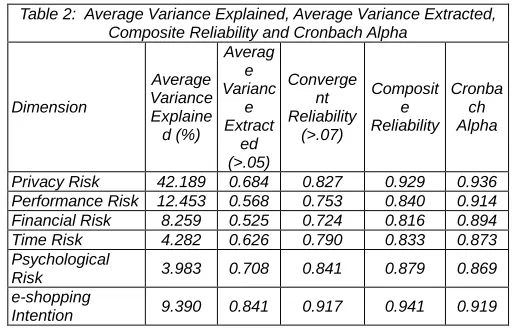
The empirical data was analyzed using Amos 21.0.A standard two step approach was followed. Firstly, confirmatory factor analysis (CFA) was run to assess the measurement model for all the latent constructs followed by Structural Equation Model (SEM) to test the hypothesis. Initially CFA was performed on each construct to check for factor loadings < 0.7 [68]. The overall CFA analysis (Table 1) shows that all factor loadings > 0.5 (ranging from 0.707 to 0.926) signifying adequate individual item reliability [70]. Moreover, they were statistically significant (P < 0.05), providing strong grounds for convergent validity as well [71], [72]. However, the research instrument also exhibits discriminant validity as (AVE/(Corr2) is greater than or equal to unity in correlations with other constructs [73]. The overall goodness fit for the research model using covariance structure analysis was shown in Table 2.
Table 2: Average Variance Explained, Average Variance Extracted, Composite Reliability and Cronbach Alpha
Dimension
Average Variance Explaine
d (%)
Averag e Varianc
e Extract
ed (>.05)
Converge nt Reliability
(>.07)
Composit e Reliability
Cronba ch Alpha
Privacy Risk 42.189 0.684 0.827 0.929 0.936 Performance Risk 12.453 0.568 0.753 0.840 0.914 Financial Risk 8.259 0.525 0.724 0.816 0.894 Time Risk 4.282 0.626 0.790 0.833 0.873 Psychological
Risk 3.983 0.708 0.841 0.879 0.869 e-shopping
Intention 9.390 0.841 0.917 0.941 0.919
6.4 Analysis of Structural Model
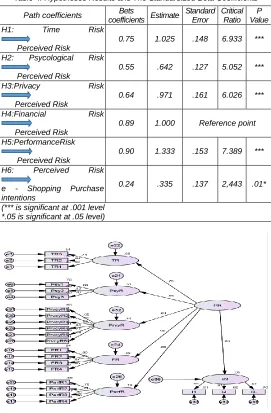
After assessing the proposed research model with satisfactory results from CFA with the help of correlation matrix, second step i.e. Structure Equation Model {SEM} was developed (Figure2) to elucidate the hypothesis and statistically validate the proposed structure. On the basis of fit indices of our hypothesized model (Table 3), a reasonable fit between the structural model and the underlying observed variables has been observed [74]. The results support H1, H2, H3, H4, H5 proving that perceived risk is explained by Time Risk (TR), Psychological Risk (PsyR); Privacy Risk (PrcvyR), Financial Risk (FR) and Performance Risk (PerfR). The results of the analysis portray that all the five estimates were significant. Table4 illustrates the hypothesis results and the standardized beta coefficients.
3630 Name of Indices Measurement Model Structural Model
Chi Square/Degree of Freedom 310.563 / 160 = 1.941
434.464/ 224 = 1.940 GFI (Goodness of Fit) 0.81 0.78
AGFI 0.75 0.72
NFI 0.86 0.83
RFI (Relative Fit Index) 0.83 0.81 IFI (Incremental Fit Index) 0.93 0.91
TLI 0.91 0.90
CFI (Comparative Fit Index) 0.92 0.91 RMSEA (Root Mean Square
Error Approximation) 0.08 0.79
*Chi square/degree of freedom lower than 3 indicate a good fit of model **RMR, GFI, AGFI, NFI, RFI, IFI, CFI, TLI closer to 1 indicate a good fit of model.
***The lower the RMSEA values, the better the model is considered
Table 4: Hypotheses Results and The Standardized Beta Coefficients
Path coefficients Bets
coefficients Estimate
Standard Error
Critical Ratio
P Value H1: Time Risk
Perceived Risk
0.75 1.025 .148 6.933 ***
H2: Psycological Risk
Perceived Risk
0.55 .642 .127 5.052 ***
H3:Privacy Risk
Perceived Risk
0.64 .971 .161 6.026 ***
H4:Financial Risk
Perceived Risk
0.89 1.000 Reference point
H5:PerformanceRisk
Perceived Risk
0.90 1.333 .153 7.389 ***
H6: Perceived Risk
e - Shopping Purchase intentions
0.24 .335 .137 2,443 .01*
(*** is significant at .001 level *.05 is significant at .05 level)
Figure:2 Structure Equation Model
7.
DISCUSSION
This paper provides a number of theoretical and practical implications along with useful insights about multifaceted dimension of perceived risk especially in context of e-shopping.
3631 factors and situations that foster risk and impede growth of
e-shopping[87]. Careful selection of appropriate digital tools and campaign tactics will result in engaging, attracting, converting, and delighting their audience. Distrust amongst the consumers can further be curtailed by building strong legal system clubbed with robust cyber-crime management system. In addition, government is expected to provide a robust infrastructure for online retailers along with conducive business environment to the shoppers.
8.
LIMITATIONS
Our research is subject to few limitations that refrains the generality of the results. Firstly, due to the constraints of time and funding, the sample was drawn from the four metropolitan cities only, barring the understanding of e-shopping intentions in tier-1 and tier-2 cities. However, in future, cross county analysis could also be done that would disclose risk perception of the e-shoppers across different countries. Elements like trust, subjective norms etc. can also be incorporated in future research for increasing the research horizon.
9
REFERENCES
[1] Deloitte and Indian Chambers of Commerce Report, ―Disruptions in Retail through Digital Transformation Reimagining the Store of the Future‖ Nov 2017. Available at: https://www2.deloitte.com/content/ dam/Deloitte/in/Documents/CIP/in-cip-disruptions-in-retail-oexp. pdf
[2] M. Jocevski, N. Arvidsson, G. Miragliotta, A. Ghezzi, and R. Mangiaracina, ―Transitions Towards Omni-channel Retailing Strategies: A Business Model Perspective‖. International Journal of Retail & Distribution Management, vol. 47, no. 2, pp. 78-93, 2019.
[3] KPMG Report,‖ The Truth About Online Consumers - 2017 Global Online Consumer Report‖ (2107). Available at: https://home.kpmg/xx /en/home/insights/2017/01/the-truth-about-online-consumers.html)
[4] B. Ives, B. Palese, and J.A. Rodriguez, ―Enhancing Customer Service Through the Internet of Things and Digital Data Streams,‖ MIS Quarterly Executive, vol.15, no.4, pp-1-2, 2016.
[5] Retail association of India and Deloitte, ―Indian e-commerce market to touch USD 84 billion in 2021: Report‖ (Feb. 2019). Available at //economictimes.indiatimes.com/articleshow/6816923 9.
cms?from=mdr&utm_source=contentofinterest&utm_ medium=text&utm_campaign=cppst\.
[6] Deloitte Report 2019, ―Retail Outlook Transition Ahead‖. Available at: https://www2.deloitte.com /content/dam/ Deloitte / us / Documents / consumer-business/us-cb-retail-outlook-transition-ahead-2019.pdf. [7] IBEF, 2019. Available at: https : // www.ibef.org / industry/
ecommerce. aspx)
[8] C. Hatch Ecommerce, Marketing Be in the Know: Ecommerce Statistics you Should Know. Available At: https://www.disruptiveadvertising.com/ppc/
ecommerce/2018-ecommerce-statistics/
[9] KPMG Report 2018, ―India Trends 2018-Trends-Shaping-Digital-India-Internet,‖ Available at: https://assets.kpmg/content/ dam /kpmg /in/pdf
/2018/05/ India Trends2018-Trends-shaping-Digital-India-Internet. pdf.
[10]H.Y. Ha, ―The Effect of Consumer Risk Perception on Pre-purchase Information in Online Auction: Brand, Word-of-Mouth, and Customized Information,‖ Journal of Computer-Mediated Communication, vol. 8, no.1, pp. JCMC813, October 2002.
[11]R. Thakur and M. Srivastava, ―A Study on the Impact of Consumer Risk Perception and Innovativeness on Online Shopping in India,‖ International Journal of Retail & Distribution Management, vol.43, no. 2, pp.148-166, 2015.
[12]T. Do, T. Nguyen, and C. Nguyen, ―Online Shopping in an Emerging Market,‖ Journal of Economics and Management Sciences, vol.2, no. 2, pp.1,2019. [13]R. D. Frost and J, Strauss. E-marketing. Routledge,
2016
[14]D.J. Kim, D. L Ferrin, and H.R. Rao,‖ An Investigation of Consumer Online Trust and Purchase, Re-purchase Intentions,‖ International Conference on Information Systems. Seattle, WA,2003.
[15]R.A. Bauer, ―Consumer Behaviour as Risk Taking. In Dynamic Marketing for a Changing World, ed. R.S. Hancock, 389–98. Chicago: American Marketing Association, 1960.
[16]S.M. Cunningham, ―The Major Dimensions of Perceived Risk. In Risk Taking and Information Handling in Consumer Behavior‖, ed. D.F. Cox, 82– 108. Boston, MA: Harvard University Press, 1967. [17]D.F. Cox and S.U. Rich,‖ Perceived Risk and
Consumer Decision-Making—The Case of Telephone Shopping,‖ Journal of Marketing Research, vol. 1, no. 4, pp. 32-39, 1964.
[18]J. Choi and K.H. Lee, ―Risk Perception and e-shopping: A Cross-Cultural Study,‖ Journal of Fashion Marketing and Management: An International Journal, vol. 7, no.1, pp. 49-64, 2003.
[19]N. Arora and M. Rahul, ―The Role of Perceived Risk in Influencing Online Shopping Attitude among Women in India,‖ International Journal of Public Sector Performance Management, vol. 4, no. 1, pp.98-113. 2018.
[20]J.R. Lumpkin and M.G. Dunn, ―Perceived Risk as a factor in Store Choice: An Examination of Inherent Versus Handled Risk,‖ Journal of Applied Business Research, vol.6, no.2, pp.104-118,1990.
[21]S.J. Tan, ―Strategies for Reducing Consumers’ Risk Aversion in Internet Shopping,‖ Journal of Consumer Marketing, vol.16, no.2, pp.163-180, 1999.
[22]S. Khalid, T. Jalees, and K. Malik, ―Extending the TAM Model for Understanding Antecedents to Online Purchase Intentions,‖ Market Forces, vol. 13, no. 1, pp. 90-112, 2018.
[23]Q. Yang, C. Pang, L. Liu, D. C. Yen, and J.M. Tarn, ―Exploring Consumer Perceived Risk and Trust for Online Payments: An Empirical Study in China’s Younger Generation,‖ Computers in Human Behaviour, vol. 50, pp. 9-24, 2015
3632 [24]D. Grewal, J. Gotlieb, and H. Marmorstein, ―The
Moderating Effects of Message Framing and Source Credibility on the Price-Perceived Risk Relationship,‖ Journal of Consumer Research, vol. 21, pp.145–153, 1994.
[25] Asawa and V. Kumar, ―A study on Perceived Risk & Trust in Online Shopping: A Comparative Study Among Various Demographic Groups of Pune Shoppers. Paper presented at the International Conference Strategies for Business Intelligence, 2016.
[26]H. H. Chang, and S.W. Chen, ―The Impact of Online Store Environment Cues on Purchase Intention‖, Online Information Review, vol. 32 no. 6, pp. 818-41, 2008.
[27]H. Tan, X. Lv, X. Liu, and D. Gursoy, ―Evaluation Nudge: Effect of Evaluation Mode of Online Customer Reviews on Consumers’ Preferences,‖ Tourism Management, vol 65, pp. 29-40, 2018,
[28]F. Aldhmour and I. Sarayrah, ―An Investigation of Factors Influencing Consumers' Intention to Use Online Shopping: An Empirical Study in South of Jordan,‖ The Journal of Internet Banking and Commerce, vol.21, no.2, 2016.
[29]P. Kumar and R. Bajaj, ―Dimensions of Perceived Risk Among Students of High Educational Institutes Towards Online Shopping in Punjab,‖ Journal of Internet Banking and Commerce, vol.21, no. S5, pp.1-21, 2016.
[30]H. R. Marriott, and M.D. Williams, ―Exploring Consumers Perceived Risk and Trust for Mobile Shopping: A Theoretical Framework and Empirical Study,‖ Journal of Retailing and Consumer Services, vol. 42, pp. 133-146, 2018.
[31]M. Zendehdel, L. H. Paim, and N. Delafrooz, ―The Moderating Effect of Culture on the Construct Factor of Perceived Risk Towards Online Shopping Behaviour,‖ Cogent Business & Management, vol. 3, no.1, pp.1-13, 2016.
[32]O. Kunze, and M. Li-Wei, ―Consumer Adoption of Online Music Services‖, International Journal of Retail & Distribution Management, vol. 35, no. 11, pp. 862-877, 2007.
[33]C.S.K.Dogbe,M. Zakari, and A.G. Pesse-Kuma, ― Perceived Online Risk, Consumer Trust and m-shopping Behaviour,‖ e-Journal of Social & Behavioral Research in Business, vol. 10, no.1, pp.10-23, 2019.
[34]T. Tanadi, B. Samadi, and B. Gharleghi, ―The Impact of Perceived Risks and Perceived Benefits to Improve Online Intention Among Generation-Y in Malaysia,‖ Asian Social Science, vol.11, no.26, pp.226-237, 2015.
[35]S. Dai Forsythe and W.S. Kwon, ―The Impact of Online Shopping Experience on Risk Perceptions and Online Purchase Intentions: Does Product Category Matter‖, Journal of Electronic Commerce Research, vol.15 no.1, pp. 13-24, 2014.
[36]S. Forsythe, C. Liu, D. Shannon, and L.C. Gardner, ―Development of a Scale to Measure the Perceived Benefits and Risks of Online Shopping‖, Journal of Interactive Marketing, vol.20, no.2, pp. 55-75, 2006.
[37]V.N. Marcelo, L. Michel, and O.R. Marie, ―How to Reduce Perceived Risk When Buying Online: The Interactions Between Intangibility, Product Knowledge, Brand Familiarity, Privacy and Security Concerns‖, Journal of Retailing and Consumer Services, vol. 21 no.4, pp. 619-629, 2014.
[38]M.G. Jones, ―Privacy: A Significant Marketing Issue for the 1990s,‖ Journal of Public Policy & Marketing, vol. 10, no. 1, pp. 133-148, 1991.
[39]A.D. Miyazaki, and A. Fernandez, ―Consumer Perceptions of Privacy and Security Risks for Online Shopping‖, Journal of Consumer Affairs, vol. 35, Summer, pp. 27-44, 2001.
[40]M.S. Featherman and P.A. Pavlou, ―Predicting E-services Adoption: A perceived Risk Facets Perspective,‖ International Journal of Human– Computer Studies, vol. 59, pp. 451–74, 2003.
[41]L. Van Zoonen, ―Privacy Concerns in Smart Cities,‖ Government Information Quarterly, vol. 33, no. 3, pp. 472-480, 2016.
[42]E.S.T Wang, ―Effects of Brand Awareness and Social Norms on User-Perceived Cyber Privacy Risk,‖ International Journal of Electronic Commerce, vol. 23, no.2, pp. 272-293, 2019.
[43]S. Cardoso and L.F. Martinez, ―Online Payments Strategy: How Third-party Internet Seals of Approval and Payment Provider Reputation Influence the Millennials’ Online Transactions,‖ Electronic Commerce Research, vol.19, no. 1, pp.189-209, 2019.
[44]N. Lim, ―Consumer’s Perceived Risk: Sources versus Consequences,‖ Electronic Commerce Research and Applications, vol.2, no.3, pp.216-228,2003.
[45]J.J. Ma’ruf, P.L. Honeyta, and S. Chan, ―The Effect of Perceived Risk on Repurchase Intention of Online Shopping Mediated by Customer Satisfaction in Indonesia,‖ KnE Social Sciences, pp. 340-348, 2019. [46]J.K. Sharma and D. Kurien, ―Perceived Risk in
E-Commerce: A Demographic Perspective. NMIMS Management Review, vol. 34, no. 1, pp. 31-57, 2017. [47]R. Priya, A.V. Gandhi, and A. Shaikh, ―Mobile
Banking Adoption in an Emerging Economy: An Empirical Analysis of Young Indian Consumers,‖ Benchmarking: An International Journal, vol.25, no. 2, pp.743-762, 2018.
[48]S.M.Forsythe and B. Shi,‖ Consumer Patronage and Risk Perceptions in Internet Shopping,‖ Journal of Business Research, vol.56, no.11, pp.867-875, 2003. [49]H.Y.Ha and H.Y.Son, ―Investigating Temporal Effects
of Risk Perceptions and Satisfaction on Customer Loyalty,‖ Managing Service Quality, vol.24, no.3, pp 252-273, 2014.
[50]M.P. Conchar, G.M. Zinkhan, C. Peters, and S. Olavarrieta, ―An Integrated Framework for the Conceptualization of Consumers’ Perceived-Risk Processing,‖ Journal of the Academy of Marketing Science, vol. 32, no. 4, pp.418-436, 2004.
3633 [52]J. Juniwati, ―Influence of Perceived Usefulness, Ease
of Use, Risk on Attitude and Intention to Shop Online,‖ European Journal of Business and Management, vol. 6, no. 27, pp. 218-228, 2014.
[53]Y. Perea, T. Monsuwé, T. Dellaert, and K. De Ruyter, ―What Drives Consumers to Shop Online? A literature Review,‖ International Journal of Service Industry Management, vol. 15 no. 1, pp. 102-12, 2004.
[54]H.-F. Lin, ―Predicting Consumer Intentions to Shop Online: An Empirical Test of Competing Theories,‖ Electronic Commerce Research and Applications, vol. 6 no. 4, pp. 433-442, 2008.
[55]Akhlaq and E. Ahmed, ―Digital Commerce in Emerging Economics: Factors Associated with Online Shopping Intentions Pakistan, International Journal of Emerging Markets, vol. 10, no. 4, pp. 634-647, 2015. [56]M. Almousa, ―Perceived Risk in Apparel Online
Shopping: A Multi-Dimensional Perspective,‖ Canada Social Science, vol.7 no.2, pp. 23-21, 2011.
[57]L. Zhang, W. Tan, W, Y. Xu, and G. Tan, ―Dimensions of consumers' perceived risk and their influences on online consumers' purchasing behavior,‖ Communications in Information Science and Management Engineering, vol. 2, no. 7, pp. 8-14, 2012.
[58]S.L. Jarvenpaa and P.A. Todd, Is there a Future for Retailing on the Internet. In Electronic Marketing and the Consumer, ed. R.A. Peterson, 139–54. Thousand Oaks, CA: Sage Publication, 1997.
[59]C.A. Ingene and M. A. Hughes, Risk Management by Consumers. In Research in Consumer Behavior, ed. J. Sheth, vol.1, pp.103–58, Greenwich: JAI Press Inc. 1985.
[60]R.N. Stone and K. Gronhaug, ―Perceived Risk: Further Considerations for Marketing Discipline,‖ European Journal of Marketing, vol. 27, no. 3, pp.39– 50, 1993.
[61]J. Jacoby and B. Kaplan, ―The Components of Perceived Risk,‖ In Proceedings of the Third Annual Conference of the Association for Consumer Research, ed. M. Venkatesan, pp.382–93. Ann Arbor, MI: Association for Consumer Research, 1972. [62]J.P. Peter and M.J. Ryan, ―An Investigation of
Perceived Risk at the Brand Level,‖ Journal of Marketing Research, vol.13, no. 2, pp.184–8, 1976. [63]R. Bhukya and S. Singh, ―The Effect of Perceived
Risk Dimensions on Purchase Intention: An Empirical Evidence from Indian Private Labels Market,‖ American Journal of Business, vol. 30, no.4, pp. 218-230, 2015.
[64]Y. Chen and S. Barnes, ―Initial Trust and Online Buyer Behavior,‖ Industrial Management & Data Systems, vol. 107, no.1, pp. 21-36, 2007.
[65]C. Fife-Schaw, Questionnaire Design. Research Methods in Psychology, Sage, 1995.
[66]J. Nunnally, Psychometric Theory (2nd ed.). New York: McGraw-Hill. 1978.
[67]J.F. Hair, R.E. Anderson, R.L. Tatham, and W.C. Black, ―Multivariate Data Analysis,‖5th ed. Englewood Cliffs, NJ: Prentice Hall, 1998.
[68]U. Sekaran and R. Bougie, ―Research Methods for Business.‖ John Willey & Sons Ltd., 2009.
[69]R.P. Bagozzi and T. Yi, ―On the Evaluation of Structural Equation Models,‖ Journal of the Academy of Marketing Science, vol. 16, pp.74–94, 1998. [70]J. Anderson and D. Gerbing, ―Structural Equation
Modeling in Practice: A Review and Recommended Two-Step Approach,‖ Psychological Bulletin, vol. 103, pp 411– 423, 1998.
[71]K.A. Bollen, Structural Equations with Latent Variables, John Wiley & Sons, Inc, New York, NY., 1989.
[72]C. Fornell and D.F. Larcker, ―Evaluating Structural Equation Models with Unobservable Variables and Measurement Error,‖ Journal of Marketing Research, vol. 18, pp.39–50, 1981.
[73]P. M. Bentler, ―Comparative Fit Indexes in Structural Models,‖ Psychological Bulletin, vol.107, no. 2, pp. 238, 1990.
[74]J.F. Engel, R.D. Blackwell, and P.W. Miniard, ―Consumer Behavior,‖ The Dryden Press, Chicago, IL., 1986.
[75]B.H. Sheppard, J. Hartwick, and P. R. Warshaw, ―The Theory Of Reasoned Action: A Meta-Analysis of Past Research with Recommendations for Modifications and Future Research,‖ Journal of Consumer Research, vol. 15, no. 3, pp. 325-343, 1988.
[76]V. Venkatesh, M. G. Morris, G. B. Davis, and F. D. Davis, ―User Acceptance of Information Technology: Toward A Unified View,‖ MIS Quarterly, vol. 27, no. 3, pp. 425-478, 2003.
[77]B. W. Keating, A. M. Quazi, and A. Kriz, ―Financial Risk and Its Impact on New Purchasing Behavior in the Online Retail Setting,‖ Electronic Markets, vol. 19, no.4, pp. 237-250, 2009.
[78]U.J. Yu, H.H. Lee, and M.L. Damhorst, ―Exploring Multidimensions Of Product Performance Risk in The Online Apparel Shopping Context: Visual, Tactile, And Trial Risks,‖ Clothing and Textiles Research Journal, vol. 30, no. 4, pp. 251-266, 2012.
[79]L. Zhang, W. Tan, Y. Xu, and G. Tan, ―Dimensions of Consumers’ Perceived Risk and their Influences on Online Consumers’ Purchasing Behaviour,‖ Communications in Information Science and Management Engineering, vol. 2, no.7, pp.8-14, 2012. [80]C. W. Yoo, G. L. Sanders, and J. Moon, ―Exploring the Effect Of wom participation on Loyalty in E-Commerce,‖ Decision Support Systems, vol. 55, no.3, pp. 669-678, 2013.
[81]S.K. Sharma and P. Chopra, ―Predicting Factors Influencing Online Purchase Behavior among Indian Youth,‖ International Journal of Recent Technology and Engineering, vol.8, no.2S6, pp.765-772, 2019. [82]M.S. Featherman, A.D. Miyazaki, and D.E. Sportt,
―Reducing Online Privacy Risk to Facilitate E-Service Adoption: The Influence of Perceived Ease of Use and Corporate Credibility,‖ Journal of Services Marketing, vol.24, no. 3, pp.219-229, 2010.
[83]Y. Pan and G.M. Zinkhan, ―Exploring the Impact of Online Privacy Disclosures on Consumer Trust,‖ Journal of Retailing, vol. 82, no. 4, pp. 331-338, 2006.
3634 Economy,‖ Information, Communication &
Society, vol. 21, no. 10, pp. 1472-1492, 2018.
[85]M.Y. Chen and C. I. Teng, ―A Comprehensive Model of The Effects of Online Store Image on Purchase Intention in an E-Commerce Environment,‖ Electronic Commerce Research, vol.13, no. 1, pp. 1-23, 2013. [86]S.K. Sharma and P. Chopra, ―Behavioral Intentions to