A Router-aided P2P Tra
ffi
c Localization Method with
Bandwidth Limitation
Hiep Hoang-Van1, Takumi Miyoshi1, Olivier Fourmaux2
1Graduate School of Engineering and Science, Shibaura Institute of Technology, Saitama-shi, Saitama, 337-8570 Japan 2Laboratoire d’Informatique de Paris 6, UPMC Sorbonne Universit´es, Paris, 75005 France
Abstract
Recently, peer-to-peer (P2P) systems generate a large amount of unwanted cross-domain traffic on the Internet due to a lack of knowledge about physical network topology. The unwanted cross-domain traffic is especially costly for the internet service providers (ISPs). To reduce the cross-ISP/AS (autonomous system) traffic, the existing approaches introduce network-aware strategies in which a lot of modifications of P2P systems are required. In par-ticular, each P2P application must be modified to integrate with a locality-aware procedure and/or a communication protocol to obtain the topological information from an “oracle” server. In this paper, we propose two schemes for localizing P2P traffic without any peer reaction: (1) fixed-length bandwidth limitation scheme, (2) hierarchical bandwidth limitation scheme. By intentionally limiting the bandwidth of each connection path between peers based on geographical location of the peers destinations, the traffic can be localized with single level for the first scheme and with multiple levels for the second scheme. Compared to the existing locality-enhancing approaches, our two schemes require neither dedicated servers, nor cooperation between ISPs and users, nor any modification of existing P2P application software. Therefore, we believe that all types of P2P applications can easily utilize our proposals. Experiments on P2P streaming applications indicate that the fixed-length bandwidth limitation scheme successfully realizes P2P traffic localization. Moreover, the hierarchical bandwidth limitation scheme not only significantly reduces the cross AS/ISP traffic but also maintains a good performance of P2P applications.
c
2014 Published by VNU Journal of Science.
Manuscript communication: received 14 December 2013, revised 04 April 2014, accepted 23 April 2014 Corresponding author: Hiep Hoang-Van, [email protected]
Keywords: P2P, router-aided approach, hierarchical traffic localization, bandwidth limitation.
1. Introduction
Most P2P applications form overlay networks for communicating among peers on top of
the physical network topology. However, the
overlay is often established based on the resource availability and thus largely independent from the
underlay network topology. As a result, P2P
systems generate a large quantity of unwanted traffic on the Internet. In particular, the unwanted cross-domain traffic proves to be costly for the ISPs. Therefore, the ISPs or network operators often manage P2P traffic by bandwidth throttling
or limiting and/or even blocking P2P systems
in their network. On the contrary, the P2P
systems try to hide them from the network by changing their design, e.g., applying dynamic
port strategies. It is more challenging to
recognize the P2P traffic. In addition, blocking P2P systems would reduce sharply the demand of end users, who are familiar with using some P2P applications. Therefore, the fundamental concern of the ISPs is essentially not to block, but to turn the inter-ISP/AS traffic into the intra-domain traffic.
reduce the cross-domain traffic as well as
conserve the bandwidth. However, almost all
of existing approaches solve the problem on the application layer. Therefore, P2P systems must be essentially equipped with a locality-aware neighbor peer-selection mechanism to realize traffic localization. This can be achieved by one of the following ways:
• The enhancement of trackers to efficiently gather information of the underlay network. On the P2P applications side, they need to implement an appropriate protocol to communicate with the enhanced trackers.
• The modification of the P2P application
software to upgrade from the current
neighbor peer-selection mechanisms to
locality-aware ones. P2P applications
currently only employ random and/or
round-trip time (RTT)-based strategies.
• Or both of the above.
Several modifications of P2P systems are inevitable as described above.
In this paper, we introduce a novel approach to localize P2P traffic without any modification
of existing application software. We exploit
an important feature of P2P applications that a querying peer will select a candidate peer
as its neighbor if the candidate peer is
likely to provide better performance. For
instance, the querying peer tends to select a candidate peer who has shorter RTT than others. Since the network performance is affected by various factors, communication with peers across network domains is sometimes better
than the local communication. This leads to
the increasing of cross-domain traffic. Based on this observation, if we intentionally degrade the quality of connection paths of inter-domain traffic, the querying peer will tend to remove the inter-domain connections and select the local
connections instead. In other words, we can
turn the inter-domain traffic into the intra-domain traffic. To achieve this, we propose to limit the bandwidth of the inter-domain traffic at network routers.
We propose two different schemes: (1)
fixed-length bandwidth limitation scheme; (2) hierarchical bandwidth limitation scheme. In the first scheme, the bandwidth of all the connections to foreign peers will be limited with a constant
value. This scheme is to demonstrate the
effectiveness of the bandwidth limitation in traffic
localization problem. In the second scheme,
the traffic can be hierarchically localized with multiple levels of localization such as inside an
AS, inside an ISP, or inside a country. The
value of limited bandwidth should depend on both the physical distance between peers and the number of peers exist in the same area as the querying peer. The first factor ensures that lower bandwidth will be allocated for farther peers than closer ones, whereas the second factor realizes our hierarchical feature of localization. In particular, we first try to localize the traffic at AS level if some candidate peers exist inside the same AS. The scope of localization will change from AS level to ISP level if no candidate peer exists in the same AS. Similarly, the scope can be change from ISP level to country level if no candidate peer exists in the same ISP. Since our proposal is deployed on network routers outside of the peers, it is completely independent of P2P applications, and thus requires neither dedicated servers, nor collaboration between ISPs and P2P users, nor modification of application software. Therefore, we believe that the proposal can be easily applied to all P2P applications.
According to the report of Cisco System Inc. [1], the P2P traffic is on the declining in percentage of overall Internet traffic due to the degradation of P2P file sharing systems. However, it is still increasing rapidly in volume with tremendous growing of video streaming services. Therefore, our goal is to realize traffic localization focusing on P2PTV services, which are predicted to be much more popular in the very near future. Thus, currently, P2PTV applications such as PPTV (update version of PPLive) [2], PPStream [3], SopCast [4], Zattoo [5] have become increasingly popular.
The remainder of this paper is organized as
related work. Section III describes two proposed schemes for hierarchical traffic localization, and Section IV then shows the implementation two schemes. The experimental results are presented in Section V. Finally, Section VI provides conclusions and our future work.
2. Relate Work
Overprovisioning and deep packet inspection
(DPI)-based bandwidth management are
considered the best conventional strategies
to deal with P2P traffic [6]. However, they do not solve the fundamental concern of the ISPs, which is to reduce the cross-domain traffic, i.e., to localize the traffic. The idea of P2P traffic localization was first introduced by Karagiannis et al., who studied BitTorrent trace logs and found that about 50 percent of the files could be downloaded from peers at the same ISP if a locality-aware peer-selection mechanism is used [7]. Plissonneau et al. analyzed eDonkey file sharing system, and reported that most of traffic traversed nationwide or international networks, in which 40 percent of the traffic could be localized [8].
Aggarwal et al. proposed a solution to build up a relationship between ISPs and P2P users [9]. ISPs maintain an “oracle service to help P2P users in selecting their neighboring peers. When a P2P user sends a list of possible neighbors to the oracle, the oracle ranks them according to certain criteria such as high bandwidth links, low latency, or closer peers, etc. Although the oracle can be introduced into the network independently of the P2P applications, this scheme requires a dedicated server as well as a good cooperation
between ISPs and P2P users. In addition,
each P2P application must be modified to add an additional protocol to communicate with the oracle.
P4P is a famous framework that follows
the oracle idea [10]. In P4P, ISPs maintain
iTrackers in their own networks. The iTrackers provide the p-distance interface, representing the logical distance between each pair of
PIDs (aggregation nodes). There are several
dimensions for the ISPs to control the p-distance information. From the P2P applications side, they can obtain the necessary information for neighbor peer selection directly from the iTrackers or indirectly via appTrackers. Recently, the Internet Engineering Task Force (IETF) has standardized a query/respond protocol for the oracle-based system in rfc5693 and rfc6708, known as Application Layer Traffic Optimization (ALTO) [11, 12]. Although the ALTO approaches improve not only the network efficiency but also the P2P application performance, they require dedicated servers and several modifications of existing P2P application software.
Choffnes and Bustamante proved that the
presence of the oracle service provided by ISPs is redundant because the content distributed networks (CDNs) have already gathered all necessary information [13]. By using CDNs DNS redirection, they hypothesized that two peers are recognized as close to each other if they are
sent to a similar set of replica servers. This
idea is implemented as a java plugin to Azureus BitTorrent client, named “Ono. This method requires support from many subscribing peers installing Ono plugin distributed worldwide. Furthermore, to apply this method for other types of P2P applications such as P2P streaming applications (P2PTV), we believe that some modifications must be required.
Bindal et al. proposed biased
depends on the P2P applications.
Lee and Nakao introduced another approach for traffic localization applying to BitTorrent,
called Netpherd, which is independent of
the application [15, 16]. Netpherd tries to
enable local peers to communicate with each other by adding artificial delay into the inter-domain traffic. The idea of degrading network performance of inter-domain connections is
similar to our work. However, they focused
on BitTorrent, a file sharing system. Moreover, Netpherd only localizes the traffic at AS level because the delay length is constant for all inter-AS traffic, e.g., 100 ms.
We previously proposed P2P-DISTO for P2P traffic localization without any peer reaction, which focused on P2PTV services [17]. P2P-DISTO inserts an additional delay into each P2P packet according to geographical locations of peers. The delay length is constant for all foreign
traffic, e.g., 500 ms or 1000 ms, P2P-DISTO
thus only realizes traffic localization at country level. In this study, we proceed to follow P2P-DISTO but use a different mechanism. We limit the bandwidth of the inter-domain traffic instead of inserting delay. In addition, we extend the scope of localization from single level to multiple levels.
3. Proposed Schemes
The majority of existing P2PTV applications
implements RTT-based peer-selection
mechanism. In particular, P2PTV tends to
eliminate worse connections based on the RTT measured before starting downloads the data pieces. From this observation, we proposed two different schemes based on bandwidth limitation. Since the RTT information can be changed by limiting the bandwidth, we influence the neighbor peer selection of P2PTV indirectly.
Given a querying peer, peer0, and a list
of N candidate peers, {peer1,peer2, ...,peerN}, let (as0,isp0,cc0) be denoted AS number, ISP
name, and country code of the querying peer, respectively, and (asi,ispi,cci) be denoted AS
number, ISP name, and country code of peeri,
Inside country
For traffic outside of country Limit the bandwidth For traffic inside country
Do nothing
Fig. 1: The concept of fixed-length bandwidth limitation scheme.
respectively. Our goal is to compute the limited bandwidth assigned to a candidate peeri.
3.1. Fixed-length bandwidth limitation scheme
To prove the effectiveness of bandwidth
limitation method in P2P traffic localization
problem, we first introduce fixed-length
bandwidth limitation scheme. Figure 1 presents
the concept of the scheme. The scheme does
nothing with local traffic inside the same country as the querying peer, but limits the bandwidth of traffic that goes out to or come in from different
countries. In other words, the bandwidth of
connections with foreign peers is forced to be much lower than that of local ones. Since the protocol of P2PTV systems are derived from
BitTorrent protocol, the P2PTV application
focuses on the speed of downloading the video data pieces from the other peers, i.e., it wants to download the data pieces as fast as possible. This will cause the bandwidth-hungry of P2P applications [6]. Therefore, a connection with higher bandwidth will be certainly better than the one with lower bandwidth. The querying peer will then prefer to connect with local neighboring peers that have better performance.
The limited bandwidth assigned to a candidate peeriis computed by [kbps], as follows:
bwi = f(cci,cc0)=
(
+∞, if cci=cc0
C, if cci,cc0 (1)
whereCis a constant number.
3.2. Hierarchical bandwidth limitation scheme
multiple levels. Figure 2 illustrates the concept of the scheme at AS level. We do nothing with local traffic within the same AS, but limit the bandwidth of the traffic that goes out to or comes in from different ASes, ISPs, or countries. For farther peers, a lower bandwidth is allocated than closer ones. The scope of localization will change from AS level to ISP level if no candidate peer exists in the same AS. Similarly, the scope can be change from ISP level to country level if no candidate peer exists in the same ISP. The behavior of the ISP level is as follows: do nothing with the traffic within the same ISP, but limit the bandwidth of the traffic that goes out to or comes in from different ISPs, or countries. Similarly, for the country level, we do nothing with the traffic inside the country but limit the bandwidth of oversea traffic.
To realize the concept of hierarchical traffic
localization mentioned above, we propose
a logical distance representing a distance
adjustment factor between a candidate peer and the querying peer. The logical distance between peeri and peer0is defined as follows:
Di = f1(asi,as0)e−
1
n1+ε + f2(isp
i,isp0)e−
1 n2+ε
+f3(ispi,cci,isp0,cc0)e−
1
n3+ε, (2)
where n1, n2, and n3 are the total numbers of peers in the same AS, ISP, and country as peer0, respectively,εis a very tiny constant to ensure the denominators of all fractions never come to zero, and
f1(asi,as0) =
(
0, if asi=as0
θ1, if asi,as0 (3)
f2(ispi,isp0) =
(
0, if ispi =isp0 θ2, if ispi ,isp0
(4)
f3(ispi,cci,isp0,cc0)
=
0, if ispi=isp0
d(peeri,peer0), if ispi,isp0, and cci=cc0
θ3+d(peeri,peer0),if cci ,cc0
(5)
Since ISPs, including ASes, have to manage their own networks, the information that the
Same ISP
Same country Same AS
Limit the bandwidth with
much lower value
Do nothing
Limit the bandwidth with
lower value
Limit the bandwidth
Fig. 2: The concept of hierarchical bandwidth limitation scheme.
querying peer connects to a peer exists inside or outside the AS/ISP is the most important. Hence, θ1 and θ2 are coefficients to differentiate the
inter-AS/ISP traffic from the intra-AS/ISP traffic, respectively. To ensure that the logical distances of farther peers will be higher than those of closer ones, we define d(peeri,peer0) as the physical distance between peeri and peer0. Even though some nearby physical locations might be far apart from each other in terms of network connectivity in some specific cases, the physical distance is still a reasonable estimation in most cases. The coefficient,θ3, is to make the distances of foreign
peers sufficient higher than those of local ones. Since lower bandwidth should be allocated for farther peers, we compute the limited bandwidth for a candidate peerias follows:
bwi =
1 Di+ε1 ×
B[kbps], (6)
where B is a bandwidth unit, and ε1 is a tiny
constant to ensure the denominator of the fraction never come to zero.
From above equations, we define the allocated bandwidth of a candidate peer based on not only the physical distance but also the number of peers
in the same area as the querying peer. This
enables our method to realize the hierarchy of localization. For instance, if no candidate peer exists in the same AS or ISP, i.e., n1 = n2 = 0, the first two exponential functions in Eq. (2) will come to zero, the logical distance will therefore depend only on the country information. In the worst case, if no candidate peer exists in the
same country as the querying peer, n1 = n2 =
n3 = 0, the logical distance will be almost zero; the limited bandwidth for every peer in Eq. (6)
limitation is applied. Therefore, the proposed method will not affect the performance of P2P applications even when no local peer exists.
3.3. Proposed router architecture
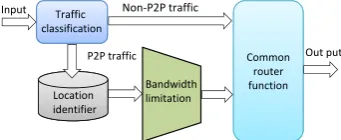
We introduce a router-aided approach to implement the proposed method independently
of the P2P applications. Figure 3 shows the
architecture of the router. Three modules,
a traffic classification, location identifier, and bandwidth limitation module, are added into
a common router. The traffic classification
module classifies the input traffic into P2P or
non-P2P traffic. To avoid the degradation of
service quality of non-P2P applications, the
non-P2P traffic goes directly to the common
router function. In the location identifier, the destination IP address of every P2P packet is
first examined. The identifier then resolves
the location information of the destination by using several IP-to-geographic-location database services. According to this geographical location information, the bandwidth limitation module limits the bandwidth of connection between the querying peer and the candidate peer. The limited bandwidth for each peer is computed according to Eqs. (1) and (6) for the fixed-length bandwidth limitation scheme and the hierarchical bandwidth limitation scheme, respectively.
4. Implementation of Proposed Method
To implement the proposed router, we set up a PC-based router equipped with an Intel Core i7-2600 3.4 GHz CPU, 12 GB of DDR3 memory, and two 1 Gbps Ethernet network interface cards, operated under Linux Ubuntu 12.04 with 3.2.0-29 generic kernel.
In the research field of traffic classification, there are many methods that have been previous proposed. For instance, to block P2P traffic, ISPs usually apply deep packet inspection and session-based classification with 5 tuples (IP addresses, port numbers, and protocol type). In our previous work, by deep packet inspection (DPI), we could easily check the peer list format of some P2P streaming applications because the
Traffic classification
Location identifier
Bandwidth limitation
Common router function Input
Out put P2P traffic
Non-P2P traffic
Fig. 3: The proposed router architecture.
peer list packets were sent in clear text without
any encoding [18]. The peer list packets sent
by trackers contain a list of IP addresses of the candidate peers. Therefore, we can distinguish the P2P traffic from non-P2P traffic by assuming that all traffic transferred with the peers exist in the peer list is recognized as P2P traffic. Recently, an accurate behavioral classification method for P2P traffic, named “Abacus, has been proposed [19]. Abacus relies only on the count of packets and bytes that peers exchange during
small fixed-length time windows. Therefore,
we can utilize such type of the above methods to implement the traffic classification module in our router. In this study, however, we assume that such the classification module is beyond the scope of this paper, and thus focus only on the implementation of bandwidth limitation module to verify the effectiveness of traffic localization in a real network.
The bandwidth limitation module is
implemented in the following main steps:
• Packet monitoring: we uselibpcap, a
well-known packet capture library to examine all packets going through the router [20]. The headers of the packets are checked to read their source and destination IP addresses.
• IP-to-location mapping: the locations of
the obtained IP addresses are then resolved
by using IP-to-location services. In this
implementation, we use GeoLite database services including GeoLite ASN, GeoLite City, and GeoLite Country, which are free IP geolocation databases created by MaxMind [21].
• Computation of logical distance and limited
Algorithm 1: Fixed-length bandwidth limitation scheme: configure the bandwidth for a new peer
Data: New packet, List of connected IP addresses: ip list
Result: Configure the bandwidth for a candidate peer
whileTRUEdo
1
packet⇐read new packet(); 2
ip⇐check header(packet);
3
ifip is newthen 4
country code⇐resolve location(ip); 5
ifcountry code !=“JP”then 6
bw⇐C; 7
call dummynet for limiting bandwith(ip,bw);
else 8
do nothing;
9
ip list⇐add new ip to list(ip); 10
else 11
do nothing;
12
each candidate peer is computed according to Eqs. (1) and (6) for the fixed-length
bandwidth limitation scheme and the
hierarchical bandwidth limitation scheme, respectively.
• Bandwidth limitation: for the bandwidth
limitation, we utilize dummynet, a flexible
tool for simulating packet filtering,
bandwidth management, packet delay,
and packet loss [22]. By changing the
configuration of ipfw firewall, a user
interface provided by dummynet, we can
easily setup many pipes between sender and receiver peers. All the packets will be
carried in these pipes. Each pipe can be
configured with a different bandwidth value computed from the previous step.
For the fixed-length bandwidth limitation
scheme, the value of limited bandwidth
is constant for all foreign peers. The
implementation is therefore very simple as
shown in algorithm 1. For every new peer
coming to the router, we simply check its country information and apply bandwidth limitation if the peer does not come from Japan.
For the hierarchical bandwidth limitation scheme, the value of limited bandwidth depends
Algorithm 2: Hierarchical bandwidth limitation scheme: configure the bandwidth for a new peer
Data: New packet
Result: Configure the bandwidth for a new peer
whileTRUEdo
1
packet⇐read new packet(); 2
ip⇐check header(packet);
3
ifip is newthen 4
(as,isp,country,lat,lon)⇐ 5
resolve location(ip);
(n1,n2,n3)⇐ 6
update no peers same area(as,isp,
country);
logical distance⇐ 7
compute logical distance(as,isp,
country,lat,lon,n1,n2,n3);
bw⇐ 8
compute limited bandwidth(logical distance);
call dummynet for limiting bandwith(ip,bw);
9
ip list⇐add new ip to list(ip); 10
else 11
do nothing;
12
on the numbers of peers in the same area as the querying peer. Since these numbers may be changed when a new peer comes, the limited bandwidth values of all connected peers should be recomputed again many times. This causes
high CPU usage and affects other processes
of the router. In addition, the bandwidth
limitation strategy might not be effective in traffic localization if we change the configuration too
often. Therefore, our solution is to compute
the limited bandwidth for the new peer in real time and to recalculate the limited bandwidth for all the connected peers every one minute. This avoids the high load on the router’s CPU, and ensures a regular updating of the bandwidth value for all connections. Algorithms 2 and 3 show pseudo codes of bandwidth configuration for a new peer and bandwidth reconfiguration for a list of connected peers, respectively.
5. Experimental results
5.1. Experimental setup
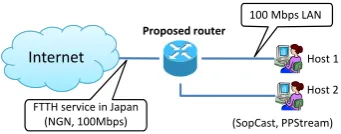
4. We performed experiments using P2PTV
applications because of their popularity. Two
types of P2PTV applications are selected: SopCast version 3.5.0 for performing video live streaming and PPStream version 3.2.0.1067 for
performing video-on-demand service. These
applications did not consider peer locality, as reported in several previous studies [23, 24]. We set each application to run one-by-one on the
measurement hosts. On SopCast we played a
live Chinese channel, CCTV-2. On PPStream, an on-demand drama popular in Japan was selected
for the experiment. The average bit rates
of these two video streams were 800kbps and
705kbps, respectively. Since we also wanted
to check the possibility that a measurement host downloading the video data from the very neighbor peer inside our laboratory, we always run each P2P application on two measurement hosts simultaneously, as host 1 and host 2. All the experiments were conducted in September 2013 in our laboratory. The location information of measurement hosts in detail is as follows:
• AS number: AS4713
• ISP: NTT Communications Corp.
• Country: Japan.
We utilize Wireshark [25], a well-known
packet sniffer application, to generate statistical information of traffic on the measurement hosts. Since we skip the implementation of the traffic classification module, only P2P applications and Wireshark are permitted to run on the measurement hosts.
The values of the parameters in the equations were chosen as follows: C = 800,ε= 0.1,θ1 =
θ2 =1000,θ3=2000,ε1=1, andB=2000000.
Internet
Proposed router
(SopCast, PPStream) FTTH service in Japan
(NGN, 100Mbps)
100 Mbps LAN
Host 1
Host 2
Fig. 4: The proposed router architecture.
Algorithm 3: Hierarchical bandwidth limitation scheme: reconfigure the bandwidth for all connected peers
Data: List of connected IP addresses:ip list
Result: Reconfigure the bandwidth for all connected
peers
call dummynet for flushing all old configurations();
1
(n1,n2,n3)⇐count no peers same area(ip list);
2
fori=1to count(ip list)do
3
(as,isp,country,lat,lon)⇐ 4
get location(ip list[i]);
logical distance⇐ 5
compute logical distance(as,isp,
country,lat,lon,n1,n2,n3);
bw⇐ 6
compute limited bandwidth(logical distance);
call dummynet for limiting bandwith(ip,bw);
7
5.2. Criteria of Evaluation
To evaluate the effectiveness of the proposed method, we compared the results of three
different schemes: (1) random and/or
RTT-based peer-selection scheme, i.e., the original
behavior of P2PTV applications; (2)
fixed-length bandwidth limitation scheme, in which the bandwidth of all the connections to foreign peers were limited at 800kbps maximum. We chose 800kbps as a limited value because 800kbps is approximate equal to the average bit rates of the two video streams of SopCast and PPStream. This is to avoid sharply degradation of the performance of P2P application in the worst
situation: very few Japanese peers exist for
localizing the traffic inside Japan; (3) hierarchical bandwidth limitation scheme.
We compared the results of three schemes from two viewpoints: the traffic locality and the QoS. From the former viewpoint, we measured the volume of downloaded data and the number of neighbor peers, and reported their ratios by regions as evaluation indexes. For each scheme, we ran each P2P application three times, with 300 seconds each time. The means of evaluation indexes were calculated as final results.
From the latter viewpoint, QoS, we evaluated
the quality performance of SopCast and
PPStream. Since SopCast is a live streaming
0 0.1 0.2 0.3 0.4 0.5 0.6 0.7 0.8 0.9
0 20 40 60 80
1 0 0 1 2 0 1 4 0 1 6 0 1 8 0 2 0 0 2 2 0 2 4 0 2 6 0 2 8 0 T h ro u g h p u t [M B /s ] Time [s] China Japan
US Others
AS4713 Neighbor peer
(a) Keep original behavior of SopCast, host 1. 0 0.1 0.2 0.3 0.4 0.5 0.6 0.7 0.8 0.9
0 20 40 60 80
1 0 0 1 2 0 1 4 0 1 6 0 1 8 0 2 0 0 2 2 0 2 4 0 2 6 0 2 8 0 3 0 0 T h ro u g h p u t [M B /s ] Time [s] China Japan
US Others
AS4713 Neighbor peer
(b) Apply fixed-length bandwidth limitation scheme, host 2.
Fig. 5: Temporal changes of throughput when simultaneously keeping original behavior of SopCast on the measurement host 1 and applying the fixed-length bandwidth limitation scheme on the measurement host 2. 0 0.1 0.2 0.3 0.4 0.5 0.6 0.7
0 20 40 60 80
1 0 0 1 2 0 1 4 0 1 6 0 1 8 0 2 0 0 2 2 0 2 4 0 2 6 0 2 8 0 T h ro u g h p u t [M B /s ] Time [s]
China Japan
US Others
AS4713 Neighbor peer
(a) Keep original behavior of SopCast, host 1.
0 0.1 0.2 0.3 0.4 0.5 0.6 0.7
0 20 40 60 80
1 0 0 1 2 0 1 4 0 1 6 0 1 8 0 2 0 0 2 2 0 2 4 0 2 6 0 2 8 0 T h ro u g h p u t [M B /s ] Time [s]
China Japan
US Others
AS4713 Neighbor peer
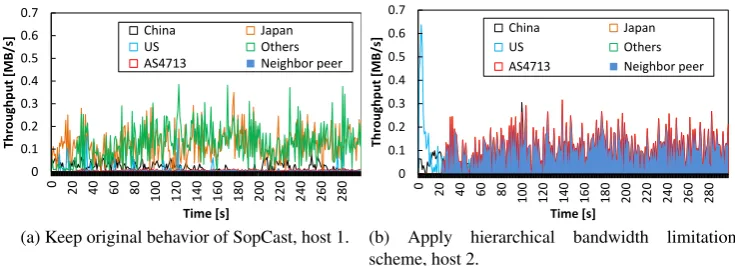
(b) Apply hierarchical bandwidth limitation scheme, host 2.
Fig. 6: Temporal changes of throughput when simultaneously keeping original behavior of SopCast on the measurement host 1 and applying the hierarchical bandwidth limitation scheme on the measurement host 2.
time of users. The waiting time is the time that users have to wait for the application to buffer enough data for starting playing. Therefore, the waiting time reflects the down load speed, and thus can be used as a metric for evaluating the application performance. On PPStream, because we ran an on-demand video, we measured the size of cached file buffered by PPStream within 300 seconds of the measurement.
5.3. Results with SopCast
First, we present the results obtained with
SopCast. Figure 5 shows an example of
temporal changes of throughput when keeping original behavior of SopCast on the measurement host 1 and applying the fixed-length bandwidth
0 0.1 0.2 0.3 0.4 0.5 0.6 0.7 0.8 0.9 1
No limit 800Kbps Hierarchy
D
a
t
a
r
a
t
io
Bandwidth limitation modes
Other countries
United States
China
Other ASes in Japan
AS17676 Softbank BB
AS4713 NTT Commun.
(a) Downloaded data distribution
0 0.1 0.2 0.3 0.4 0.5 0.6 0.7 0.8 0.9 1
No limit 800Kbps Hierarchy
P
e
e
r
r
a
t
io
Bandwidth limitation modes
Other countries
United States
China
Other ASes in Japan
AS17676 Softbank BB
AS4713 NTT Commun.
(b) Neighbor peer distribution
Fig. 7: Downloaded data distributions and neighbor peer distributions for SopCast in three modes of bandwidth limitation.
Bandwidth limitation modes Average waiting time [s]
No limit 13.45
Fixed-length (800kbps) 42.50
Hierarchy 14.00
Table 1: Average waiting time of SopCast.
pieces from the very neighbor peer at one time, and from other Japanese peers at other times when the new peers are better.
Figure 6 shows an example of temporal changes of throughput when keeping original behavior of SopCast on the measurement host 1 and applying the hierarchical bandwidth limitation scheme on the measurement host 2. With the hierarchical scheme, almost all the traffic measured on host 2 is downloaded from the very neighbor peer, host 1, with IP address
192.168.12.32 as shown in Fig. 6 (b). In
contrast, at the same time host 1 could not download any video data from its very neighbor
peer, host 2. This is because our hierarchical
scheme has degraded network performance of inter-AS connections by limiting their bandwidth. Therefore, SopCast tends to preferably download video data pieces from the neighbor peer in the same AS that usually has better performance than other peers, e.g., shorter RTT. The feature of our hierarchical bandwidth limitation scheme that forces a P2P streaming application to download the data from a peer in the same LAN is very
significant. To the best of our knowledge, no
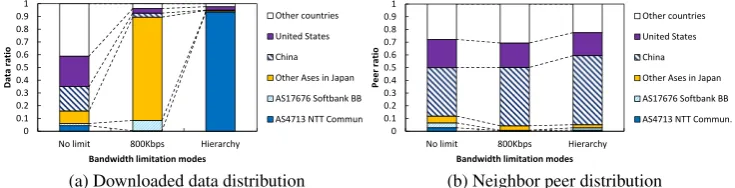
other research shows the same result to ours. Figure 7 (a) presents the average downloaded data distributions by three schemes. The vertical axis represents the region-by-region ratios for
the downloaded traffic that the measurement host received from other peers. We listed the ratios by ASes/ISPs for the traffic inside Japan, and by countries for the overseas traffic. The information of AS and ISP was grouped together in the results because we had not found any traffic coming from different AS in the same ISP in the experiments. We marked that the traffic coming from outside of AS4713 NTT Communications Corp. as cross-AS/ISP traffic. The cross traffic accounts for 95% of the total traffic in case of no limit, i.e., original behavior of SopCast. This is a very high percent of inter-domain traffic. In case of fixed-length bandwidth limitation scheme, almost all traffic comes from Japan. This indicates that SopCast tends to preferably download data pieces from Japanese peers that have better performance than foreign peers due to bandwidth limitation applied to overseas traffic. However, the cross-AS/ISP traffic is still very high, which accounts for 94% of the total traffic. On the other hand, with the hierarchical bandwidth limitation scheme, such the cross traffic accounts for only 13% of the total traffic. This statistic shows that our hierarchical scheme significantly reduces the cross-AS/ISP traffic.
Bandwidth limitation modes Size of cached file [MB]
No limit 195
Fixed-length (800kbps) 43
Hierarchy 193
Table 2: Average size of cached file buffered by PPStream within 300 seconds.
list of available online peers, and then forms an overlay network for exchanging video data pieces
with a subset of those peers. Our bandwidth
limitation schemes, however, cannot intervene
at the step of obtaining the peer list. The
neighbor peer distributions are therefore pretty stable. Nevertheless, the application preferably selects closer peers to download data pieces even when very few candidates exist. Our proposal thus successfully realizes traffic localization on SopCast.
Table 1 shows the average waiting time for
SopCast by three schemes. It is easy to
see that the fixed-length bandwidth limitation scheme degrades the performance of SopCast. In comparison with the original behavior of SopCast, the waiting time is much longer in
case of 800kbps bandwidth limitation. This
is because the fixed-length bandwidth limitation scheme always limits the bandwidth of overseas traffic even when very few Japanese peers exist for localizing. In the worst case, no Japanese peer for contact, the waiting time of SopCast will be very long due to bandwidth limitation applied to overseas traffic. In contrast, the waiting time of the hierarchical bandwidth limitation scheme is almost the same as that of the original behavior.
These results show the effectiveness of the
hierarchical feature. In case of no Japanese peer for contact, no bandwidth limitation is applied
as described in previous section. Therefore,
we conclude that the hierarchical bandwidth limitation scheme also maintains the quality performance of SopCast.
5.4. Results with PPStream
Secondly, we present the results obtained with
PPStream. The experiments are performed in
a similar manner to SopCast case. Figure 8
presents an example of throughput changing when simultaneously keeping original behavior
of PPStream on the measurement host 1 and applying fixed-length bandwidth limitation scheme on the measurement host 2. The results resemble the SopCast case. In particular, when applying the fixed-length bandwidth limitation, almost all the traffic measured on host 2 comes
from Japan. This feature proves the success
of bandwidth limitation scheme in P2P traffic
localization. However, both hosts could not
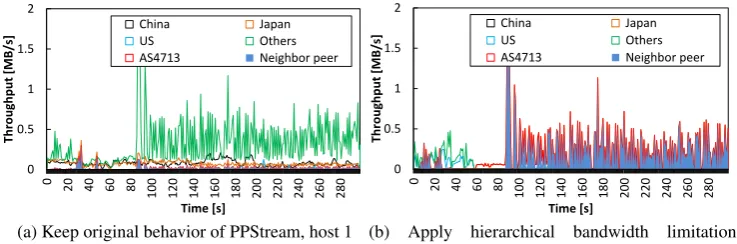
recognize the very neighbor peer to download video data pieces. In contrast, Fig. 9 indicates that in case of applying the hierarchical bandwidth limitation on host 2 and keeping original behavior of PPStream on host 1, almost all the traffic comes from the very neighbor peer, host 1. Simultaneously, host 1 did not download any video data from its very neighbor peer, host 2.
Figure 10 shows the downloaded data
distributions and the neighbor peer distributions
by three schemes. The results indicate that
even though the neighbor peer distributions are fairly steady, the amount of data received from Japan increases dramatically in case of applying
bandwidth limitation method. Furthermore,
the amount of the cross-AS/IP traffic decreases significantly when applying the hierarchical bandwidth limitation scheme. As shown in Fig. 10 (a), the cross-AS/ISP traffic accounts for 95%, 99%, and 6% of the total traffic in case of no limit, fixed-length bandwidth limitation, and hierarchical bandwidth limitation scheme, respectively.
Table 2 presents the average size of cached file for PPStream within five minutes by
three schemes. Similar to SopCast case, the
fixed-length bandwidth limitation scheme also
degrades the performance of PPStream. In
0 0.05 0.1 0.15 0.2 0.25 0.3 0.35 0 2 0 4 0 6 0 8 0 1 0 0 1 2 0 1 4 0 1 6 0 1 8 0 2 0 0 2 2 0 2 4 0 2 6 0 2 8 0 T h ro u g h p u t [M B /s ] Time [s]
China Japan
US Others
AS4713 Neighbor peer
(a) Keep original behavior of PPStream, host 1
0 0.05 0.1 0.15 0.2 0.25 0.3 0.35
0 20 40 60 80
1 0 0 1 2 0 1 4 0 1 6 0 1 8 0 2 0 0 2 2 0 2 4 0 2 6 0 2 8 0 T h ro u g h p u t [M B /s ] Time [s]
China Japan
US Others
AS4713 Neighbor peer
(b) Apply fixed-length bandwidth limitation scheme, host 2
Fig. 8: Temporal changes of throughput when simultaneously keeping original behavior of PPStream on the measurement host 1 and applying the fixed-length bandwidth limitation scheme on the measurement host 2. 0 0.5 1 1.5 2
0 20 40 60 80
1 0 0 1 2 0 1 4 0 1 6 0 1 8 0 2 0 0 2 2 0 2 4 0 2 6 0 2 8 0 T h ro u g h p u t [M B /s ] Time [s]
China Japan
US Others
AS4713 Neighbor peer
(a) Keep original behavior of PPStream, host 1
0 0.5 1 1.5 2
0 20 40 60 80
1 0 0 1 2 0 1 4 0 1 6 0 1 8 0 2 0 0 2 2 0 2 4 0 2 6 0 2 8 0 T h ro u g h p u t [M B /s ] Time [s]
China Japan
US Others
AS4713 Neighbor peer
(b) Apply hierarchical bandwidth limitation scheme, host 2
Fig. 9: Temporal changes of throughput when simultaneously keeping original behavior of PPStream on the measurement host 1 and applying the hierarchical bandwidth limitation scheme on the measurement host 2.
6. Conclusion
In summary, this paper provides the following meaningful contributions to the field of P2P traffic localization: (1) we proposed two different schemes based on bandwidth limitation, to solve the problem on network layer; (2) with the hierarchical scheme, the traffic can be localized hierarchically with multiple levels including AS level, ISP level, and country level; (3) our proposals requires neither modification of
existing application software, nor dedicated
servers, nor collaboration between ISPs and P2P
users. The experiment measurements indicate
that the fixed-length bandwidth limitation
successfully realized traffic localization by the suppression of the connection paths with
the foreign peers. Moreover, our hierarchical
bandwidth limitation scheme significantly
0 0.1 0.2 0.3 0.4 0.5 0.6 0.7 0.8 0.9 1
No limit 800Kbps Hierarchy
D
a
t
a
r
a
t
io
Bandwidth limitation modes
Other countries
United States
China
Other Ases in Japan
AS17676 Softbank BB
AS4713 NTT Commun.
(a) Downloaded data distribution
0 0.1 0.2 0.3 0.4 0.5 0.6 0.7 0.8 0.9 1
No limit 800Kbps Hierarchy
P
e
e
r
r
a
t
io
Bandwidth limitation modes
Other countries
United States
China
Other Ases in Japan
AS17676 Softbank BB
AS4713 NTT Commun.
(b) Neighbor peer distribution
Fig. 10: Downloaded data distributions and neighbor peer distributions for PPStream in three modes of bandwidth limitation.
to original behavior of these two applications.
Several future challenges remain. First, we
only measured the waiting time as a QoS
evaluation metric. In the future, we will
investigate the QoS with many other factors when applying the bandwidth limitation. Second,
the effectiveness of our proposed router in
a real network might be influenced much by the accuracy of the traffic classification
module. Therefore, we are also planning to
consider deeply the traffic classification module to complete our router-aided approach. We also have a plan to evaluate our proposal on a P2P application other than P2PTV such as BitTorrent.
Acknowledgment
This study was partly supported by a Grant-in-Aid for Young Scientists (B) No. 23760344 from the Japan Society for the Promotion of Science (JSPS).
References
[1] Cisco System, Inc. “Cisco visual networking index: forecast and methodology, 2011-2016,” White paper, May 2012.
[2] PPTV, Available online at: http://www.pptv.com/. [3] PPStream, Available online at: http://www.pps.tv/. [4] SopCast, Available online at:
http://www.sopcast.com/.
[5] Zattoo, Available online at: http://zattoo.com/. [6] R. Dunaytsev, D. Moltchanov, Y. Koucheryavy,
O. Strandberg, H. Flinck, A survey of p2p traffic management approaches: best practices and future directions, Internet Engineering 5 (1) (2012) 318–330. [7] T. Karagiannis, P. Rodriguez, K. Papagiannaki, Should internet service providers fear peer-assisted content
distribution?, in: Proc. Internet Management Conf. (IMC 2005), 2005, pp. 63–76.
[8] L. Plissonneau, J. Costeux, P.Brown, Detailed analysis of edonkey transfers on adsl, in: Proc. 2nd Conf. Next Generation Internet Design and Engineering (NGI ’06), 2006, pp. 256–262.
[9] V. Aggarwal, A. Feldmann, C. Scheideler, Can isps and p2p users cooperate for improved performance?, ACM SIGCOMM Comput. Commun. Rev. 37 (3) (2007) 29–40.
[10] H. Xie, Y. Yang, A. Krishnamurthy, Y. Liu, A. Silberschatz, P4p: provider portal for applications, in: Proc. ACM SIGCOMM 2008, 2008, pp. 351–362. [11] J. Seedorf, S. Kiesel, M. Stiemerling, Traffic
localization for p2p-applications: the alto apprach, in: Proc. IEEE Int. Conf. Peer-to-Peer Comput. (P2P2009), 2009, pp. 171–177.
[12] R. Alimi, R. Penno, Y. Yang, Alto protocol, in: Internet draft, draft-ietf-alto-protocol-10.txt, 2011. [13] D. Choffnes, F. Bustamante, Taming the torrent - a
practical approach to reducin cross-isp traffic in peer-to-peer systems, in: Proc. ACM SIGCOMM2008, 2008, pp. 363–374.
[14] R. Bindal, P. Cao, W. Chan, J. Medved, G. Suwala, T. Bates, A. Zhang, Improving traffic locality in bittorrent via biased neighbor selection, in: Proc. IEEE Int. Conf. Distributed Comput. Syst. (ICDCS2006), 2006.
[15] H.-Y. Lee, A. Nakao, Isp-driven delay insertion for p2p traffic localization., IEICE Trans. Commun. E96-B (1) (2013) 40–47.
[16] H.-Y. Lee, A. Nakao, A feasibility study of p2p traffic localization through network delay insertion, IEICE Trans. Commun. E95-B (11) (2012) 3464–3471. [17] T. Miyoshi, Y. Shinozaki, O. Fourmaux, A p2p traffic
[19] S. Valenti, D. Rossi, Fine-grained behavioral classification in the core: the issue of flow sampling, in: Proc. 7th Int. Wireless Commun. and Mobile Comput. Conf. (IWCMC2011), 2011, pp. 1028–1032. [20] Tcpdump and libpcap pulbic repository, Available
online at: http://tcpdump.org/.
[21] MaxMind and GeoIP, IP address location technology, Available online at:
http://www.maxmind.com/app/ip-location/. [22] Dummynet, Available online at:
http://info.iet.unipi.it/˜luigi/dummynet/.
[23] X. Su, L. Chang, A measurement study of ppstream, in: 3rd Int. Conf. Commun. and Networking in China (ChinaCom 2008), 2008, pp. 1162–1166.
[24] A. Horvath, M. Telek, D. Rossi, P. Veglia, D. Ciullo, M. Garcia, E. Leonardi, M. Mellia, Dissecting pplive, sopcast, tvants, Tech. rep., NAPA-WINE project (2009).