www.ijaer.in Copyright © IJAER 2019, All rights reserved Page 369
EFFECT OF PROCESSING ON DIETARY FIBRE, PROXIMATE AND
FUNCTIONAL PROPERTIES OF SOYBEAN (
Gyycine max. mer.
) AND
AFRICAN YAM BEAN (
Sphenostylis stenocarpa
) FLOUR SAMPLES.
Offia Olua, Blessing I., *Onwuzuruike, Uzochukwu A. and Okoroafor, Oyinyechi, S.
Department of Food Science and Technology, College of Applied Food Sciences and Tourism, Michael Okpara University of Agriculture, Umudike, Abia State, Nigeria.
*Corresponding Author
ABSTRACT
The effects of toasting (l0 and 15 minutes), soaking (12 and 24 hours) and boiling (20 and 30 minutes) on the dietary fibre content, proximate composition and functional properties of soybean flour (SF) and African yam bean flour (AYBF) samples were studied. Dietary fibre composition of SF comprised 4.62 - 3.40 %, 8.57 % - 5.75 % and 12.52% - 10.43 % for soluble, insoluble and total dietary fibre (TDF) respectively, while that of AYBF comprised 5.47 % - 3.28 %, 11.64 % - 8.71 % and 16.62 % - 12.28 % for soluble, insoluble and TDF. The proximate composition of SF comprised 12.02 % - 9.14 %, 29.00 % - 5.18 %, 29.86 % - 17.68 %, 29.57 % - 19.91 %, for moisture, fat, protein and carbohydrate content, while in AYBF, 9.27 % - 5.00 %, 17.00 % - 7.00 %, 23.53 % - 14.22 %, 55.83 % - 51.97 % for moisture, fat, protein and carbohydrate content. The functional properties of SF ranged from 2.49 g/ml - 1.80 g/ml for oil absorption capacity (OAC), 4.50 g/ml - 2.94 g/ml for water absorption capacity (WAC), 86.67°C - 77.00°C for gelation temperature (GT), while that of AYBF comprised, 21.4 g/ml - 1.68 g/ml (OAC), 3.44 g/ml - 2.10 g/ml (WAC), and 82.00°C - 75.00°C (GT). Conclusively, processing had significant effects on the dietary fibre composition, proximate composition, and the functional properties of SF and AYBF with toasting being discovered to increase significantly their IDF and TDF.
Keywords: African yam bean, Dietary fibre, Processing, Proximate analysis, Soybean.
1. INTRODUCTION
www.ijaer.in Copyright © IJAER 2019, All rights reserved Page 370
beneficial in reducing body fat and triglycerides in individuals with cardiovascular health challenges. Thus, regular consumption of fibre rich foods tends to lower the risk of cardiovascular disease [14]. Soybean and African yam bean are important legumes with significant quantity of dietary fibre, which makes them beneficial in blood cholesterol triglycerides regulation [22]. For these reasons, raw fibre is being largely introduced into food formulation for improved health. However, the constituents that make up the total fibre composition may be significantly affected by different processing techniques, which may in turn affect physiological effects to good health [2].
Soybean (Glycine max. mer.) is appreciably rich in cheap and high-quality protein (36 %). Comparable to meat, poultry and eggs, soybean is readily available to the poor and low-income earners. They contain important vitamins and minerals, riboflavin, omega-3 fatty acids, copper, manganese, molybdenum and potassium. Consistently, there has been a moderate reduction of low-density lipoprotein cholesterol associated with soybean intake [17]. More so, about 20 % of oil can be found in soybean seed, making it an essential and important oil-bearing seed.
African yam bean (AYB) (Sphenostylis stenocarpa) is underutilize and less known compared to other major legumes in the tropics [19]. African yam bean is pronouncedly cultivated in Nigeria [30]. AYB is more grown in the Southern [33] part of Nigeria because of the conducive growth, however, extensive cultivation has been reported in the eastern [1] and western Nigeria [31]. African yam bean contains a protein content of approximately 21 % and can rise up to 30 % depending on the variety and growing condition as well as soil characteristics. Depending on the region and tradition of the people, AYB can be referred to different names in Nigeria, for instance, as “Odudu” in Igbo language, “Sese” in Yoruba language, “Girgiri” in Hausa language and many more in different parts of the country. [9]. Legumes are usually subjected to different processing techniques because of the presence of anti-nutrient before consumption but the information on their effect on dietary fibre is limited. More so, sufficient research has not been carried out on dietary fibre contents of most locally processed flour samples and the effects of processing on their dietary fibre. Understanding the effects of processing on dietary fibre, proximate and functional properties of soybean and African yam bean flour samples was the basis for this study.
2. MATERIALS AND METHODS
2.1 Source of raw materials
African yam bean and Soybean were purchased from Umuahia main market Ubani, Abia state.
www.ijaer.in Copyright © IJAER 2019, All rights reserved Page 371
The soybean flour was produced according to the method of Sowonola et al. [34] and Olaoye [25] with slight modifications. The soybeans were cleaned and sorted for defects. A portion of raw soybeans were milled and sieved into fine flour. Furthermore, some cleaned soybeans were divided into three different portions and was subjected to three different processing methods at two distinct times, respectively. Firstly, 300 g of soybean seeds were toasted for 10 minutes and 15 minutes at 85°C respectively. After which, they were cracked, dehulled, milled, sieved into fine flour, packaged with airtight cellophane bag and stored prior to analysis. Secondly, 300 g of soybean seed were soaked in 1000 ml of distilled water for 12 hours and 24 hours followed by dehulled manually and washing and rinsing severally with tap water. They were oven-dried at 65°C and then milled, sieved, packaged with airtight cellophane bag and stored prior to analysis. Thirdly, 300 g of soybean seeds were boiled for 20 minutes and 30 minutes respectively. After which, they were dehulled manually, rinsed thoroughly with clean water, oven-dried, milled, sieved, packaged with airtight cellophane bag, and stored until required for analysis.
2.3 Production of African yam bean into different flour samples
The African yam bean flour was produced according to the method of Ishimu and Onyeji [15] with slight modifications. The African yam bean seeds were cleaned and sorted. A portion of raw sample was milled and sieved into fine flour. Thereafter, some quantity of the already cleaned sample was divided into three different portions and was subjected to three different processing methods at two distinct times, respectively. The first portion was divided into two different portions; they were toasted for 10 minutes and 15 minutes at 85°C respectively, and were cracked, dehulled, milled, sieved, packaged with an airtight cellophane bag, and stored until required for analysis. The second portion was divided into two different portions, and were soaked in 2 litres of water, for 12 hours and 24 hours respectively. The seeds were dehulled, washed and rinsed with clean water, followed by oven-drying at 65°C, milled, sieved, packaged with airtight cellophane bag and stored until required for analysis. The third portion was divided also into two different portions, they were boiled with clean water for 20 minutes and 30 minutes respectively. After which, they were dehulled, rinsed with clean water, oven-dried, milled, sieved and packaged with an airtight cellophane bag. Then, they were stored until required for analysis.
2.4 Sample analyses
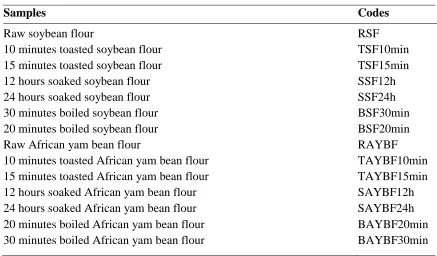
Samples were subjected to dietary fibre analysis, proximate and functional analysis. Table I present the codes representing each sample.
2.5 Dietary fibre analysis
Dietary fibre was determined using enzymatic gravimetric method of AOAC [10].
www.ijaer.in Copyright © IJAER 2019, All rights reserved Page 372
The method of Okaka and Potter [23] was used to determine bulk density. The method of Onwuka [28] was used to determine foam capacity, wettability, gelatinization temperature, oil absorption capacity, emulsion capacity, water absorption capacity and swelling index.
2.7 Proximate analysis
Moisture content was carried out by the method of AOAC [10]. Ash content, crude fibre content and carbohydrate content was determined by the method described by James [16]. Fat determination was carried out as described by Pike [29]. Crude protein was analysed by the Kjeldahl method described by Change [12].
2.8 Statistical analysis
All experimental data were expressed as mean ± SD (standard deviation). The data were subjected to a normality check, followed by Levene’s test for homogeneity of variance. The pre-requisites test fulfilled the assumption of using one-way analysis of variance (ANOVA) to analyse the data by the SPSS software (version 16, IBM, USA, while the Duncan Multiple Range Test method was used to compare the means of experimental data at 95 % confidence interval when a significant difference was observed from the One-way ANOVA.
Table 1: Codes representing each flour sample.
Samples Codes
Raw soybean flour RSF
10 minutes toasted soybean flour TSF10min 15 minutes toasted soybean flour TSF15min
12 hours soaked soybean flour SSF12h
24 hours soaked soybean flour SSF24h
30 minutes boiled soybean flour BSF30min
20 minutes boiled soybean flour BSF20min
Raw African yam bean flour RAYBF
www.ijaer.in Copyright © IJAER 2019, All rights reserved Page 373
3. RESULTS AND DISCUSSIONS
3.1 Dietary fibre composition
www.ijaer.in Copyright © IJAER 2019, All rights reserved Page 374
Table II: Dietary fibre composition of Soybean flour samples.
Sample codes
Soluble dietary fibre (SDF) (%)
Insoluble dietary fibre (IDF) (%)
Total dietary fibre (TDF)
(%)
RSF 3.40f±0.14 8.03b±0.18 11.43d±0.04 TSF10min 3.82c± 0.03 8.56a ± 0.64 12.38b ± 0.04
TSF15min 3.96c± 0.02 8.57a ± 0.13 12.52a ± 0.11
SSF12h 3.64e± 0.02 7.85b± 0.05 11.48d ± 0.03 SSF24h 3.77d± 0.02 7.96b± 0.01 11.73c ± 0.04 BSF20min 4.41b± 0.01 6.17c ± 0.05 10.58e ± 0.04 BSF30min 4.62a± 0.03 5.75d± 0.01 10.43f ± 0.04
LSD (0.05%)
0.06 0.01 0.06
Mean values down the columns with different letters are significantly different (P < 0.05).
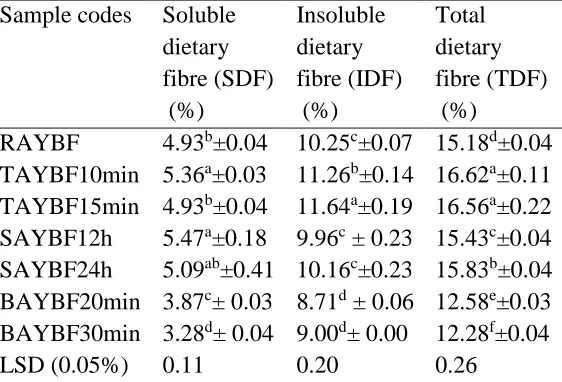
Table III: Dietary fibre composition of African yam bean flour samples.
Sample codes Soluble dietary fibre (SDF) (%)
Insoluble dietary fibre (IDF) (%)
Total dietary fibre (TDF) (%)
RAYBF 4.93b±0.04 10.25c±0.07 15.18d±0.04 TAYBF10min 5.36a±0.03 11.26b±0.14 16.62a±0.11 TAYBF15min 4.93b±0.04 11.64a±0.19 16.56a±0.22 SAYBF12h 5.47a±0.18 9.96c ± 0.23 15.43c±0.04
SAYBF24h 5.09ab±0.41 10.16c±0.23 15.83b±0.04 BAYBF20min 3.87c± 0.03 8.71d ± 0.06 12.58e±0.03 BAYBF30min 3.28d± 0.04 9.00d± 0.00 12.28f±0.04 LSD (0.05%) 0.11 0.20 0.26
Mean values down the columns with different letters are significantly different (P < 0.05).
3.2 Proximate composition
www.ijaer.in Copyright © IJAER 2019, All rights reserved Page 375
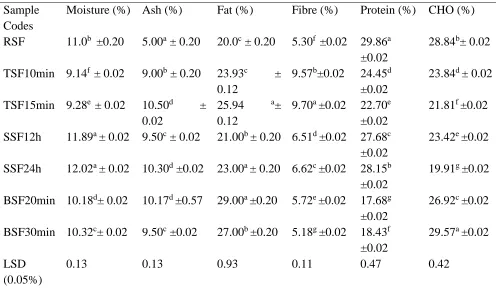
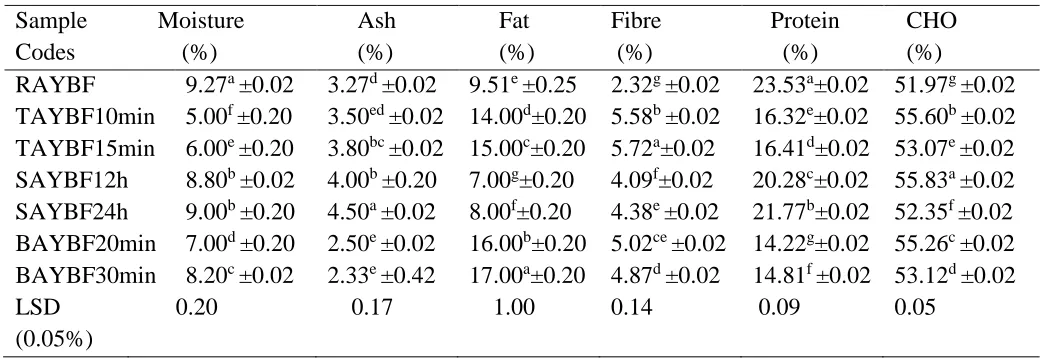
content (12.02 % and 9.00 %). Although, the moisture contents of the flour samples were generally moderate which implied good stable shelf life if appropriately packaged and stored. However, toasting resulted to having the highest reduction in the moisture content of both soybean and African yam bean flour samples. This indicates that the flour is better preserved by toasting compared to other treatment [11]. The ash content of TSF15min was the highest (10.50 %) and while RSF had the lowest value (5.00 %). Comparing the processed flour samples to the raw sample (RSF), toasting, soaking and boiling increased the ash content of the soybean flour samples, which signified that processing improved the mineral availability of soybean [27]. However, toasting and soaking increased the ash content of the African yam bean (AYB) flour samples while, boiling decreased the ash content. Protein content was highest in RSF (29.86 %) and lowest in BSF20min (17.68 %). It was observed that the crude protein of the processed soybean flour was lower than that of the flour from the raw. Particularly, boiled samples of soybean flours had the lowest protein content while those subjected to soaking operation (SSF12h and SSF24h) had a protein content (27.68 % and 28.15 %) close to those of the raw samples.
www.ijaer.in Copyright © IJAER 2019, All rights reserved Page 376
cellulose and softens it and ultimately improves the bioavailability of starch. This could be the reason the processed samples had improved carbohydrate content. Furthermore, it was observed that, processing for shorter time such as 10 minutes (toasting), 12 hours (soaking), 20 minutes (boiling) seems to increase the carbohydrate content of the AYB flour samples.
Table IV: Proximate composition of processed soybean flour samples.
Sample Codes
Moisture (%) Ash (%) Fat (%) Fibre (%) Protein (%) CHO (%)
RSF 11.0b ±0.20 5.00a ± 0.20 20.0c ± 0.20 5.30f ±0.02 29.86a
±0.02
28.84b± 0.02
TSF10min 9.14f ± 0.02 9.00b ± 0.20 23.93c ± 0.12
9.57b±0.02 24.45d ±0.02
23.84d ± 0.02
TSF15min 9.28e ± 0.02 10.50d ± 0.02
25.94 a± 0.12
9.70a ±0.02 22.70e ±0.02
21.81f ±0.02
SSF12h 11.89a ± 0.02 9.50c ± 0.02 21.00b ± 0.20 6.51d ±0.02 27.68c ±0.02
23.42e ±0.02
SSF24h 12.02a ± 0.02 10.30d ±0.02 23.00a ± 0.20 6.62c ±0.02 28.15b ±0.02
19.91g ±0.02
BSF20min 10.18d± 0.02 10.17d ±0.57 29.00a ±0.20 5.72e ±0.02 17.68g
±0.02
26.92c ±0.02
BSF30min 10.32c± 0.02 9.50c ±0.02 27.00b ±0.20 5.18g ±0.02 18.43f ±0.02
29.57a ±0.02
LSD (0.05%)
0.13 0.13 0.93 0.11 0.47 0.42
www.ijaer.in Copyright © IJAER 2019, All rights reserved Page 377
Table V: Proximate composition of processed African yam bean flour samples.
Mean values down the columns with different letters are significantly different (P < 0.05).
3.3 Functional properties
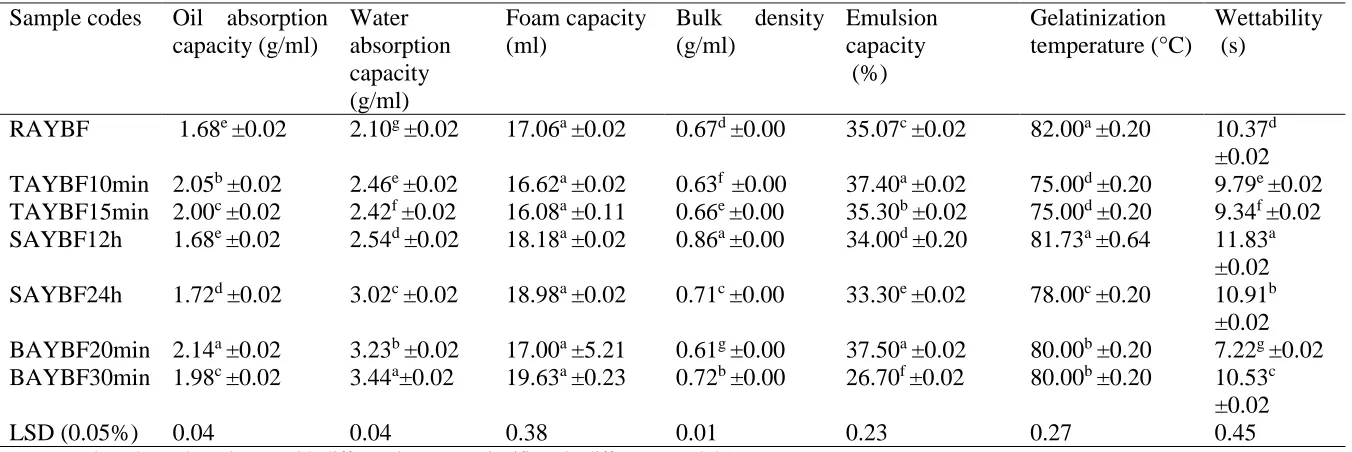
The functional properties of processed soybean and African yam bean flour samples are shown in Table VI and Table VII respectively. Oil absorption capacity (OAC) is attributed mainly to the physical entrapment of oil [13]. The results showed that the oil absorption capacity (OAC) of soybean flour sample increased significantly with boiling and toasting but decreases with soaking. This possible suggest that heating operations increased the OAC of soybean flours. Similar to soybean flours, toasting and boiling had more pronounced effect on OAC than soaking in AYB flour samples. However, the OAC of soybean and AYB flours are quite low. Adebowale and Lawal [3], reported that differences in the proportion of non-polar side chains that capable of attaching to the hydrocarbon side chains of oil, explains the behaviour of different flour exhibiting different oil binding capacity. Hence, the lower OAC of the raw and processed soybean and AYB flour samples can be linked to lower amount of hydrophobic proteins when compared to other flour samples [24]. The water Absorption Capacity (WAC) in soybean flour samples reduced significantly with processing such that the RSF had the highest value (4.50 g/ml) while the processed samples had values that ranged from 2.94 to 3.28 g/ml. However, the WAC value of the raw and processed soybean flour samples was comparatively within the range (3.00 - 5.00 g/ml) reported by Akinyede and Amoo [6]. In contrast to the results obtain for soybean flours, the WAC in AYB flour samples increased with processing such that boiling operation, particularly boiling for 30 minutes (BAYBF30min) (3.44 g/ml) resulted to increased WAC of the AYBF samples. Water absorption capacity indicate how efficiently the incorporation of protein into aqueous food formulations can be [20]. The implication of this property is that, it allows food manufacturers, particularly confectionery industries, to propagate the extent to which water can be added to dough for improve handling and freshness [21]. It is Sample
Codes
Moisture (%)
Ash (%)
Fat (%)
Fibre (%)
Protein (%)
CHO (%)
RAYBF 9.27a ±0.02 3.27d ±0.02 9.51e ±0.25 2.32g ±0.02 23.53a±0.02 51.97g ±0.02
TAYBF10min 5.00f ±0.20 3.50ed ±0.02 14.00d±0.20 5.58b ±0.02 16.32e±0.02 55.60b ±0.02 TAYBF15min 6.00e ±0.20 3.80bc ±0.02 15.00c±0.20 5.72a±0.02 16.41d±0.02 53.07e ±0.02 SAYBF12h 8.80b ±0.02 4.00b ±0.20 7.00g±0.20 4.09f±0.02 20.28c±0.02 55.83a ±0.02 SAYBF24h 9.00b ±0.20 4.50a ±0.02 8.00f±0.20 4.38e ±0.02 21.77b±0.02 52.35f ±0.02 BAYBF20min 7.00d ±0.20 2.50e ±0.02 16.00b±0.20 5.02ce ±0.02 14.22g±0.02 55.26c ±0.02
BAYBF30min 8.20c ±0.02 2.33e ±0.42 17.00a±0.20 4.87d ±0.02 14.81f ±0.02 53.12d ±0.02
LSD (0.05%)
www.ijaer.in Copyright © IJAER 2019, All rights reserved Page 378
www.ijaer.in Copyright © IJAER 2019, All rights reserved Page 379
suggested that the processed samples would have a lower temperature at which the starch is converted into a water-soluble gel. Wettability is the time required for a given amount of flour to be wetted. The ability of food flours or powder to disperse is largely dependent on their wettability capacity. However, the polarity of the flour particles and the surface tension of liquid plays a major role in the wettability of flours [26]. Wettability of soybean flour decreased with processing such that RSF had the highest wettability values (14.82 s) and lowest in BSF30min (7.39 s). The results suggested that processed soybean flours would have lower dispensability. In AYB flour samples, wettability was highest in SAYBF12h (11.83 s) and lowest in BAYBF20min (7.22 s). Toasted AYBF had lower wettability compared to other samples which suggested that toasting affect the wettability of AYBF compared to other processing methods.
CONCLUSION
www.ijaer.in Copyright © IJAER 2019, All rights reserved Page 380
Table VI: Functional properties of processed soybean flour samples.
Mean values down the columns with different letters are significantly different (P < 0.05).
Table VII: Functional properties of processed African yam bean flour samples.
Mean values down the columns with different letters are significantly different (P < 0.05).
Sample codes Oil absorption capacity (g/ml) Water absorption capacity (g/ml) Foam capacity (ml)
Bulk density (g/ml) Emulsion capacity (%) Gelatinization temperature (°C) Wettability (sec)
RSF 2.12e ± 0.02 4.50a ± 0.20 19.03b±0.03 0.51ab±0.00 30.50b ± 0.02 82.00c ± 0.20 14.82a ± 0.02
TSF10min 2.21d ± 0.02 3.10c ± 0.02 13.57f ±0.08 0.52ab ± 0.00 27.50f ± 0.02 86.67a ± 0.76 11.55b ± 0.02 TSF15min 2.26e ± 0.02 3.25b ± 0.20 13.07g ±0.06 0.61a ± 0.21 25.00g ± 0.20 83.00b ± 0.20 9.57d ± 0.02 SSF12h 1.80g ± 0.02 3.28b ± 0.25 17.86e ±0.03 0.49ab ± 0.00 28.90d ± 0.02 77.00d ± 0.20 7..65f ± 0.02
SSF24h 2.07f ± 0.02 3.15bc ± 0.20 18.03d ±0.03 0.52ab ± 0.00 38.50a ± 0.02 73.00f ± 0.20 10.24c ± 0.02 BSF20min 2.49a ±0.02 2.94d ± 0.20 19.74a ±0.02 0.54ab ± 0.00 29.30c ± 0.02 75.00e ± 0.20 8.45e ± 0.02 BSF30min 2.32b ± 0.02 3.16bc ± 0.20 18.66c ±0.03 0.43b ± 0.00 28.00e ± 0.20 77.00d ± 0.20 7.39g ± 0.02
LSD (0.05%) 0.05 0.01 0.16 0.01 0.40 1.00 0.26
Sample codes Oil absorption capacity (g/ml) Water absorption capacity (g/ml) Foam capacity (ml)
Bulk density (g/ml) Emulsion capacity (%) Gelatinization temperature (°C) Wettability (s)
RAYBF 1.68e ±0.02 2.10g ±0.02 17.06a ±0.02 0.67d ±0.00 35.07c ±0.02 82.00a ±0.20 10.37d ±0.02 TAYBF10min 2.05b ±0.02 2.46e ±0.02 16.62a ±0.02 0.63f ±0.00 37.40a ±0.02 75.00d ±0.20 9.79e ±0.02 TAYBF15min 2.00c ±0.02 2.42f ±0.02 16.08a ±0.11 0.66e ±0.00 35.30b ±0.02 75.00d ±0.20 9.34f ±0.02 SAYBF12h 1.68e ±0.02 2.54d ±0.02 18.18a ±0.02 0.86a ±0.00 34.00d ±0.20 81.73a ±0.64 11.83a
±0.02 SAYBF24h 1.72d ±0.02 3.02c ±0.02 18.98a ±0.02 0.71c ±0.00 33.30e ±0.02 78.00c ±0.20 10.91b
±0.02 BAYBF20min 2.14a ±0.02 3.23b ±0.02 17.00a ±5.21 0.61g ±0.00 37.50a ±0.02 80.00b ±0.20 7.22g ±0.02
BAYBF30min 1.98c ±0.02 3.44a±0.02 19.63a ±0.23 0.72b ±0.00 26.70f ±0.02 80.00b ±0.20 10.53c ±0.02
www.ijaer.in Copyright © IJAER 2019, All rights reserved Page 381
REFERENCES
[1] Abbey, B. W. and Berezi, P. E. (1998). Influence of processing on the digestibility of African yam bean (Sphenostylis stenocarpa). Nutrition Report International 39 (3) 519-528.
[2] ADA (Amer. Diet. Assoc.) (1997). Health Implications of dietary fibre. J. Amer. Diet. Assoc. 97: 1157-1159.
[3] Adebowale, K. O. and Lawal, O. S. (2004). Comparative study of the functional properties of Bambara groundnut jack bean and Mucuna bean flours. Food Res. Int. 37: 355-365.
[4] Agiang, M. A., Umoh, I. B., Essien, A. I. and Eteng, M. U. (2010). Nutrient changes and antinutrient contents of beniseed and beniseed soup during cooking using a Nigerian traditional method. Pak. J. Biol. Sci. 13: 1011-1015.
[5] Ahmedna, M., Prinyawiwatkul and Rao, R.M. (1999). Solubilized wheat protein isolate: Functional properties and potential food applications. J. Agric. Food Chem., 47: 1340-1345.
[6] Akinyede, A. I. and Amoo, I. A. (2009). Chemical and functional properties of full fat and defatted Cassia fistula seed flours. Pak. J. Nutr.8: 765 - 769.
[7] Akubor, P. I. and Badifu, G. I. O. (2004). Chemical composition, functional properties and baking potential of African breadfruit kernel and wheat flour blends. Int. J. Food Sci. Technol., 39: 223 - 229.
[8] Amankwah, E.A., Barimah, J., Nuamah, A. K. M., Oldham, J. H. and Nnaji, C. O. (2009). Formulation of weaning food from fermented Maize, Rice, Soybean, and Fishmeal. Pakistan Journal of nutrition, 8 (11): 1747– 1752.
[9] Amihud, R. (1992). Effect of storage on Nutritive value of food. In Handbook of Nutritive value of processed foods. CRC – Press, Florida. Pp. 275 – 294.
[10] AOAC (1992). Metthod of analysis of the Association of Official Analytical Chemist, 15th ed. Washington D. C. USA. International Journal of Basic and Applied Sciences
Nwosu, Justina N. Vol. 2. No. 4 ISSN: 2277 – 1921168.
www.ijaer.in Copyright © IJAER 2019, All rights reserved Page 382
[12] Chang, S. K. C. (2003). Protein analysis. In: Food analysis. 3rd edition. Kluwer academic
planum publishers, New York. 133 – 141.
[13] Etudaiye, H. A., Oti, E. and Amed, C. (2008). Functional properties of Wheat: Sweet potato composite flour and Sensory Qualities of confectionaries produced from the composites. Nig. J. of Nutritional Sciences Vol. 29 (2) pp.140 – 147.
[14] Gallaher, A. and Daniel, D. (2006). Dietary fibre. Washington, D.C.: ILSI Press. Pp. 102 – 110.
[15] Ishiwu, C. N. and Onyeji, A. C. (2004). Properties of an instant gruel based on blend of maize (Zea mays. L.) starch, African yam bean (Sphenostylis stenocarpa) flour and soybean (Glycine max.) flour. Nigeria Journal of Nutritional Sciences 25 (1): 16-19.
[16] James, C. S. (1995). Analytical chemistry of foods. Blackie Academic and professional press, New York. Food sci. Nutr. 7: 217-230.
[17] Liu, K. (2000). Expanding soybean food utilization. Food Technol. 54 (7): 46-47.
[18] Morenol, C. R. and Lopez, O. P. (1993). Hard to cook phenomenon in common beans are view. Crit. Rev. Food Sci. Nutr. 42: 117 – 124.
[19] Moyib, O. K., Gbadegesin, M. A., Aina, O. O. and Odunola, O. A., (2008). Genetic variation within a collection of Nigerian accessions of African yam bean (Sphenostylis
stenocarpa) revealed by RAPD primers. Afr. J. Biotechnol., 7(12): 1839 – 1846.
[20] Narayana, K. and M. S. Narasinga Rao, (1982). Functional properties of raw and processed winged bean (Psophocarpus tetragonolobus) flours. J. Food Sci., 47: 1534 – 1538.
[21] Nwokolo, E. (1987). Nutritional quality of the seeds of the African breadfruit (Treculia
Africana decne). Trop. Sci., 27: 39-47.
[22] Ojimelukwe, P. C., Asomugha, V. U., Omeire, G. C. (2005). Fundamentals of food science and Nutrition. Pp. 86 – 89.
[23] Okaka, J. C. and Potter, N. N. (1997). Functional and storage properties of cowpea powder, wheat flour blends in Bread making Journal, Food sci. 42 (3): 823 – 828.
www.ijaer.in Copyright © IJAER 2019, All rights reserved Page 383
[25] Olaoye, O. A. (2006). Quality Characteristics of Bread produced from composite flours of Wheat, plantain, and soybean. African Journal of Biotechnology Vol. 5 (11) pp. 1102 – 1106.
[26] Onimawo, A. I. and Akurbor, P. I. (2005). Food Chemistry. (Integrated Approach with Biochemical Background). Ambik press Ltd. 4 Otike – Ochibi Avenue, Lagos road, Benin city, Edo State. Pp . 208 – 219.
[27] Onimawo, A. I. and Egbekun, K. M. (1998). Comprehensive Food Science and Nutrition. Revised Edition Admik press Ltd Benin City Edo State. Pp. 193 – 207.
[28] Onwuka, G. I. (2010). Food Analysis and Instrumentation. Theory and practice. Naphtali prints Lagos Nigeria, pp. 64 – 84, 133 – 139.
[29] Pike, N. (2003). Oats, Intermediate moisture foods. In: Food Science and Technology. John Murray. London Pp. 69 – 70, 266.
[30] Potter, D. (1992). Economic Botany of Sphenostylis (Legumonosae). Economic Botany, 46:262 -275.
[31] Raemaekers, R. H. (2001). Crop production in tropical Africa. Geoknit graphics nv., Belgium. Pp. 372-374.
[32] Roberfroid, M. (1993). Dietary fibre, inulin and Olgofructose: a review comparing their effects. Crit. Rev. Food Sci. Nutr. 33 (2) 103– 148.
[33] Saka, J. O. and Ajibade, S. R. (2004). Survey of underutilized grain legume production systems in the Southwest agricultural zone of Nigeria. J. Agric. And Food Info., 6: 93-108.
[34] Sowonola, O. A., Ashaya, O. A., and Akinde, B. A. (2002). Quality Evaluation of Ebiripo using Cocoyam/Soybean/Soy residue Blends. The journal of food Tech. In Africa, pp. 30– 32.
[35] Thed, S. T. and Philips, R. D. (1995). Changes of Dietary fibre and starch composition of processed potato products during domestic cooking. Food Chemistry. 52: 301 – 304.
[36] Vidal – Valverde, C. and Frias, J. (1991). Effects of legume processing on dietary fibre components, J. Food sci. 56: 1350 – 1355.