
Development and charecterization of an itraconazole solid -lipid dispersion formulation using spray drying technique for improved oral bioavailability
9
0
0
Full text
(2) Ganesh et al / Int. J. of Pharmacy and Analytical Research Vol-4(2) 2015 [135-143]. largely driven by the growing need for novel drug delivery systems to deal with the vast majority of the new chemical entities (NCE) that have poor solubility or permeability, to improve the delivery of existing drugs, and for line extensions3. Currently the philosophy in relation to lipid-based drug delivery systems appears to be that of ‘one size fits all’. Realization that the oral bioavailability of poorly water soluble, lipophilic drugs may be enhanced when co-administered with a meal. rich in fat has led to increasing interest in the formulation of poorly water-soluble drugs in lipids as a means to enhance drug solubilisation in the gastrointestinal tract. The main goal of lipid based formulations is to improve the bioavailability of poorly soluble drugs to an extent greater than that achievable with a conventional oral solid dosage form by overcoming the rate limiting steps in the absorption through the intestine3 (Fig.1.1).. Fig.1.1. Schematic representation of the critical steps in oral drug absorption and the possible influences of lipidbased formulations The improvement in the bioavailability by the lipids is assumed to the following mechanisms4. Solubilization of the drug Preventing drug precipitation on intestinal dilution Enhancing membrane permeability Reduction of P-glycoprotein-mediated efflux Mitigation of hepatic first pass Enhancing chylomicron production and lymphatic transport Prolongation of gastrointestinal (GI) transit time Protection from degradation in the GI tract Appropriate excipient selection is vital to successful formulation design. It is no longer sufficient to consider only the traditional roles, such as solubilisation capacity in the case of a surfactant, but the increasing evidence of the bioactive nature of many excipients must also be evaluated. Formulation scientist has a wide range of choices for selecting the lipid excipients for formulation development. The factors to be considered in selecting the excipients are. Miscibility of drug Morphology at room temperature (i.e. melting point) Self-dispersibility and role in promoting selfdispersion of the formulation Digestibility and fate of digested products Regulatory issues—irritancy, toxicity, knowledge and experience Compatibility with the carrier Purity, chemical stability Cost of goods. MATERIALS AND METHODS MATERIALS Gelucire 50/13 (Stearoyl macrogoglycerides) and Compritol 888 ATO (Glyceryl dibehenate) are generous gifts from Gateefosse, india. Itraconazole is obtained from Bridge pharmaceuticals, Hyderabad, India. All HPLC and analytical grade chemicals are purchased from Standard reagents, India.. www.ijpar.com. ~ 136~.
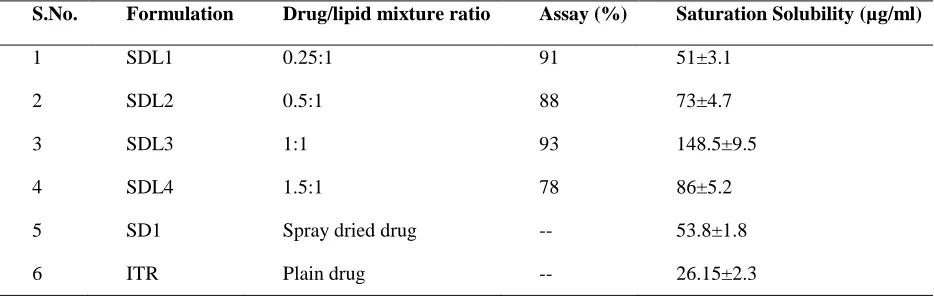
(3) Ganesh et al / Int. J. of Pharmacy and Analytical Research Vol-4(2) 2015 [135-143]. solution is spray dried using a co-axial nozzle with cocurrent flow. The total solid contents concentration is maintained at 5 w/v%. The optimium conditions that are maintained during spray drying. The dried ITR loaded lipid-solid dispersions are collected from the spray drier and stored in desiccated environment until further study. Plain ITR is dispersed in DCM and spray dried using similar conditions to prepare the spray dried itraconazole (SD1) composition of each batch shown in Table-1.. METHOD FORMULATION OF ITRACONAZOLE LIPID SOLID DISPERSION The preparation method includes the dispersion of ITR in the lipid matrix consisting of gelucire and compritol at different a weight ratios. The drug dispersed lipid matrix is dissolved in the dichloromethane (DCM) to obtain a clear solution. The ratio of lipids in the lipid mixture is maintained at a final concentration of 1:3 of gelucire and compritol. The drug and lipid mixture. Table 3.1: Table showing formulations with different drug/ excipient ratios and their assay value and saturation solubility values S.No.. Formulation. Drug/lipid mixture ratio. Assay (%). Saturation Solubility (µg/ml). 1. SDL1. 0.25:1. 91. 51±3.1. 2. SDL2. 0.5:1. 88. 73±4.7. 3. SDL3. 1:1. 93. 148.5±9.5. 4. SDL4. 1.5:1. 78. 86±5.2. 5. SD1. Spray dried drug. --. 53.8±1.8. 6. ITR. Plain drug. --. 26.15±2.3. CHARACTERIZATION DRUG CONTENT ESTIMATION The amount drug incorporated in the lipid-solid dispersions is determined by using a HPLC method after completely extracting the drug by using non aqueous solvent. The extraction method includes dispersion of 10 mg sample in 10 mL of acetonitrile and vortexed well. The solutions are filtered through a membrane filter (0.45 mm) and suitably diluted with mobile phase before injecting to the HPLC. SATURATION SOLUBILITY The efficacy of the formulations in improving the dissolution is preliminarily evaluated by measuring the saturation solubility of the drug from the formulations. The saturation solubility is determined for the plain drug (ITR), spray dried drug (SD1) and the formulations (SDL1 to SDL4). The impact of spray drying on the solubility enhancement is studied by taking plain drug as a control (ITR). The known excess amount of itraconazole is added to 10 mL of pH 1.2 acetate buffers. Samples are rotated at 20 rpm in a water bath. (37± 0.5oC) for 48 hours. The samples are then filtered, suitably diluted, and analyzed by HPLC. LASER DIFFRACTION PARTICLE SIZE ANALYSIS The particle size and particle size distribution of the developed formulations are measured using a laser diffraction size analyzer (HELOS Germany). Samples are suspended in water and two to three drops of isopropyl alcohol is added to disperse the particles and ultrasonicated at 50% amplitude. The particle size and distribution is measured at a measurement range of 10 seconds in 500ms time base and at the optimum concentration of 10%. DIFFERENTIAL SCANNING CALORIMETRY (DSC) The enhanced solubility of the itraconazole from the developed formulations can be attributed to the morphological conversion of the drug upon spray drying. To validate the morphological conversion of the itraconazole, DSC studies are performed for the. www.ijpar.com. ~ 137~.
(4) Ganesh et al / Int. J. of Pharmacy and Analytical Research Vol-4(2) 2015 [135-143]. formulations using a TA instrument, Model Q200 equipped with a RCS-90(-90°C to 450°C) cooling unit. DSC is performed with 2mg sample in T zero panAluminium, encapsulated with T zero lid-Aluminium by T zero press. Inert atmosphere is maintained by purging nitrogen gas at a flow rate of 50 mL/min. Samples are heated at a temperature range of 0 to 300°C with ramping at 10°C/min. INFRARED SPECTROSCOPY (IR) Infrared spectra are obtained for plain itraconazole, gelucire, compritol and spray dried formulation (SDL3) for evaluating the chemical compatibility of ITR with the excipients used in the formulation development. Spectra are taken after preparing the pellet with 2-3 mg of sample with potassium bromide and the samples are scanned from 4000-400cm-1. IN VITRO DISSOLUTION The dissolution rate of ITR from the prepared dispersion (SDL3) is measured in a Disso-2000 model dissolution test system (Labindia, India) using simulated gastric fluid (SGF) without pepsin at pH 1.2 and USP apparatus II (paddle) method. The drug dispersed dispersions are filled into hard gelatin capsule equivalent to 30mg of ITR. The equivalent plain ITR is filled into capsules along with mannitol as an inactive excipient (ITR1). In each dissolution vessel, drug filled capsules are added to 900 mL dissolution medium. Bath temperature and paddle rotation speed are maintained at 37°C and stirred at 100 rpm. Samples are collected periodically and replaced with a fresh dissolution medium. After collection of 90min sample, recovery study is conducted by stirring the paddle at 200rpm for 5min and sample is collected. Samples are filtered through filters (10µm) and analyzed using HPLC.. RESULTS AND DISCUSSION. The itraconazole incorporated solid-lipid dispersions are prepared by dissolving the drug in the lipid matrix consisting of gelucire and Compritol and then dispersed into DCM to prepare a clear solution and then spray dried. The spay drying of drug lipid solution produces fully dried drug incorporated solid lipid particles. By preparing the itraconazole incorporated solid-lipid particles it is assumed to have a higher aqueous dissolution of drug due to morphological conversion of the drug and reduced particle size. After morphological conversion to amorphous form the itraconazole is stabilized by lipids and additionally by the spray drying process the particle size can be precisely controlled to lower range. DRUG CONTENT AND SATURATION SOLUBILITY HPLC analysis is used to estimate the drug content in the formulations after the complete extraction of the drug from the formulations. The obtained values for the formulation (SD1-4) are between 80% and 95% (w/w) of the theoretical values. The saturation solubility study is conducted for the plain drug, spray dried drug and spray dried formulation (SDL1-3) in phosphate buffer pH 7.4. After 48hrs of incubation the solubilized drug is evaluated by HPLC and values were represented in the Table 5.1. The saturation solubility of plain ITR is 26.15 µg /ml, whereas the spray dried drug and lipid dispersion formulations have shown improved solubility. The saturation solubility of the spray dried drug is improved by two times compared to the plain drug. The formulated dispersions also have shown improved solubility and is highest in SDL3. The enhancement is 5.2 times higher to the SDL3 (148.5 µg/ml) when compared to the plain drug (ISD1). The higher solubility in the formulation can be attributed to the morphological conversion of the drug and also to the improvement in the wetting of the drug, reduced particle size and localized solubilization by lipid carriers.. Table 5.1: Table showing formulations with different drug/ excipient ratios and their assay value and saturation solubility values S.No.. Formulation. Drug/lipid mixture ratio. Assay (%). Saturation Solubility (µg/ml). 1. SDL1. 0.25:1. 91. 51±3.1. 2. SDL2. 0.5:1. 88. 73±4.7. www.ijpar.com. ~ 138~.
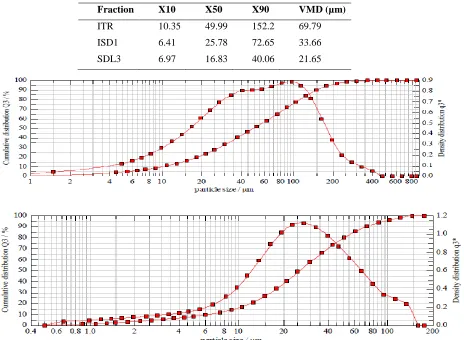
(5) Ganesh et al / Int. J. of Pharmacy and Analytical Research Vol-4(2) 2015 [135-143]. 3. SDL3. 1:1. 93. 148.5±9.5. 4. SDL4. 1.5:1. 78. 86±5.2. 5. SD1. Spray dried drug. --. 53.8±1.8. 6. ITR. Plain drug. --. 26.15±2.3. formulations (SDL3) is found to be 33.66µm and 21.65µm respectively and 90% of formulations and spray dried drug particles are below 40.06 µm & 72.65µm, respectively. However the plain drug has larger particle size and distribution compared to spray dried drug and formulation. The size of the particle in the formulations is precisely controlled by atomization pressure and feed rate during the spray drying process.. LASER DIFFRACTION PARTICLE SIZE ANALYSIS The reason for the enhancement of solubility from the lipid solid dispersion formulations can be attributed to the reduced particle size of the drug. The plain itraconazole has mean volume diameter (VMD) of 69.79 µm and 90% of the particles are below 152.2 µm. The VMD of the spray dried drug particles (SD1) and Table 5.2:. Particle size analysis data of the solid-lipid dispersions (SDL3), Spray dried itraconazole and plain itraconazole. Fraction. X10. X50. X90. VMD (µm). ITR. 10.35. 49.99. 152.2. 69.79. ISD1. 6.41. 25.78. 72.65. 33.66. SDL3. 6.97. 16.83. 40.06. 21.65. www.ijpar.com. ~ 139~.
(6) Ganesh et al / Int. J. of Pharmacy and Analytical Research Vol-4(2) 2015 [135-143]. Fig 5.1: Histograms of Particle size distribution A) Solid-lipid dispersion (SDL3) B) spray dried drug (SD1) C) plain itraconazole DIFFERENTIAL SCANNING CALORIMETRY (DSC) DSC thermograms obtained for ITR, gelucire, compritol and for solid-lipid dispersion (SDL3) are shown in Fig.5.2. Pure ITR has shown well defined endothermic peak at 168.11oc corresponding to the melting point of crystalline drug. Likewise the lipid excipients have shown endothermic peaks at 43.42oc and 71.82oc for gelucire and compritol, respectively, representing the. melting points. However in the thermogram of the spray dried lipid-solid dispersion, the endotherm peak of drug disappeared and instead new peak is observed at 158.3oc. However the endothermic peaks of gelucire and compritol remained same. The significant reduction in the melting point of the ITR can be attributed to the morphological conversion of ITR from crystalline to amorphous form.. Fig.5.2: Differential Scanning Calorimetry (DSC) thermograms of Itraconazole, gelucire, compritol and Itraconazole loaded solid-lipid dispersion. A) Thermgrams of Itraconazole API and SDL3 B) Thermograms of Gelucire and Compritol. www.ijpar.com. ~ 140~.
(7) Ganesh et al / Int. J. of Pharmacy and Analytical Research Vol-4(2) 2015 [135-143]. INFRARED SPECTROSCOPY To evaluate the chemical compatibility between the Itraconazole and excipients, IR analysis is performed and is shown in Fig.5.3. The IR spectra’s of plain Itraconazole showed characteristic peaks at 4001800cm-1. They might have arisen from the stretching and vibrations of functional groups such as –C=C- of aromatic groups. A peak observed at 1600-1800 cm-1 can be attributed to –C=O stretching and vibration, whereas peaks for alkane and amine groups are noticed at 2800-3200 cm-1. Peaks of lipid carriers, gelucire and. compritol, have shown significant broadening O-H stretching vibrations peaks between 2800—3200 cm-1 representing the characteristic peaks of lipids. The same peaks are seen in the spectra of the formulation also. The major peaks observed for Itraconazole before and after the preparation of solid dispersion formulation at 400-1800cm-1 are almost superimposable. This suggests the absence of any significant interactions between Itraconazole and excipients used to preparing the lipidsolid dispersion formulation.. (A) Itraconazole. (B)Gelucire. (C)Compritol. www.ijpar.com. ~ 141~.
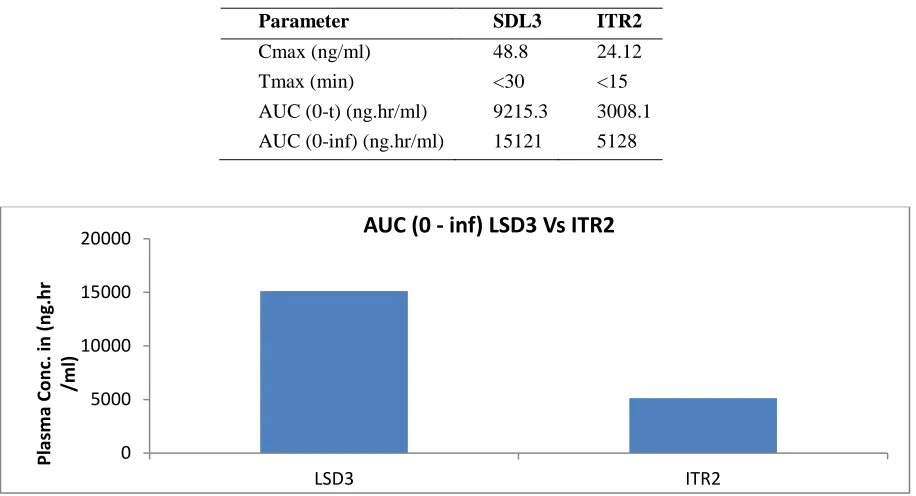
(8) Ganesh et al / Int. J. of Pharmacy and Analytical Research Vol-4(2) 2015 [135-143]. (D) Formulation SDL3. Fig.5.3: Infrared spectra’s of Itraconazole (A), gelucire (B), compritol (C) and formulation-SDL3 (D). % Cumulative Drug Release. IN-VITRO DISSOLUTION In order to assess the performance of the solid-lipid dispersions prepared prior to the in vivo testing, in vitro dissolution testing is conducted under sink conditions. The dissolution profiles of the SDL3 and ITR1 are shown in the Table 5.3 and Fig.5.4. The release of ITR from the SDL3 is steepest initial slope and the dissolution rate is higher compared to ITR1 in all time points. The enhancement of dissolution is approximately 3-4 times higher until 60 mins compared to ITR3. The percent drug release in SDL3 formulation in 60 mins is 64% whereas it is only 19% in the plain drug 100 80 60 40 20 0. formulation. It is assumed that there are two mechanisms responsible for dissolution of ITR. They are drug controlled and carrier controlled dissolution. As ITR in solid-lipid dispersion is in amorphous form the dissolution is more compared to plain drug. And by means of spray drying more precise particles are prepared and the produced smaller particles enhanced the dissolution by increased surface area. The spray dried particles improved the wettability of the drug and localized solubilization in the diffusion layer more efficiently.. Dissolution Profile ITR Vs LSD-3 ITR LSD-3 0. 20. 40. 60. 80. 100. Time in mins. Fig.5.4:-Dissolution profile of spray dried formulation (SDL3) and plain Itraconazole (ITR1) in acetate buffer pH 1.2. IN-VIVO BIOAVAILABILITY STUDY The efficacy of the SDL3 in the improvement of oral bioavailability of ITR is evaluated after administering the dose to the rats. The plain drug suspension is prepared (ITR2) and administered to the rats for comparative evaluation. The tested formulations (SDL3 & ITR2) are dispersed in pH 7.4 phosphate buffer and administered orally. All the dosage forms are well. tolerated and no obvious side effects are observed. After dosing, plasma samples are analyzed by HPLC for ITR levels and drug plasma concentrations as a function of time are shown in Fig.5.5. The plasma profiles are analyzed by non-compartmental analysis for extravasucular administration to determine the appropriate pharmacokinetic parameters of administered formulations and represented in Table 4.3. The SDL3. www.ijpar.com. ~ 142~.
(9) Ganesh et al / Int. J. of Pharmacy and Analytical Research Vol-4(2) 2015 [135-143]. has shown increased Cmax value compared to ICZ2. The Cmax values of SDL3 and ITR2 are found to be 48.8 ng/ml and 24.12ng/ml, respectively. The enhancement in the Cmax from the SDL3 is 2.02 times. higher compared to ITR2. The AUC (0-inf) values are 2.94 times higher in formulation SDL3 compared to ITR2 (15121 vs 5128 ng/h/ml).. Table 5.3: Mean Pharmacokinetic parameters for Itraconazole formulations in plasma after oral administrations to the rats Parameter. SDL3. ITR2. Cmax (ng/ml) Tmax (min). 48.8 <30. 24.12 <15. AUC (0-t) (ng.hr/ml) AUC (0-inf) (ng.hr/ml). 9215.3 15121. 3008.1 5128. AUC (0 - inf) LSD3 Vs ITR2. Plasma Conc. in (ng.hr /ml). 20000 15000 10000 5000 0 LSD3. ITR2. Fig.5.5: AUC values of itraconazole after oral administration of formulations SDL3 and ITR2.. REFERENCES 1. Drugs.com The drug information online Itraconazole. 2. G.L. Amidon, H. Lennernas, V.P. Shah, and J.R. Crison. A Theoretical Basis for a Biopharmaceutic Drug Classification: The Correlation of In Vitro Drug Product Dissolution and In Vivo Bioavailability, Pharm Res 12, 413–420, 1995 3. Hauss DJ, Fogal SE, Ficorilli JV, et al. Lipid based delivery systems for improving the bioavailability and lymphatic transport of a poorly watersoluble LTB4 inhibitor.J Pharm Sci. 1998; 87(2):164-169. 4. L. Gibson, Lipid-based excipients for oral drug delivery, in: D.J. Hauss (Ed.), Oral Lipid-based Formulations: Enhancing the Bioavailability of Poorly Water-soluble Drugs, Informa Healthcare, Inc., New York, 2007, pp. 43–51. 5. Mei-Ling Chen Lipid excipients and delivery systems for pharmaceutical development:A regulatory perspective Advanced Drug Delivery Reviews 60 (2008) 768–777 6. David J. Hauss Oral lipid-based formulations Advanced Drug Delivery Reviews 59 (2007) 667–676 7. KISHOR M. WASAN The Biological Functions of Lipid Excipients and the Implications for Pharmaceutical Products Development Received 4 March 2008; revised 14 April 2008; accepted 15 April 2008 8. Sagar S. Rane, Bradley D. Anderson What determines drug solubility in lipid vehicles: Is it predictable? Advanced Drug Delivery Reviews 60 (2008) 638–656 9. Colin W. Pouton a, Christopher J.H. Porter Formulation of lipid-based delivery systems for oral administration: Materials, methods and strategies Advanced Drug Delivery Reviews 60 (2008) 625–637. www.ijpar.com. ~ 143~.
(10)
Figure


+2
Related documents
However, USAID reserves to require a CDC/ILB evaluation under Section H of the test as a condition of approval... For the CDC/ILB evaluation, a test kit must meet the
The Popcorn Hour C-200 Networked Media Tank (NMT) allows you to stream digital video, audio and photos from various sources for your enjoyment on your HDTV or Home Theater setup.. You
The distributor may seek to limit the producer’s right to terminate until distributor has recouped its advance (assuming it has given the producer an advance.) Another
• Storage node - node that runs Account, Container, and Object services • ring - a set of mappings of OpenStack Object Storage data to physical devices To increase reliability, you
In the previous sections, we dis- cuss the expectation that a neural network exploiting the fractional convolution should perform slightly worse than a pure binary (1-bit weights
• Our goal is to make Pittsburgh Public Schools First Choice by offering a portfolio of quality school options that promote high student achievement in the most equitable and
Political Parties approved by CNE to stand in at least some constituencies PLD – Partido de Liberdade e Desenvolvimento – Party of Freedom and Development ECOLOGISTA – MT –
• Taxpayers subject to the provisions of Title II of the Income Tax Law (ITL) which have declared taxable income of $644,599,005 or more in the immediately preceding tax
