46
prOVIsIOn Of bAsIC EDUCATIOn
In KEnyA: ImplICATIOns
fOr ThE pOOr
achoka Judith Serah Kasandi, ogenga Paul akumu masinde muliro University of science and Technology, Kenya E-mail: [email protected]; [email protected]
abstract
Poverty is the world’s current greatest threat to peace and stability more than terrorism and other highly published struggles. In Kenya the wish to alleviate poverty has been articulated since independence through various sessional papers, commissions, task forces and development plans. However, the proportion of Ken-yans living in abject poverty continues to rise steadily as years go by. Education is widely accepted as an important exit route from poverty to social and economic advancement. That is why Kenya subscribes to the international protocol that established Education for All (EFA) in Jonitien, Thailand in 1990 and the world education forum in Dakar, Senegal in 2002. Nevertheless, optimal access to basic education continues to be elusive among the Kenyan populace due to widespread poverty and high cost of education. As a result, low enrolments, poor transition from one level of basic education to another; high dropout rates and low quality characterize the provision of basic education in Kenya. As such, poverty threatens the very means meant to reduce or eradicate it.
Implications of provision of basic education for the poor include, gender disparities in the provision of basic education, and creation of caste system, that is, where learners from economically well to do families get best education because their parents can pay for it, while children from poor families hardly complete even the third grade type of education which is provided in impoverished environments. It is recommended that the entire basic education should be made completely free and compulsory, ensure equity in disbursement of bursaries and grants, introduce intentional tax rebates on learning materials; and, encourage schools to borrow money from financial institutions like banks to fund feasible income generating projects set by the schools. Key words: poverty, basic education.
introduction
47
IN THE 21 CENTURY
Volume 8, 2008
significant is that it is a long-term investment in peace and development not only for individual persons but also for nations. No doubt, basic education is most critical in the life of any nation’s citizenry. Yet, more than 100 million children worldwide are out of school, among whom, 60% are girls (Department for International Development- UK, 2007). Moreover, one in every four children globally does not complete five years of basic education and nearly one billion adults are illiterate. Importantly, most of the people who are affected reside in the developing countries. (Maina, 2007; Republic of Kenya, 2005).
Incidentally, the global scene shows great disparities in population and wealth distribution. For instance, the developing countries have 79 percent of the world’s population with only 20% of global wealth while developed countries have 21% of population and 80% of global wealth. In addition 10-15% of those who live in developed countries are poor compared to 90% poor people in developing countries (Maiyo et al, 2007). Within the developing countries moreover, there exist great disparities in income between the poor and the rich. Concisely, 80% of income in developing countries goes to 20% of the population while the remaining 80% of the popula-tion shares the remaining 20% of the income (Todaro, 1977).
In Kenya specific, in spite of her economic growth, the number of people living below poverty line has been rising steadily from 44.7% in 1992 to 52% in 1997 and 56% in 2002, see map on poverty incidence per Province. About 82% of the poor people in Kenya live in rural areas (Republic of Kenya, 2005). Five out of eight Provinces in Kenya have poverty incidence of over 57% (Kumba, 2007). It is very difficult for them to afford financial expenses for basic education of their children. And yet, education is widely accepted as the main exit route from poverty to better living conditions (Republic of Kenya, 2003); this is partly why Kenya hopes to achieve targets such as Education For All (EFA) and Universal Primary Education (UPE) by 2015.
In demonstration of her commitment to the above, the Kenyan Government has come up with certain initiatives aimed at fostering prosperity and changing the story of hopelessness and lethargy among the population into one of hope and enthusiasm. Such initiatives as Free Primary Education (F.P.E), Economic Recovery Strategies (Republic of Kenya, 2004), and more recently, subsidized Secondary Education and vision 2030 are pointers to how Kenya hopes to provide education to all her people. Moreover, in the last three years, the education sector has received the lion’s share of the national budget. For instance, in the last financial year, 2006/07, the sector received Shs.108billion. This amount was raised to Shs.119.5billion this financial year, 2007/08, representing an 11% rise (Siringi and Macharia, 2007)
Nevertheless, Kenya encounters formidable challenges, which continue to erode her efforts to provide education to all her people. Some of the challenges are poverty, diseases, famine, insecurity and diseases such as HIV and AIDS, Tuberculosis and Malaria (The standard Educa-tion Team, 5th September, 2007).
In this paper, authors address the issue of provision of basic education in Kenya and its implications for the poor. The paper is sectionalized into four parts. Provision of basic educa-tion vis-à-vis cost is addressed in the first seceduca-tion. Included are sub-seceduca-tions on Early Childhood Development and Education (ECDE), primary and secondary education. The second section focuses on discussion. Here, poverty is presented as a major hindrance to the provision of basic education in Kenya. Implications for the poor are provided in the third section while recom-mendations are presented in the fourth section.
Provision of Basic Education vis-à-vis cost
48
Source: Daily Nation, 17th October, 2007.
True to say, over the past decades, the number of students enrolled at various levels of basic education in Kenya has substantially increased (UNESCO, 2004). For instance, at primary level, enrolment grew from 891,533 pupils in 1963 to about 7.4 million pupils in 2004. Secondary school enrolment grew from 30,000 in 1963 to over 700,000 in 2003 and 850,000 by 2004(Republic of Kenya, 2005). Access in early childhood development and education (ECDE) improved by 33.6% million between 1999 and 2004 (Republic of Kenya, 2004). That not withstanding, the high cost of education has had a negative impact on access, retention, equity and quality of education at all the three levels of basic education (Republic of Kenya, 2001; Chege and Sifuna, 2006).
As far as the provision of Early Childhood Development and Education (ECDE) is concerned, Kenya is eager and urges parents to enroll their children for ECDE. This is because ECDE provides holistic integrated services that create a strong foundation for the child’s cognitive, psychosocial, moral, emotional and psychomotor needs (Republic of Kenya, 2004). Unfortunately, a large percent-age of children who should enroll for the ECDE do not access it (Kojwang, 2005). Enrolment rates by province and gender are less than 50% by far. Enrolment in the year 2003/04 for instance, was about 30% only. See table 2.1. Yet, out of the 34million Kenyans, 20% are children under 5years of age (Achoka et al, 2007; Republic of Kenya 2004).
table 1.1. EcdE net Enrolment rate by Gender and Province, 2003 – 2004.
PROVINCE
NET ENROLMENT RATE (%)
2003 2004
Boys Girls Boys Girls
Coast 26.7 26.0 36.2 35.7
Central 28.3 27.0 31.6 30.6
Eastern 28.8 28.1 29.9 28.1
Nairobi 26.2 29.8 28.8 31.5
Rift Valley 38.1 36.8 40.8 40.2
Western 30.8 29.2 32.7 29.7
Nyanza 33.7 32.9 33.2 32.1
North Eastern 20.9 23.1 11.5 7.6
Total 31.3 30.7 33.4 32.4
Total 31.0 32.9
49
IN THE 21 CENTURY
Volume 8, 2008
The low enrolment rates suggest that many children miss ECDE. One of the reasons for this phenomenon is poverty of the parents (Achoka, et al, 2007). To say the least, education is a very ex-pensive service in Kenya (Achoka, 2003). For example, out of the estimated cost to meet EFA goals in ECDE sub-sector of Kenya shillings four billion, six hundred and nineteen million, six hundred and fifty thousand, two hundred and thirty (4,619,615,230.00), the Kenya Government contributes a pastry about one percent only (Achoka et al., 2007). This means that parents have to pay the bulk of the cost. It should be noted that on average it costs about ten thousand to ninety thousand Kenya shillings for sustain tuition fee for one child in Kenya.
Compounding the problem is the withdrawal of support by the local authorities that previously paid wages to ECDE teachers (Kojwang, 2005). This imposes a heavy financial burden on the already impoverished parents since many Kenyans are poor (Republic of Kenya 2003).
Currently, Primary Education is noted to be free in Kenya. The Government in 2003 introduced Free Primary Education policy. This witnessed increase in the enrolment of primary school going children, although not all children have been able to access this education because of some costs, which the parents must bear (Ndiku, 2007). For instance, about 700,000 children countrywide are out of school because their parents are too poor to afford food and uniform (The Standard Education Team, 5th September 2007). It is therefore, evident that poverty and cost of education militate against the Government’s determination to achieve Education for All (EFA) goals for the Kenya citizenry. Worse affected are people living in Arid and semi arid regions. According to the Minister for Educa-tion (Siringi and Macharia, 2007), there are over 1million children in Kenya who are out of school. Majority of these, live in slum, arid and semi arid areas. For example, drought and poverty in these regions of Kenya combine to make education the exception rather than the rule. In Turkana District of Kenya for example, 60% of children do not attend school. Turkana District is located in arid zone. Majority of Turkanas are very poor; they cannot pay the expensive school levies that are required to keep a child in school. The Government only pays tuition fee. Parents must pay the remaining bulky amount of fees required. On average, it takes Kenya Shillings thirty - sixty thousand to sustain a learner in primary school in Kenya. For this matter, only one out of three children attends primary school in North Eastern Province; a province with the highest poverty index (Achoka, et al, 2007). On the other hand, central province, which is a high economic region, recorded a primary school net enrolment rate of 81.6% in 2004 (Republic of Kenya, 2005).
Regarding provision of secondary education in Kenya, pressure from the World Bank and IMF through Structural Adjustment Policy (SAP) forced the Kenya Government to introduce cost – shar-ing policy in financshar-ing of secondary education (Republic of Kenya, 1988). Accordshar-ingly, families and households bore the cost of recurrent and capital expenditure in schools, estimated at about 2/3 of the total cost of secondary education as the government bears the cost of hiring teachers (Republic of Kenya, 1999). It takes a total of about Kenya Shillings fifty to one hundred and twenty thousand to keep a student in school for one year only. However, the government recent initiative to introduce subsidized secondary schooling has eased the parents’ fees burden a little bit.
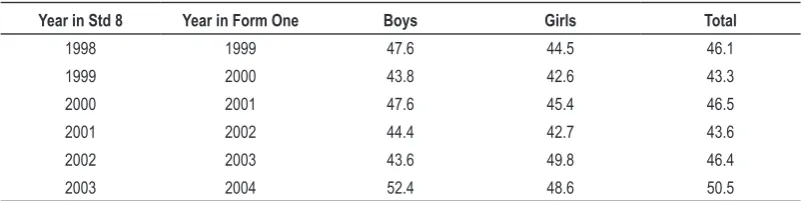
Be that as it may, access to this sector of learning in Kenya has remained restricted over the years. For instance about only 45% of pupils who complete primary level education are selected for entry to the secondary level; see transition rates for 1999 – 2004 in table 3.1. Myriad factors contribute to this low primary to secondary school transition rates. One of these factors is poverty.
table 2.1. Primary to Secondary Education transition rate 1999– 2004.
Year in Std 8 Year in Form One Boys Girls Total
1998 1999 47.6 44.5 46.1
1999 2000 43.8 42.6 43.3
2000 2001 47.6 45.4 46.5
2001 2002 44.4 42.7 43.6
2002 2003 43.6 49.8 46.4
2003 2004 52.4 48.6 50.5
50 Table 4.1 contains enrolment rates between 1999 and 2004 inclusively by province and gender. North Eastern Province posted lowest gross enrolment rate of 5.9% boys and 2.9% girls in 2004 (Republic of Kenya, 2004). A programme lunched by the Government launched to raise pastoralist communities participation in schooling through the provision of boarding schools failed because parents did not send their children to school. Not that pastoralists communities have no interest in education, on the contrary, reluctance lies in their inability to pay the relatively exorbitant school fees and to meet other costs that are required in order to benefit from the boarding schools built for them (Chege and Sifuna, 2006). As such many students from poor backgrounds cannot join and complete the secondary school cycle.
In some of the marginal districts such as Kilifi, Kwale, Lamu, Tana River, Marsabit and Garissa, secondary school enrolment is less than 20%. It is only in high economic areas such as Kiambu and Nyeri in Central Province and Marakwet in Rift Valley Province that have an enrolment of atleast 40% (Kamotho, 2005).
table 3.1. Percentage Secondary School Enrolment rate by Province, 1999-2004.
Province 1999 2000 2001 2002 2003 2004
Boys Girls Boys Girls Boys Girls Boys Girls Boys Girls Boys Girls
Coast 20.3 17.5 20.0 17.3 20.0 17.4 19.3 16.4 22.7 18.3 25.8 19.3
Central 38.5 43.2 40.7 42.0 42.5 44.4 43.2 45.1 42.4 46.4 44.7 45.1
Eastern 28.5 27.4 26.9 26.5 28.7 27.8 29.4 28.5 33.4 32.9 34.9 32.7
Nairobi 23.2 113.6 19.2 12.7 15.8 9.7 13.1 8.1 16.4 6.7 27.5 16.3
Rift valley 24.9 19.7 24.5 19.5 25.7 21.2 25.1 20.7 27.6 24.4 29.3 24.3
Western 28.3 26.4 27.4 24.9 25.2 24.9 26.6 26.2 28.3 29.5 31.7 28.8
Nyanza 28.8 22.6 29.7 22.9 29.2 22.2 30.0 22.6 32.4 28.6 31.9 23.2
North eastern 6.2 2.9 5.7 3.0 5.2 3.0 4.9 2.9 14.1 2.6 5.9 2.9
TOTAL 27.2 24.3 26.8 23.6 27.1 24.2 27.2 24.2 29.7 27.4 31.7 27.3
GRAND
TOTAL 25.7 25.2 25.6 25.7 28.6 29.8
Source: Statistic section, MoE, 2004, Kenya.
In situations where parents cannot pay for both boys and girls, the latter are obvious sacrifice. Boys are allowed to proceed while the girls drop out of school (Republic of Kenya, 2001; Chege and Sifuna, 2004). This explains the great gender disparities in secondary school drop out rates experi-enced in low-income regions of the Republic of Kenya, see table 5.1. For instance, during the years 1999 and 2003, the secondary school drop out rate in Kenya was 5.5 and 6.6 respectively. Nyanza Province recorded the highest rate (9.5 percent) in 2003 with the girls’ rate being 10.3% (Republic of Kenya, 2004). In too many communities, education for girls is not a priority. The main riding actor in such families is poverty (Wekesa, 1993).
table 4.1. Percentage Secondary School dropout rates By Gender and Province, 1999 and 2003.
PROVINCE 1999 2003
Boys Girls Total Boys Girls Total
Coast 5.7 5.0 5.4 7.3 5.3 6.4
Central 4.4 3.6 4.0 6.1 4.4 5.2
Eastern 5.0 5.4 5.2 5.9 5.0 5.5
Nairobi 6.9 7.4 7.1 6.3 4.4 5.5
Rift valley 4.5 6.0 5.1 7.9 7.6 7.7
Western 4.2 5.2 4.6 8.3 9.2 8.8
Nyanza 4.1 5.2 4.6 9.0 10.3 9.5
North eastern 7.8 7.1 7.6 4.0 3.4 3.8
NATIONAL 5.3 5.6 5.5 6.9 6.2 6.6
51
IN THE 21 CENTURY
Volume 8, 2008
discussion
Education is the backbone of growth and development (Ndiku, 2007). It should therefore be provided to all human beings (UNESCO, 2005). Meaningful education calls for massive resource investments. However, the bulk of financing basic education in Kenya rests with the parents among whom majorities are impoverished (Republic of Kenya, 2003). Doubts are therefore cast on the ability of poor parents in providing basic education to their children. Not surprisingly, although Early Childhood Development and Education (ECDE) forms the most important springboard for the total development of an individual and society (Achoka et al, 2007), statistics for Kenya indicate that only 35 percent of the children get quality Early Child-hood Development and Education (Kojwang, 2005).
Many factors are responsible for this state of affair. For example, it is noted that in Ke-nya, the management of ECDE has been long left to the abilities of individuals and affiliated societies. Hence, it is a pity to realize that ECDE in many parts of the country is processed in tiny rooms called “academies” whose managers are not trained teachers or caretakers (Ibid). Such centers are patched either behind shops or in some ‘bandas’ or shanty- like buildings or religious centers with too many activities taking place. Such environments are not conducive for adequate and proper learning (Ibid). The major reason for such haphazard handling of the ECDE is poverty. The proprietors exploit opportunities to make money quickly. Parents, par-ticularly those who do not have much money but want their children to get ECDE take them to the so-called “academies”. Poverty in this case becomes vicious in the provision of basic education for the poor in Kenya.
Children who either do not receive or get low quality early childhood Development and Education exhibit frustration at school, have transitional problem from home to school, poor toilet training habits, are isolated, traumatized and have difficulty coping with school (Kojwang, 2005). It seems this is where majority of Kenyan children fall. But who wants to be in this unfortunate category of persons? This type of up bringing lays a weak foundation for affected individuals and nation at large; it is caused and perpetuated by poverty.
Even at the primary school level, although the Government has spent well over Kenya shilling 36 billion on Free Primary Education with Kshs. 21.1million spent on learning materi-als, overcrowding and teacher shortages continue to impede enrolment, retention of learners and quality of education (The Standard Education Team, 5th Sep 2007). The bottom line in this situation is inadequate funds to provide the needed facilities and personnel (Ngare, 2007).
Seemingly, the policy of cost – sharing in Kenya has become self-defeating. Instead of boosting enrolment in the basic education sector, it highlights drop out rates by region and by gender in such ways that poor region and families record higher rates compared with richer regions and families in Kenya.
The same phenomenon of poverty haunts the secondary school sector. Poverty is the plight of many families in Kenya, leading to poor transition rates from primary to secondary schools. Poor transition rates are particularly worrying because educationalists consider secondary edu-cation critical to the nurturing of a country’s human resources. Indeed secondary eduedu-cation is looked upon as gateway to social and economic advancement, mainly because of its placement between primary and tertiary sectors of education (Kamotho, 2005).
52 Ngare, 2007). Besides, students from such homes dropping out of secondary school education seem to be the norm. Moreover the quality of education offered in such environments is poor (Chege and Sifuna, 2006).
As a result, there has been debate on the issues of quality of education offered at public schools vis-à-vis, private schools in Kenya. For instance, in the recent years, indications are that on national examinations, the best performing schools have consistently been private. Equally important is the perception among parents and students that, with some exceptions, private schools have enough funds, provide better quality education and are more efficiently managed than public schools (Kamotho, 2005). Therefore,, parents in the middle and upper economic classes take their children to the high cost private schools where they believe quality educa-tion is offered while the poor rely on the substandard educaeduca-tion offered in the public schools (Maiyo, et al, 2007). Poverty in this case has far reaching destroyer effect on the majority of the learners.
implications for the poor
As earlier noted, poverty is the world’s current greatest threat to peace and stability (Ndiku, 2007). Unfortunately, more than a half of Kenyan’s 34million people live below poverty level. As such, despite the heavy investment in basic education by the Government, not all children have been able to access it because of poverty; their parents cannot pay required fees. Thus by implication, poverty threatens to destroy the very “road-block” it is meant to reduce if not eradicate.
Moreover, success in the provision of basic education is impeded by high levies imposed on parents through the cost –sharing policy. Impact of this approach to provision of basic education in Kenya is that majority of the parents cannot pay the fees. Consequently their children drop out of school. An implication of the cost – sharing policy therefore is increased basic education dropouts and low transition rates from primary to secondary schools. Majority of the dropouts come from poor families.
Furthermore, distribution of wealth in Kenya has implication for provision of basic edu-cation. Learners in some regions like Central and Rift Valley Provinces are better situated to complete basic education than learners from the ASALs such as North Eastern Province where poverty indices are highest.
More often than not, at the expense of their education, children from humble backgrounds join their weak, sick and ageing parents and guardians in production processes. Together, they farm, fish, mine and even trade in attempt to make ends meet. To say the least, they are trapped in child labour. Free basic education therefore deny such families great ‘resources’ as their children are ‘detained’ in schools. Consequently, such families continue to languish in poverty.
Lastly, implication of provision of basic education vis – a – vis poverty in Kenya seems to point at creation of “Caste system”. In other words, learners from economically well to do families will get best education because their parents can pay for it. These are the minority (10% of the total population) but control 35% of the national income (Republic of Kenya, 2005). They form top “Caste” and are educated in best national and /or private schools. Learners from middle class families receive next best quality education while those from poor families who happen to be the majority in population, hardly complete even the third rate type of education which is provided in “impoverished” environments. Is this the way Kenya wants to develop or under -develop?
recommendations
Suggested below are some of the approaches that could be used to achieve optimal a.
53
IN THE 21 CENTURY
Volume 8, 2008
Make the entire basic education free and compulsory so that there are no extra costs b.
such as levies for paying teachers, school uniforms, school buses, libraries and school buildings. This commitment must be reflected in transparent national budget expenditure management systems that will ensure resources reach the classroom. The country must devote a significant share of domestic generated funds to education. Approach money lending institutions like banks to finance feasible income generating c.
projects set up in schools to boost funds for schools development. This will reduce poor parents’ financial burden.
Ensure equity in disbursement of bursaries and grants for basic education. This will d.
encourage and exonerate the poor.
Intentional tax rebates on learning materials such as computers, books, and laboratory e.
equipment among others will keep the poor longer in the learning systems.
Empower the populace by creating more job opportunities in the service industry f.
and infrastructure. A case of giving fishing gear instead of the fish. This will greatly boost many parents’ ability to access quality of basic education for their children. Setting up of education insurance for the poor, especially the orphaned and other g.
vulnerable groups.
references
Achoka, JSK. (2007). Extent of Parents’ Involvement in Provision and Management of Physical Facilities in Public Secondary Schools in Kenya; Evidence from Rift Valley and Western Provinces. Maseno. Journal of Arts and Sciences, Vol. 2, pp 1-5.
Achoka, J.S.K; Odebero, S; Maiyo, J.K; Ndiku, J.M. (2007). Access to Basic Education In Kenya: Inherent Concerns. Paper presented in the first conference by the Kenya Association of Educational Administration and Management, 9th-11th April. Eldoret: Kenya.
Achoka, JSK. (2003). Parents’ Involvement in Public Secondary School Management: The case of Busia and Uasin Gishu Districts. Unpublished Doctoral Thesis, Kenyatta University, Kenya.
Chege, F.N. and Sifuna D. N. (2006). Girls and Women’s Education in Kenya: Gender Perspectives and Trends.
Nairobi: UNESCO.
Kamotho, K. (2005, Jan 20). Expanding Access to Quality Education. Daily Nation, PP. 23-27.
Kojwang, O. (2005, Jan 20). The Woes of Pre – School Education. The East Africa Standard, PP 3 Col. 1-4 Maina, W. (2007, Sep 12). Target the Needy Students to Achieve Education For All. The East Africa Standard,
PP. 4 Col. 1
Maiyo, J.K, et al. (2007). Income Inequality Controversies on the Development of Education in Kenya: A way forward. Paper presented at Egerton Research week and international conference, July 16th –20th. Egerton,
Kenya.
Ngare, P. (2007, Aug 18). Extra Tuition Costs Burden on Parents. Daily Nation, p.8, col 1-3.
Ndiku, J. M. (2007). The Issue of Poverty in the Provision of Quality Education in Kenya Secondary Schools”.
Educational Research and review, Vol. 2(6). Available via Internet: www.academic journals.org/ERR Nairobi: Eroding the Gains of Free Education. (2007, Sep 5). The East Africa Standard, pp 1, 4 & 5. Todaro, M. (1977). Economics for Developing World. London: Longman Group Ltd.
Republic of Kenya (1988). Presidential Working Party on Education for Manpower Training For Next Decade and Beyond. Nairobi: Government Printer.
Republic of Kenya (1999). First Poverty Report in Kenya. Nairobi: Central Bureau of Statistics and Human Resource and Social Services Departments.
Republic of Kenya (2001). Poverty Reduction Strategy Paper 2001/2004. Nairobi: Government Printer. Republic of Kenya (2003). Economic Recovery Strategy for Wealth and Employment Creation.2003. 2007.
54 Republic of Kenya (2004). Education Statistical Booklet 1999 – 2004. Nairobi: Government Printer.
Republic of Kenya (2005). Millennium Development Goals, Status Report for Kenya. Nairobi: Government Printer.
Siringi S and Macharia, D. (2007, October 3rd) A Million Children Still out of School: Arid areas and Slums
yet to gain fully from learning, says Saitoti. Daily Nation, PP. 8 Col. 4-6.
United Nations Girls Education Initiative-Kenya. (2004). Kenya: Regional Disparities
Threaten Progress towards Education For All. Retreaved September, 27 2007, http://www.ungei.org/infoby-country/kenya_209html.
Adviced by Laima Railienė, Siauliai University, Lithuania
Achoka Judith Serah Kasandi Senior Lecturer at Masinde Muliro University of Science and Technology, Kenya. E-mail: [email protected]
Website: http://www.mmust.ac.ke
Ogenga Paul Akumu Graduate Assistant at Masinde Muliro University of Science and Technology, Kenya.