JOURNAL OF MATHEMATICAL NANOSCIENCE
JMNS
Vol. 3, No. 1, 2013, 23-31.23
A new method for computing ABC index of nanostar
dendrimers
MOHAMMAD ALI HOSSEINZADEH
Department of Mathematics, Tarbiat Modarres University, P. O. Box: 14115-137, Tehran, I. R. Iran
ABSTRACT. The ABC index is a topological index was defined as
uv E G G G G
ABC G( ) (d u( )d v( ) 2) / d u d v( ) ( ), where d ( )G u denotes degree of vertex u.
The second version of ABC index is defined as ABC G2( )uv E (nunv 2) /n nu v where nu
is the number of vertices closer to vertex u than v. In this paper we study some properties of these new topological indices.
1.
I
NTRODUCTIONMathematical chemistry is a branch of theoretical chemistry. The goal of it is prediction of molecular structure by using mathematical methods [1-3]. An important branch of mathematical chemistry is chemical graph theory. Nowadays many of scientists work on this area [4,5].
A graph is a collection of points and lines connecting a subset of them. The points and lines of a graph also called vertices and edges of the graph, respectively. If e is an edge of G, connecting the vertices u and v, then we write e = uv and say "u and v are adjacent". A connected graph is a graph such that there is a path between all pairs of vertices. A simple graph is an unweighted, undirected graph without loops or multiple edges. A molecular graph is a simple graph such that its vertices correspond to the atoms and the edges to the bonds. Note that hydrogen atoms are often omitted.
A topological index for a graph G is a numeric quantity related to G which is invariant under its automorphisms. Obviously, the number of vertices and the number of edges are topological index. The Wiener [6] index is the first reported distance
Jo
u
rn
a
l o
f M
a
th
e
m
a
ti
c
a
l N
a
n
o
S
c
ie
n
c
24
based topological index and is defined as half sum of the distances between all the pairs of vertices in a molecular graph. Let P be the shortest path in G connecting vertices x and y. Then the distance d x yG( , )between x and y is defined as the length of
P.
A class of ABC indices [7] may be defined as u v
uv E general
u v
Q Q
ABC
Q Q
2
, where Qu
is some quantity that in a unique manner can be associated with the vertex u of the graph G. The first member of this class was considered by Vukicevic et al. [8] as
G G
uv E
G G
u v
ABC G
u v
d ( ) d ( ) 2 ( )
d ( )d ( )
,
where d ( )G u is the degree of vertex u. The second member of this class considered
. Here our notations are standard and mainly taken from [10 – 21].
2.
M
AINR
ESULTS ANDD
ISCUSSIONThe goal of this section is computing these new topological indices for chain graphs. Then we use this method to compute the truncated ABC index for an infinite class of nanostar dendrimers. To do this let U { ,u u1 2,...,uk} be a subset of V(G). The truncated ABC index ( )U
ABC is defined as
u u uk G G
uv E G
G G u v U
d u d v
ABC G
d u d v
1,2,...,
( ) ,
( ) ( ) 2 ( )
( ) ( )
i. e.,
U G G
uv E G G G u v U
d u d v
ABC G
d u d v
( ) ,
( ) ( ) 2 ( )
( ) ( )
.
It should be noticed that in the case U = Ø, ABC( )U ( )G ABC G( ). Let Gi (1 ≤ i ≤ n) be
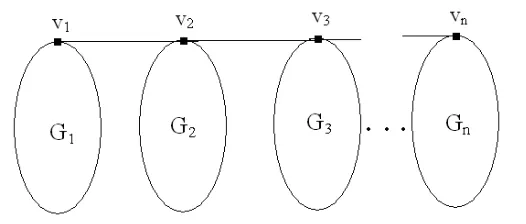
some graphs and viV G( )i . A chain graph denoted by G G G ( 1,...,G vn, ,...,1 vn) is obtained from the union of the graphs G ii, 1,2,...,n, by adding the edges vivi+1 (1 ≤ i ≤
n-1), see Figure 1. Then V G( ) ni1| (V Gi)| and | ( )| (E G n1) ni1| (E Gi)|.
Jo
u
rn
a
l
o
f
M
a
th
e
m
a
ti
c
a
l
N
a
n
o
S
c
ie
n
c
25
Figure 1. The chain graph G G G G ( 1, 2,...,G v vn, 1, 2,...,vn).
It is worth noting that the above specified class of chain graphs embraces, as special cases, all trees (among which are the molecular graphs of alkanes) and all unicyclic graphs (among which are the molecular graphs of mono cyclo alkanes). Also the molecular graphs of many polymers and dendrimers are chain graphs.
Lemma 1. Suppose that G G G G ( 1, 2,...,G v vn, 1, 2,...,vn) is a chain graph. Then:
(i) G G G( 1, 2,...,G v vn, 1, 2,...,vn) is connected if and only if Gi (1 i n) are connected.
(ii).
i
i
i
G i i
G G i
G i
a a V G and a v
a a a v i n
a a v , i n
d ( ) ( )
d ( ) d ( ) 1 , 1,
d ( ) 2 2 1
.
Theorem 2. The truncated ABC index of the chain graph G G G G v v ( 1, 2, 1, 2)
1 2 1
(v v, u ,...,uk) is:
1,..., 2 1,..., ,
1
( ) ( )
k k i
u u u u v
i i
ABC G ABC G +
2
1
( ) ( ) 1
( ) ( ) 1
i i
Gi i i i
G G i
i u N v U G G i
d u d v
d u d v
+
1 2
1 2
1 2
1 2
( ) ( )
( ) 1 ( ) 1
G G
G G
d v d v
d v d v
,
In which Nu( ) {u v V G uv ( )| E G( )}.
Proof.
Jo
u
rn
a
l o
f M
a
th
e
m
a
ti
c
a
l N
a
n
o
S
c
ie
n
c
26
( ) ,( ) ( ) 2
( )
( ) ( )
U G G
uv E G G G
u v U
d u d v
ABC G
d u d v =
2
1 ( ) ,
( ) ( ) 2
( ) ( )
i i
i i
G G
i uv E G G G
u v U
d u d v
d u d v
+ 2
1 ( )
( ) ( ) 2
( ) ( )
i i
G G i
i uv E G G G i
u U
d u d v
d u d v +
1 2
1 2
( ) ( ) 2
( ) ( )
G G
G G
d v d v
d v d v
=
1
2 ,..., ,
1
( )
k i
u u v
i i
ABC G +
2 1( ) ( ) 1
( ) ( ) 1
i i
Gi i
i i
G G i
i u N v U G G i
d u d v
d u d v
+
1 2 1 2 1 2 1 2 ( ) ( )( ) 1 ( ) 1
G G
G G
d v d v
d v d v
.
We use this theorem in the next section.
Theorem 3. If n3 and v1,...,vn u1,...,uk , then for G G G G ( 1, 2,...,G v vn, 1, 2,...,vn) it holds:
1,..., 1,..., ,
1
( ) ( )
k n k i
u u u u v
i i
ABC G ABC G +
1 2 ( ) ( )( ) ( ) 2
i i
Gi i i i
n G G i
i u N v U G G i
d u d v
d u d v
+
1,( ) ( ) 1
( ) ( ) 1
i i
Gi i i i
G G i
i n u N v U G G i
d u d v
d u d v
+
1 1 1 1 2 1( ) ( ) 2
( ) 2 ( ) 2
i i
i i
n G i G i
i G i G i
d v d v
d v d v
+
1 2 1 2 1 2 1 2( ) ( ) 1
( ) 1 ( ) 2
G G
G G
d v d v
d v d v
+
1 1 1 1( ) ( ) 1
( ) 2 ( ) 1
n n
n n
G n G n
G n G n
d v d v
d v d v
27
Proof. By using the definition of the truncated ABC index, one can see that
1 2, ,...,
( ) ,
( ) ( ) 2
( )
( ) ( )
k
u u u G G
uv E G G G
u v U
d u d v
ABC G
d u d v =
1 ( )
,
( ) ( ) 2
( ) ( )
i
n
G G
i uv E G G G
u v U
d u d v
d u d v
+
1 1 1 1 2 1( ) ( ) 2
( ) 2 ( ) 2
i i
i i
n G i G i
i G i G i
d v d v
d v d v
+
1 2 1 2 1 2 1 2( ) ( ) 1
( ) 1 ( ) 2
G G
G G
d v d v
d v d v
+
1 1 1 1( ) ( ) 1
( ) 2 ( ) 1
n n
n n
G n G n
G n G n
d v d v
d v d v
=
1,..., ,
1
( )
k i
n u u v
i i
ABC G +
1 2 ( ) ( )( ) ( ) 2
i i
Gi i i i
n G G i
i u N v U G G i
d u d v
d u d v
+
1,( ) ( ) 1
( ) ( ) 1
i i
Gi i i i
G G i
i n u N v U G G i
d u d v
d u d v
+
1 1 1 1 2 1( ) ( ) 2
( ) 2 ( ) 2
i i
i i
n G i G i
i
G i G i
d v d v
d v d v
+
1 2 1 2 1 2 1 2( ) ( ) 1
( ) 1 ( ) 2
G G
G G
d v d v
d v d v
+
1 2 1 2 1 2 1 2( ) ( ) 1
( ) 1 ( ) 2
G G
G G
d v d v
d v d v
.
Example 2. Consider the graph G1 shown in Figure 2. It is easy to see that
1
( ) 9 2 2
ABC G ,
28
3
1 2 ( )
( ) ( ) ( )
1 1 1 1
( ) ( ) v ( ) ( ) 8 2 2
v v v
ABC G ABC G ABC G ABC G
and so, for 1i j, 3,i j ,
( , ) ( , )
1 1
( ) v vi j ( ) 7 2 2
v v
ABC G ABC G .
( 1, 1, 1, 1)
n i n i i i i
G G G H v u
2 ( 1, n 1, n 1, n 1).
G G G H v u
Then by using Theorem 3, we have the following relations:
( 1) ( 1)
1 1
2
( ) ( ) ( ) 2 2
3
v u
n n
ABC G ABC G ABC H
1 1
( ) ( ) ( , )
1 1
2
( ) ( ) ( ) 2 2
3
i i i i
v v v u
n i n i i
ABC G ABC G ABC H
2 1 2 1
( ) ( ) ( , )
2 1 1
2
( ) ( ) ( ) 2 2
3
n n n n
v v v u
n
ABC G ABC G ABC H .
Summation of these relations yields
1 1 1 1
( ) ( ) ( , )
1 1
2
2
( ) ( ) ( ) ( ) ( 1)(2 2 )
3
n n i i
v u v u
n i
i
ABC G ABC G ABC H ABC H n
and so by using Example 1, it is easy to obtain
1 1 2
( ) ( , )
1 1
2
( ) 2 ( ) ( 2) ( ) ( 1)(2 2 )
3
v v v
n
ABC G ABC G n ABC G n
=
8 2
9 2
3 n 3.
In other words we arrived at the following:
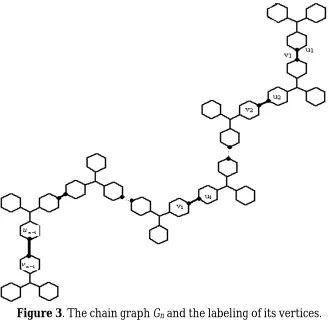
Theorem 4. Consider the chain graph Gn G G( n1,H v u1, 1 1, )(n2, shown in Figure 3. Then,
8 2
( ) 9 2 .
3 3
n
ABC G n
Corollary 5. Consider the nanostar dendrimer D, shown in Figure 4. Then,
8 2
( ) 9 2 ,
3 3
ABC D n
Jo
u
rn
a
l o
f M
a
th
e
m
a
ti
c
a
l N
a
n
o
S
c
ie
n
c
e
Jo
u
rn
a
l
o
f
M
a
th
e
m
a
ti
c
a
l
N
a
n
o
S
c
ie
n
c
29
where n is the number of repetition of the fragment G1.
Figure 3. The chain graph Gn and the labeling of its vertices.
Jo
u
rn
a
l
o
f
M
a
th
e
m
a
ti
c
a
l
N
a
n
o
S
c
ie
n
c
30
Figure 4: The graph of the nanostar dendrimer D.
R
EFERENCES[1] M. V. Diudea, (Ed.), QSPR/QSAR Studies by Molecular Descriptors, NOVA, New
York (2001).
[2] M. V. Diudea, I. Gutman and L. Jäntschi, Molecular Topology, NOVA, New York
(2002).
[3] M. V. Diudea, M. S. Florescu and P. V. Khadikar, Molecular Topology and Its
Applications, EFICON, Bucharest (2006).
[4] I. Gutman and O. E. Polansky, Mathematical Concepts in Organic Chemistry,
Springer - Verlag, New York (1986).
[5] M. A. Johnson, G. M. Maggiora, Concepts and Applications of Molecular Similarity,
Wiley Interscience, New York, (1990).
[6] H. Wiener, J. Am. Chem. Soc., 69 (1947) 17.
[7] B. Furtula, A. Graovac, D. Vukičević, Disc. Appl. Math., 157 (2009) 2828.
[8] D. Vukicevic and B. Furtula, J. Math. Chem. 46 (2009) 1369 .
[9] Ante Graovac and Modjtaba Ghorbani. Acta Chim. Slov., 57 (2010) 609.
[10] B. Zhou, I. Gutman, B. Furtula, and Z. Du, Chem. Phys. Lett., 482 (2009) 153.
Jo
u
rn
a
l o
f M
a
th
e
m
a
ti
c
a
l N
a
n
o
S
c
ie
n
c
31
[11] M. A. Hosseinzadeh and M. Ghorbani, J. Optoelectron. Adv. Mater., 11 (11) (2009)
1671.
[12] N. Trinajstić and I. Gutman, Croat. Chem. Acta, 75 (2002) 329.
[13] D. B. West, Introduction to Graph theory, Prentice Hall, Upper Saddle River
(1996).
[14] A. R. Ashra i, M. Ghorbani and M. Jalali, J. Theor. Comput. Chem., 7, 221 (2008).
[15] A. R. Ashra i, M. Ghorbani and M. Jalali, J. Theor. Comput. Chem., 8, 451 (2009).
[16] A. R. Ashra i, M. Jalali, M. Ghorbani and M. V. Diudea, MATCH Commun. Math.
Comput. Chem., 60, 905 (2008).
[17] M. Ghorbani and M. Jalali, MATCH Commun. Math. Comput. Chem., 62 (2009) 353.
[18] M. Ghorbani, A. R. Ashra i and M. Hemmasi, Optoelectron. Adv. Mater. – Rapid
Comm., 3 (2009) 1306.
[19] A. R. Ashrafi, M. Ghorbani and M. Jalali, Optoelectron. Adv. Mater. – Rapid Comm.,
3 (2009) 823.
[20] A. R. Ashrafi and M. Ghorbani, Optoelectron. Adv. Mater. – Rapid Comm., 3 (2009)
596.
Jo
u
rn
a
l
o
f
M
a
th
e
m
a
ti
c
a
l
N
a
n
o
S
c
ie
n
c