Modern Journal of Language Teaching Methods (MJLTM)
ISSN: 2251 - 6204
www.mjltm.com
Editor – in – Chief
Hamed Ghaemi, Islamic Azad University, Iran
Editorial Board
Abednia Arman
, PhD in TEFL, Allameh Tabataba’i University, Tehran, Iran
Azizi Masoud
, PhD in Applied Linguisitcs, University of Tehran, Iran
Basiroo Reza
, PhD in TEFL, University of Tehran, International Campus,
Iran
Elahi Shirvan Majid
, PhD in TEFL, Ferdowsi University of Mashhad, Iran
Fernández Miguel
, PhD, Chicago State University, USA
Ghaemi Hamide
, PhD in Speech and Language Pathology, Mashhad
University of Medical Sciences, Iran
Grim Frédérique
M. A., Associate Professor of French, Colorado State
University, USA
Izadi Dariush,
PhD candidate in Applied Linguistics, Macquarie University,
Sydney, Australia
Kargozari Hamid Reza
, PhD Candidate in TEFL, Payame Noor University
of Tehran, Iran
Kaviani Amir
, Assistant Professor at Zayed University, UAE
Kirkpatrick Robert
, Assistant Professor of Applied Linguistics, Shinawatra
International University, Thailand
Morady Moghaddam Mostafa,
PhD Candidate in TEFL, University of
Tabriz, Iran
Ndhlovu Finex,
PhD, Linguistics Programme, University of New England,
Australia
Raddaoui
Ali Hechemi,
PhD, Associate Professor of Applied Linguistics,
University of Wyoming in Laramie, USA
Rezaei Saeed
, PhD in TEFL, Sharif University of Technology, Tehran, Iran
Rolstad Kellie,
PhD, Associate Professor of Education, University of
Maryland, USA
Shahbazirad Mohammad
, PhD in English language and Literature, Yerevan
State University, Armenia
Weir George R. S.,
PhD in Philosophy of Psychology, University of
Strathclyde, Glasgow, UK
Zegarac Vladimir
, PhD, University of Bedfordshire, UK
Vol. 3, Issue 3, September 2013
Abstracting/Indexing
Index
Copernicus 2011
Linguistics Abstract
EBSCO Publication
Lulu Publication
Vol. 3, Issue 3, September 2013
Directory of Open Access Journals
ProQuest
Modern Language Association
Cabell's Directories
COPE
Vol. 3, Issue 3, September 2013
Directory of Research Journal Indexing (DRJI)
Indian Citation Index
International Society of Universal Research in Sciences
Vol. 3, Issue 3, September 2013
J-Gate
Ulrich's
Vol. 3, Issue 3, September 2013
TABLE OF CONTENTS
The impact of culturally-oriented texts on the students' listening
comprehension and their motivation in language learning
Abbas Abbasi, Fatemeh Alavi, Zahra Momeni……….….7
Trends affecting second language curriculum in the third millinium
Majid Farahian, Seifodin Rajabi………..…20
The effects of pragmatic instruction on EFL learners' awareness of
suggestions
Seifoddin Rajabi, Majid Farahian…………..………..28
The impact of culture-learning on motivation level of Iranian EFL learners
Zahra Momeni……….. ………39
The effect of intensive vs. Extensive reading on Iranian intermediate EFL learners' knowledge of collocations
Seyyede Zahra Naghibi, Mahmud Pourhassan Moghaddam………..……51
Metalinguistic intuition in FLA: a seminal enterprise deserving deeper
scrutiny
Nassim Golaghaei, Mortaza Yamini ………..67
The effects on listening strategies and listening anxiety by listening
training program among EFL senior high school students in Taiwan
Cheng-Chang Tsai………...83
The effect of using call on the improvement of the listening
comprehension of the intermediate EFL learners
Mohammad Reza Khodashenas, Elaheh Amouzegar………...…94
Extroversion / introversion and breadth of vocabulary knowledge
Nassim Golaghaei and Firooz Sadighi………..102
The impact of using noticing – reformulation tasks on Iranian
low-intermediate EFL learners’ retention of collocations
Ali Eliasi, Reza Mobashshernia, Morteza Khodabandehlu ………..118
The effect of intensive vs. Extensive reading on Iranian intermediate EFL
learners' knowledge of collocations
Seyyede Zahra Naghibi, Mahmud Pourhassan Moghaddam………133
The effect of incidental learning of grammar on Iranian intermediate EFL
learners' paragraph writing
Hamide Vahidi Borji, Morteza Khodabandelu………..149
Output collaborative tasks, noticing, and dyadic learning: a case study of
Iranian advanced EFL learners' use of multi-word verbs
Ali Eliasi, Kiomars Amiri Parandani………...161
Vol. 3, Issue 3, September 2013
THE IMPACT OF CULTURALLY-ORIENTED TEXTS
ON THE STUDENTS' LISTENING COMPREHENSION
AND THEIR MOTIVATION IN LANGUAGE
LEARNING
Abbas Abbasi, PhD Fatemeh Alavi, PhD Zahra Momeni, MA student
Islamic Azad University, Science and Research Branch, Bushehr, Iran [email protected]
Abstract
This study was an attempt to investigate whether teaching culturally-oriented texts to Iranian EFL learners has any influence on their listening comprehension. In addition, the study explored the difference between the motivation level of the students exposed to English culture and those who were not. In order to carry out the research, two groups of EFL learners comprised of 35 students studying English in Zaban Sara Institute and Iran Language Institute in Bushehr took part in this study. Two parallel tests of listening comprehension which were heavily culturally-loaded were administered to both groups to examine their cultural competencies. After that, the two groups received another listening test which was culture-free to determine their listening ability. They were also given a motivation questionnaire to examine the impact of culture on their motivation in learning English. Having analysed the obtained data, the results of the statistical tests revealed that teaching cultural elements can have a significant impact on the performance of the language learners in listening comprehension tests. The study also showed that culture learning does not influence the motivation level of the learners.
Key terms: Communicative competence, Culture, Cultural background, Extrinsic motivation, Intrinsic motivation.
Introduction
The relationship between language and culture has long been a concern for second and foreign language teachers. There have been positive and negative views to incorporating target language culture into second language teaching. Learning a new language entails new ways of thinking and feeling. It is believed that teaching a foreign language is not limited to learning new vocabularies and syntactic structures. It should also be integrated with some cultural elements of that language. As Krasner (1999) believed linguistic competence alone is not enough for learners of a language to be competent in that language. Without the study of culture, teaching second language is inaccurate and incomplete. It is senseless for second language students to know nothing about the people who speak the target language. In other words, the acquisition of a second language is also the acquisition of a second culture. An effective language teaching program should not only enable the learners to be accurate in the
foreign language but alsoto enable them to be culturally competent. People's culture
Vol. 3, Issue 3, September 2013
includes their beliefs, rules of behavior, language, rituals, art, styles of dress, ways of producing and cooking food, and religion. So culture distinguishes one group of people from others. Brown (1994) asserted that culture is like the glue that binds a group of people together.
Iranian EFL learners also need to learn the target language culture along with Persian culture and cultural understanding should be more emphasized in EFL education in Iran. According to Gardener's socio-educational model of learning English language, "students' attitudes to the target culture, their position in the educational situation, their ability to integrate into the target culture and their motivation are connected" (1985, p.65). He maintains that the main factor in this model is motivation. The issue of motivation also plays a major role in the area of EFL/ESL learning, and it is widely accepted as one of the key issues in learning and for over fifty years it has been a significant research topic. In addition, it has been consider ed significant as a basic ingredient of second language acquisition. Homola (1969) says that "motivation is a general term for all the conditions which determine any human activity" (p.7). Therefore, this study discusses the impact of culture on Iranian EFL learners' listening comprehension and it also examines the impact of cultural values on the motivation of learners in learning a foreign language.
Background of the study
The topic of teaching and learning culture has been a matter of considerable interest to language educators and much has been written about the role of culture in foreign language instruction over the past four decades such as, Morain, 1986; Grittner, 1990; Bragaw, 1991; Moore, 1991; Byram and Morgan, 1994. The integration of language teaching with culture teaching dates back to the language teaching theory of the fifties and sixties (Stern, 1983). Since the 1960s, many scholars have concerned themselves with the importance and the crucial aspect in foreign language learning , with Hammerly (1982), Seelye (1984), and Damen (1987) being among those who have considered ways of incorporating culture into language teaching. As Thanasoulas (2001) points out, language teaching is culture teaching, and someone involved in teaching language is involved in teaching culture at the same time. As to the relationship between language and culture, Samovar, Porter, & Jain (1981) believe that culture and communication are inseparable because culture not only dictates who talks to whom, about what, and how the communication proceeds, it also helps to determine how people encode messages. Culture is the foundation of communication.
In a study done with ESL readers Johnson (1982) found that prior cultural background knowledge had a significant effect on reading comprehension scores for a test passage related to a familiar American custom, Halloween. Students first experienced some of the most familiar aspects of Halloween, then they read passages in which there were some familiar and some unfamiliar information. Johnson's most important conclusion was that background knowledge helped increase comprehension more significantly than did knowledge of vocabulary. It is proved that the effects of vocabulary difficulty on reading comprehension are not as clear as the effects of background knowledge (Johnson, 1982). Schmidt-Rinehart (1994) also carried out a study with the main purpose of discovering the effects of topic familiarity on L2 listening comprehension. University students of Spanish at three different course levels listened to two familiar passages, one about a familiar topic and another about a novel topic. The results indicated that the subjects scored considerably higher on the familiar topic than on the new one. On the other hand, all of the students in different levels outscored in listening task of familiar topic. The effect of background
Vol. 3, Issue 3, September 2013
knowledge on listening comprehension was also explored by Sadighi and Zare (2002). Two TOEFL preparation classes allocated to EFL students took part in this study. The experiment group received some treatment in the form of topic familiarity, and their background knowledge was activated. Then a TOEFL test of listening comprehension was administered to both experimental and control groups. The results provided some evidence in support of the effect of background knowledge on listening comprehension. It has been emphasized that without the study of culture, teaching a second language is inaccurate and incomplete. In a study conducted with intermediate level students from the school of Business and Information Technology, Othman and Vanathas (2004) aimed to find out the impact of topic familiarity on listening comprehension and how far certain aspects of the language are likely to be influenced by topic familiarity. The analysis of the scores of pre-test and post-test indicated that topic familiarity helped learners to better comprehend the listening texts. There is clear evidence that the subjects' answers in the post-test are better than those in the pre-test. The finding of this study also revealed that background knowledge has a significant effect on listening comprehension and it can be improved by providing appropriate instructions. It also established that topic familiarity is an essential factor in the comprehension of unfamiliar texts.
Bakhtiarvand and Adinevand (2010) investigated the effect of cultural familiarity in improving Iranian EFL learners' listening comprehension. To achieve this purpose, one hundred and twenty pre-intermediate language learners were selected and, based on systematic random sampling, divided into four groups. Then, the four groups took a listening comprehension test, which included sample authentic listening comprehension materials, as a post-test which was the same as pre-test to see whether or not there were changes regarding their listening proficiency. The results of the post-test showed that the four groups performed differently on the post-test, which was indicative of the fact that greater familiarity to specific culturally-oriented listening materials promoted the Iranian EFL learners' listening proficiency. The experimental group outperformed the control group in their listening comprehension. According to the results of the study, having background knowledge is a key feature of any kind of listening materials, so through having greater exposure to specific culturally-oriented texts, language learners can improve their listening comprehension. The results also indicate that the Iranian EFL course books do not prepare students to cope with the international society.
The significance of learning and teaching culture as an inseparable part of language is pointed out by Abdollahi-Guilani (2011). This study justifies the importance of including culture in the language teaching programs because familiarity with the cultural features of the target language helps the learners to modify their attitude toward other cultures. According to this study, it is important to connect language and culture especially in teaching vocabulary. According to the results, acknowledging that there are cultural differences helps students understand that not only linguistic knowledge but also cultural information is helpful for successful communication.
Karabinar (2012) has questioned the attitudes of language teachers at Turkish universities towards teaching culture. This study investigated the effects of teacher-related variables such as being a native English speaking teacher or non-native English speaking teacher, working at a state or private university, participation in professional development activities on their perception of culture teaching. According to the findings of the study, the topic that is mainly given priority in teaching culture is tangible products of culture such as foods, dresses, types of dwelling and toys. It also showed that the most strongly supported reason for including
Vol. 3, Issue 3, September 2013
culture in FL classrooms is because knowledge of culture is important in a communication and it prevents cultural misunderstanding.
Motivation is one of the most highly studied issues within the field of second language education and it has been long the subject of research of many theoreticians, teachers, and psychologists. Fontana claims that "sufficient learning at school would not take place without motivation" (2003, p. 127). The early work of Gardner and Lambert (1972) posited two major clusters of motivation indices: instrumental and integrative. Integrative motivation, the desire by the student to be liked by people in the target culture, is the major motivational influence on language learning in the school setting.
According to Gardner (1985) individuals with high levels of integrativeness would be expected to view the language learning situation positively, other things being equal and vice versa. And, individuals who are high in integrativeness would also be expected to be high in instrumentality. A number of studies have been conducted to determine the impact of motivation on language learning, such as Gardner (1985), Dornyei (2001), Csizer and Kormos (2008), and Vazquez, Paulina, Guzman and Rodriguez (2010). The majority of the studies in this field showed that increased motivation has a positive effect on EFL learning.
Little, Devitt, and Singleton (1989, p.26) claimed that "authentic texts bring learners closer to the target language culture and make learning more enjoyable and, therefore, more motivating". Peacock (1997) investigated the effect of authentic materials on the motivation of EFL learners. The authentic materials which are used in this research are two poems, some television listening, two short articles, an advice column from a local English-language newspaper, an American pop song, and some English language magazine advertisements. The participants involved were beginner-level students in two classes at a South Korean university EFL institute. Two observation sheets and a self-report questionnaire were used to investigate the study. The results indicated that overall class motivation significantly increased when the learners in this study used authentic materials. It also showed that learners reported authentic materials to be significantly less interesting than artificial materials. It means that the learners were more motivated by authentic materials, but not because they were more interesting.
Target culture interaction and motivation was also the focus of Bongartz & Schneider’s (2003) study. Data was obtained in a one-year period from the social interaction of two English-speaking boys, ages 5 and 7, who acquired German in an immersion context. The data revealed that preferred interactional motivation strategies led to differences in linguistic choices and hence to differences in motivation for linguistic practice.
Yet another study which emphasizes the effect of the L2 culture on learner motivation and progress is that of Sasaki (2004). Using multiple quantitative and qualitative data sources, this study investigated possible changes in Japanese students’ English-writing behavior over a period of three years and a half. The results revealed that over the observation period, all of the students were able to improve their English proficiency, composition, and fluency and that the experiences of the ESL overseas students were quite helpful in improving their writing strategy, motivating them to write better compositions.
As this review has demonstrated, there are a lot of interesting and challenging works going on about culture learning and motivation research. All in all, considering the aforementioned studies, this paper adresses the following research questions:
1. Do the target-culturally-oriented texts have any effect on the language learners'
listening performance?
Vol. 3, Issue 3, September 2013
2. Do the target-culture-free texts have any effect on the language learners' listening
performance?
3. Do the target-culturally-oriented texts have any effect on the language learners'
motivation level?
Based on the above research questions, the following hypotheses were formulated in this study:
1. Target-culturally-oriented texts have no effect on language learners' listening performance.
2. Target-culture-free texts have no effect on the language learners' listening performance. 3. Target culture learning has no effect on the students' motivation level in learning English.
Methodology Participants
The participants of this study were selected among a population of 65 students on the basis of the results of a TOEFL test. To select the homogeneous subjects, the researcher administered the TOEFL test to determine the subjects' listening comprehension proficiency. They were all native speakers of Persian and learners of English as a foreign language. They included two groups. The first group consisted of 20 female Iranian EFL students within the age range of 20-28 who enrolled at Zaban Sara Institute of Bushehr, Iran. They had learnt English through different books written by the well-known applied linguist, Jack C. Richards for about 2 years. Since the books are heavily culturally-oriented, language learners were familiar with cultural values of English. The second group consisted of 15 female Iranian EFL students within the age range of 19-26 who enrolled at Iran Language Institute in Bushehr. They had learnt English through different books which are culture free and published by Iran Language Institute. Thus, they were not very familiar with English culture.
Instruments
The instruments used in this study included four data collection instruments in gathering information on students' knowledge of English culture and also to determine their motivation level in listening performance. The two groups became homogenous by administering the listening section of an actual TOEFL.This test was applied to identify the English listening knowledge of the participants. Then, two parallel heavily culturally-loaded tests of listening comprehension were prepared. After that, the two groups received another listening test consisting of 30 items which was culture-free. The tests are piloted before administering to the participants to detect any unforeseen problems and to collect data to test the reliability and validity of the instruments.
The reliability of the tests was calculated by means of the KR-21 formula. The researcher obtained the reliability index of 0.79 for the culturally-loaded test, and the reliability of the culture-free test was calculated as 0.63. In addition, a motivation questionnaire which consists of 30 items was adapted from Gardner's AMTB (1985) and was employed to probe the impact of culturally-loaded texts on learners' motivation level in learning English.
Data collection
Three kinds of tests were carried out in this study. The participants of the study received a TOEFL test for being homogenous and after that the two groups of learners were given a
Vol. 3, Issue 3, September 2013
parallel listening comprehension test focusing on some American cultural values such as holidays, customs, entertainment, celebrations and festivals, etc. In the meantime, they received another parallel listening comprehension test which was culture-free to determine their equality in listening comprehension ability. In the end, the two groups received the motivation questionnaire to determine any possible difference between their motivation levels for learning English.
Data analysis
The data gathered on the culturally-loaded test was used to elicit the cultural differences between two groups and it was an analysis of foreign culture competence of those who were familiar with foreign culture and then arriving at some conclusions such as lack of ability in listening performances across cultures for those who were not familiar with foreign culture. In addition to descriptive analysis measures such as means, standard deviation, and percentages, independent sample t-test was also run to explore the possible differences between culture learning and listening ability of the learners. The results of the second test determined both groups' listening comprehension ability in culture-free tests. And by administering a motivation questionnaire, the difference between their motivation levels in language learning was determined. All the statistical procedures were conducted by SPSS software. After gathering the required data and in order to see the possible differences between the performance of the two groups in listening comprehension test, one independent t-test was run. In addition, in order to see both groups' listening ability another t-test was run. A Mann-Whitney U test, which is a test for independent samples carrying ordinal values, was used to compare the motivation levels of the participants in the two groups.
Results and Disscusion
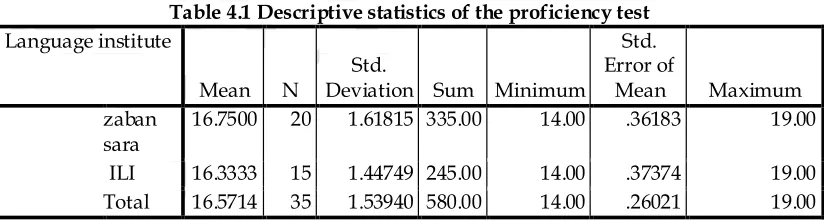
In order to identify the English knowledge of the participants, a proficiency test (TOEFL) was administered to the participants. Table 4.1 shows the descriptive statistics of the participants' scores on the proficiency test.
As can be seen from Table 4.1, the mean of the first group (M=16.75) in this test is a bit higher than the mean of the second group (M=16.33) but the difference is not remarkable. The standard deviations also do not show any great diversity in the distribution of the scores of the two groups. So, according to the results of the proficiency test, they were at the same level of profociency. Having done the required calculations on TOEFL scores of the subjects, the researcher administered the culturally-loaded test to the participants of the two groups to
Table 4.1 Descriptive statistics of the proficiency test
Language institute
Mean N Deviation Sum Minimum Std.
Std. Error of
Mean Maximum
zaban sara
16.7500 20 1.61815 335.00 14.00 .36183 19.00
ILI 16.3333 15 1.44749 245.00 14.00 .37374 19.00
Total 16.5714 35 1.53940 580.00 14.00 .26021 19.00
Vol. 3, Issue 3, September 2013
see any possible difference in their performance. Table 4.2 shows the descriptive statistics of the first group (Zaban Sara), on the first test which was culture-oriented.
Table 4.2 Descriptive statistics of the culturally-loaded test for the two groups
Language
institute N Mean Deviation Std. Error Mean Std.
culturally loaded test 1, 50 scores
zaban sara
20 40.2000 2.14231 .47903
ILI 15 22.9333 4.55861 1.17703
According to the results, the mean of the scores obtained from the administration of this test is 40.20 and the standard deviation is 2.14, for the first group. As is observed, the mean of the scores of the second group for this test is 22.93, which is highly different from the first group. And the standard deviation is 4.55, which shows great diversity in the distribution of the scores. Table 4.2 clearly indicates that the means of the two groups are different and as can be seen in this table, the mean score of the first group is higher than the second group. It is depicted that the first group who were familiar with the target culture outperformed the second group who were not familiar with the target culture. The results of the study made this fact clear that culture familiarity had a positive impact on learners' listening comprehension.
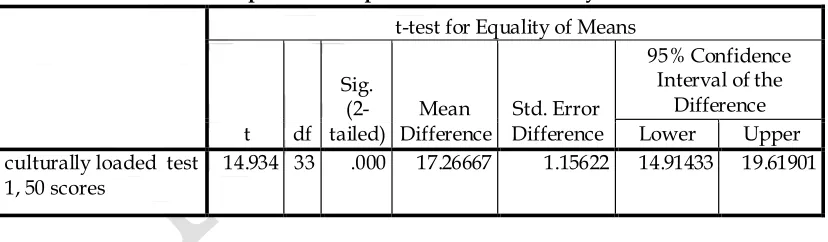
As for the purpose of the study, we wanted to seek the effect of cultural background on the performance of the two groups in the listening comprehension test. So, the t-test was conducted to make sure that the difference in the mean scores of the two groups in the listening comprehension test was statistically significant. The results are shown in Table 4.3 below:
Table 4.3 Independent sample t-test of the culturally-loaded test t-test for Equality of Means
t df
Sig. (2-tailed)
Mean Difference
Std. Error Difference
95% Confidence Interval of the
Difference
Lower Upper
culturally loaded test 1, 50 scores
14.934 33 .000 17.26667 1.15622 14.91433 19.61901
As can be seen from the table above, the results of the t-test indicated that the performance of the first group differed significantly (P = 0.00) from the second group. (M = 40.26, SD = 2.14) (M = 22.93, SD = 4.56) ; t (33) = 14.93, P = 005. In other words, it can be claimed that the participants of the first group who were familiar with the target culture did better on the culturally-loaded test than the second group who were not familiar with the target culture. Therefore, the first null hypothesis of the study which stated that "there is no difference between those students who are familiar with English culture and those who are not, in listening comprehension tests" can safely be rejected and it can be said that there is a
Vol. 3, Issue 3, September 2013
significant difference between the performance of the two groups in the culturally-loaded listening comprehension test. This shows that subjects in the first group performed better in the culturally-loaded test than the second group. It can be stated that culture familiarity has a positive impact on the listening comprehension of the learners.
After that, to examine the subjects' listening ability and to see if the two groups performed statistically differently or not in the listening comprehension test, disregarding their cultural familiarity, another listening test, which was culture-free was administered to both groups. The descriptive statistics are shown in table 4.4. According to this table, the mean score of the first group is 24.75, and the mean score of the second group is 24.20. And the standard deviations also do not show any great diversity in the distribution of the scores of the two groups (1.55 and 1.89).
Table 4.4 Descriptive statistics of the culture-free test for the two groups
Language institute
Mean N
Std.
Deviation Sum Minimum
Std. Error
of Mean Maximum
dimension1
zaban sara
24.7500 20 1.55174 495.00 22.00 .34698 27.00
ILI 24.2000 15 1.89737 363.00 20.00 .48990 27.00
Total 24.5143 35 1.70417 858.00 20.00 .28806 27.00
In order to find out whether or not this difference is statistically significant, another t-test was employed. Table 4.5 shows the results of this t-test.
Table 4.5 Independent sample t-test of the culture-free test
t-test for Equality of Means
T df
Sig. (2-tailed)
Mean Difference
Std. Error Difference
95% Confidence Interval of the Difference
Lower Upper
culture free test
2, 30 scores .943 33 .352 .55000 .58303 -.63618 1.73618
By looking at this table, it can be seen that the second null hypothesis, "There is no significant difference between the listening ability of the two groups in the culture free test" was verified: Zaban Sara students (M = 24.75, SD = 1.89) and ILI students (M = 24.20, SD = 1.89), t(33) = 0.94, P = 0.35. Therefore, low scores of the second group (on the first test), were not due to their listening comprehension ability; rather, lack of culture familiarity was the reason. The listeners who listened to the culturally-oriented texts did not have to deal with unfamiliar terms in the texts and this resulted in better comprehension. So, the participants in the second group could improve their listening comprehension through having greater exposure to target culture texts as one kind of specific culturally-oriented language listening materials.
The other part of the current study investigated the difference between the motivation levels of the learners who were taught English culture and those who were not. Motivation has
Vol. 3, Issue 3, September 2013
long been a significant research topic due to its vital importance in language learning. As mentioned earlier, in order to find the difference between culture learning and the motivation level of the participants under study, Gardner's Attitude / Motivation Test Battery questionnaire was employed. In order to give a comparative picture of the data, means of the two groups were calculated and are shown in the following table. According to this table, the mean score of the first group who were taught English culture is 88.30 and the mean score of the second group who were not taught English culture is 87.26.
Table 4.6 descriptive statistics of the questionnaire
Language institute Mean N Std. Deviation
dimension1
zaban sara 88.3000 20 4.61234
ILI 87.2667 15 2.71153
Total 87.8571 35 3.89678
In order to ascertain whether the difference between the two groups were significant or not in their motivation levels, another statistical analysis was carried out. A Mann-Whitney U test, which is a test for independent samples carrying ordinal values was used to compare the motivation levels for n = 20 students in Zaban Sara versus the n = 15 for ILI students. The resuts indicated no significant difference between these two groups of language learners, U = 128.5, P> 0.05. Thus the third null hypothesis is not rejected. In other words, it can be stated that the means of the two groups are not statistically different. Surprisingly, the two groups did not differ on their answers to the questionnaire.
Table 4.7, Mann-Whitney test for the questionnaire
questionnaire
Mann-Whitney U 128.500
Wilcoxon W 248.500
Z -.722
Asymp. Sig. (2-tailed) .470
Exact Sig. [2*(1-tailed Sig.)] .479a
As is observed these two groups are not different significantly in their motivation levels even though they study different textbooks. Therefore, the difference of motivation levels between students who are familiar with English culture and those who are not, is not statistically significant. In other words, the analysis of the results show that the two groups are statistically similar in their motivation level.
Overall, it can be stated that integrating culture into language teaching programs alone doesn't have a motivating effect on the language learners and the learning process, but rather some other factors can influence students motivation. These factors include the popularity of the language institute in which they learn English, the methodology and the integrated system of that institute, and so on.
Based on the results, a significant difference was observed on the listening performance of the two groups, and it can be stated that culture familiarity has a positive impact on the listening comprehension of the learners. As it was discussed in the preceding part of the study, culture and language learning are linked together and cannot be separated and teaching culture to EFL learners is unavoidable.
Vol. 3, Issue 3, September 2013
The findings of the study show that the first group who were familiar with cultural values of the target language had a better performance in their listening comprehension, as compared with the other group who were not, and this better performance in the listening comprehension tests seems to be the result of the culture familiarity of the target language. This familiarity enabled the students in the first group to successfully identify the cultural elements of the listening test. This ability facilitated their understanding of the text which explains why they performed significantly better in the culturally-loaded test. The lack of cultural knowledge has led to problems faced by the students in the second group in comprehending listening texts and this can present an obstacle to comprehension. All these findings, confirm the significant effect of culture familiarity on language learners' listening comprehension performance. It also showed that failure in comprehending the listening texts in cross-culturalcommunication is seen to be cultural rather than linguistic in
nature. The results ofthe tests leave no doubt that the participants’ communication
problems mainly stemfrom their unawareness and lack of knowledge about the English
culture. As far as the results obtained from the analysis of the data are concerned, it has been concluded that raising students’ cultural awareness is considered an important constituent of every general English course. In other words, knowledge of the cross-cultural patterns is necessary for learning a foreign language and unawareness of cultural barriers may impede learners' success.
The third research question in the study examined whether there is any difference between the learners' motivation levels. Before doing the present study, the researcher supposed that there is a significant difference between the motivation level of the two groups, but based on the results of the questionnaire there was no significant difference between motivation levels of the two groups. Participants' motivation towards the English culture does not seem to be related to the textbooks through which they learn language, since they study completely different textbooks. This explains the fact that students who are familiar with target culture are not generally more motivated than those who are not. Another point to be taken into account is that the books alone do not have the power to motivate students. The results of the questionnaire are in line with Adasko, Britten, and Fahsi (1990) who discovered nothing motivating in using western culture. Overall, it can be stated that integrating culture into language teaching programs does not have a motivating effect on the language learner and the learning process. To sum up, although the participants of the present research studied English through different textbooks, they have the same level of motivation and they are not statistically significantly different in their motivation level.
Conclusions and suggestions
As mentioned earlier, the role of culture learning in the foriegn language classrooms has been the main concern of the current study. Based on the results obtained, it was observed that having cultural information had a positive effect on learners' performance in the listening test, and having cultural background could boost their listening comprehension. Cultural familiarization has a significant effect on listening comprehension and this familiarity enabled the students to successfully comprehend and identify the details of the listening test. This ability facilitated their understanding and, therefore, they performed significantly better than the second group. This is consistent with previous studies (e.g Schmidt-Rinehat, 1994) indicating that topic familiarity facilitates listening comprehension. According to Brown (1994), when language is learned, the culture of that language is learned along with it. One of the main reasons for integrating culture into the language program is to raise awareness
Vol. 3, Issue 3, September 2013
about the target language culture. If students have no background knowledge on a special topic, they are not able to comprehend the questions. Acknowledging the cultural differences helps students not only to understand linguistic knowledge but also to help successful communication. According to what is mentioned about the effective role of culture, the findings of the current study are in line with studies of Markham & Latham (1987), Chiang and Dunkel (1992), and Schmidt-Rinehart (1994), since they all claimed that background knowledge and topic familiarity would improve students' performance in listening comprehension. All in all, the finding of the study showed that the first group had a better performance in comparison to the second group in their listening comprehension and this better performance seemed to be the result of the cultural familiarity that the students obtained during their learning English.
By way of conclusion, the main purpose of this study is that culture teaching should become an integral part of the foreign language curriculum. It seems important and necessary to incorporate culture into an EFL curriculum with a view to increasing the cultural awareness. Such a cultural awareness can develop students' understanding of the target culture and, therefore, develop their tolerance for those whose attitudes and values are different from theirs. On the other hand, the other part of the study which investigated the issues of culture and motivation surprisingly shows that although the learners study different textbooks they have the same motivation level. Therefore, those learners who were familiar with the target culture and those who were not, are not statistically different in their motivation level. These results show that the motivation level of the learners of English is not influenced by the textbooks they study. These two groups study two different textbooks, but their motivation levels as measured in this research are not statistically significantly different. In other words, the analysis of the results shows that the two groups are statistically similar in their motivation levels. The results show that the cultural values alone do not influence the learners' motivation and there are some other motivating factors.
Since this study was narrowed down in terms of its participants, genre, age, etc., it seems necessary to point out some further research to be done in this regard:
1. Considering the fact that this study was limited to only 35 participants, it is suggested that similar studies be conducted with more students.
2. More studies could be done to investigate the effect of culture on other skills, since this study investigated the effect of culture on listening skill.
3. This study was conducted with female learners of English. Similar research could be done with male participants to find out if there is any different result in the findings.
4. The need is felt to carry out similar experiments to investigate whether the effect of culture varies among different age groups.
5. As the materials of the study included Interchange Series, as a heavily culturally-loaded textbook, other sources or textbooks which are culturally-loaded are recommended for further studies.
6. Finally, this study could be replicated with learners at higher and lower levels of language proficiency.
References
Abdollahi-Guilani, M. (2011). Culture-Integrated Teaching for the Enhancement of EFL Learner Tolerance . Asian Social Science, Vol. 8, No. 6; May 2012.
Adasko, K, D. Britten & B. Fahsi. (1990). Design Decisions on the Cultural Content of a
Vol. 3, Issue 3, September 2013
Course for Morocco. ELT Journal.
Bakhtiarvand, M. & Adinevand, S. (2010). Is Listening Comprehension Influenced by the Cultural Knowledge of the Learners?
A Case Study of Iranian EFL pre-intermediate learners. Andimeshk, Iran.
Bongartz, C. & Schneider, M. (2003). Linguistic Development in Social Contexts: A Study of
Two Brothers Learning German. The Modern Language Journal. Retrieved November 29, 2005,
from Blackwell Synergy database.
Bragaw, D. (1991). Priority Curriculum: The global imperative and its metalanguage.
Foreign Language Annals.
Brown, D. (1994). Teaching by principles: An interactive approach to language pedagogy.
Englewood Cliffs, NJ: Prentice Hall Regents.
Brown, D. (1994). Teaching by principles: An interactive approach to language pedagogy.
Englewood Cliffs, NJ: Prentice Hall Regents.
Byran, M., & Morgan, C. (1994). Teaching-and-learning language-and-culture. Clevedon: Multilingual Matters Ltd.
Chiang, C. C., & Dunkel, P. (1992). The effect of speech modification, prior knowledge
and listening proficiency on EFL lecture learning. TESOL Quarterly.
Csizér, K. & Kormos, J. (2008). The relationship of inter-cultural contact and language
learning motivation among Hungarian students of English and German. Journal of
Multilingual and Multicultural Development .
Damen, D. (1987). Culture learning: The fifth dimension in language classroom. Boston: Addison
Wesley.
Dörnyei, Z. (2001). Teaching and researching motivation. Essex: Longman.
Fontana, D. (2003). Psychology ve školni praxi: priručka pro učitele, Praha: Portál, p.127.
Gardner, R. C. (1985). Social psychology and second language learning: The role of attitudes and motivation. p.65. London: Edward Arnold Publishers.
Gardner, R. C. & Lambert, W. E. (1972). Attitudes and motivation in second language learning.
Rowley, MA: Newbury House.
Grittner, F. (1990). Bandwagons revisited: A perspective on movements in foreign language
education. The American Council on the Teaching of Foreign Languages Foreign Language Education Series. Lincolnwood, IL: National Textbook.
Hammerly, H. (1982). Syntheses in language teaching. Blaine, WA: Second Language.
Homola, M. (1969). Otázky motivace v psychologii, Praha: SPN.p.7.
Johnson, P. (1982). Effects on reading comprehension of building background knowledge.
TESOL Q.
Karabinar, S. and, Yunuslar Guler,C. (2012). The Attitudes of EFL Teachers Towards Teaching Culture and Their Classroom Practices.
Journal of Educational and Social Research, Vol. 2 (2).
Krasner, I. (1999). The role of culture in language teaching. Dialog on Language Instruction. Little, D., S. Devitt, and D. Singleton. (1989). Learning Foreign Languages from Authentic Texts: Theory and Practice (P. 26). Dublin: Authentik.
Markham, P., &, Latham, M.L. (1987). The influence of religion-specific background knowledge on the listening comprehension of adult second-language students. Language Learning.
Moore, J. (1991). An analysis of the cultural content of post-secondary textbooks for Spanish: Evidence of information processing strategies and types of learning in reading selections and
Vol. 3, Issue 3, September 2013
post-reading adjunct questions. Unpublished doctoral dissertation, University of Minnesota, Minneapolis.
Morain, G. (1986). Commitment to the teaching of foreign cultures. Modern Language Journal.
Othman, J. and Vanathas, C. (2004). Topic familiarity and its influence on listening
comprehension. The English Teacher.
Peacock, M. (1997). The effect of authentic materials on the motivation of EFL learners. ELT
Journal, volume 51/2.
Sadighi, F. and Zare, S. (2002). Is listening comprehension influenced by the background
knowledge of the learners? A case study of Iranian EFL learners. The linguistics Journal.
Samovar, Larry A., Porter, Richard E. & Jain, N. (1981): Understanding Intercultural Communication. Belmont, CA: Wadswortppph
Sasaki, M. (2004). A Multiple-Data Analysis of the 3.5-Year Development of EFL Student
Writers. Language Learning. Retrieved November 29, 2005, from Blackwell Synergy database.
Schmidt-Rinehart, B. C. (1994). The effect of topic familiarity on second language listening
comprehension. Modern Language Journal.
Schmidt-Rinehart, B. C. (1994). The effect of topic familiarity on second language listening
comprehension. Modern Language Journal.
Seelye, N. (1984). Teaching culture: Strategies for inter-cultural communication. Revised
Stern , H.H. (1983). Fundamental Concepts of Language Teaching. Oxford: Oxford University
Press.
Thanasoulas, D.(2001). The Importance of Teaching culture in the Foreign Language Classroom. Retrieved December 17, 2006 from
http://radicalpedagogy.icaap.org/content.issue_317.thanasoulas.html
Vázquez, Alberto M., Guzmán, Nelly Paulina T., Rodríguez, & Ruth R. (2010). A Small Scale Investigation into Mexican University Student's Language Learning Motivation. [Online] Available: http://revista.inie.ucr.ac.cr/articulos/1.2010/archivos/scale.pdf
Vol. 3, Issue 3, September 2013
TRENDS AFFECTING SECOND LANGUAGE
CURRICULUM IN THE THIRD MILLINIUM
Majid Farahian, Seifodin Rajabi,
Department of Foreign Languages, Kermanshah Branch, Islamic Azad University, Kermanshah, Iran
Corresponding Author: Majid Farahian [email protected]
Abstract
The new millennium has the potentiality to affect education in general and second language curriculum in particular. Different trends in the 21 century have in one way or another affected the language curriculum design and may continue to impact it in the near future. In the context of the globalization of English language teaching which has been promising and at the same time a challenge for English language teaching at an international status, the consideration of the ongoing reform in the curriculum seems to be inevitable. Therefore, the present article discusses some of influential trends such as the philosophical shift, the postmodern movement, the impact of technology, World Englishes and linguistic imperialism. It also argues that all trends can be seen as elements of a continuum overlapping and affecting each other.
Key Words: Curriculum, philosophical shift, the postmodern movement, technology, World Englishes, linguistic imperialism
1. Introduction
Curriculum in general has always undergone changes despite the fact that these changes have sometimes been very drastic and sometimes very subtle. The trend of second language curriculum is no exception. Looking back, we can easily see how foreign and second language teaching has developed over the past few decades. The profession of second language teaching has witnessed the time when there was no curriculum for language teaching and methods imposed their syllabuses to the whole profession. It has moved through the objective curricula under the influence of the linguistics and psychological schools of the time to learner-centered process-oriented syllabuses of the present time. All in all, many trends have affected language curriculum design in the late few decades. However,
we are now in 21 centuryfacing issueswhich are at one hand promising but at the other
chaotic.Foreign languageeducation cannot be properly understood and developed without
understanding the current state of affairs (Tella, 2004).Even the significance of these changes,
as Littlejohn (1998) holds, can lead educationalists to call for a “future curriculum”. Therefore, among the whole range of issues affecting the language curriculum in the third millennium the present article discusses the philosophical shift, the postmodern movement, the impact of technology, World Englishes and linguistic imperialism. As it is discussed, all these trends can be seen as elements of a continuum overlapping and affecting each other.
Vol. 3, Issue 3, September 2013
Therefore, discussing all these issues may help one have the current outlook of the roots of the reform in second language curriculum. Each trend will be discussed here.
2. Philosophical shift
Every important decision ever made about curriculum has been under the influence of philosophy and those to be made in the future would be most likely affected by it (Hopkins, 1941, cited in Salamah, 2001). Like other trends in education, different philosophies of education have had effect on the second language curriculum. Among all philosophical views, Classical Humanism and Rconstructionism have been the two major orientations which provided philosophical orientation for the education in general and second language teaching in particular. However, new ideology called Progressivism with its meaning-centered orientation has begun to substitute the former philosophies. Based on this philosophy, learners’ responsibility for learning and the development of the individual as the
whole person is emphasized (Srijono, 2006). Moreover, bottom up approaches to curriculum
are preferred to the former top-down prescribed approaches which were imposed by those specialists who viewed the curriculum design as a product instead of a process. Progressivism offers a learner-centered approach to education which attempts to promote the pupil’s development. Based on Vermunt and Verschaffel (2000), this process oriented teaching is important for two reasons
From an epistemological perspective, it is important that teaching is aimed at fostering learning processes characterized by active knowledge construction. From a societal point of view, it is important that education takes care that students learn to self-initiate such types of learning. In this way, students acquire a disposition to keep acquiring new knowledge actively and self-directedly after their formal education has come to an end. (p. 209).
The growth through experience which learners acquire with their creative problem-solving capacities has reshaped the whole education. The philosophical orientation, as Nunan (2001) notes, has affected the whole aspects of the curriculum and the trend has been accompanied by the shift from the transmission model of education to an interactive experiential model with an emphasis on the process of learning. Therefore, as White (1988) states in the new perspective “content is subordinate to the learning process and pedagogical procedures.” (p. 46). A process model in English language teaching is represented in task based, needs-based, and learner-based curricula. Such curricula are said to be more flexible and responsive to the needs and interests of the learners they serve (Bolstad, 2004).
3. The postmodern movement
We are moving from a modernist conception of the world to a post-modern conception (Koo, 2002). Proponents of postmodernism rarely agree over what the term 'postmodern' actually means (Finch, 2005). Influenced by diverse disciplines such as phenomenology, existentialism, psychoanalysis, Marxism, and structuralism, Postmodernism, as Pishghadam & Mirzaee (2008) explain, “portrays the human subject as alienated in contemporary society, estranged from his or her authentic modes of experience and being” (p. 91), whether the source of that estrangement is capitalism, or the scientific naturalism.In fact, all forms of postmodernism reject the belief that the study of humanity could be modeled on (objectivity) or be reduced to the physical science (reductionism). Unlike hard sciences, they focus not merely on facts but on the meaning of facts for human subjects. Furthermore, the search for absolute knowledge in science which was the mainstream Western scientific practice is no
Vol. 3, Issue 3, September 2013
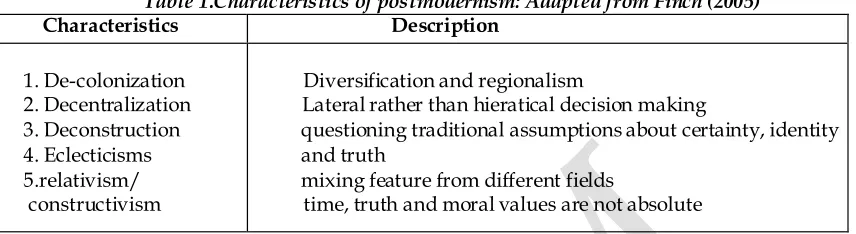
longer accepted in postmodernism. Table 1 represents the summary of the characteristics of postmodernism.
Table 1.Characteristics of postmodernism: Adapted from Finch (2005)
Characteristics Description
1. De-colonization 2. Decentralization 3. Deconstruction 4. Eclecticisms 5.relativism/ constructivism
Diversification and regionalism
Lateral rather than hieratical decision making
questioning traditional assumptions about certainty, identity and truth
mixing feature from different fields
time, truth and moral values are not absolute
Based on the guidelines and despite varying views on postmodernism, one can find some common points regarding the tenets of postmodernism. In Pishghadam and Mirzaee's (2008) words, “they reject global decisions…, question the notion of expertise…, are against absolutism…, and are constructivists… (p.94).
It should not be forgotten that unlike modernism the field of postmodernism is chaotic and therefore difficult to grasp. Breen (1999) who is well aware of the fact explains that
A postmodern perceptive does not resemble a set of pedagogic principles like the communicative approach to language teaching. In essence, postmodern thinking is not concerned with prescriptions for how we may act. It is more a coming together of diverse ideas which seek to interpret the human condition … (p. 47).
It seems that Postmodernism have influenced TESOL in the last few decades and has had some implications for second language teaching (Fahim and Pishgadam, 2009). Along with the development of postmodernism doubt was raised about the concept of method which had preoccupied the ELT profession and this concept was put into question. A number of major criticisms that have recently been leveled against "the notion of all-purpose methods" (see Richards and Rodgers, 2001) and the post-method era began to emerge affected by postmodernism. Under such an influence, as Fahim and Pishgadam (2009) note, postmethod pedagogy is motivated by such trends as,
downplaying the role of experts outside the field;
disbelieving in grand theories and supermethods, embracing only local and
situation-based decisions;
being subjective, giving more power to the teachers as reflective, strategic researchers
are always involved in classroom-oriented action research;
seeking to dispute the theory/practice dichotomy ;
celebrating the diversity of the individual learners, rejecting one-size-fits-all
philosophy (p. 42).
As to the curriculum design, postmodernism sees modernist models as Tyler’s as mechanistic, prescribed, instrumentalistic, behavioristic, and predictable (Pishghadam & Mirzaee, 2008). Based on postmodernist view, such a scientific model of learning is severely limited. Moreover, it takes side with Doll (1993 cited in Bach and Jolly ,2011) who sees a curriculum as a process which is not supposed to transmit what is known to the learners but of exploring what is unknown. Based on such a view, learning and understanding are the
Vol. 3, Issue 3, September 2013
result of dialogue and reflection, the issue which is emphasized in postmodernism. Here, the emphasis is on both the constructive and nonlinear nature of a post-modern curriculum which emerges through the action and interaction of the participants.
4. The impact of technology
From the 20 century on, technology has always been with second language teaching;
however, in 21st century, with the advent of computers and the Internet, technology turned to
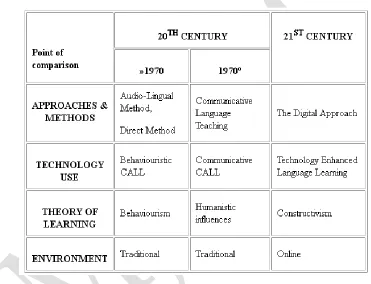
be an integrated part of lots of English teaching courses. (See Table 2).
Table 2: Summary of the evolution of approaches and of technology use in the teaching of ESL adopted from Murphy’s (2000)
Whereas the approaches of the 20th century relied on Behavioristic and Communicative
CALL which reflected the basic philosophical tenets of behaviorism and humanism and in Murphy’s (2000) terms “the computer’s role remained marginal or peripheral with technology being used in a disconnected way”. (P. 22), the Digital Approach of the 21st
century depends on Technology Enhanced Language Learning. The distinction between CALL and Technology-Enhanced Language Learning (TELL) as Murphy notes is that “the computer simultaneously becomes less visible yet more ubiquitous. The change in emphasis from computer to technology places direct importance on the media of communication made possible by the computer, which itself often remains unseen, rather than on the computer itself” (p. 19).
Based on the Digital Approach, Technology use becomes an integral and necessary part of the learning process and not just something added to language courses to motivate students. Contrary to common prescriptive approaches and methods to second and foreign language teaching, the Digital Approach does not dictate or prescribe specific activities, techniques or
Vol. 3, Issue 3, September 2013
methods. Such an approach mainly relies on the use of online rather than traditional learning environments.
As to the learning theories, the constructivist and sociocognitive approaches have been the influential trends which hastened the use of technology in second language curriculum in the 21 century. Warschauer and Meskill (2000) elaborate on the theoretical foundation provided by these approaches for the application of technology. According to Warschauer and Meskill, technologies which are based on constructivism are those which allow learners' maximum opportunity to interact within meaning-rich contexts through which they construct and acquire competence in the language. Thus, in the new perspective, as Warschauer and Meskill maintain, the internet and online interaction facilitate interaction giving maximum opportunity for authentic social interaction. It provides not only comprehensible input but also gives students practice in the kinds of communication they will later engage outside the classroom (Wang, 2005)
Numerous studies have pinpointed the advantages as well as caveats of the implications of technology into second language curriculum; however, it seems that the advantages outweigh the disadvantages. Therefore, as LeLoup and Ponterio (2006) comment, in the new millennium, the question no longer is whether technology should be integrated into the curriculum, but rather how best to do so. Since most of the technologies which are believed to have the potential to improve second language learning are not necessarily invented for this purpose (Zhao, 2005), teachers and learners need to be given enough training in this regard.
5. World Englishes
There is no doubt that the English language has spread and developed rapidly around the world as an International Language (EIL). EIL emphasizes that English, with its many varieties, is a language of international, and therefore intercultural, communication. The
conceptualization of EIL rejects the idea of any particular variety being selected as a lingua
franca for international communication. The recognition of world Englishes (WEs) (Sharifian,
2009) is the central themes ofEIL. Based on WEs, teaching the standard English is no longer
the aim of English language teaching (ELT) courses and some practical issues are posed for
the teachers’ concern:What standard of grammaticalness and correctness shall we use in the
classroom? What pronunciation shall we recommend to the learners, American or British? Why shall we teach English, just to know the English-speaking countries or to make others know us, or both?
Such a conceptualization of the world necessitates that language curriculum design be focused more on teaching and understanding World Englishes (Fang & Yuan, 2009) since, as
D.Brown (1991) puts it, “WEs puts a new light on curriculum design and the specific focus of
classroom activities, especially in nonnative-English-speaking countries” (p. 250). In line with D. Brown, K. Brown (2008) states that “Attention to a world Englishes perspective in choice of methodology and curriculum design will result in an ecologically sound approach to language education…” (p. 689). Canagarajah (2006) has referred to some of the implications and suggested that those involved in the education as well as curriculum planners have to ensure that intelligibility is sometimes more useful than sounding American or British with standard accent. It has also been determined that in the context of world Englishes, teaching cultural differences to establish “a sphere of interculturality” (McKay, 2003, p. 82) is very important for ELT. Meanwhile, the following implications expressed by different scholars can be referred to
Vol. 3, Issue 3, September 2013
particular characteristics relating to culture and identity of each variety of English
should be incorporated in the design of language curriculum (Kirkpatrick, 2007).
Jenkins (2006) believes that “this approach would enable each learner’s and speaker’s English to reflect his or her own sociolinguistic reality, rather than that of a usually distant native speaker” (p. 173).
teachers and learners have been given insight that none of English varieties has
more prestigious stance than others and it has been decided that the variety that best reflects learners’ own language use should be taught;
teachers in different communities have to devise curricula that have local relevance;
as to the development of teaching materials, according to Canagarajah (2006), the
emphasizes is on the localization of the materials and as he adds, “teaching materials have to accommodate the values and needs of diverse settings” (p. 27);
the material developed is the result of the cooperation between local and outside
experts.
since as Canagarajah argues in the realm of WEs, one can no longer expect to see “the top-down imposition of expertise from outside the community”(p. 27);
assessment should take care of growth rather than native-like proficiency. (Caine,
2008).
Different educational systems have begun incorporating such insights into their curriculum in the 21 century and some have continued adopting curricula with no relevance to their own context of use.
6. Linguistic Imperialism
Different intellectual, economic, and cultural factors have resulted in the spread of English across the world. With the spread of English language learners experienced some sense of powerlessness and inferiority with respect to culture they have there are some scholars who see the relationship between the native English speaking community and the foreign or second language learning countries a sort of superior-inferior. It seems that ELT has ideological basis which serves to strengthen the superiority of the English to other languages (Phillipson, 1992 cited in Aliakbari, 2003). Standard British English or American English norms are taken as models and the use of authentic materials which is assumed to be produced by native speakers is supposed to enhance communicative competence. This has resulted in what has been called “the linguistic imperialism”. The powerful spread of English reminds us that linguistic imperialism is getting stronger in the new millennium and cannot be overlooked (Viet, 2008). In such a context, the focus of the curricula, textbooks and materials prepared in different countries, is still largely under the influence of the imposed Anglo-American culture(s) (Seidlhofer, 2003). Such a trend has had consequences which would hasten the process of imperialism and may face resistance on the part of the learners and teachers.
There are scholars (e.g., Seidlhofer, 2003) who have warned us against the spread of the linguistic imperialism in the new millennium. As Aliakbari (2003) notes
The worldwide spread of English should by no means be considered as a homogenizing factor, which causes cultural differences to disappear. Rather the ever-increasing use of English throughout the world offers a medium to express and explain these differences (p. 10).
Vol. 3, Issue 3, September 2013
Aliakbari (2003) explains that both native and nonnative speakers towards English should alter their orientations. This may help impede imperialism. McKey (2003) assets that “It is time to recognize the multilingual context of English use and to put aside the native speaker model of research and pedagogy” (p. 19). On the same page she maintains that it is the time for local educators to “take the ownership of English and the manner in which it is taught”.
7. Concluding Remarks
The new millennium has brought many changes to the world in which we live. Looking back at the present states of affairs, we can easily see how second language teaching has developed and how different trends such as progress in linguistics and psychology have affected teaching English as a second language; however, there have been other trends which have directly or indirectly affected the language curriculum design and continued to impact it in the near future. It is not difficult to see how all these trends are interrelated in one way or another. All three trends; the philosophical shift, the postmodern movement, and technology enhanced language learning, share a constructivist view which regards learning as a dialogue between the participants. Another example for the integrity of the concepts is the incorporation of technology in the 21 century's curriculum which from one hand seems promising and at the other hand may contribute to the process of imperialism. Therefore, any attempt to develop or modernize curriculum in the 21 century should , among all other factors, take care of the interactive nature of these issues.
References
Aliakbari, M. (2003). Linguistic imperialism, linguistic democracy and English language Teaching.
Proceedings of the international conference on information technology and universities in Asia. Chulalongkon University. Bangkok, Thailand.
Bach, J., & Jolly, J. L. (2011). Chalking the profession: Unintended lessons about teaching.
Journal of Curriculum Theorizing, 27(1), 87-98.
Bolstad, R. (2004). School-based curriculum development: Redefining the term for New Zealand schools today and tomorrow. Paper presented at the conference of the New Zealand Association of Research in Education (NZARE) Wellington.
Breen, M. P. (1999). Teaching language in the postmodern classroom. Retrieved June 2011
from http://www.raco.cat/index.php/bells articles
Brown, H. D. (1991). TESOL at twenty-five: What are the issues? TESOL Quarterly, 25, 245–
260.
Brown, K. (2008). Models, methods, and curriculum for ELT preparation. In B. B. Kachru, Y.
Kachru, and C. L. Nelson (Eds.), The handbook of world Englishes (pp. 693-680). Malden:
Blackwell Publishing.
Caine, T. M. (2008). Do you speak global? The spread of English and the implications for
English language teaching. Canadian Journal for New Scholars in Education, 1(1), 1-11.
Canagarajah, S. (2006). TESOL at forty: What are the Issues?TESOL Quarterly, 40(1), 9-34.
Fahim, M., & Pishghadam, R. (2009). Postmodernism and English language teaching. IJALS,
(1)2, 27-54.
Finch, A. E. (2005). The postmodern language teacher: The future of task-based teaching. Retrieved
June 2011 from http://www.finchpark.com/arts/Postmodern_Language_Teacher.pdf Jenkins, J. (2006). Current perspectives on teaching world Englishes and English as a lingua franca. TESOL Quarterly, 40(1), 157-181.
Vol. 3, Issue 3, September 2013
Kirkpatrick, A. (2007). World Englishes: Implications for international communication and
English language teaching. EA Journal, 24(2), 84-86.
Koo, H. C. K. (2002). Quality education through a post-modern curriculum. Hong Kong
Teacher’s Journal, 1, 56-73.
LeLoup, J. W., & Ponterio, R