This work is licensed under the Creative Commons Attribution 4.0 International Licence.
To view a copy o this licence, visit https://creativecommons.org/licenses/by/4.0/
Network Investigation and Performance Analysis
of ZigBee Technology Using OPNET
Ojo Jayeola Adaramola1, Jamiu Rotimi Olasina2
1,2 Department of Computer Engineering, Federal Polytechnic, Ilaro,Ogun State, Nigeria. 1([email protected])
Received (2018-08-23) Accepted (2018-11-10)
Abstract: Communication has become inevitably part of our day to day activities, in academic, business, banking, and other sectors. It has therefore become so important to implement good and efficient communication system. A reference point according to this research is the wireless sensor networking (WSN) system, and most important thing in communication is to be free from interference, attenuation, crosstalk, and fading. Any of these factors is a serious problem in communication system. To solve these problems, mobile and fixed nodes networks were considered for efficient operation of WSN when ZigBee technology was employed and designed using the OPNET when certain network parameters: Throughput (bits/s), load (bits/s), and end-to end delay (second) parameters from fixed and mobile networks were compared and considered for smooth operation of WSN that is free from interference, attenuation, crosstalk and fading. The network investigation and performance analysis of fixed and mobile networks were based on tree, star and mesh topologies between the two systems. After considering all the parameters for various analyses, the fixed network was considered the most suitable over the mobile network for WSN.
Keywords: Network Parameters, OPNET, Topology, Wireless Sensor Network, ZigBee.
I. INTRODUCTION
F
undamentally ZigBee is a specificationon the basis of IEEE 802.15.4 for a suite of high-level communication protocols which are used to create PANs (Personal Area Networks) with small and extremely low-powered digital radios. ZigBee Alliance developed and standardized ZigBee that provides network security and application support services and these were built on top of IEEE 802.15.4 that defines the medium access control and physical layer standard [1]. Based on the low rate- wireless personal area network (LR-WPAN) standard, ZigBee standard has
then become simple, and it provides reliable data transfer, ease of installation, short range operation, extremely low cost, high battery life, low-power, cost effective and it maintains a scalable and flexible protocol. Usually, IEEE 802.15.4 ZigBee network defines three types of devices of which are ZigBee coordinator based in terms of its manner in which it is coordinated and responsible for initializing network, selecting the transmission channel and allowing connection of other ZigBee nodes to its network. It also allows traffic to be routed within a network [2]. ZigBee router acts as an intermediate devices that allow other devices to join the network [3], multi-hop routing, relay packets for other nodes, increase in distance of nodes above 100m and How to cite this article:
210 J. ADV COMP ENG TECHNOL, 4(4) Autumn 2018
aiding in communication for its battery-powered end devices [3]. ZigBee end device by its simplest factor, cannot in any way forward packets, and no individual can depends on it and can also sleep off as to save energy [4], ZigBee utilizes a standard called, CSMA/CA media access mechanism and this standard supports three topologies. These are: Star, mesh and tree. Star topology is the simplest and most limited in functions; but yet, consists of coordinator and several end devices that can communicate only with coordinator that allow packets to be passed, through the coordinator to the required destination with no alternative routes, even when the transmission link between the coordinator and the end device failed. Also, all the packets must pass through coordinator and this may lead to congestion on the network during Transmission. Tree topology is another supported configuration that fits well with the ZigBee, and it comprises of coordinator, routers for network coverage extension and end devices in which only the coordinator and routers can have children and can equally be the parents. Tree topology has no alternative route like the case of a star topology if the transmission link should fail to ensure safety delivery of packets to the destination. The mesh topology therefore consists of one coordinator responsible for the network initialization and maintenance, several routers which are used to extend the network and end devices. Mesh is also regarded as a multi-hop network, a self-healing with alternative path to the destination even when the intended transmission link failed [1] IEEE 802.15.4 defines the three license-free frequency bands as: 1. First band which is at 2.4 GHz frequency band with affordable 16 channels, each with frequency capacity of 250kbps (worldwide); 2. Second band is at 902-929 MHz of frequency bands with affordable 10 channels, each with frequency capacity of 40kbps (America and Australia specification); and 3. Third band is at 868-870 MHz of frequency with affordable but only one channel, each with frequency capacity of 20kbps (Europe) [5]. ZigBee was chosen for research due to the following characteristics: low power design, battery life is between 100-1000 days, transmission range in terms of distance is between 10-100 meters by line- of- sight [2], allocated 16-bit short or 64-bit extended addresses, it is highly a scalable network and the network size is
unlimited and of course it is of the order of 264. The deployment of ZigBee technology is equally expected to have diverse areas of applications such as: point–to-point cable replacement, environmental control, home automation, industrial automation, automated meter reading (AMR), lighting control, security system, military field, high mountainous oriented application and danger zones, and to fit in for hospital patient monitoring [5]. The success of ZigBee technology rests solely on low power consumption, reduced cost, durability and reliability. In determination of excellent performance as regards to basic topologies using the OPNET simulation as a tool that investigates and presents accurate performance analysis of ZigBee technology with respect to network parameters, two scenarios were examined. The two scenarios are: 1. The ZigBee topologies (tree, star, and mesh) in a fixed node were compared with respect to the network parameters in terms of throughput (bits/s), Mac load (bits/s) and end-to end delay (in second). 2. The ZigBee topologies (tree, star, and mesh) in a mobile node were equally compared with respect to the network parameters like throughput (bits/s), load (bits/s) and end-to end delay (in second). Their differences in the generated results by fixed and mobile nodes in the ZigBee network based on these parameters were then obtained, interpreted, analyzed and evaluated.
The article is orchestrated, fashioned hierarchically in terms of structure, and this is divided into: Introduction, Related work, Methodology, Results and Discussion of Results, Conclusions and Future work
II. RELATED WORK
J. ADV COMP ENG TECHNOL, 4(4) Autumn 2018 211
many area such as industrial control system, automation, security surveillance, monitoring wildlife habitat and military field. This scenario is coupled with the fact that ZigBee network model is more appropriate in terms of bandwidth, battery capacity and computing power’s limitation of various available Wireless Network Sensor. However, OPNET Modeler v14 simulator was used to investigate the performance of mesh routing, tree routing and multiple coordinator system with failure in one of the coordinators. Thus, it is therefore declared in the results obtained, that the better the performance of tree routing over mesh routing in WSN , better mobility of end device in multiple coordinator system. However [7], the Interest of research community has been on ZigBee technology because of its wide usefulness in the area of monitoring, controlling and automation and it is also known with characteristics of low cost, little power consumptions and localization. Because of several challenges faced by ZigBee at different network model’s layers, topologies are selected in ZigBee and are thus centered on requirements of application and performance. This thus brings about investigations of ZigBee performance, which based on mesh and tree topologies using OPNET simulation on parameters such as MAC delay, MAC throughput, end-to-end delay, MAC load, and therefore, it is computed in terms of the best performance of these topologies in ZigBee. Also [8], the provision of profitable result for low power consumption and low cost which are characterized with ZigBee network make it a better option for Wireless Sensor Network in various applications such as monitoring medical equipment, home automation, natural disaster condition and industrial control. However, ZigBee protocol was implemented with Optimized Network Engineering Tool (OPNET) 14.5 network to evaluate its effectiveness in both mobile and fixed node network based on end to end delay with respect to network time. It is therefore concluded that end –to-end delay is higher in mobile node with active and failing router node but keep on increasing with increase in time for fixed node while it remains constant for mobile node after some time. Additionally [9], ZigBee which is based on IEEE 802.15.4 standard with characteristics of little power and little processing ability, enables several usage
J. ADV COMP ENG TECHNOL, 4(4) Autumn 2018 212
III. METHODOLOGY
The method was capture in the simulation environment, and this involve the use of OPNET. The fixed and mobile nodes were designed in the OPNET environment. This study therefore investigates and determines the topology that is more suitable for IEEE802.15.4. This is based on the chosen network performance. OPNET modeler 17.1 provides satisfactory platform to conduct the experiment. This is because, OPNET is highly accurate and its sophisticated graphical user interface for wireless network analysis proved itself beyond human doubt.
The research work consists of two separate configured Personal Area Networks, and these are: Fixed nodes and Mobile nodes, and the two are the point of reference for the necessary comparison. These designed PANs consist of one ZigBee Coordinator (ZC), and it is the most capable device that store the needful information about the network, also, five ZigBee Routers (ZR) that act as intermediary, and it also allow data to be passed from one device to another (i.e. router to router/ coordinator/end device) and seven ZigBee end devices (ZED) that has a functionality to talk to either router or the coordinator when the need arise.
Throughput (bits/s), Load (bits/s) and end-to-end delay (second) are the selected parameters as they remained the global statistical data that best describe ZigBee network in terms of performance. The fixed network uses the ZigBee fixed nodes and the mobile network employed the mobile ZigBee nodes from OPNET object palette as shown in Figures 1-6. Tree, Star, and Mesh topologies were deployed in both fixed and mobile PANs. The scenarios are the: Fixed_Star, Fixed¬_Mesh, Fixed_Tree, and Mobile_Star, Mobile_Mesh, Mobile_Tree.
Trajectories are defined from OPNET application for 0.1, 10, 20, 50, 80 and 100 Km/ hour for mobile network as indicated in Table I-III. In each case, simulation scenarios are run for 1 hour and results are recorded from Discrete Event Simulation (DES) Results menu.
Fig, 1. Fixed_Star Scenario
Fig, 2. Fixed_Mesh Scenario
213 J. ADV COMP ENG TECHNOL, 4(4) Autumn 2018
Fig, 4. Mobile_Star Scenario
Fig, 5. Mobile_Mesh Scenario
Fig, 6. Mobile_Tree Scenario
IV. RESULTS
The results were generated by the Discrete Event Simulation (DES) of the OPNET. The generated results therefore showed that, the network performance is significantly different from one another when different network topologies are deployed. In this research work, two ZigBee PANs (IEEE 802.15.4) were considered; that is, one category for fixed node, and the other for mobile node. The performance analyses in terms of comparisons between the two nodes of fixed and mobile nodes were critically and logically criticized before any further establishment for any researcher’s perusal. Network parameters of interest and considerations are: throughput (bits/s), load (bits/s) and end-to end delay (second), and each of these parameters was plotted against the speed. All of which remained the global statistical data of interest when similar matter of this form arise. The load (bits/s) refers to the MAC load on the ZigBee network, throughput (bits/s) is the traffic at a particular moment of span while the end-to-end delay (second) is the span of time between the sending end node and the receiving end node for creation and delivery of packets. In all the cases, the recorded results from DES of OPNET were analyzed using MATLAB for clarity sake and all respective but related graphs were accordingly generated.
A. Fixed ZigBee Network
The following results were obtained for ZigBee PAN with all fixed nodes in OPNET. The related graphical representation can be seen from Figure 7-9. Both ‘As is’ and ‘average’ plotting were studied for brevity, only ‘average’ graphs were presented in most cases.
214 J. ADV COMP ENG TECHNOL, 4(4) Autumn 2018
Fig, 7. MAC Load (bits/s) in Fixed Network
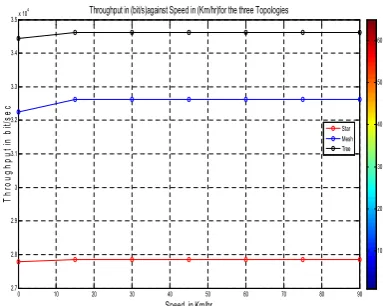
2. Tree topology observed to be higher with 35569.6023 bits/s in Average MAC throughput in fixed ZigBee network than Mesh with 32257.40777 bits/s and Star topology with (27782.0082 bit/s) as indicated in Figure 8, because in tree routing, each end device could only communicates with their respective coordinators and routers but in the case of mesh routing, any device can communicate with any other device.
Fig, 8. MAC Throughput in Fixed Network
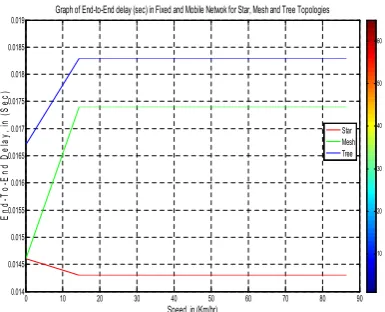
3. Lowest average E-T-E delay was obtained in Star topology with 0.014553872 second for average end-to-end delay in fixed type ZigBee network. It was slightly higher In Mesh that has 0.014574393 second and more higher in Tree topology that has 0.016673851 second as indicated in Figure 9. Therefore, star topology is considered to have being more efficient, because each device joining the network and willing to
communicate with other devices must send its data to the coordinator under any situation.
Fig, 9. End-to-End Delay in Fixed Network
(As Is and Average)
B. Results Obtained in Mobile ZigBee Network
The same parameters were considered in mobile network for Star, Tree, and Mesh topologies and the results obtained are shown in Figures and in Tables for clarity.
Tree topology has the highest MAC load of 34448.1962 (bit/s) as compare to mesh and star with 32258.5436 (bit/s) and 27782.008 (bit/s) of Mac loads respectively, and the justifications have pictorially been presented in Figure 10 as shown below.
Fig, 10. MAC Load (bits/s) in Mobile Network
215 J. ADV COMP ENG TECHNOL, 4(4) Autumn 2018
27849.25402 (bit/s) as pictorially shown in Figure 11 below.
Fig, 11. Throughput in Mobile Network
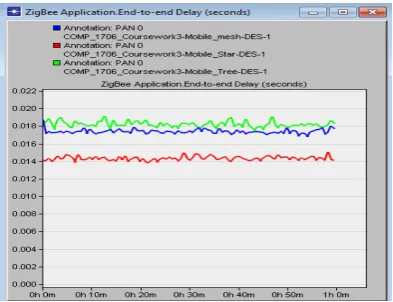
Star topology has the lowest end-to-end delay of 0.014292826 second as compared to tree and mesh topology with 0.018289861 second and 0.017412529 second respectively as presented in Figure 12 below.
Fig, 12. End-to-End Delay (sec) in Mobile Network
C. Comparative study between fixed and
Mobile ZigBee Network
Lastly, the parameters were considered in the perspective of comparison between fixed and mobile network to throw more light on respective performances. Values were presented in the tables for simulation, 0km/h was chosen for fixed ZigBee PAN due to its static condition
while different speed conditions were chosen for mobile PAN in all tables due to dynamic mobility of the nodes.
1. Table 1 presents average load (bits/sec) and as indicated in the table, the higher mac load is presented in tree topology while MAC load is lower in star and mesh topologies for fixed network at 0km/h. Also higher MAC load is presented in tree topology while MAC load is lower in star and mesh topologies for mobile network with variation in speeds. Comparison between the two ZigBee networks confirmed tree topology for fixed network with higher MAC load, while lower MAC load in star topology for mobile network is also confirmed. This is illustrated in Figure 13. Further clarification and pictorial representation using MATLAB is shown in Figure 14 below.
Table I: Average Load (bit/sec)
Average Load (Bits/secs)
Fixed Nodes
Mobile Nodes with Varying Speeds
Topology 0 km/h 0.1 km/h 10 km/h 20 km/h 50 km/h 80 km/h 100
km/h
Star 27880.46 27782.00 27782.00 27782.00 27782.00 27782.00 27782.00
Mesh 29273.70 32258.54 32258.54 32257.41 32257.41 32257.41 32257.41
Tree 35569.60 34448.20 34448.20 34448.20 34448.20 34448.20 34448.20
216 J. ADV COMP ENG TECHNOL, 4(4) Autumn 2018
0 10 20 30 40 50 60 70 80 90
2.7 2.8 2.9 3 3.1 3.2 3.3 3.4 3.5
3.6x 10
4 Speed, (Km/hr) Lo ad s, ( bi ts /s ec )
Plots of Loads of Star,Mesh and Tree Topologies, against Speed
10 20 30 40 50 60 Star Mesh Tree
Fig, 14. Graph Average Load (bit/sec) in Fixed and Mobile Network
2. Table 2 presents throughput (bits/sec) parameter. As indicated in the table, higher throughput is presented in tree topology and lower in star and mesh topologies for fixed network at 0km/h. Also, higher throughput is also presented in tree topology and it lower in star and mesh topologies for mobile network as their speed varied. Comparison carried-out between the two ZigBee networks confirmed tree topology to have been more suitable for fixed network with higher throughput. This is illustrated in Figure 15 and pictorially represented in Figure 16 using MATLAB
Table II: Throughput (bit/sec)
Average Throughput (Bits/Sec)
Fixed Nodes
Mobile Nodes with Varying Speeds
Topology 0 km/h 0.1 km/h 10 km/h 20 km/h 50 km/h 80 km/h 100 km/h
Star 27782.00 27849.25 27849.25 27849.25 27849.25 27849.25 27849.25
Mesh 32257.41 32620.97 32620.97 32617.43 32617.43 32617.43 32617.43
Tree 34448.20 34615.67 34615.67 34615.67 34615.67 34615.67 34615.67
Fig, 15. MAC Throughput (Fixed Vs Mobile)
0 10 20 30 40 50 60 70 80 90
2.7 2.8 2.9 3 3.1 3.2 3.3 3.4 3.5x 10
4 Throughput in (bit/s)against Speed in (Km/hr)for the three Topologies
Speed, in Km/hr
Thr oug hput in bi t/s ec Star Mesh Tree 10 20 30 40 50 60
Fig, 16. Graph Average Throughput (bit/sec) in Fixed and Mobile Network
217 J. ADV COMP ENG TECHNOL, 4(4) Autumn 2018
Table III: End-to-end delay
Average End-to-End Delay (Sec)
Fixed
Nodes Mobile Nodes with Varying Speed
Topol
ogy 0 km/h 0.1 km/h 10 km/h 20 km/h 50 km/h 80 km/h 100 km/h
Star 0.0146 0.014
3 0.0143 0.0143 0.0143 0.0143 0.0143
Mesh 0.0146 0.017
4 0.0174 0.0174 0.0174 0.0174 0.0174
Tree 0.0167 0.018
3 0.0183 0.0183 0.0183 0.0183 0.0183
Fig, 17. End-to-End Delay(s) (Fixed Vs Mobile)
0 10 20 30 40 50 60 70 80 90
0.014 0.0145 0.015 0.0155 0.016 0.0165 0.017 0.0175 0.018 0.0185 0.019
Speed, in (Km/hr)
End
-T
o-E
nd
D
el
ay
, i
n
(S
ec
)
Graph of End-to-End delay (sec) in Fixed and Mobile Netwok for Star, Mesh and Tree Topologies
10 20 30 40 50 60
Star Mesh Tree
Fig, 18. Graph End-to-End delay (sec) in Fixed and Mobile Netwok
V. CONCLUSION
In this research work, IEEE 802.15.4 ZigBee based Wireless Sensor Network was introduced. OPNET 17.1 a leading discrete-event network modelling and simulator were used owing to its exactness and its sophisticated graphical user interface to investigate and analyzed performance of various network parameters. Extensive comparison between three topologies such as star, mesh, and tree in fixed and mobile network to show which is more suitable for WSN representation were done. From the results obtained in table I-III, fixed network established to have been more suitable for WSN with tree topology having the highest MAC load and throughput value with acceptable end-to-end delay when compared with mobile network. Furthermore, other parameters such as packet delivery ratio, packet loss, network lifetime, media access delay could be further investigated as a future work.
ACKNOWLEDGMENT
218 J. ADV COMP ENG TECHNOL, 4(4) Autumn 2018
REFERENCES
1. Elahi, A., and Gschwender, A., 2009. Introduction to the ZigBee Wireless Sensor and Control Network. http:// www.informit.com/articles/article.aspx?p=1409785, last accessed on June 2018.
2. Deepika, S., M., 2014. Effective Data Flow In ZigBee Network Using OPNET. International Conference on Communication and Signal Processing, (pp. 1155-1158)
3. Agawal, A., Agarwal, M., Vyas, M., and Sharma, R., 2013. A Study of Zigbee Technology. International Journal on Recent and Innovation Trends in Computing and Communication, Vol. 1, No. 2, pp. 287 – 292.
4. Saraswala, P., P., 2013. A Survey on Routing Protocols in ZigBee Network. International Journal of Engineering Science and Innovative Technology (IJESIT), Vol. 2, No. 1, pp. 471-476.
5. Vancin, S., and Erdem, E., 2015. Design and Simulation of Wireless Sensor Network Topologies Using the ZigBee Standard. International Journal of Computer Networks and Applications (IJCNA), Vol. 2, No. 3, pp. 135-143.
6. Shayma, W., N., 2012. A Study of ZigBee Network Topologies for Wireless Sensor Network with One Coordinator and Multiple Coordinators. Tikrit Journal of Engineering Sciences, Vol 19, N0 4, pp. 65-81.
7. Manpreet, J., M., 2015. Simulation Analysis of Tree and Mesh Topologies in Zigbee Network. International Journal of Grid Distribution Computing, Vol 8, No. 1, pp. 81-92.
8. Deepika, S., M., 2014, April. Effective Data Flow In ZigBee Network Using OPNET. International Conference on Communication and Signal Processing, (pp. 1155-1158) IEEE
9. Dhaka, H., Jain, A., and Verma, K., 2010. Impact of Coordinator Mobility on the Throughput in a Zigbee Mesh Networks. 2nd International Advance Computing Conference. pp. (279-284) IEEE
10. Vancin, S., and Erdem, E., 2015. Design and Simulation of Wireless Sensor Network Topologies Using the ZigBee Standard. International Journal of Computer Networks and Applications (IJCNA) Vol. 2, No. 3, pp. 135-143