Volume. 7, Issue. 2, Ser. 14, (2018), 1-30
The Study of Stage-like Development of
Morpho-Syntactic Structures in EFL Learners’
Writing Performance: A Processability Theory
Account for Cases of “Plural-s” and
“Adverb Fronting”
Mahin Sadat Tabatabaee
Ph.D. Candidate of TEFL English Language Department Islamic Azad University, Malayer Branch
Hamedan, Iran [email protected]
Keivan Mahmoodi
∗Assistant Professor English Language Department Islamic Azad University, Malayer Branch
Hamedan, Iran Keivan [email protected]
Abbas Bayat
Assistant Professor English Language Department Islamic Azad University, Malayer Branch
Hamedan, Iran [email protected]
Abstract. Processability Theory (PT) is a theory of second language acquisition (SLA) developed to explain developmental sequences in SLA as well as some other phenomena (Pienemann, 1998; 2015). Process-ability has been a significant concern in second language acquisition research since the 1990s. Within the framework of processability the-ory and through analyzing the writing performances of Iranian EFL
Received: November 2017; Accepted: February 2018
∗Corresponding author
1
Journal of Studies in Learning and Teaching English
Volume. 7, Issue. 2, Ser. 14, (2018), 1-30
The Study of Stage-like Development of
Morpho-Syntactic Structures in EFL Learners’
Writing Performance: A Processability Theory
Account for Cases of “Plural-s” and
“Adverb Fronting”
Mahin Sadat Tabatabaee
Ph.D. Candidate of TEFL English Language Department Islamic Azad University, Malayer BranchHamedan, Iran [email protected]
Keivan Mahmoodi
∗ Assistant Professor English Language Department Islamic Azad University, Malayer BranchHamedan, Iran Keivan [email protected]
Abbas Bayat
Assistant Professor English Language Department Islamic Azad University, Malayer BranchHamedan, Iran [email protected]
Abstract. Processability Theory (PT) is a theory of second language acquisition (SLA) developed to explain developmental sequences in SLA as well as some other phenomena (Pienemann, 1998; 2015). Process-ability has been a significant concern in second language acquisition research since the 1990s. Within the framework of processability the-ory and through analyzing the writing performances of Iranian EFL
Received: November 2017; Accepted: February 2018 ∗Corresponding author
2
M. S. Tabatabaee, K. Mahmoodi and A. Bayatlearners, the present research focused on the acquisition of “Plural-s” and “Adverb-fronting” across five proficiency levels, from elemen-tary to advanced, and compared it with the stage-like development model of morpho-syntactic structures proposed by Pienemann (1998, 2015). The study followed a descriptive method of research, and the data was collected from 350 participants at five different proficiency levels from elementary, pre-intermediate, intermediate, upper-intermediate, and advanced. The participants were asked to provide samples of their written s-plural on different tasks such as introduction task, habit-ual action task, story retelling task, picture description task, compo-sition, and communication task. The data in this research was analyzed both qualitatively, in order to identify and classify the type and order of the morpho-syntactic structures and quantitatively, by calculating means. The results of the Kruskal-Wallis test revealed that both “Plural-s” and “Adverb-fronting,” as two morpho-syntactic structures, emerge very early in the language learners’ performance. Just the same, the competence of the learner grows stronger in concern with these vari-ables through the higher proficiency levels. These findings imply that Processability Theory is valid to a considerable extent for Iranian EFL learners, as well.
Keywords:Adverb fronting, plural-s, processability theory, second lan-guage learning, stage-like development
1. Introduction
Processability Theory (PT) is a theory of second language acquisition
(SLA) which was developed to explain developmental sequences in SLA
as well as some other phenomena (Pienemann, 1998; 2015). The
pur-pose of Second Language Acquisition (SLA) research has been to clarify
how the learners acquire a language based on the input they receive
and to describe different patterns in order to indicate systematicity in
the learning and use of L2 (Ellis, 2008). Irrespective of whether it is
a first or second language, one can find a large amount of evidence in
support of the notion that language learning for the speakers of any
lan-guage is systematic (Pienemann, 1995, 1998; Heinsch, 1994; Doughty,
2003; Larsen-Freeman & Long, 1991).
1997) firmly pointed to the idea that language is learned in sequences,
al-though they showed that some amount of variation occurred in language
learning. The existence of L2 acquisition order was initially proposed by
Dulay and Burt (1973, 1974) and Bailey, Madden, and Krashen (1974)
inspired by the research done by Brown (1973). Most of these studies are
considered descriptive since they suggest systematicity and regularity of
L2, but they fail to provide an answer to why this phenomenon
hap-pens. One of the theories that aim to follow an explanatory-adequacy
line in this area is the Processability Theory (PT) presented by
Piene-mann (1998). PT addresses the problem of SLA from a processing point
of view. It claims that some processing operations are used to predict
the developmental order of second language grammar acquisition
regard-less of the language under study. PT aims to offer a cross-linguistically
applicable and psycholinguistically plausible explanation for the stages
and sequences the learners get through in learning to produce
morpho-syntactic structures of the target L2. The logic underlying processability
theory is that: “at any stage of development, the learner can produce
and comprehend only those L2 linguistic forms which the current state
of the language processor can handle”. Therefore, the notion of the
ar-chitecture of the human language processor is crucial in theory. The
architecture of human language processing constrains language
acqui-sition: “learners can acquire only those linguistic forms and functions
which he or she can process’ (Pienemann, 2011b, p. 27).
4
M. S. Tabatabaee, K. Mahmoodi and A. Bayatin the development of the second language needs more investigation at
least in EFL contexts.
Therefore, the primary purpose of the present study was to
cross-sectionally validate the processability theory, in general, and, to test
the written performance of Iranian EFL learners’ use for identifying the
stage-like development of morpho-syntactic structures, in particular by
comparing it with Pienemann’s model to identify whether there is any
consistency or not. To this end, the present research focused on the
ac-quisition of “Plural-s” and “Adverb-fronting” across five proficiency
lev-els from elementary to advanced. The question that guided this research
was whether there was any significant difference among the means of
the frequency of “Plural-s” and “Adverb-fronting” in the interlanguage
of Iranian EFL learners across five proficiency levels.
2. Literature Review
2. 1. Background of the study
morphemes: present progressive; in, on; plural; past irregular;
posses-sive; uncontractible copula; articles; past regular; third person regular;
third person irregular; uncontractible auxiliary; contractible copula; and
contractible auxiliary. Dulay and Burt (1973) adapted this study to L2
acquisition research to study a developmental sequence of grammatical
morphemes in L2 English.
The research paradigm was advanced by looking at various aspects
of language (e.g., morphology and syntax) from various perspectives
(e.g., contrastive, error, textual analysis, and psycholinguistics). They
investigated L2 learners’ developmental sequence of eight morphemes in
L2 English. They collected speech samples from 151 Spanish-speaking
children, aged six to eight, learning English as a second language in the
USA. The results suggested the following standard sequence of
acquisi-tion for individual grammatical morphemes in L2 acquisiacquisi-tion:
1) plural;
2)-ing (progressive);
3) copula;
4) article;
5) auxiliary;
6) irregular past;
7) third person singular; and
8) -’s (possessive).
6
M. S. Tabatabaee, K. Mahmoodi and A. Bayatto the one suggested by Dulay and Burt (1974). Research by Krashen,
Sferlazza, Feldman, and Fathman (1976) tested the acquisition of
En-glish morphemes with 66 adult L2 learners from different L1s. The
re-sults showed a similar acquisition sequence pattern to the one by Bailey,
Madden, and Krashen (1974) regardless of L1. Many studies criticized
these morpheme studies mostly because of the methods that the
stud-ies employed, such as unsuitable criteria for acquisition (based on the
accuracy of morpheme production). Moreover, morpheme studies did
not consider the theoretical explanations for the typical sequence of
ac-quisition, namely what makes acquisition occur, i.e., a property theory,
and why the acquisition of morphemes follows a specific order, i.e., a
transition theory (e.g., Gregg, 2005).
The Multidimensional Model was proposed by Clahsen, Meisel, and
Pienemann (1981) based on further investigations of the morpheme
stud-ies in order to predict a second language acquisition sequence. In this
model, two significant aspects of second language development were
highlighted: fixed development sequence which is not affected by the
individual and environmental differences, as well as various features
responding to the individual and environmental differences. The fixed
developmental sequence is based on the learner’s language processing
capacity, and the variation features rely on the learner variables, such
as the learner’s psychological orientation toward the simplification of
grammar.
Teachability Hypothesis was proposed by Pienemann (1984, 1988b)
based on his application of the multidimensional model to German as a
second language. According to the teachability hypothesis, the
instruc-tion does not change an L2 learner’s acquisiinstruc-tion sequence of grammatical
structures because the L2 learners can skip none of the developmental
stages, which was hypothesized by the multidimensional model.
pro-cesses indicating that language acquisition is reliant on the acquisition
of a set of procedural skills. PT aims to solve the developmental problem
of what causes the development of L2 competence to follow a describable
route. The central construct in this theory is that language-processing
mechanisms constrain SLA. Hence, language development occurs mainly
based on the elimination of these processing constraints (Pienemann,
1998c). Therefore, based on a universal psycholinguistics matrix, namely
the hierarchy of language processability (Pienemann 1988 and 2005), one
can identify the current states of learner’s second language development.
Pienemann (1998c) stated that the three central features of PT are
language-specific, incremental, and linear. According to processability
theory, there are specific procedural skills obligatory for the processing
and the production of utterances in the second language. In the first
stage, learners develop lexicon that is the essential element to all
lan-guage processing in later stages. In the second stage, the learners use
the bound morphemes to produce free morphemes. In the third stage,
disconnected phrases bring together by intra-phrasal components such
as conjunctions.
Nevertheless, learners do not know syntactic structures, and the
or-der of words is based on pragmatics. In the fourth and fifth stages,
lexical features gradually emerge into phrases based on syntactic
knowl-edge. The last stage is consistent with the automatic use of subordinate
clauses.
8
M. S. Tabatabaee, K. Mahmoodi and A. Bayatand how it handles a second language. This enables one to predict the
course of development of L2 linguistic forms in language production and
comprehension across languages. Since knowing about the path of
sec-ond language development provides essential insights into what learners
are ready to acquire in the foreign/second language at any given point
of time and this can support second language learning both in natural
and instructional settings (Kessler, 2008, Pienemann and Kessler 2007).
Pienemann (1998) claimed that English morphology and syntax
de-velop in six stages presented in Table 1.
Table 1:
Developmental stages for English morphology and syntax
(Pienemann, 2005b, p. 24)
The elements presented in Table 1 form a hierarchy so that the element
of a lower stage is a prerequisite for the other elements in the higher
stages, and it is impossible for the stages to be skipped.
6 Table 1
Developmental stages for English morphology and syntax (Pienemann, 2005b, p. 24)
Stage Processing procedure L2 process Morphology Syntax 6 Subordinate clause procedure Main and subordinate
clause Cancel inversion
5 Sentence procedure Inter-phrasal agreement
Subject+ verb agreement(3rd
person singular-s)
Do2nd, Aux2nd
4 Verb phrase procedure Inter-phrasal agreement
Tense agreement Y-N inversion, copula inversion 3 Noun phrase procedure Phrasal information Noun phrase
agreement, negation + verb
Adverb fronting, Do- fronting 2 Category procedure Lexical morphology
Possessive pronouns
Plural Canonical word order 1 Word/lemma Noun procedure Invariant forms Single
constituents
The elements presented in Table 1 form a hierarchy so that the element of a lower stage is a prerequisite for the other elements in the higher stages, and it is impossible for the stages to be skipped.
2.2. Lexical-Functional Grammar
Processability Theory was supported by Lexical Functional Grammar (LFG) as a grammatical theory. LFG belongs to the frame of generative grammar, and feature unification is the main characteristic of this grammar. Put, the process of feature unification ensures that the different parts that constitute a sentence do fit together. (Pienemann, 1998). Kaplan and Bresnan published the original version in 1982 and consisted of three parts. The first part was a constituent structure(=c-structure) component that generates ‘surface structure’ constituents and c-structure relationships. The second part was a lexicon, whose entries contain syntactic and other information relevant to the generation of sentences. The third part was a functional component which compiles for every sentence all the grammatical information needed to interpret the sentence semantically.
It was revised by Bresnan in 2001 and contained additional features that were necessary to preserve the principle of typological plausibility. While the original version only accounted for the constituent structure, Bresnan included an argument and functional structure (a- and f- structure). These structures only appear in the extended version of PT since the original version (1998) was based on the early LFG. Pienemann's choice for Lexical-Functional Grammar was due to many factors. First and foremost, the processability hierarchy of PT relies on the concept of feature unification, and this concept is a central notion in LFG. The concept of feature unification is fundamental to PT because it "captures a psychologically plausible process that involves the identification of grammatical information in the lexical entry, the temporal storage of that
8
M. S. Tabatabaee, K. Mahmoodi and A. Bayatand how it handles a second language. This enables one to predict the
course of development of L2 linguistic forms in language production and
comprehension across languages. Since knowing about the path of
sec-ond language development provides essential insights into what learners
are ready to acquire in the foreign/second language at any given point
of time and this can support second language learning both in natural
and instructional settings (Kessler, 2008, Pienemann and Kessler 2007).
Pienemann (1998) claimed that English morphology and syntax
de-velop in six stages presented in Table 1.
Table 1:
Developmental stages for English morphology and syntax
(Pienemann, 2005b, p. 24)
The elements presented in Table 1 form a hierarchy so that the element
of a lower stage is a prerequisite for the other elements in the higher
stages, and it is impossible for the stages to be skipped.
The Study of Stage-like Development of...9
2.2. Lexical-functional grammar
Processability Theory was supported by Lexical Functional Grammar
(LFG) as a grammatical theory. LFG belongs to the frame of
gen-erative grammar, and feature unification is the main characteristic of
this grammar. Put, the process of feature unification ensures that the
different parts that constitute a sentence do fit together. (Pienemann,
1998). Kaplan and Bresnan published the original version in 1982 and
consisted of three parts. The first part was a constituent
structure(=c-structure) component that generates ‘surface structure’ constituents and
c-structure relationships. The second part was a lexicon, whose entries
contain syntactic and other information relevant to the generation of
sentences. The third part was a functional component which compiles
for every sentence all the grammatical information needed to interpret
the sentence semantically.
It was revised by Bresnan in 2001 and contained additional features
that were necessary to preserve the principle of typological
plausibil-ity. While the original version only accounted for the constituent
struc-ture, Bresnan included an argument and functional structure (a-and
f-structure). These structures only appear in the extended version of
PT since the original version (1998) was based on the early LFG.
Piene-mann’s choice for Lexical-Functional Grammar was due to many
fac-tors. First and foremost, the processability hierarchy of PT relies on the
concept of feature unification, and this concept is a central notion in
LFG. The concept of feature unification is fundamental to PT because
it “captures a psychologically plausible process that involves the
iden-tification of grammatical information in the lexical entry, the temporal
storage of that information and its utilization at another point in the
constituent structure” (Pienemann 2005, 18).
The Study of Stage-like Development of...
9
2.2. Lexical-functional grammar
Processability Theory was supported by Lexical Functional Grammar
(LFG) as a grammatical theory. LFG belongs to the frame of
gen-erative grammar, and feature unification is the main characteristic of
this grammar. Put, the process of feature unification ensures that the
different parts that constitute a sentence do fit together. (Pienemann,
1998). Kaplan and Bresnan published the original version in 1982 and
consisted of three parts. The first part was a constituent
structure(=c-structure) component that generates ‘surface structure’ constituents and
c-structure relationships. The second part was a lexicon, whose entries
contain syntactic and other information relevant to the generation of
sentences. The third part was a functional component which compiles
for every sentence all the grammatical information needed to interpret
the sentence semantically.
It was revised by Bresnan in 2001 and contained additional features
that were necessary to preserve the principle of typological
plausibil-ity. While the original version only accounted for the constituent
struc-ture, Bresnan included an argument and functional structure (a-and
f-structure). These structures only appear in the extended version of
PT since the original version (1998) was based on the early LFG.
Piene-mann’s choice for Lexical-Functional Grammar was due to many
fac-tors. First and foremost, the processability hierarchy of PT relies on the
concept of feature unification, and this concept is a central notion in
LFG. The concept of feature unification is fundamental to PT because
it “captures a psychologically plausible process that involves the
iden-tification of grammatical information in the lexical entry, the temporal
storage of that information and its utilization at another point in the
constituent structure” (Pienemann 2005, 18).
Lexical-Functional Grammar also adjusts to PT because the
gram-mar has proven to be typological plausible. According to Pienemann,
PT has to apply to any given language. Finally, LFG considers language
acquisition as a lexically driven process; hence, it represents a lexical
approach to grammar. In a lexically driven grammar, lexical items can
also contain grammatical information. The words of a language are
con-sidered the atoms of the syntactic structure, signifying that they are the
2.2. Lexical-functional grammar
Processability Theory was supported by Lexical Functional Grammar
(LFG) as a grammatical theory. LFG belongs to the frame of
gen-erative grammar, and feature unification is the main characteristic of
this grammar. Put, the process of feature unification ensures that the
different parts that constitute a sentence do fit together. (Pienemann,
1998). Kaplan and Bresnan published the original version in 1982 and
consisted of three parts. The first part was a constituent
structure(=c-structure) component that generates ‘surface structure’ constituents and
c-structure relationships. The second part was a lexicon, whose entries
contain syntactic and other information relevant to the generation of
sentences. The third part was a functional component which compiles
for every sentence all the grammatical information needed to interpret
the sentence semantically.
It was revised by Bresnan in 2001 and contained additional features
that were necessary to preserve the principle of typological
plausibil-ity. While the original version only accounted for the constituent
struc-ture, Bresnan included an argument and functional structure (a-and
f-structure). These structures only appear in the extended version of
PT since the original version (1998) was based on the early LFG.
Piene-mann’s choice for Lexical-Functional Grammar was due to many
fac-tors. First and foremost, the processability hierarchy of PT relies on the
concept of feature unification, and this concept is a central notion in
LFG. The concept of feature unification is fundamental to PT because
it “captures a psychologically plausible process that involves the
iden-tification of grammatical information in the lexical entry, the temporal
storage of that information and its utilization at another point in the
constituent structure” (Pienemann 2005, 18).
Lexical-Functional Grammar also adjusts to PT because the
gram-mar has proven to be typological plausible. According to Pienemann,
PT has to apply to any given language. Finally, LFG considers language
acquisition as a lexically driven process; hence, it represents a lexical
approach to grammar. In a lexically driven grammar, lexical items can
also contain grammatical information. The words of a language are
con-sidered the atoms of the syntactic structure, signifying that they are the
10
M. S. Tabatabaee, K. Mahmoodi and A. Bayatsmallest units of the language (Fabri, 2008).
2.3. Previous studies
Numerous empirical studies have supported processability theory.
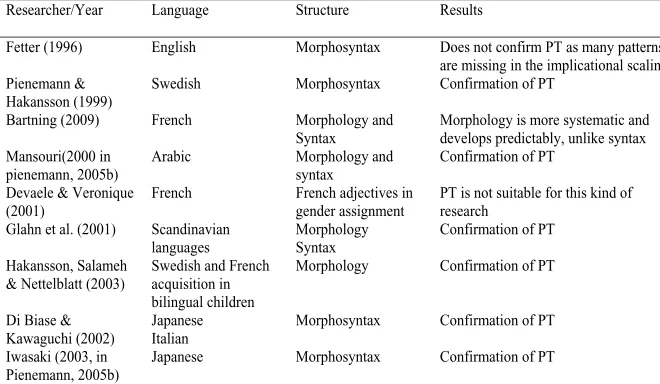
Table 2:
Overview of Interlanguage Researches based on Processibility
Theory from 1996 to 2004 (according to Pienmann, 2005b, p. 61-65)
10
M. S. Tabatabaee, K. Mahmoodi and A. Bayatsmallest units of the language (Fabri, 2008).
2.3. Previous studies
Numerous empirical studies have supported processability theory.
Table 2:
Overview of Interlanguage Researches based on Processibility
Theory from 1996 to 2004 (according to Pienmann, 2005b, p. 61-65)
Table 2 shows that the recent researches confirmed the PT; in other
words, specific structures appear in the predicted order.
10
M. S. Tabatabaee, K. Mahmoodi and A. Bayatsmallest units of the language (Fabri, 2008).
2.3. Previous studies
Numerous empirical studies have supported processability theory.
Table 2:
Overview of Interlanguage Researches based on Processibility
Theory from 1996 to 2004 (according to Pienmann, 2005b, p. 61-65)
Table 2 shows that the recent researches confirmed the PT; in other
words, specific structures appear in the predicted order.
7
information and its utilization at another point in the constituent structure" (Pienemann 2005, 18).
Lexical-Functional Grammar also adjusts to PT because the grammar has proven to be typological plausible. According to Pienemann, PT has to apply to any given language. Finally, LFG considers language acquisition as a lexically driven process; hence, it represents a lexical approach to grammar. In a lexically driven grammar, lexical items can also contain grammatical information. The words of a language are considered the atoms of the syntactic structure, signifying that they are the smallest units of the language (Fabri, 2008).
2.3. Previous Studies
Numerous empirical studies have supported processability theory.
Table 2
Overview of Interlanguage Researches based on Processibility Theory from 1996 to 2004 (according to Pienmann, 2005b, p. 61-65)
Researcher/Year Language Structure Results
Fetter (1996) English Morphosyntax Does not confirm PT as many patterns are missing in the implicational scaling Pienemann &
Hakansson (1999)
Swedish Morphosyntax Confirmation of PT Bartning (2009) French Morphology and
Syntax
Morphology is more systematic and develops predictably, unlike syntax Mansouri(2000 in
pienemann, 2005b) Arabic Morphology and syntax Confirmation of PT Devaele & Veronique
(2001)
French French adjectives in gender assignment
PT is not suitable for this kind of research
Glahn et al. (2001) Scandinavian languages
Morphology Syntax
Confirmation of PT Hakansson, Salameh
& Nettelblatt (2003) Swedish and French acquisition in bilingual children
Morphology Confirmation of PT
Di Biase &
Kawaguchi (2002) Japanese Italian Morphosyntax Confirmation of PT Iwasaki (2003, in
Pienemann, 2005b)
Japanese Morphosyntax Confirmation of PT
Table 2 shows that the recent researches confirmed the PT; in other words, specific structures appear in the predicted order.
10
M. S. Tabatabaee, K. Mahmoodi and A. Bayatsmallest units of the language (Fabri, 2008).
2.3. Previous studies
Numerous empirical studies have supported processability theory.
Table 2:
Overview of Interlanguage Researches based on Processibility
Theory from 1996 to 2004 (according to Pienmann, 2005b, p. 61-65)
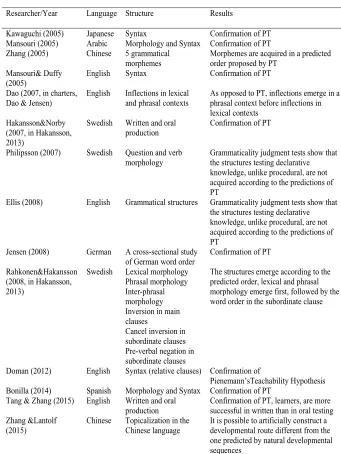
Table 3:
The latest interlanguage research based on Processability
Theory
8
Table 3The latest interlanguage research based on Processability Theory
Researcher/Year Language Structure Results
Kawaguchi (2005) Japanese Syntax Confirmation of PT Mansouri (2005) Arabic Morphology and Syntax Confirmation of PT Zhang (2005) Chinese 5 grammatical
morphemes Morphemes are acquired in a predicted order proposed by PT Mansouri& Duffy
(2005) English Syntax Confirmation of PT Dao (2007, in charters,
Dao & Jensen) English Inflections in lexical and phrasal contexts As opposed to PT, inflections emerge in a phrasal context before inflections in lexical contexts
Hakansson&Norby (2007, in Hakansson, 2013)
Swedish Written and oral
production Confirmation of PT
Philipsson (2007) Swedish Question and verb
morphology Grammaticality judgment tests show that the structures testing declarative knowledge, unlike procedural, are not acquired according to the predictions of PT
Ellis (2008) English Grammatical structures Grammaticality judgment tests show that the structures testing declarative knowledge, unlike procedural, are not acquired according to the predictions of PT
Jensen (2008) German A cross-sectional study
of German word order Confirmation of PT Rahkonen&Hakansson
(2008, in Hakansson, 2013)
Swedish Lexical morphology Phrasal morphology Inter-phrasal morphology Inversion in main clauses
Cancel inversion in subordinate clauses Pre-verbal negation in subordinate clauses
The structures emerge according to the predicted order, lexical and phrasal morphology emerge first, followed by the word order in the subordinate clause
Doman (2012) English Syntax (relative clauses) Confirmation of
Pienemann’sTeachability Hypothesis Bonilla (2014) Spanish Morphology and Syntax Confirmation of PT
Tang & Zhang (2015) English Written and oral
production Confirmation of PT, learners, are more successful in written than in oral testing Zhang &Lantolf
(2015) Chinese Topicalization in the Chinese language It is possible to artificially construct a developmental route different from the one predicted by natural developmental sequences
12
M. S. Tabatabaee, K. Mahmoodi and A. BayatTable 3 displays that most of the structures are acquired according to
the schedule predicted by the PT. Furthermore, it is evident from tables
2 and 3 that, it is possible to predict the path of the second language
by applying PT not only to English but also to other languages as well.
PT has been supported by several empirical studies which have
mainly targeted learners’ oral performance (e.g., Baten, 2011; Dyson,
2009; Kawaguchi, 2009). Recently, the learners’ production, as well as
the reception skills, have been tested using the PT framework (Buyl &
Housen, 2015; Spinner, 2013). These studies have suggested that a
sim-ilar mechanism may be at work for the learners in an L2 development
course concerning both production and reception.
However, the validity of PT has not been adequately tested for
writ-ing performance because the learners’ writwrit-ing -s plural based on PT has
not been sufficiently studied yet. PT studies on writing were done by
Michimoto (2015a; 2015b) in which 45 and 56 Japanese EFL (English
as a foreign language) learners participated respectively. Unfortunately,
technical problems remain in both these studies, and the studies have
insufficient morphological data to meet the PT criterion regarding the
emergence of lexical and morphological variation. The study discusses
how to establish a suitable method for designing writing tasks. In his
more recent study, a reanalysis was done for the data from Michimoto
(2015a) by separating morphology and syntax under recent PT studies
(Eguchi & Sugiura, 2015; Yamaguchi & Kawaguchi, 2014). The results of
the study showed evidence of predictive ability regarding the learners’
syntactic structures based on PT. Also, Hakansson and Norby (2006)
studied Swedish learners’ writing performance. They tested PT with
production and writing tasks such as composition and translation tasks
to elicit target structures from the learners. The results clarified that the
participants produced syntactic structures following PT production in
their speaking and writing, but for some participants, the writing tasks
which allowed planning time helped the participants produce some
tar-get structures that they could not produce in speaking tasks. The results
of writing done by the subjects showed evidence of predictive ability
re-garding the learners’ syntactic structures based on PT.
validity of processability theory among Iranian EFL learners’ oral
per-formance. In order to do research, 10 intermediate EFL learners were
se-lected based on their performance on the Oxford Placement Test. Then,
they participated in five tasks; namely, interview, spot-the-difference
task, picture description, picture identification, and story-telling task.
Their speech was recorded and then transcribed according to
prede-termined target structures (i.e., interrogatives, word order, and
nega-tion). The frequency of the occurrence of target structures was calculated
based on the emergence criterion. The results indicated that Iranian EFL
learners produced language structures in the predicted procedural stages
as proposed by processability theory.
Likewise, Khansir and Zaab (2015) studied the impact of
processabil-ity theory on the speaking skill of Iranian EFL learners. In their study,
Iranian EFL learners’ speaking ability in producing the morpheme
struc-tures was examined through two production tasks. One through the use
of the picture description task designed on the basis of particular focus
on the learners’ ability to use target structures in context; another, was
reconstruction task in which the learners were asked to read and listen
to two audio texts to help the learners focus on forms and elicit the
tar-get structures. The result of this research showed that both tasks were
capable instruments to help EFL learners produce the target structures
in the order predicted by processability theory. In another study,
Mo-hammadkhani, Eslamdoost, and Gholamreza’i (2011) tried to find a
re-lationship between second language instruction and learners’ productive
use of third-person singular-s. Researchers collected written data from
151 participants in three different proficiency groups in two phases. The
findings showed that elementary learners were less developed in their
Interlanguage and are in lower levels of development based on
Process-ability theory (1998, 2003). While advanced and intermediate learners
were in fact in higher levels of processing capacity and could provide the
grammatical structures systematically.
14
M. S. Tabatabaee, K. Mahmoodi and A. Bayatthe present study was an attempt to address this gap by focusing on
the acquisition of “Plural-s” and “Adverb fronting” across five
profi-ciency levels, from elementary to advanced on EFL learners’ writing-s
plural and comparing it with Pienemann’s stage-like development model
of morpho-syntactic structures.
3. Method
Within the framework of processability theory and through analyzing
the written performance of Iranian EFL learners, the present research
focused on the acquisition of “Plural-s” and “Adverb fronting” across
five proficiency levels, from elementary to advanced and compared it
with the stage-like development model of morpho-syntactic structures
proposed by Pienemann (1998; 2015).
Following a descriptive model of research and a post-hoc design, the
purpose was to find out whether the order of emergence of
“Plural-s” and “Adverb fronting” in the Iranian EFL learners’ writing
perfor-mance was compatible with the order presented in Pienemann’s model
or not. Plural-s is plural marking on nouns, for example: “I like cats,”
and adverb fronting is the position of adverb at the beginning of the
sentence before subject to make more emphasis, for example: “Last
sum-mer, I graduated from the university”. According to Pienemann’s PT
model, plural-s occurs at the second stage of second language
develop-ment, and adverb fronting occurs at the third stage of second language
development.
3. 1. Participants
students). They were all adult EFL learners whose age ranged from
18 to 55 years old. They were all native speakers of the Persian
lan-guage learning English through Touch Stone series from elementary to
advance. Each level was divided into 6 terms, and totally the learners
attended language classes for 42 terms. The learners’ proficiency levels
were determined through institutional placement tests.
3.2. Materials
The materials utilized in this study consisted of learner corpora collected
from the EFL learners studying in different branches of Safir institutes
in Tehran. The corpora were 350 writings from five levels of elementary,
pre-intermediate, intermediate, upper-intermediate, and advanced. The
writings were elicited through different writing tasks, such as picture
description task, routine action task, story writing task, story retelling
task, audio-video retelling task, communication task, introduction task,
and composition. Two TEFL professors approved the construct validity
of the procedure for eliciting the writing performance. For content
va-lidity, the researchers made sure that the topic chosen for writing tasks
were general enough, and they matched the topics covered through the
classes.
3.3. Data collection procedures
16
M. S. Tabatabaee, K. Mahmoodi and A. Bayat4. Results and Discussion
The present study aimed at investigating the stage-like development of
morpho-syntactic structures in the EFL learners’ writing performance
concerning “-s plural” and “adverb fronting” at different levels from
elementary, pre-intermediate, intermediate, upper-intermediate and
ad-vanced levels. The data in this research was analyzed both qualitatively
(in order to identify and classify the type and order of the
morpho-syntactic structures), and quantitatively (using SPSS and analysis
throu-gh cross-tabulation, normality test, and Kruskal-Wallis). In this part,
the results of the data analysis are presented.
4. 1. Result for “Plural-S”
The first morpho-syntactic variable which was studied in this research
was the processability of “Plural- S” across the five mentioned levels
from elementary to advanced.
Table 4. 1:
Level * Crosstabulation for plural-s
In Table 4.1, the lowest and highest score and also the frequency for the
scores regarding language learners’ performances for the correct usage
of “plural-s” have been illustrated. As it is observed, “plural-s” emerges
in the very early stages of learner language and its frequency of
us-age increases along the higher stus-ages of proficiency. The next step for
this variable is to show the graphic representation of the distribution of
plural-s across five levels from elementary to advance.
12 Table 4. 1
Level * Crosstabulation for plural-s
0 1 2 3 4 5 6 7 8 9 10 11 12 13 14 15 16 17 18 19 20 21 23 25 26 27 28 33
Tota l
Le
ve
l Elementary 1
6 5 10 9 3 3 8 3 1 1 1 0 0 1 1 0 0 0 0 0 0 0 0 0 0 0 0 0 62
Preintermediate 5 0 5 6 6 4 5 1 4 3 1 0 1 1 0 0 0 1 0 0 1 0 0 1 0 0 0 0 45
Intermediate 3 0 7 5 2 6 5 0 1 2 1 1 2 2 2 2 1 1 0 0 0 0 0 0 0 0 0 0 43
Upperintermediat e
1
2 2 12 8 5 8 9 7 9 2 6 2 6 2 0 0 3 0 2 1 2 1 0 1 0 0 0 0 100
Advanced 4 0 2 6 5 5 7 2 9 0 14 3 5 3 5 6 3 1 3 1 7 3 1 0 2 1 1 1 100
Total 4
0 7 36 34 21 26 34 13 24 8 23 6 14 9 8 8 7 3 5 2 10 4 1 2 2 1 1 1 350
In Table 4.1, the lowest and highest score and also the frequency for the scores regarding language learners' performances for the correct usage of "plural-s” have been illustrated. As it is observed, “plural-s” emerges in the very early stages of learner
language and its frequency of usage increases along the higher stages of proficiency. The next step for this variable is to show the graphic representation of the distribution of plural-s across five levels from elementary to advance.
16
M. S. Tabatabaee, K. Mahmoodi and A. Bayat4. Results and Discussion
The present study aimed at investigating the stage-like development of
morpho-syntactic structures in the EFL learners’ writing performance
concerning “-s plural” and “adverb fronting” at different levels from
elementary, pre-intermediate, intermediate, upper-intermediate and
ad-vanced levels. The data in this research was analyzed both qualitatively
(in order to identify and classify the type and order of the
morpho-syntactic structures), and quantitatively (using SPSS and analysis
throu-gh cross-tabulation, normality test, and Kruskal-Wallis). In this part,
the results of the data analysis are presented.
4. 1. Result for “Plural-S”
The first morpho-syntactic variable which was studied in this research
was the processability of “Plural- S” across the five mentioned levels
from elementary to advanced.
Table 4. 1:
Level * Crosstabulation for plural-s
-Figure 4. 1.
The frequency for the scores about language learners’
performance for actual usage of “plural-s.”
In order to find out if there is any significant difference among the
dis-tributions of “plural-s” across the levels, a comparison of the means
distribution for each level was necessary. To choose the appropriate
sta-tistical test, the normality was checked.
Table 4. 2:
Tests of Normality for plural-s
Table 4.2 shows that the data is not distributed normally (
sig. <
05).
There-fore, the Kruskal-Wallis test was chosen to compare the means of
distri-bution of “plural-s” at each level.
13
Figure 4. 1. The frequency for the scores about language learners' performance for actual usage of "plural-s."
In order to find out if there is any significant difference among the distributions of
“plural-s” across the levels, a comparison of the means distribution for each level was
necessary. To choose the appropriate statistical test, the normality was checked.
Table 4. 2
Tests of Normality for plural-s
Level
Kolmogorov-Smirnova Shapiro-Wilk Statistic df Sig. Statistic df Sig. Elementary .177 62 .000 .868 62 .000 Preintermediate .180 45 .001 .835 45 .000 Intermediate .202 43 .000 .906 43 .002 Upperintermediate .128 100 .000 .913 100 .000 Advanced .115 100 .002 .962 100 .006 a. Lilliefors Significance Correction
13
Figure 4. 1. The frequency for the scores about language learners' performance for actual usage of "plural-s."
In order to find out if there is any significant difference among the distributions of
“
plural-s
” across the levels, a comparison of the means distribution for each level was
necessary. To choose the appropriate statistical test, the normality was checked.
Table 4. 2
Tests of Normality for plural-s
Level
Kolmogorov-Smirnova Shapiro-Wilk Statistic df Sig. Statistic df Sig.
Elementary .177 62 .000 .868 62 .000
Preintermediate .180 45 .001 .835 45 .000
Intermediate .202 43 .000 .906 43 .002
Upperintermediate .128 100 .000 .913 100 .000
Advanced .115 100 .002 .962 100 .006
a. Lilliefors Significance Correction
The Study of Stage-like Development of...
17
-Figure 4. 1.
The frequency for the scores about language learners’
performance for actual usage of “plural-s.”
In order to find out if there is any significant difference among the
dis-tributions of “plural-s” across the levels, a comparison of the means
distribution for each level was necessary. To choose the appropriate
sta-tistical test, the normality was checked.
Table 4. 2:
Tests of Normality for plural-s
Table 4.2 shows that the data is not distributed normally (sig. <
05).
There-fore, the Kruskal-Wallis test was chosen to compare the means of
distri-bution of “plural-s” at each level.
The Study of Stage-like Development of...
17
-Figure 4. 1.
The frequency for the scores about language learners’
performance for actual usage of “plural-s.”
In order to find out if there is any significant difference among the
dis-tributions of “plural-s” across the levels, a comparison of the means
distribution for each level was necessary. To choose the appropriate
sta-tistical test, the normality was checked.
Table 4. 2:
Tests of Normality for plural-s
18
M. S. Tabatabaee, K. Mahmoodi and A. BayatTable 4. 3:
Ranks for plural-s
Table 4. 3 provides the mean rank of the participants at each proficiency
level for their performance regarding plural-s.
Table 4. 4:
Kruskal Wallis Test for plural-s
According to Table 4.4, there is a statistically significant difference
among the distribution of “plural-s” across language learners’ level of
proficiency (sig. <
0.05).
4. 2. Results for “Adverb fronting”
The next variable studied in
this article was “adverb fronting” usage across the levels.
14
Table 4.2 shows that the data is not distributed normally (sig.<05). Therefore, the
Kruskal-Wallis test was chosen to compare the means of distribution of
“
plural-s
”
at
each level.
Table 4. 3 Ranks for plural-s
Level N Mean Rank
Plural S True Elementary 62 101.96
Pre-intermediate 45 154.57
Intermediate 43 170.05
Upper-intermediate 100 169.36
Advanced 100 239.01
Total 350
Table 4. 3 provides the mean rank of the participants at each proficiency level for
their performance regarding plural-s.
Table 4. 4
Kruskal Wallis Test for plural-s
Chi-Square 75.005
Df 4
Asymp. Sig. .000
a. Grouping Variable: Level
According to Table 4.4, there is a statistically significant difference among the
distribution of
“
plural-s
”
across language learners’ level of proficiency
(sig.<0.05).
4. 2. Results for “Adverb fronting"
The next variable studied in this article was “
adverb fronting
” usage across the
levels.
14
Table 4.2 shows that the data is not distributed normally (sig.<05). Therefore, the
Kruskal-Wallis test was chosen to compare the means of distribution of
“plural-s”
at
each level.
Table 4. 3
Ranks for plural-s
Level
N
Mean Rank
Plural S True
Elementary
62
101.96
Pre-intermediate
45
154.57
Intermediate
43
170.05
Upper-intermediate
100
169.36
Advanced
100
239.01
Total
350
Table 4. 3 provides the mean rank of the participants at each proficiency level for
their performance regarding plural-s.
Table 4. 4
Kruskal Wallis Test for plural-s
Chi-Square
75.005
Df
4
Asymp. Sig.
.000
a. Grouping Variable: Level
According to Table 4.4, there is a statistically significant difference among the
distribution of
“plural-s”
across language learners’ level of proficiency
(sig.<0.05).
4. 2. Results for “Adverb fronting"
The next variable studied in this article was “
adverb fronting
” usage across the
levels.
15 Table 4. 5
Level * Crosstabulation for Adverb fronting
0 1 2 3 4 5 6 7 8 9 10 12 15 Total
Level
Elementary 27 16 9 3 2 2 1 2 0 0 0 0 0 62 Preintermediate 17 10 4 3 2 1 2 2 2 0 1 1 0 45 Intermediate 8 9 7 5 5 2 1 2 1 0 1 1 1 43 Upperintermediat
e 19 14 17 26 7 15 1 1 0 0 0 0 0 100 Advanced 6 12 17 19 10 15 7 2 8 1 3 0 0 100 Total 77 61 54 56 26 35 12 9 11 1 5 2 1 350
In Table 4.5, the lowest and highest score and also the frequency for the scores concerning language learners' performance for correct usage of "adverb fronting" have been illustrated. The table shows that "adverb fronting" emerges in the early stages and the ability to use it grows stronger as the proficiency of the learners increases. The next step for this variable is to show the graphic representation of the distribution of adverb fronting across five levels from elementary to advanced.
Figure 4. 2. The frequency for the scores regarding language learners' performance for actual usage of "Adverb fronting."
In order to find out if there is a significant difference among the distributions of "adverb-fronting” across the levels, a comparison of the means distribution for each level was necessary. To choose the appropriate statistical test, the normality was checked.
The Study of Stage-like Development of...
19
Table 4. 5:
Level * Crosstabulation for Adverb fronting
In Table 4.5, the lowest and highest score and also the frequency for
the scores concerning language learners’ performance for correct usage
of “adverb fronting” have been illustrated. The table shows that “adverb
fronting” emerges in the early stages and the ability to use it grows
stronger as the proficiency of the learners increases. The next step for
this variable is to show the graphic representation of the distribution of
adverb fronting across five levels from elementary to advanced.
Figure 4. 2.
The frequency for the scores regarding language learners’
performance for actual usage of “Adverb fronting.”
The Study of Stage-like Development of...
19
Table 4. 5:
Level * Crosstabulation for Adverb fronting
In Table 4.5, the lowest and highest score and also the frequency for
the scores concerning language learners’ performance for correct usage
of “adverb fronting” have been illustrated. The table shows that “adverb
fronting” emerges in the early stages and the ability to use it grows
stronger as the proficiency of the learners increases. The next step for
this variable is to show the graphic representation of the distribution of
adverb fronting across five levels from elementary to advanced.
Figure 4. 2.
The frequency for the scores regarding language learners’
performance for actual usage of “Adverb fronting.”
In order to find out if there is a significant difference among the
distribu-tions of “adverb-fronting” across the levels, a comparison of the means
15
Table 4. 5
Level * Crosstabulation for Adverb fronting
0 1 2 3 4 5 6 7 8 9 10 12 15 Total
Level
Elementary 27 16 9 3 2 2 1 2 0 0 0 0 0 62
Preintermediate 17 10 4 3 2 1 2 2 2 0 1 1 0 45
Intermediate 8 9 7 5 5 2 1 2 1 0 1 1 1 43
Upperintermediat
e 19 14 17 26 7 15 1 1 0 0 0 0 0 100
Advanced 6 12 17 19 10 15 7 2 8 1 3 0 0 100
Total 77 61 54 56 26 35 12 9 11 1 5 2 1 350
In Table 4.5, the lowest and highest score and also the frequency for the scores
concerning language learners' performance for correct usage of "adverb fronting" have
been illustrated. The table shows that "adverb fronting" emerges in the early stages and
the ability to use it grows stronger as the proficiency of the learners increases. The next
step for this variable is to show the graphic representation of the distribution of adverb
fronting across five levels from elementary to advanced.
Figure 4. 2. The frequency for the scores regarding language learners' performance for actual usage of "Adverb fronting."
In order to find out if there is a significant difference among the distributions of
"
adverb-fronting” across the levels, a comparison of the means distribution for each
level was necessary. To choose the appropriate statistical test, the normality was checked.
Table 4. 5:
Level * Crosstabulation for Adverb fronting
In Table 4.5, the lowest and highest score and also the frequency for
the scores concerning language learners’ performance for correct usage
of “adverb fronting” have been illustrated. The table shows that “adverb
fronting” emerges in the early stages and the ability to use it grows
stronger as the proficiency of the learners increases. The next step for
this variable is to show the graphic representation of the distribution of
adverb fronting across five levels from elementary to advanced.
Figure 4. 2.
The frequency for the scores regarding language learners’
performance for actual usage of “Adverb fronting.”
In order to find out if there is a significant difference among the
distribu-tions of “adverb-fronting” across the levels, a comparison of the means
The Study of Stage-like Development of...
19
Table 4. 5:
Level * Crosstabulation for Adverb fronting
In Table 4.5, the lowest and highest score and also the frequency for
the scores concerning language learners’ performance for correct usage
of “adverb fronting” have been illustrated. The table shows that “adverb
fronting” emerges in the early stages and the ability to use it grows
stronger as the proficiency of the learners increases. The next step for
this variable is to show the graphic representation of the distribution of
adverb fronting across five levels from elementary to advanced.
Figure 4. 2.
The frequency for the scores regarding language learners’
performance for actual usage of “Adverb fronting.”
In order to find out if there is a significant difference among the
distribu-tions of “adverb-fronting” across the levels, a comparison of the means
20
M. S. Tabatabaee, K. Mahmoodi and A. Bayatdistribution for each level was necessary. To choose the appropriate
sta-tistical test, the normality was checked.
Table 4. 6:
Tests of Normalityb for Adverb fronting
Table 4. 6 shows that the data is not distributed normally (
sig. <
05). Therefore, the Kruskal-Wallis test was chosen to compare the means
of distribution of “adverb fronting” at each level.
Table 4. 7:
Ranks for Adverb fronting
20
M. S. Tabatabaee, K. Mahmoodi and A. Bayatdistribution for each level was necessary. To choose the appropriate
sta-tistical test, the normality was checked.
Table 4. 6:
Tests of Normalityb for Adverb fronting
Table 4. 6 shows that the data is not distributed normally (sig. <
05). Therefore, the Kruskal-Wallis test was chosen to compare the means
of distribution of “adverb fronting” at each level.
Table 4. 7:
Ranks for Adverb fronting
Table 4. 7 provides the mean rank of the participants at each proficiency
level for their performance regarding adverb fronting.
20
M. S. Tabatabaee, K. Mahmoodi and A. Bayatdistribution for each level was necessary. To choose the appropriate
sta-tistical test, the normality was checked.
Table 4. 6:
Tests of Normalityb for Adverb fronting
Table 4. 6 shows that the data is not distributed normally (sig. <
05). Therefore, the Kruskal-Wallis test was chosen to compare the means
of distribution of “adverb fronting” at each level.
Table 4. 7:
Ranks for Adverb fronting
Table 4. 7 provides the mean rank of the participants at each proficiency
level for their performance regarding adverb fronting.
16
Table 4. 6Tests of Normalityb for Adverb fronting
Level
Kolmogorov-Smirnova Shapiro-Wilk Statistic df Sig. Statistic df Sig.
Elementary .263 62 .000 .743 62 .000
Preintermediate .266 45 .000 .768 45 .000
Intermediate .187 43 .001 .810 43 .000
Upperintermediate .130 100 .000 .925 100 .000
Advanced .162 100 .000 .939 100 .000
a. Lilliefors Significance Correction
Table 4. 6 shows that the data is not distributed normally (sig.<05). Therefore, the
Kruskal-Wallis test was chosen to compare the means of distribution of "adverb
fronting”
at each level.
Table 4. 7
Ranks for Adverb fronting
Level N Mean Rank
Adverb Fronting Elementary 62 113.01 Pre-intermediate 45 145.11 Intermediate 43 181.01 Upper-intermediate 100 176.52
Advanced 100 224.54
Total 350
Table 4. 7 provides the mean rank of the participants at each proficiency level for
their performance regarding adverb fronting.
Table 4. 8
Kruskal Wallis Test for Adverb-fronting
Chi-Square 52.662
Df 4
Asymp. Sig. .000 a. Grouping Variable: Level
According to Table 4.8, there was a statistically significant difference among the
distribution of
“
adverb fronting
” across
language learners’ level of proficiency
(sig.<0.05).
16
Table 4. 6
Tests of Normalityb for Adverb fronting
Level
Kolmogorov-Smirnova Shapiro-Wilk Statistic df Sig. Statistic df Sig.
Elementary .263 62 .000 .743 62 .000
Preintermediate .266 45 .000 .768 45 .000
Intermediate .187 43 .001 .810 43 .000
Upperintermediate .130 100 .000 .925 100 .000
Advanced .162 100 .000 .939 100 .000
a. Lilliefors Significance Correction
Table 4. 6 shows that the data is not distributed normally (sig.<05). Therefore, the
Kruskal-Wallis test was chosen to compare the means of distribution of "
adverb
fronting”
at each level.
Table 4. 7
Ranks for Adverb fronting
Level N Mean Rank
Adverb Fronting Elementary 62 113.01 Pre-intermediate 45 145.11 Intermediate 43 181.01 Upper-intermediate 100 176.52
Advanced 100 224.54
Total 350
Table 4. 7 provides the mean rank of the participants at each proficiency level for
their performance regarding adverb fronting.
Table 4. 8
Kruskal Wallis Test for Adverb-fronting
Chi-Square 52.662
Df 4
Asymp. Sig. .000
a. Grouping Variable: Level
According to Table 4.8, there was a statistically significant difference among the
distribution of
“
adverb fronting
” across
language learners’ level of proficiency
(sig.<0.05).
20
M. S. Tabatabaee, K. Mahmoodi and A. Bayatdistribution for each level was necessary. To choose the appropriate
sta-tistical test, the normality was checked.
Table 4. 6:
Tests of Normalityb for Adverb fronting
Table 4. 6 shows that the data is not distributed normally (
sig. <
05). Therefore, the Kruskal-Wallis test was chosen to compare the means
of distribution of “adverb fronting” at each level.
Table 4. 7:
Ranks for Adverb fronting
Table 4. 7 provides the mean rank of the participants at each proficiency
level for their performance regarding adverb fronting.
16
Table 4. 6
Tests of Normality
bfor Adverb fronting
Level
Kolmogorov-Smirnov
aShapiro-Wilk
Statistic
df
Sig.
Statistic
df
Sig.
Elementary
.263
62
.000
.743
62
.000
Preintermediate
.266
45
.000
.768
45
.000
Intermediate
.187
43
.001
.810
43
.000
Upperintermediate
.130
100
.000
.925
100
.000
Advanced
.162
100
.000
.939
100
.000
a. Lilliefors Significance Correction
Table 4. 6 shows that the data is not distributed normally (sig.<05). Therefore, the
Kruskal-Wallis test was chosen to compare the means of distribution of "
adverb
fronting”
at each level.
Table 4. 7
Ranks for Adverb fronting
Level N Mean Rank
Adverb Fronting Elementary 62 113.01 Pre-intermediate 45 145.11
Intermediate 43 181.01
Upper-intermediate 100 176.52
Advanced 100 224.54
Total 350
Table 4. 7 provides the mean rank of the participants at each proficiency level for
their performance regarding adverb fronting.
Table 4. 8
Kruskal Wallis Test for Adverb-fronting
Chi-Square
52.662
Df
4
Asymp. Sig.
.000
a. Grouping Variable: Level
According to Table 4.8, there was a statistically significant difference among the
distribution of
“
adverb fronting
” across
language learners’ level of proficiency
(sig.<0.05).
The Study of Stage-like Development of...
21
Table 4. 8:
Kruskal Wallis Test for Adverb-fronting
According to Table 4.8, there was a statistically significant difference
among the distribution of “adverb fronting” across language learners’
level of proficiency (
sig. <
0
.
05).
4. 3. Discussion
The primary purpose of the present study was to explore whether there
were any systematicity and regularity in the learners’ use of their
In-terlanguage at different proficiency levels and to compare it with the
model presented by Pienemann (1998; 2015). This purpose was achieved
by asking the learners to provide samples of their written performances
on different tasks such as introduction task, habitual action task, story
retelling task, picture description task, composition, communication task.
In this regard, the present research focused on the acquisition of
“plural-s” and “adverb fronting” across five proficiency levels, from elementary
to advance. The findings of this study showed a significant difference
in the distribution of “plural-s” across different levels. First of all, the
use of “Plural-s” was observed in the writing performance of language
learners at all levels. Meanwhile, the higher the level of proficiency, the
more the use of “Plural-s” was. The findings implied that “Plural-s” is a
morpho-syntactic feature which emerges very early in the language
learn-ers’ performance. Just the same, the competence of the learner grows
stronger in concern with this variable through the higher proficiency
levels. The finding of this study is to a great extent in line with that of
Pienemann (1998; 2015) who concluded that this structure emerges in
the earliest stages of second language development. It should be noted
that “the emergence stage” for this variable in Pienemann’s model is the
second stage after the development of “words” and “formulae”;
mean-while, the results in this study marked elementary stage for this variable
The Study of Stage-like Development of...
21
Table 4. 8:
Kruskal Wallis Test for Adverb-fronting
According to Table 4.8, there was a statistically significant difference
among the distribution of “adverb fronting” across language learners’
level of proficiency (sig. <
0.05).
4. 3. Discussion
4. 3. Discussion
22
M. S. Tabatabaee, K. Mahmoodi and A. Bayatthe competence of the learner grows stronger in concern with this
vari-able through the higher proficiency levels. Nevertheless, this finding is
somehow different from that of Pienemann (1998 & 2015), who
con-cluded that this syntactic structure is observed in the third stage of
sec-ond language development. In the present study, it was observed earlier
but with a lower frequency of occurrence and this minor difference may
be attributed to the effect of transfer from the learners’ first language
since the adverb is used at the beginning of the sentences in the Persian
language. Another reason could be the low cognitive complexity of these
structures, so they emerge sooner than it is expected. In line with this
claim, Ellis (2005) also states that the emergence of such structures is
due to their low cognitive complexity rather than their developmental
complexity.
So, based on the results, it is concluded that the Iranian EFL learners
pass through definite stages in the processing of second language
devel-opment. Their development is progressed hierarchically. These stages
are acquired cumulatively in an order predicted by processability
the-ory. There is no counterevidence for the above assumptions behind the
theory. Findings of this study are generally consistent with the
predic-tions made by processability theory. Generally, the processability theory
showed to be valid for Iranian EFL learners.
5. Conclusion and Implications
24
M. S. Tabatabaee, K. Mahmoodi and A. BayatReferences
[1] Agren, M. (2009). Morphological development in Swedish learners of French: Discussing the processability perspective. In J.-U. Keler, & D. Keatinge (Eds.), Research in second language acquisition: Empirical ev-idence across languages (pp. 121-152). Newcastle: Cambridge Scholars Publishing.
[2] Bailey, N., Madden, C., and Krashen, S. (1974). Is there a “natural se-quence” in adult second language learning? Language Learning, 21(2), 235-243.
[3] Baten, K. (2011). Processability theory and German case acquisition. Lan-guage Learning, 61(2), 455-505.
[4] Bartning, I. (2000). Gender agreement in L2 French: Pre-advanced vs. advanced learners.Studia Linguistica, 54(3), 225-237.
[5] Bettoni, C., Di Biase, B., and Nuzzo, E. (2009). “Postverbal subject in Italian L2 - a Processability Theory approach”, in Jrg-U. Keler/Dagmar Keatinge (eds.), Research in second language acquisition: Empirical evi-dence across languages(pp. 153-173). Newcastle upon Tyne: Cambridge Scholars Publishing.
[6] Bonilla, C. L. (2014). From number agreement to the subjunctive: Evi-dence for Processability Theory in L2 Spanish.Second Language Research, 31(1), 1-22.
[7] Bresnan, J. (2001). Lexical-Functional Syntax. Oxford: Blackwell Pub-lishers.
[8] Brown, R. (1973). A first language: The first stages. London: George Allen & Unwin Ltd.
[9] Buyl, A. and Housen, A. (2015). Developmental stages in receptive gram-mar acquisition: A Processability Theory account. Second language Re-search, 31(4), 523-550.
[10] Charters, H., Dao, L., and Jansen, L. (2011). Reassessing the applicabil-ity of Processing Theory: The case of nominal plural. Second Language Research, 27(4), 509-533.
[11] Dewaele, J.-M. and Vronique, D. (2001). Gender assignment and gen-der agreement in advanced French interlanguage: a cross-sectional study. Bilingualism,Language and Cognition, 4(3), 275-297.
24
M. S. Tabatabaee, K. Mahmoodi and A. BayatReferences
[1] Agren, M. (2009). Morphological development in Swedish learners of French: Discussing the processability perspective. In J.-U. Keler, & D. Keatinge (Eds.), Research in second language acquisition: Empirical ev-idence across languages (pp. 121-152). Newcastle: Cambridge Scholars Publishing.
[2] Bailey, N., Madden, C., and Krashen, S. (1974). Is there a “natural se-quence” in adult second language learning? Language Learning, 21(2), 235-243.
[3] Baten, K. (2011). Processability theory and German case acquisition. Lan-guage Learning, 61(2), 455-505.
[4] Bartning, I. (2000). Gender agreement in L2 French: Pre-advanced vs. advanced learners.Studia Linguistica, 54(3), 225-237.
[5] Bettoni, C., Di Biase, B., and Nuzzo, E. (2009). “Postverbal subject in Italian L2 - a Processability Theory approach”, in Jrg-U. Keler/Dagmar Keatinge (eds.), Research in second language acquisition: Empirical evi-dence across languages(pp. 153-173). Newcastle upon Tyne: Cambridge Scholars Publishing.
[6] Bonilla, C. L. (2014). From number agreement to the subjunctive: Evi-dence for Processability Theory in L2 Spanish.Second Language Research, 31(1), 1-22.
[7] Bresnan, J. (2001). Lexical-Functional Syntax. Oxford: Blackwell Pub-lishers.
[8] Brown, R. (1973). A first language: The first stages. London: George Allen & Unwin Ltd.
[9] Buyl, A. and Housen, A. (2015). Developmental stages in receptive gram-mar acquisition: A Processability Theory account. Second language Re-search, 31(4), 523-550.
[10] Charters, H., Dao, L., and Jansen, L. (2011). Reassessing the applicabil-ity of Processing Theory: The case of nominal plural. Second Language Research, 27(4), 509-533.
[12] Di Biase, B. and Kawaguchi, S. (2002). Exploring the typological plausi-bility of Processaplausi-bility Theory: language development in Italian L2 and Japanese L2.Second Language Research, 18(3), 274-302.
[13] Doman, E. (2012). Further evidence for the developmental stages of lan-guage learning and processability.US-China Education Review, 2(9), 813-825.
[14] Dulay, H. and Burt, M. (1973). Should we teach children syntax?Language
Learning, 23(2), 245-58.
[15] Dulay, H. and Burt, M. (1974). Natural sequence in child language acqui-sition.TESOL quarterly, 8(2), 129-36.
[16] Doughty, C. (2003). Instructed SLA: Constraints, compensation, and en-hancement. In C. Doughty, & M. H. Long (Eds.), Handbook of second
language acquisition: Blackwell handbooks in linguistics (pp. 256-310).
New York: Basil Blackwell.
[17] Dyson, B. (2009). Processability theory and the role of mo