ISSN(Online): 2320-9801 ISSN (Print): 2320-9798
I
nternational
J
ournal of
I
nnovative
R
esearch in
C
omputer
and
C
ommunication
E
ngineering
(A High Impact Factor, Monthly, Peer Reviewed Journal)
Vol. 4, Issue 1, January 2016
An Educational Knowledge Diffusion Using
Social Media
G.Ayyappan, Dr.C.Nalini
Research Scholar, Department of Computer Science, Bharath University, Chennai, India
Professor, Department of Computer Science, Bharath University, Chennai, India
ABSTRACT: The rise of on-line social networks has bestowed several new opportunities and ways for human communication generally and tutorial communication particularly. data is formed at each level of world, as well as people, project teams, and analysis communities. This paper explores tutorial data transfer inside social networks in many ways in which. It 1st presents a model of educational data transfer, beside the wants for a software package that instantiates that model. The proof-of-concept, named Whisper, for that software package is represented, beside the feedback from its users and therefore the changes created to the system's style supported that feedback.
Additionally, associate experiment of information transfer inside the Facebook social network is explored, with implications for the data transfer system style. Finally, knowledge from celebrity users and regular users of the Twitter social network is contrasted, providing insight into however usually info from the various varieties of users is re-shared to others, however the “packaging" of that info (a easy statement vs a link to a website) a effects the re-sharing rate, and ways users may attempt to increase the depth their messages will reach within the Twitter network.
Academics presently have terribly poor tool support for a few of the foremost common tasks they perform, like organizing the files (both knowledge and analysis output) across software package applications, and linking analysis output back to the data. each of those issues, and others, would be addressed by a data sharing atmosphere supported the model represented here. the complete development of such a system presents further opportunities for analysis in human factors, CSCW, and psychology.
KEYWORDS: CSCW, OAI, facebook, twitter, ACM, IEEE
I. INTRODUCTION
The rise of online social networks has presented many new opportunities and methods for human communication in general and academic communication in particular. Gone are the days (only a few decades ago) of collaboration via postal service. The speed at which knowledge flows through these new networks can be dizzying, with an idea or fact being posted by a single person and available to millions of people, both known and unknown to the original poster, within seconds. However, the application of social networks to problems that arise in academic communication is still being explored.
Knowledge transfer has been studied by researchers in a variety of fields. Researchers in Sociology and Social Psychology have been examining knowledge transfer and its effect on social groups and organizations for decades. With the advent of radio and television, advertisers, politicians, and academics wanted to better understand how knowledge and opinions spread, giving rise to the modern field of Media Communications. More recently, the ubiquity of computers and their subsequent interconnection via the internet has led to the study of Computer Supported Cooperative Work (CSCW).
ISSN(Online): 2320-9801 ISSN (Print): 2320-9798
I
nternational
J
ournal of
I
nnovative
R
esearch in
C
omputer
and
C
ommunication
E
ngineering
(A High Impact Factor, Monthly, Peer Reviewed Journal)
Vol. 4, Issue 1, January 2016
ability to associate personal notes with items in the library, and send links to the items as well, but most implementations of these features are rudimentary.
Most digital libraries are maintained and organized by the institutions that provide them.For example, the ACM and IEEE both provide digital libraries to their members, while businesses and organizations involved in book or journal publication frequently require payment to download the text of each article or journal issue. The Open Archives Initiative (OAI) [108] is working to develop standards for open protocols that will enable communication between various digital library installations. There has been some work to develop personal spaces [63] within the context of these institutional libraries and across them [139], but these e orts have mostly focused on customization and saved searches within the system. Sharing and personalization capabilities 17 within institutional libraries are extremely useful within that context, but only provide marginal assistance to the individual trying to create and maintain a digital collection of research materials.
The most popular social networks today include Twitter, Facebook, Google+, Digg, Slashdot, and others. They tend to be purpose built for a relatively small subset of communication activities. Twitter allows anything to be shared with others, as long as it fits into a 140 character limit. Facebook and Google+ enable people to easily stay in contact with their larger social circle, sharing events, links, news, and photos. News aggregation sites such as Digg and Slashdot allow people to highlight articles online that they find interesting and which their friends might also enjoy.
II. AMODELOFACADEMICKNOWLEDGETRANSFER
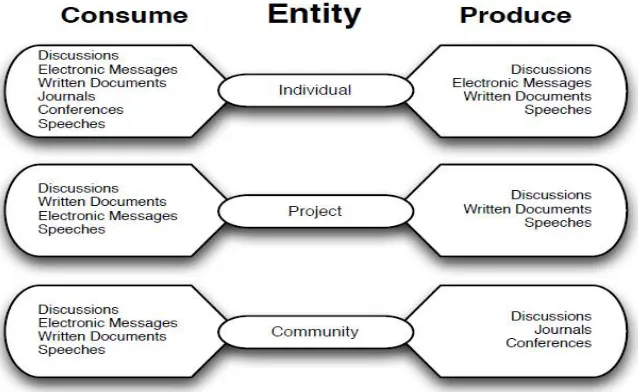
Individuals are the building blocks of academic entities; they may work alone or in project groups, and they frequently belong to multiple research communities. Knowledge is created and organized within all three of these entities, but to move between them, a transfer mechanism must be employed. This mechanism can be as simple as a conversation between two individuals, or as complex as a conference with thousands of attendees.
Fig 1: Knowledge Transfer Mechanisms
III.KNOWLEDGETRANSFERPATHS
ISSN(Online): 2320-9801 ISSN (Print): 2320-9798
I
nternational
J
ournal of
I
nnovative
R
esearch in
C
omputer
and
C
ommunication
E
ngineering
(A High Impact Factor, Monthly, Peer Reviewed Journal)
Vol. 4, Issue 1, January 2016
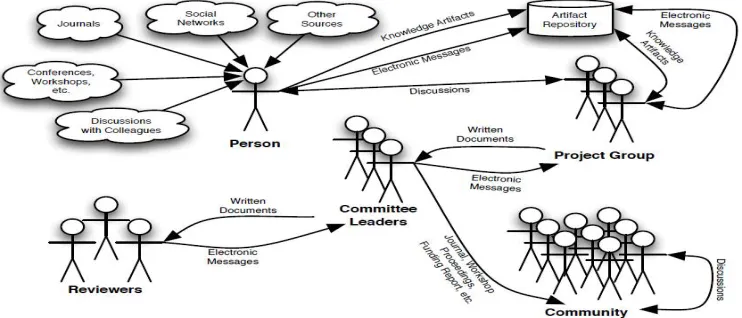
Most projects eventually organize the new knowledge into one or more cohesive documents that will describe their newly developed or discovered knowledge. Sometimes these documents are shared only with individuals, as is the case for student projects in a classroom, while others are fed into, or subsumed by, other projects. The figure, however, describes the path taken to publication in a community journal or conference. In this situation, the document is passed to the group in charge of organizing the journal or conference, represented as another project group. The organizers will often send the document to individuals within the community for review, who respond with their opinions of the document (another kind of knowledge). Assuming the document is accepted for publication without additional revisions (frequently, this is not the case), the organizers of the journal or conference will publish the document, distributing it to the greater community. The case study presented here does not demonstrate the entirety of knowledge flow; there are many other paths knowledge can take as it moves from one entity to another.
Figure 2: Example Knowledge Transfer Paths
IV.ASOFTWARESYSTEMFORACADEMICKNOWLEDGETRANSFER
In addition to the basic features of a digital library and social network, Mendeley also supports a public API which, as noted in Section is useful for both future the implementation and enabling support across multiple platforms. This has allowed Mendeley to offer a native client application for both desktop and mobile clients, in addition to its web client. The native apps can sync with Mendeley's servers when they have internet connectivity to get the latest comments in a group or on a library item. Some features, such as adding annotations within a PDF file (as opposed to comments associated with the artefact), are only supported in the native clients.
A Prototype Personal Digital Library for an Academic Knowledge Transfer System We believe there is a strong need for digital library systems designed primarily for individual use where users are able to collect the breadth of their research work into a single system and share that work with others. Oleksik et al. noted, further progress is dependent on supporting not only data access but the entire process of scientific inquiry That includes a range of individual and team practices, from running experiments to preparing scientific publications." [131] The features and architecture here are, perhaps, a minimalist place to start; once there are systems of this nature in common use, listening to users will certainly give rise to more features than we have considered here.
ISSN(Online): 2320-9801 ISSN (Print): 2320-9798
I
nternational
J
ournal of
I
nnovative
R
esearch in
C
omputer
and
C
ommunication
E
ngineering
(A High Impact Factor, Monthly, Peer Reviewed Journal)
Vol. 4, Issue 1, January 2016
We have also described an architecture capable of supporting many styles of user interfaces, including web interfaces, and native interfaces for both mobile devices and desktop computers. A prototype we developed based on this architecture showed the potential to be valuable tool for the students who used it, even though its feature set was very limited at the time. The feedback we received provided very clear directions for user interface modifications in our system, with users having come to expect a more dynamic experience than our prototype provided.
While it is easy to state that work is better when it is turned into play, the experience presented here suggests simply having features that the users want in an fun environment does not guarantee adoption. Especially when operating in a social area (whether a multi-player game, or social networking site) designers must also consider the social rami cations of their decisions. A analysis of the users determined that the major aw was the failure to recognize the size of the user sub-group that is uninterested in being socially connected to collaborators, even lab mates, within Facebook. Had the applications been developed independently of an existing social networking website, but with the ability to connect to those sites (for the users who wanted to), it is possible they would have seen much greater success. At the same time, given the popularity of email as an information sharing approach, and the number of people who like using it, there is no guarantee that a social networking tool would capture a significant user base without additional (non-game) features. All in all, our experience provides a cautionary tale of the challenges inherent in turning work into play.
V. INFORMATIONSHARINGONTWITTER
With the rise of the internet and the culture of constant connection, researchers are, for perhaps the first time, able to passively track the dissemination of knowledge in real time, or near real time. Twitter is one of many innovative communication channels to appear in the last decade, but its large public dataset and API make it one of the ost interesting channels for researchers. Retweets, Tweets with Links, and Retweets with Links are the key measurable knowledge transference mechanism on Twitter. In all three cases, a user had to read a tweet, or see something on a web page, and decide it was interesting enough to pass on to their followers.
This study has shown that celebrities and regular users have very different patterns of usage and follower behavior. Celebrity users seem to embody the opinion leader role, posting more knowledge transferring tweets than regular users. Likewise, regular users appear to embody the media consumer role, retweeting much of the celebrities' content while having relatively little of their own content retweeted. As an conduit, however, Twitter seems to be de efficient in that most knowledge is only passed on one time.
Future work in this area should combine the automatic celebrity account detection employed by Wu et al. [171] to see if the patterns of behavior identified here are seen in a random sample of celebrity accounts, rather than the haphazard selection employed here. With more data, these analyses might be re fined to determine which celebrity accounts are corporations or are managed by a team of people, and which ones are real people. Additionally, user studies and interviews could be conducted to explore why retweets are themselves so rarely retweeted.
VI.CONCLUSIONS
This research was inspired by sporadic observations of various inefficient methods for managing the process of academic research used by both graduate students and professors in various disciplines, and the realization that increased focus in one's area of expertise can limit one's awareness of other research and make cross-cutting research 185 harder to perform. The model of academic knowledge transfer presented here will hope- fully provide a useful tool for exploring how academics can improve their own work processes, whether at the individual, group, or community level. The results presented in this paper provide insight into not only the process of academic knowledge transfer, but also demonstrate methods by that process can be made more efficient. The goals and requirements of the software system provide a solid foundation upon which a complete knowledge sharing system can be built today and will provide a solid basis for future research and adjustment of both the requirements and the underlying model. In a world growing ever more complex, systems that help us manage that complexity will be among our most valuable tools.
ISSN(Online): 2320-9801 ISSN (Print): 2320-9798
I
nternational
J
ournal of
I
nnovative
R
esearch in
C
omputer
and
C
ommunication
E
ngineering
(A High Impact Factor, Monthly, Peer Reviewed Journal)
Vol. 4, Issue 1, January 2016
REFERENCES
[1] W. Lance Bennett and Shanto Iyengar. A new era of minimal effects? the changing foundations of political communication. Journal of Communication, 58(4):707{ 731, 2008.
[2] Michael Bieber, Douglas C. Engelbart, Richard Furuta, Starr Roxanne Hiltz, John Noll, Jennifer Preece, Edward A. Stohr, Murray Turo , and Bartel van de Walle. Toward virtual community knowledge evolution. Journal of Management Information Systems, 18(4):11{35, 2002. [3] Pierre Bourdieu. Outline of a Theory of Practice. Cambridge University Press, New York, 1977.
[4] Richard M. Emerson. Social exchange theory. Annual Review of Sociology, 2(1976):335{362, 1976.
[5] Lourdes Fernandez, J. Alfredo Sanchez, and Alberto Garc a. Mibiblio: personal spaces in a digital library universe. In DL '00: Proceedings of the fth ACM conference on Digital libraries, pages 232-233, New York, NY, USA, 2000. ACM.
[6] Martin Fishbein and Icek Ajzen. Belief, attitude, intention and behaviour: An introduction to theory and research. Addison-Wesley, 1975. [7] M. S. Granovetter. The Strength of Weak Ties. The American Journal of Sociol-ogy, 78(6):1360{1380, 1973.
[8] Shanto Iyengar. Is anyone responsible? How television frames political issues. University Of Chicago Press, Chicago, IL, 1991. [9] Jane Jacobs. The Death and Life of Great American Cities. Random House, 1961.
[10] Elihu Katz and Paul F. Lazarsfeld. Personal In uence. The Free Press, 1955.
[11] Carl Lagoze, Herbert Van de Sompel, Michael Nelson, and Simeon Warner. The open archives initiative protocol for metadata harvesting. http://www.openarchives.org/OAI/openarchivesprotocol.html.
[12] Harold D. Lasswell. The structure and function of communication in society. In Lyman Bryson, editor, The Communication of Ideas, pages 37-51. Institute for Religious and Social Studies, New York, NY, 1948.
[13] http://escholarship.org/uc/item/4n3332xn
[14] Paul F. Lazarsfeld, Bernard Berelson, and Hazel Gaudet. The People's Choice. Columbia University Press, third edition, 1968.
[15] Natalia Reyes-Farfan and J. Alfredo Sanchez. Personal spaces in the context of oai. In JCDL '03: Proceedings of the 3rd ACM/IEEE-CS joint conference on Digital libraries, pages 182{183, Washington, DC, USA, 2003. IEEE Computer Society.
[16] Joseph B. Walther, Caleb T. Carr, Scott Seung W. Choi, David C. DeAndrea,Jinsuk Kim, Stephanie Tom Tong, and Brandon Van Der Heide. Interaction of interpersonal, peer, and media influence sources online. In Zizi Papacharissi, editor, A Networked Self. Routledge, New York, NY, 2011.