ISSN (Print) : 2347 - 6710
I
nternationalJ
ournal ofI
nnovativeR
esearch inS
cience,E
ngineering andT
echnology Volume 3, Special Issue 3, March 20142014 International Conference on Innovations in Engineering and Technology (ICIET’14)
On 21st&22ndMarch Organized by
K.L.N. College of Engineering, Madurai, Tamil Nadu, India
ABSTRACT— Peak current mode control of a buck-boost converter along with the load and transient analysis using a PIC microcontroller is done. The new elucidation includes a discrete time controller using digital slope compensation technique which removes all the sub-harmonic oscillations using a discrete staircase ramp. Combining a digital controller with peak current control gives a number of benefits which is implemented by a new single chip solution with on chip comparators without any external analog ICs. Digital slope compensation is implemented within the PIC controller as a digital staircase ramp using the on board modules.
KEYWORDS— DC–DC switch mode power supplies (SMPS), peak current mode control, digital slope compensation, transient analysis and load variation.
I. INTRODUCTION
Voltage mode control and current mode control are the two most popular control methods used in DC-DC converters. For controlling switched mode power supplies, current mode control is the commonly used method because of its advantageous features like better dynamic performance and natural protection from short circuit. This method can again be classified into average and peak current mode control. A control reference is used to regulate the peak current in peak current mode control which has benefits likeimproved load line regulation, better flux balancing, inherent cycle by cycle current limiting and protection. This control is commonly used in converters operating in continuous conduction mode. Here, when the duty cycle becomes more than 0.5, the feedback loop becomes highly unstable and this
instability is called as sub harmonic oscillations. By using slope compensation technique an external ramp is added to reduce this oscillation.
In continuous conduction mode, the current will flow continuously throughout the switching period and one of its advantages over discontinuous conduction mode is that the dc conversion ratio is independent of the load, making the analysis simpler. Also peak currents are higher in discontinuous conduction mode which leads to heavy losses in the path of conduction affecting the efficiency and leading to switching stresses with higher ripples. A switched mode power supply (SMPS) is an electronic power supply that includes a switching regulator that converts electric power skillfully and this high efficiency is one of its important benefits. Source to load power flow is the main application of SMPS; (for eg: from the main power supply to any household appliance). During this transfer voltage and current characteristics are adjusted frequently. SMPS dissipates no energy when it is ideal and is the best alternative for linear regulator that controls the output voltage by dropping power frequently in the pass transistor because it reduces the unwanted wastage of energy and is highly efficient and is adaptive to usage when smaller size and lighter weights are considered.
Peak current mode control is mainly required in order to save the devices from damaging. In this control, two rapidly changing ramp signals are compared and thepeak current limit is said to be reached when these two ramps are equal. The two ramp signals considered are the slope compensated reference voltage signal and sensed output inductor current. Digital control of peak current with the implementation of slope compensation had been a very tedious task till recent days because of the unique
Application of Digital Slope Compensation
in Peak Current Mode Control of
Buck-Boost Converter
Nikhila N,A. Rajalakshmi
Department of EEE, Rajalakshmi Engineering College, Anna University, Thandalam, Chennai, India
features of the control technique and its need for extra support circuits which made it very expensive. But nowadays we can see that with the arrival of digital signal processors and microcontrollers with strong performance graphs, use of digital architecture for control has become very simple. Microcontrollers available today are very cheap, easier to get hold of and are of very high accuracy. So these are used in large number of applications that include power systems, industrial production and supply, rectifier supplies, medical applications etc [3].
II. BUCK-BOOST CONVERTER
A. Block Diagram showing Peak Current Mode Control
Fig.1. Block diagram of peak current mode control of buck- boost converter
The input voltage source is connected with the buck-boost converter and has a resistive load connected in a closed loop circuit. Functions of the microcontroller are,
Analog to Digital conversion
Digital Slope Compensation
Digital to Analog conversion
PWM generation
When peak current problem arises, the output voltage as well as the input voltage are sensed by the microcontroller and based on the ‘C’ language coding, it compensates the ramp signals and incorporates the digital slope compensation technique. The inbuilt comparators of the microcontroller compares the output signal with the reference signal as well as the input signal and as a result PWM is generated which thereby turns on or turns off the switch of the converter so as to control the peak current.
III. PEAK CURRENT MODE WITH DIGITAL SLOPE
COMPENSATION
The control circuit of the buck-boost converter when digital slope compensation is used is revealed in Fig.2. The basic principles of peak current mode control and the advantages of slope compensation are thoroughly discussed in this part.
Fig.2. Digital peak current mode control of buck-boost converter
In situations without use of slope compensation, some instabilities may occur when the duty cycle go beyond 50%.This can be reduced by adding a compensation ramp with slope 𝑚𝑠𝑐 to the switch off
threshold. This compensation technique has now become easier to be controlled digitally with the advent of microcontrollers that use analog comparators (eg: PIC, Piccolo etc) which makes it feasible for conversion of the threshold value to analog voltage which represents the current threshold of the on chip comparators [6].
At the start of every cycle DPWM unit is used to turn on the switch and to restrict the duty cycle value within the maximum tolerable limit. Here the output from the comparator is connected with the DPWM generator and hence it compels the DPWM output to be switched off.But still with the use of slope compensation an appropriate control technique has to be developed for the digital control of peak current. An evident answer to this task is to implement slope compensation using analog technique and by adding ramp to the inductor current signal[6]. So it is evident that for the digital implementation of the ramp compensation, the discrete threshold value should be reduced permanently for every switching cycle with least possible step size.
Fig.3. Inductor current characteristics to illustrate principle of digital slope compensation
As indicated in fig.3, the current threshold level icmp can be expressed as
𝑖𝑐𝑚𝑝 = 𝑖∗− 𝑚𝑠𝑐× 𝐷𝑇𝑠 (2)
From (1) and (2) we get
𝐷𝑇𝑠= 𝑖∗−𝑖𝑛
𝑚1+𝑚𝑠𝑐 (3)
Using (3) to eliminate 𝐷𝑇𝑠 from (2) we get
𝑖𝑐𝑚𝑝 = 𝑖∗− 𝑚𝑠𝑐 𝑖∗−𝑖𝑛
𝑚1+𝑚𝑠𝑐 (4)
Now a compensating factor 𝑘𝑠𝑐 is introduced which is,
𝑘𝑠𝑐= 𝑚𝑠𝑐
𝑚1 (5)
Thus (4) can be expressed as
𝑖𝑐𝑚𝑝 = 𝑖∗− 𝑘𝑠𝑐
1+𝑘𝑠𝑐 𝑖
∗− 𝑖 𝑛 (6)
So the threshold value of the comparator current can be measured by considering the reference value 𝑖∗
which we get from the voltage controller and this is now transferred to the digital control through the analog to digital converter (ADC). Choosing of the compensating factor should be appropriate in order to adjust the obtained current threshold value with the slope compensation technique used [6].
IV.DESIGN EXAMPLE
A. Calculation Of Duty Cycle
After choosing the various parameters of the converter the next priority objective is to obtain the duty cycle for the buck mode which is minimum and for the boost mode which is maxima [10].
𝐷𝑏𝑢𝑐𝑘 =
𝑉0× ɳ
𝑉𝑠𝑚𝑎𝑥
(7)
𝐷𝑏𝑜𝑜𝑠𝑡 = 1 −
𝑉𝑠𝑚𝑖𝑛 × ɳ
𝑉0
(8)
Where ɳ is the estimated efficiency.
B. Inductor Selection
We know that as the inductance value increases the higher is the maximum output current that is plausible since the ripple currentlessens[10].
In the buck mode the inductor value can be calculated properly and correctly calculated using the equation:
𝐿 > 𝑉𝑜×(𝑉𝑠 𝑚𝑎𝑥−𝑉𝑜)
𝑘𝑖𝑛𝑑×𝐹𝑠𝑤×𝑉𝑠 𝑚𝑎𝑥×𝐼𝑜 (9)
Similarly in the boost modethe following equation is a fine [10] estimate for the appropriate inductance value:
𝐿 >𝑉𝑠 𝑚𝑖𝑛2 ×(𝑉𝑜−𝑉𝑠 𝑚𝑖𝑛)
𝑓𝑠×𝑘𝑖𝑛𝑑×𝐼𝑜×𝑉𝑜2 (10)
When the ripple current shown in the inductor is 20or 40 percentage of the output current it is noted to be a proper calculation.
V. SOFTWARE SIMULATION
A. Simulation Circuit of the Buck-Boost Converter with Peak Current in Open Loop
The peak current in a buck-boost converter can be measured by an open loop circuit without using the digital slope compensation technique which forms the feedback.
Fig.4. Circuit diagram of the buck-boost converter in open loop boost mode
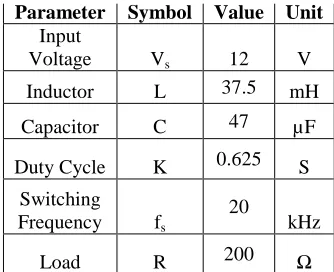
B. Simulation Values of the Circuit Elements in Open Loop
Table.I shows the specifications of the buck-boost converter in open loop circuit. Using these values the simulation has been done and the waveforms are analyzed.
C. Simulation Circuit of the Buck-Boost Converter in Closed Loop using Digital Slope Compensation
The peak current in the open loop can be reduced using the digital slope compensation technique which is applied in the form of a feedback loop.
Fig.5. Circuit diagram of the buck-boost converter in closed loop boost mode
Fig.5 shows the circuit for the peak current mode control of the buck- boost converter (boost mode) simulated in MATLAB. In the circuit the voltage between the load and the source is continuously monitored by a feedback loop. Based on the comparator output the PWM is generated to update the duty cycle by which peak current appearance in the circuit is eliminated. For the boost mode the input is 12 volt and the reference voltage is 20 volts.
D. Simulation Values of the Circuit Elements in Closed Loop
Table.II Specifications of the converter in closed loop
Table. II shows the specifications of the buck-boost converter in closed loop circuit. Using these values the simulation has been done and the waveforms are analyzed.
VI.SIMULATION RESULTS
A. Output Current Waveforms of the Buck-Boost Converter with and without Digital Slope Compensation
In the closed loop operation digital slope compensation technique is used to reduce the peak current in the converter that is present in open loop. Hence the amount of peak current reduced can be measured. Also sub harmonic oscillations can be condensed using this technique easily.
Fig.6. Comparison between open loop and closed loop output current waveforms
Parameter Symbol Value Unit
Input
Voltage Vs 12 V
Inductor L 37.5 mH
Capacitor C 47 µF
Duty Cycle K 0.625 S
Switching Frequency fs
20
kHz
Load R 200 Ω
Parameter Symbol Value Unit
Input Voltage Vs 12 V
Output Voltage V0 20 V
Inductor L 37.5 mH
Capacitor C 47 µF
Switching
Frequency fs
20
KHz
Load R 200 Ω
In open loop the current goes to maximum overshoot and then settle down to the required level.
Peak current in open loop = 0.145A
Peak current in closed loop = 0.0991A
Amount of peak current reduced is 45.9Ma
B. Output Voltage Waveforms Showing Peak Voltage in Open Loop Boost Mode And closed Loop Boost Mode
Fig.7. Comparison between open loop and closed loop output voltage waveforms
In open loop the voltage goes to maximum and then settles down to the required level.
Peak voltage in open loop = 29V
Peak voltage in closed loop=19.96V
Amount of Peak voltage reduced =29-19.96=9.04V
C. Transient Analysis
When there is any disturbance in the input voltage, the transients developed and the changes in the output voltage and output current waveforms are analyzed. Here the input voltage is changed from 12 V to 14 V and the stability analysis for both open loop as well as closed loop operation of peak current mode control of buck-boost converter is done.
Fig.8. Transient analysis of closed loop boost mode
Fig.9. Transient analysis of open loop boost mode
VII. CONCLUSION
ACKNOWLEDGMENT
The authors wish to acknowledge the management of Rajalakshmi Engineering College and especially the faculties of EEE department for their full support during the course of this project phase. Also gratefully thank the helpful comments and suggestions of the reviewers which have greatly improved the presentation.
REFERENCES
[1 ]Brad Bryant and Marian Kazimierczuk, k. (2005) ‘Modellingthe
Closed-Current Loop of PWM Boost DC–DC ConvertersOperating in CCM With Peak Current-Mode Control’, IEEE Transactions on
circuits and systems—I: regular papers, vol 52, no.11
[2] Brad Bryant and Marian Kazimierczuk, k. (2005) ‘Open- Loop Power-Stage Transfer Functions Relevant to Current-Mode Control of Boost PWM Converter Operating in CCM’, IEEE Transactions on Circuits and Systems—I: regular papers, vol 52,no.10 [3]
[3]Brett Novak (2012) ‘Implementing peak current mode control of a switch mode power supply with a single microcontroller’, Texas Instrument
[4] [4] Everrert Rogers (2002) ‘Understanding Buck-Boost Power Stages in Switch Mode Power Supplies’, Application Report SLVA059A
[5] GiridharanShanmugavel( 2012)‘Using a Peak-Current-Mode Controller to Design aBoost Converter’, Application Note 5503
[6] Grote, T. ,Schafmeister, F. , Figge1, H. , Fröhleke1, N. and Ide, P. (2004) ‘Adaptive Digital Slope Compensation for Peak Current Mode’, University of Paderborn, Power Electronics and Electric Drives, Germany
[7] Hyoung Cho, Y. and Enrico Santi (2009) ‘ Peak Current Mode-Controlled Buck Converter with Positive Feed forward Control’,
University of South Carolina
[8] Jian Li and Fred Lee, C. (2010) ‘New Modelling Approach and Equivalent Circuit Representation for Current-Mode Control’, IEEE Transactions on Power Electronics, vol 25,no.5 [9] Jian Li (1990) ‘Current Mode Control: Modeling and its Digital
Application’, Dissertation submitted to Virginia Polytechnic Institute and State University
[10] Michael Green (2012) ‘Design Calculations for Buck-Boost Converters’, Application Report SLVA535A
[11] Ray Ridley (2001) ‘A More Accurate Current Mode Control Model’, Ridley Engineering Inc.
[12] SouvikChattopadhyay and Somshubhra Das (2006) ‘ A
Digital Current-Mode Control Technique for DC–DC Converters’, IEEE Transactions on Power Electronics, vol 21, no.6
[13] Ting Qian (2013) ‘Subharmonic Analysis for Buck Converters with Constant On-Time Control and Ramp Compensation’, IEEE Transactions on Industrial Electronics, vo 60, no4
[14] Robert Sheehan (2007) ‘Understanding and Applying Current- Mode Control Theory’, Practical Design Guide For Fixed-Frequency, Continuous Conduction-Mode Operation