Environment Friendly BB-BC Optimized Economic
Dispatch with Real and Reactive Power Constraints
H. K. Verma
Department Of Electrical Engineering Shri Govindram Seksaria Institute of Technology
and Science Indore, INDIA
Prachi Mafidar
Department Of Electrical Engineering Shri Govindram Seksaria Institute of Technology
and Science Indore, INDIA
ABSTRACT
The basic objective of Economic Dispatch (ED) of electric power generation is to schedule the committed generating unit outputs to meet the load demand at minimum operating cost subject to equality and inequality constraints. In recent years with increasing awareness about environmental issues this problem has taken an essential development i.e. economic dispatch now includes the dispatch of power to minimize pollutants (from fossil fuel power generating units), as well as to achieve minimum cost. This paper presents comparative study of two algorithms namely Particle Swarm Optimization (PSO) and Big Bang-Big Crunch Optimization (BB-BC) which are implemented on Environment Friendly BB-BC Optimized Economic Dispatch with Real and Reactive Power Constraints problem. It is shown that the performance of BB-BC method demonstrates superiority over PSO algorithm.
Keywords
Particle Swarm Optimization, Big Bang–Big Crunch, economic Dispatch, emission dispatch, fuel cost function, total emission function, penalty factor.
1. INTRODUCTION
The typical economic dispatch problem involves minimization in total operating cost by means of appropriate allotment of total power to be generated by different power generating units. Fossil fuel power generating units are main producer of large amount of emission which includes various harmful gases such as sulfur oxides (SO2) and nitrogen oxides (NOx) also some greenhouse gases such as carbon dioxide and chlorofluorocarbons which severely affect the atmosphere. But with the increasing awareness of the environmental pollution caused by these plants, basic economic dispatch is very unsatisfactory as the requirements of environmental protection cannot be accommodated by the traditional economic power dispatch, because it particularly concerns about only reduction in operating cost. The existence of emission dispatch leads to the formulation of Environment Friendly Economic Dispatch.
The main emissions from thermal power plants are the oxides of sulfur and nitrogen which are major contributor to acidic discharge. Hence these emissions are responsible for, producing harmful global warming [1].
The typical economic dispatch reduces total operating cost of the system but this increases the amount of emission where as simple emission dispatch can reduce total emission from the system but operating cost of the system becomes larger in this case. Therefore the Environment Friendly Economic dispatch with Real and Reactive Power constraints finds the optimum solution operating point at which real and reactive power constraints are also satisfied.
There are several optimization techniques such as lambda iteration, quadratic programming, linear programming,
non-linear programming, and intelligent search methods (e.g. genetic algorithm [2], evolutionary programming [3], [4], Differential evolution, particle swarm optimization [1], [5], [6] etc) are employed for solving the various economic dispatch problems. A relatively new optimization technique which is based on development of universe namely, the Big Bang - Big Crunch optimization technique introduced by Erol and Eksin, which is having relatively higher convergence speed with low computational time [7], [8], [9].
2.
ENVIRONMENT
FRIENDLY
ECONOMIC DISPATCH WITH REAL
AND
REACTIVE
POWER
CONSTRAINTS
2.1 Economic Load Dispatch
2.1.1 Problem Description
The main objective of Economic Load Dispatch (ELD) is to minimize the fuel cost while satisfying the load demand with transmission constraints.
2.1.2 Objective Function
minimize Ft= Fi(Pi) n
i=1
… … … . . (1)
Fi Pi = αiPi2+ βiPi+ γi … … … . (2)
Where
Ft total fuel cost of the generation,
Fi(Pi) fuel cost function of ith generator,
𝛼𝑖, 𝛽𝑖, 𝛾𝑖 cost coefficients of ith generator,
Pi real power generation of i
th
generator,
n represents number of generators
connected in the network.
The above objective function has to be minimized with satisfying following constraints.
The real power balance constraint
Pi− PD− PL= 0 ng
i=1
… … … . . (3)
Where
PD total real power demand of the system and
PL real power losses of the system obtained from load flow.
The reactive power balance constraint
Qi− QD− QL= 0 ng
i=1
… … … . . (4)
QD total load of the system and
QL reactive power losses of the system
obtained from load flow.
The inequality constraint on real power generation Pi and reactive power generation for each generator are given by
Pi min ≤ Pi≤ Pi (max )
… … … . . (5) Qi min ≤ Qi≤ Qi
(max )
… … … . . (6)
Where in equation (5) Pimin and Pimax are respectively minimum and maximum values of real power allowed at generator i. and in equation (6) Qimin and Qimax are
respectively minimum and maximum values of reactive power allowed at generator i.
2.2
Environment
Friendly
Economic
Dispatch with Real and Reactive Power
Constraints
2.2.1 Problem Description
The conventional economic dispatch may not be best in terms of environmental criteria. The reduction in the amount of harmful ecological effects by emission of gaseous pollutants from fossil fuel power generating units can be obtained by proper load allocation among the various generating units of plant. But it causes increase in the operating cost therefore it is necessary to find the optimum solution which can be achieved by Environment Friendly Economic dispatch with Real and Reactive Power constraints [5].
2.2.2 Objective Function
Minimize FC, E = (αiPi2+ βiPi+ γi) n
i=1
+h (aiPi2+ biPi+ ci) n
i=1
… … … . . (7)
Where
FC expected fuel cost,
E expected emission,
n number of generating units,
𝛼𝑖, 𝛽𝑖, 𝛾𝑖 cost coefficients of ith generator,
𝑎, 𝑏𝑖, 𝑐𝑖 emission coefficients of ith generator,
Pi real power generation of ith generator,
h price penalty factor.
In above equation dual-objective function is converted into single optimization problem by using price penalty factor h which blends emission with fuel cost. The approximate value of h can be determined by following steps:
Step 1: Compute the average cost of each generator at its maximum output; i.e.
FC(Pimax)
(Pimax) Rs MWhr … … … . . (8)
Step 2: Compute the average NOX emission of each generator at its maximum output; i.e.
E(Pimax)
(Pimax) kg MWhr … … . . . (9)
Step 3: from above equation Penalty factor can be obtained as;
FC(Pimax)
E(Pimax) = hi Rs kg … … . (10)
Step 4: Arrange the values of price penalty factor (hi ,i=1, 2, ….,n) in ascending order.
Step 5: Add the maximum capacity of each unit (Pimax) one at a time, starting from the smallest hiunit until ni=1Pimax ≥
Pidemand,where Pidemandis the power demand.
Step 6: At this stage,hi associated with the last generator in the process is the price penalty factor hi (Rs/kg) for the given power demand [5].
3.
ENVIRONMENT
FRIENDLY
ECONOMIC DISPATCH WITH REAL
AND
REACTIVE
POWER
CONSTRAINTS USING PSO
3.1
Overview
of
Particle
Swarm
Optimization (PSO)
Particle swarm optimization (PSO) is a population based stochastic optimization technique developed by Dr. Ebehart and Dr. Kennedy in 1995, inspired by social behavior of bird flocking or fish schooling [10], [11]. Consider that the number of birds searching food in a field and the food is located only at one point in that field also all the birds are not aware of the location of food but they know the distance of food, so the best way for finding the food is to follow the bird, which is nearest to the food. PSO applied this strategy to solve the optimization problems. In PSO, each single particle acts as a bird. All the particles having fitness values, which are calculated by the fitness function of the particular problem and they also having velocities, which shows the particle’s movement in the field. For each particle the current position, velocity and the best position found in the search field by swarm are kept as a record.
Let X and V denote a particle coordinates (position) and its corresponding flight speed (velocity) in a search space, respectively, which can be determined within their minimum and maximum range by following equations:
Xiu= Xmin + rand ∗ Xmax − Xmin Vmax … . . (11)
Viu= 0.4 ∗ rand ∗ Vmax … … … . . (12)
The best previous position of a particle is recorded and represented as personal best or pbest. The location of the best particle among all the particles in the group is represented as global best or gbest. The particle tries to modify its position using the current velocity and the distance from pbest and
gbest [11].The velocity and position of each particle can be updated using the following equations:
Vi(u+1)= W ∗ Vi(u)+ C1∗ rand1 ∗ (pbseti− Xiu) + C2
∗ rand2 ∗ (gbesti− Xi u ) … … . . (13)
Xi(u+1)= Xiu+ Vi (u+1)
… … … . . (14)
Where
Viu velocity of particle i at iteration u,
W inertia weight factor,
C1, C2 acceleration constants,
rand1, rand2 random number between 0 and 1,
Xiu position of particle i at iteration u.
personal best solution. The third term called the social component which forces the particle to move towards the highest fitness swarm has achieved so far. The value of social coefficient C2 also lies between 0 to 2 and it indicates the size of the step by which particle runs towards the global best solution. The inertia weight W is linearly decreasing as the iteration proceeds and obtained as [12]:
W = Wmax −
(Wmax − Wmin)
ITERmax × ITER … … … (15)
3.2 Optimization Algorithm
1. Generate the particles:
Xgi= Xi1, Xi2, … , Xin … … … . 16
(Using equation (11)).
2. Generate the velocity Vi (using equation (12)). 3. Evaluate the fitness function.
4. Evaluate pbest value and then identify gbest value. 5. Update the velocities (using equation 13). 6. Update generation (using equation 14).
3.3 Implementation of Proposed Algorithm
The practical Environment Friendly Economic dispatch with Real and Reactive Power constraints problems are represented as a nonlinear programming problem with equality and inequality constraints, and this makes the problem of finding the global optimum difficult. This study presents an optimal solution to the Environmental Economic dispatch with Real and Reactive Power constraints problem using the PSO algorithm.
Fitness= equ.(7)+Ppf *[equ.(3)]+Qpf*[equ.(4)] …… (17) Its implementation can be better understood by following flow chart:
In equation (17) Ppf and Qpf are real power balance penalty factor and reactive power balance penalty factor which are placed into objective function in such a way that these impose the penalty for any violations of the constraints and force the optimal solution towards the appropriate region.
Figure 1. Flow chart of PSO based Environment Friendly Economic dispatch with Real and Reactive
Power constraints problem
4.
ENVIRONMENT
FRIENDLY
ECONOMIC DISPATCH WITH REAL
AND
REACTIVE
POWER
CONSTRAINTS
USING
BB-BC
OPTIMIZATION
4.1 Overview of Big Bang-Big Crunch
Optimization (BB-BC)
About the growth of universe there are two famous theories: Big bang and Big crunch theories. Big bang theory states that the universe originally was in an extremely hot and infinitely dense state that expanded rapidly and due to expansion has since cooled and continues to expand today. This theory only explains the commencement of universe very well, but doesn’t explain the end of the universe. Another theory considered by astronomers is namely Big Crunch theory which is about the end of the universe according to this theory universe’s expansion, which is due to Big Bang, will stop at a certain point and eventually all matter would collapse into a biggest black hole ever [7].
Erol and Eksin inspired from these theories, and in 2006 they introduced a new optimization algorithm named Big Bang-Big Crunch (BB-BC) algorithm. In this algorithm there are two phases; Big Bang phase which is based on Big Bang Theory and Big Crunch phase which is based on Big Crunch Theory. In Big Bang Phase, the candidate’s population is randomly generated over the search space and in Big Crunch phase these candidates are concentrated towards center of
Set unit parameter, Pdemand , iter=1,
Initialize pf, population =n, iterations Start
Initial position Pid and Qid matrix for each
individual Equ. (16)
Calculate h steps (1) - (6)
Evaluate fitness function Equ. (17)
is iter=max iteration?
Is equ(3) & equ(4)< 𝜀?
Optimal solution Stop
iter=iter+1
Update velocities
equ(13)
Update positions
equ(14)
Adjust bound fit to equ(5)&(6)
Ppf=Ppf+1 &
Qpf=Qpf+1
Yes Yes No
mass which acts as a convergence operator. Evaluation of new position of each candidate is done using center of mass. This process continues until convergence is obtained [7], [13], [14].In the original version of the algorithm, center of mass is calculated as follows:
xc =
1 fixi N i=1
1 fi N i=1
… … … … . (18)
Where
xc position of center of mass, xi position of candidate,
fi fitness function value of candidate i,
N population size.
The new generation for next iteration Big Bang phase is normally distributed around xc. The new candidates around center of mass are calculated by adding or subtracting standard deviation of normal distribution.
xinew = xc+ σ … … … . . (19)
The standard deviation decreases as the iteration elapse according to following formula
σ =α. xmax − xmin . rand
k … … . . … (20)
Where
xmin, xmax minimum and maximum range respectively,
rand random number between 0 and 1,
k number of iterations.
α parameter limiting size of search space Therefore the new candidate is generated as follows:
xinew = xc+ α. xmax − xmin . rand k … . (21)
Also it is necessary to limit population to the prescribed search space boundaries.
4.2 Optimization Algorithm
(Big Bang Phase)1).Generate randomly N number of candidates with in the search space.
2). Obtain the fitness function values of all candidate solutions.
(Big Crunch Phase)
3). Evaluate the center of mass using equation (18). 4).The new candidates are evaluated around the new point calculated in step 3 by adding or subtracting the standard deviation whose value decreases as the iteration elapse. (Using equation (21))
5).Return to step 2 until stopping criteria has been met [7], [15].
4.3 Implementation of Proposed Algorithm
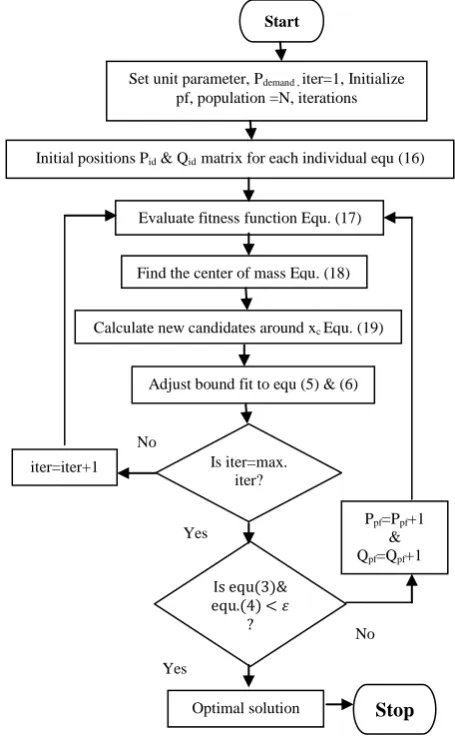
[image:4.595.314.542.78.448.2]This study presents an optimal solution to the Environment Friendly Economic dispatch with Real and Reactive Power constraints problem using the Big Bang-Big Crunch (BB-BC) algorithm. Its implementation can be easily understood by using following flow chart.
Figure 2. Flow chart of BB-BC based Environment Friendly Economic dispatch with Real and Reactive
Power constraints problem
5. RESULTS AND DISCUSSION
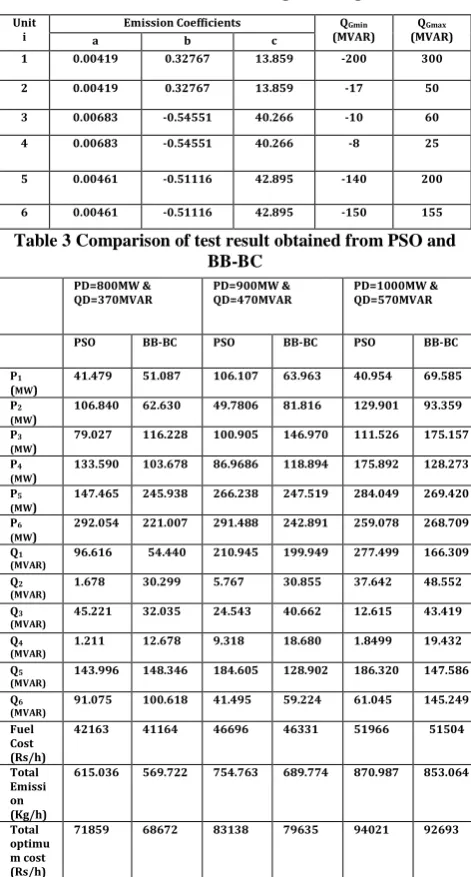
The effectiveness of the proposed method is tested with 30 bus six generating unit system, where PSO and BB-BC methods are applied to solve the problem. The fuel cost coefficients and emission coefficients of IEEE 30 bus six generating units are given in table 1 and table 2 respectively. Also the test results obtained from PSO and proposed BB-BC is given in table 3.
Table 1 Fuel cost coefficients of six generating units
Unit i Fuel Cost Coefficients PGmin
(MW) (MW) PGmax
Alpha Beta Gamma
1 0.15247 38.539 756.79 10 125
2 0.10587 46.159 451.32 10 150
3 0.02803 40.396 1049.99 35 225
4 0.03546 38.305 1243.53 35 210
5 0.02111 36.327 1658.56 130 325
6 0.01799 38.270 1356.65 125 315
Start
Set unit parameter, Pdemand , iter=1, Initialize
pf, population =N, iterations
Initial positions Pid & Qid matrix for each individual equ (16)
Evaluate fitness function Equ. (17)
Is iter=max. iter?
Is equ(3)& equ.(4) < 𝜀
?
Optimal solution Find the center of mass Equ. (18)
iter=iter+1
Calculate new candidates around xc Equ. (19)
Adjust bound fit to equ (5) & (6)
No
No
Yes
Yes Ppf=P& pf+1
Qpf=Qpf+1
[image:4.595.312.546.605.720.2]Table 2 Emission coefficients of six generating units
Table 3 Comparison of test result obtained from PSO and BB-BC
Figure 3, Figure 4 and Figure 5 shows convergence characteristics for different loads. It is clear that BB-BC has better convergence characteristics than PSO.
Figure 3. Convergence characteristics at 800MW load
[image:5.595.326.547.297.477.2]Figure 4. Convergence characteristics at 900 MW load
Figure 5. Convergence characteristics at 1000 MW load
6. CONCLUSION
In this study Particle Swarm Optimization (PSO) and Big Bang Big Crunch (BB-BC) optimization techniques are applied on Environment Friendly Economic dispatch with Real and Reactive Power constraints problem and from this it is clear that the main advantage of BB-BC optimization is its numerically simple algorithm and with relatively few control parameters it gives better convergence result as compared to PSO because PSO has problems of dependency on initial coefficients and parameters and difficulty in finding their optimal design parameters.
7. ACKNOWLEDGMENTS
The authors gratefully acknowledge the authorities of Shri Govindram Seksaria Institute of Technology and Science Indore, India for the facilities offered to carry out this work.
8. REFERENCES
[1] K. Sathish Kumar, V. Tamilselvan, N. Murali, R. Rajaram, N. Shanmuga Sundaram, T. Jayabarathi, “Economic Load Dispatch with Emission Constraints using Various PSO Algorithms”, WSEAS Transactions on Power Systems, Issue 9, Volume 3, September 2008.
[2] U_ur Güvenç, “Combined Economic Emission Dispatch Solution using Genetic Algorithm Based on Similarity
0 10 20 30 40 50 60 70 80 90 100
6.8 6.9 7 7.1 7.2 7.3 7.4 7.5x 10
4
to
ta
l
o
p
ti
m
u
m
c
o
s
t
iterations PD=800MW & QD=370MVAR
PSO BB-BC
0 10 20 30 40 50 60 70 80 90 100
7.9 8 8.1 8.2 8.3 8.4 8.5x 10
4
iterations
to
ta
l
o
p
ti
m
u
m
c
o
s
t
PSO BB-BC PD=900MW & QD=470MVAR
0 10 20 30 40 50 60 70 80 90 100
9.25 9.3 9.35 9.4 9.45 9.5 9.55x 10
4
iterations
to
ta
l
o
p
ti
m
u
m
c
o
s
t
PD=1000MW & QD=570MVAR
PSO BB-BC
Unit
i a Emission Coefficients b c (MVAR) QGmin (MVAR) QGmax
1 0.00419 0.32767 13.859 -200 300
2 0.00419 0.32767 13.859 -17 50
3 0.00683 -0.54551 40.266 -10 60
4 0.00683 -0.54551 40.266 -8 25
5 0.00461 -0.51116 42.895 -140 200
6 0.00461 -0.51116 42.895 -150 155
PD=800MW &
QD=370MVAR PD=900MW & QD=470MVAR PD=1000MW & QD=570MVAR
PSO BB-BC PSO BB-BC PSO BB-BC
P1
(MW) 41.479 51.087 106.107 63.963 40.954 69.585 P2
(MW) 106.840 62.630 49.7806 81.816 129.901 93.359 P3
(MW) 79.027 116.228 100.905 146.970 111.526 175.157 P4
(MW) 133.590 103.678 86.9686 118.894 175.892 128.273 P5
(MW) 147.465 245.938 266.238 247.519 284.049 269.420 P6
(MW) 292.054 221.007 291.488 242.891 259.078 268.709 Q1
(MVAR) 96.616 54.440 210.945 199.949 277.499 166.309
Q2
(MVAR) 1.678 30.299 5.767 30.855 37.642 48.552
Q3
(MVAR) 45.221 32.035 24.543 40.662 12.615 43.419
Q4
(MVAR) 1.211 12.678 9.318 18.680 1.8499 19.432
Q5
(MVAR) 143.996 148.346 184.605 128.902 186.320 147.586
Q6
(MVAR) 91.075 100.618 41.495 59.224 61.045 145.249
Fuel Cost (Rs/h)
42163 41164 46696 46331 51966 51504
Total Emissi on (Kg/h)
615.036 569.722 754.763 689.774 870.987 853.064
Total optimu m cost (Rs/h)
[image:5.595.68.288.568.751.2]Crossover”, Scientific Research and Essays Vol. 5(17), pp. 2451-2456, 4 September, 2010.
[3]K. Senthil M.E., “Combined Economic Emission Dispatch using Evolutionary Programming Technique”, IJCA Special Issue on “Evolutionary Computation for Optimization Techniques” ECOT, 2010.
[4] A. Lakshmi Devi, O. Vamsi Krishna, “ Combined Economic and Emission Dispatch Using Evolutionary
Algorithms-A Case Study” ARPN Journal of
Engineering and Applied Sciences, Vol. 3, No. 6, December 2008.
[5] Yee Ming Chen, Wen-Shiang Wang, “Economic Power Dispatch of Power System with Emission Controlled using Particle Swarm Optimization” 12th WSEAS International Conference on SYSTEMS, Heraklion, Greece, July 22-24, 2008.
[6] C.Rani, AfshinYazdani, “Emission Constrained Economic Dispatch using Various PSO Algorithm”, International Journal Of Power System Operation and Energy Management (IJPSOEM) Volume-1, Issue-1, 2011
[7] O. K. Erol, I. Eksin, “A new optimization method: Big Bang–Big Crunch,” Advances in Engineering Software, Elsevier, vol. 37, pp. 106–111, 2006.
[8] A. Kaveh, S. Talatahari, “Size optimization of space trusses using Big Bang–Big Crunch algorithm,” Computers and Structures, vol. 87 (17-18), pp. 1129-1140, 2009.
[9] Y.Labbi, D. Ben Attuos,” Big Bang Big Crunch Optimization algorithm for economic dispatch with
valve-point effect”, Journal of Theoretical and Applied Information Technology.
[10] D.C. Secui, I. Felea, S. Dzitac, L. Popper, “A Swarm Intelligence Approach to the Power Dispatch Problem”, Int. J. of Computers, Communications & Control, Vol. V (2010), No. 3, pp. 375-384.
[11] J. Kennedy and R. C. Eberhart, “Particle swarm optimization”, Proceedings of IEEE International Conference on Neural Networks (ICNN’95), Vol. IV, pp. 1942-1948, Perth, Australia, 1995.
[12] Frans Van den Bergh, “An Analysis of Particle Swarm Optimizers”, University of Pertoria, Pertoria November 2001.
[13] Tufan Kumbasar, Engin Yeşil, İbrahim Eksin, Müjde Güzelkaya, “Inverse Fuzzy Model Control With Online Adaptation via Big Bang-Big Crunch Optimization”,
ISCCSP 2008, Malta, 12-14 March 2008.
[14] Hakkl M. Gene;, ibrahim Eksin, Osman K. Erol, “Big Bang - Big Crunch Optimization Algorithm Hybridized With Local Directional Moves and Application to Target Motion Analysis Problem”, IEEE 201 0.
[15] Ghaith M. Jaradat, Masri Ayob, “Big Bang-Big Crunch Optimization Algorithm to Solve the Course Timetabling Problem”, IEEE 2010.